FUNGAL
ENDOPHTHALMATITS
Kamal thakur
2nd year bsc opto
FUNGAL ENDOPHTHALMATITS
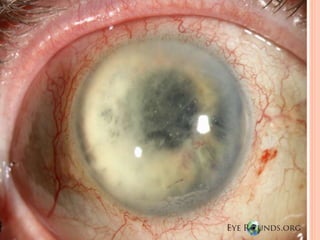
 It is suppurative inflammation of inner ocular
coats and their adjacent structure, with
involvement of anterior chamber and vitreous
fluid.
 It is caused by various fungal agents
FUNGAL ENDOPHTHALMITIS
 Clinically two types
 Endogenous due to hematogenous spread
 Exogenous due to trauma or post operative
ENDOGENOUS ENDOPHTHALMITIS
 The first description of endogenous fungal
endophthalmitis was by Dimmer in 1913.
ENDOGENOUS ENDOPHTHALMITIS
 Predisposing factors
 Malignancy
 IVDU (intravenous drug use)
 Chemotherapy
 Systemic antibiotics
 Alcoholism & Diabetes
CAUSATIVE AGENTS OF ENDOGENOUS
ENDOPHTHALMITIS
 Candida albicans
 Fusarium species
 Aspergillus species
 Histoplasma capsulatum
 Coccidioides immitis
 Blastomyces dermatitidis
 Cryptococcus neoformnas
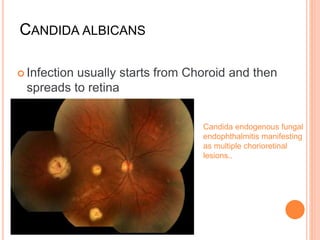
CANDIDA ALBICANS
 Infection usually starts from Choroid and then
spreads to retina
Candida endogenous fungal
endophthalmitis manifesting
as multiple chorioretinal
lesions..
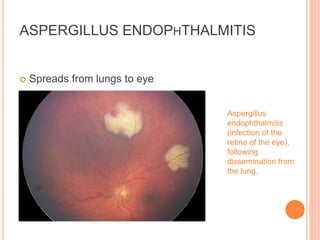
ASPERGILLUS ENDOPHTHALMITIS
 Spreads from lungs to eye
Aspergillus
endophthalmitis
(infection of the
retina of the eye),
following
dissemination from
the lung.
CRYPTOCOCCAL ENDOPTHALMITIS
 From lung,
 disseminated haematogenesouly and can affect CNS
causing fungal meningitis & endophthalmitis in eye.
 Choroids is the probably first site of ocular infections
CAUSATIVE AGENT OF EXOGENOUS
ENDOPHTHALMITIS
 Aspergillus spp.
 C. albicans,C. glabrata, C. tropicalis, C.
parapsilosis
 Fusarium spp.
 Acremonium spp.
 Curvularia spp.
PATHOGENESIS: EXOGENOUS
Direct introduction of the organisms following
 Surgery(Catarct removal with placement of IOL
mainly Candida spp)
 Trauma(Mainly Fusarium spp. )
 spread from Fungal keratitis
CLINICAL FEATURES
 Symptoms
Visual loss
Red eye.
Photophobia.
Pain.
Floaters.
Scotoma
LABORATORY DIAGNOSIS
 Sample collection and transport
 AC tap
 Vitreous tap Fluids
CONVENTIONAL TECHNIQUES
 Direct microscopy Rapid and cost effective
 10% KOH preparation .
 Gram stain .
 Calcoflour Stain – Easy and fast.
 Culture SDA, Blood agar.
Susceptibility testing
CULTURE
 Vitreous fluid inoculated on routine fungal culture media .
 Vitreous sample should be concentrate either by
centrifugation Millipore filtration
 All the culture checked everyday during first week and
twice a week during next 3 weeks.
 Positive culture are more convincing when growth is
obtained on more than one occasion.
ENDOGENOUS ENDOPHTHALMITIS
Systemic antifungal agents:
 Fluconazole,
 voriconazole (azole compounds)
 Systemic antifungal agents:
 Amphotericin B: Parenteral ± intravitreal
EXOGENOUS ENDOPHTHALMITIS
 Intraocular (intracameral ± intravitreal) amphotericin B
Intravitreal voriconazole or miconazole
 Subconjunctival antifungal agents: when associated with
keratitis
 Systemic antifungal agents: fluconazole, ketoconazole,
voriconazole, itraconazole, miconazole, and amphotericin
B:
Fungal endophthalmatits

Fungal endophthalmatits

  • 1.
  • 2.
    FUNGAL ENDOPHTHALMATITS  Itis suppurative inflammation of inner ocular coats and their adjacent structure, with involvement of anterior chamber and vitreous fluid.  It is caused by various fungal agents
  • 4.
    FUNGAL ENDOPHTHALMITIS  Clinicallytwo types  Endogenous due to hematogenous spread  Exogenous due to trauma or post operative
  • 5.
    ENDOGENOUS ENDOPHTHALMITIS  Thefirst description of endogenous fungal endophthalmitis was by Dimmer in 1913.
  • 6.
    ENDOGENOUS ENDOPHTHALMITIS  Predisposingfactors  Malignancy  IVDU (intravenous drug use)  Chemotherapy  Systemic antibiotics  Alcoholism & Diabetes
  • 7.
    CAUSATIVE AGENTS OFENDOGENOUS ENDOPHTHALMITIS  Candida albicans  Fusarium species  Aspergillus species  Histoplasma capsulatum  Coccidioides immitis  Blastomyces dermatitidis  Cryptococcus neoformnas
  • 8.
    CANDIDA ALBICANS  Infectionusually starts from Choroid and then spreads to retina Candida endogenous fungal endophthalmitis manifesting as multiple chorioretinal lesions..
  • 9.
    ASPERGILLUS ENDOPHTHALMITIS  Spreadsfrom lungs to eye Aspergillus endophthalmitis (infection of the retina of the eye), following dissemination from the lung.
  • 10.
    CRYPTOCOCCAL ENDOPTHALMITIS  Fromlung,  disseminated haematogenesouly and can affect CNS causing fungal meningitis & endophthalmitis in eye.  Choroids is the probably first site of ocular infections
  • 11.
    CAUSATIVE AGENT OFEXOGENOUS ENDOPHTHALMITIS  Aspergillus spp.  C. albicans,C. glabrata, C. tropicalis, C. parapsilosis  Fusarium spp.  Acremonium spp.  Curvularia spp.
  • 12.
    PATHOGENESIS: EXOGENOUS Direct introductionof the organisms following  Surgery(Catarct removal with placement of IOL mainly Candida spp)  Trauma(Mainly Fusarium spp. )  spread from Fungal keratitis
  • 13.
    CLINICAL FEATURES  Symptoms Visualloss Red eye. Photophobia. Pain. Floaters. Scotoma
  • 14.
    LABORATORY DIAGNOSIS  Samplecollection and transport  AC tap  Vitreous tap Fluids
  • 15.
    CONVENTIONAL TECHNIQUES  Directmicroscopy Rapid and cost effective  10% KOH preparation .  Gram stain .  Calcoflour Stain – Easy and fast.  Culture SDA, Blood agar. Susceptibility testing
  • 16.
    CULTURE  Vitreous fluidinoculated on routine fungal culture media .  Vitreous sample should be concentrate either by centrifugation Millipore filtration  All the culture checked everyday during first week and twice a week during next 3 weeks.  Positive culture are more convincing when growth is obtained on more than one occasion.
  • 17.
    ENDOGENOUS ENDOPHTHALMITIS Systemic antifungalagents:  Fluconazole,  voriconazole (azole compounds)  Systemic antifungal agents:  Amphotericin B: Parenteral ± intravitreal
  • 18.
    EXOGENOUS ENDOPHTHALMITIS  Intraocular(intracameral ± intravitreal) amphotericin B Intravitreal voriconazole or miconazole  Subconjunctival antifungal agents: when associated with keratitis  Systemic antifungal agents: fluconazole, ketoconazole, voriconazole, itraconazole, miconazole, and amphotericin B: