
OPTOMETRY - Part V
POLARIZATION OF LIGHT
ER. FARUK BIN POYEN
DEPT. OF AEIE, UIT, BU, BURDWAN, WB, INDIA
FARUK.POYEN@GMAIL.COM
Contents:
1. Polarization of Light – Definition
2. Brewster’s Angle
3. Degree of Polarization
4. Optical Rotation
5. Polarization by Reflection
6. Polarization by Refraction
7. Dichroism
8. Birefringence
2
Polarization of Light:
 Definition: Separation of light waves with electric field vector oriented only in a single
direction is called polarization of light or this is a process in which light and other
radiations are restricted to vibrate in a single direction only and therefore the
electric/magnetic field of the wave is unsymmetrical.
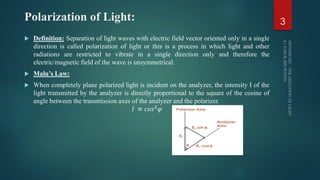
 Malu’s Law:
 When completely plane polarized light is incident on the analyzer, the intensity I of the
light transmitted by the analyzer is directly proportional to the square of the cosine of
angle between the transmission axes of the analyzer and the polarizer.
𝐼 ∝ 𝑐𝑜𝑠2 𝜑
3
Polarization of Light – Brewster’s Angle:
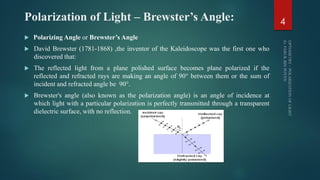
 Polarizing Angle or Brewster’s Angle
 David Brewster (1781-1868) ,the inventor of the Kaleidoscope was the first one who
discovered that:
 The reflected light from a plane polished surface becomes plane polarized if the
reflected and refracted rays are making an angle of 90° between them or the sum of
incident and refracted angle be 90°.
 Brewster's angle (also known as the polarization angle) is an angle of incidence at
which light with a particular polarization is perfectly transmitted through a transparent
dielectric surface, with no reflection.
4
Polarization of Light – Degree of Polarization:
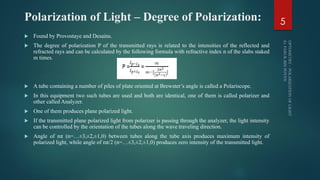
 Found by Provostaye and Desains.
 The degree of polarization P of the transmitted rays is related to the intensities of the reflected and
refracted rays and can be calculated by the following formula with refractive index n of the slabs staked
m times.
 A tube containing a number of piles of plate oriented at Brewster’s angle is called a Polariscope.
 In this equipment two such tubes are used and both are identical, one of them is called polarizer and
other called Analyzer.
 One of them produces plane polarized light.
 If the transmitted plane polarized light from polarizer is passing through the analyzer, the light intensity
can be controlled by the orientation of the tubes along the wave traveling direction.
 Angle of nπ (n=…±3,±2,±1,0) between tubes along the tube axis produces maximum intensity of
polarized light, while angle of nπ/2 (n=…±3,±2,±1,0) produces zero intensity of the transmitted light.
5
Polarization of Light – Optical Rotation:
 When a plane polarized light is passed through certain crystals, they rotate the plane of polarization.
 Quartz and sodium chlorate crystals typical examples, which are termed as optically active crystals.
 A few millimeter thickness of such crystals will rotate the plane of polarization by many degrees.
 Certain organic substances, such a sugar and tartaric acid, show optical rotation when they are in
solution.
 This property of optically active substances can be used to determine their concentration in their
solutions.
 Polarization can be achieve in five ways i.e. by:
1. Reflection and Transmission
2. Pile of plates
3. Dichroism
4. Birefringence
5. Scattering
6
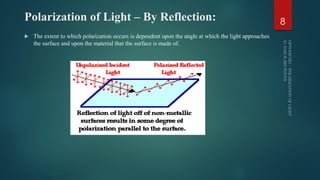
Polarization of Light – By Reflection:
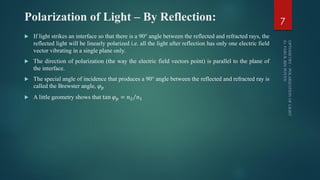
 If light strikes an interface so that there is a 90° angle between the reflected and refracted rays, the
reflected light will be linearly polarized i.e. all the light after reflection has only one electric field
vector vibrating in a single plane only.
 The direction of polarization (the way the electric field vectors point) is parallel to the plane of
the interface.
 The special angle of incidence that produces a 90° angle between the reflected and refracted ray is
called the Brewster angle, 𝜑 𝑝
 A little geometry shows that tan 𝜑 𝑝 = 𝑛2 𝑛1
7
Polarization of Light – By Reflection:
 The extent to which polarization occurs is dependent upon the angle at which the light approaches
the surface and upon the material that the surface is made of.
8
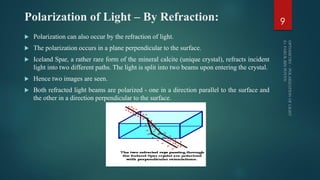
Polarization of Light – By Refraction:
 Polarization can also occur by the refraction of light.
 The polarization occurs in a plane perpendicular to the surface.
 Iceland Spar, a rather rare form of the mineral calcite (unique crystal), refracts incident
light into two different paths. The light is split into two beams upon entering the crystal.
 Hence two images are seen.
 Both refracted light beams are polarized - one in a direction parallel to the surface and
the other in a direction perpendicular to the surface.
9
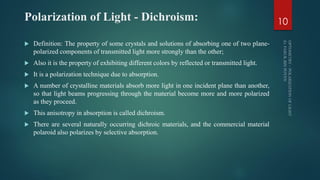
Polarization of Light - Dichroism:
 Definition: The property of some crystals and solutions of absorbing one of two plane-
polarized components of transmitted light more strongly than the other;
 Also it is the property of exhibiting different colors by reflected or transmitted light.
 It is a polarization technique due to absorption.
 A number of crystalline materials absorb more light in one incident plane than another,
so that light beams progressing through the material become more and more polarized
as they proceed.
 This anisotropy in absorption is called dichroism.
 There are several naturally occurring dichroic materials, and the commercial material
polaroid also polarizes by selective absorption.
10
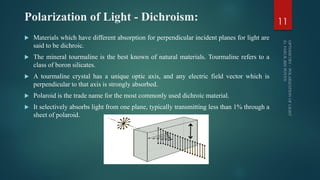
Polarization of Light - Dichroism:
 Materials which have different absorption for perpendicular incident planes for light are
said to be dichroic.
 The mineral tourmaline is the best known of natural materials. Tourmaline refers to a
class of boron silicates.
 A tourmaline crystal has a unique optic axis, and any electric field vector which is
perpendicular to that axis is strongly absorbed.
 Polaroid is the trade name for the most commonly used dichroic material.
 It selectively absorbs light from one plane, typically transmitting less than 1% through a
sheet of polaroid.
11
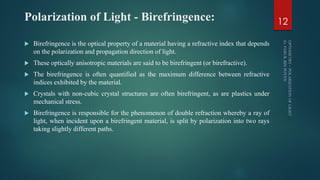
Polarization of Light - Birefringence:
 Birefringence is the optical property of a material having a refractive index that depends
on the polarization and propagation direction of light.
 These optically anisotropic materials are said to be birefringent (or birefractive).
 The birefringence is often quantified as the maximum difference between refractive
indices exhibited by the material.
 Crystals with non-cubic crystal structures are often birefringent, as are plastics under
mechanical stress.
 Birefringence is responsible for the phenomenon of double refraction whereby a ray of
light, when incident upon a birefringent material, is split by polarization into two rays
taking slightly different paths.
12
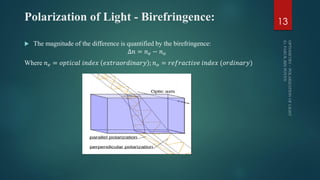
Polarization of Light - Birefringence:
 The magnitude of the difference is quantified by the birefringence:
∆𝑛 = 𝑛 𝑒 − 𝑛 𝑜
Where 𝑛 𝑒 = 𝑜𝑝𝑡𝑖𝑐𝑎𝑙 𝑖𝑛𝑑𝑒𝑥 𝑒𝑥𝑡𝑟𝑎𝑜𝑟𝑑𝑖𝑛𝑎𝑟𝑦 ; 𝑛 𝑜 = 𝑟𝑒𝑓𝑟𝑎𝑐𝑡𝑖𝑣𝑒 𝑖𝑛𝑑𝑒𝑥 (𝑜𝑟𝑑𝑖𝑛𝑎𝑟𝑦)
13
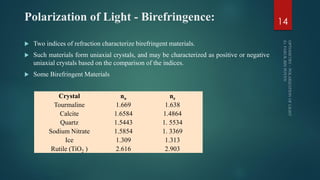
Polarization of Light - Birefringence:
 Two indices of refraction characterize birefringent materials.
 Such materials form uniaxial crystals, and may be characterized as positive or negative
uniaxial crystals based on the comparison of the indices.
 Some Birefringent Materials
14
Crystal no ne
Tourmaline 1.669 1.638
Calcite 1.6584 1.4864
Quartz 1.5443 1. 5534
Sodium Nitrate 1.5854 1. 3369
Ice 1.309 1.313
Rutile (TiO2 ) 2.616 2.903
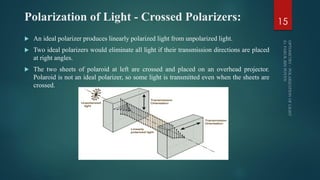
Polarization of Light - Crossed Polarizers:
 An ideal polarizer produces linearly polarized light from unpolarized light.
 Two ideal polarizers would eliminate all light if their transmission directions are placed
at right angles.
 The two sheets of polaroid at left are crossed and placed on an overhead projector.
Polaroid is not an ideal polarizer, so some light is transmitted even when the sheets are
crossed.
15
References:
1. http://www.andor.com/learning-academy/radiometry-and-photometry-an-overview-of-
the-science-of-measuring-light
2. https://www.emedicalprep.com/study-material/physics/wave-optics/interference-light-
waves-youngs-experiment/
3. https://physicsabout.com/diffraction-of-light/
4. https://physicsabout.com/polarization-of-light/
5. http://www.physicsclassroom.com/class/light/Lesson-1/Polarization
6. http://hyperphysics.phy-astr.gsu.edu/hbase/hframe.html
16

OPTOMETRY - Part V POLARIZATION OF LIGHT

  • 1.
    OPTOMETRY - PartV POLARIZATION OF LIGHT ER. FARUK BIN POYEN DEPT. OF AEIE, UIT, BU, BURDWAN, WB, INDIA FARUK.POYEN@GMAIL.COM
  • 2.
    Contents: 1. Polarization ofLight – Definition 2. Brewster’s Angle 3. Degree of Polarization 4. Optical Rotation 5. Polarization by Reflection 6. Polarization by Refraction 7. Dichroism 8. Birefringence 2
  • 3.
    Polarization of Light: Definition: Separation of light waves with electric field vector oriented only in a single direction is called polarization of light or this is a process in which light and other radiations are restricted to vibrate in a single direction only and therefore the electric/magnetic field of the wave is unsymmetrical.  Malu’s Law:  When completely plane polarized light is incident on the analyzer, the intensity I of the light transmitted by the analyzer is directly proportional to the square of the cosine of angle between the transmission axes of the analyzer and the polarizer. 𝐼 ∝ 𝑐𝑜𝑠2 𝜑 3
  • 4.
    Polarization of Light– Brewster’s Angle:  Polarizing Angle or Brewster’s Angle  David Brewster (1781-1868) ,the inventor of the Kaleidoscope was the first one who discovered that:  The reflected light from a plane polished surface becomes plane polarized if the reflected and refracted rays are making an angle of 90° between them or the sum of incident and refracted angle be 90°.  Brewster's angle (also known as the polarization angle) is an angle of incidence at which light with a particular polarization is perfectly transmitted through a transparent dielectric surface, with no reflection. 4
  • 5.
    Polarization of Light– Degree of Polarization:  Found by Provostaye and Desains.  The degree of polarization P of the transmitted rays is related to the intensities of the reflected and refracted rays and can be calculated by the following formula with refractive index n of the slabs staked m times.  A tube containing a number of piles of plate oriented at Brewster’s angle is called a Polariscope.  In this equipment two such tubes are used and both are identical, one of them is called polarizer and other called Analyzer.  One of them produces plane polarized light.  If the transmitted plane polarized light from polarizer is passing through the analyzer, the light intensity can be controlled by the orientation of the tubes along the wave traveling direction.  Angle of nπ (n=…±3,±2,±1,0) between tubes along the tube axis produces maximum intensity of polarized light, while angle of nπ/2 (n=…±3,±2,±1,0) produces zero intensity of the transmitted light. 5
  • 6.
    Polarization of Light– Optical Rotation:  When a plane polarized light is passed through certain crystals, they rotate the plane of polarization.  Quartz and sodium chlorate crystals typical examples, which are termed as optically active crystals.  A few millimeter thickness of such crystals will rotate the plane of polarization by many degrees.  Certain organic substances, such a sugar and tartaric acid, show optical rotation when they are in solution.  This property of optically active substances can be used to determine their concentration in their solutions.  Polarization can be achieve in five ways i.e. by: 1. Reflection and Transmission 2. Pile of plates 3. Dichroism 4. Birefringence 5. Scattering 6
  • 7.
    Polarization of Light– By Reflection:  If light strikes an interface so that there is a 90° angle between the reflected and refracted rays, the reflected light will be linearly polarized i.e. all the light after reflection has only one electric field vector vibrating in a single plane only.  The direction of polarization (the way the electric field vectors point) is parallel to the plane of the interface.  The special angle of incidence that produces a 90° angle between the reflected and refracted ray is called the Brewster angle, 𝜑 𝑝  A little geometry shows that tan 𝜑 𝑝 = 𝑛2 𝑛1 7
  • 8.
    Polarization of Light– By Reflection:  The extent to which polarization occurs is dependent upon the angle at which the light approaches the surface and upon the material that the surface is made of. 8
  • 9.
    Polarization of Light– By Refraction:  Polarization can also occur by the refraction of light.  The polarization occurs in a plane perpendicular to the surface.  Iceland Spar, a rather rare form of the mineral calcite (unique crystal), refracts incident light into two different paths. The light is split into two beams upon entering the crystal.  Hence two images are seen.  Both refracted light beams are polarized - one in a direction parallel to the surface and the other in a direction perpendicular to the surface. 9
  • 10.
    Polarization of Light- Dichroism:  Definition: The property of some crystals and solutions of absorbing one of two plane- polarized components of transmitted light more strongly than the other;  Also it is the property of exhibiting different colors by reflected or transmitted light.  It is a polarization technique due to absorption.  A number of crystalline materials absorb more light in one incident plane than another, so that light beams progressing through the material become more and more polarized as they proceed.  This anisotropy in absorption is called dichroism.  There are several naturally occurring dichroic materials, and the commercial material polaroid also polarizes by selective absorption. 10
  • 11.
    Polarization of Light- Dichroism:  Materials which have different absorption for perpendicular incident planes for light are said to be dichroic.  The mineral tourmaline is the best known of natural materials. Tourmaline refers to a class of boron silicates.  A tourmaline crystal has a unique optic axis, and any electric field vector which is perpendicular to that axis is strongly absorbed.  Polaroid is the trade name for the most commonly used dichroic material.  It selectively absorbs light from one plane, typically transmitting less than 1% through a sheet of polaroid. 11
  • 12.
    Polarization of Light- Birefringence:  Birefringence is the optical property of a material having a refractive index that depends on the polarization and propagation direction of light.  These optically anisotropic materials are said to be birefringent (or birefractive).  The birefringence is often quantified as the maximum difference between refractive indices exhibited by the material.  Crystals with non-cubic crystal structures are often birefringent, as are plastics under mechanical stress.  Birefringence is responsible for the phenomenon of double refraction whereby a ray of light, when incident upon a birefringent material, is split by polarization into two rays taking slightly different paths. 12
  • 13.
    Polarization of Light- Birefringence:  The magnitude of the difference is quantified by the birefringence: ∆𝑛 = 𝑛 𝑒 − 𝑛 𝑜 Where 𝑛 𝑒 = 𝑜𝑝𝑡𝑖𝑐𝑎𝑙 𝑖𝑛𝑑𝑒𝑥 𝑒𝑥𝑡𝑟𝑎𝑜𝑟𝑑𝑖𝑛𝑎𝑟𝑦 ; 𝑛 𝑜 = 𝑟𝑒𝑓𝑟𝑎𝑐𝑡𝑖𝑣𝑒 𝑖𝑛𝑑𝑒𝑥 (𝑜𝑟𝑑𝑖𝑛𝑎𝑟𝑦) 13
  • 14.
    Polarization of Light- Birefringence:  Two indices of refraction characterize birefringent materials.  Such materials form uniaxial crystals, and may be characterized as positive or negative uniaxial crystals based on the comparison of the indices.  Some Birefringent Materials 14 Crystal no ne Tourmaline 1.669 1.638 Calcite 1.6584 1.4864 Quartz 1.5443 1. 5534 Sodium Nitrate 1.5854 1. 3369 Ice 1.309 1.313 Rutile (TiO2 ) 2.616 2.903
  • 15.
    Polarization of Light- Crossed Polarizers:  An ideal polarizer produces linearly polarized light from unpolarized light.  Two ideal polarizers would eliminate all light if their transmission directions are placed at right angles.  The two sheets of polaroid at left are crossed and placed on an overhead projector. Polaroid is not an ideal polarizer, so some light is transmitted even when the sheets are crossed. 15
  • 16.
    References: 1. http://www.andor.com/learning-academy/radiometry-and-photometry-an-overview-of- the-science-of-measuring-light 2. https://www.emedicalprep.com/study-material/physics/wave-optics/interference-light- waves-youngs-experiment/ 3.https://physicsabout.com/diffraction-of-light/ 4. https://physicsabout.com/polarization-of-light/ 5. http://www.physicsclassroom.com/class/light/Lesson-1/Polarization 6. http://hyperphysics.phy-astr.gsu.edu/hbase/hframe.html 16