TOPICS
Covalent Bonding
Lewis Structure
Octet Rule
Polar Covalent Bond
Chemical bonding
Atoms combines with one another to
form compounds,which properties
different from that of atoms.
The attractive force exist between
the atoms in the compound is called
Chemical bond
Covalent bond
Covalent or shared electron pair of
bonding was explained by G.N.Lewis
(greatest American chemist) in 1916. He
proposed that, "Sharing of two electrons
by two hydrogen atoms permits each one
to have a stable closed shell electronic
configuration analogous to helium".
There are two types of electrons-
Core electrons and Valance electrons.
Sharing of electrons will takes place in the
valance shell.
Example for Single Covalent Bond
Example for double and triple
covalent bond
Lewis Structure
Structural formulas in which the
electrons are represented as dots are
called lewis Structure
The electron pairs which are not
involved in bond formation is
unshared pairs or lone pairs.Thus
the fluorine has three unshared pairs
of electrons.
Atoms in the same coloumn of the
periodic table have similar valence
electrons.Thus they are called
Isoelectronic atoms
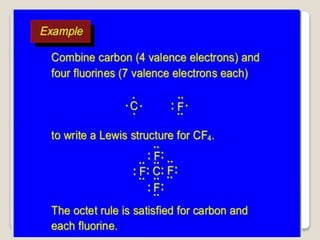
Examples for lewis structure
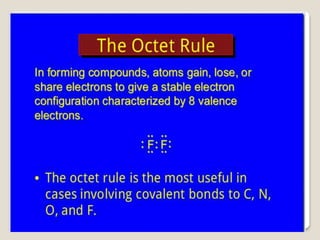
Octet rule
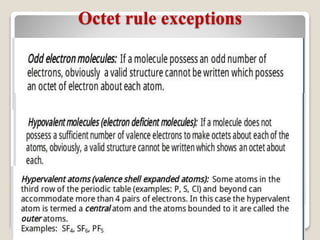
Octet rule exceptions
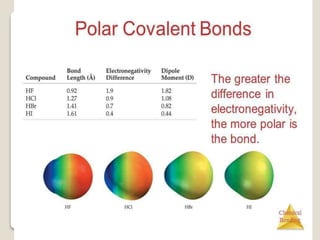
Polar covalent bond
Electron polarization in the
compound can be explained by
Electrostatic potential map,which
uses the colour of the rainbow
shades. Blue colour is to dominate
the polarized positive charge and
Red is for polarized negative
charge.
bonding

bonding