Welcome to Our Presentation
TOPIC: POLARIZATION
01
Group Members Name
SHAHID AL MAHMUD
ID: 133/33/1708
MD. KHALID HASAN
ID: 133/33/1673
MD. SHAIFUR RAHMAN
ID: 133/33/1681
JOY SHARMA
ID: 133/33/1685
MD. SUDIP MONDOL
ID: 133/33/1707
MITHAN KUMAR DAS
ID: 133/33/1680
02
03
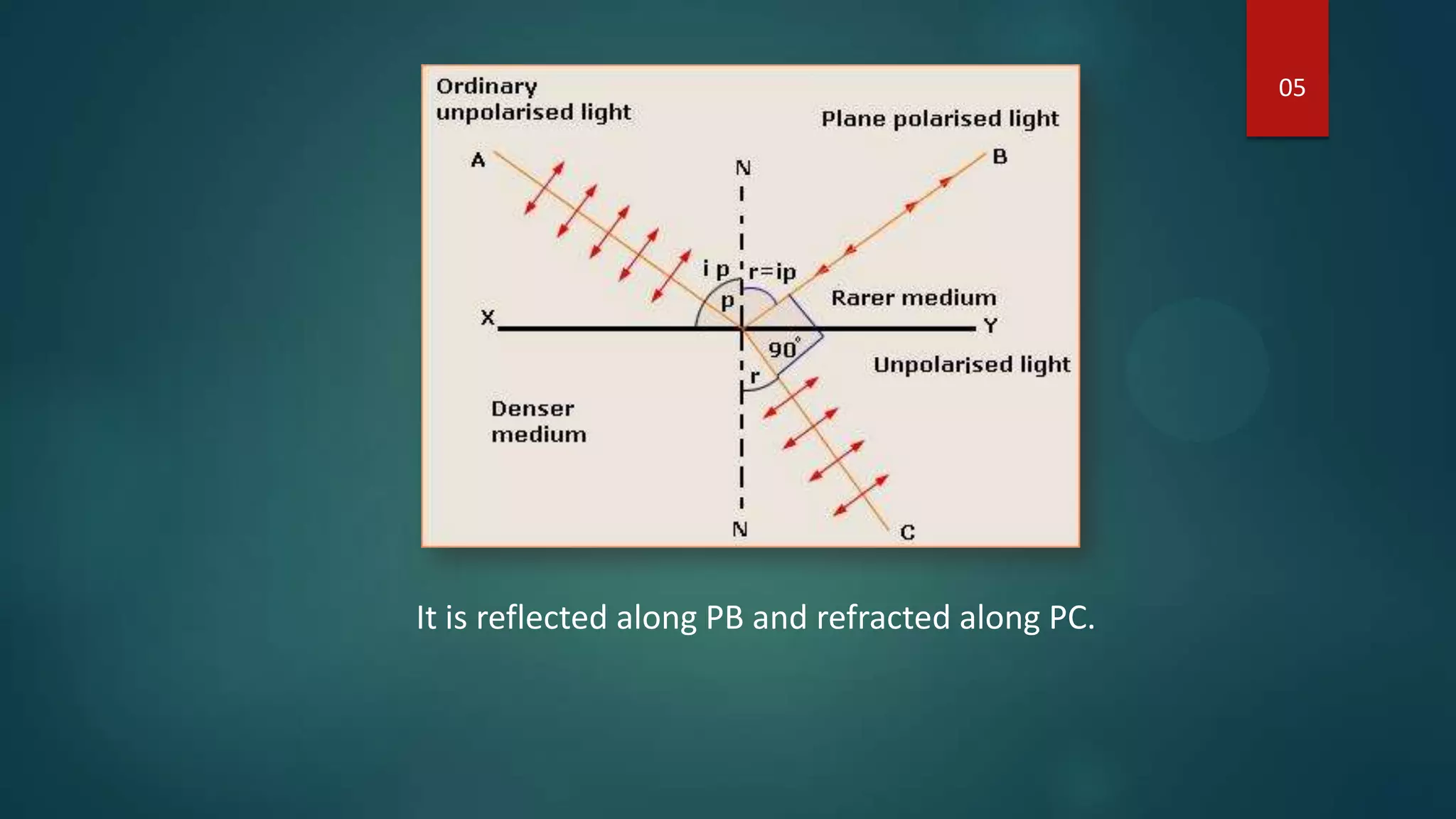
Brewster’s Law 04
It is reflected along PB and refracted along PC.
05
06
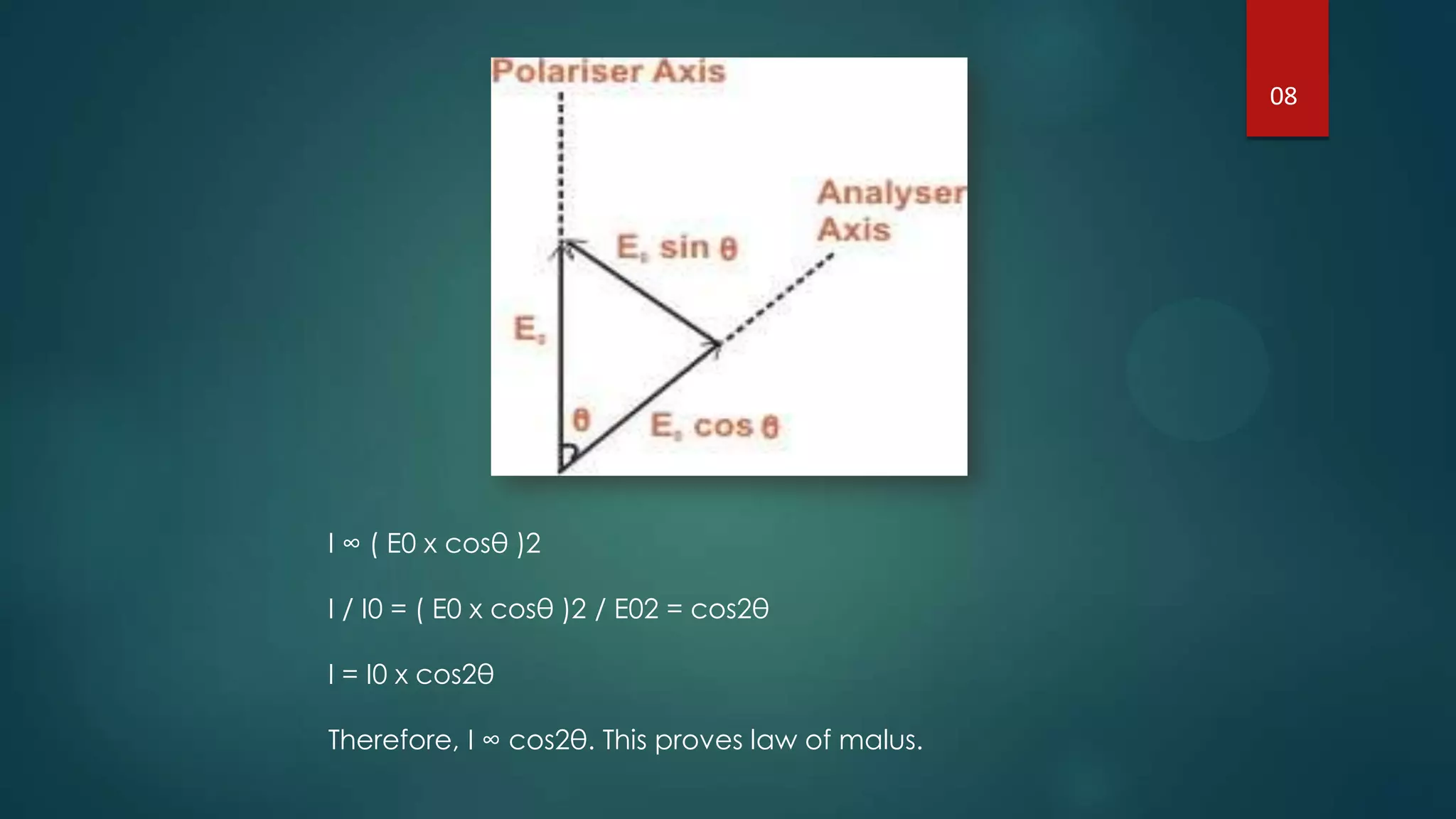
Malus's Law
According to malus, when completely plane polarized light is
incident on the analyzer, the intensity I of the light transmitted by
the analyzer is directly proportional to the square of the cosine of
angle between the transmission axes of the analyzer and the
polarizer.
i.e I ∞ cos2θ
07
I ∞ ( E0 x cosθ )2
I / I0 = ( E0 x cosθ )2 / E02 = cos2θ
I = I0 x cos2θ
Therefore, I ∞ cos2θ. This proves law of malus.
08
09
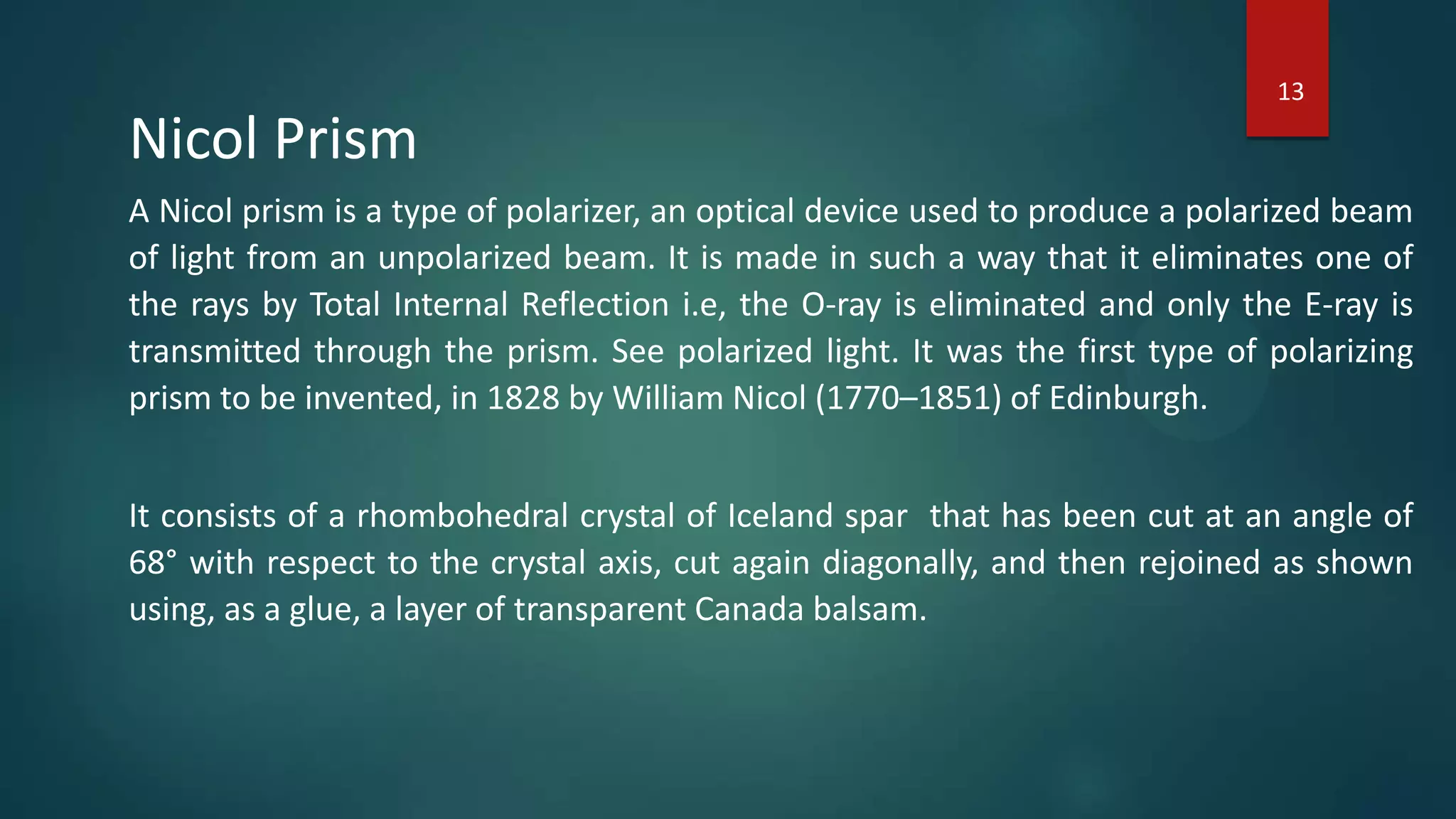
Polarization by Double Refraction
Polarization can also occur by the refraction of light. Refraction occurs
when a beam of light passes from one material into another material. At
the surface of the two materials, the path of the beam changes its
direction. The refracted beam acquires some degree of polarization.
Most often, the polarization occurs in a plane perpendicular to the
surface. The polarization of refracted light is often demonstrated in a
Physics class using a unique crystal that serves as a double-refracting
crystal. Iceland Spar, a rather rare form of the mineral calcite, refracts
incident light into two different paths.
10
11
12
Nicol Prism
A Nicol prism is a type of polarizer, an optical device used to produce a polarized beam
of light from an unpolarized beam. It is made in such a way that it eliminates one of
the rays by Total Internal Reflection i.e, the O-ray is eliminated and only the E-ray is
transmitted through the prism. See polarized light. It was the first type of polarizing
prism to be invented, in 1828 by William Nicol (1770–1851) of Edinburgh.
It consists of a rhombohedral crystal of Iceland spar that has been cut at an angle of
68° with respect to the crystal axis, cut again diagonally, and then rejoined as shown
using, as a glue, a layer of transparent Canada balsam.
13
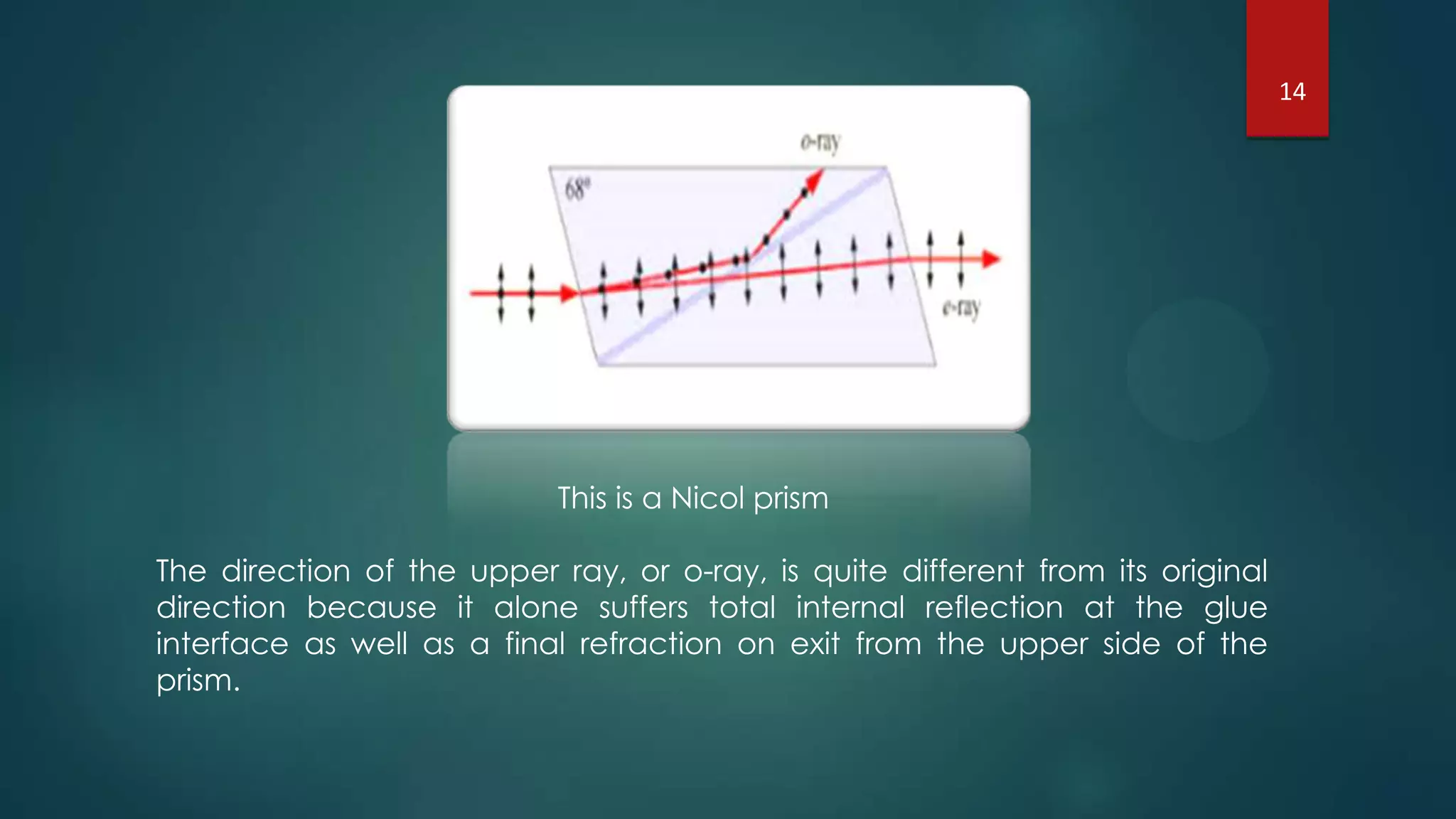
This is a Nicol prism
The direction of the upper ray, or o-ray, is quite different from its original
direction because it alone suffers total internal reflection at the glue
interface as well as a final refraction on exit from the upper side of the
prism.
14
15
Polari meters
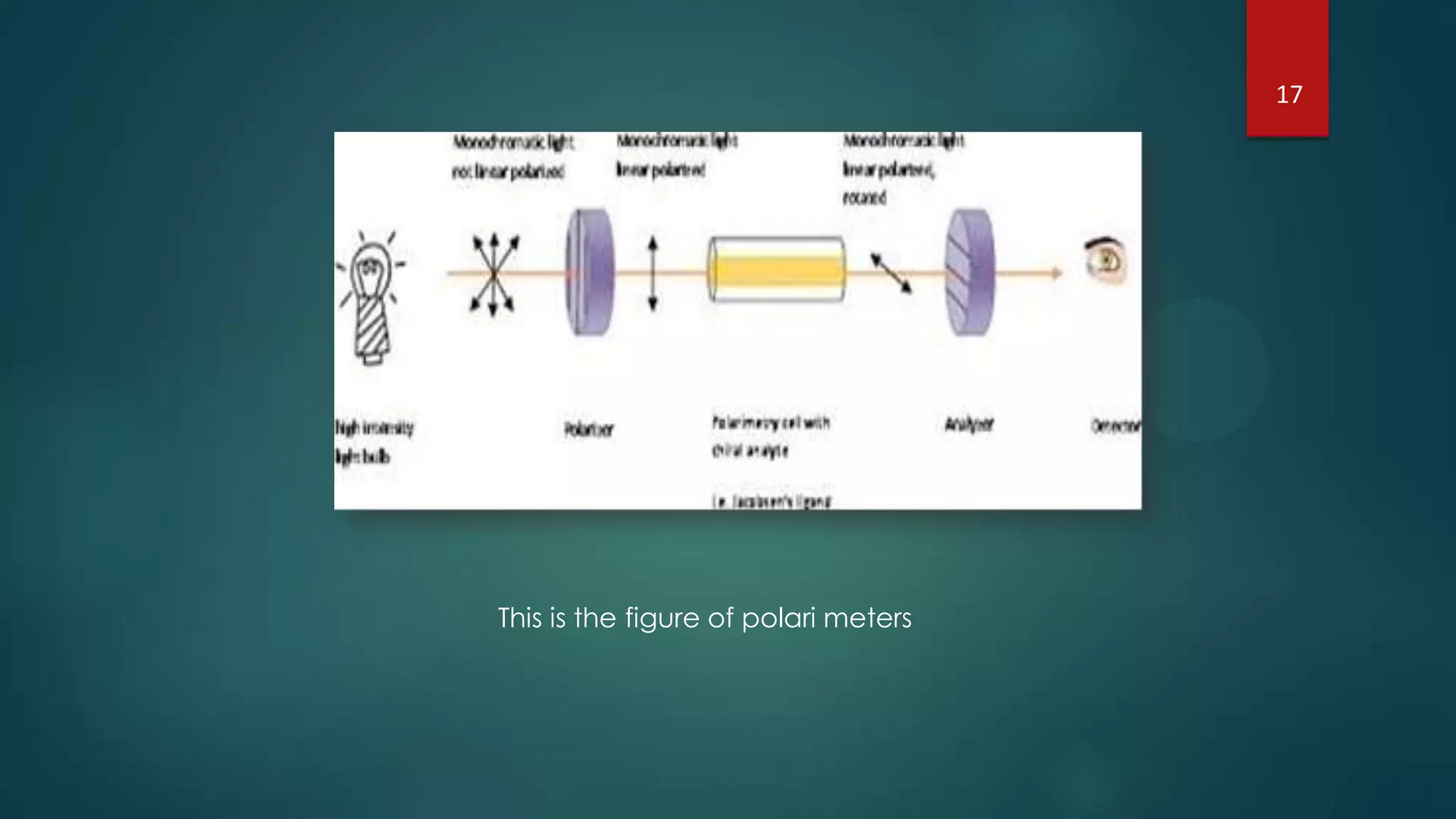
A Polari meter is a device for studying a transparent sample between
crossed polarizing devices. Jean-Baptiste Biot (1774-1862) developed the
polarimeter at the right, which was made by Soliel/Duboscq of Paris ca.
1850. The polarizer on the right-hand side uses a single plate of glass, while
the analyzer on the Polarization by reflection was discovered in 1808 by
Etienne Malus (1775-1812).
Malus, who had been doing experimental work on double refraction while
working on a theory of the effect, observed the light of the setting
sun, reflected from the windows of a nearby window, through a crystal of
Iceland Spar. As he rotated the crystal, the two images of the sun became
alternately stronger and weaker, though there was never complete
extinction. Almost at once he repeated the experiment under controlled
conditions, and found that the angles at which complete extinction of the
reflected ray was obtained for water and glass.
16
This is the figure of polari meters
17
18
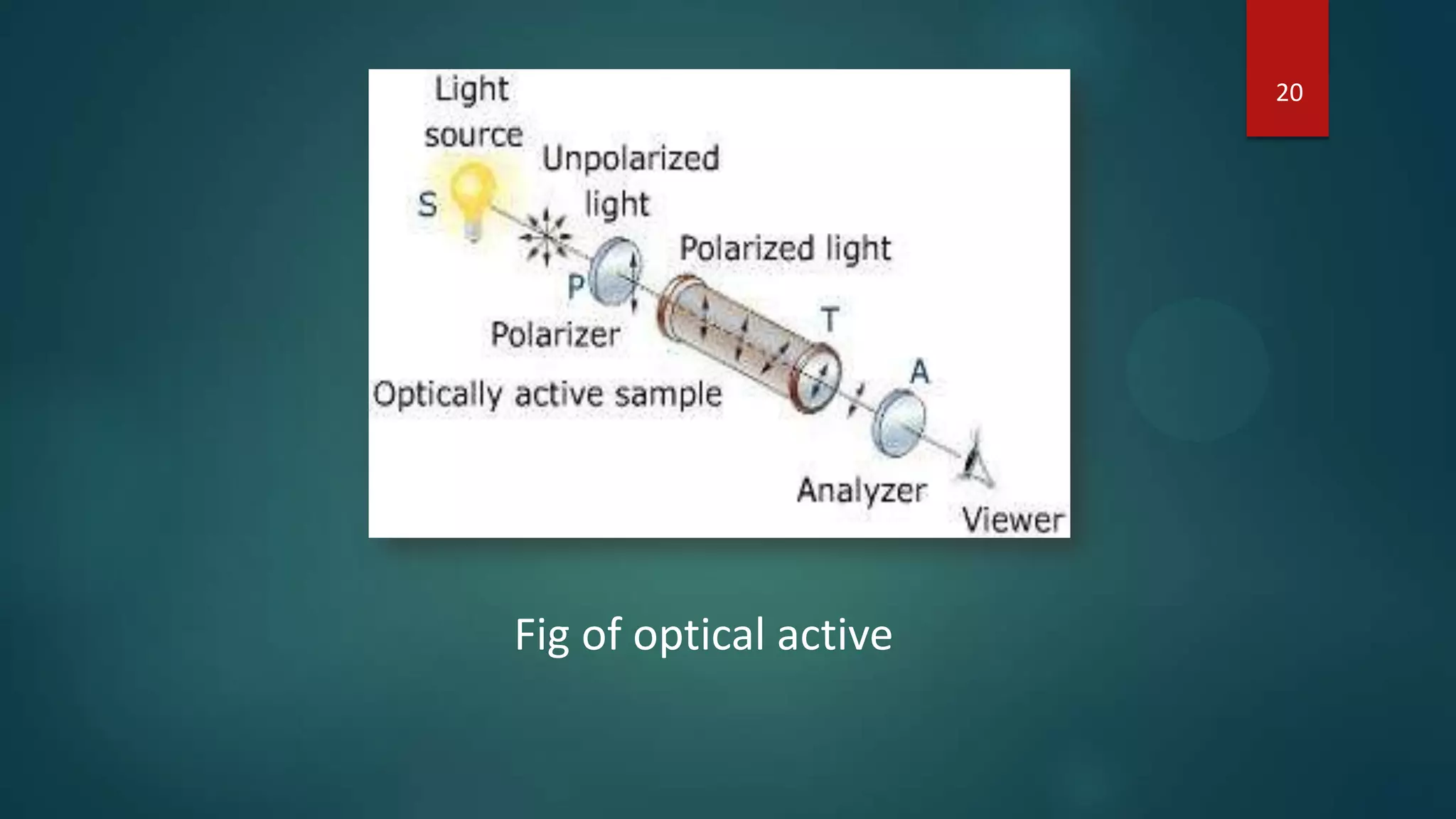
Optical Activity
A material which rotates the plane of incident linearly polarized
light is said to be optically active.
Optical activity was first observed by the French physicist Jean-Baptiste
Biot. He concluded that the change in direction of plane-polarized light
when it passed through certain substances was actually a rotation of light,
and that it had a molecular basis. His work was supported by the
experimentation of Louis Pasteur
19
Fig of optical active
20
21

Presentation on Polarization

  • 1.
    Welcome to OurPresentation TOPIC: POLARIZATION 01
  • 2.
    Group Members Name SHAHIDAL MAHMUD ID: 133/33/1708 MD. KHALID HASAN ID: 133/33/1673 MD. SHAIFUR RAHMAN ID: 133/33/1681 JOY SHARMA ID: 133/33/1685 MD. SUDIP MONDOL ID: 133/33/1707 MITHAN KUMAR DAS ID: 133/33/1680 02
  • 3.
  • 4.
  • 5.
    It is reflectedalong PB and refracted along PC. 05
  • 6.
  • 7.
    Malus's Law According tomalus, when completely plane polarized light is incident on the analyzer, the intensity I of the light transmitted by the analyzer is directly proportional to the square of the cosine of angle between the transmission axes of the analyzer and the polarizer. i.e I ∞ cos2θ 07
  • 8.
    I ∞ (E0 x cosθ )2 I / I0 = ( E0 x cosθ )2 / E02 = cos2θ I = I0 x cos2θ Therefore, I ∞ cos2θ. This proves law of malus. 08
  • 9.
  • 10.
    Polarization by DoubleRefraction Polarization can also occur by the refraction of light. Refraction occurs when a beam of light passes from one material into another material. At the surface of the two materials, the path of the beam changes its direction. The refracted beam acquires some degree of polarization. Most often, the polarization occurs in a plane perpendicular to the surface. The polarization of refracted light is often demonstrated in a Physics class using a unique crystal that serves as a double-refracting crystal. Iceland Spar, a rather rare form of the mineral calcite, refracts incident light into two different paths. 10
  • 11.
  • 12.
  • 13.
    Nicol Prism A Nicolprism is a type of polarizer, an optical device used to produce a polarized beam of light from an unpolarized beam. It is made in such a way that it eliminates one of the rays by Total Internal Reflection i.e, the O-ray is eliminated and only the E-ray is transmitted through the prism. See polarized light. It was the first type of polarizing prism to be invented, in 1828 by William Nicol (1770–1851) of Edinburgh. It consists of a rhombohedral crystal of Iceland spar that has been cut at an angle of 68° with respect to the crystal axis, cut again diagonally, and then rejoined as shown using, as a glue, a layer of transparent Canada balsam. 13
  • 14.
    This is aNicol prism The direction of the upper ray, or o-ray, is quite different from its original direction because it alone suffers total internal reflection at the glue interface as well as a final refraction on exit from the upper side of the prism. 14
  • 15.
  • 16.
    Polari meters A Polarimeter is a device for studying a transparent sample between crossed polarizing devices. Jean-Baptiste Biot (1774-1862) developed the polarimeter at the right, which was made by Soliel/Duboscq of Paris ca. 1850. The polarizer on the right-hand side uses a single plate of glass, while the analyzer on the Polarization by reflection was discovered in 1808 by Etienne Malus (1775-1812). Malus, who had been doing experimental work on double refraction while working on a theory of the effect, observed the light of the setting sun, reflected from the windows of a nearby window, through a crystal of Iceland Spar. As he rotated the crystal, the two images of the sun became alternately stronger and weaker, though there was never complete extinction. Almost at once he repeated the experiment under controlled conditions, and found that the angles at which complete extinction of the reflected ray was obtained for water and glass. 16
  • 17.
    This is thefigure of polari meters 17
  • 18.
  • 19.
    Optical Activity A materialwhich rotates the plane of incident linearly polarized light is said to be optically active. Optical activity was first observed by the French physicist Jean-Baptiste Biot. He concluded that the change in direction of plane-polarized light when it passed through certain substances was actually a rotation of light, and that it had a molecular basis. His work was supported by the experimentation of Louis Pasteur 19
  • 20.
    Fig of opticalactive 20
  • 21.