Name of the Project title
In optics and optical fibers
Polarisation of light wave
Presented By
Md Saddam
Reg.200101130005
Branch.B-Tech(ECE)
Sem. 4Th
Under the gguidence
by Dr.satiya
Narayan Dhal
1
POLARIZATION OF LIGHTWAVES
• Light wave is an electromagnetic wave, which is transverse in
nature.
• In the case of the transverse wave the particles in the medium
has a freedom to vibrate in any direction perpendicular to the
direction propagation.
• If the direction of propagation is along the X-axis the particle
can vibrate in any direction in Y – Zplane.
• If we look along the x-axis, the wave is symmetrical. This light
wave is unpolarized.
• Restricting vibration of the particles in the medium along thedirection
of the wave into a single direction is called polarization.
• Using tourmaline crystal light can be polarized.
• The unsymmetrical light wave along the direction of propagation is
called polarized light wave.
Pictorial Representation of
Light
• Arrows indicate the plane of polarization:
• A: End view, unpolarized
• C: Side view, unpolarized
• B: End view: Plane polarized
• D1: Side view: Plane polarized vibrating in the plane of thescreen
• D2: Side view: Plane polarized vibrating orthogonal to the plane ofthe
screen.
Plane of Vibration and
Polarizatio
n
• Plane of vibration, it is the imaginary plane which is in the
crystal which is having the vibrations for the electric vector in
the polarized light and the direction of the propagation of the
light wave.
Plane of Vibration and
Polarizatio
n
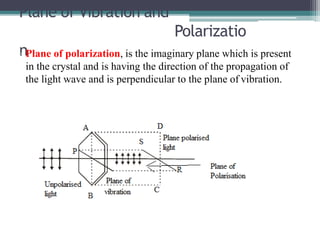
• Plane of polarization, is the imaginary plane which is present
in the crystal and is having the direction of the propagation of
the light wave and is perpendicular to the plane of vibration.
TYPES OF POLARIZTION
• Plane – vibration of the particle in the medium is always in one
direction all the time
• Circular – direction of vibration changes regularly and
periodically as time increases
Terminus of the amplitude is circle
• Elliptical – both direction and the amplitude of the vibration
changes regularly and periodically as time increases
Terminus of the amplitude is ellipse
Production of plane polarized
light
• Plane polarized light may be produced by the following
methods:
1. reflection,
2. refraction
3. double refraction
4. scattering.
5. selective absorption
Proof:
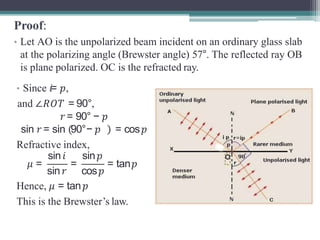
• Let AO is the unpolarized beam incident on an ordinary glass slab
at the polarizing angle (Brewster angle) 57°. The reflected ray OB
is plane polarized. OC is the refracted ray.
• Since 𝑖= 𝑝,
and ∠𝑅𝑂𝑇 = 90°,
𝑟= 90° − 𝑝
sin 𝑟= sin 90°− 𝑝 = cos𝑝
Refractive index,
𝜇 =
sin𝑖 sin𝑝
sin𝑟 cos𝑝
= = tan𝑝
Hence, 𝜇 = tan𝑝
This is the Brewster’s law.
ANALYSER ANDPOLARIZER
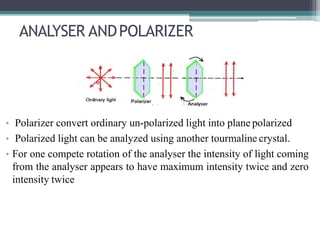
• Polarizer convert ordinary un-polarized light into plane polarized
• Polarized light can be analyzed using another tourmaline crystal.
• For one compete rotation of the analyser the intensity of light coming
from the analyser appears to have maximum intensity twice and zero
intensity twice
Law of Malus
• The law states that the intensity of light transmitted by the
analyzer varies with the square of the cosine of the angle
between the planes of transmission of the analyzer and the
polarizer.
𝐼∝ cos2 𝜃
Where 𝜃 is angle between the planes of transmission of the
analyzer and the polarizer.
I is the intensity of transmitted light through the analyzer.
So, when 𝜃 = 0, 𝐼=𝐼𝑚𝑎𝑥.
But, when they are orthogonal, 𝜃 = 90°, I=0.
• Proof:
• The plane polarized light from polarizer is resolved into two
components, one parallel to the plane of transmission of the analyzer
and the other perpendicular to it. Only the 1st component passes
through the analyzer.
• Let, E=Amplitude of transmitted light from polarizer.
• 𝜃 is angle between the planes of transmission of the analyzer and the
polarizer.
•Resolving we get, 𝐸1 = 𝐸 cos 𝜃 parallel to plane of Analyzer
and, 𝐸2 = 𝐸 sin 𝜃perpendicular to plane of analyzer.
So, 𝐼= 𝐸1
2 = 𝐸2 cos2 𝜃 = 𝐼𝑜cos2 𝜃
Where, 𝐼𝑜is the intensity of incident polarized beam.
THANK
YOU

7.Polarisation-converted.pptx

  • 1.
    Name of theProject title In optics and optical fibers Polarisation of light wave Presented By Md Saddam Reg.200101130005 Branch.B-Tech(ECE) Sem. 4Th Under the gguidence by Dr.satiya Narayan Dhal 1
  • 2.
    POLARIZATION OF LIGHTWAVES •Light wave is an electromagnetic wave, which is transverse in nature. • In the case of the transverse wave the particles in the medium has a freedom to vibrate in any direction perpendicular to the direction propagation. • If the direction of propagation is along the X-axis the particle can vibrate in any direction in Y – Zplane. • If we look along the x-axis, the wave is symmetrical. This light wave is unpolarized.
  • 3.
    • Restricting vibrationof the particles in the medium along thedirection of the wave into a single direction is called polarization. • Using tourmaline crystal light can be polarized. • The unsymmetrical light wave along the direction of propagation is called polarized light wave.
  • 4.
    Pictorial Representation of Light •Arrows indicate the plane of polarization: • A: End view, unpolarized • C: Side view, unpolarized • B: End view: Plane polarized • D1: Side view: Plane polarized vibrating in the plane of thescreen • D2: Side view: Plane polarized vibrating orthogonal to the plane ofthe screen.
  • 5.
    Plane of Vibrationand Polarizatio n • Plane of vibration, it is the imaginary plane which is in the crystal which is having the vibrations for the electric vector in the polarized light and the direction of the propagation of the light wave.
  • 6.
    Plane of Vibrationand Polarizatio n • Plane of polarization, is the imaginary plane which is present in the crystal and is having the direction of the propagation of the light wave and is perpendicular to the plane of vibration.
  • 7.
    TYPES OF POLARIZTION •Plane – vibration of the particle in the medium is always in one direction all the time • Circular – direction of vibration changes regularly and periodically as time increases Terminus of the amplitude is circle • Elliptical – both direction and the amplitude of the vibration changes regularly and periodically as time increases Terminus of the amplitude is ellipse
  • 8.
    Production of planepolarized light • Plane polarized light may be produced by the following methods: 1. reflection, 2. refraction 3. double refraction 4. scattering. 5. selective absorption
  • 9.
    Proof: • Let AOis the unpolarized beam incident on an ordinary glass slab at the polarizing angle (Brewster angle) 57°. The reflected ray OB is plane polarized. OC is the refracted ray. • Since 𝑖= 𝑝, and ∠𝑅𝑂𝑇 = 90°, 𝑟= 90° − 𝑝 sin 𝑟= sin 90°− 𝑝 = cos𝑝 Refractive index, 𝜇 = sin𝑖 sin𝑝 sin𝑟 cos𝑝 = = tan𝑝 Hence, 𝜇 = tan𝑝 This is the Brewster’s law.
  • 10.
    ANALYSER ANDPOLARIZER • Polarizerconvert ordinary un-polarized light into plane polarized • Polarized light can be analyzed using another tourmaline crystal. • For one compete rotation of the analyser the intensity of light coming from the analyser appears to have maximum intensity twice and zero intensity twice
  • 11.
    Law of Malus •The law states that the intensity of light transmitted by the analyzer varies with the square of the cosine of the angle between the planes of transmission of the analyzer and the polarizer. 𝐼∝ cos2 𝜃 Where 𝜃 is angle between the planes of transmission of the analyzer and the polarizer. I is the intensity of transmitted light through the analyzer. So, when 𝜃 = 0, 𝐼=𝐼𝑚𝑎𝑥. But, when they are orthogonal, 𝜃 = 90°, I=0.
  • 12.
    • Proof: • Theplane polarized light from polarizer is resolved into two components, one parallel to the plane of transmission of the analyzer and the other perpendicular to it. Only the 1st component passes through the analyzer. • Let, E=Amplitude of transmitted light from polarizer. • 𝜃 is angle between the planes of transmission of the analyzer and the polarizer. •Resolving we get, 𝐸1 = 𝐸 cos 𝜃 parallel to plane of Analyzer and, 𝐸2 = 𝐸 sin 𝜃perpendicular to plane of analyzer. So, 𝐼= 𝐸1 2 = 𝐸2 cos2 𝜃 = 𝐼𝑜cos2 𝜃 Where, 𝐼𝑜is the intensity of incident polarized beam.
  • 13.