1
Project Quality Management
Chapter 8
2
 Quality Theories
 Evolution of Quality Management
 8.1 Plan Quality Management
 8.2 Perform Quality Assurance
 8.3 Control Quality
KEY TERMS
Project Quality Management
Knowledge
Area
Process
Initiating Planning Executing
Monitoring &
Control
Closing
Cost
8.1 Plan
Quality
Management
8.2 Perform
Quality Assurance
8.3 Control
Quality
Enter phase/
Start project
Exit phase/
End project
Initiating
Processes
Closing
Processes
Planning
Processes
Executing
Processes
Monitoring &
Controlling Processes
 Quality is the degree to which the project fulfills
requirements.
3
4
8.1 Plan Quality Management
The process of identifying quality requirements and/or
standards for the project and its deliverables and
documenting how the project will demonstrate compliance
with quality requirements.
8.2 Perform Quality Assurance
The process of auditing the quality requirements and the
results from quality control measurements to ensure that
appropriate quality standards and operational definitions are
used.
8.3 Control Quality
The process of monitoring and recording results of
executing the quality activities to assess performance and
recommend necessary changes.
5
Joseph
Juran
• 80/20 principle, top management
involvement. Quality is fitness for use.
• Advocated top management involvement
Quality Theorists
Philip
Crosby
• Cost of poor quality, prevention over
inspection and zero defects.
• Quality = Conformance To Requirements
Edwards
Deming
• 14 steps of Total Quality Management,
Plan-Do-Check-Act cycle.
• Basis for quality improvement.
Quality Concepts
Quality vs. Grade
 Quality: the degree to which a set of inherent
characteristics fulfill requirements
 Quality level that fails to meet quality requirements is
always a PROBLEM
 Grade: a category assigned to product or service having
the same functional use but different technical
characteristics
 Low grade may not be a problem
6
• Customer satisfaction
• Conformance to requirement
• Fitness for use: product/service produced must satisfy
real needs
• Prevention over inspection
• Cost of preventing mistakes < cost of correcting
• Continuous improvement (Kaizen) Japanese concept
• Based on PDCA cycle
• Using quality improvement initiatives e.g. TQM, 6 sigma
• Management responsibility
• To provide the resource needed to succeed
7
8
 Gold Plating: giving the customer extras not recommended
 Marginal Analysis: looking for the point where..
benefits/revenue to be received from improving quality
EQUALS the incremental cost to achieve that quality
 Just in Time (JIT): just when they are needed or just before
they are needed.
 It forces attention on quality practices.
 decreasing inventory to close to zero.
 Total Quality Management (TQM)
 Company & their employees focus on finding ways to continuous
improve the quality of their business practices & products.
9
• ISO to help ensure that organizations have quality
procedures and that they follow them.
• Six Sigma a methodology for organizational
process improvement and achieving high levels of
correctness with extremely reduced variances.)
• 1 sigma = 68.26 %
• 2 sigma = 95.44 %
• 3 sigma = 99.73 %
• 6 sigma = 99.99 %
10
8.1- Plan Quality
Management
11
8.1- Plan Quality Management.
The process of identifying quality requirements and/or
standards for the project and its deliverables and
documenting how the project will demonstrate compliance
with quality requirements.
12
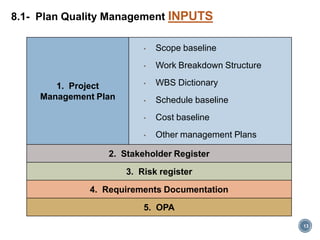
8.1- Plan Quality Management INPUTS
13
1. Project
Management Plan
• Scope baseline
• Work Breakdown Structure
• WBS Dictionary
• Schedule baseline
• Cost baseline
• Other management Plans
2. Stakeholder Register
3. Risk register
4. Requirements Documentation
5. OPA
8.1- Plan Quality Management T & T
14
• Cost-benefit Analysis The primary benefit of meeting
quality requirements is less rework, i.e., higher
productivity, lower costs and increased stakeholder
satisfaction.
• Benchmarking This technique involves looking at other
projects to get ideas for improvement on the current
project and to provide a basis (or benchmark) to use in
measuring quality performance.
• Meetings
15
• Cost Of Quality
Refers to the total cost of the conformance work and the
nonconformance work
8.1- Plan Quality Management T & T
16
• Design of Experiment DOE statistical method
• Helps identify which factors might influence specific variables.
• DOE can help shorten the time and effort required to discover the best
conditions to produce a quality deliverable
Which parts are
best integrated to
give best result
8.1- Plan Quality Management T & T
17
• Seven Basic Quality Tools 7QC Tools
used within the context of the PDCA Cycle to solve quality-
related problems.
1. Cause-and-effect (fishbone diagrams / Ishikawa diagrams) Trace
the problem’s source back to its “actionable root cause”
18
• Seven Basic Quality Tools 7QC Tools
2. Flowcharting (Process Map) a graphical representation of a
process showing the relationships among process steps and display the
sequence of steps
19
• Seven Basic Quality Tools 7QC Tools
3. Check sheet (Tally Sheet) a type of checklist that can be used to
keep track of data such as quality problems uncovered during inspections.
20
• Seven Basic Quality Tools 7QC Tools
4. Pareto Diagram (Pareto Chart)
Identify the vital few sources that are responsible for causing most of a
problem’s effects.
• Focus attention to most
critical issues
• Pareto Principle :
80/20 principle states that
80 percent of problems
are due to 20 percent of
the root causes
21
• Seven Basic Quality Tools 7QC Tools
5. Histograms
A bar chart and are used to describe the central tendency, distraction.
Does not consider the influence of time on the variation exists within a
distribution.
Helps identify which Problems are worth dealing with.
22
• Seven Basic Quality Tools 7QC Tools
6. Control Charts
 Graphic displays of the results, over time, of a process; used to assess
whether the process is “in control”.
 Control Limits : represent the performing organization's standards
 Mean (Average) : It shows the middle of the range of acceptable variation.
 Specification Limits : represent the customer's expectations or contractual
requirements
23
• Seven Basic Quality Tools 7QC Tools
6. Control Charts
• Rule of Seven : seven points toward upper or lower control limit may indicate
that process is out of control
 Assignable causes – Variations may be caused by differences in
machines, workers overtime, etc. Identify the root cause.
 A process is considered out of control when :
1. a data point exceeds a control limit.
2. seven consecutive plot points are above the mean
3. seven consecutive plot points are below the mean.
24
Upper
control limit
Mean Line
(center )
Out of control
Assignable/special
cause
Specification limit:
is point determines by
customer, not calculated
based on control chart
Normal and expected
variation Usually 3 or 6
sigma
Rule of seven (non random
data points) Out of control
Assignable/special cause
Normal
distribution
curve
Lower
control limit
25
• Seven Basic Quality Tools 7QC Tools
7. Scatter diagrams ( correlation charts )
• Tracks two variables to determine their relationship.
• Determines the relationship of independent variables such as paint
quantity, dryer fan speed, and door weight to the dependent variable of
drying time.
Door Paint Spray
Quantity (mL/sqm)
Dryer Fan Speed
(rpm)
Door weight
DoorDrying
Time(minutes)
26
• Statistical Sampling
8.1- Plan Quality Management T & T
 Involves choosing part of a population of interest for inspection
(e.g., selecting 10 samples of 75 electronic components).
 Appropriate sampling can often reduce the cost of quality
control.
 Brainstorming. This technique is used to generate ideas.
 Nominal group technique. This technique is used to allow
ideas to be brainstormed in small groups and then reviewed by
a larger group.
• Additional Quality Planning Tools
8.1- Plan Quality Management Outputs
27
Quality
Management
Plan
• What processes will be followed to help ensure
quality
• Review of earlier decisions to make sure those
decisions are correct
• The meetings to be held addressing quality
• The reports that will address quality
• What metrics will be used to measure quality
• What parts of the project or deliverables will be
measured and when
Process
Improvement
Plan
• Process boundaries. purpose of the process, the start
and end of the process, its inputs
and outputs, the process owner, and the stakeholders of
the process.
• Process configuration. Provides a graphic depiction of
processes, How to improve quality processes.
• Process metrics.
• Targets for improved performance.
8.1- Plan Quality Management Outputs
28
Quality Metrics
• How the control quality process will measure the
deliverables / product.
• What is the measures for each part including
time / cost tolerance / quality accepted level.
Quality
Checklists
a structured tool, used to verify that a set of required
steps has been performed.
Project
Documents
Updates
• Stakeholder register assign new people for tasks.
• Responsibility assignment matrix (change
responsibilities.
• WBS and WBS Dictionary.
29
8.2- Perform Quality
Assurance
30
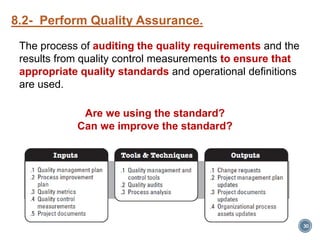
8.2- Perform Quality Assurance.
The process of auditing the quality requirements and the
results from quality control measurements to ensure that
appropriate quality standards and operational definitions
are used.
Are we using the standard?
Can we improve the standard?
31
8.2- Perform Quality Assurance Inputs
32
1. Quality Management Plan
2. Process Improvement Plan
3. Quality Metrics
4. Project Documents
5.
Quality Control
Measurements
• Are the results of control quality activities.
• Analyze and evaluate the quality of the
processes of the project against the standards
of the performing organization or the requirements
specified
.
• Compare the processes used to create the
measurements, and validate actual
measurements to determine their level of
correctness.
8.2- Perform Quality Assurance T & T
33
• Quality Audits
• To see if you are complying to company policies,
standards & procedures.
• Determine whether they are used efficiently & effectively
• Identify all the good practices being implemented
• Identify all the gaps/shortcomings
• Look for new lesson learned & good practices
• Process Analysis
• Includes root cause analysis
• How is the processes going to
find out the defect.
• Quality Management and Control Tools
34
1. Affinity Diagram: A technique that allows large numbers of ideas to be
classified into groups for review and analysis.
8.2- Perform Quality Assurance T & T
35
2. Process Decision Program Charts Used to understand a
goal in relation to the steps for getting to the goal. The PDPC is useful as
a method for contingency planning.
8.2- Perform Quality Assurance T & T
• Quality Management and Control Tools
36
3. Interrelationship Digraphs analyze the relationships among
numerous different issues to find the root cause of the problem.
8.2- Perform Quality Assurance T & T
• Quality Management and Control Tools
37
4. Tree Diagrams (systematic diagrams )
• Used to represent decomposition hierarchies such as the WBS, RBS
(risk breakdown structure), and OBS (organizational breakdown
structure), RBS (resource breakdown structure)
• Decompose processes to find a solution to a problem, and arrive at
corrective or preventive action.
8.2- Perform Quality Assurance T & T
• Quality Management and Control Tools
Arrive at school
on time
Arrive at school
late
Miss school
Catch 1st train
Catch 2nd train
Miss trains
Catch 1st bus
Catch 2nd bus
Miss buses
Leave
home
38
4. Prioritization Matrices
Identify the key issues and the suitable alternatives to be prioritized as
a set of decisions for implementation
8.2- Perform Quality Assurance T & T
• Quality Management and Control Tools
5. Activity Network Diagram if you're looking to improve time
management processes.
6. Matrix Diagrams
• Used to perform data analysis within the organizational structure.
• Seeks to show the strength of relationships between factors,
causes, and objectives
39
8.2- Perform Quality Assurance Outputs
40
1. Change Requests
2. Project Management Plan Updates
3. Project Documents Updates
4. OPA
41
8.3- Control Quality
42
8.3- Control Quality.
• The process of monitoring and recording results of
executing the quality activities to assess performance
• The key benefits of this process include
 Identifying the causes of poor quality
 Validating that project deliverables and work meet
the requirements
43
8.3- Control Quality.
 Prevention (Keeping errors out of the process).
 Inspection (Keeping errors out of the hands of the
customer).
 Attribute sampling ( either conform or not )
 Variables sampling (degree of conformity)
 Tolerance (range of acceptable results) and
 Control limits (thresholds which may indicate out of
control)
44
8.3- Control Quality Inputs
45
Project Management Plan
Quality Metrics
Quality checklists
Work Performance Data
Approved Change Requests
Deliverables
Project
Documents
• Agreements,
• Quality audit reports
• Training plans and assessments of effectiveness.
• Process documentation
OPA
8.3- Control Quality T & T
46
Seven Basic Quality Tools
Statistical Sampling
Inspection
Approved Change Request Reviews
8.3- Control Quality Outputs
47
Quality Control Measurements
Validated Changes
Verified Deliverables
Work Performance Information
Change Requests
Project Management Plan Updates
Project Document Updates
OPA
Questions
48
1. When a product or service completely meets a customer's
requirements:
A. Quality is achieved.
B. The cost of quality is high.
C. The cost of quality is low.
D. The customer pays the minimum price.
Questions
49
1. When a product or service completely meets a customer's
requirements:
A. Quality is achieved.
B. The cost of quality is high.
C. The cost of quality is low.
D. The customer pays the minimum price.
Answer : A
Questions
50
2. To what does the following definition refer? "The point
where the benefits or revenue to be received from improving
quality equals the incremental cost to achieve that quality ?
A. Quality control analysis
B. Marginal analysis
C. Standard quality analysis
D. Conformance analysis
Questions
51
2. To what does the following definition refer? "The point
where the benefits or revenue to be received from improving
quality equals the incremental cost to achieve that quality ?
A. Quality control analysis
B. Marginal analysis
C. Standard quality analysis
D. Conformance analysis
Answer : B
Questions
52
3. Who is ultimately responsible for quality management on
the project?
A. The project engineer
B. The project manager
C. The quality manager
D. The team member
Questions
53
3. Who is ultimately responsible for quality management on
the project?
A. The project engineer
B. The project manager
C. The quality manager
D. The team member
Answer : B
Questions
54
4. All the following are tools of Control Quality EXCEPT:
A. Inspection.
B. Cost of quality.
C. Pareto diagram.
D. Fishbone diagram.
Questions
55
4. All the following are tools of Control Quality EXCEPT:
A. Inspection.
B. Cost of quality.
C. Pareto diagram.
D. Fishbone diagram.
Answer : B
Questions
56
5. Pareto diagrams help the project manager:
A. Focus on the most critical issues to improve quality.
B. Focus on stimulating thinking.
C. Explore a desired future outcome.
D. Determine if a process is out of control.
Questions
57
5. Pareto diagrams help the project manager:
A. Focus on the most critical issues to improve quality.
B. Focus on stimulating thinking.
C. Explore a desired future outcome.
D. Determine if a process is out of control.
Answer : A
Questions
58
6. A control chart helps the project manager:
A. Focus on the most critical issues to improve quality.
B. Focus on stimulating thinking.
C. Explore a desired future outcome.
D. Determine if a process is functioning within set limits.
Questions
59
6. A control chart helps the project manager:
A. Focus on the most critical issues to improve quality.
B. Focus on stimulating thinking.
C. Explore a desired future outcome.
D. Determine if a process is functioning within set limits.
Answer : D
Questions
60
7. Testing the entire population would:
A. Take too long.
B. Provide more information than wanted.
C. Be mutually exclusive.
D. Show many defects.
Questions
61
7. Testing the entire population would:
A. Take too long.
B. Provide more information than wanted.
C. Be mutually exclusive.
D. Show many defects.
Answer : A
Questions
62
8. All of the following are examples of the cost of
nonconformance EXCEPT:
A. Rework.
B. Quality training.
C. Scrap.
D. Warranty costs.
Questions
63
8. All of the following are examples of the cost of
nonconformance EXCEPT:
A. Rework.
B. Quality training.
C. Scrap.
D. Warranty costs.
Answer : B
Questions
64
9. You are asked to select tools and techniques to implement
a quality assurance program to supplement existing quality
control activities. Which of the following would NOT be
appropriate for this purpose?
A. Quality audits
B. Statistical sampling
C. Pareto diagrams
D. Focus groups
Questions
65
9. You are asked to select tools and techniques to implement
a quality assurance program to supplement existing quality
control activities. Which of the following would NOT be
appropriate for this purpose?
A. Quality audits
B. Statistical sampling
C. Pareto diagrams
D. Focus groups
Answer : D
Focus groups are a tool of the Collect Requirements process, and
would not be useful in the Perform Quality Assurance process.
Questions
66
10. As the project manager, you are preparing your quality
management plan. You are looking for a tool that can
demonstrate the relationship between events and their
resulting effects. You want to use this tool to depict the events
that cause a negative effect on quality. Which of the following is
the BEST choice for accomplishing your objective?
A. Histogram
B. Pareto diagram
C. Ishikawa diagram
D. Control chart
Questions
67
10. As the project manager, you are preparing your quality
management plan. You are looking for a tool that can
demonstrate the relationship between events and their
resulting effects. You want to use this tool to depict the events
that cause a negative effect on quality. Which of the following is
the BEST choice for accomplishing your objective?
A. Histogram
B. Pareto diagram
C. Ishikawa diagram
D. Control chart
Answer : C

Pmp quality chapter 8

  • 1.
  • 2.
    2  Quality Theories Evolution of Quality Management  8.1 Plan Quality Management  8.2 Perform Quality Assurance  8.3 Control Quality KEY TERMS
  • 3.
    Project Quality Management Knowledge Area Process InitiatingPlanning Executing Monitoring & Control Closing Cost 8.1 Plan Quality Management 8.2 Perform Quality Assurance 8.3 Control Quality Enter phase/ Start project Exit phase/ End project Initiating Processes Closing Processes Planning Processes Executing Processes Monitoring & Controlling Processes  Quality is the degree to which the project fulfills requirements. 3
  • 4.
    4 8.1 Plan QualityManagement The process of identifying quality requirements and/or standards for the project and its deliverables and documenting how the project will demonstrate compliance with quality requirements. 8.2 Perform Quality Assurance The process of auditing the quality requirements and the results from quality control measurements to ensure that appropriate quality standards and operational definitions are used. 8.3 Control Quality The process of monitoring and recording results of executing the quality activities to assess performance and recommend necessary changes.
  • 5.
    5 Joseph Juran • 80/20 principle,top management involvement. Quality is fitness for use. • Advocated top management involvement Quality Theorists Philip Crosby • Cost of poor quality, prevention over inspection and zero defects. • Quality = Conformance To Requirements Edwards Deming • 14 steps of Total Quality Management, Plan-Do-Check-Act cycle. • Basis for quality improvement.
  • 6.
    Quality Concepts Quality vs.Grade  Quality: the degree to which a set of inherent characteristics fulfill requirements  Quality level that fails to meet quality requirements is always a PROBLEM  Grade: a category assigned to product or service having the same functional use but different technical characteristics  Low grade may not be a problem 6
  • 7.
    • Customer satisfaction •Conformance to requirement • Fitness for use: product/service produced must satisfy real needs • Prevention over inspection • Cost of preventing mistakes < cost of correcting • Continuous improvement (Kaizen) Japanese concept • Based on PDCA cycle • Using quality improvement initiatives e.g. TQM, 6 sigma • Management responsibility • To provide the resource needed to succeed 7
  • 8.
    8  Gold Plating:giving the customer extras not recommended  Marginal Analysis: looking for the point where.. benefits/revenue to be received from improving quality EQUALS the incremental cost to achieve that quality  Just in Time (JIT): just when they are needed or just before they are needed.  It forces attention on quality practices.  decreasing inventory to close to zero.  Total Quality Management (TQM)  Company & their employees focus on finding ways to continuous improve the quality of their business practices & products.
  • 9.
    9 • ISO tohelp ensure that organizations have quality procedures and that they follow them. • Six Sigma a methodology for organizational process improvement and achieving high levels of correctness with extremely reduced variances.) • 1 sigma = 68.26 % • 2 sigma = 95.44 % • 3 sigma = 99.73 % • 6 sigma = 99.99 %
  • 10.
  • 11.
    11 8.1- Plan QualityManagement. The process of identifying quality requirements and/or standards for the project and its deliverables and documenting how the project will demonstrate compliance with quality requirements.
  • 12.
  • 13.
    8.1- Plan QualityManagement INPUTS 13 1. Project Management Plan • Scope baseline • Work Breakdown Structure • WBS Dictionary • Schedule baseline • Cost baseline • Other management Plans 2. Stakeholder Register 3. Risk register 4. Requirements Documentation 5. OPA
  • 14.
    8.1- Plan QualityManagement T & T 14 • Cost-benefit Analysis The primary benefit of meeting quality requirements is less rework, i.e., higher productivity, lower costs and increased stakeholder satisfaction. • Benchmarking This technique involves looking at other projects to get ideas for improvement on the current project and to provide a basis (or benchmark) to use in measuring quality performance. • Meetings
  • 15.
    15 • Cost OfQuality Refers to the total cost of the conformance work and the nonconformance work 8.1- Plan Quality Management T & T
  • 16.
    16 • Design ofExperiment DOE statistical method • Helps identify which factors might influence specific variables. • DOE can help shorten the time and effort required to discover the best conditions to produce a quality deliverable Which parts are best integrated to give best result 8.1- Plan Quality Management T & T
  • 17.
    17 • Seven BasicQuality Tools 7QC Tools used within the context of the PDCA Cycle to solve quality- related problems. 1. Cause-and-effect (fishbone diagrams / Ishikawa diagrams) Trace the problem’s source back to its “actionable root cause”
  • 18.
    18 • Seven BasicQuality Tools 7QC Tools 2. Flowcharting (Process Map) a graphical representation of a process showing the relationships among process steps and display the sequence of steps
  • 19.
    19 • Seven BasicQuality Tools 7QC Tools 3. Check sheet (Tally Sheet) a type of checklist that can be used to keep track of data such as quality problems uncovered during inspections.
  • 20.
    20 • Seven BasicQuality Tools 7QC Tools 4. Pareto Diagram (Pareto Chart) Identify the vital few sources that are responsible for causing most of a problem’s effects. • Focus attention to most critical issues • Pareto Principle : 80/20 principle states that 80 percent of problems are due to 20 percent of the root causes
  • 21.
    21 • Seven BasicQuality Tools 7QC Tools 5. Histograms A bar chart and are used to describe the central tendency, distraction. Does not consider the influence of time on the variation exists within a distribution. Helps identify which Problems are worth dealing with.
  • 22.
    22 • Seven BasicQuality Tools 7QC Tools 6. Control Charts  Graphic displays of the results, over time, of a process; used to assess whether the process is “in control”.  Control Limits : represent the performing organization's standards  Mean (Average) : It shows the middle of the range of acceptable variation.  Specification Limits : represent the customer's expectations or contractual requirements
  • 23.
    23 • Seven BasicQuality Tools 7QC Tools 6. Control Charts • Rule of Seven : seven points toward upper or lower control limit may indicate that process is out of control  Assignable causes – Variations may be caused by differences in machines, workers overtime, etc. Identify the root cause.  A process is considered out of control when : 1. a data point exceeds a control limit. 2. seven consecutive plot points are above the mean 3. seven consecutive plot points are below the mean.
  • 24.
    24 Upper control limit Mean Line (center) Out of control Assignable/special cause Specification limit: is point determines by customer, not calculated based on control chart Normal and expected variation Usually 3 or 6 sigma Rule of seven (non random data points) Out of control Assignable/special cause Normal distribution curve Lower control limit
  • 25.
    25 • Seven BasicQuality Tools 7QC Tools 7. Scatter diagrams ( correlation charts ) • Tracks two variables to determine their relationship. • Determines the relationship of independent variables such as paint quantity, dryer fan speed, and door weight to the dependent variable of drying time. Door Paint Spray Quantity (mL/sqm) Dryer Fan Speed (rpm) Door weight DoorDrying Time(minutes)
  • 26.
    26 • Statistical Sampling 8.1-Plan Quality Management T & T  Involves choosing part of a population of interest for inspection (e.g., selecting 10 samples of 75 electronic components).  Appropriate sampling can often reduce the cost of quality control.  Brainstorming. This technique is used to generate ideas.  Nominal group technique. This technique is used to allow ideas to be brainstormed in small groups and then reviewed by a larger group. • Additional Quality Planning Tools
  • 27.
    8.1- Plan QualityManagement Outputs 27 Quality Management Plan • What processes will be followed to help ensure quality • Review of earlier decisions to make sure those decisions are correct • The meetings to be held addressing quality • The reports that will address quality • What metrics will be used to measure quality • What parts of the project or deliverables will be measured and when Process Improvement Plan • Process boundaries. purpose of the process, the start and end of the process, its inputs and outputs, the process owner, and the stakeholders of the process. • Process configuration. Provides a graphic depiction of processes, How to improve quality processes. • Process metrics. • Targets for improved performance.
  • 28.
    8.1- Plan QualityManagement Outputs 28 Quality Metrics • How the control quality process will measure the deliverables / product. • What is the measures for each part including time / cost tolerance / quality accepted level. Quality Checklists a structured tool, used to verify that a set of required steps has been performed. Project Documents Updates • Stakeholder register assign new people for tasks. • Responsibility assignment matrix (change responsibilities. • WBS and WBS Dictionary.
  • 29.
  • 30.
    30 8.2- Perform QualityAssurance. The process of auditing the quality requirements and the results from quality control measurements to ensure that appropriate quality standards and operational definitions are used. Are we using the standard? Can we improve the standard?
  • 31.
  • 32.
    8.2- Perform QualityAssurance Inputs 32 1. Quality Management Plan 2. Process Improvement Plan 3. Quality Metrics 4. Project Documents 5. Quality Control Measurements • Are the results of control quality activities. • Analyze and evaluate the quality of the processes of the project against the standards of the performing organization or the requirements specified . • Compare the processes used to create the measurements, and validate actual measurements to determine their level of correctness.
  • 33.
    8.2- Perform QualityAssurance T & T 33 • Quality Audits • To see if you are complying to company policies, standards & procedures. • Determine whether they are used efficiently & effectively • Identify all the good practices being implemented • Identify all the gaps/shortcomings • Look for new lesson learned & good practices • Process Analysis • Includes root cause analysis • How is the processes going to find out the defect.
  • 34.
    • Quality Managementand Control Tools 34 1. Affinity Diagram: A technique that allows large numbers of ideas to be classified into groups for review and analysis. 8.2- Perform Quality Assurance T & T
  • 35.
    35 2. Process DecisionProgram Charts Used to understand a goal in relation to the steps for getting to the goal. The PDPC is useful as a method for contingency planning. 8.2- Perform Quality Assurance T & T • Quality Management and Control Tools
  • 36.
    36 3. Interrelationship Digraphsanalyze the relationships among numerous different issues to find the root cause of the problem. 8.2- Perform Quality Assurance T & T • Quality Management and Control Tools
  • 37.
    37 4. Tree Diagrams(systematic diagrams ) • Used to represent decomposition hierarchies such as the WBS, RBS (risk breakdown structure), and OBS (organizational breakdown structure), RBS (resource breakdown structure) • Decompose processes to find a solution to a problem, and arrive at corrective or preventive action. 8.2- Perform Quality Assurance T & T • Quality Management and Control Tools Arrive at school on time Arrive at school late Miss school Catch 1st train Catch 2nd train Miss trains Catch 1st bus Catch 2nd bus Miss buses Leave home
  • 38.
    38 4. Prioritization Matrices Identifythe key issues and the suitable alternatives to be prioritized as a set of decisions for implementation 8.2- Perform Quality Assurance T & T • Quality Management and Control Tools 5. Activity Network Diagram if you're looking to improve time management processes. 6. Matrix Diagrams • Used to perform data analysis within the organizational structure. • Seeks to show the strength of relationships between factors, causes, and objectives
  • 39.
  • 40.
    8.2- Perform QualityAssurance Outputs 40 1. Change Requests 2. Project Management Plan Updates 3. Project Documents Updates 4. OPA
  • 41.
  • 42.
    42 8.3- Control Quality. •The process of monitoring and recording results of executing the quality activities to assess performance • The key benefits of this process include  Identifying the causes of poor quality  Validating that project deliverables and work meet the requirements
  • 43.
    43 8.3- Control Quality. Prevention (Keeping errors out of the process).  Inspection (Keeping errors out of the hands of the customer).  Attribute sampling ( either conform or not )  Variables sampling (degree of conformity)  Tolerance (range of acceptable results) and  Control limits (thresholds which may indicate out of control)
  • 44.
  • 45.
    8.3- Control QualityInputs 45 Project Management Plan Quality Metrics Quality checklists Work Performance Data Approved Change Requests Deliverables Project Documents • Agreements, • Quality audit reports • Training plans and assessments of effectiveness. • Process documentation OPA
  • 46.
    8.3- Control QualityT & T 46 Seven Basic Quality Tools Statistical Sampling Inspection Approved Change Request Reviews
  • 47.
    8.3- Control QualityOutputs 47 Quality Control Measurements Validated Changes Verified Deliverables Work Performance Information Change Requests Project Management Plan Updates Project Document Updates OPA
  • 48.
    Questions 48 1. When aproduct or service completely meets a customer's requirements: A. Quality is achieved. B. The cost of quality is high. C. The cost of quality is low. D. The customer pays the minimum price.
  • 49.
    Questions 49 1. When aproduct or service completely meets a customer's requirements: A. Quality is achieved. B. The cost of quality is high. C. The cost of quality is low. D. The customer pays the minimum price. Answer : A
  • 50.
    Questions 50 2. To whatdoes the following definition refer? "The point where the benefits or revenue to be received from improving quality equals the incremental cost to achieve that quality ? A. Quality control analysis B. Marginal analysis C. Standard quality analysis D. Conformance analysis
  • 51.
    Questions 51 2. To whatdoes the following definition refer? "The point where the benefits or revenue to be received from improving quality equals the incremental cost to achieve that quality ? A. Quality control analysis B. Marginal analysis C. Standard quality analysis D. Conformance analysis Answer : B
  • 52.
    Questions 52 3. Who isultimately responsible for quality management on the project? A. The project engineer B. The project manager C. The quality manager D. The team member
  • 53.
    Questions 53 3. Who isultimately responsible for quality management on the project? A. The project engineer B. The project manager C. The quality manager D. The team member Answer : B
  • 54.
    Questions 54 4. All thefollowing are tools of Control Quality EXCEPT: A. Inspection. B. Cost of quality. C. Pareto diagram. D. Fishbone diagram.
  • 55.
    Questions 55 4. All thefollowing are tools of Control Quality EXCEPT: A. Inspection. B. Cost of quality. C. Pareto diagram. D. Fishbone diagram. Answer : B
  • 56.
    Questions 56 5. Pareto diagramshelp the project manager: A. Focus on the most critical issues to improve quality. B. Focus on stimulating thinking. C. Explore a desired future outcome. D. Determine if a process is out of control.
  • 57.
    Questions 57 5. Pareto diagramshelp the project manager: A. Focus on the most critical issues to improve quality. B. Focus on stimulating thinking. C. Explore a desired future outcome. D. Determine if a process is out of control. Answer : A
  • 58.
    Questions 58 6. A controlchart helps the project manager: A. Focus on the most critical issues to improve quality. B. Focus on stimulating thinking. C. Explore a desired future outcome. D. Determine if a process is functioning within set limits.
  • 59.
    Questions 59 6. A controlchart helps the project manager: A. Focus on the most critical issues to improve quality. B. Focus on stimulating thinking. C. Explore a desired future outcome. D. Determine if a process is functioning within set limits. Answer : D
  • 60.
    Questions 60 7. Testing theentire population would: A. Take too long. B. Provide more information than wanted. C. Be mutually exclusive. D. Show many defects.
  • 61.
    Questions 61 7. Testing theentire population would: A. Take too long. B. Provide more information than wanted. C. Be mutually exclusive. D. Show many defects. Answer : A
  • 62.
    Questions 62 8. All ofthe following are examples of the cost of nonconformance EXCEPT: A. Rework. B. Quality training. C. Scrap. D. Warranty costs.
  • 63.
    Questions 63 8. All ofthe following are examples of the cost of nonconformance EXCEPT: A. Rework. B. Quality training. C. Scrap. D. Warranty costs. Answer : B
  • 64.
    Questions 64 9. You areasked to select tools and techniques to implement a quality assurance program to supplement existing quality control activities. Which of the following would NOT be appropriate for this purpose? A. Quality audits B. Statistical sampling C. Pareto diagrams D. Focus groups
  • 65.
    Questions 65 9. You areasked to select tools and techniques to implement a quality assurance program to supplement existing quality control activities. Which of the following would NOT be appropriate for this purpose? A. Quality audits B. Statistical sampling C. Pareto diagrams D. Focus groups Answer : D Focus groups are a tool of the Collect Requirements process, and would not be useful in the Perform Quality Assurance process.
  • 66.
    Questions 66 10. As theproject manager, you are preparing your quality management plan. You are looking for a tool that can demonstrate the relationship between events and their resulting effects. You want to use this tool to depict the events that cause a negative effect on quality. Which of the following is the BEST choice for accomplishing your objective? A. Histogram B. Pareto diagram C. Ishikawa diagram D. Control chart
  • 67.
    Questions 67 10. As theproject manager, you are preparing your quality management plan. You are looking for a tool that can demonstrate the relationship between events and their resulting effects. You want to use this tool to depict the events that cause a negative effect on quality. Which of the following is the BEST choice for accomplishing your objective? A. Histogram B. Pareto diagram C. Ishikawa diagram D. Control chart Answer : C