QUALITY MANAGEMENT
Minu Mariya Thomas
Swathi Mukundan
INDEX
 Quality Management (QM)
-definition, importance
 QM Process and activities
-plan, assurance & control
 Quality Policy
 Quality Objectives
 Responsibilities
 Corrective actions & Continuous improvements
DEFINITION
 Quality management is the act of overseeing all
activities and tasks needed to maintain a desired
level of excellence.
 Also referred as ‘TQM’ –Total Quality
Management
WHAT IS QUALITY?
 “Quality” - The degree to which a set of inherent
characteristics fulfils requirements.
[PMBOK Guide V.5]
 Managing quality means constantly pursuing
excellence
 making sure that what your organisation does
is fit for purpose and improvement.
WHY “QUALITY MANAGEMENT” ?
Process of controlling, ensuring, and improving
quality, both in business operations and
productivity.
 Increases customer satisfaction
 Reduces risk
 Increased visibility
 Improves product quality
 Business growth
PROCESS & ACTIVITIES
Process and activities of an organization determine
quality policies, objectives and responsibilities so
that the project will satisfy the needs for which it
was undertaken.
It includes:
1)Plan quality management
2)Perform quality assurance
3)Control quality
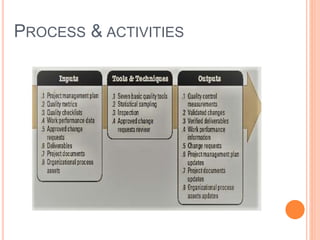
PROCESS & ACTIVITIES
PLAN QUALITY MANAGEMENT
 It determines quality requirements, how they
will be measured, and controlled.
 A quality plan includes:
- Quality metrices
- Quality checklists
- Process improvement plan
- Project documents
 Input includes:
- Quality statement -Scope statement
- Product description -Standards&regulations
-Other process and outputs
 Methods used:
- benefit / cost analysis -bench marking
- flowcharting -design of experiments
 Output includes:
- Quality Management plan
- Operational definitions
-checklists
PERFORM QUALITY ASSURANCE
 Quality Assurance ensures that processes are in place to
produce the project deliverables at the applicable level of
quality and asks the following questions:
i )What are the applicable quality standards?
ii )How will quality be measured?
iii )Who will measure it?
iv )What will be measured?
v ) When will it be measured?
vi ) What is the criteria for rejection?
 Input includes:
-quality management plan
-results of quality control measurements
-operational definitions
 Methods used:
-quality planning tools & techniques
-quality audits
 Output includes:
-quality improvement
CONTROL QUALITY
Control Quality is the process of monitoring and
recording results of executing the quality
activities to assess performance and recommend
necessary changes.
The key benefits :
(1) identifying the causes of poor process or
product quality and recommending and/or taking
action to eliminate them
(2) validating that project deliverables and work
meet the requirements specified by key
stakeholders necessary for final acceptance.
 Input includes:
-work results
-quality management plan
-operational definition -checklists
 Methods used:
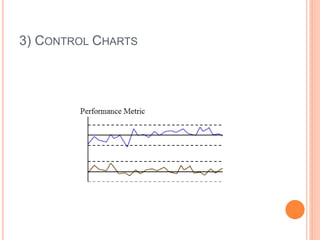
-inspection -control charts
-statistical sampling -trend analysis
 Output includes:
-quality improvements -rework
-acceptence decision -completed checklist
QUALITY POLICY
Top management must ensure that the quality
policy:
 Is appropriate to the organisation
 Includes a commitment to requirements and
continual improvement
 Provides a basis for establishing and quality
objectives
 Is communicated and understood within the
organisation
 Is periodically reviewed for suitability
[ISO 9001-2008 recommendation]
QUALITY OBJECTIVES
The objective is to measure each component
and achieve improvements.
 Product testing - measure accuracy and
compliance with standards
 Functional testing - show whether the products
meet customer expectations.
Test scores yield information about problems
and indicate areas where there is room for
improvement.
CONT…….
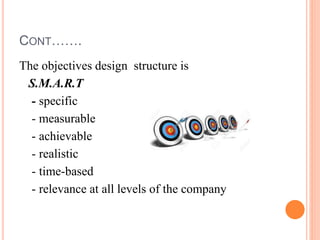
The objectives design structure is
S.M.A.R.T
- specific
- measurable
- achievable
- realistic
- time-based
- relevance at all levels of the company
RESPONSIBILITIES
 Devising and establishing a company's quality procedures,
standards and specifications
 reviewing customer requirements
and with purchasing staff
 setting standards for quality as well as health and safety
 making sure that manufacturing or production processes
meet international and national standards
 looking at ways to reduce waste and increase efficiency
 defining quality procedures in conjunction with operating
staff
CONT………
 setting up and maintaining controls and
documentation procedures
 monitoring performance by gathering relevant
data and producing statistical reports
 making suggestions for changes and
improvements and how to implement them
 using relevant quality tools and making sure
managers and other staff understand how to
improve the business
 making sure the company is working as
effectively as possible to keep up with competitors.
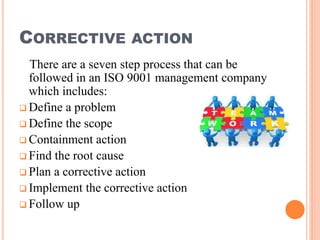
CORRECTIVE ACTION
There are a seven step process that can be
followed in an ISO 9001 management company
which includes:
 Define a problem
 Define the scope
 Containment action
 Find the root cause
 Plan a corrective action
 Implement the corrective action
 Follow up
CONTINUOUS IMPROVEMENT
 Continuous improvement is an ongoing effort to improve
products, services or processes.
 These efforts can seek “incremental” improvement over
time or “breakthrough” improvement all at once
 It follows a four-step quality model—the
plan-do-check-act (PDCA) cycle also known as
Deming Cycle or Shewhart Cycle:
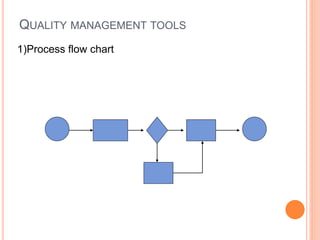
QUALITY MANAGEMENT TOOLS
1)Process flow chart
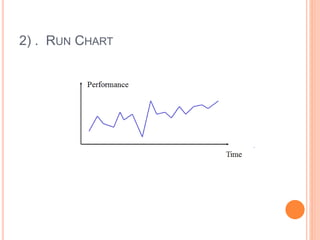
2) . RUN CHART
3) CONTROL CHARTS
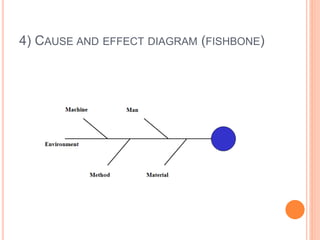
4) CAUSE AND EFFECT DIAGRAM (FISHBONE)
 Also referred to as “Fishbone Chart” (because of its
shape which resembles the side view of a fish
skeleton)and Ishikawa diagrams after its creator
Kaoru Ishikawa, Cause and Effect Diagram records
causes of a particular and specific problem .The
cause and effect diagram plays a crucial role in
identifying the root cause of a particular problem
and also potential factors which give rise to a
common problem at the workplace.
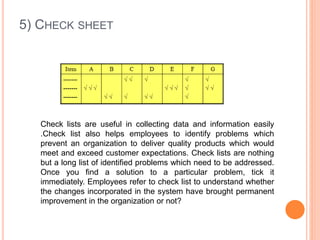
5) CHECK SHEET
Check lists are useful in collecting data and information easily
.Check list also helps employees to identify problems which
prevent an organization to deliver quality products which would
meet and exceed customer expectations. Check lists are nothing
but a long list of identified problems which need to be addressed.
Once you find a solution to a particular problem, tick it
immediately. Employees refer to check list to understand whether
the changes incorporated in the system have brought permanent
improvement in the organization or not?
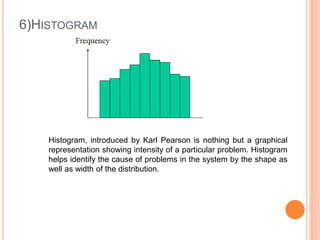
6)HISTOGRAM
Histogram, introduced by Karl Pearson is nothing but a graphical
representation showing intensity of a particular problem. Histogram
helps identify the cause of problems in the system by the shape as
well as width of the distribution.
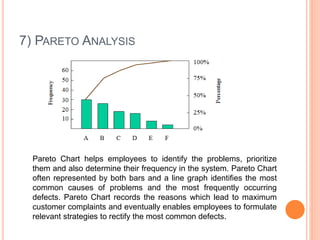
7) PARETO ANALYSIS
Pareto Chart helps employees to identify the problems, prioritize
them and also determine their frequency in the system. Pareto Chart
often represented by both bars and a line graph identifies the most
common causes of problems and the most frequently occurring
defects. Pareto Chart records the reasons which lead to maximum
customer complaints and eventually enables employees to formulate
relevant strategies to rectify the most common defects.
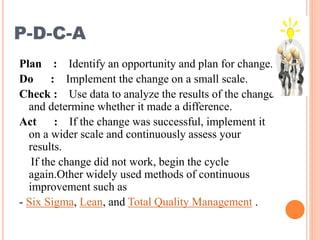
P-D-C-A
Plan : Identify an opportunity and plan for change.
Do : Implement the change on a small scale.
Check : Use data to analyze the results of the change
and determine whether it made a difference.
Act : If the change was successful, implement it
on a wider scale and continuously assess your
results.
If the change did not work, begin the cycle
again.Other widely used methods of continuous
improvement such as
- Six Sigma, Lean, and Total Quality Management .
SIX SIGMA QUALITY
 A philosophy and set of methods companies use to
eliminate defects in their products and processes
 Seeks to reduce variation in the processes that lead
to product defects
 The name “six sigma” refers to the variation that
exists within plus or minus six standard deviations
of the process outputs
TQM
 Total Quality Management is a combined effort of
both top level management as well as employees of
an organization to formulate effective strategies and
policies to deliver high quality products which not
only meet but also exceed customer satisfaction.
 Models:
-Deming Application Prize
-Malcolm Baldrige Criteria for Performance Excellence
-European Foundation for Quality Management, and
-ISO quality management standards
QUALITY CONCEPTS UNDER TQM
 All good organisations big or small, for profit or non-
profit, public or private sector, new or old, well -
established or not, operate with following basic
premise:
 Become capable of creating long term value for all
its stakeholders and they do this by:
 Developing and growing, by anticipating and
meeting their external customer’s requirements for
products and services, all the time.
 Becoming and being operationally efficient and
effective internally, all the time.
QUERIES??????????
Quality management

Quality management

  • 1.
    QUALITY MANAGEMENT Minu MariyaThomas Swathi Mukundan
  • 2.
    INDEX  Quality Management(QM) -definition, importance  QM Process and activities -plan, assurance & control  Quality Policy  Quality Objectives  Responsibilities  Corrective actions & Continuous improvements
  • 3.
    DEFINITION  Quality managementis the act of overseeing all activities and tasks needed to maintain a desired level of excellence.  Also referred as ‘TQM’ –Total Quality Management
  • 4.
    WHAT IS QUALITY? “Quality” - The degree to which a set of inherent characteristics fulfils requirements. [PMBOK Guide V.5]  Managing quality means constantly pursuing excellence  making sure that what your organisation does is fit for purpose and improvement.
  • 5.
    WHY “QUALITY MANAGEMENT”? Process of controlling, ensuring, and improving quality, both in business operations and productivity.  Increases customer satisfaction  Reduces risk  Increased visibility  Improves product quality  Business growth
  • 6.
    PROCESS & ACTIVITIES Processand activities of an organization determine quality policies, objectives and responsibilities so that the project will satisfy the needs for which it was undertaken. It includes: 1)Plan quality management 2)Perform quality assurance 3)Control quality
  • 7.
  • 8.
    PLAN QUALITY MANAGEMENT It determines quality requirements, how they will be measured, and controlled.  A quality plan includes: - Quality metrices - Quality checklists - Process improvement plan - Project documents
  • 9.
     Input includes: -Quality statement -Scope statement - Product description -Standards&regulations -Other process and outputs  Methods used: - benefit / cost analysis -bench marking - flowcharting -design of experiments  Output includes: - Quality Management plan - Operational definitions -checklists
  • 10.
    PERFORM QUALITY ASSURANCE Quality Assurance ensures that processes are in place to produce the project deliverables at the applicable level of quality and asks the following questions: i )What are the applicable quality standards? ii )How will quality be measured? iii )Who will measure it? iv )What will be measured? v ) When will it be measured? vi ) What is the criteria for rejection?
  • 11.
     Input includes: -qualitymanagement plan -results of quality control measurements -operational definitions  Methods used: -quality planning tools & techniques -quality audits  Output includes: -quality improvement
  • 12.
    CONTROL QUALITY Control Qualityis the process of monitoring and recording results of executing the quality activities to assess performance and recommend necessary changes. The key benefits : (1) identifying the causes of poor process or product quality and recommending and/or taking action to eliminate them (2) validating that project deliverables and work meet the requirements specified by key stakeholders necessary for final acceptance.
  • 13.
     Input includes: -workresults -quality management plan -operational definition -checklists  Methods used: -inspection -control charts -statistical sampling -trend analysis  Output includes: -quality improvements -rework -acceptence decision -completed checklist
  • 14.
    QUALITY POLICY Top managementmust ensure that the quality policy:  Is appropriate to the organisation  Includes a commitment to requirements and continual improvement  Provides a basis for establishing and quality objectives  Is communicated and understood within the organisation  Is periodically reviewed for suitability [ISO 9001-2008 recommendation]
  • 15.
    QUALITY OBJECTIVES The objectiveis to measure each component and achieve improvements.  Product testing - measure accuracy and compliance with standards  Functional testing - show whether the products meet customer expectations. Test scores yield information about problems and indicate areas where there is room for improvement.
  • 16.
    CONT……. The objectives designstructure is S.M.A.R.T - specific - measurable - achievable - realistic - time-based - relevance at all levels of the company
  • 17.
    RESPONSIBILITIES  Devising andestablishing a company's quality procedures, standards and specifications  reviewing customer requirements and with purchasing staff  setting standards for quality as well as health and safety  making sure that manufacturing or production processes meet international and national standards  looking at ways to reduce waste and increase efficiency  defining quality procedures in conjunction with operating staff
  • 18.
    CONT………  setting upand maintaining controls and documentation procedures  monitoring performance by gathering relevant data and producing statistical reports  making suggestions for changes and improvements and how to implement them  using relevant quality tools and making sure managers and other staff understand how to improve the business  making sure the company is working as effectively as possible to keep up with competitors.
  • 19.
    CORRECTIVE ACTION There area seven step process that can be followed in an ISO 9001 management company which includes:  Define a problem  Define the scope  Containment action  Find the root cause  Plan a corrective action  Implement the corrective action  Follow up
  • 20.
    CONTINUOUS IMPROVEMENT  Continuousimprovement is an ongoing effort to improve products, services or processes.  These efforts can seek “incremental” improvement over time or “breakthrough” improvement all at once  It follows a four-step quality model—the plan-do-check-act (PDCA) cycle also known as Deming Cycle or Shewhart Cycle:
  • 21.
  • 22.
    2) . RUNCHART
  • 23.
  • 24.
    4) CAUSE ANDEFFECT DIAGRAM (FISHBONE)
  • 25.
     Also referredto as “Fishbone Chart” (because of its shape which resembles the side view of a fish skeleton)and Ishikawa diagrams after its creator Kaoru Ishikawa, Cause and Effect Diagram records causes of a particular and specific problem .The cause and effect diagram plays a crucial role in identifying the root cause of a particular problem and also potential factors which give rise to a common problem at the workplace.
  • 26.
    5) CHECK SHEET Checklists are useful in collecting data and information easily .Check list also helps employees to identify problems which prevent an organization to deliver quality products which would meet and exceed customer expectations. Check lists are nothing but a long list of identified problems which need to be addressed. Once you find a solution to a particular problem, tick it immediately. Employees refer to check list to understand whether the changes incorporated in the system have brought permanent improvement in the organization or not?
  • 27.
    6)HISTOGRAM Histogram, introduced byKarl Pearson is nothing but a graphical representation showing intensity of a particular problem. Histogram helps identify the cause of problems in the system by the shape as well as width of the distribution.
  • 28.
    7) PARETO ANALYSIS ParetoChart helps employees to identify the problems, prioritize them and also determine their frequency in the system. Pareto Chart often represented by both bars and a line graph identifies the most common causes of problems and the most frequently occurring defects. Pareto Chart records the reasons which lead to maximum customer complaints and eventually enables employees to formulate relevant strategies to rectify the most common defects.
  • 29.
    P-D-C-A Plan : Identifyan opportunity and plan for change. Do : Implement the change on a small scale. Check : Use data to analyze the results of the change and determine whether it made a difference. Act : If the change was successful, implement it on a wider scale and continuously assess your results. If the change did not work, begin the cycle again.Other widely used methods of continuous improvement such as - Six Sigma, Lean, and Total Quality Management .
  • 30.
    SIX SIGMA QUALITY A philosophy and set of methods companies use to eliminate defects in their products and processes  Seeks to reduce variation in the processes that lead to product defects  The name “six sigma” refers to the variation that exists within plus or minus six standard deviations of the process outputs
  • 31.
    TQM  Total QualityManagement is a combined effort of both top level management as well as employees of an organization to formulate effective strategies and policies to deliver high quality products which not only meet but also exceed customer satisfaction.  Models: -Deming Application Prize -Malcolm Baldrige Criteria for Performance Excellence -European Foundation for Quality Management, and -ISO quality management standards
  • 32.
    QUALITY CONCEPTS UNDERTQM  All good organisations big or small, for profit or non- profit, public or private sector, new or old, well - established or not, operate with following basic premise:  Become capable of creating long term value for all its stakeholders and they do this by:  Developing and growing, by anticipating and meeting their external customer’s requirements for products and services, all the time.  Becoming and being operationally efficient and effective internally, all the time.
  • 33.