Quantitative Project Risk Analysis
1
Intaver Institute Inc.
303, 6707, Elbow Drive S.W.,
Calgary AB Canada T2V 0E5
www.intaver.com
Agenda
• Introduction
• Part One
– Project Decision Framework
– Quantitative Analysis within Project Risk Management
• Part Two
– Practical Exercises
• Q and A
2
Introduction
Who is Intaver Institute?
– Formed 2002
– Group of risk, economic, and decision analysis experts
– All to some extent were involved in developing software
tools for these fields
3
Problem
• Many IT projects were late or over budget
• No readily available tools for the analysis of project
schedules, the provided similar analysis as the ones they were
developing for other industries
• Decision analysis processes including quantitative analysis
widely used in many industries, but not project management
– Many project manager don’t believe in benefits of quantitative
methods
– Most methods and tools remain relatively complex, require special
training, and expensive
4
Vision: Quantitative project
analysis for the rest of us
1. Develop application
– No specialist training required to get started
– Easier to use and understand
– Relatively inexpensive
1. Provide project decision analysis training and consulting to support
application
5© Intaver Institute 2009
Part One: Project Decisions Framework and
Quantitative Analysis
• Project Decision Analysis
• Quantitative Project Risk Analysis and Management
6
Project Decision Analysis
• Successful projects are the result of good decisions
• Structure decision analysis
– Well defined process founded in decision analysis science
– Applicable to project management
– Provides framework that will improve project decisions
7
Decision Analysis vs. PMBOK
• Decision analysis not in conflict with PMBOK
• Can be easily integrated (as needed) into current PM
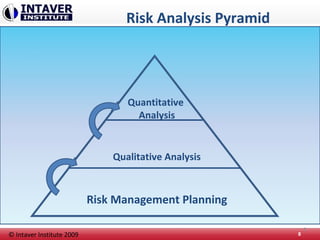
Risk Analysis Pyramid
8
Quantitative
Analysis
Qualitative Analysis
Risk Management Planning
© Intaver Institute 2009
8
Quantitative Estimates
• Uncertainties
– 3pt estimates
– Distributions
• Risk events
– Chance
– Outcome
– Result
– Moment of risk
9© Intaver Institute 2009
Types of uncertainties
• Duration
• Cost
• Start and Finish Times
• Lags
• Rates and Resource Allocation
• Entered as 3 pt estimate
10© Intaver Institute 2009
Types of Risk
• Task
• Resource
• Global (project or local)
11© Intaver Institute 2009
Risks or uncertainties?
• Use uncertainties in cases where you have historical data that
is both strong and analogous
• Use uncertainties in cases where you have some historical
data and strong expert opinion (experts have consensus)
• Use risk events when little historical data exists to back up
expert opinion
• Use risk events on higher risk projects
• You can use a combination of risk events and uncertainties
12
Risk or uncertainties
• Risk events are less prone to the effects of human biases and
heuristics
• Easier to recall effect of risk events on projects
13
Event Based Analysis
• Risk event estimates less affected by heuristics and biases
• Risk events estimates easier to obtain via relative frequency analysis
• Event based analysis of causes of project uncertainty
– Sensitivity analysis can be done to identify critical risks
– Uncertainties require additional root cause analysis to identify critical risks
14
Modeling Risk Events
• Chance - % chance that the risk will occur
• Outcome – relative % or fixed (e.g. % cost increase, Fixed
delay)
• Result - 15%
• Example Fire: 20% Chance of a Fixed Delay of 14 days
• Risks can have mutually exclusive alternatives
15
Monte Carlo Analysis
• Statistical sampling
• Runs many simulations of a project that produces
probabilistic distributions of particular results (cost, duration,
finish time, etc.)
• Gaining popularity as size and power of hardware and
software improve
16
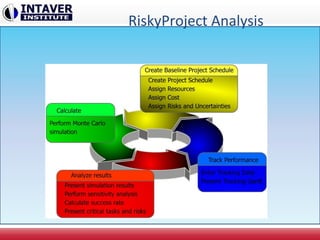
Project Risk Analysis
• Create project schedule
• Define project uncertainties
• Define project risks
• Perform Monte Carlo Simulations
• Analyze results
17
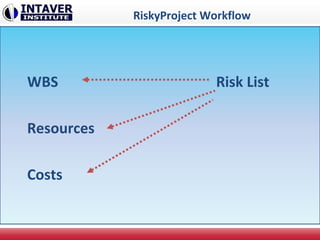
RiskyProject Workflow
WBS
Resources
Costs
Risk List
RiskyProject Analysis
Results of Analysis
• Project outcomes with and without risks and uncertainties
• Sensitivity analysis
• Cost analysis
• Identifying critical risks and uncertainties
• Success rates
20
Project Summary
21
Main Project
Parameters with and
without risks
Probabilistic results
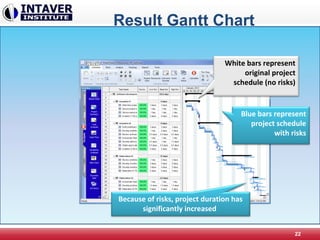
Result Gantt Chart
22
White bars represent
original project
schedule (no risks)
Blue bars represent
project schedule
with risks
Because of risks, project duration has
significantly increased
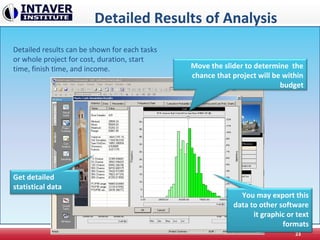
Detailed Results of Analysis
23
Move the slider to determine the
chance that project will be within
budget
Get detailed
statistical data
You may export this
data to other software
it graphic or text
formats
Detailed results can be shown for each tasks
or whole project for cost, duration, start
time, finish time, and income.
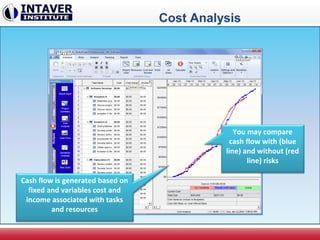
Cost Analysis
You may compare
cash flow with (blue
line) and without (red
line) risks
Cash flow is generated based on
fixed and variables cost and
income associated with tasks
and resources
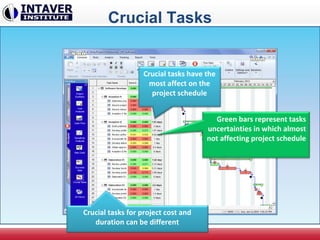
Crucial Tasks
Crucial tasks have the
most affect on the
project schedule
Green bars represent tasks
uncertainties in which almost
not affecting project schedule
Crucial tasks for project cost and
duration can be different
Critical Risks
Tornado chart shows the risks
that have the most affect on
the project schedule
Critical risks need to be
mitigated first
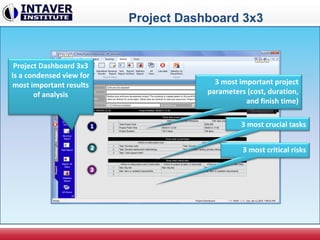
Project Dashboard 3x3
3 most important project
parameters (cost, duration,
and finish time)
3 most crucial tasks
3 most critical risks
Project Dashboard 3x3
is a condensed view for
most important results
of analysis
Risk Chart
The risk chart shows risk uncertainty for tasks versus duration or cost
This task has low
duration but high
risk
These tasks have
balanced risk versus
duration ratio.
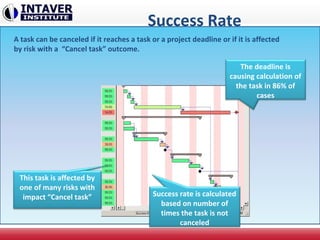
Success Rate
The deadline is
causing calculation of
the task in 86% of
cases
A task can be canceled if it reaches a task or a project deadline or if it is affected
by risk with a “Cancel task” outcome.
This task is affected by
one of many risks with
impact “Cancel task” Success rate is calculated
based on number of
times the task is not

canceled
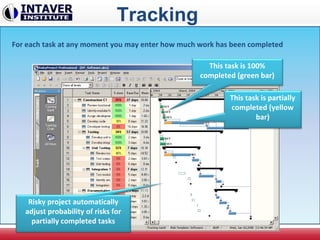
Tracking
This task is 100%
completed (green bar)
For each task at any moment you may enter how much work has been completed
This task is partially
completed (yellow
bar)
Risky project automatically
adjust probability of risks for
partially completed tasks
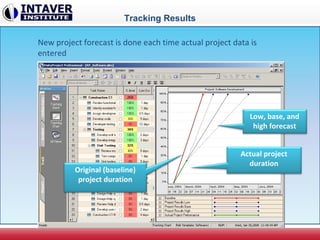
Tracking Results
New project forecast is done each time actual project data is
entered
Original (baseline)
project duration
Actual project
duration
Low, base, and
high forecast
Intaver Institute
32
Intaver Institute performs project risk management, risk
analysis, and decision analysis training and consulting
Download a trial version of RiskyProject at:
http://www.intaver.com/index-downloads.html (version 2.1)
White papers, presentations : http://www.intaver.com/index-
whitepapers.html
Courses: http://www.intaver.com/riskyproject_training.html
Future Reading
Lev Virine and Michael Trumper
Project Decisions:
The Art and Science
Management Concepts, Vienna, VA, 2007
Lev Virine and Michael Trumper
Project Think:
Why Good Managers Make Poor Project Choices
Gower, 2013

Quantitative Project Risk Analysis

  • 1.
    Quantitative Project RiskAnalysis 1 Intaver Institute Inc. 303, 6707, Elbow Drive S.W., Calgary AB Canada T2V 0E5 www.intaver.com
  • 2.
    Agenda • Introduction • PartOne – Project Decision Framework – Quantitative Analysis within Project Risk Management • Part Two – Practical Exercises • Q and A 2
  • 3.
    Introduction Who is IntaverInstitute? – Formed 2002 – Group of risk, economic, and decision analysis experts – All to some extent were involved in developing software tools for these fields 3
  • 4.
    Problem • Many ITprojects were late or over budget • No readily available tools for the analysis of project schedules, the provided similar analysis as the ones they were developing for other industries • Decision analysis processes including quantitative analysis widely used in many industries, but not project management – Many project manager don’t believe in benefits of quantitative methods – Most methods and tools remain relatively complex, require special training, and expensive 4
  • 5.
    Vision: Quantitative project analysisfor the rest of us 1. Develop application – No specialist training required to get started – Easier to use and understand – Relatively inexpensive 1. Provide project decision analysis training and consulting to support application 5© Intaver Institute 2009
  • 6.
    Part One: ProjectDecisions Framework and Quantitative Analysis • Project Decision Analysis • Quantitative Project Risk Analysis and Management 6
  • 7.
    Project Decision Analysis •Successful projects are the result of good decisions • Structure decision analysis – Well defined process founded in decision analysis science – Applicable to project management – Provides framework that will improve project decisions 7 Decision Analysis vs. PMBOK • Decision analysis not in conflict with PMBOK • Can be easily integrated (as needed) into current PM
  • 8.
    Risk Analysis Pyramid 8 Quantitative Analysis QualitativeAnalysis Risk Management Planning © Intaver Institute 2009 8
  • 9.
    Quantitative Estimates • Uncertainties –3pt estimates – Distributions • Risk events – Chance – Outcome – Result – Moment of risk 9© Intaver Institute 2009
  • 10.
    Types of uncertainties •Duration • Cost • Start and Finish Times • Lags • Rates and Resource Allocation • Entered as 3 pt estimate 10© Intaver Institute 2009
  • 11.
    Types of Risk •Task • Resource • Global (project or local) 11© Intaver Institute 2009
  • 12.
    Risks or uncertainties? •Use uncertainties in cases where you have historical data that is both strong and analogous • Use uncertainties in cases where you have some historical data and strong expert opinion (experts have consensus) • Use risk events when little historical data exists to back up expert opinion • Use risk events on higher risk projects • You can use a combination of risk events and uncertainties 12
  • 13.
    Risk or uncertainties •Risk events are less prone to the effects of human biases and heuristics • Easier to recall effect of risk events on projects 13
  • 14.
    Event Based Analysis •Risk event estimates less affected by heuristics and biases • Risk events estimates easier to obtain via relative frequency analysis • Event based analysis of causes of project uncertainty – Sensitivity analysis can be done to identify critical risks – Uncertainties require additional root cause analysis to identify critical risks 14
  • 15.
    Modeling Risk Events •Chance - % chance that the risk will occur • Outcome – relative % or fixed (e.g. % cost increase, Fixed delay) • Result - 15% • Example Fire: 20% Chance of a Fixed Delay of 14 days • Risks can have mutually exclusive alternatives 15
  • 16.
    Monte Carlo Analysis •Statistical sampling • Runs many simulations of a project that produces probabilistic distributions of particular results (cost, duration, finish time, etc.) • Gaining popularity as size and power of hardware and software improve 16
  • 17.
    Project Risk Analysis •Create project schedule • Define project uncertainties • Define project risks • Perform Monte Carlo Simulations • Analyze results 17
  • 18.
  • 19.
  • 20.
    Results of Analysis •Project outcomes with and without risks and uncertainties • Sensitivity analysis • Cost analysis • Identifying critical risks and uncertainties • Success rates 20
  • 21.
    Project Summary 21 Main Project Parameterswith and without risks Probabilistic results
  • 22.
    Result Gantt Chart 22 Whitebars represent original project schedule (no risks) Blue bars represent project schedule with risks Because of risks, project duration has significantly increased
  • 23.
    Detailed Results ofAnalysis 23 Move the slider to determine the chance that project will be within budget Get detailed statistical data You may export this data to other software it graphic or text formats Detailed results can be shown for each tasks or whole project for cost, duration, start time, finish time, and income.
  • 24.
    Cost Analysis You maycompare cash flow with (blue line) and without (red line) risks Cash flow is generated based on fixed and variables cost and income associated with tasks and resources
  • 25.
    Crucial Tasks Crucial taskshave the most affect on the project schedule Green bars represent tasks uncertainties in which almost not affecting project schedule Crucial tasks for project cost and duration can be different
  • 26.
    Critical Risks Tornado chartshows the risks that have the most affect on the project schedule Critical risks need to be mitigated first
  • 27.
    Project Dashboard 3x3 3most important project parameters (cost, duration, and finish time) 3 most crucial tasks 3 most critical risks Project Dashboard 3x3 is a condensed view for most important results of analysis
  • 28.
    Risk Chart The riskchart shows risk uncertainty for tasks versus duration or cost This task has low duration but high risk These tasks have balanced risk versus duration ratio.
  • 29.
    Success Rate The deadlineis causing calculation of the task in 86% of cases A task can be canceled if it reaches a task or a project deadline or if it is affected by risk with a “Cancel task” outcome. This task is affected by one of many risks with impact “Cancel task” Success rate is calculated based on number of times the task is not canceled
  • 30.
    Tracking This task is100% completed (green bar) For each task at any moment you may enter how much work has been completed This task is partially completed (yellow bar) Risky project automatically adjust probability of risks for partially completed tasks
  • 31.
    Tracking Results New projectforecast is done each time actual project data is entered Original (baseline) project duration Actual project duration Low, base, and high forecast
  • 32.
    Intaver Institute 32 Intaver Instituteperforms project risk management, risk analysis, and decision analysis training and consulting Download a trial version of RiskyProject at: http://www.intaver.com/index-downloads.html (version 2.1) White papers, presentations : http://www.intaver.com/index- whitepapers.html Courses: http://www.intaver.com/riskyproject_training.html
  • 33.
    Future Reading Lev Virineand Michael Trumper Project Decisions: The Art and Science Management Concepts, Vienna, VA, 2007 Lev Virine and Michael Trumper Project Think: Why Good Managers Make Poor Project Choices Gower, 2013

Editor's Notes

  • #7 Bring out parking lot questions
  • #13 So what should we use.
  • #15 Risks are separated from the schedule and cost. When we use distributions, we set “boundaries” on them. Risk events less effected as we do not know the statistical outcome until Monte Carlo is run. Less conscious or unconscious “gaming” of estimates.