Module 8
Project Quality Management
Agus Suhanto
Module Overview
• Lesson 1: Key Concepts & Terms
• Lesson 2: Plan Quality Management
• Lesson 3: Manage Quality
• Lesson 4: Control Quality
Lesson 1: Key Concepts & Terms
• Definition of Quality
• Project Quality Management
• Quality, Grade, & Gold Plating
• Prevention & Inspection
• Attribute Sampling & Variable Sampling
• Tolerances & Control Limits
• Trend Analysis
• Trends & Emerging Practices
• Tailoring Considerations
• Considerations for Adaptive Environment
• Project Quality Management Processes Interrelations
Definition of Quality
• Quality is
• the totality of characteristics of an entity that bears on
its ability to satisfy stated or implied needs. [ISO8402]
• the degree to which the project fulfills requirements.
[PMBOK6 / ISO9000]
Project Quality Management
The processes for incorporating the organization’s
quality policy regarding planning, managing, and
controlling project and product quality
requirements in order to meet stakeholders’
objectives.
Quality, Grade, & Gold Plating
• Quality ≠ Grade
• Grade is a category assigned to deliverables
having the same functional use but different
technical characteristics.
• Low-grade product of high quality is OK.
• High-grade product of low quality is NOT OK.
• Gold plating is giving the customer extras.
Prevention & Inspection
• Prevention means keeping errors out of the
process.
• Inspection means keeping errors out of the
customers’ hands.
Attribute Sampling & Variable Sampling
• Attribute sampling means the result either
conform or does not conform.
• Variable sampling means the result is rated on a
continuous scale that measures the degree of
conformity.
Tolerances & Control Limits
• Tolerances means specified range of acceptable
results.
• Control limits means identify the boundaries of
common variation in a statistically stable process
or process performance.
Trend Analysis
• Trend analysis is the science of analyzing past
results to predict future performance.
Trends & Emerging Practices
• Customer satisfaction
• Continual improvement
• Plan-do-check-act (PDCA) by Shewhart / Deming
• Total Quality Management (TQM)
• Six Sigma
• Lean Six Sigma
• Management responsibility
• Mutually beneficial partnership with suppliers
Tailoring Considerations
• Policy compliance & auditing
• Standards & regulatory compliance
• Continuous improvements
• Stakeholder engagement
Considerations for Adaptive Environment
• Quality & review steps are built-in throughout the
project.
• Checking the effectiveness of quality processes is
done in recurring retrospectives.
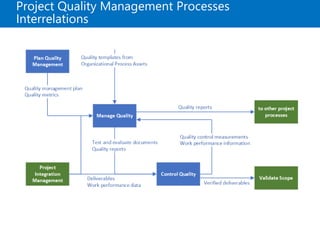
Project Quality Management Processes
Interrelations
Lesson 2: Plan Quality Management
• Plan Quality Management Overview
• Plan Quality Management Data Flow
• Plan Quality Management Input
• Plan Quality Management Tools & Techniques
• Plan Quality Management Output
Plan Quality Management Overview
• The process of identifying quality requirements
and/or standards for the project and its
deliverables, and documenting how the project
will demonstrate compliance with quality
requirements and/or standards. [PMBOK6]
• The process of identifying all relevant organizational or
industry practices, standards, and requirements for the
quality of the project, the product of the project, and the
project management efforts, and then to plan how to meet
those quality standards and requirements. [RITA9]
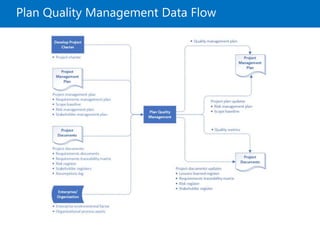
Plan Quality Management Data Flow
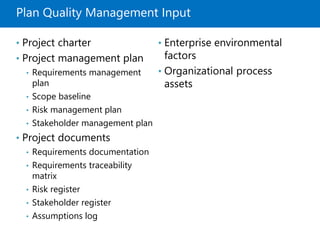
Plan Quality Management Input
• Project charter
• Project management plan
• Requirements management
plan
• Scope baseline
• Risk management plan
• Stakeholder management plan
• Project documents
• Requirements documentation
• Requirements traceability
matrix
• Risk register
• Stakeholder register
• Assumptions log
• Enterprise environmental
factors
• Organizational process
assets
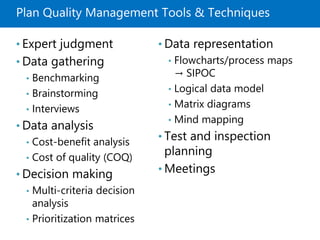
Plan Quality Management Tools & Techniques
• Expert judgment
• Data gathering
• Benchmarking
• Brainstorming
• Interviews
• Data analysis
• Cost-benefit analysis
• Cost of quality (COQ)
• Decision making
• Multi-criteria decision
analysis
• Prioritization matrices
• Data representation
• Flowcharts/process maps
→ SIPOC
• Logical data model
• Matrix diagrams
• Mind mapping
• Test and inspection
planning
• Meetings
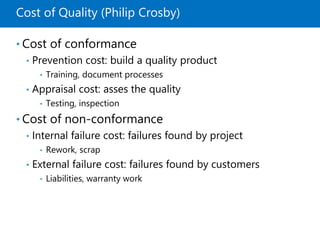
Cost of Quality (Philip Crosby)
• Cost of conformance
• Prevention cost: build a quality product
• Training, document processes
• Appraisal cost: asses the quality
• Testing, inspection
• Cost of non-conformance
• Internal failure cost: failures found by project
• Rework, scrap
• External failure cost: failures found by customers
• Liabilities, warranty work
Marginal Analysis
Analysis focuses on finding the point at which the
benefits or revenue to be received from improving
quality equals the increment cost to achieve that
quality.
Plan Quality Management Output
• Quality management plan
• Quality metrics
• Project management plan updates
• Risk management plan
• Stakeholder management plan
• Project documents updates
• Lessons learned register
• Requirements traceability matrix
• Risk register
• Stakeholder register
Lesson 3: Manage Quality
• Manage Quality Overview
• Manage Quality Data Flow
• Manage Quality Input
• Manage Quality Tools & Techniques
• Manage Quality Outputs
Manage Quality Overview
• The process of transforming quality management
plan into executable quality activities that
incorporate organization’s quality policies into the
project.
• Sometimes is called Quality Assurance → using project
processes effectively
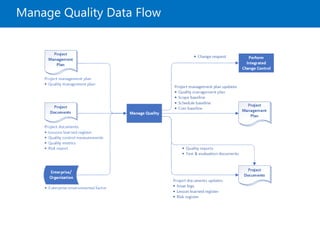
Manage Quality Data Flow
Manage Quality Input
• Project management plan
• Quality management plan
• Project documents
• Lessons learned register
• Quality metrics
• Quality control measurements
• Risk report
• Organizational process assets
Manage Quality Tools & Techniques
• Data gathering
• Checklists
• Data analysis
• Alternative analysis
• Document analysis
• Process analysis
• Root cause analysis
• Decision making
• Multicriteria decision
analysis
• Prioritization matrix
• Data representation
• Affinity diagrams
• Cause-end-effect
diagrams (fishbone,
Ishikawa, why-why)
• Flowcharts
• Histograms
• Matrix diagrams
• Scatter diagrams
Manage Quality Tools & Techniques (continued)
• Audits
• Design for X (DfX)
• Problem solving
• Quality improvement methods
• Plan-do-check-act (PDCA)
• Six sigma
Design of Experiments (DOE)
• A technique that can be used to analyze
alternatives.
• Allows to systematically change important factors
in a process to see which combinations have an
optimal impact on the project deliverables.
• Example: determining combination of materials,
structure, and construction to product the
highest-quality product.
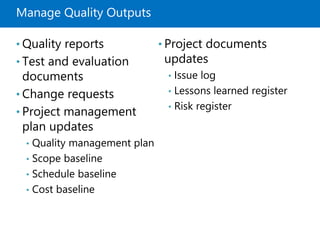
Manage Quality Outputs
• Quality reports
• Test and evaluation
documents
• Change requests
• Project management
plan updates
• Quality management plan
• Scope baseline
• Schedule baseline
• Cost baseline
• Project documents
updates
• Issue log
• Lessons learned register
• Risk register
Lesson 4: Control Quality
• Control Quality Overview
• Control Quality Data Flow
• Control Quality Input
• Control Quality Tools & Techniques
• Control Quality Output
Control Quality Overview
• The process of monitoring and recording results
of executing the quality management activities in
order to assess performance and ensure the
project outputs are complete, correct, and meet
customer expectations. [PMBOK6]
• The process of ensuring a certain level of quality in a
deliverable, whether it be a product, service, or result.
[RITA9]
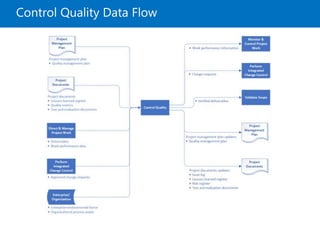
Control Quality Data Flow
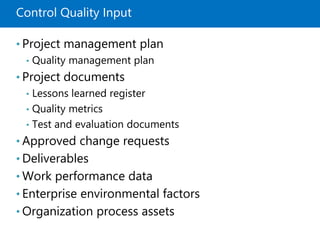
Control Quality Input
• Project management plan
• Quality management plan
• Project documents
• Lessons learned register
• Quality metrics
• Test and evaluation documents
• Approved change requests
• Deliverables
• Work performance data
• Enterprise environmental factors
• Organization process assets
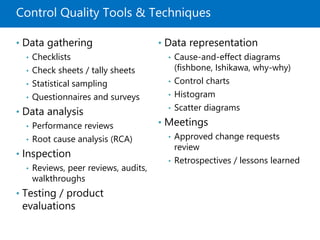
Control Quality Tools & Techniques
• Data gathering
• Checklists
• Check sheets / tally sheets
• Statistical sampling
• Questionnaires and surveys
• Data analysis
• Performance reviews
• Root cause analysis (RCA)
• Inspection
• Reviews, peer reviews, audits,
walkthroughs
• Testing / product
evaluations
• Data representation
• Cause-and-effect diagrams
(fishbone, Ishikawa, why-why)
• Control charts
• Histogram
• Scatter diagrams
• Meetings
• Approved change requests
review
• Retrospectives / lessons learned
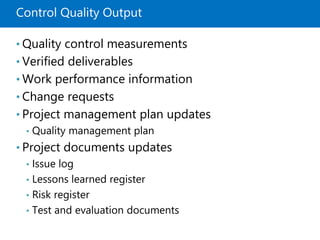
Control Quality Output
• Quality control measurements
• Verified deliverables
• Work performance information
• Change requests
• Project management plan updates
• Quality management plan
• Project documents updates
• Issue log
• Lessons learned register
• Risk register
• Test and evaluation documents
Quiz
Module Reviews
References
• [PMBOK6] – The PMBOK 6th edition from pmi.org
• [RITA9] – Rita Mulcahy’s PMP Exam Prep 9th
edition from RMC Publications™
• [ISO8402] –
https://www.iso.org/standard/20115.html

Project Quality Management - PMBOK6

  • 1.
    Module 8 Project QualityManagement Agus Suhanto
  • 2.
    Module Overview • Lesson1: Key Concepts & Terms • Lesson 2: Plan Quality Management • Lesson 3: Manage Quality • Lesson 4: Control Quality
  • 3.
    Lesson 1: KeyConcepts & Terms • Definition of Quality • Project Quality Management • Quality, Grade, & Gold Plating • Prevention & Inspection • Attribute Sampling & Variable Sampling • Tolerances & Control Limits • Trend Analysis • Trends & Emerging Practices • Tailoring Considerations • Considerations for Adaptive Environment • Project Quality Management Processes Interrelations
  • 4.
    Definition of Quality •Quality is • the totality of characteristics of an entity that bears on its ability to satisfy stated or implied needs. [ISO8402] • the degree to which the project fulfills requirements. [PMBOK6 / ISO9000]
  • 5.
    Project Quality Management Theprocesses for incorporating the organization’s quality policy regarding planning, managing, and controlling project and product quality requirements in order to meet stakeholders’ objectives.
  • 6.
    Quality, Grade, &Gold Plating • Quality ≠ Grade • Grade is a category assigned to deliverables having the same functional use but different technical characteristics. • Low-grade product of high quality is OK. • High-grade product of low quality is NOT OK. • Gold plating is giving the customer extras.
  • 7.
    Prevention & Inspection •Prevention means keeping errors out of the process. • Inspection means keeping errors out of the customers’ hands.
  • 8.
    Attribute Sampling &Variable Sampling • Attribute sampling means the result either conform or does not conform. • Variable sampling means the result is rated on a continuous scale that measures the degree of conformity.
  • 9.
    Tolerances & ControlLimits • Tolerances means specified range of acceptable results. • Control limits means identify the boundaries of common variation in a statistically stable process or process performance.
  • 10.
    Trend Analysis • Trendanalysis is the science of analyzing past results to predict future performance.
  • 11.
    Trends & EmergingPractices • Customer satisfaction • Continual improvement • Plan-do-check-act (PDCA) by Shewhart / Deming • Total Quality Management (TQM) • Six Sigma • Lean Six Sigma • Management responsibility • Mutually beneficial partnership with suppliers
  • 12.
    Tailoring Considerations • Policycompliance & auditing • Standards & regulatory compliance • Continuous improvements • Stakeholder engagement
  • 13.
    Considerations for AdaptiveEnvironment • Quality & review steps are built-in throughout the project. • Checking the effectiveness of quality processes is done in recurring retrospectives.
  • 14.
    Project Quality ManagementProcesses Interrelations
  • 15.
    Lesson 2: PlanQuality Management • Plan Quality Management Overview • Plan Quality Management Data Flow • Plan Quality Management Input • Plan Quality Management Tools & Techniques • Plan Quality Management Output
  • 16.
    Plan Quality ManagementOverview • The process of identifying quality requirements and/or standards for the project and its deliverables, and documenting how the project will demonstrate compliance with quality requirements and/or standards. [PMBOK6] • The process of identifying all relevant organizational or industry practices, standards, and requirements for the quality of the project, the product of the project, and the project management efforts, and then to plan how to meet those quality standards and requirements. [RITA9]
  • 17.
  • 18.
    Plan Quality ManagementInput • Project charter • Project management plan • Requirements management plan • Scope baseline • Risk management plan • Stakeholder management plan • Project documents • Requirements documentation • Requirements traceability matrix • Risk register • Stakeholder register • Assumptions log • Enterprise environmental factors • Organizational process assets
  • 19.
    Plan Quality ManagementTools & Techniques • Expert judgment • Data gathering • Benchmarking • Brainstorming • Interviews • Data analysis • Cost-benefit analysis • Cost of quality (COQ) • Decision making • Multi-criteria decision analysis • Prioritization matrices • Data representation • Flowcharts/process maps → SIPOC • Logical data model • Matrix diagrams • Mind mapping • Test and inspection planning • Meetings
  • 20.
    Cost of Quality(Philip Crosby) • Cost of conformance • Prevention cost: build a quality product • Training, document processes • Appraisal cost: asses the quality • Testing, inspection • Cost of non-conformance • Internal failure cost: failures found by project • Rework, scrap • External failure cost: failures found by customers • Liabilities, warranty work
  • 21.
    Marginal Analysis Analysis focuseson finding the point at which the benefits or revenue to be received from improving quality equals the increment cost to achieve that quality.
  • 22.
    Plan Quality ManagementOutput • Quality management plan • Quality metrics • Project management plan updates • Risk management plan • Stakeholder management plan • Project documents updates • Lessons learned register • Requirements traceability matrix • Risk register • Stakeholder register
  • 23.
    Lesson 3: ManageQuality • Manage Quality Overview • Manage Quality Data Flow • Manage Quality Input • Manage Quality Tools & Techniques • Manage Quality Outputs
  • 24.
    Manage Quality Overview •The process of transforming quality management plan into executable quality activities that incorporate organization’s quality policies into the project. • Sometimes is called Quality Assurance → using project processes effectively
  • 25.
  • 26.
    Manage Quality Input •Project management plan • Quality management plan • Project documents • Lessons learned register • Quality metrics • Quality control measurements • Risk report • Organizational process assets
  • 27.
    Manage Quality Tools& Techniques • Data gathering • Checklists • Data analysis • Alternative analysis • Document analysis • Process analysis • Root cause analysis • Decision making • Multicriteria decision analysis • Prioritization matrix • Data representation • Affinity diagrams • Cause-end-effect diagrams (fishbone, Ishikawa, why-why) • Flowcharts • Histograms • Matrix diagrams • Scatter diagrams
  • 28.
    Manage Quality Tools& Techniques (continued) • Audits • Design for X (DfX) • Problem solving • Quality improvement methods • Plan-do-check-act (PDCA) • Six sigma
  • 29.
    Design of Experiments(DOE) • A technique that can be used to analyze alternatives. • Allows to systematically change important factors in a process to see which combinations have an optimal impact on the project deliverables. • Example: determining combination of materials, structure, and construction to product the highest-quality product.
  • 30.
    Manage Quality Outputs •Quality reports • Test and evaluation documents • Change requests • Project management plan updates • Quality management plan • Scope baseline • Schedule baseline • Cost baseline • Project documents updates • Issue log • Lessons learned register • Risk register
  • 31.
    Lesson 4: ControlQuality • Control Quality Overview • Control Quality Data Flow • Control Quality Input • Control Quality Tools & Techniques • Control Quality Output
  • 32.
    Control Quality Overview •The process of monitoring and recording results of executing the quality management activities in order to assess performance and ensure the project outputs are complete, correct, and meet customer expectations. [PMBOK6] • The process of ensuring a certain level of quality in a deliverable, whether it be a product, service, or result. [RITA9]
  • 33.
  • 34.
    Control Quality Input •Project management plan • Quality management plan • Project documents • Lessons learned register • Quality metrics • Test and evaluation documents • Approved change requests • Deliverables • Work performance data • Enterprise environmental factors • Organization process assets
  • 35.
    Control Quality Tools& Techniques • Data gathering • Checklists • Check sheets / tally sheets • Statistical sampling • Questionnaires and surveys • Data analysis • Performance reviews • Root cause analysis (RCA) • Inspection • Reviews, peer reviews, audits, walkthroughs • Testing / product evaluations • Data representation • Cause-and-effect diagrams (fishbone, Ishikawa, why-why) • Control charts • Histogram • Scatter diagrams • Meetings • Approved change requests review • Retrospectives / lessons learned
  • 36.
    Control Quality Output •Quality control measurements • Verified deliverables • Work performance information • Change requests • Project management plan updates • Quality management plan • Project documents updates • Issue log • Lessons learned register • Risk register • Test and evaluation documents
  • 37.
  • 38.
  • 39.
    References • [PMBOK6] –The PMBOK 6th edition from pmi.org • [RITA9] – Rita Mulcahy’s PMP Exam Prep 9th edition from RMC Publications™ • [ISO8402] – https://www.iso.org/standard/20115.html

Editor's Notes

  • #2 Presentation: 80 minutes Lab: 90 minutes After completing this module, students will be able to: Describe the architectural features of Microsoft SharePoint 2016. Identify new, deprecated, and removed features in SharePoint 2016. Describe the editions for SharePoint 2016 on-premises and Microsoft SharePoint Online. Required materials To teach this module, you need the Microsoft PowerPoint file 20339-2A_01.pptx. Preparation tasks To prepare for this module: Read all of the materials for this module. Practice performing the demonstrations and labs. Work through the Module Review and Takeaways section, and determine how you will use the information to reinforce student learning and promote knowledge transfer to on-the-job performance. As you prepare for this class, it is imperative that you complete the labs yourself. This gives you an understanding of how the labs work and the concepts that each covers, so that you can provide meaningful hints to students who might have issues. Furthermore, it will help guide your lecture to ensure that you discuss the concepts that the labs cover. Ask the students to start 20339-2A-NYC-DC1-A at this point, as per step 1 of the Lab.