1.7 PROJECT
LIFE CYCLES
 A project life cycle refers to the series of phases
that a project goes through from its initiation
through to its closure. Project life cycles are
either predictive or adaptive and may be
sequential, iterative, or overlapping. Within the
project life cycle, there is typically a
development life cycle that consists of phases
that encompass the development of a
product or service.
1.8.1 INITIATING
PROCESS
GROUP
 The Initiating Process Group consists of those
processes performed to define a new project
or a new phase of an existing project by
obtaining authorization to start the project or
phase. Within the Initiating processes, the initial
scope is defined and initial financial resources
are committed. Internal and external
stakeholders who will interact and influence
the overall outcome of the project are
identified.
 The key purpose of this Process Group is to
align the stakeholders’ expectations with the
project’s purpose.
1.8.2 PLANNING
PROCESS
GROUP
 The Planning Process Group consists of those
processes performed to establish the total
scope of the effort, define and refine the
objectives, and develop the course of action
required to attain those objectives. The
Planning processes develop the project
management plan and the project documents
that will be used to carry out the project.
 The key benefit of this Process Group is to
delineate the strategy and tactics as well as
the course of action or path to successfully
complete the project or phase.
1.8.3
EXECUTING
PROCESS
GROUP
 The Executing Process Group consists of those
processes performed to complete the work
defined in the project management plan to
satisfy the project specifications. This Process
Group involves coordinating people and
resources, managing stakeholder
expectations, as well as integrating and
performing the activities of the project in
accordance with the project management
plan.
 A large portion of the project’s budget will be
expended in performing the Executing Process
Group processes.
1.8.4
MONITORING
AND
CONTROLLING
PROCESS
GROUP
 The Monitoring and Controlling Process Group
consists of those processes required to track,
review, and orchestrate the progress and
performance of the project; identify any areas
in which changes to the plan are required;
and initiate the corresponding changes.
 The key benefit of this Process Group is that
project performance is measured and
analyzed at regular intervals, appropriate
events, or exception conditions to identify
variances from the project management plan.
1.8.4
MONITORING
AND
CONTROLLING
PROCESS
GROUP
 Controlling changes and recommending
corrective or preventive action in anticipation
of possible problems,
 Monitoring the ongoing project activities
against the project management plan and the
project performance measurement baseline,
and
 Influencing the factors that could circumvent
integrated change control or configuration
management so only approved changes are
implemented.
1.8.5 CLOSING
PROCESS
GROUP
 The Closing Process Group consists of those
processes performed to conclude all activities
across all Project Management Process Groups
to formally complete the project, phase, or
contractual obligations.
 This Process Group also formally establishes the
premature closure of the project. Prematurely
closed projects may include, for example:
aborted projects, cancelled projects, and
projects having a critical situation.
1.8.5 CLOSING
PROCESS
GROUP
At project or phase closure, the following may
occur:
 Obtain acceptance by the customer or
sponsor to formally close the project or phase,
 Conduct post-project or phase-end review,
 Record impacts of tailoring to any process,
 Document lessons learned,
 Apply appropriate updates to organizational
process assets,
1.8.5 CLOSING
PROCESS
GROUP
 Archive all relevant project documents in the
project management information system
(PMIS) to be used as historical data,
 Close out all procurement activities ensuring
termination of all relevant agreements, and
 Perform team members’ assessments and
release project resources.
1.9 ROLE OF THE
KNOWLEDGE
AREAS
 The 49 project management processes
identified in the PMBOK® Guide are further
grouped into ten separate Knowledge Areas.
A Knowledge Area represents a complete set
of concepts, terms, and activities that make up
a professional field, project management field,
or area of specialization. These ten Knowledge
Areas are used on most projects most of the
time. Project teams should utilize these ten
Knowledge Areas and other Knowledge Areas,
as appropriate, for their specific project.
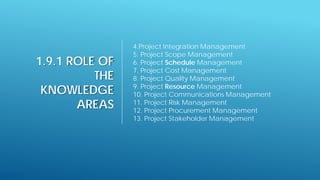
1.9.1 ROLE OF
THE
KNOWLEDGE
AREAS
4.Project Integration Management
5. Project Scope Management
6. Project Schedule Management
7. Project Cost Management
8. Project Quality Management
9. Project Resource Management
10. Project Communications Management
11. Project Risk Management
12. Project Procurement Management
13. Project Stakeholder Management
2.1
ORGANIZATIONAL
CULTURES AND
STYLES
Organizational culture is shaped by the common
experiences of members of the organization and
most organizations have developed unique
cultures over time by practice and common
usage. Common experiences include, but are
not limited to:
 Shared vision, mission, values, beliefs, and
expectations;
 Regulations, policies, methods, and
procedures;
 Motivation and reward systems;
2.1
ORGANIZATIONAL
CULTURES AND
STYLES
 Risk tolerance;
 View of leadership, hierarchy, and authority
relationships;
 Code of conduct, work ethic, and work hours;
and
 Operating environments.
2.2
ORGANIZATIONAL
COMMUNICATIONS
 Stakeholders and project team members can
also use electronic communications (including
e-mail, texting, instant messaging, social
media, video and web conferencing, and
other forms of electronic media) to
communicate with the project manager
formally or informally.
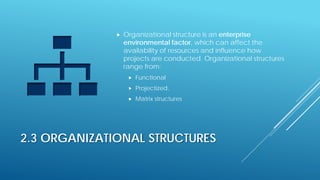
2.3 ORGANIZATIONAL STRUCTURES
 Organizational structure is an enterprise
environmental factor, which can affect the
availability of resources and influence how
projects are conducted. Organizational structures
range from:
 Functional
 Projectized,
 Matrix structures
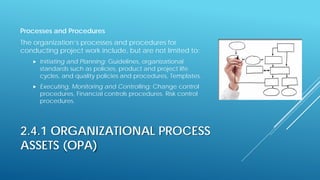
2.4.1 ORGANIZATIONAL PROCESS
ASSETS (OPA)
Processes and Procedures
The organization’s processes and procedures for
conducting project work include, but are not limited to:
 Initiating and Planning: Guidelines, organizational
standards such as policies, product and project life
cycles, and quality policies and procedures, Templates.
 Executing, Monitoring and Controlling: Change control
procedures, Financial controls procedures, Risk control
procedures.
2.5 PROJECT
MANAGEMENT
OFFICE
A project management office (PMO) is a
management structure that standardizes the
project-related governance processes and
facilitates the sharing of resources,
methodologies, tools, and techniques. The
responsibilities of a PMO can range from
providing project management support functions
to actually being responsible for the direct
management of one or more projects.
2.5 PROJECT
MANAGEMENT
OFFICE
There are several types of PMO structures in
organizations, each varying in the degree of
control and influence they have on projects
within the organization, such as:
 Supportive. Provide a consultative role to
projects by supplying templates, best
practices, training, access to information and
lessons learned from other projects. This type of
PMO serves as a project repository. The degree
of control provided by the PMO is low.
2.5 PROJECT
MANAGEMENT
OFFICE
 Controlling. Controlling PMOs provide support
and require compliance through various
means. Compliance may involve adopting
project management frameworks or
methodologies, using specific templates, forms
and tools, or conformance to governance. The
degree of control provided by the PMO is
moderate.
 Directive. Directive PMOs take control of the
projects by directly managing the projects. The
degree of control provided by the PMO is high.
3 ROLE OF THE
PROJECT
MANAGER
3.1 Competencies of the Project Manager
 Knowledge—Refers to what the project
manager knows about project management.
 Performance—Refers to what the project
manager is able to do or accomplish while
applying his or her project management
knowledge.
 Personal—Refers to how the project manager
behaves when performing the project or
related activity. Personal effectiveness
encompasses attitudes, core personality
characteristics, and leadership, which provides
the ability to guide the project team while
achieving project objectives and balancing
the project constraints.
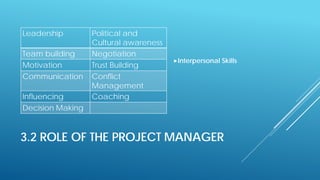
3.2 ROLE OF THE PROJECT MANAGER
Interpersonal Skills
Leadership Political and
Cultural awareness
Team building Negotiation
Motivation Trust Building
Communication Conflict
Management
Influencing Coaching
Decision Making
3.4 PROJECT STAKEHOLDERS
Project Stakeholders
• Sponsor
• Customers and users
• Sellers
• Business partners
• Organizational groups
• Functional managers
• Other stakeholders
3.5 PROJECT TEAM
• Project management staff
• Project staff
• Supporting experts
• User or Customer Representatives
• Sellers
• Business partner members
• Business partners
3.5 PROJECT
TEAM
3.5.1 Composition of Project Teams
 Dedicated. In a dedicated team, all or a
majority of the project team members are
assigned to work full-time on the project.
 Part-Time. Some projects are established as
temporary additional work, with the project
manager and team members working on the
project while remaining in their existing
organizations and continuing to carry out their
normal functions.
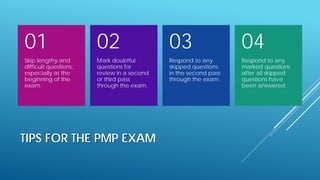
TIPS FOR THE PMP EXAM
Skip lengthy and
difficult questions,
especially at the
beginning of the
exam.
01
Mark doubtful
questions for
review in a second
or third pass
through the exam.
02
Respond to any
skipped questions
in the second pass
through the exam.
03
Respond to any
marked questions
after all skipped
questions have
been answered.
04
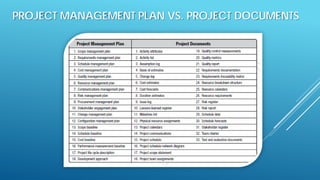
PROJECT MANAGEMENT PLAN VS. PROJECT DOCUMENTS
WHAT IS GOLD PLATING?
Gold plating refers to the addition of any feature not considered in
the original scope plan at any point of the project since it
introduces a new source of risks to the original planning i.e.
additional testing, documentation, costs, timelines, etc.
Gold Plating is thinking to make our customers happy but
according PMI as PM we need to avoid the Gold Plating because
this will increase our customers expectations.
5.4.3 CREATE
WBS: OUTPUTS
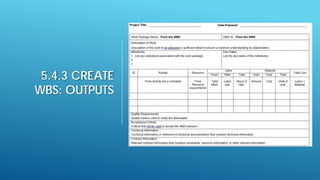
WBS Dictionary:
Code of account identifier, Description of work,
Assumptions and constraints, Responsible
organization, Schedule milestones, Associated
schedule activities, Resources required, Cost
estimates, Quality requirements, Acceptance
criteria, Technical references, and Agreement
information.
5.4.3 CREATE
WBS: OUTPUTS
5.5.2 VALIDATE SCOPE: TOOLS AND
TECHNIQUES
1. Inspection
Inspection includes activities such as
measuring, examining, and validating to
determine whether work and
deliverables meet requirements and
product acceptance criteria.
2. Decision Making (Voting)
5.6.1
CONTROL
SCOPE: INPUTS
1. Project Management Plan
 Scope baseline, Scope
management plan, Change
management plan, Configuration
management plan, Requirements
management plan.
2. Project Documents (Lessons Learned,
Requirements, Requirements Matrix)
3. Work Performance Data
4. Organizational Process Assets
5.6.2 CONTROL
SCOPE: TOOLS
AND
TECHNIQUES
1. Data Analysis (Variance Analysis)
Variance analysis is a technique for determining
the cause and degree of difference between
the baseline and actual performance. Project
performance measurements are used to assess
the magnitude of variation from the original
scope baseline. Important aspects of project
scope control include determining the cause
and degree of variance relative to the scope
baseline and deciding whether corrective or
preventive action is required.
AGILE
CONCEPTS FOR
SCOPE
MANAGEMENT
 Product Backlog: It is a list of all functional and
nonfunctional work identified for the project. It
is a list of the work that needs to be done, the
items are removed from the list as they are
completed. Sprint Backlog is a subset of the
Product Backlog, there you can find the items
to be complete in the coming sprint.
 Product Owner: The Product Owner is the
responsible for developing the Backlog and
prioritize all the backlog items based on the
business value for the organization.
6.1.3 PLAN SCHEDULE
MANAGEMENT: OUTPUTS
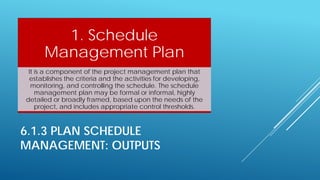
1. Schedule
Management Plan
It is a component of the project management plan that
establishes the criteria and the activities for developing,
monitoring, and controlling the schedule. The schedule
management plan may be formal or informal, highly
detailed or broadly framed, based upon the needs of the
project, and includes appropriate control thresholds.
6.2.2 DEFINE
ACTIVITIES:
TOOLS AND
TECHNIQUES
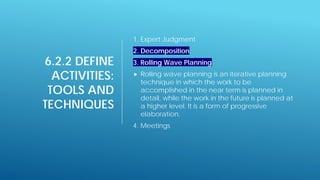
1. Expert Judgment
2. Decomposition
3. Rolling Wave Planning
 Rolling wave planning is an iterative planning
technique in which the work to be
accomplished in the near term is planned in
detail, while the work in the future is planned at
a higher level. It is a form of progressive
elaboration.
4. Meetings
6.2.3 DEFINE
ACTIVITIES:
OUTPUTS
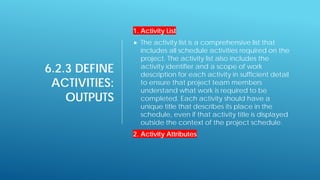
1. Activity List
 The activity list is a comprehensive list that
includes all schedule activities required on the
project. The activity list also includes the
activity identifier and a scope of work
description for each activity in sufficient detail
to ensure that project team members
understand what work is required to be
completed. Each activity should have a
unique title that describes its place in the
schedule, even if that activity title is displayed
outside the context of the project schedule.
2. Activity Attributes
6.2.3 DEFINE
ACTIVITIES:
OUTPUTS
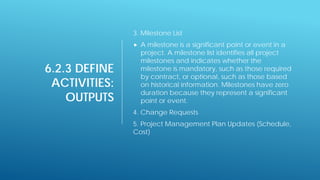
3. Milestone List
 A milestone is a significant point or event in a
project. A milestone list identifies all project
milestones and indicates whether the
milestone is mandatory, such as those required
by contract, or optional, such as those based
on historical information. Milestones have zero
duration because they represent a significant
point or event.
4. Change Requests
5. Project Management Plan Updates (Schedule,
Cost)
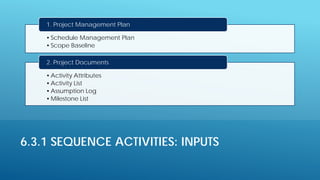
6.3.1 SEQUENCE ACTIVITIES: INPUTS
•Schedule Management Plan
•Scope Baseline
1. Project Management Plan
•Activity Attributes
•Activity List
•Assumption Log
•Milestone List
2. Project Documents
6.3.2 SEQUENCE
ACTIVITIES:
TOOLS AND
TECHNIQUES
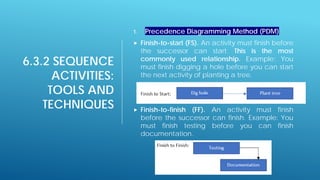
1. Precedence Diagramming Method (PDM)
 Finish-to-start (FS). An activity must finish before
the successor can start. This is the most
commonly used relationship. Example: You
must finish digging a hole before you can start
the next activity of planting a tree.
 Finish-to-finish (FF). An activity must finish
before the successor can finish. Example: You
must finish testing before you can finish
documentation.
6.3.2 SEQUENCE
ACTIVITIES:
TOOLS AND
TECHNIQUES
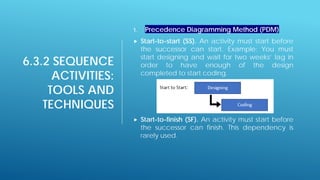
1. Precedence Diagramming Method (PDM)
 Start-to-start (SS). An activity must start before
the successor can start. Example: You must
start designing and wait for two weeks’ lag in
order to have enough of the design
completed to start coding.
 Start-to-finish (SF). An activity must start before
the successor can finish. This dependency is
rarely used.
6.3.2 SEQUENCE
ACTIVITIES:
TOOLS AND
TECHNIQUES
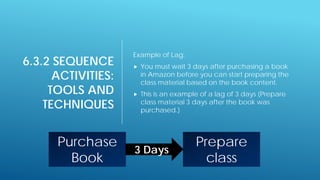
Example of Lag:
 You must wait 3 days after purchasing a book
in Amazon before you can start preparing the
class material based on the book content.
 This is an example of a lag of 3 days (Prepare
class material 3 days after the book was
purchased.)
Purchase
Book
Prepare
class
3 Days
6.3.2 SEQUENCE
ACTIVITIES:
TOOLS AND
TECHNIQUES
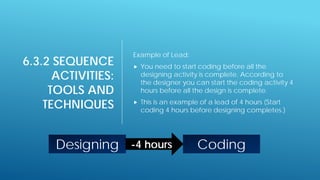
Example of Lead:
 You need to start coding before all the
designing activity is complete. According to
the designer you can start the coding activity 4
hours before all the design is complete.
 This is an example of a lead of 4 hours (Start
coding 4 hours before designing completes.)
Designing Coding
-4 hours
6.4.3 ESTIMATE ACTIVITY DURATIONS:
TOOLS AND TECHNIQUES
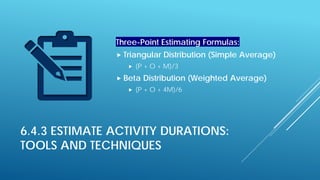
Three-Point Estimating Formulas:
 Triangular Distribution (Simple Average)
 (P + O + M)/3
 Beta Distribution (Weighted Average)
 (P + O + 4M)/6
6.4.3 ESTIMATE ACTIVITY DURATIONS:
TOOLS AND TECHNIQUES
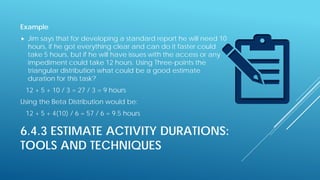
Example
 Jim says that for developing a standard report he will need 10
hours, if he got everything clear and can do it faster could
take 5 hours, but if he will have issues with the access or any
impediment could take 12 hours. Using Three-points the
triangular distribution what could be a good estimate
duration for this task?
12 + 5 + 10 / 3 = 27 / 3 = 9 hours
Using the Beta Distribution would be:
12 + 5 + 4(10) / 6 = 57 / 6 = 9.5 hours
6.4.3 ESTIMATE ACTIVITY DURATIONS:
TOOLS AND TECHNIQUES - AGILE
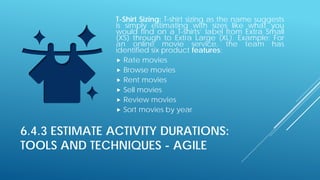
T-Shirt Sizing: T-shirt sizing as the name suggests
is simply estimating with sizes like what you
would find on a T-shirts’ label from Extra Small
(XS) through to Extra Large (XL). Example: For
an online movie service, the team has
identified six product features:
 Rate movies
 Browse movies
 Rent movies
 Sell movies
 Review movies
 Sort movies by year
PLANNING
POKER
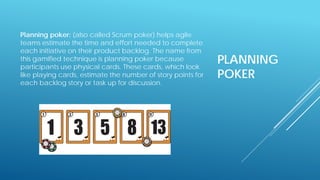
Planning poker: (also called Scrum poker) helps agile
teams estimate the time and effort needed to complete
each initiative on their product backlog. The name from
this gamified technique is planning poker because
participants use physical cards. These cards, which look
like playing cards, estimate the number of story points for
each backlog story or task up for discussion.
6.4.3 ESTIMATE ACTIVITY DURATIONS:
OUTPUTS
1. Duration Estimates
 Activity duration estimates may include some indication of
the range of possible results. For example:
 2 weeks +- 2 days, which indicates that the activity will take at
least eight days and not more than twelve (assuming a five-
day workweek); and
 15 % probability of exceeding three weeks, which indicates a
high probability—85 %—that the activity will take three weeks
or less.
2. Basis of Estimates (The amount and type of additional details
supporting the duration estimate vary by application area.)
3. Project Documents Updates (Activity Attributes, Assumption
Log, Lessons Learned Register)
6.5.2 DEVELOP SCHEDULE: TOOLS AND
TECHNIQUES
1. Schedule Network Analysis
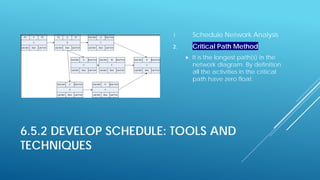
2. Critical Path Method
 It is the longest path(s) in the
network diagram. By definition
all the activities in the critical
path have zero float.
6.5.2 DEVELOP
SCHEDULE:
TOOLS AND
TECHNIQUES
Resource Optimization Techniques
 Resource Smoothing. It is a modified form of
resource leveling, where resources are leveled
only within the limits of the float of their
activities, so the completion dates of activities
are not delayed.
6.5.2 DEVELOP
SCHEDULE:
TOOLS AND
TECHNIQUES
Data Analysis
 What-If Scenario Analysis. Is the process of
evaluating scenarios in order to predict their
effect, positively or negatively, on project
objectives. This is an analysis of the question,
“What if the situation represented by scenario
‘X’ happens?” A schedule network analysis is
performed using the schedule to compute the
different scenarios, such as delaying a major
component delivery, extending specific
engineering durations, or introducing external
factors, such as a strike or a change in the
permitting process.
6.5.2 DEVELOP
SCHEDULE:
TOOLS AND
TECHNIQUES
Data Analysis
 Simulation. Monte Carlo Analysis is the most
popular simulation technique. This uses
computer software to simulate the outcome of
a project, based on the three-point estimates
(optimistic, pessimistic, and most likely) for
each activity and the network diagram. The
simulation can tell you:
 The probability of completing the project on
any specific day.
 The probability of completing the project for
any specific cost.
 The probability of any activity being on the
critical path.
 An indication of the overall project risk.
7.1.3 PLAN COST
MANAGEMENT:
OUTPUTS
1. Cost
Management Plan
The cost management plan is a component
of the project management plan and
describes how the project costs will be
planned, structured, and controlled. The cost
management processes and their associated
tools and techniques are documented in the
cost management plan.
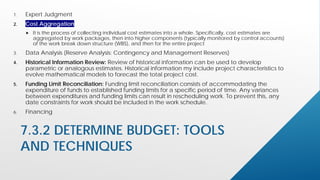
7.3.2 DETERMINE BUDGET: TOOLS
AND TECHNIQUES
1. Expert Judgment
2. Cost Aggregation
 It is the process of collecting individual cost estimates into a whole. Specifically, cost estimates are
aggregated by work packages, then into higher components (typically monitored by control accounts)
of the work break down structure (WBS), and then for the entire project.
3. Data Analysis (Reserve Analysis: Contingency and Management Reserves)
4. Historical Information Review: Review of historical information can be used to develop
parametric or analogous estimates. Historical information my include project characteristics to
evolve mathematical models to forecast the total project cost.
5. Funding Limit Reconciliation: Funding limit reconciliation consists of accommodating the
expenditure of funds to established funding limits for a specific period of time. Any variances
between expenditures and funding limits can result in rescheduling work. To prevent this, any
date constraints for work should be included in the work schedule.
6. Financing
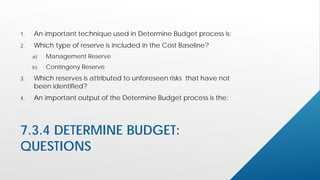
7.3.4 DETERMINE BUDGET:
QUESTIONS
1. An important technique used in Determine Budget process is:
2. Which type of reserve is included in the Cost Baseline?
a) Management Reserve
b) Contingeny Reserve
3. Which reserves is attributed to unforeseen risks that have not
been identified?
4. An important output of the Determine Budget process is the:
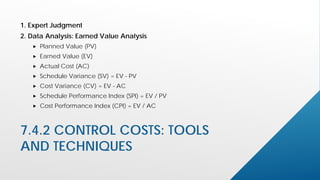
7.4.2 CONTROL COSTS: TOOLS
AND TECHNIQUES
1. Expert Judgment
2. Data Analysis: Earned Value Analysis
 Planned Value (PV)
 Earned Value (EV)
 Actual Cost (AC)
 Schedule Variance (SV) = EV - PV
 Cost Variance (CV) = EV - AC
 Schedule Performance Index (SPI) = EV / PV
 Cost Performance Index (CPI) = EV / AC
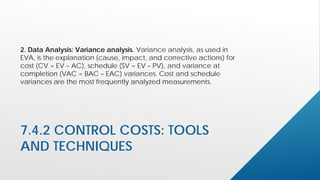
7.4.2 CONTROL COSTS: TOOLS
AND TECHNIQUES
2. Data Analysis: Variance analysis. Variance analysis, as used in
EVA, is the explanation (cause, impact, and corrective actions) for
cost (CV = EV – AC), schedule (SV = EV – PV), and variance at
completion (VAC = BAC – EAC) variances. Cost and schedule
variances are the most frequently analyzed measurements.
7.4.2 CONTROL COSTS: TOOLS
AND TECHNIQUES
2. Data Analysis: Forecasting
 EAC forecast for ETC work performed at the budgeted rate.
 Equation: EAC = AC + (BAC – EV)
 EAC forecast for ETC work performed at the present CPI.
 Equation: EAC = BAC / CPI
 EAC forecast for ETC work considering both SPI and CPI factors.
 Equation: EAC = AC + [(BAC – EV) / (CPI × SPI)]
7.4.2 CONTROL COSTS: TOOLS
AND TECHNIQUES
2. Data Analysis: Reserve Analysis
 During cost control, reserve analysis is used to monitor the status
of contingency and management reserves for the project to
determine if these reserves are still needed or if additional
reserves need to be requested.
7.4.2 CONTROL COSTS: TOOLS
AND TECHNIQUES
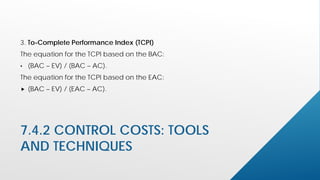
3. To-Complete Performance Index (TCPI)
The equation for the TCPI based on the BAC:
• (BAC – EV) / (BAC – AC).
The equation for the TCPI based on the EAC:
 (BAC – EV) / (EAC – AC).
QUALITY
Quality is the degree to which a set of inherent
characteristics fulfills requirements.
A project is said to meet quality expectations, when
all the project requirements agreed in the
beginning of the project are met, and the resulting
product is usable.
CONCEPTS RELATED TO
QUALITY
 Prevention over Inspection
 Is it better to inspect work to find problems or to
prevent them in the first place? Which takes less effort
and is less costly? Remember that quality must be
planned in, not inspected in! The concept of
prevention over inspection was advocated by quality
theorist Philip Crosby. You may see exam questions
that test your understanding that failure to plan
quality into a project will lead to problems later in the
project.
8.2.2 MANAGE
QUALITY: TOOLS
AND
TECHNIQUES
5. Audits
 Quality Audit is a structured, independent
process to determine if project activities
comply with organizational and project
policies, processes, and procedures. Quality
Audits are typically performed by individuals
outside of the project, such as internal or
external auditors.
6. Design for X (DfX)
 Includes a set of technical guidelines applied
during design of a product to optimize a
specific design aspect (e.g. reliability,
assembly, usability, safety).
9.4.2 DEVELOP TEAM: TOOLS AND TECHNIQUES
Tuckman Ladder
 Forming. This phase is where the team members meet and learn about the
project and their formal roles and responsibilities. Team members tend to be
independent and not as open in this phase.
 Storming. During this phase, the team begins to address the project work,
technical decisions, and the project management approach. If team members
are not collaborative or open to differing ideas and perspectives, the
environment can become counterproductive.
 Norming. In this phase, team members begin to work together and adjust their
work habits and behaviors to support the team. The team members learn to trust
each other.
 Performing. Teams that reach the performing stage function as a well-organized
unit. They are interdependent and work through issues smoothly and effectively.
 Adjourning. In this phase, the team completes the work and moves on from the
project. This typically occurs when staff is released from the project as deliverables
are completed or as part of the Close Project or Phase process.
9.4.2 DEVELOP TEAM: TOOLS AND TECHNIQUES
Shu-Ha-Ri Model of Skill Mastery
Shuhari is a Japanese martial art concept which describes
the stages of learning to mastery.
Shu - Follow the rules, obeying the rules to keep or
maintain.
Ha - Move away from the rules, to detach or break free.
Ri - Unconsciously finding an individual path, means to go
beyond or transcend.
Shu ha ri is roughly translated to “first learn, then detach,
and finally, transcend.”
9.5.2 MANAGE TEAM: TOOLS AND TECHNIQUES
Conflict Management:
 Withdraw/avoid. Retreating from an actual or potential conflict situation; postponing the
issue to be better prepared or to be resolved by others. This is referred to as a Lose-Leave
situation.
 Smooth/accommodate. Emphasizing areas of agreement rather than areas of difference;
conceding one’s position to the needs of others to maintain harmony and relationships.
This is referred to as a Lose-Yield situation
 Compromise/reconcile. Searching for solutions that bring some degree of satisfaction to
all parties in order to temporarily or partially resolve the conflict. This approach
occasionally results in a Lose-Lose situation.
 Force/direct. Pushing one’s viewpoint at the expense of others; offering only win-lose
solutions, usually enforced through a power position to resolve an emergency. This
approach often results to a Win-Lose situation.
 Collaborate/problem solve. Incorporating multiple viewpoints and insights from differing
perspectives; requires a cooperative attitude and open dialogue that typically leads to
consensus and commitment. This approach can result in a Win-Win situation.
9.5.2 MANAGE TEAM: TOOLS AND TECHNIQUES
Management and leadership styles:
Some of the primary styles are:
Directing
Facilitating
Coaching
Supporting
Influencing
Delegating
Servant
9.5.2 MANAGE TEAM: TOOLS AND TECHNIQUES
Management and leadership styles:
The following ones are effective when the team is dealing with
issues such as resolving conflicts, negotiating, prioritizing, or other
decision-making activities:
Consultative
Consensus
Democratic or participative
Bureaucratic
Analytical
9.5.2 MANAGE TEAM: TOOLS AND TECHNIQUES
Management and leadership styles:
These ones are additional styles based on some challenging
situations:
Charismatic
Autocratic
Consultative-autocratic
Laissez-faire
Driver
9.5.2 MANAGE TEAM: TOOLS AND TECHNIQUES
Powers of the Project Manager
One of the major difficulties for a project manager is getting people to
cooperate and perform. This is a major issue in a matrix organization. The
different types of power for the project managers include:
 Formal (legitimate): This power is based on the position of the project
manager
 Reward: This power stems from giving rewards
 Penalty (Coercive): This power comes from the ability to penalize team
members
 Expert: This power comes from being the technical expert or even the
project management expert
 Referent: Referent is the power of charisma and fame. This power comes
from another person liking the project manager, respecting him, or
wanting to be like him.
10. COMMUNICATIONS MANAGEMENT: KEY
CONCEPTS
Communication is the exchange of information, intended or involuntary. The
information exchanged can be in the form of ideas, instructions, or emotions. The
mechanisms by which information is exchanged can be in:
 Written form. Either physical or electronic.
 Spoken. Either face-to-face or remote.
 Formal or informal (as in formal papers or social media).
 Through gestures. Tone of voice and facial expressions.
 Through media. Pictures, actions, or even just the choice of words.
 Choice of words. There is often more than one word to express an idea; there can
be subtle differences in the meaning of each of these words and phrases.
10. COMMUNICATIONS MANAGEMENT: KEY
CONCEPTS
Communication activities have many dimensions, including but not limited to:
 Internal. Focus on stakeholders within the project and within the organization.
 External. Focus on external stakeholders such as customers, vendors, other
projects, organizations, government, the public, and environmental advocates.
 Formal. Reports, formal meetings (both regular and ad hoc), meeting agendas
and minutes, stakeholder briefings, and presentations.
 Informal. General communications activities using emails, social media, websites,
and informal ad hoc discussions.
10. COMMUNICATIONS MANAGEMENT: KEY
CONCEPTS
 Hierarchical focus. The position of the stakeholder or group with respect to the
project team will affect the format and content of the message, in the following
ways:
 Upward. Senior management stakeholders.
 Downward. The team and others who will contribute to the work of the project.
 Horizontal. Peers of the project manager or team.
 Official. Annual reports; reports to regulators or government bodies.
 Unofficial. Communications that focus on establishing and maintaining the profile
and recognition of the project and building strong relationships between the
project team and its stakeholders using flexible and often informal means.
 Written and oral. Verbal (words and voice inflections) and nonverbal (body
language and actions), social media and websites, media releases
10.1 PLAN
COMMUNICATIONS
MANAGEMENT
Important considerations that may need to be
taken into account include, but are not limited
to:
 Who needs what information, and who is
authorized to access that information;
 When they will need the information;
 Where the information should be stored;
 What format the information should be stored
in;
 How the information can be retrieved; and
 Whether time zone, language barriers, and
cross-cultural considerations need to be taken
into account.
10.2.2 MANAGE COMMUNICATIONS:
TOOLS AND TECHNIQUES
Types of Reports
 Status report: This report describes where the project currently stands in relation to
the performance measurement baseline.
 Progress report: A progress report describes what has been accomplished.
 Trend report: This report examines project results over time to see if performance is
improving or deteriorating.
 Forecasting report: This report predicts future project status and performance.
 Variance report: A variance report compares actual results to baselines.
 Earned value report: An earned value report integrates scope, cost, and
Schedule measurements to assess project performance.
10.2.2 MANAGE COMMUNICATIONS:
TOOLS AND TECHNIQUES
Types of Reports
 Progress metrics: Reports such as Cumulative Flow Diagrams and
burnup charts are used to assess performance.
 Retrospective findings: This report is used to inspect, adapt, and
improve projects and team performance.
 Lessons learned: Lessons learned report of performance and may
be used for future projects.
10.2.2 MANAGE COMMUNICATIONS:
TOOLS AND TECHNIQUES
Interpersonal and Team Skills
 Active Listening
 Conflict Management
 Cultural awareness
 Meeting Management
 Networking
 Political awareness
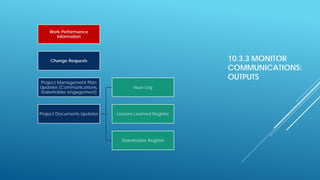
10.3.3 MONITOR
COMMUNICATIONS:
OUTPUTS
Work Performance
Information
Change Requests
Project Management Plan
Updates (Communications,
Stakeholder engagement)
Project Documents Updates
Issue Log
Lessons Learned Register
Stakeholder Register
11. RISK MANAGEMENT: KEY CONCEPTS
According to the PMBOK® Guide, once a negative risk event occurs, it's considered an issue and is no
longer a risk.
 Risk attitude consists of three elements:
 Risk appetite is the level of uncertainty the stakeholders are willing to accept in exchange for
the potential positive impacts of the risk.
 Risk tolerance is that balance where stakeholders are comfortable taking a risk because the
known benefits to be gained outweigh what could be lost—or just the opposite.
 Risk thresholds are measures or levels of uncertainty or impact the organization is willing to
operate within.
 Risk Trigger: An event, condition, or something that generate the occurrence of a risk. They are
warning signs or symptoms that a risk event is about to occur.
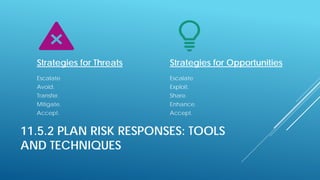
11.5.2 PLAN RISK RESPONSES: TOOLS
AND TECHNIQUES
Strategies for Threats
Escalate
Avoid.
Transfer.
Mitigate.
Accept.
Strategies for Opportunities
Escalate
Exploit.
Share.
Enhance.
Accept.
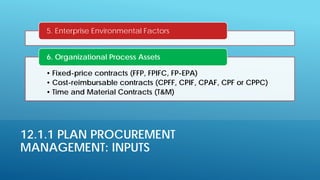
12.1.1 PLAN PROCUREMENT
MANAGEMENT: INPUTS
5. Enterprise Environmental Factors
• Fixed-price contracts (FFP, FPIFC, FP-EPA)
• Cost-reimbursable contracts (CPFF, CPIF, CPAF, CPF or CPPC)
• Time and Material Contracts (T&M)
6. Organizational Process Assets
12.1.1 PLAN PROCUREMENT
MANAGEMENT: INPUTS
Contract Types (Fixed-Price):
 Firm Fixed Price Contracts (FFP). Most commonly used. Cost
increase due performance is responsibility of the seller.
 Fixed Price Incentive Fee Contracts (FPIF). Gives the buyer and
seller some flexibility in that it allows for deviation from
performance
 Fixed Price with Economic Price Adjustment Contracts (FP-EPA),
considered for big projects that last many years and factors like
inflation or cost increases or decreases affect the project. The FP-
EPA contract is intended to protect both buyer and seller from
external conditions beyond their control
12.1.1 PLAN PROCUREMENT
MANAGEMENT: INPUTS
Contract Types (Cost-Reimbursable):
 Cost Plus Fixed Fee Contracts (CPFF). The seller is reimbursed for all allowable costs for
performing the contract work and receives a fixed-fee payment calculated as a
percentage of the initial estimated project costs.
 Cost Plus Incentive Fee Contracts (CPIF). The seller is reimbursed for all allowable costs for
performing the contract work and receives a predetermined incentive fee based upon
achieving certain performance objectives as set forth in the contract.
 Cost Plus Award Fee Contracts (CPAF). The seller is reimbursed for all legitimate costs, but
the majority of the fee is earned only based on the satisfaction of certain broad subjective
performance criteria defined and incorporated into the contract.
 Cost Plus Fee (CPF) or Cost-Plus Percentage of Costs (CPPC). It requires the buyer to pay for
all costs plus a percentage of costs as a fee.
12.1.1 PLAN PROCUREMENT
MANAGEMENT: INPUTS
Contract Types (T&M):
 Time and material contracts (T&M). Time and material contracts
(also called time and means) are a hybrid type of contractual
arrangement with aspects of both cost-reimbursable and fixed-
price contracts. They are often used for staff augmentation,
acquisition of experts, and any outside support when a precise
statement of work cannot be quickly prescribed.
12.1.1 PLAN PROCUREMENT
MANAGEMENT: INPUTS
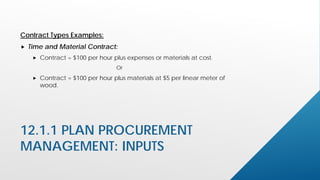
Contract Types Examples:
 Firm Fixed Price Contracts (FFP).
 Contract = $US 1’000,000
 Fixed Price Incentive Fee Contracts (FPIF).
 Contract = $US 1’000,000
 For every month early the project is finished, an additional US$ 10,000 is paid to the
seller.
 Fixed Price with Economic Price Adjustment Contracts
 Contract = $US 1’000,000, but a price increase will be allowed in year 2 based on
the US Consumer Price Index report for year 1. Or
 Contract = $US 1’000,000, but a price increase will be allowed in year 2 to account
for increases in specific material costs
12.1.1 PLAN PROCUREMENT
MANAGEMENT: INPUTS
Contract Types Examples:
 Cost Plus Fixed Fee Contracts (CPFF).
 Contract = Cost plus a fee of US$100,000
 Cost Plus Incentive Fee Contracts (CPIF).
 Contract = US$ 500,000 target cost plus US$ 50,000 target fee. The buyer and seller
share any cost savings or overruns at 80% to the buyer and 20% to the seller.
 Cost Plus Award Fee Contracts (CPAF).
 Contract = Cost plus a base fee plus award for meeting buyer-specified performance
criteria. Maximum award available is US$ 50,000.
 Cost Plus Fee (CPF) or Cost-Plus Percentage of Costs (CPPC).
 Contract = Cost plus 10 percent of costs as fee.
12.1.1 PLAN PROCUREMENT
MANAGEMENT: INPUTS
Contract Types Examples:
 Time and Material Contract:
 Contract = $100 per hour plus expenses or materials at cost.
Or
 Contract = $100 per hour plus materials at $5 per linear meter of
wood.
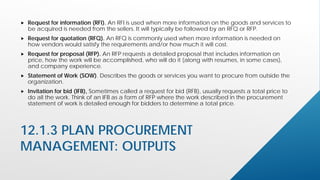
12.1.3 PLAN PROCUREMENT
MANAGEMENT: OUTPUTS
 Request for information (RFI). An RFI is used when more information on the goods and services to
be acquired is needed from the sellers. It will typically be followed by an RFQ or RFP.
 Request for quotation (RFQ). An RFQ is commonly used when more information is needed on
how vendors would satisfy the requirements and/or how much it will cost.
 Request for proposal (RFP). An RFP requests a detailed proposal that includes information on
price, how the work will be accomplished, who will do it (along with resumes, in some cases),
and company experience.
 Statement of Work (SOW). Describes the goods or services you want to procure from outside the
organization.
 Invitation for bid (IFB), Sometimes called a request for bid (RFB), usually requests a total price to
do all the work. Think of an IFB as a form of RFP where the work described in the procurement
statement of work is detailed enough for bidders to determine a total price.
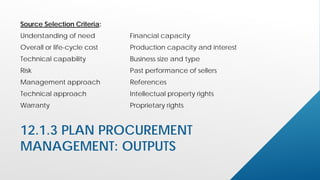
12.1.3 PLAN PROCUREMENT
MANAGEMENT: OUTPUTS
Source Selection Criteria:
Understanding of need
Overall or life-cycle cost
Technical capability
Risk
Management approach
Technical approach
Warranty
Financial capacity
Production capacity and interest
Business size and type
Past performance of sellers
References
Intellectual property rights
Proprietary rights
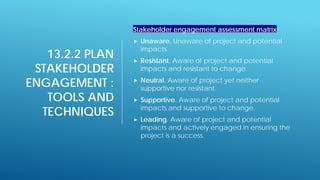
13.2.2 PLAN
STAKEHOLDER
ENGAGEMENT :
TOOLS AND
TECHNIQUES
Stakeholder engagement assessment matrix
 Unaware. Unaware of project and potential
impacts.
 Resistant. Aware of project and potential
impacts and resistant to change.
 Neutral. Aware of project yet neither
supportive nor resistant.
 Supportive. Aware of project and potential
impacts and supportive to change.
 Leading. Aware of project and potential
impacts and actively engaged in ensuring the
project is a success.
13.4.2
MONITOR
STAKEHOLDER
ENGAGEMENT:
TOOLS AND
TECHNIQUES
Interpersonal and Team Skills
Active Listening
Cultural Awareness
Leadership
Networking
Political Awareness
Meetings

Pmp Complete Notes

  • 1.
    1.7 PROJECT LIFE CYCLES A project life cycle refers to the series of phases that a project goes through from its initiation through to its closure. Project life cycles are either predictive or adaptive and may be sequential, iterative, or overlapping. Within the project life cycle, there is typically a development life cycle that consists of phases that encompass the development of a product or service.
  • 2.
    1.8.1 INITIATING PROCESS GROUP  TheInitiating Process Group consists of those processes performed to define a new project or a new phase of an existing project by obtaining authorization to start the project or phase. Within the Initiating processes, the initial scope is defined and initial financial resources are committed. Internal and external stakeholders who will interact and influence the overall outcome of the project are identified.  The key purpose of this Process Group is to align the stakeholders’ expectations with the project’s purpose.
  • 3.
    1.8.2 PLANNING PROCESS GROUP  ThePlanning Process Group consists of those processes performed to establish the total scope of the effort, define and refine the objectives, and develop the course of action required to attain those objectives. The Planning processes develop the project management plan and the project documents that will be used to carry out the project.  The key benefit of this Process Group is to delineate the strategy and tactics as well as the course of action or path to successfully complete the project or phase.
  • 4.
    1.8.3 EXECUTING PROCESS GROUP  The ExecutingProcess Group consists of those processes performed to complete the work defined in the project management plan to satisfy the project specifications. This Process Group involves coordinating people and resources, managing stakeholder expectations, as well as integrating and performing the activities of the project in accordance with the project management plan.  A large portion of the project’s budget will be expended in performing the Executing Process Group processes.
  • 5.
    1.8.4 MONITORING AND CONTROLLING PROCESS GROUP  The Monitoringand Controlling Process Group consists of those processes required to track, review, and orchestrate the progress and performance of the project; identify any areas in which changes to the plan are required; and initiate the corresponding changes.  The key benefit of this Process Group is that project performance is measured and analyzed at regular intervals, appropriate events, or exception conditions to identify variances from the project management plan.
  • 6.
    1.8.4 MONITORING AND CONTROLLING PROCESS GROUP  Controlling changesand recommending corrective or preventive action in anticipation of possible problems,  Monitoring the ongoing project activities against the project management plan and the project performance measurement baseline, and  Influencing the factors that could circumvent integrated change control or configuration management so only approved changes are implemented.
  • 7.
    1.8.5 CLOSING PROCESS GROUP  TheClosing Process Group consists of those processes performed to conclude all activities across all Project Management Process Groups to formally complete the project, phase, or contractual obligations.  This Process Group also formally establishes the premature closure of the project. Prematurely closed projects may include, for example: aborted projects, cancelled projects, and projects having a critical situation.
  • 8.
    1.8.5 CLOSING PROCESS GROUP At projector phase closure, the following may occur:  Obtain acceptance by the customer or sponsor to formally close the project or phase,  Conduct post-project or phase-end review,  Record impacts of tailoring to any process,  Document lessons learned,  Apply appropriate updates to organizational process assets,
  • 9.
    1.8.5 CLOSING PROCESS GROUP  Archiveall relevant project documents in the project management information system (PMIS) to be used as historical data,  Close out all procurement activities ensuring termination of all relevant agreements, and  Perform team members’ assessments and release project resources.
  • 10.
    1.9 ROLE OFTHE KNOWLEDGE AREAS  The 49 project management processes identified in the PMBOK® Guide are further grouped into ten separate Knowledge Areas. A Knowledge Area represents a complete set of concepts, terms, and activities that make up a professional field, project management field, or area of specialization. These ten Knowledge Areas are used on most projects most of the time. Project teams should utilize these ten Knowledge Areas and other Knowledge Areas, as appropriate, for their specific project.
  • 11.
    1.9.1 ROLE OF THE KNOWLEDGE AREAS 4.ProjectIntegration Management 5. Project Scope Management 6. Project Schedule Management 7. Project Cost Management 8. Project Quality Management 9. Project Resource Management 10. Project Communications Management 11. Project Risk Management 12. Project Procurement Management 13. Project Stakeholder Management
  • 12.
    2.1 ORGANIZATIONAL CULTURES AND STYLES Organizational cultureis shaped by the common experiences of members of the organization and most organizations have developed unique cultures over time by practice and common usage. Common experiences include, but are not limited to:  Shared vision, mission, values, beliefs, and expectations;  Regulations, policies, methods, and procedures;  Motivation and reward systems;
  • 13.
    2.1 ORGANIZATIONAL CULTURES AND STYLES  Risktolerance;  View of leadership, hierarchy, and authority relationships;  Code of conduct, work ethic, and work hours; and  Operating environments.
  • 14.
    2.2 ORGANIZATIONAL COMMUNICATIONS  Stakeholders andproject team members can also use electronic communications (including e-mail, texting, instant messaging, social media, video and web conferencing, and other forms of electronic media) to communicate with the project manager formally or informally.
  • 15.
    2.3 ORGANIZATIONAL STRUCTURES Organizational structure is an enterprise environmental factor, which can affect the availability of resources and influence how projects are conducted. Organizational structures range from:  Functional  Projectized,  Matrix structures
  • 16.
    2.4.1 ORGANIZATIONAL PROCESS ASSETS(OPA) Processes and Procedures The organization’s processes and procedures for conducting project work include, but are not limited to:  Initiating and Planning: Guidelines, organizational standards such as policies, product and project life cycles, and quality policies and procedures, Templates.  Executing, Monitoring and Controlling: Change control procedures, Financial controls procedures, Risk control procedures.
  • 17.
    2.5 PROJECT MANAGEMENT OFFICE A projectmanagement office (PMO) is a management structure that standardizes the project-related governance processes and facilitates the sharing of resources, methodologies, tools, and techniques. The responsibilities of a PMO can range from providing project management support functions to actually being responsible for the direct management of one or more projects.
  • 18.
    2.5 PROJECT MANAGEMENT OFFICE There areseveral types of PMO structures in organizations, each varying in the degree of control and influence they have on projects within the organization, such as:  Supportive. Provide a consultative role to projects by supplying templates, best practices, training, access to information and lessons learned from other projects. This type of PMO serves as a project repository. The degree of control provided by the PMO is low.
  • 19.
    2.5 PROJECT MANAGEMENT OFFICE  Controlling.Controlling PMOs provide support and require compliance through various means. Compliance may involve adopting project management frameworks or methodologies, using specific templates, forms and tools, or conformance to governance. The degree of control provided by the PMO is moderate.  Directive. Directive PMOs take control of the projects by directly managing the projects. The degree of control provided by the PMO is high.
  • 20.
    3 ROLE OFTHE PROJECT MANAGER 3.1 Competencies of the Project Manager  Knowledge—Refers to what the project manager knows about project management.  Performance—Refers to what the project manager is able to do or accomplish while applying his or her project management knowledge.  Personal—Refers to how the project manager behaves when performing the project or related activity. Personal effectiveness encompasses attitudes, core personality characteristics, and leadership, which provides the ability to guide the project team while achieving project objectives and balancing the project constraints.
  • 21.
    3.2 ROLE OFTHE PROJECT MANAGER Interpersonal Skills Leadership Political and Cultural awareness Team building Negotiation Motivation Trust Building Communication Conflict Management Influencing Coaching Decision Making
  • 22.
    3.4 PROJECT STAKEHOLDERS ProjectStakeholders • Sponsor • Customers and users • Sellers • Business partners • Organizational groups • Functional managers • Other stakeholders
  • 23.
    3.5 PROJECT TEAM •Project management staff • Project staff • Supporting experts • User or Customer Representatives • Sellers • Business partner members • Business partners
  • 24.
    3.5 PROJECT TEAM 3.5.1 Compositionof Project Teams  Dedicated. In a dedicated team, all or a majority of the project team members are assigned to work full-time on the project.  Part-Time. Some projects are established as temporary additional work, with the project manager and team members working on the project while remaining in their existing organizations and continuing to carry out their normal functions.
  • 25.
    TIPS FOR THEPMP EXAM Skip lengthy and difficult questions, especially at the beginning of the exam. 01 Mark doubtful questions for review in a second or third pass through the exam. 02 Respond to any skipped questions in the second pass through the exam. 03 Respond to any marked questions after all skipped questions have been answered. 04
  • 26.
    PROJECT MANAGEMENT PLANVS. PROJECT DOCUMENTS
  • 27.
    WHAT IS GOLDPLATING? Gold plating refers to the addition of any feature not considered in the original scope plan at any point of the project since it introduces a new source of risks to the original planning i.e. additional testing, documentation, costs, timelines, etc. Gold Plating is thinking to make our customers happy but according PMI as PM we need to avoid the Gold Plating because this will increase our customers expectations.
  • 28.
    5.4.3 CREATE WBS: OUTPUTS WBSDictionary: Code of account identifier, Description of work, Assumptions and constraints, Responsible organization, Schedule milestones, Associated schedule activities, Resources required, Cost estimates, Quality requirements, Acceptance criteria, Technical references, and Agreement information.
  • 29.
  • 30.
    5.5.2 VALIDATE SCOPE:TOOLS AND TECHNIQUES 1. Inspection Inspection includes activities such as measuring, examining, and validating to determine whether work and deliverables meet requirements and product acceptance criteria. 2. Decision Making (Voting)
  • 31.
    5.6.1 CONTROL SCOPE: INPUTS 1. ProjectManagement Plan  Scope baseline, Scope management plan, Change management plan, Configuration management plan, Requirements management plan. 2. Project Documents (Lessons Learned, Requirements, Requirements Matrix) 3. Work Performance Data 4. Organizational Process Assets
  • 32.
    5.6.2 CONTROL SCOPE: TOOLS AND TECHNIQUES 1.Data Analysis (Variance Analysis) Variance analysis is a technique for determining the cause and degree of difference between the baseline and actual performance. Project performance measurements are used to assess the magnitude of variation from the original scope baseline. Important aspects of project scope control include determining the cause and degree of variance relative to the scope baseline and deciding whether corrective or preventive action is required.
  • 33.
    AGILE CONCEPTS FOR SCOPE MANAGEMENT  ProductBacklog: It is a list of all functional and nonfunctional work identified for the project. It is a list of the work that needs to be done, the items are removed from the list as they are completed. Sprint Backlog is a subset of the Product Backlog, there you can find the items to be complete in the coming sprint.  Product Owner: The Product Owner is the responsible for developing the Backlog and prioritize all the backlog items based on the business value for the organization.
  • 34.
    6.1.3 PLAN SCHEDULE MANAGEMENT:OUTPUTS 1. Schedule Management Plan It is a component of the project management plan that establishes the criteria and the activities for developing, monitoring, and controlling the schedule. The schedule management plan may be formal or informal, highly detailed or broadly framed, based upon the needs of the project, and includes appropriate control thresholds.
  • 35.
    6.2.2 DEFINE ACTIVITIES: TOOLS AND TECHNIQUES 1.Expert Judgment 2. Decomposition 3. Rolling Wave Planning  Rolling wave planning is an iterative planning technique in which the work to be accomplished in the near term is planned in detail, while the work in the future is planned at a higher level. It is a form of progressive elaboration. 4. Meetings
  • 36.
    6.2.3 DEFINE ACTIVITIES: OUTPUTS 1. ActivityList  The activity list is a comprehensive list that includes all schedule activities required on the project. The activity list also includes the activity identifier and a scope of work description for each activity in sufficient detail to ensure that project team members understand what work is required to be completed. Each activity should have a unique title that describes its place in the schedule, even if that activity title is displayed outside the context of the project schedule. 2. Activity Attributes
  • 37.
    6.2.3 DEFINE ACTIVITIES: OUTPUTS 3. MilestoneList  A milestone is a significant point or event in a project. A milestone list identifies all project milestones and indicates whether the milestone is mandatory, such as those required by contract, or optional, such as those based on historical information. Milestones have zero duration because they represent a significant point or event. 4. Change Requests 5. Project Management Plan Updates (Schedule, Cost)
  • 38.
    6.3.1 SEQUENCE ACTIVITIES:INPUTS •Schedule Management Plan •Scope Baseline 1. Project Management Plan •Activity Attributes •Activity List •Assumption Log •Milestone List 2. Project Documents
  • 39.
    6.3.2 SEQUENCE ACTIVITIES: TOOLS AND TECHNIQUES 1.Precedence Diagramming Method (PDM)  Finish-to-start (FS). An activity must finish before the successor can start. This is the most commonly used relationship. Example: You must finish digging a hole before you can start the next activity of planting a tree.  Finish-to-finish (FF). An activity must finish before the successor can finish. Example: You must finish testing before you can finish documentation.
  • 40.
    6.3.2 SEQUENCE ACTIVITIES: TOOLS AND TECHNIQUES 1.Precedence Diagramming Method (PDM)  Start-to-start (SS). An activity must start before the successor can start. Example: You must start designing and wait for two weeks’ lag in order to have enough of the design completed to start coding.  Start-to-finish (SF). An activity must start before the successor can finish. This dependency is rarely used.
  • 41.
    6.3.2 SEQUENCE ACTIVITIES: TOOLS AND TECHNIQUES Exampleof Lag:  You must wait 3 days after purchasing a book in Amazon before you can start preparing the class material based on the book content.  This is an example of a lag of 3 days (Prepare class material 3 days after the book was purchased.) Purchase Book Prepare class 3 Days
  • 42.
    6.3.2 SEQUENCE ACTIVITIES: TOOLS AND TECHNIQUES Exampleof Lead:  You need to start coding before all the designing activity is complete. According to the designer you can start the coding activity 4 hours before all the design is complete.  This is an example of a lead of 4 hours (Start coding 4 hours before designing completes.) Designing Coding -4 hours
  • 43.
    6.4.3 ESTIMATE ACTIVITYDURATIONS: TOOLS AND TECHNIQUES Three-Point Estimating Formulas:  Triangular Distribution (Simple Average)  (P + O + M)/3  Beta Distribution (Weighted Average)  (P + O + 4M)/6
  • 44.
    6.4.3 ESTIMATE ACTIVITYDURATIONS: TOOLS AND TECHNIQUES Example  Jim says that for developing a standard report he will need 10 hours, if he got everything clear and can do it faster could take 5 hours, but if he will have issues with the access or any impediment could take 12 hours. Using Three-points the triangular distribution what could be a good estimate duration for this task? 12 + 5 + 10 / 3 = 27 / 3 = 9 hours Using the Beta Distribution would be: 12 + 5 + 4(10) / 6 = 57 / 6 = 9.5 hours
  • 45.
    6.4.3 ESTIMATE ACTIVITYDURATIONS: TOOLS AND TECHNIQUES - AGILE T-Shirt Sizing: T-shirt sizing as the name suggests is simply estimating with sizes like what you would find on a T-shirts’ label from Extra Small (XS) through to Extra Large (XL). Example: For an online movie service, the team has identified six product features:  Rate movies  Browse movies  Rent movies  Sell movies  Review movies  Sort movies by year
  • 46.
    PLANNING POKER Planning poker: (alsocalled Scrum poker) helps agile teams estimate the time and effort needed to complete each initiative on their product backlog. The name from this gamified technique is planning poker because participants use physical cards. These cards, which look like playing cards, estimate the number of story points for each backlog story or task up for discussion.
  • 47.
    6.4.3 ESTIMATE ACTIVITYDURATIONS: OUTPUTS 1. Duration Estimates  Activity duration estimates may include some indication of the range of possible results. For example:  2 weeks +- 2 days, which indicates that the activity will take at least eight days and not more than twelve (assuming a five- day workweek); and  15 % probability of exceeding three weeks, which indicates a high probability—85 %—that the activity will take three weeks or less. 2. Basis of Estimates (The amount and type of additional details supporting the duration estimate vary by application area.) 3. Project Documents Updates (Activity Attributes, Assumption Log, Lessons Learned Register)
  • 48.
    6.5.2 DEVELOP SCHEDULE:TOOLS AND TECHNIQUES 1. Schedule Network Analysis 2. Critical Path Method  It is the longest path(s) in the network diagram. By definition all the activities in the critical path have zero float.
  • 49.
    6.5.2 DEVELOP SCHEDULE: TOOLS AND TECHNIQUES ResourceOptimization Techniques  Resource Smoothing. It is a modified form of resource leveling, where resources are leveled only within the limits of the float of their activities, so the completion dates of activities are not delayed.
  • 50.
    6.5.2 DEVELOP SCHEDULE: TOOLS AND TECHNIQUES DataAnalysis  What-If Scenario Analysis. Is the process of evaluating scenarios in order to predict their effect, positively or negatively, on project objectives. This is an analysis of the question, “What if the situation represented by scenario ‘X’ happens?” A schedule network analysis is performed using the schedule to compute the different scenarios, such as delaying a major component delivery, extending specific engineering durations, or introducing external factors, such as a strike or a change in the permitting process.
  • 51.
    6.5.2 DEVELOP SCHEDULE: TOOLS AND TECHNIQUES DataAnalysis  Simulation. Monte Carlo Analysis is the most popular simulation technique. This uses computer software to simulate the outcome of a project, based on the three-point estimates (optimistic, pessimistic, and most likely) for each activity and the network diagram. The simulation can tell you:  The probability of completing the project on any specific day.  The probability of completing the project for any specific cost.  The probability of any activity being on the critical path.  An indication of the overall project risk.
  • 52.
    7.1.3 PLAN COST MANAGEMENT: OUTPUTS 1.Cost Management Plan The cost management plan is a component of the project management plan and describes how the project costs will be planned, structured, and controlled. The cost management processes and their associated tools and techniques are documented in the cost management plan.
  • 53.
    7.3.2 DETERMINE BUDGET:TOOLS AND TECHNIQUES 1. Expert Judgment 2. Cost Aggregation  It is the process of collecting individual cost estimates into a whole. Specifically, cost estimates are aggregated by work packages, then into higher components (typically monitored by control accounts) of the work break down structure (WBS), and then for the entire project. 3. Data Analysis (Reserve Analysis: Contingency and Management Reserves) 4. Historical Information Review: Review of historical information can be used to develop parametric or analogous estimates. Historical information my include project characteristics to evolve mathematical models to forecast the total project cost. 5. Funding Limit Reconciliation: Funding limit reconciliation consists of accommodating the expenditure of funds to established funding limits for a specific period of time. Any variances between expenditures and funding limits can result in rescheduling work. To prevent this, any date constraints for work should be included in the work schedule. 6. Financing
  • 54.
    7.3.4 DETERMINE BUDGET: QUESTIONS 1.An important technique used in Determine Budget process is: 2. Which type of reserve is included in the Cost Baseline? a) Management Reserve b) Contingeny Reserve 3. Which reserves is attributed to unforeseen risks that have not been identified? 4. An important output of the Determine Budget process is the:
  • 55.
    7.4.2 CONTROL COSTS:TOOLS AND TECHNIQUES 1. Expert Judgment 2. Data Analysis: Earned Value Analysis  Planned Value (PV)  Earned Value (EV)  Actual Cost (AC)  Schedule Variance (SV) = EV - PV  Cost Variance (CV) = EV - AC  Schedule Performance Index (SPI) = EV / PV  Cost Performance Index (CPI) = EV / AC
  • 56.
    7.4.2 CONTROL COSTS:TOOLS AND TECHNIQUES 2. Data Analysis: Variance analysis. Variance analysis, as used in EVA, is the explanation (cause, impact, and corrective actions) for cost (CV = EV – AC), schedule (SV = EV – PV), and variance at completion (VAC = BAC – EAC) variances. Cost and schedule variances are the most frequently analyzed measurements.
  • 57.
    7.4.2 CONTROL COSTS:TOOLS AND TECHNIQUES 2. Data Analysis: Forecasting  EAC forecast for ETC work performed at the budgeted rate.  Equation: EAC = AC + (BAC – EV)  EAC forecast for ETC work performed at the present CPI.  Equation: EAC = BAC / CPI  EAC forecast for ETC work considering both SPI and CPI factors.  Equation: EAC = AC + [(BAC – EV) / (CPI × SPI)]
  • 58.
    7.4.2 CONTROL COSTS:TOOLS AND TECHNIQUES 2. Data Analysis: Reserve Analysis  During cost control, reserve analysis is used to monitor the status of contingency and management reserves for the project to determine if these reserves are still needed or if additional reserves need to be requested.
  • 59.
    7.4.2 CONTROL COSTS:TOOLS AND TECHNIQUES 3. To-Complete Performance Index (TCPI) The equation for the TCPI based on the BAC: • (BAC – EV) / (BAC – AC). The equation for the TCPI based on the EAC:  (BAC – EV) / (EAC – AC).
  • 60.
    QUALITY Quality is thedegree to which a set of inherent characteristics fulfills requirements. A project is said to meet quality expectations, when all the project requirements agreed in the beginning of the project are met, and the resulting product is usable.
  • 61.
    CONCEPTS RELATED TO QUALITY Prevention over Inspection  Is it better to inspect work to find problems or to prevent them in the first place? Which takes less effort and is less costly? Remember that quality must be planned in, not inspected in! The concept of prevention over inspection was advocated by quality theorist Philip Crosby. You may see exam questions that test your understanding that failure to plan quality into a project will lead to problems later in the project.
  • 62.
    8.2.2 MANAGE QUALITY: TOOLS AND TECHNIQUES 5.Audits  Quality Audit is a structured, independent process to determine if project activities comply with organizational and project policies, processes, and procedures. Quality Audits are typically performed by individuals outside of the project, such as internal or external auditors. 6. Design for X (DfX)  Includes a set of technical guidelines applied during design of a product to optimize a specific design aspect (e.g. reliability, assembly, usability, safety).
  • 63.
    9.4.2 DEVELOP TEAM:TOOLS AND TECHNIQUES Tuckman Ladder  Forming. This phase is where the team members meet and learn about the project and their formal roles and responsibilities. Team members tend to be independent and not as open in this phase.  Storming. During this phase, the team begins to address the project work, technical decisions, and the project management approach. If team members are not collaborative or open to differing ideas and perspectives, the environment can become counterproductive.  Norming. In this phase, team members begin to work together and adjust their work habits and behaviors to support the team. The team members learn to trust each other.  Performing. Teams that reach the performing stage function as a well-organized unit. They are interdependent and work through issues smoothly and effectively.  Adjourning. In this phase, the team completes the work and moves on from the project. This typically occurs when staff is released from the project as deliverables are completed or as part of the Close Project or Phase process.
  • 64.
    9.4.2 DEVELOP TEAM:TOOLS AND TECHNIQUES Shu-Ha-Ri Model of Skill Mastery Shuhari is a Japanese martial art concept which describes the stages of learning to mastery. Shu - Follow the rules, obeying the rules to keep or maintain. Ha - Move away from the rules, to detach or break free. Ri - Unconsciously finding an individual path, means to go beyond or transcend. Shu ha ri is roughly translated to “first learn, then detach, and finally, transcend.”
  • 65.
    9.5.2 MANAGE TEAM:TOOLS AND TECHNIQUES Conflict Management:  Withdraw/avoid. Retreating from an actual or potential conflict situation; postponing the issue to be better prepared or to be resolved by others. This is referred to as a Lose-Leave situation.  Smooth/accommodate. Emphasizing areas of agreement rather than areas of difference; conceding one’s position to the needs of others to maintain harmony and relationships. This is referred to as a Lose-Yield situation  Compromise/reconcile. Searching for solutions that bring some degree of satisfaction to all parties in order to temporarily or partially resolve the conflict. This approach occasionally results in a Lose-Lose situation.  Force/direct. Pushing one’s viewpoint at the expense of others; offering only win-lose solutions, usually enforced through a power position to resolve an emergency. This approach often results to a Win-Lose situation.  Collaborate/problem solve. Incorporating multiple viewpoints and insights from differing perspectives; requires a cooperative attitude and open dialogue that typically leads to consensus and commitment. This approach can result in a Win-Win situation.
  • 66.
    9.5.2 MANAGE TEAM:TOOLS AND TECHNIQUES Management and leadership styles: Some of the primary styles are: Directing Facilitating Coaching Supporting Influencing Delegating Servant
  • 67.
    9.5.2 MANAGE TEAM:TOOLS AND TECHNIQUES Management and leadership styles: The following ones are effective when the team is dealing with issues such as resolving conflicts, negotiating, prioritizing, or other decision-making activities: Consultative Consensus Democratic or participative Bureaucratic Analytical
  • 68.
    9.5.2 MANAGE TEAM:TOOLS AND TECHNIQUES Management and leadership styles: These ones are additional styles based on some challenging situations: Charismatic Autocratic Consultative-autocratic Laissez-faire Driver
  • 69.
    9.5.2 MANAGE TEAM:TOOLS AND TECHNIQUES Powers of the Project Manager One of the major difficulties for a project manager is getting people to cooperate and perform. This is a major issue in a matrix organization. The different types of power for the project managers include:  Formal (legitimate): This power is based on the position of the project manager  Reward: This power stems from giving rewards  Penalty (Coercive): This power comes from the ability to penalize team members  Expert: This power comes from being the technical expert or even the project management expert  Referent: Referent is the power of charisma and fame. This power comes from another person liking the project manager, respecting him, or wanting to be like him.
  • 70.
    10. COMMUNICATIONS MANAGEMENT:KEY CONCEPTS Communication is the exchange of information, intended or involuntary. The information exchanged can be in the form of ideas, instructions, or emotions. The mechanisms by which information is exchanged can be in:  Written form. Either physical or electronic.  Spoken. Either face-to-face or remote.  Formal or informal (as in formal papers or social media).  Through gestures. Tone of voice and facial expressions.  Through media. Pictures, actions, or even just the choice of words.  Choice of words. There is often more than one word to express an idea; there can be subtle differences in the meaning of each of these words and phrases.
  • 71.
    10. COMMUNICATIONS MANAGEMENT:KEY CONCEPTS Communication activities have many dimensions, including but not limited to:  Internal. Focus on stakeholders within the project and within the organization.  External. Focus on external stakeholders such as customers, vendors, other projects, organizations, government, the public, and environmental advocates.  Formal. Reports, formal meetings (both regular and ad hoc), meeting agendas and minutes, stakeholder briefings, and presentations.  Informal. General communications activities using emails, social media, websites, and informal ad hoc discussions.
  • 72.
    10. COMMUNICATIONS MANAGEMENT:KEY CONCEPTS  Hierarchical focus. The position of the stakeholder or group with respect to the project team will affect the format and content of the message, in the following ways:  Upward. Senior management stakeholders.  Downward. The team and others who will contribute to the work of the project.  Horizontal. Peers of the project manager or team.  Official. Annual reports; reports to regulators or government bodies.  Unofficial. Communications that focus on establishing and maintaining the profile and recognition of the project and building strong relationships between the project team and its stakeholders using flexible and often informal means.  Written and oral. Verbal (words and voice inflections) and nonverbal (body language and actions), social media and websites, media releases
  • 73.
    10.1 PLAN COMMUNICATIONS MANAGEMENT Important considerationsthat may need to be taken into account include, but are not limited to:  Who needs what information, and who is authorized to access that information;  When they will need the information;  Where the information should be stored;  What format the information should be stored in;  How the information can be retrieved; and  Whether time zone, language barriers, and cross-cultural considerations need to be taken into account.
  • 74.
    10.2.2 MANAGE COMMUNICATIONS: TOOLSAND TECHNIQUES Types of Reports  Status report: This report describes where the project currently stands in relation to the performance measurement baseline.  Progress report: A progress report describes what has been accomplished.  Trend report: This report examines project results over time to see if performance is improving or deteriorating.  Forecasting report: This report predicts future project status and performance.  Variance report: A variance report compares actual results to baselines.  Earned value report: An earned value report integrates scope, cost, and Schedule measurements to assess project performance.
  • 75.
    10.2.2 MANAGE COMMUNICATIONS: TOOLSAND TECHNIQUES Types of Reports  Progress metrics: Reports such as Cumulative Flow Diagrams and burnup charts are used to assess performance.  Retrospective findings: This report is used to inspect, adapt, and improve projects and team performance.  Lessons learned: Lessons learned report of performance and may be used for future projects.
  • 76.
    10.2.2 MANAGE COMMUNICATIONS: TOOLSAND TECHNIQUES Interpersonal and Team Skills  Active Listening  Conflict Management  Cultural awareness  Meeting Management  Networking  Political awareness
  • 77.
    10.3.3 MONITOR COMMUNICATIONS: OUTPUTS Work Performance Information ChangeRequests Project Management Plan Updates (Communications, Stakeholder engagement) Project Documents Updates Issue Log Lessons Learned Register Stakeholder Register
  • 78.
    11. RISK MANAGEMENT:KEY CONCEPTS According to the PMBOK® Guide, once a negative risk event occurs, it's considered an issue and is no longer a risk.  Risk attitude consists of three elements:  Risk appetite is the level of uncertainty the stakeholders are willing to accept in exchange for the potential positive impacts of the risk.  Risk tolerance is that balance where stakeholders are comfortable taking a risk because the known benefits to be gained outweigh what could be lost—or just the opposite.  Risk thresholds are measures or levels of uncertainty or impact the organization is willing to operate within.  Risk Trigger: An event, condition, or something that generate the occurrence of a risk. They are warning signs or symptoms that a risk event is about to occur.
  • 79.
    11.5.2 PLAN RISKRESPONSES: TOOLS AND TECHNIQUES Strategies for Threats Escalate Avoid. Transfer. Mitigate. Accept. Strategies for Opportunities Escalate Exploit. Share. Enhance. Accept.
  • 80.
    12.1.1 PLAN PROCUREMENT MANAGEMENT:INPUTS 5. Enterprise Environmental Factors • Fixed-price contracts (FFP, FPIFC, FP-EPA) • Cost-reimbursable contracts (CPFF, CPIF, CPAF, CPF or CPPC) • Time and Material Contracts (T&M) 6. Organizational Process Assets
  • 81.
    12.1.1 PLAN PROCUREMENT MANAGEMENT:INPUTS Contract Types (Fixed-Price):  Firm Fixed Price Contracts (FFP). Most commonly used. Cost increase due performance is responsibility of the seller.  Fixed Price Incentive Fee Contracts (FPIF). Gives the buyer and seller some flexibility in that it allows for deviation from performance  Fixed Price with Economic Price Adjustment Contracts (FP-EPA), considered for big projects that last many years and factors like inflation or cost increases or decreases affect the project. The FP- EPA contract is intended to protect both buyer and seller from external conditions beyond their control
  • 82.
    12.1.1 PLAN PROCUREMENT MANAGEMENT:INPUTS Contract Types (Cost-Reimbursable):  Cost Plus Fixed Fee Contracts (CPFF). The seller is reimbursed for all allowable costs for performing the contract work and receives a fixed-fee payment calculated as a percentage of the initial estimated project costs.  Cost Plus Incentive Fee Contracts (CPIF). The seller is reimbursed for all allowable costs for performing the contract work and receives a predetermined incentive fee based upon achieving certain performance objectives as set forth in the contract.  Cost Plus Award Fee Contracts (CPAF). The seller is reimbursed for all legitimate costs, but the majority of the fee is earned only based on the satisfaction of certain broad subjective performance criteria defined and incorporated into the contract.  Cost Plus Fee (CPF) or Cost-Plus Percentage of Costs (CPPC). It requires the buyer to pay for all costs plus a percentage of costs as a fee.
  • 83.
    12.1.1 PLAN PROCUREMENT MANAGEMENT:INPUTS Contract Types (T&M):  Time and material contracts (T&M). Time and material contracts (also called time and means) are a hybrid type of contractual arrangement with aspects of both cost-reimbursable and fixed- price contracts. They are often used for staff augmentation, acquisition of experts, and any outside support when a precise statement of work cannot be quickly prescribed.
  • 84.
    12.1.1 PLAN PROCUREMENT MANAGEMENT:INPUTS Contract Types Examples:  Firm Fixed Price Contracts (FFP).  Contract = $US 1’000,000  Fixed Price Incentive Fee Contracts (FPIF).  Contract = $US 1’000,000  For every month early the project is finished, an additional US$ 10,000 is paid to the seller.  Fixed Price with Economic Price Adjustment Contracts  Contract = $US 1’000,000, but a price increase will be allowed in year 2 based on the US Consumer Price Index report for year 1. Or  Contract = $US 1’000,000, but a price increase will be allowed in year 2 to account for increases in specific material costs
  • 85.
    12.1.1 PLAN PROCUREMENT MANAGEMENT:INPUTS Contract Types Examples:  Cost Plus Fixed Fee Contracts (CPFF).  Contract = Cost plus a fee of US$100,000  Cost Plus Incentive Fee Contracts (CPIF).  Contract = US$ 500,000 target cost plus US$ 50,000 target fee. The buyer and seller share any cost savings or overruns at 80% to the buyer and 20% to the seller.  Cost Plus Award Fee Contracts (CPAF).  Contract = Cost plus a base fee plus award for meeting buyer-specified performance criteria. Maximum award available is US$ 50,000.  Cost Plus Fee (CPF) or Cost-Plus Percentage of Costs (CPPC).  Contract = Cost plus 10 percent of costs as fee.
  • 86.
    12.1.1 PLAN PROCUREMENT MANAGEMENT:INPUTS Contract Types Examples:  Time and Material Contract:  Contract = $100 per hour plus expenses or materials at cost. Or  Contract = $100 per hour plus materials at $5 per linear meter of wood.
  • 87.
    12.1.3 PLAN PROCUREMENT MANAGEMENT:OUTPUTS  Request for information (RFI). An RFI is used when more information on the goods and services to be acquired is needed from the sellers. It will typically be followed by an RFQ or RFP.  Request for quotation (RFQ). An RFQ is commonly used when more information is needed on how vendors would satisfy the requirements and/or how much it will cost.  Request for proposal (RFP). An RFP requests a detailed proposal that includes information on price, how the work will be accomplished, who will do it (along with resumes, in some cases), and company experience.  Statement of Work (SOW). Describes the goods or services you want to procure from outside the organization.  Invitation for bid (IFB), Sometimes called a request for bid (RFB), usually requests a total price to do all the work. Think of an IFB as a form of RFP where the work described in the procurement statement of work is detailed enough for bidders to determine a total price.
  • 88.
    12.1.3 PLAN PROCUREMENT MANAGEMENT:OUTPUTS Source Selection Criteria: Understanding of need Overall or life-cycle cost Technical capability Risk Management approach Technical approach Warranty Financial capacity Production capacity and interest Business size and type Past performance of sellers References Intellectual property rights Proprietary rights
  • 89.
    13.2.2 PLAN STAKEHOLDER ENGAGEMENT : TOOLSAND TECHNIQUES Stakeholder engagement assessment matrix  Unaware. Unaware of project and potential impacts.  Resistant. Aware of project and potential impacts and resistant to change.  Neutral. Aware of project yet neither supportive nor resistant.  Supportive. Aware of project and potential impacts and supportive to change.  Leading. Aware of project and potential impacts and actively engaged in ensuring the project is a success.
  • 90.
    13.4.2 MONITOR STAKEHOLDER ENGAGEMENT: TOOLS AND TECHNIQUES Interpersonal andTeam Skills Active Listening Cultural Awareness Leadership Networking Political Awareness Meetings