PMP Cram Sheet
This Cram Sheet contains distilled, key facts about the PMP Exam.
11. Determine budget—Aggregating
estimated costs of individual activities to
establish cost baseline.
12. Plan quality—Identifying relevant quality
standards and determining how to
satisfy them.
13. Develop human resource plan—
Identifying and documenting project roles,
responsibilities, and reporting relationships.
14. Plan communications—Determining
stakeholder communication needs.
15. Plan risk management—Deciding how to
approach, plan, and execute risk manage-
ment activities.
16. Identify risks—Determining which risks
might affect the project and documenting
their characteristics.
17. Perform qualitative risk analysis—
Prioritizing risks for subsequent further
analysis by assessing and combining their
probabilities of occurrence and impacts.
18. Perform quantitative risk analysis—
Numerically analyzing the effect on project
objectives of identified risks.
19. Plan risk responses—Developing options
to enhance opportunities and reduce
threats to project objectives.
20. Plan procurements—Documenting
products, services, and results require-
ments and identifying potential sellers.
Executing Process Group
Integrates resources to carry out project
management plan. These eight processes are
1. Direct and manage project execution—
Directing technical and organization
interfaces to execute work defined in
project management plan.
2. Perform quality assurance—Applying
planned, systematic quality activities to
ensure project employs processes needed
to meet requirements.
3. Acquire project team—Obtaining human
resources needed to complete project.
4. Develop project team—Development
improves competencies and interaction of
team members.
5. Manage project team—Tracking team
member performance, providing feedback,
resolving issues, and coordinating changes
to enhance project performance.
6. Distribute information—Providing infor-
mation to stakeholders in a timely manner.
7. Manage stakeholder expectations—
Managing stakeholder expectations to
satisfy their requirements and resolve
issues.
8. Conduct procurements—Obtaining seller
responses, selecting sellers, and awarding
contracts.
2. Close procurements—Completing
each procurement, including resolution
of open items, and closing each pro-
curement relevant to project or project
phase.
Project Management
Knowledge Areas
Not all project management knowledge
areas apply to all projects or project phases.
Knowledge areas can interact and overlap.
All 42 project management processes are
contained within the nine project manage-
ment knowledge areas:
1. Integration Management
2. Scope Management
3. Time Management
4. Cost Management
5. Quality Management
6. Human resource Management
7. Communications Management
8. Risk Management
9. Procurement Management
Project Integration
Management
The six processes occurring in every project
management process group are
1. Develop project charter
2. Develop project management plan
3. Direct and manage project execution
4. Monitor and control project work
5. Perform integrate change control
6. Close project or phase
.	
Project statement of work (SOW)—
A narrative description of products or
services to be supplied by project.
.	
Chartering project—Links it to
ongoing work of sponsoring
organization.
.	
Project selection methods—The two
categories are benefit measurement
and mathematical models.
.	
Project management
methodology—A set of process
groups, their processes, and control
functions.
.	
Project management information
system (PMIS)—Automated tools to
support information creation and
dissemination.
Monitoring and Controlling
Process Group
Monitors progress to identify variances from the
project management plan so corrective action
can be taken to meet project objectives. The
following ten processes are included:
1. Monitor and control project work—
Collecting, measuring, and disseminating
performance information and assessing
measurements and trends to affect
process improvements. Includes risk
monitoring to ensure risks are identified
early, their statuses reported, and risk
plans executed. Monitoring includes status
reporting, progress measurement, and
forecasting.
2. Perform integrated change control—
Ensure changes are beneficial; determine
whether a change has occurred; and
manage approved changes, including
when they occur. Performed throughout
project life cycle.
3. Verify scope—Acceptance of completed
project deliverables.
4. Control scope—Controlling changes to
project scope.
5. Control schedule—Controlling changes to
project schedule.
6. Control costs—Influencing factors that
create variances and controlling changes
to project budget.
7. Perform quality control—Monitoring
project results to determine compliance
with quality standards and identifying ways
to eliminate unsatisfactory performance.
8. Report performance—Collecting and
distributing performance information,
including status reporting, progress
measurement, and forecasting.
9. Monitor and control risks—Tracking
identified risks, monitoring risks, identifying
new risks, executing risk response plans,
and evaluating their effectiveness through-
out the project life cycle.
10. Administer procurements—Managing
contract between buyer and seller, review-
ing and documenting seller performance,
and managing contractual relationship with
outside buyer of project.
Closing Process Group
Formalizes acceptance of product, service, or
result and brings project or project phase to an
end. The following two processes are included:
1. Close project or phase—Finalizing all
activities across process groups to formally
close project or project phase.
.	
Configuration management
system—Subsystem of PMIS; process
for submitting proposed changes,
tracking systems for reviewing and
approving changes, defining approval
levels for changes, and validating
approved changes.
.	
Change control system—Subsystem
of configuration management system;
documented procedures defining how
project deliverables and documentation
are controlled, changed, and approved.
.	
Closure procedures—The two types
are administrative (documents all activi-
ties for executing administrative closure
for project, including lessons learned)
and procurement (documents all
activities for executing closure of any
project contracts).
.	
Earned value technique (EVT)—
Measures project performance moving
through project life cycle; a forecast-
ing tool that uses past performance to
predict future performance.
Project Scope Management
The five processes occurring in two project
management process groups (planning, and
monitoring and controlling) are
1. Collect requirements
2. Define scope
3. Create WBS
4. Verify scope
5. Control scope
.	
Decomposition—Subdivision of project
deliverables into small, more manage-
able components until work and deliver-
ables are defined to work package level.
.	
Work package—Lowest level of WBS;
cost and schedule can be reliably
estimated.
.	
Organizational breakdown
structure (OBS)—Hierarchical break-
down of project organization to
depict work packages by performing
organizational unit.
.	
Resource breakdown structure
(RBS)—Hierarchical, organized
depiction of resources by type to
be used.
Project Management Framework
1. Project—Temporary endeavor
undertaken to create a unique product,
service, or result.
2. Progressive elaboration—Developing
in steps and continuing by increments;
it’s a characteristic of projects.
3. Project life cycle—Phases that connect
the beginning of a project to its end;
project life cycle phases are not the same
as project management processes.
4. Level of uncertainty—This is highest,
and risk of failure is greatest, at the start
of a project.
5. Ability of stakeholders to influence
project—This is highest at the start and
gets progressively lower as the project
continues.
6. Cost of changes and correcting errors—
These increase as the project continues.
Project Management Process
Groups
Not all project management processes apply to
all projects or project phases. Process groups
can overlap and interact. Forty-two project
management processes are contained within
the five project management process groups:
1. Initiating
2. Planning
3. Executing
4. Monitoring and controlling
5. Closing
Initiating Process Group
Formally authorizes new project or project
phase. The two processes are
1. Develop project charter—Authorizing
project or project phase. The project
charter defines the project’s purpose,
identifies objectives, and authorizes the
project manager to start the project.
2. Identify stakeholders—Documents all
of the people or organizations that have
an interest in the outcome of the project
and their level of interest, impact, and
involvement.
Planning Process Group
Defines objectives and plans course of action
required to meet objectives and project scope.
Facilitates project planning across process
groups. The 20 processes are
1. Develop project management plan—
Primary source for how project is planned,
executed, monitored, controlled, and
closed. It’s an iterative and ongoing
process often resulting in changes to the
project management plan. This progressive
detailing is called rolling wave planning.
2. Collect requirements—Documenting the
stakeholders’ needs to meet the project
objectives.
3. Define scope—Developing a detailed
project scope.
4. Create WBS—Subdividing major project
deliverables and project work into smaller,
more manageable components.
5. Define activities—Identifying specific
activities to be performed to produce
project deliverables.
6. Sequence activities—Identifying and
documenting dependencies among
schedule activities.
7. Estimate activity resources—Type and
quantity of resources required to perform
each schedule activity.
8. Estimate activity durations—Number
of work periods needed to complete
individual schedule activities.
9. Develop schedule—Analyzing activity
sequences, durations, resource require-
ments, and schedule constraints to create
project schedule.
10. Estimate costs—Developing approxi-
mation of costs of resources needed to
complete project activities.
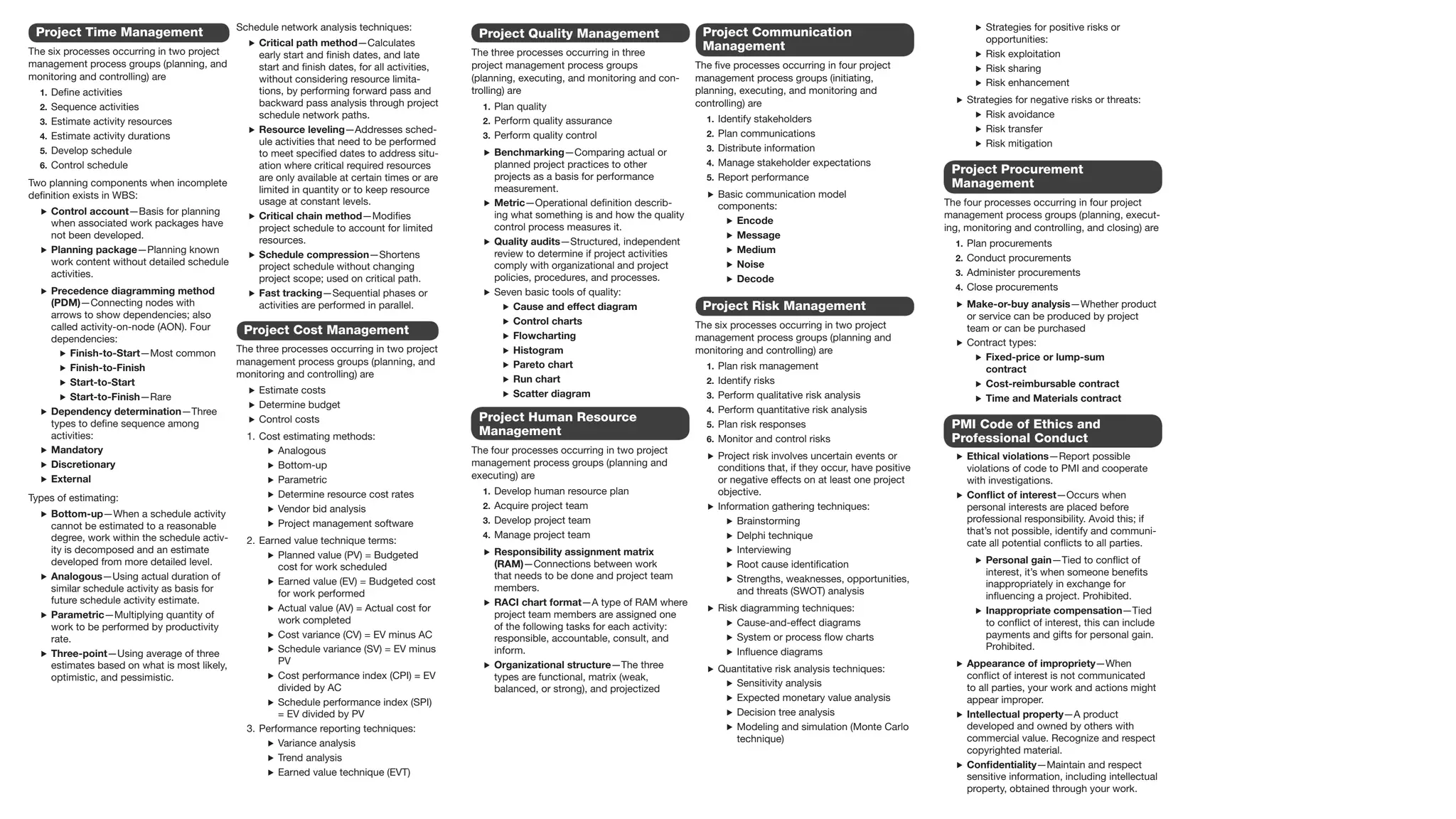
Project Time Management
The six processes occurring in two project
management process groups (planning, and
monitoring and controlling) are
1. Define activities
2. Sequence activities
3. Estimate activity resources
4. Estimate activity durations
5. Develop schedule
6. Control schedule
Two planning components when incomplete
definition exists in WBS:
.	
Control account—Basis for planning
when associated work packages have
not been developed.
.	
Planning package—Planning known
work content without detailed schedule
activities.
.	
Precedence diagramming method
(PDM)—Connecting nodes with
arrows to show dependencies; also
called activity-on-node (AON). Four
dependencies:
			 .	
Finish-to-Start—Most common
			 .	
Finish-to-Finish
			 .	
Start-to-Start
			 .	
Start-to-Finish—Rare
.	
Dependency determination—Three
types to define sequence among
activities:
.	
Mandatory
.	
Discretionary
.	
External
Types of estimating:
.	
Bottom-up—When a schedule activity
cannot be estimated to a reasonable
degree, work within the schedule activ-
ity is decomposed and an estimate
developed from more detailed level.
.	
Analogous—Using actual duration of
similar schedule activity as basis for
future schedule activity estimate.
.	
Parametric—Multiplying quantity of
work to be performed by productivity
rate.
.	
Three-point—Using average of three
estimates based on what is most likely,
optimistic, and pessimistic.
Schedule network analysis techniques:
. Critical path method—Calculates
early start and finish dates, and late
start and finish dates, for all activities,
without considering resource limita-
tions, by performing forward pass and
backward pass analysis through project
schedule network paths.
. Resource leveling—Addresses sched-
ule activities that need to be performed
to meet specified dates to address situ-
ation where critical required resources
are only available at certain times or are
limited in quantity or to keep resource
usage at constant levels.
. Critical chain method—Modifies
project schedule to account for limited
resources.
. Schedule compression—Shortens
project schedule without changing
project scope; used on critical path.
. Fast tracking—Sequential phases or
activities are performed in parallel.
Project Cost Management
The three processes occurring in two project
management process groups (planning, and
monitoring and controlling) are
. Estimate costs
. Determine budget
. Control costs
1. Cost estimating methods:
			 . Analogous
			 . Bottom-up
			 . Parametric
			 . Determine resource cost rates
			 . Vendor bid analysis
			 . Project management software
2. Earned value technique terms:
			 .	
Planned value (PV) = Budgeted
cost for work scheduled
			 .	
Earned value (EV) = Budgeted cost
for work performed
			 .	
Actual value (AV) = Actual cost for
work completed
			 .	
Cost variance (CV) = EV minus AC
			 .	
Schedule variance (SV) = EV minus
PV
			 .	
Cost performance index (CPI) = EV
divided by AC
			 .	
Schedule performance index (SPI)
= EV divided by PV
3. Performance reporting techniques:
			 .	
Variance analysis
			 .	
Trend analysis
			 .	
Earned value technique (EVT)
Project Quality Management
The three processes occurring in three
project management process groups
(planning, executing, and monitoring and con-
trolling) are
1. Plan quality
2. Perform quality assurance
3. Perform quality control
.	
Benchmarking—Comparing actual or
planned project practices to other
projects as a basis for performance
measurement.
.	
Metric—Operational definition describ-
ing what something is and how the quality
control process measures it.
.	
Quality audits—Structured, independent
review to determine if project activities
comply with organizational and project
policies, procedures, and processes.
.	
Seven basic tools of quality:
			 .	
Cause and effect diagram
			 . Control charts
			 . Flowcharting
			 . Histogram
			 . Pareto chart
			 . Run chart
			 . Scatter diagram
Project Human Resource
Management
The four processes occurring in two project
management process groups (planning and
executing) are
1. Develop human resource plan
2. Acquire project team
3. Develop project team
4. Manage project team
.	
Responsibility assignment matrix
(RAM)—Connections between work
that needs to be done and project team
members.
.	
RACI chart format—A type of RAM where
project team members are assigned one
of the following tasks for each activity:
responsible, accountable, consult, and
inform.
.	
Organizational structure—The three
types are functional, matrix (weak,
balanced, or strong), and projectized
Project Communication
Management
The five processes occurring in four project
management process groups (initiating,
planning, executing, and monitoring and
controlling) are
1. Identify stakeholders
2. Plan communications
3. Distribute information
4. Manage stakeholder expectations
5. Report performance
.	
Basic communication model
components:
			 .	
Encode
			 .	
Message
			 .	
Medium
			 .	
Noise
			 .	
Decode
Project Risk Management
The six processes occurring in two project
management process groups (planning and
monitoring and controlling) are
1. Plan risk management
2. Identify risks
3. Perform qualitative risk analysis
4. Perform quantitative risk analysis
5. Plan risk responses
6. Monitor and control risks
.	
Project risk involves uncertain events or
conditions that, if they occur, have positive
or negative effects on at least one project
objective.
.	
Information gathering techniques:
			 . Brainstorming
			 . Delphi technique
			 . Interviewing
			 . Root cause identification
			 .	
Strengths, weaknesses, opportunities,
and threats (SWOT) analysis
. Risk diagramming techniques:
			 . Cause-and-effect diagrams
			 . System or process flow charts
			 . Influence diagrams
. Quantitative risk analysis techniques:
			 . Sensitivity analysis
			 . Expected monetary value analysis
			 . Decision tree analysis
			 .	
Modeling and simulation (Monte Carlo
technique)
			 .	
Strategies for positive risks or
opportunities:
			 .	
Risk exploitation
			 .	
Risk sharing
			 .	
Risk enhancement
. Strategies for negative risks or threats:
			 .	
Risk avoidance
			 .	
Risk transfer
			 .	
Risk mitigation
Project Procurement
Management
The four processes occurring in four project
management process groups (planning, execut-
ing, monitoring and controlling, and closing) are
1. Plan procurements
2. Conduct procurements
3. Administer procurements
4. Close procurements
.	
Make-or-buy analysis—Whether product
or service can be produced by project
team or can be purchased
. Contract types:
			 .	
Fixed-price or lump-sum
contract
			 .	
Cost-reimbursable contract
			 .	
Time and Materials contract
PMI Code of Ethics and
Professional Conduct
. Ethical violations—Report possible
violations of code to PMI and cooperate
with investigations.
. Conflict of interest—Occurs when
personal interests are placed before
professional responsibility. Avoid this; if
that’s not possible, identify and communi-
cate all potential conflicts to all parties.
				 .	
Personal gain—Tied to conflict of
interest, it’s when someone benefits
inappropriately in exchange for
influencing a project. Prohibited.
			 . 
Inappropriate compensation—Tied
to conflict of interest, this can include
payments and gifts for personal gain.
Prohibited.
.	
Appearance of impropriety—When
conflict of interest is not communicated
to all parties, your work and actions might
appear improper.
.	
Intellectual property—A product
developed and owned by others with
commercial value. Recognize and respect
copyrighted material.
.	
Confidentiality—Maintain and respect
sensitive information, including intellectual
property, obtained through your work.

209560525-PMP-Study-Sheet.pdf

  • 1.
    PMP Cram Sheet ThisCram Sheet contains distilled, key facts about the PMP Exam. 11. Determine budget—Aggregating estimated costs of individual activities to establish cost baseline. 12. Plan quality—Identifying relevant quality standards and determining how to satisfy them. 13. Develop human resource plan— Identifying and documenting project roles, responsibilities, and reporting relationships. 14. Plan communications—Determining stakeholder communication needs. 15. Plan risk management—Deciding how to approach, plan, and execute risk manage- ment activities. 16. Identify risks—Determining which risks might affect the project and documenting their characteristics. 17. Perform qualitative risk analysis— Prioritizing risks for subsequent further analysis by assessing and combining their probabilities of occurrence and impacts. 18. Perform quantitative risk analysis— Numerically analyzing the effect on project objectives of identified risks. 19. Plan risk responses—Developing options to enhance opportunities and reduce threats to project objectives. 20. Plan procurements—Documenting products, services, and results require- ments and identifying potential sellers. Executing Process Group Integrates resources to carry out project management plan. These eight processes are 1. Direct and manage project execution— Directing technical and organization interfaces to execute work defined in project management plan. 2. Perform quality assurance—Applying planned, systematic quality activities to ensure project employs processes needed to meet requirements. 3. Acquire project team—Obtaining human resources needed to complete project. 4. Develop project team—Development improves competencies and interaction of team members. 5. Manage project team—Tracking team member performance, providing feedback, resolving issues, and coordinating changes to enhance project performance. 6. Distribute information—Providing infor- mation to stakeholders in a timely manner. 7. Manage stakeholder expectations— Managing stakeholder expectations to satisfy their requirements and resolve issues. 8. Conduct procurements—Obtaining seller responses, selecting sellers, and awarding contracts. 2. Close procurements—Completing each procurement, including resolution of open items, and closing each pro- curement relevant to project or project phase. Project Management Knowledge Areas Not all project management knowledge areas apply to all projects or project phases. Knowledge areas can interact and overlap. All 42 project management processes are contained within the nine project manage- ment knowledge areas: 1. Integration Management 2. Scope Management 3. Time Management 4. Cost Management 5. Quality Management 6. Human resource Management 7. Communications Management 8. Risk Management 9. Procurement Management Project Integration Management The six processes occurring in every project management process group are 1. Develop project charter 2. Develop project management plan 3. Direct and manage project execution 4. Monitor and control project work 5. Perform integrate change control 6. Close project or phase . Project statement of work (SOW)— A narrative description of products or services to be supplied by project. . Chartering project—Links it to ongoing work of sponsoring organization. . Project selection methods—The two categories are benefit measurement and mathematical models. . Project management methodology—A set of process groups, their processes, and control functions. . Project management information system (PMIS)—Automated tools to support information creation and dissemination. Monitoring and Controlling Process Group Monitors progress to identify variances from the project management plan so corrective action can be taken to meet project objectives. The following ten processes are included: 1. Monitor and control project work— Collecting, measuring, and disseminating performance information and assessing measurements and trends to affect process improvements. Includes risk monitoring to ensure risks are identified early, their statuses reported, and risk plans executed. Monitoring includes status reporting, progress measurement, and forecasting. 2. Perform integrated change control— Ensure changes are beneficial; determine whether a change has occurred; and manage approved changes, including when they occur. Performed throughout project life cycle. 3. Verify scope—Acceptance of completed project deliverables. 4. Control scope—Controlling changes to project scope. 5. Control schedule—Controlling changes to project schedule. 6. Control costs—Influencing factors that create variances and controlling changes to project budget. 7. Perform quality control—Monitoring project results to determine compliance with quality standards and identifying ways to eliminate unsatisfactory performance. 8. Report performance—Collecting and distributing performance information, including status reporting, progress measurement, and forecasting. 9. Monitor and control risks—Tracking identified risks, monitoring risks, identifying new risks, executing risk response plans, and evaluating their effectiveness through- out the project life cycle. 10. Administer procurements—Managing contract between buyer and seller, review- ing and documenting seller performance, and managing contractual relationship with outside buyer of project. Closing Process Group Formalizes acceptance of product, service, or result and brings project or project phase to an end. The following two processes are included: 1. Close project or phase—Finalizing all activities across process groups to formally close project or project phase. . Configuration management system—Subsystem of PMIS; process for submitting proposed changes, tracking systems for reviewing and approving changes, defining approval levels for changes, and validating approved changes. . Change control system—Subsystem of configuration management system; documented procedures defining how project deliverables and documentation are controlled, changed, and approved. . Closure procedures—The two types are administrative (documents all activi- ties for executing administrative closure for project, including lessons learned) and procurement (documents all activities for executing closure of any project contracts). . Earned value technique (EVT)— Measures project performance moving through project life cycle; a forecast- ing tool that uses past performance to predict future performance. Project Scope Management The five processes occurring in two project management process groups (planning, and monitoring and controlling) are 1. Collect requirements 2. Define scope 3. Create WBS 4. Verify scope 5. Control scope . Decomposition—Subdivision of project deliverables into small, more manage- able components until work and deliver- ables are defined to work package level. . Work package—Lowest level of WBS; cost and schedule can be reliably estimated. . Organizational breakdown structure (OBS)—Hierarchical break- down of project organization to depict work packages by performing organizational unit. . Resource breakdown structure (RBS)—Hierarchical, organized depiction of resources by type to be used. Project Management Framework 1. Project—Temporary endeavor undertaken to create a unique product, service, or result. 2. Progressive elaboration—Developing in steps and continuing by increments; it’s a characteristic of projects. 3. Project life cycle—Phases that connect the beginning of a project to its end; project life cycle phases are not the same as project management processes. 4. Level of uncertainty—This is highest, and risk of failure is greatest, at the start of a project. 5. Ability of stakeholders to influence project—This is highest at the start and gets progressively lower as the project continues. 6. Cost of changes and correcting errors— These increase as the project continues. Project Management Process Groups Not all project management processes apply to all projects or project phases. Process groups can overlap and interact. Forty-two project management processes are contained within the five project management process groups: 1. Initiating 2. Planning 3. Executing 4. Monitoring and controlling 5. Closing Initiating Process Group Formally authorizes new project or project phase. The two processes are 1. Develop project charter—Authorizing project or project phase. The project charter defines the project’s purpose, identifies objectives, and authorizes the project manager to start the project. 2. Identify stakeholders—Documents all of the people or organizations that have an interest in the outcome of the project and their level of interest, impact, and involvement. Planning Process Group Defines objectives and plans course of action required to meet objectives and project scope. Facilitates project planning across process groups. The 20 processes are 1. Develop project management plan— Primary source for how project is planned, executed, monitored, controlled, and closed. It’s an iterative and ongoing process often resulting in changes to the project management plan. This progressive detailing is called rolling wave planning. 2. Collect requirements—Documenting the stakeholders’ needs to meet the project objectives. 3. Define scope—Developing a detailed project scope. 4. Create WBS—Subdividing major project deliverables and project work into smaller, more manageable components. 5. Define activities—Identifying specific activities to be performed to produce project deliverables. 6. Sequence activities—Identifying and documenting dependencies among schedule activities. 7. Estimate activity resources—Type and quantity of resources required to perform each schedule activity. 8. Estimate activity durations—Number of work periods needed to complete individual schedule activities. 9. Develop schedule—Analyzing activity sequences, durations, resource require- ments, and schedule constraints to create project schedule. 10. Estimate costs—Developing approxi- mation of costs of resources needed to complete project activities.
  • 2.
    Project Time Management Thesix processes occurring in two project management process groups (planning, and monitoring and controlling) are 1. Define activities 2. Sequence activities 3. Estimate activity resources 4. Estimate activity durations 5. Develop schedule 6. Control schedule Two planning components when incomplete definition exists in WBS: . Control account—Basis for planning when associated work packages have not been developed. . Planning package—Planning known work content without detailed schedule activities. . Precedence diagramming method (PDM)—Connecting nodes with arrows to show dependencies; also called activity-on-node (AON). Four dependencies: . Finish-to-Start—Most common . Finish-to-Finish . Start-to-Start . Start-to-Finish—Rare . Dependency determination—Three types to define sequence among activities: . Mandatory . Discretionary . External Types of estimating: . Bottom-up—When a schedule activity cannot be estimated to a reasonable degree, work within the schedule activ- ity is decomposed and an estimate developed from more detailed level. . Analogous—Using actual duration of similar schedule activity as basis for future schedule activity estimate. . Parametric—Multiplying quantity of work to be performed by productivity rate. . Three-point—Using average of three estimates based on what is most likely, optimistic, and pessimistic. Schedule network analysis techniques: . Critical path method—Calculates early start and finish dates, and late start and finish dates, for all activities, without considering resource limita- tions, by performing forward pass and backward pass analysis through project schedule network paths. . Resource leveling—Addresses sched- ule activities that need to be performed to meet specified dates to address situ- ation where critical required resources are only available at certain times or are limited in quantity or to keep resource usage at constant levels. . Critical chain method—Modifies project schedule to account for limited resources. . Schedule compression—Shortens project schedule without changing project scope; used on critical path. . Fast tracking—Sequential phases or activities are performed in parallel. Project Cost Management The three processes occurring in two project management process groups (planning, and monitoring and controlling) are . Estimate costs . Determine budget . Control costs 1. Cost estimating methods: . Analogous . Bottom-up . Parametric . Determine resource cost rates . Vendor bid analysis . Project management software 2. Earned value technique terms: . Planned value (PV) = Budgeted cost for work scheduled . Earned value (EV) = Budgeted cost for work performed . Actual value (AV) = Actual cost for work completed . Cost variance (CV) = EV minus AC . Schedule variance (SV) = EV minus PV . Cost performance index (CPI) = EV divided by AC . Schedule performance index (SPI) = EV divided by PV 3. Performance reporting techniques: . Variance analysis . Trend analysis . Earned value technique (EVT) Project Quality Management The three processes occurring in three project management process groups (planning, executing, and monitoring and con- trolling) are 1. Plan quality 2. Perform quality assurance 3. Perform quality control . Benchmarking—Comparing actual or planned project practices to other projects as a basis for performance measurement. . Metric—Operational definition describ- ing what something is and how the quality control process measures it. . Quality audits—Structured, independent review to determine if project activities comply with organizational and project policies, procedures, and processes. . Seven basic tools of quality: . Cause and effect diagram . Control charts . Flowcharting . Histogram . Pareto chart . Run chart . Scatter diagram Project Human Resource Management The four processes occurring in two project management process groups (planning and executing) are 1. Develop human resource plan 2. Acquire project team 3. Develop project team 4. Manage project team . Responsibility assignment matrix (RAM)—Connections between work that needs to be done and project team members. . RACI chart format—A type of RAM where project team members are assigned one of the following tasks for each activity: responsible, accountable, consult, and inform. . Organizational structure—The three types are functional, matrix (weak, balanced, or strong), and projectized Project Communication Management The five processes occurring in four project management process groups (initiating, planning, executing, and monitoring and controlling) are 1. Identify stakeholders 2. Plan communications 3. Distribute information 4. Manage stakeholder expectations 5. Report performance . Basic communication model components: . Encode . Message . Medium . Noise . Decode Project Risk Management The six processes occurring in two project management process groups (planning and monitoring and controlling) are 1. Plan risk management 2. Identify risks 3. Perform qualitative risk analysis 4. Perform quantitative risk analysis 5. Plan risk responses 6. Monitor and control risks . Project risk involves uncertain events or conditions that, if they occur, have positive or negative effects on at least one project objective. . Information gathering techniques: . Brainstorming . Delphi technique . Interviewing . Root cause identification . Strengths, weaknesses, opportunities, and threats (SWOT) analysis . Risk diagramming techniques: . Cause-and-effect diagrams . System or process flow charts . Influence diagrams . Quantitative risk analysis techniques: . Sensitivity analysis . Expected monetary value analysis . Decision tree analysis . Modeling and simulation (Monte Carlo technique) . Strategies for positive risks or opportunities: . Risk exploitation . Risk sharing . Risk enhancement . Strategies for negative risks or threats: . Risk avoidance . Risk transfer . Risk mitigation Project Procurement Management The four processes occurring in four project management process groups (planning, execut- ing, monitoring and controlling, and closing) are 1. Plan procurements 2. Conduct procurements 3. Administer procurements 4. Close procurements . Make-or-buy analysis—Whether product or service can be produced by project team or can be purchased . Contract types: . Fixed-price or lump-sum contract . Cost-reimbursable contract . Time and Materials contract PMI Code of Ethics and Professional Conduct . Ethical violations—Report possible violations of code to PMI and cooperate with investigations. . Conflict of interest—Occurs when personal interests are placed before professional responsibility. Avoid this; if that’s not possible, identify and communi- cate all potential conflicts to all parties. . Personal gain—Tied to conflict of interest, it’s when someone benefits inappropriately in exchange for influencing a project. Prohibited. . Inappropriate compensation—Tied to conflict of interest, this can include payments and gifts for personal gain. Prohibited. . Appearance of impropriety—When conflict of interest is not communicated to all parties, your work and actions might appear improper. . Intellectual property—A product developed and owned by others with commercial value. Recognize and respect copyrighted material. . Confidentiality—Maintain and respect sensitive information, including intellectual property, obtained through your work.