This document is part of a series that
 explain the newly released PMBOK 5th
 edition. These documents provide simple
 explanation and summary of the book.
 However they do not replace the necessity
 of reading the book.


Project
Management
Processes

   Based on PMBOK® Guide 5th Edition


Amr Miqdadi, PMP
info@pmlead.net

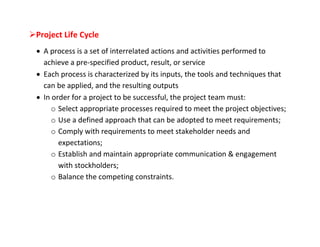
Project Life Cycle
  A process is a set of interrelated actions and activities performed to
   achieve a pre-specified product, result, or service
  Each process is characterized by its inputs, the tools and techniques that
   can be applied, and the resulting outputs
  In order for a project to be successful, the project team must:
      o Select appropriate processes required to meet the project objectives;
      o Use a defined approach that can be adopted to meet requirements;
      o Comply with requirements to meet stakeholder needs and
        expectations;
      o Establish and maintain appropriate communication & engagement
        with stockholders;
      o Balance the competing constraints.
 The project processes are performed by the project team and generally fall
   into one of two major categories:
     o Project management processes ensure the effective flow of the
        project throughout its existence.
     o Product-oriented processes specify and create the project’s product.

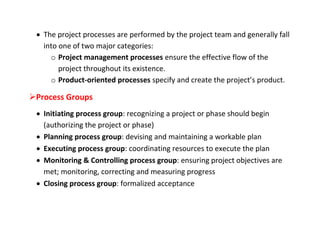
Process Groups
  Initiating process group: recognizing a project or phase should begin
   (authorizing the project or phase)
  Planning process group: devising and maintaining a workable plan
  Executing process group: coordinating resources to execute the plan
  Monitoring & Controlling process group: ensuring project objectives are
   met; monitoring, correcting and measuring progress
  Closing process group: formalized acceptance
 Common Project Management Processes Interactions:
    o Monitoring & Controlling Process Group interacts with the other
      Process Groups
    o Project Management Process Groups are linked by the outputs that
      are produced
    o The Process groups are overlapping activities that occur throughout
      the project
    o The output of one process generally becomes an input to another
      process or is a deliverable of the project, subproject or phase
    o Deliverables of subproject or project level may be called incremental
      deliverables
    o The Planning Process Group provides the Executing Process Group
      with project management plan and project documents
    o Project management plan and project documents always revisited and
      updated
o If the project is divided into phases, the process groups interact with
  each phase
o The Process Groups are not Project Life Cycle Phases
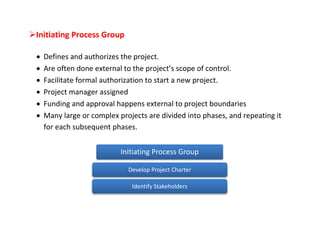
Initiating Process Group

    Defines and authorizes the project.
    Are often done external to the project’s scope of control.
    Facilitate formal authorization to start a new project.
    Project manager assigned
    Funding and approval happens external to project boundaries
    Many large or complex projects are divided into phases, and repeating it
     for each subsequent phases.


                            Initiating Process Group

                              Develop Project Charter

                               Identify Stakeholders
Planning Process Group
  Defines and refines the objectives, and plan the course of action required
   to attain the objective and scope that the project was undertaken to
   address.
  Develops project management plan and also refines project scope, project
   cost and schedule.
  It is updated and refined throughout execution process group by rolling
   wave planning.
  All necessary stakeholders are involved in this process.
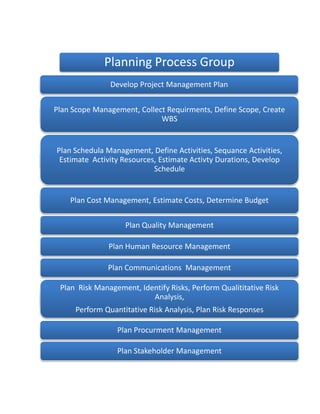
Planning Process Group
               Develop Project Management Plan


Plan Scope Management, Collect Requirments, Define Scope, Create
                             WBS


Plan Schedula Management, Define Activities, Sequance Activities,
 Estimate Activity Resources, Estimate Activty Durations, Develop
                            Schedule


    Plan Cost Management, Estimate Costs, Determine Budget

                    Plan Quality Management

               Plan Human Resource Management

               Plan Communications Management

 Plan Risk Management, Identify Risks, Perform Qualititative Risk
                          Analysis,
     Perform Quantitative Risk Analysis, Plan Risk Responses

                 Plan Procurment Management

                 Plan Stakeholder Management
Execution Process Group


  Majority of the project budget will be spent in performing Executing
   Process Group.
  Integrates people and other resources to carry out the project
   management plan.
  During the project execution, results may require planning updates
   and rebaselining.
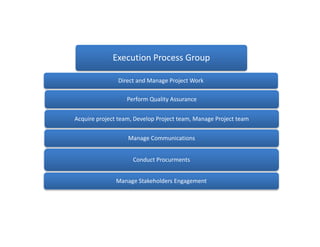
Execution Process Group

               Direct and Manage Project Work

                  Perform Quality Assurance


Acquire project team, Develop Project team, Manage Project team

                   Manage Communications


                     Conduct Procurments


               Manage Stakeholders Engagement
Monitoring & Controlling Process Group
  The main benefit of M&E Process Groups is that the project
   performance is measured and analyzed at regular intervals.
  Monitoring the ongoing project activities against the project
   management plan and the project performance measurement
   baseline
  Influencing the factors that could circumvent change control or
   configuration management so only approved changes are
   implemented.
  Controlling changes and recommending corrective or preventing
   action in anticipation of possible problems.
  M&E Process Group not only monitors and controls the work being
   done within a Process Group, but also monitors and controls the
   entire project effort.
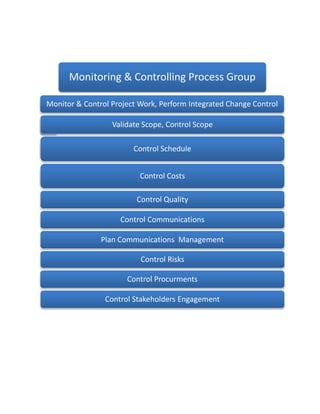
Monitoring & Controlling Process Group

Monitor & Control Project Work, Perform Integrated Change Control

                  Validate Scope, Control Scope

                        Control Schedule


                          Control Costs

                         Control Quality

                    Control Communications

               Plan Communications Management

                          Control Risks

                      Control Procurments

                Control Stakeholders Engagement
Closing Process Group
  Formalizes acceptance of the project or phase deliverable.
  Obtain acceptance by the customer or sponsor to formally close the
   project or the phase
  Conduct post-project or phase-end review
  Record impacts of tailoring to any process
  Document lessons learned
  Apply appropriate updates to organizational process assets.
  Achieve all relevant project documents in the PMIS to be used as
   historical data
  Close out all procurement activities
  Perform team members’ assessments
  Release project resources
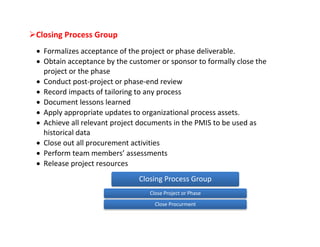
                               Closing Process Group
                                  Close Project or Phase
                                    Close Procurment
Project Information
 The project data are continuously collected and analyzed during the
 dynamic context of the project execution. The project team should use
 appropriate terminologies. Such as:
  Work performance data: the row observations and measurements
   identified during activities performed to carry out the project work.
   (Ex: reported present of work physically completed, quality and
   technical performance measures, start and finish date of scheduled
   activities, number of defects, actual cost, actual duration, etc..)
  Work performance information: the performance data collected from
   various controlling processes, analyzed in context and integrated
   based on relationships across areas.(ex: status of deliverables,
   implementation status for change requests, and furcated estimates to
   complete).
  Work performance reports: the physical or electronic representation
   of work performance information is compiled in project documents,
   intended to raise issues or generate decisions (ex: status reports,
   memos, justifications, information notes, etc…)
You need to understand the terms and the logic relationships between the inputs, outputs and tools& techniques.
Memorizing them is not enough and will lead you nowhere.

Refer to the PMBoK 5h Edition for more details. &
Please do not hesitate to contact me anytime if you have any questions, comments, and feedbacks.


Success is yours,

Prepared By: Amr Miqdadi, PMP
info@pmlead.net
http://www.pmlead.net


                      PMI®, PMP®, CAPM® and PMBOK® Guide are trademarks of the Project Management Institute, Inc.
PMI® has not endorsed and did not participate in the development of this product.

Undestand PMBok 5th, Section 3

  • 1.
    This document ispart of a series that explain the newly released PMBOK 5th edition. These documents provide simple explanation and summary of the book. However they do not replace the necessity of reading the book. Project Management Processes Based on PMBOK® Guide 5th Edition Amr Miqdadi, PMP info@pmlead.net
  • 2.
  • 3.
    Project Life Cycle  A process is a set of interrelated actions and activities performed to achieve a pre-specified product, result, or service  Each process is characterized by its inputs, the tools and techniques that can be applied, and the resulting outputs  In order for a project to be successful, the project team must: o Select appropriate processes required to meet the project objectives; o Use a defined approach that can be adopted to meet requirements; o Comply with requirements to meet stakeholder needs and expectations; o Establish and maintain appropriate communication & engagement with stockholders; o Balance the competing constraints.
  • 4.
     The projectprocesses are performed by the project team and generally fall into one of two major categories: o Project management processes ensure the effective flow of the project throughout its existence. o Product-oriented processes specify and create the project’s product. Process Groups  Initiating process group: recognizing a project or phase should begin (authorizing the project or phase)  Planning process group: devising and maintaining a workable plan  Executing process group: coordinating resources to execute the plan  Monitoring & Controlling process group: ensuring project objectives are met; monitoring, correcting and measuring progress  Closing process group: formalized acceptance
  • 5.
     Common ProjectManagement Processes Interactions: o Monitoring & Controlling Process Group interacts with the other Process Groups o Project Management Process Groups are linked by the outputs that are produced o The Process groups are overlapping activities that occur throughout the project o The output of one process generally becomes an input to another process or is a deliverable of the project, subproject or phase o Deliverables of subproject or project level may be called incremental deliverables o The Planning Process Group provides the Executing Process Group with project management plan and project documents o Project management plan and project documents always revisited and updated
  • 6.
    o If theproject is divided into phases, the process groups interact with each phase o The Process Groups are not Project Life Cycle Phases
  • 7.
    Initiating Process Group  Defines and authorizes the project.  Are often done external to the project’s scope of control.  Facilitate formal authorization to start a new project.  Project manager assigned  Funding and approval happens external to project boundaries  Many large or complex projects are divided into phases, and repeating it for each subsequent phases. Initiating Process Group Develop Project Charter Identify Stakeholders
  • 8.
    Planning Process Group  Defines and refines the objectives, and plan the course of action required to attain the objective and scope that the project was undertaken to address.  Develops project management plan and also refines project scope, project cost and schedule.  It is updated and refined throughout execution process group by rolling wave planning.  All necessary stakeholders are involved in this process.
  • 9.
    Planning Process Group Develop Project Management Plan Plan Scope Management, Collect Requirments, Define Scope, Create WBS Plan Schedula Management, Define Activities, Sequance Activities, Estimate Activity Resources, Estimate Activty Durations, Develop Schedule Plan Cost Management, Estimate Costs, Determine Budget Plan Quality Management Plan Human Resource Management Plan Communications Management Plan Risk Management, Identify Risks, Perform Qualititative Risk Analysis, Perform Quantitative Risk Analysis, Plan Risk Responses Plan Procurment Management Plan Stakeholder Management
  • 10.
    Execution Process Group  Majority of the project budget will be spent in performing Executing Process Group.  Integrates people and other resources to carry out the project management plan.  During the project execution, results may require planning updates and rebaselining.
  • 11.
    Execution Process Group Direct and Manage Project Work Perform Quality Assurance Acquire project team, Develop Project team, Manage Project team Manage Communications Conduct Procurments Manage Stakeholders Engagement
  • 12.
    Monitoring & ControllingProcess Group  The main benefit of M&E Process Groups is that the project performance is measured and analyzed at regular intervals.  Monitoring the ongoing project activities against the project management plan and the project performance measurement baseline  Influencing the factors that could circumvent change control or configuration management so only approved changes are implemented.  Controlling changes and recommending corrective or preventing action in anticipation of possible problems.  M&E Process Group not only monitors and controls the work being done within a Process Group, but also monitors and controls the entire project effort.
  • 13.
    Monitoring & ControllingProcess Group Monitor & Control Project Work, Perform Integrated Change Control Validate Scope, Control Scope Control Schedule Control Costs Control Quality Control Communications Plan Communications Management Control Risks Control Procurments Control Stakeholders Engagement
  • 14.
    Closing Process Group  Formalizes acceptance of the project or phase deliverable.  Obtain acceptance by the customer or sponsor to formally close the project or the phase  Conduct post-project or phase-end review  Record impacts of tailoring to any process  Document lessons learned  Apply appropriate updates to organizational process assets.  Achieve all relevant project documents in the PMIS to be used as historical data  Close out all procurement activities  Perform team members’ assessments  Release project resources Closing Process Group Close Project or Phase Close Procurment
  • 15.
    Project Information Theproject data are continuously collected and analyzed during the dynamic context of the project execution. The project team should use appropriate terminologies. Such as:  Work performance data: the row observations and measurements identified during activities performed to carry out the project work. (Ex: reported present of work physically completed, quality and technical performance measures, start and finish date of scheduled activities, number of defects, actual cost, actual duration, etc..)  Work performance information: the performance data collected from various controlling processes, analyzed in context and integrated based on relationships across areas.(ex: status of deliverables, implementation status for change requests, and furcated estimates to complete).  Work performance reports: the physical or electronic representation of work performance information is compiled in project documents, intended to raise issues or generate decisions (ex: status reports, memos, justifications, information notes, etc…)
  • 16.
    You need tounderstand the terms and the logic relationships between the inputs, outputs and tools& techniques. Memorizing them is not enough and will lead you nowhere. Refer to the PMBoK 5h Edition for more details. & Please do not hesitate to contact me anytime if you have any questions, comments, and feedbacks. Success is yours, Prepared By: Amr Miqdadi, PMP info@pmlead.net http://www.pmlead.net PMI®, PMP®, CAPM® and PMBOK® Guide are trademarks of the Project Management Institute, Inc.
  • 17.
    PMI® has notendorsed and did not participate in the development of this product.