PMI® PMP® CERTIFICATION
EXAM PREPARATION COURSE
PROJECT
SCHEDULE MANAGEMENT
Getting it Done on Time
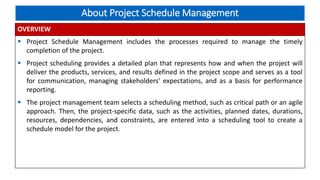
About Project Schedule Management
OVERVIEW
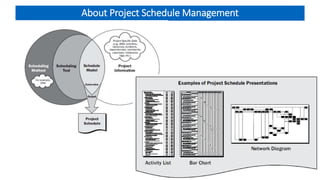
 Project Schedule Management includes the processes required to manage the timely
completion of the project.
 Project scheduling provides a detailed plan that represents how and when the project will
deliver the products, services, and results defined in the project scope and serves as a tool
for communication, managing stakeholders’ expectations, and as a basis for performance
reporting.
 The project management team selects a scheduling method, such as critical path or an agile
approach. Then, the project-specific data, such as the activities, planned dates, durations,
resources, dependencies, and constraints, are entered into a scheduling tool to create a
schedule model for the project.
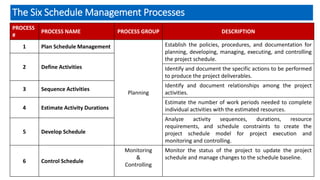
The Six Schedule Management Processes
PROCESS
#
PROCESS NAME PROCESS GROUP DESCRIPTION
1 Plan Schedule Management
Planning
Establish the policies, procedures, and documentation for
planning, developing, managing, executing, and controlling
the project schedule.
2 Define Activities Identify and document the specific actions to be performed
to produce the project deliverables.
3 Sequence Activities
Identify and document relationships among the project
activities.
4 Estimate Activity Durations
Estimate the number of work periods needed to complete
individual activities with the estimated resources.
Analyze activity sequences, durations, resource
requirements, and schedule constraints to create the
project schedule model for project execution and
monitoring and controlling.
5 Develop Schedule
6 Control Schedule
Monitoring
&
Controlling
Monitor the status of the project to update the project
schedule and manage changes to the schedule baseline.
About Project Schedule Management
Trends and Emerging Practices in Project Schedule Management
ITERATIVE SCHEDULING WITH A BACKLOG.
 This is a form of rolling wave planning based on adaptive life cycles, such as the agile
approach for product development.
 The benefit of this approach is that it welcomes changes throughout the development life
cycle.
ON-DEMAND SCHEDULING.
 This approach, typically used in a Kanban system, is based on the theory-of constraints and
pull-based scheduling concepts from lean manufacturing to limit a team’s work in progress in
order to balance demand against the team’s delivery throughput.
 On-demand scheduling is often used for projects that evolve the product incrementally in
operational or sustainment environments, and where tasks may be made relatively similar in
size and scope or can be bundled by size and scope.
About Project Schedule Management
Tailoring Consideration for Project Schedule Management
 LIFECYCLE APPROACH: What is the most appropriate life cycle approach that allows for a
more detailed schedule?
 RESOURCE AVAILABILITY: What are the factors influencing durations (such as the correlation
between available resources and their productivity)?
 PROJECT DIMENSIONS: How will the presence of project complexity, technological
uncertainty, product novelty, pace, or progress tracking (such as earned value, percentage
complete, red-yellow-green (stop light) indicators) impact the desired level of control?
 TECHNOLOGY SUPPORT: Is technology used to develop, record, transmit, receive, and store
project schedule model information and is it readily accessible?
About Project Schedule Management
Consideration for Agile / Adaptive Environments
 In large organizations, there may be a mixture of small projects and large initiatives requiring
long-term roadmaps to manage the development of these programs using scaling factors (e.g.,
team size, geographical distribution, regulatory compliance, organizational complexity, and
technical complexity).
 To address the full delivery life cycle for larger, enterprise-wide systems, a range of techniques
utilizing a predictive approach, adaptive approach, or a hybrid of both, may need to be
adopted.
 The role of the project manager does not change based on managing projects using a
predictive development life cycle or managing projects in adaptive environments. However, to
be successful in using adaptive approaches, the project manager will need to be familiar with
the tools and techniques to understand how to apply them effectively.
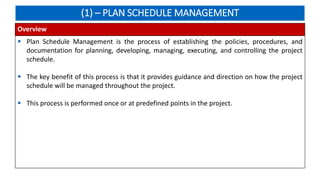
(1) – PLAN SCHEDULE MANAGEMENT
Overview
 Plan Schedule Management is the process of establishing the policies, procedures, and
documentation for planning, developing, managing, executing, and controlling the project
schedule.
 The key benefit of this process is that it provides guidance and direction on how the project
schedule will be managed throughout the project.
 This process is performed once or at predefined points in the project.
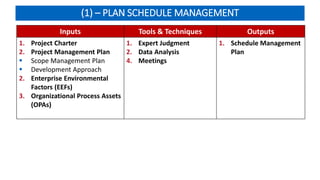
(1) – PLAN SCHEDULE MANAGEMENT
Inputs Tools & Techniques Outputs
1. Project Charter
2. Project Management Plan
 Scope Management Plan
 Development Approach
2. Enterprise Environmental
Factors (EEFs)
3. Organizational Process Assets
(OPAs)
1. Expert Judgment
2. Data Analysis
4. Meetings
1. Schedule Management
Plan
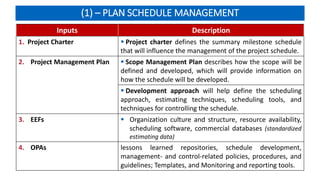
(1) – PLAN SCHEDULE MANAGEMENT
Inputs Description
1. Project Charter  Project charter defines the summary milestone schedule
that will influence the management of the project schedule.
2. Project Management Plan  Scope Management Plan describes how the scope will be
defined and developed, which will provide information on
how the schedule will be developed.
 Development approach will help define the scheduling
approach, estimating techniques, scheduling tools, and
techniques for controlling the schedule.
3. EEFs  Organization culture and structure, resource availability,
scheduling software, commercial databases (standardized
estimating data)
4. OPAs lessons learned repositories, schedule development,
management- and control-related policies, procedures, and
guidelines; Templates, and Monitoring and reporting tools.
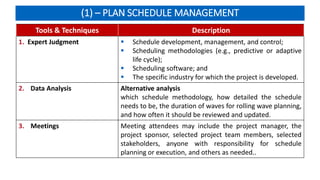
(1) – PLAN SCHEDULE MANAGEMENT
Tools & Techniques Description
1. Expert Judgment  Schedule development, management, and control;
 Scheduling methodologies (e.g., predictive or adaptive
life cycle);
 Scheduling software; and
 The specific industry for which the project is developed.
2. Data Analysis Alternative analysis
which schedule methodology, how detailed the schedule
needs to be, the duration of waves for rolling wave planning,
and how often it should be reviewed and updated.
3. Meetings Meeting attendees may include the project manager, the
project sponsor, selected project team members, selected
stakeholders, anyone with responsibility for schedule
planning or execution, and others as needed..
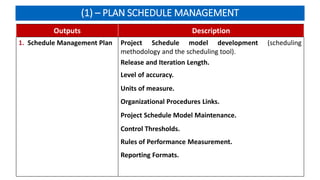
(1) – PLAN SCHEDULE MANAGEMENT
Outputs Description
1. Schedule Management Plan Project Schedule model development (scheduling
methodology and the scheduling tool).
Release and Iteration Length.
Level of accuracy.
Units of measure.
Organizational Procedures Links.
Project Schedule Model Maintenance.
Control Thresholds.
Rules of Performance Measurement.
Reporting Formats.
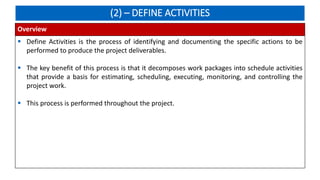
(2) – DEFINE ACTIVITIES
Overview
 Define Activities is the process of identifying and documenting the specific actions to be
performed to produce the project deliverables.
 The key benefit of this process is that it decomposes work packages into schedule activities
that provide a basis for estimating, scheduling, executing, monitoring, and controlling the
project work.
 This process is performed throughout the project.
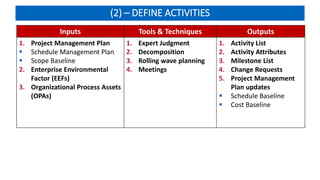
(2) – DEFINE ACTIVITIES
Inputs Tools & Techniques Outputs
1. Project Management Plan
 Schedule Management Plan
 Scope Baseline
2. Enterprise Environmental
Factor (EEFs)
3. Organizational Process Assets
(OPAs)
1. Expert Judgment
2. Decomposition
3. Rolling wave planning
4. Meetings
1. Activity List
2. Activity Attributes
3. Milestone List
4. Change Requests
5. Project Management
Plan updates
 Schedule Baseline
 Cost Baseline
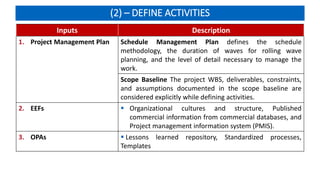
(2) – DEFINE ACTIVITIES
Inputs Description
1. Project Management Plan Schedule Management Plan defines the schedule
methodology, the duration of waves for rolling wave
planning, and the level of detail necessary to manage the
work.
Scope Baseline The project WBS, deliverables, constraints,
and assumptions documented in the scope baseline are
considered explicitly while defining activities.
2. EEFs  Organizational cultures and structure, Published
commercial information from commercial databases, and
Project management information system (PMIS).
3. OPAs  Lessons learned repository, Standardized processes,
Templates
(2) – DEFINE ACTIVITIES
Tools & Techniques Description
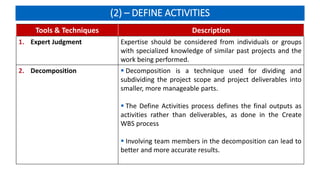
1. Expert Judgment Expertise should be considered from individuals or groups
with specialized knowledge of similar past projects and the
work being performed.
2. Decomposition  Decomposition is a technique used for dividing and
subdividing the project scope and project deliverables into
smaller, more manageable parts.
 The Define Activities process defines the final outputs as
activities rather than deliverables, as done in the Create
WBS process
 Involving team members in the decomposition can lead to
better and more accurate results.
(2) – DEFINE ACTIVITIES
Tools & Techniques Description
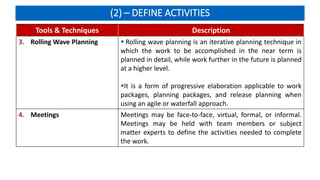
3. Rolling Wave Planning  Rolling wave planning is an iterative planning technique in
which the work to be accomplished in the near term is
planned in detail, while work further in the future is planned
at a higher level.
It is a form of progressive elaboration applicable to work
packages, planning packages, and release planning when
using an agile or waterfall approach.
4. Meetings Meetings may be face-to-face, virtual, formal, or informal.
Meetings may be held with team members or subject
matter experts to define the activities needed to complete
the work.
(2) – DEFINE ACTIVITIES
Outputs Description
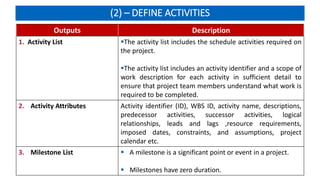
1. Activity List The activity list includes the schedule activities required on
the project.
The activity list includes an activity identifier and a scope of
work description for each activity in sufficient detail to
ensure that project team members understand what work is
required to be completed.
2. Activity Attributes Activity identifier (ID), WBS ID, activity name, descriptions,
predecessor activities, successor activities, logical
relationships, leads and lags ,resource requirements,
imposed dates, constraints, and assumptions, project
calendar etc.
3. Milestone List  A milestone is a significant point or event in a project.
 Milestones have zero duration.
(2) – DEFINE ACTIVITIES
Outputs Description
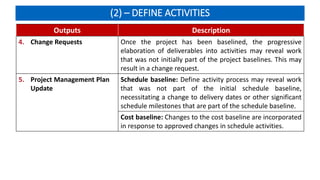
4. Change Requests Once the project has been baselined, the progressive
elaboration of deliverables into activities may reveal work
that was not initially part of the project baselines. This may
result in a change request.
5. Project Management Plan
Update
Schedule baseline: Define activity process may reveal work
that was not part of the initial schedule baseline,
necessitating a change to delivery dates or other significant
schedule milestones that are part of the schedule baseline.
Cost baseline: Changes to the cost baseline are incorporated
in response to approved changes in schedule activities.
(3) – SEQUENCE ACTIVITIES
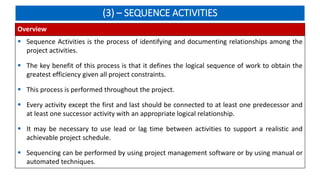
Overview
 Sequence Activities is the process of identifying and documenting relationships among the
project activities.
 The key benefit of this process is that it defines the logical sequence of work to obtain the
greatest efficiency given all project constraints.
 This process is performed throughout the project.
 Every activity except the first and last should be connected to at least one predecessor and
at least one successor activity with an appropriate logical relationship.
 It may be necessary to use lead or lag time between activities to support a realistic and
achievable project schedule.
 Sequencing can be performed by using project management software or by using manual or
automated techniques.
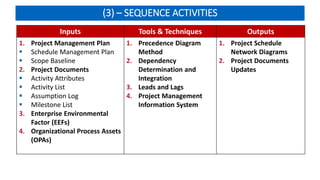
(3) – SEQUENCE ACTIVITIES
Inputs Tools & Techniques Outputs
1. Project Management Plan
 Schedule Management Plan
 Scope Baseline
2. Project Documents
 Activity Attributes
 Activity List
 Assumption Log
 Milestone List
3. Enterprise Environmental
Factor (EEFs)
4. Organizational Process Assets
(OPAs)
1. Precedence Diagram
Method
2. Dependency
Determination and
Integration
3. Leads and Lags
4. Project Management
Information System
1. Project Schedule
Network Diagrams
2. Project Documents
Updates
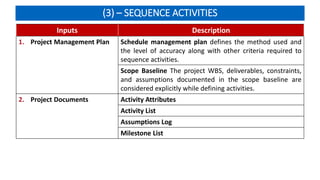
(3) – SEQUENCE ACTIVITIES
Inputs Description
1. Project Management Plan Schedule management plan defines the method used and
the level of accuracy along with other criteria required to
sequence activities.
Scope Baseline The project WBS, deliverables, constraints,
and assumptions documented in the scope baseline are
considered explicitly while defining activities.
2. Project Documents Activity Attributes
Activity List
Assumptions Log
Milestone List
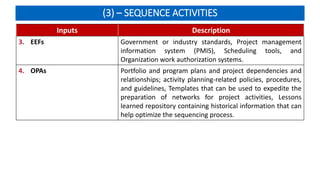
(3) – SEQUENCE ACTIVITIES
Inputs Description
3. EEFs Government or industry standards, Project management
information system (PMIS), Scheduling tools, and
Organization work authorization systems.
4. OPAs Portfolio and program plans and project dependencies and
relationships; activity planning-related policies, procedures,
and guidelines, Templates that can be used to expedite the
preparation of networks for project activities, Lessons
learned repository containing historical information that can
help optimize the sequencing process.
(3) – SEQUENCE ACTIVITIES
Tools & Techniques Description
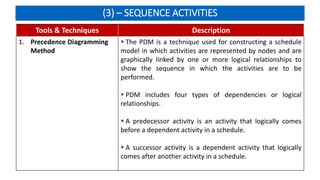
1. Precedence Diagramming
Method
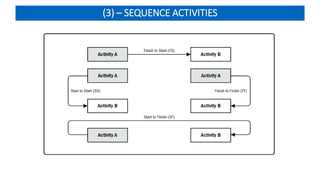
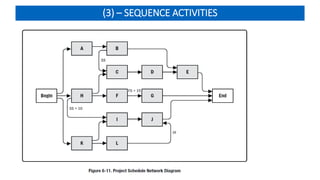
 The PDM is a technique used for constructing a schedule
model in which activities are represented by nodes and are
graphically linked by one or more logical relationships to
show the sequence in which the activities are to be
performed.
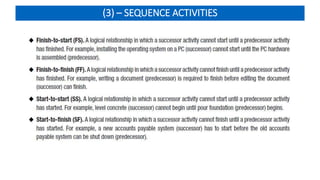
 PDM includes four types of dependencies or logical
relationships.
 A predecessor activity is an activity that logically comes
before a dependent activity in a schedule.
 A successor activity is a dependent activity that logically
comes after another activity in a schedule.
(3) – SEQUENCE ACTIVITIES
Tools & Techniques Description
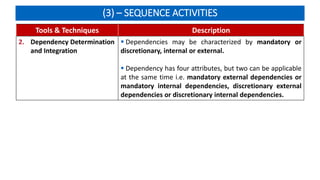
2. Dependency Determination
and Integration
 Dependencies may be characterized by mandatory or
discretionary, internal or external.
 Dependency has four attributes, but two can be applicable
at the same time i.e. mandatory external dependencies or
mandatory internal dependencies, discretionary external
dependencies or discretionary internal dependencies.
(3) – SEQUENCE ACTIVITIES
Tools & Techniques Description
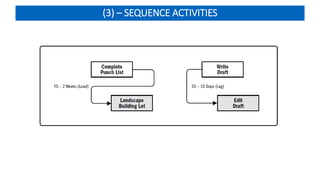
3. Leads and Lags  A lead is the amount of time a successor activity can be
advanced with respect to a predecessor activity.
 A lag is the amount of time a successor activity will be
delayed with respect to a predecessor activity.
4. PMIS Project management information systems includes
scheduling software that has the capability to help plan,
organize, and adjust the sequence of the activities; insert
the logical relationships, lead and lag values; and
differentiate the different types of dependencies.
(3) – SEQUENCE ACTIVITIES
Outputs Description
1. Project Schedule Network
Diagrams
 A project schedule network diagram is a graphical
representation of the logical relationships, also referred to
as dependencies, among the project schedule activities.
 Activities that have multiple predecessor activities indicate
a path convergence.
 Activities that have multiple successor activities indicate a
path divergence.
 Activities with divergence and convergence are at greater
risk as they are affected by multiple activities or can affect
multiple activities.
(3) – SEQUENCE ACTIVITIES
Outputs Description
2. Project Documents Updates Activity Attributes
Activity List
Assumption Log
Milestone List
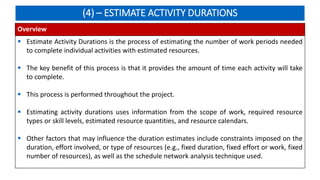
(4) – ESTIMATE ACTIVITY DURATIONS
Overview
 Estimate Activity Durations is the process of estimating the number of work periods needed
to complete individual activities with estimated resources.
 The key benefit of this process is that it provides the amount of time each activity will take
to complete.
 This process is performed throughout the project.
 Estimating activity durations uses information from the scope of work, required resource
types or skill levels, estimated resource quantities, and resource calendars.
 Other factors that may influence the duration estimates include constraints imposed on the
duration, effort involved, or type of resources (e.g., fixed duration, fixed effort or work, fixed
number of resources), as well as the schedule network analysis technique used.
(4) – ESTIMATE ACTIVITY DURATIONS
Overview
Factors for consideration when estimating duration include:
 Law of diminishing returns. When one factor (e.g., resource) used to determine the effort
required to produce a unit of work is increased while all other factors remain fixed, a point
will eventually be reached at which additions of that one factor start to yield progressively
smaller or diminishing increases in output.
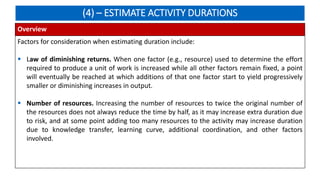
 Number of resources. Increasing the number of resources to twice the original number of
the resources does not always reduce the time by half, as it may increase extra duration due
to risk, and at some point adding too many resources to the activity may increase duration
due to knowledge transfer, learning curve, additional coordination, and other factors
involved.
(4) – ESTIMATE ACTIVITY DURATIONS
Overview
Factors for consideration when estimating duration include:
 Advances in technology. This may also play an important role in determining duration
estimates. For example, an increase in the output of a manufacturing plant may be achieved
by procuring the latest advances in technology, which may impact duration and resource
needs.
 Motivation of staff. The project manager also needs to be aware of Student Syndrome—or
procrastination— when people start to apply themselves only at the last possible moment
before the deadline, and Parkinson’s Law where work expands to fill the time available for its
completion.
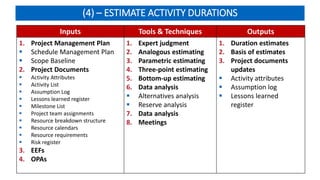
(4) – ESTIMATE ACTIVITY DURATIONS
Inputs Tools & Techniques Outputs
1. Project Management Plan
 Schedule Management Plan
 Scope Baseline
2. Project Documents
 Activity Attributes
 Activity List
 Assumption Log
 Lessons learned register
 Milestone List
 Project team assignments
 Resource breakdown structure
 Resource calendars
 Resource requirements
 Risk register
3. EEFs
4. OPAs
1. Expert judgment
2. Analogous estimating
3. Parametric estimating
4. Three-point estimating
5. Bottom-up estimating
6. Data analysis
 Alternatives analysis
 Reserve analysis
7. Data analysis
8. Meetings
1. Duration estimates
2. Basis of estimates
3. Project documents
updates
 Activity attributes
 Assumption log
 Lessons learned
register
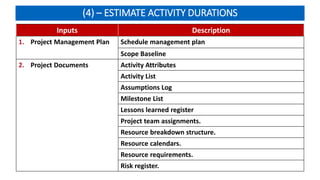
(4) – ESTIMATE ACTIVITY DURATIONS
Inputs Description
1. Project Management Plan Schedule management plan
Scope Baseline
2. Project Documents Activity Attributes
Activity List
Assumptions Log
Milestone List
Lessons learned register
Project team assignments.
Resource breakdown structure.
Resource calendars.
Resource requirements.
Risk register.
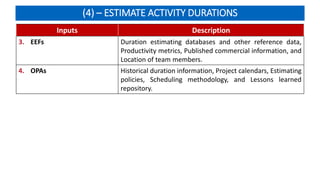
(4) – ESTIMATE ACTIVITY DURATIONS
Inputs Description
3. EEFs Duration estimating databases and other reference data,
Productivity metrics, Published commercial information, and
Location of team members.
4. OPAs Historical duration information, Project calendars, Estimating
policies, Scheduling methodology, and Lessons learned
repository.
(4) – ESTIMATE ACTIVITY DURATIONS
Tools & Techniques Description
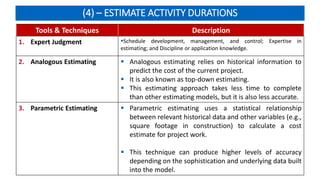
1. Expert Judgment Schedule development, management, and control; Expertise in
estimating; and Discipline or application knowledge.
2. Analogous Estimating  Analogous estimating relies on historical information to
predict the cost of the current project.
 It is also known as top-down estimating.
 This estimating approach takes less time to complete
than other estimating models, but it is also less accurate.
3. Parametric Estimating  Parametric estimating uses a statistical relationship
between relevant historical data and other variables (e.g.,
square footage in construction) to calculate a cost
estimate for project work.
 This technique can produce higher levels of accuracy
depending on the sophistication and underlying data built
into the model.
(4) – ESTIMATE ACTIVITY DURATIONS
Tools & Techniques Description
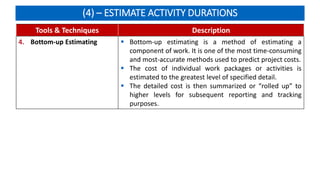
4. Bottom-up Estimating  Bottom-up estimating is a method of estimating a
component of work. It is one of the most time-consuming
and most-accurate methods used to predict project costs.
 The cost of individual work packages or activities is
estimated to the greatest level of specified detail.
 The detailed cost is then summarized or “rolled up” to
higher levels for subsequent reporting and tracking
purposes.
(4) – ESTIMATE ACTIVITY DURATIONS
Tools & Techniques Description
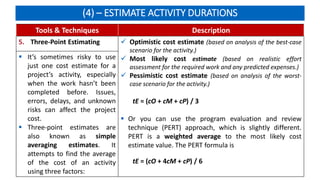
5. Three-Point Estimating  Optimistic cost estimate (based on analysis of the best-case
scenario for the activity.)
 Most likely cost estimate (based on realistic effort
assessment for the required work and any predicted expenses.)
 Pessimistic cost estimate (based on analysis of the worst-
case scenario for the activity.)
tE = (cO + cM + cP) / 3
 Or you can use the program evaluation and review
technique (PERT) approach, which is slightly different.
PERT is a weighted average to the most likely cost
estimate value. The PERT formula is
tE = (cO + 4cM + cP) / 6
 It’s sometimes risky to use
just one cost estimate for a
project’s activity, especially
when the work hasn’t been
completed before. Issues,
errors, delays, and unknown
risks can affect the project
cost.
 Three-point estimates are
also known as simple
averaging estimates. It
attempts to find the average
of the cost of an activity
using three factors:
(4) – ESTIMATE ACTIVITY DURATIONS
Tools & Techniques Description
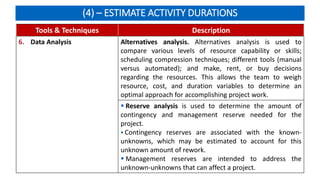
6. Data Analysis Alternatives analysis. Alternatives analysis is used to
compare various levels of resource capability or skills;
scheduling compression techniques; different tools (manual
versus automated); and make, rent, or buy decisions
regarding the resources. This allows the team to weigh
resource, cost, and duration variables to determine an
optimal approach for accomplishing project work.
 Reserve analysis is used to determine the amount of
contingency and management reserve needed for the
project.
 Contingency reserves are associated with the known-
unknowns, which may be estimated to account for this
unknown amount of rework.
 Management reserves are intended to address the
unknown-unknowns that can affect a project.
(4) – ESTIMATE ACTIVITY DURATIONS
Tools & Techniques Description
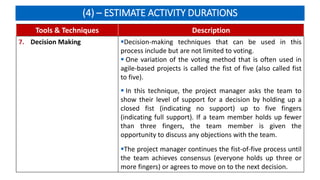
7. Decision Making Decision-making techniques that can be used in this
process include but are not limited to voting.
 One variation of the voting method that is often used in
agile-based projects is called the fist of five (also called fist
to five).
 In this technique, the project manager asks the team to
show their level of support for a decision by holding up a
closed fist (indicating no support) up to five fingers
(indicating full support). If a team member holds up fewer
than three fingers, the team member is given the
opportunity to discuss any objections with the team.
The project manager continues the fist-of-five process until
the team achieves consensus (everyone holds up three or
more fingers) or agrees to move on to the next decision.
(4) – ESTIMATE ACTIVITY DURATIONS
Tools & Techniques Description
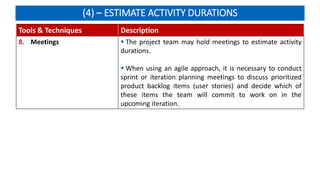
8. Meetings  The project team may hold meetings to estimate activity
durations.
 When using an agile approach, it is necessary to conduct
sprint or iteration planning meetings to discuss prioritized
product backlog items (user stories) and decide which of
these items the team will commit to work on in the
upcoming iteration.
(4) – ESTIMATE ACTIVITY DURATIONS
Outputs Description
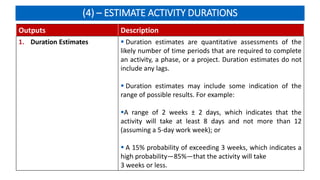
1. Duration Estimates  Duration estimates are quantitative assessments of the
likely number of time periods that are required to complete
an activity, a phase, or a project. Duration estimates do not
include any lags.
 Duration estimates may include some indication of the
range of possible results. For example:
A range of 2 weeks ± 2 days, which indicates that the
activity will take at least 8 days and not more than 12
(assuming a 5-day work week); or
 A 15% probability of exceeding 3 weeks, which indicates a
high probability—85%—that the activity will take
3 weeks or less.
(4) – ESTIMATE ACTIVITY DURATIONS
Outputs Description
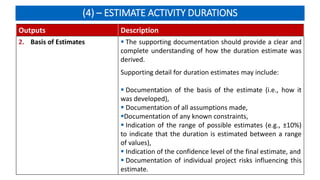
2. Basis of Estimates  The supporting documentation should provide a clear and
complete understanding of how the duration estimate was
derived.
Supporting detail for duration estimates may include:
 Documentation of the basis of the estimate (i.e., how it
was developed),
 Documentation of all assumptions made,
Documentation of any known constraints,
 Indication of the range of possible estimates (e.g., ±10%)
to indicate that the duration is estimated between a range
of values),
 Indication of the confidence level of the final estimate, and
 Documentation of individual project risks influencing this
estimate.
(4) – ESTIMATE ACTIVITY DURATIONS
Outputs Description
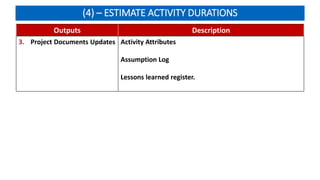
3. Project Documents Updates Activity Attributes
Assumption Log
Lessons learned register.
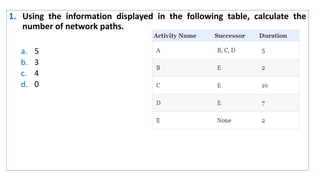
1. Using the information displayed in the following table, calculate the
number of network paths.
a. 5
b. 3
c. 4
d. 0
1. Using the information displayed in the following table, calculate the
number of network paths.
a. 5
b. 3
c. 4
d. 0
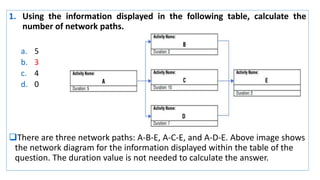
There are three network paths: A-B-E, A-C-E, and A-D-E. Above image shows
the network diagram for the information displayed within the table of the
question. The duration value is not needed to calculate the answer.
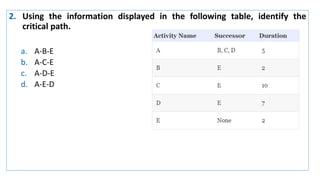
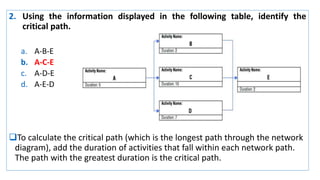
2. Using the information displayed in the following table, identify the
critical path.
a. A-B-E
b. A-C-E
c. A-D-E
d. A-E-D
2. Using the information displayed in the following table, identify the
critical path.
a. A-B-E
b. A-C-E
c. A-D-E
d. A-E-D
To calculate the critical path (which is the longest path through the network
diagram), add the duration of activities that fall within each network path.
The path with the greatest duration is the critical path.
3. You are the project manager for Changing Tides video games. Your
project is a long-term project and will be completed in three phases over
the next two years. You have gathered the inputs for the Estimate
Activity Durations process and are ready to produce the activity duration
estimates. Your sponsor would like a project estimate for all three phases
by the end of the week. He understands that at this stage it will be a
rough order of magnitude estimate and not entirely accurate. Which of
the following tools and techniques will you use to produce this estimate?
a. Parametric estimating
b. Expert judgment
c. Analogous estimating
d. Three-point estimating
3. You are the project manager for Changing Tides video games. Your project is a
long-term project and will be completed in three phases over the next two
years. You have gathered the inputs for the Estimate Activity Durations process
and are ready to produce the activity duration estimates. Your sponsor would
like a project estimate for all three phases by the end of the week. He
understands that at this stage it will be a rough order of magnitude estimate
and not entirely accurate. Which of the following tools and techniques will you
use to produce this estimate?
a. Parametric estimating
b. Expert judgment
c. Analogous estimating
d. Three-point estimating
 Analogous estimating is less time-consuming than other estimating techniques
and can be used to estimate time for different phases on the project. Analogous
estimating is not as accurate as other estimating techniques.

06- PROJECT SCHEDULE MANAGEMENT (PMBOK Ch - 06).pptx

  • 1.
    PMI® PMP® CERTIFICATION EXAMPREPARATION COURSE PROJECT SCHEDULE MANAGEMENT Getting it Done on Time
  • 2.
    About Project ScheduleManagement OVERVIEW  Project Schedule Management includes the processes required to manage the timely completion of the project.  Project scheduling provides a detailed plan that represents how and when the project will deliver the products, services, and results defined in the project scope and serves as a tool for communication, managing stakeholders’ expectations, and as a basis for performance reporting.  The project management team selects a scheduling method, such as critical path or an agile approach. Then, the project-specific data, such as the activities, planned dates, durations, resources, dependencies, and constraints, are entered into a scheduling tool to create a schedule model for the project.
  • 3.
    The Six ScheduleManagement Processes PROCESS # PROCESS NAME PROCESS GROUP DESCRIPTION 1 Plan Schedule Management Planning Establish the policies, procedures, and documentation for planning, developing, managing, executing, and controlling the project schedule. 2 Define Activities Identify and document the specific actions to be performed to produce the project deliverables. 3 Sequence Activities Identify and document relationships among the project activities. 4 Estimate Activity Durations Estimate the number of work periods needed to complete individual activities with the estimated resources. Analyze activity sequences, durations, resource requirements, and schedule constraints to create the project schedule model for project execution and monitoring and controlling. 5 Develop Schedule 6 Control Schedule Monitoring & Controlling Monitor the status of the project to update the project schedule and manage changes to the schedule baseline.
  • 4.
  • 5.
    About Project ScheduleManagement Trends and Emerging Practices in Project Schedule Management ITERATIVE SCHEDULING WITH A BACKLOG.  This is a form of rolling wave planning based on adaptive life cycles, such as the agile approach for product development.  The benefit of this approach is that it welcomes changes throughout the development life cycle. ON-DEMAND SCHEDULING.  This approach, typically used in a Kanban system, is based on the theory-of constraints and pull-based scheduling concepts from lean manufacturing to limit a team’s work in progress in order to balance demand against the team’s delivery throughput.  On-demand scheduling is often used for projects that evolve the product incrementally in operational or sustainment environments, and where tasks may be made relatively similar in size and scope or can be bundled by size and scope.
  • 6.
    About Project ScheduleManagement Tailoring Consideration for Project Schedule Management  LIFECYCLE APPROACH: What is the most appropriate life cycle approach that allows for a more detailed schedule?  RESOURCE AVAILABILITY: What are the factors influencing durations (such as the correlation between available resources and their productivity)?  PROJECT DIMENSIONS: How will the presence of project complexity, technological uncertainty, product novelty, pace, or progress tracking (such as earned value, percentage complete, red-yellow-green (stop light) indicators) impact the desired level of control?  TECHNOLOGY SUPPORT: Is technology used to develop, record, transmit, receive, and store project schedule model information and is it readily accessible?
  • 7.
    About Project ScheduleManagement Consideration for Agile / Adaptive Environments  In large organizations, there may be a mixture of small projects and large initiatives requiring long-term roadmaps to manage the development of these programs using scaling factors (e.g., team size, geographical distribution, regulatory compliance, organizational complexity, and technical complexity).  To address the full delivery life cycle for larger, enterprise-wide systems, a range of techniques utilizing a predictive approach, adaptive approach, or a hybrid of both, may need to be adopted.  The role of the project manager does not change based on managing projects using a predictive development life cycle or managing projects in adaptive environments. However, to be successful in using adaptive approaches, the project manager will need to be familiar with the tools and techniques to understand how to apply them effectively.
  • 8.
    (1) – PLANSCHEDULE MANAGEMENT Overview  Plan Schedule Management is the process of establishing the policies, procedures, and documentation for planning, developing, managing, executing, and controlling the project schedule.  The key benefit of this process is that it provides guidance and direction on how the project schedule will be managed throughout the project.  This process is performed once or at predefined points in the project.
  • 9.
    (1) – PLANSCHEDULE MANAGEMENT Inputs Tools & Techniques Outputs 1. Project Charter 2. Project Management Plan  Scope Management Plan  Development Approach 2. Enterprise Environmental Factors (EEFs) 3. Organizational Process Assets (OPAs) 1. Expert Judgment 2. Data Analysis 4. Meetings 1. Schedule Management Plan
  • 10.
    (1) – PLANSCHEDULE MANAGEMENT Inputs Description 1. Project Charter  Project charter defines the summary milestone schedule that will influence the management of the project schedule. 2. Project Management Plan  Scope Management Plan describes how the scope will be defined and developed, which will provide information on how the schedule will be developed.  Development approach will help define the scheduling approach, estimating techniques, scheduling tools, and techniques for controlling the schedule. 3. EEFs  Organization culture and structure, resource availability, scheduling software, commercial databases (standardized estimating data) 4. OPAs lessons learned repositories, schedule development, management- and control-related policies, procedures, and guidelines; Templates, and Monitoring and reporting tools.
  • 11.
    (1) – PLANSCHEDULE MANAGEMENT Tools & Techniques Description 1. Expert Judgment  Schedule development, management, and control;  Scheduling methodologies (e.g., predictive or adaptive life cycle);  Scheduling software; and  The specific industry for which the project is developed. 2. Data Analysis Alternative analysis which schedule methodology, how detailed the schedule needs to be, the duration of waves for rolling wave planning, and how often it should be reviewed and updated. 3. Meetings Meeting attendees may include the project manager, the project sponsor, selected project team members, selected stakeholders, anyone with responsibility for schedule planning or execution, and others as needed..
  • 12.
    (1) – PLANSCHEDULE MANAGEMENT Outputs Description 1. Schedule Management Plan Project Schedule model development (scheduling methodology and the scheduling tool). Release and Iteration Length. Level of accuracy. Units of measure. Organizational Procedures Links. Project Schedule Model Maintenance. Control Thresholds. Rules of Performance Measurement. Reporting Formats.
  • 13.
    (2) – DEFINEACTIVITIES Overview  Define Activities is the process of identifying and documenting the specific actions to be performed to produce the project deliverables.  The key benefit of this process is that it decomposes work packages into schedule activities that provide a basis for estimating, scheduling, executing, monitoring, and controlling the project work.  This process is performed throughout the project.
  • 14.
    (2) – DEFINEACTIVITIES Inputs Tools & Techniques Outputs 1. Project Management Plan  Schedule Management Plan  Scope Baseline 2. Enterprise Environmental Factor (EEFs) 3. Organizational Process Assets (OPAs) 1. Expert Judgment 2. Decomposition 3. Rolling wave planning 4. Meetings 1. Activity List 2. Activity Attributes 3. Milestone List 4. Change Requests 5. Project Management Plan updates  Schedule Baseline  Cost Baseline
  • 15.
    (2) – DEFINEACTIVITIES Inputs Description 1. Project Management Plan Schedule Management Plan defines the schedule methodology, the duration of waves for rolling wave planning, and the level of detail necessary to manage the work. Scope Baseline The project WBS, deliverables, constraints, and assumptions documented in the scope baseline are considered explicitly while defining activities. 2. EEFs  Organizational cultures and structure, Published commercial information from commercial databases, and Project management information system (PMIS). 3. OPAs  Lessons learned repository, Standardized processes, Templates
  • 16.
    (2) – DEFINEACTIVITIES Tools & Techniques Description 1. Expert Judgment Expertise should be considered from individuals or groups with specialized knowledge of similar past projects and the work being performed. 2. Decomposition  Decomposition is a technique used for dividing and subdividing the project scope and project deliverables into smaller, more manageable parts.  The Define Activities process defines the final outputs as activities rather than deliverables, as done in the Create WBS process  Involving team members in the decomposition can lead to better and more accurate results.
  • 17.
    (2) – DEFINEACTIVITIES Tools & Techniques Description 3. Rolling Wave Planning  Rolling wave planning is an iterative planning technique in which the work to be accomplished in the near term is planned in detail, while work further in the future is planned at a higher level. It is a form of progressive elaboration applicable to work packages, planning packages, and release planning when using an agile or waterfall approach. 4. Meetings Meetings may be face-to-face, virtual, formal, or informal. Meetings may be held with team members or subject matter experts to define the activities needed to complete the work.
  • 18.
    (2) – DEFINEACTIVITIES Outputs Description 1. Activity List The activity list includes the schedule activities required on the project. The activity list includes an activity identifier and a scope of work description for each activity in sufficient detail to ensure that project team members understand what work is required to be completed. 2. Activity Attributes Activity identifier (ID), WBS ID, activity name, descriptions, predecessor activities, successor activities, logical relationships, leads and lags ,resource requirements, imposed dates, constraints, and assumptions, project calendar etc. 3. Milestone List  A milestone is a significant point or event in a project.  Milestones have zero duration.
  • 19.
    (2) – DEFINEACTIVITIES Outputs Description 4. Change Requests Once the project has been baselined, the progressive elaboration of deliverables into activities may reveal work that was not initially part of the project baselines. This may result in a change request. 5. Project Management Plan Update Schedule baseline: Define activity process may reveal work that was not part of the initial schedule baseline, necessitating a change to delivery dates or other significant schedule milestones that are part of the schedule baseline. Cost baseline: Changes to the cost baseline are incorporated in response to approved changes in schedule activities.
  • 20.
    (3) – SEQUENCEACTIVITIES Overview  Sequence Activities is the process of identifying and documenting relationships among the project activities.  The key benefit of this process is that it defines the logical sequence of work to obtain the greatest efficiency given all project constraints.  This process is performed throughout the project.  Every activity except the first and last should be connected to at least one predecessor and at least one successor activity with an appropriate logical relationship.  It may be necessary to use lead or lag time between activities to support a realistic and achievable project schedule.  Sequencing can be performed by using project management software or by using manual or automated techniques.
  • 21.
    (3) – SEQUENCEACTIVITIES Inputs Tools & Techniques Outputs 1. Project Management Plan  Schedule Management Plan  Scope Baseline 2. Project Documents  Activity Attributes  Activity List  Assumption Log  Milestone List 3. Enterprise Environmental Factor (EEFs) 4. Organizational Process Assets (OPAs) 1. Precedence Diagram Method 2. Dependency Determination and Integration 3. Leads and Lags 4. Project Management Information System 1. Project Schedule Network Diagrams 2. Project Documents Updates
  • 22.
    (3) – SEQUENCEACTIVITIES Inputs Description 1. Project Management Plan Schedule management plan defines the method used and the level of accuracy along with other criteria required to sequence activities. Scope Baseline The project WBS, deliverables, constraints, and assumptions documented in the scope baseline are considered explicitly while defining activities. 2. Project Documents Activity Attributes Activity List Assumptions Log Milestone List
  • 23.
    (3) – SEQUENCEACTIVITIES Inputs Description 3. EEFs Government or industry standards, Project management information system (PMIS), Scheduling tools, and Organization work authorization systems. 4. OPAs Portfolio and program plans and project dependencies and relationships; activity planning-related policies, procedures, and guidelines, Templates that can be used to expedite the preparation of networks for project activities, Lessons learned repository containing historical information that can help optimize the sequencing process.
  • 24.
    (3) – SEQUENCEACTIVITIES Tools & Techniques Description 1. Precedence Diagramming Method  The PDM is a technique used for constructing a schedule model in which activities are represented by nodes and are graphically linked by one or more logical relationships to show the sequence in which the activities are to be performed.  PDM includes four types of dependencies or logical relationships.  A predecessor activity is an activity that logically comes before a dependent activity in a schedule.  A successor activity is a dependent activity that logically comes after another activity in a schedule.
  • 25.
    (3) – SEQUENCEACTIVITIES
  • 26.
    (3) – SEQUENCEACTIVITIES
  • 27.
    (3) – SEQUENCEACTIVITIES Tools & Techniques Description 2. Dependency Determination and Integration  Dependencies may be characterized by mandatory or discretionary, internal or external.  Dependency has four attributes, but two can be applicable at the same time i.e. mandatory external dependencies or mandatory internal dependencies, discretionary external dependencies or discretionary internal dependencies.
  • 28.
    (3) – SEQUENCEACTIVITIES
  • 29.
    (3) – SEQUENCEACTIVITIES
  • 30.
    (3) – SEQUENCEACTIVITIES
  • 31.
    (3) – SEQUENCEACTIVITIES Tools & Techniques Description 3. Leads and Lags  A lead is the amount of time a successor activity can be advanced with respect to a predecessor activity.  A lag is the amount of time a successor activity will be delayed with respect to a predecessor activity. 4. PMIS Project management information systems includes scheduling software that has the capability to help plan, organize, and adjust the sequence of the activities; insert the logical relationships, lead and lag values; and differentiate the different types of dependencies.
  • 32.
    (3) – SEQUENCEACTIVITIES
  • 33.
    (3) – SEQUENCEACTIVITIES
  • 34.
    (3) – SEQUENCEACTIVITIES Outputs Description 1. Project Schedule Network Diagrams  A project schedule network diagram is a graphical representation of the logical relationships, also referred to as dependencies, among the project schedule activities.  Activities that have multiple predecessor activities indicate a path convergence.  Activities that have multiple successor activities indicate a path divergence.  Activities with divergence and convergence are at greater risk as they are affected by multiple activities or can affect multiple activities.
  • 35.
    (3) – SEQUENCEACTIVITIES Outputs Description 2. Project Documents Updates Activity Attributes Activity List Assumption Log Milestone List
  • 36.
    (4) – ESTIMATEACTIVITY DURATIONS Overview  Estimate Activity Durations is the process of estimating the number of work periods needed to complete individual activities with estimated resources.  The key benefit of this process is that it provides the amount of time each activity will take to complete.  This process is performed throughout the project.  Estimating activity durations uses information from the scope of work, required resource types or skill levels, estimated resource quantities, and resource calendars.  Other factors that may influence the duration estimates include constraints imposed on the duration, effort involved, or type of resources (e.g., fixed duration, fixed effort or work, fixed number of resources), as well as the schedule network analysis technique used.
  • 37.
    (4) – ESTIMATEACTIVITY DURATIONS Overview Factors for consideration when estimating duration include:  Law of diminishing returns. When one factor (e.g., resource) used to determine the effort required to produce a unit of work is increased while all other factors remain fixed, a point will eventually be reached at which additions of that one factor start to yield progressively smaller or diminishing increases in output.  Number of resources. Increasing the number of resources to twice the original number of the resources does not always reduce the time by half, as it may increase extra duration due to risk, and at some point adding too many resources to the activity may increase duration due to knowledge transfer, learning curve, additional coordination, and other factors involved.
  • 38.
    (4) – ESTIMATEACTIVITY DURATIONS Overview Factors for consideration when estimating duration include:  Advances in technology. This may also play an important role in determining duration estimates. For example, an increase in the output of a manufacturing plant may be achieved by procuring the latest advances in technology, which may impact duration and resource needs.  Motivation of staff. The project manager also needs to be aware of Student Syndrome—or procrastination— when people start to apply themselves only at the last possible moment before the deadline, and Parkinson’s Law where work expands to fill the time available for its completion.
  • 39.
    (4) – ESTIMATEACTIVITY DURATIONS Inputs Tools & Techniques Outputs 1. Project Management Plan  Schedule Management Plan  Scope Baseline 2. Project Documents  Activity Attributes  Activity List  Assumption Log  Lessons learned register  Milestone List  Project team assignments  Resource breakdown structure  Resource calendars  Resource requirements  Risk register 3. EEFs 4. OPAs 1. Expert judgment 2. Analogous estimating 3. Parametric estimating 4. Three-point estimating 5. Bottom-up estimating 6. Data analysis  Alternatives analysis  Reserve analysis 7. Data analysis 8. Meetings 1. Duration estimates 2. Basis of estimates 3. Project documents updates  Activity attributes  Assumption log  Lessons learned register
  • 40.
    (4) – ESTIMATEACTIVITY DURATIONS Inputs Description 1. Project Management Plan Schedule management plan Scope Baseline 2. Project Documents Activity Attributes Activity List Assumptions Log Milestone List Lessons learned register Project team assignments. Resource breakdown structure. Resource calendars. Resource requirements. Risk register.
  • 41.
    (4) – ESTIMATEACTIVITY DURATIONS Inputs Description 3. EEFs Duration estimating databases and other reference data, Productivity metrics, Published commercial information, and Location of team members. 4. OPAs Historical duration information, Project calendars, Estimating policies, Scheduling methodology, and Lessons learned repository.
  • 42.
    (4) – ESTIMATEACTIVITY DURATIONS Tools & Techniques Description 1. Expert Judgment Schedule development, management, and control; Expertise in estimating; and Discipline or application knowledge. 2. Analogous Estimating  Analogous estimating relies on historical information to predict the cost of the current project.  It is also known as top-down estimating.  This estimating approach takes less time to complete than other estimating models, but it is also less accurate. 3. Parametric Estimating  Parametric estimating uses a statistical relationship between relevant historical data and other variables (e.g., square footage in construction) to calculate a cost estimate for project work.  This technique can produce higher levels of accuracy depending on the sophistication and underlying data built into the model.
  • 43.
    (4) – ESTIMATEACTIVITY DURATIONS Tools & Techniques Description 4. Bottom-up Estimating  Bottom-up estimating is a method of estimating a component of work. It is one of the most time-consuming and most-accurate methods used to predict project costs.  The cost of individual work packages or activities is estimated to the greatest level of specified detail.  The detailed cost is then summarized or “rolled up” to higher levels for subsequent reporting and tracking purposes.
  • 44.
    (4) – ESTIMATEACTIVITY DURATIONS Tools & Techniques Description 5. Three-Point Estimating  Optimistic cost estimate (based on analysis of the best-case scenario for the activity.)  Most likely cost estimate (based on realistic effort assessment for the required work and any predicted expenses.)  Pessimistic cost estimate (based on analysis of the worst- case scenario for the activity.) tE = (cO + cM + cP) / 3  Or you can use the program evaluation and review technique (PERT) approach, which is slightly different. PERT is a weighted average to the most likely cost estimate value. The PERT formula is tE = (cO + 4cM + cP) / 6  It’s sometimes risky to use just one cost estimate for a project’s activity, especially when the work hasn’t been completed before. Issues, errors, delays, and unknown risks can affect the project cost.  Three-point estimates are also known as simple averaging estimates. It attempts to find the average of the cost of an activity using three factors:
  • 45.
    (4) – ESTIMATEACTIVITY DURATIONS Tools & Techniques Description 6. Data Analysis Alternatives analysis. Alternatives analysis is used to compare various levels of resource capability or skills; scheduling compression techniques; different tools (manual versus automated); and make, rent, or buy decisions regarding the resources. This allows the team to weigh resource, cost, and duration variables to determine an optimal approach for accomplishing project work.  Reserve analysis is used to determine the amount of contingency and management reserve needed for the project.  Contingency reserves are associated with the known- unknowns, which may be estimated to account for this unknown amount of rework.  Management reserves are intended to address the unknown-unknowns that can affect a project.
  • 46.
    (4) – ESTIMATEACTIVITY DURATIONS Tools & Techniques Description 7. Decision Making Decision-making techniques that can be used in this process include but are not limited to voting.  One variation of the voting method that is often used in agile-based projects is called the fist of five (also called fist to five).  In this technique, the project manager asks the team to show their level of support for a decision by holding up a closed fist (indicating no support) up to five fingers (indicating full support). If a team member holds up fewer than three fingers, the team member is given the opportunity to discuss any objections with the team. The project manager continues the fist-of-five process until the team achieves consensus (everyone holds up three or more fingers) or agrees to move on to the next decision.
  • 47.
    (4) – ESTIMATEACTIVITY DURATIONS Tools & Techniques Description 8. Meetings  The project team may hold meetings to estimate activity durations.  When using an agile approach, it is necessary to conduct sprint or iteration planning meetings to discuss prioritized product backlog items (user stories) and decide which of these items the team will commit to work on in the upcoming iteration.
  • 48.
    (4) – ESTIMATEACTIVITY DURATIONS Outputs Description 1. Duration Estimates  Duration estimates are quantitative assessments of the likely number of time periods that are required to complete an activity, a phase, or a project. Duration estimates do not include any lags.  Duration estimates may include some indication of the range of possible results. For example: A range of 2 weeks ± 2 days, which indicates that the activity will take at least 8 days and not more than 12 (assuming a 5-day work week); or  A 15% probability of exceeding 3 weeks, which indicates a high probability—85%—that the activity will take 3 weeks or less.
  • 49.
    (4) – ESTIMATEACTIVITY DURATIONS Outputs Description 2. Basis of Estimates  The supporting documentation should provide a clear and complete understanding of how the duration estimate was derived. Supporting detail for duration estimates may include:  Documentation of the basis of the estimate (i.e., how it was developed),  Documentation of all assumptions made, Documentation of any known constraints,  Indication of the range of possible estimates (e.g., ±10%) to indicate that the duration is estimated between a range of values),  Indication of the confidence level of the final estimate, and  Documentation of individual project risks influencing this estimate.
  • 50.
    (4) – ESTIMATEACTIVITY DURATIONS Outputs Description 3. Project Documents Updates Activity Attributes Assumption Log Lessons learned register.
  • 51.
    1. Using theinformation displayed in the following table, calculate the number of network paths. a. 5 b. 3 c. 4 d. 0
  • 52.
    1. Using theinformation displayed in the following table, calculate the number of network paths. a. 5 b. 3 c. 4 d. 0 There are three network paths: A-B-E, A-C-E, and A-D-E. Above image shows the network diagram for the information displayed within the table of the question. The duration value is not needed to calculate the answer.
  • 53.
    2. Using theinformation displayed in the following table, identify the critical path. a. A-B-E b. A-C-E c. A-D-E d. A-E-D
  • 54.
    2. Using theinformation displayed in the following table, identify the critical path. a. A-B-E b. A-C-E c. A-D-E d. A-E-D To calculate the critical path (which is the longest path through the network diagram), add the duration of activities that fall within each network path. The path with the greatest duration is the critical path.
  • 55.
    3. You arethe project manager for Changing Tides video games. Your project is a long-term project and will be completed in three phases over the next two years. You have gathered the inputs for the Estimate Activity Durations process and are ready to produce the activity duration estimates. Your sponsor would like a project estimate for all three phases by the end of the week. He understands that at this stage it will be a rough order of magnitude estimate and not entirely accurate. Which of the following tools and techniques will you use to produce this estimate? a. Parametric estimating b. Expert judgment c. Analogous estimating d. Three-point estimating
  • 56.
    3. You arethe project manager for Changing Tides video games. Your project is a long-term project and will be completed in three phases over the next two years. You have gathered the inputs for the Estimate Activity Durations process and are ready to produce the activity duration estimates. Your sponsor would like a project estimate for all three phases by the end of the week. He understands that at this stage it will be a rough order of magnitude estimate and not entirely accurate. Which of the following tools and techniques will you use to produce this estimate? a. Parametric estimating b. Expert judgment c. Analogous estimating d. Three-point estimating  Analogous estimating is less time-consuming than other estimating techniques and can be used to estimate time for different phases on the project. Analogous estimating is not as accurate as other estimating techniques.