QUESTIONS FOR PROJECT MANAGEMENT FRAMEWORK – PMP Course
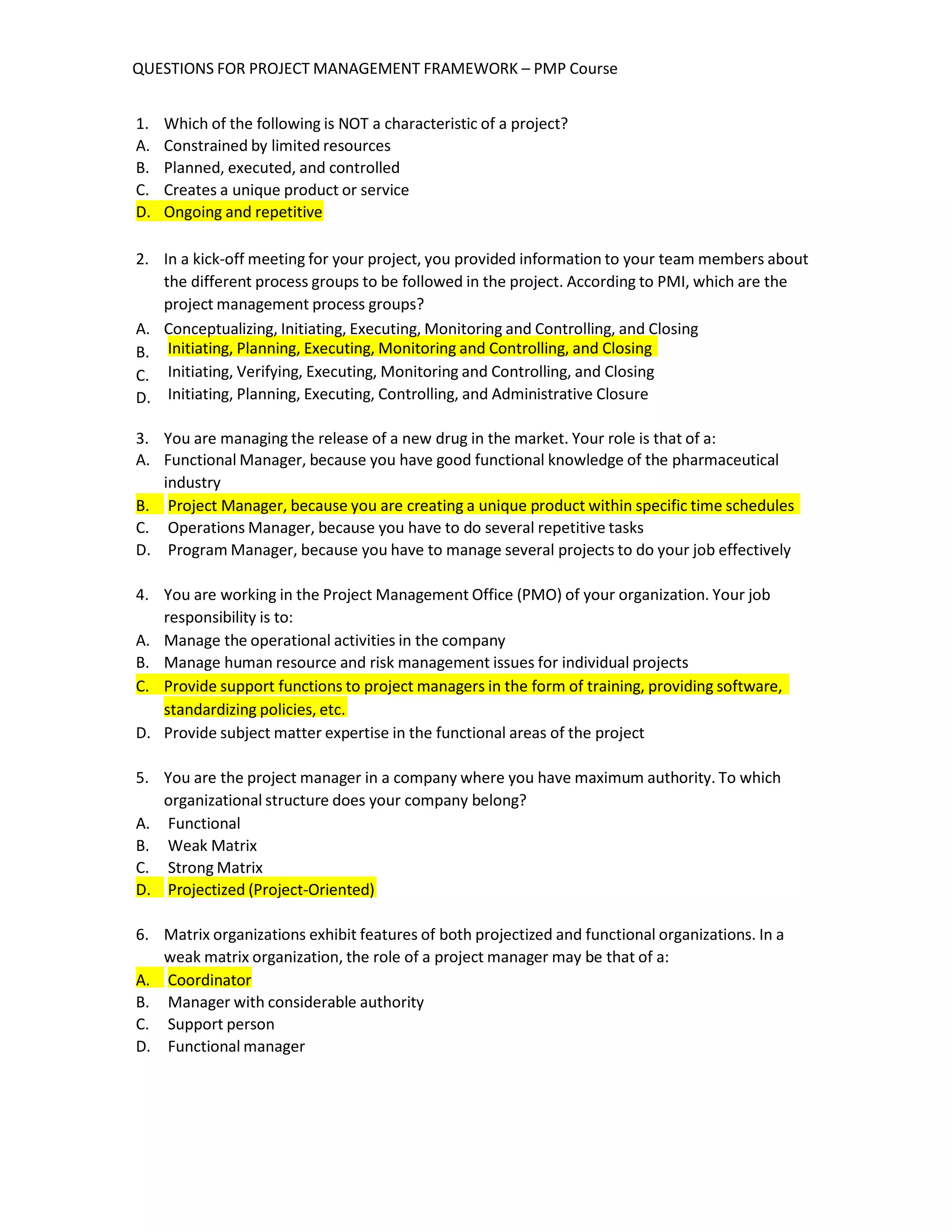
1. Which of the following is NOT a characteristic of a project?
A. Constrained by limited resources
B. Planned, executed, and controlled
C. Creates a unique product or service
D. Ongoing and repetitive
2. In a kick-off meeting for your project, you provided information to your team members about
the different process groups to be followed in the project. According to PMI, which are the
project management process groups?
A. Conceptualizing, Initiating, Executing, Monitoring and Controlling, and Closing
B.
C.
D.
Initiating, Planning, Executing, Monitoring and Controlling, and Closing
Initiating, Verifying, Executing, Monitoring and Controlling, and Closing
Initiating, Planning, Executing, Controlling, and Administrative Closure
3. You are managing the release of a new drug in the market. Your role is that of a:
A. Functional Manager, because you have good functional knowledge of the pharmaceutical
industry
B. Project Manager, because you are creating a unique product within specific time schedules
C. Operations Manager, because you have to do several repetitive tasks
D. Program Manager, because you have to manage several projects to do your job effectively
4. You are working in the Project Management Office (PMO) of your organization. Your job
responsibility is to:
A. Manage the operational activities in the company
B. Manage human resource and risk management issues for individual projects
C. Provide support functions to project managers in the form of training, providing software,
standardizing policies, etc.
D. Provide subject matter expertise in the functional areas of the project
5. You are the project manager in a company where you have maximum authority. To which
organizational structure does your company belong?
A. Functional
B. Weak Matrix
C. Strong Matrix
D. Projectized (Project-Oriented)
6. Matrix organizations exhibit features of both projectized and functional organizations. In a
weak matrix organization, the role of a project manager may be that of a:
A. Coordinator
B. Manager with considerable authority
C. Support person
D. Functional manager
QUESTIONS FOR PROJECT MANAGEMENT FRAMEWORK – PMP Course
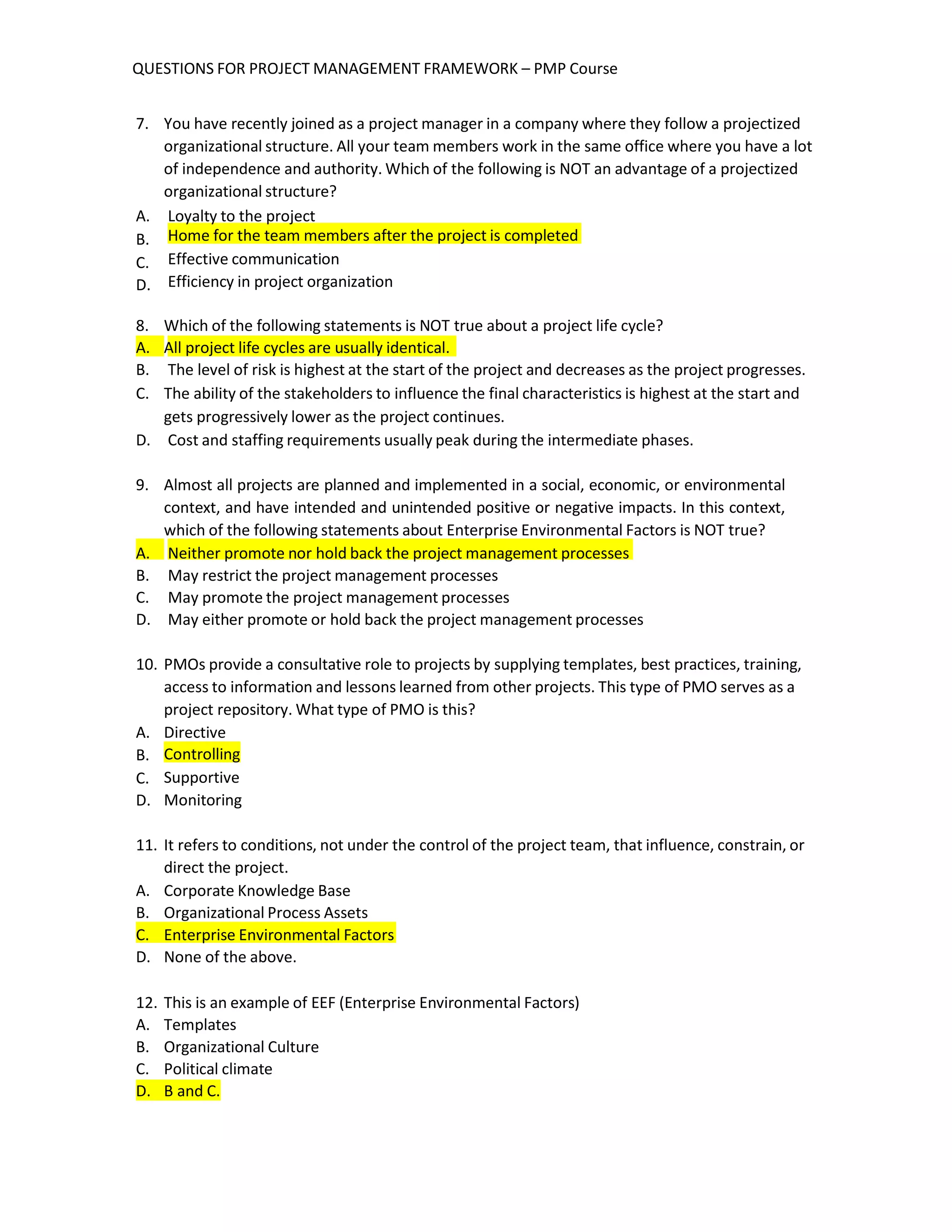
7. You have recently joined as a project manager in a company where they follow a projectized
organizational structure. All your team members work in the same office where you have a lot
of independence and authority. Which of the following is NOT an advantage of a projectized
organizational structure?
A. Loyalty to the project
B.
C.
D.
Home for the team members after the project is completed
Effective communication
Efficiency in project organization
8. Which of the following statements is NOT true about a project life cycle?
A. All project life cycles are usually identical.
B. The level of risk is highest at the start of the project and decreases as the project progresses.
C. The ability of the stakeholders to influence the final characteristics is highest at the start and
gets progressively lower as the project continues.
D. Cost and staffing requirements usually peak during the intermediate phases.
9. Almost all projects are planned and implemented in a social, economic, or environmental
context, and have intended and unintended positive or negative impacts. In this context,
which of the following statements about Enterprise Environmental Factors is NOT true?
A. Neither promote nor hold back the project management processes
B. May restrict the project management processes
C. May promote the project management processes
D. May either promote or hold back the project management processes
10. PMOs provide a consultative role to projects by supplying templates, best practices, training,
access to information and lessons learned from other projects. This type of PMO serves as a
project repository. What type of PMO is this?
A. Directive
B.
C.
D.
Controlling
Supportive
Monitoring
11. It refers to conditions, not under the control of the project team, that influence, constrain, or
direct the project.
A. Corporate Knowledge Base
B. Organizational Process Assets
C. Enterprise Environmental Factors
D. None of the above.
12. This is an example of EEF (Enterprise Environmental Factors)
A. Templates
B. Organizational Culture
C. Political climate
D. B and C.
QUESTIONS FOR PROJECT MANAGEMENT FRAMEWORK – PMP Course
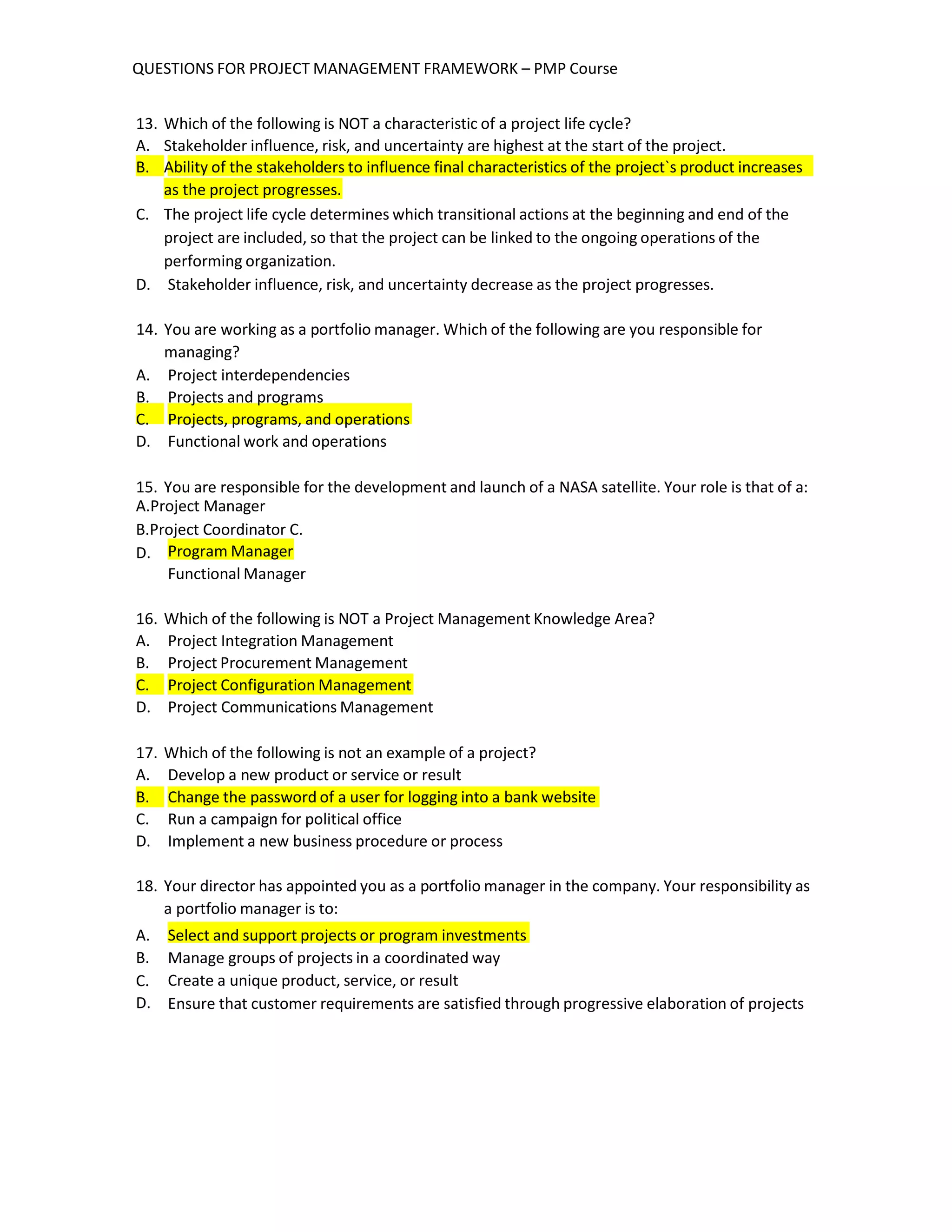
13. Which of the following is NOT a characteristic of a project life cycle?
A. Stakeholder influence, risk, and uncertainty are highest at the start of the project.
B. Ability of the stakeholders to influence final characteristics of the project`s product increases
as the project progresses.
C. The project life cycle determines which transitional actions at the beginning and end of the
project are included, so that the project can be linked to the ongoing operations of the
performing organization.
D. Stakeholder influence, risk, and uncertainty decrease as the project progresses.
14. You are working as a portfolio manager. Which of the following are you responsible for
managing?
A. Project interdependencies
B. Projects and programs
C. Projects, programs, and operations
D. Functional work and operations
15. You are responsible for the development and launch of a NASA satellite. Your role is that of a:
A.Project Manager
B.Project Coordinator C.
D. Program Manager
Functional Manager
16. Which of the following is NOT a Project Management Knowledge Area?
A. Project Integration Management
B. Project Procurement Management
C. Project Configuration Management
D. Project Communications Management
17. Which of the following is not an example of a project?
A. Develop a new product or service or result
B. Change the password of a user for logging into a bank website
C. Run a campaign for political office
D. Implement a new business procedure or process
18. Your director has appointed you as a portfolio manager in the company. Your responsibility as
a portfolio manager is to:
A. Select and support projects or program investments
B.
C.
D.
Manage groups of projects in a coordinated way
Create a unique product, service, or result
Ensure that customer requirements are satisfied through progressive elaboration of projects
QUESTIONS FOR PROJECT MANAGEMENT FRAMEWORK – PMP Course
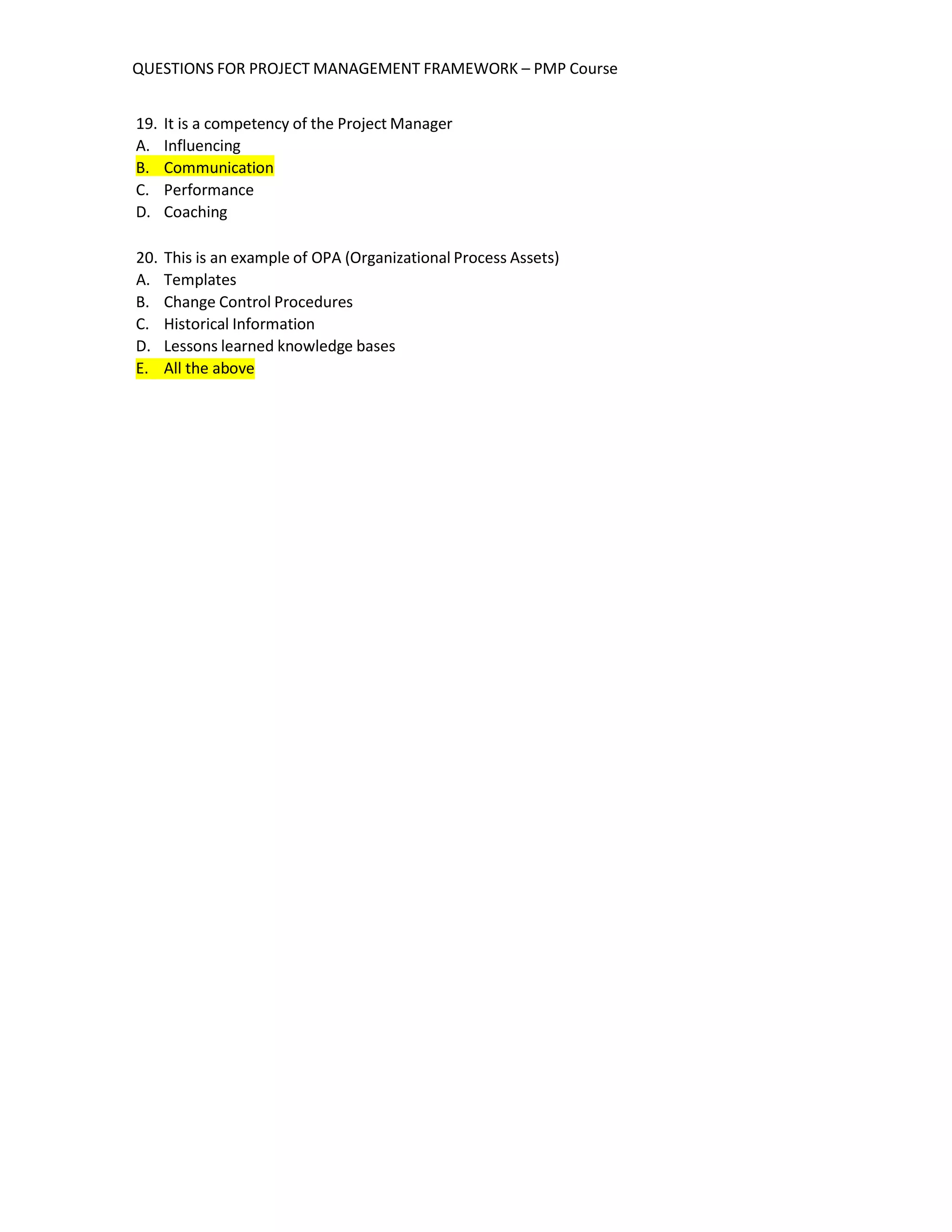
19. It is a competency of the Project Manager
A. Influencing
B. Communication
C. Performance
D. Coaching
20. This is an example of OPA (Organizational Process Assets)
A. Templates
B. Change Control Procedures
C. Historical Information
D. Lessons learned knowledge bases
E. All the above
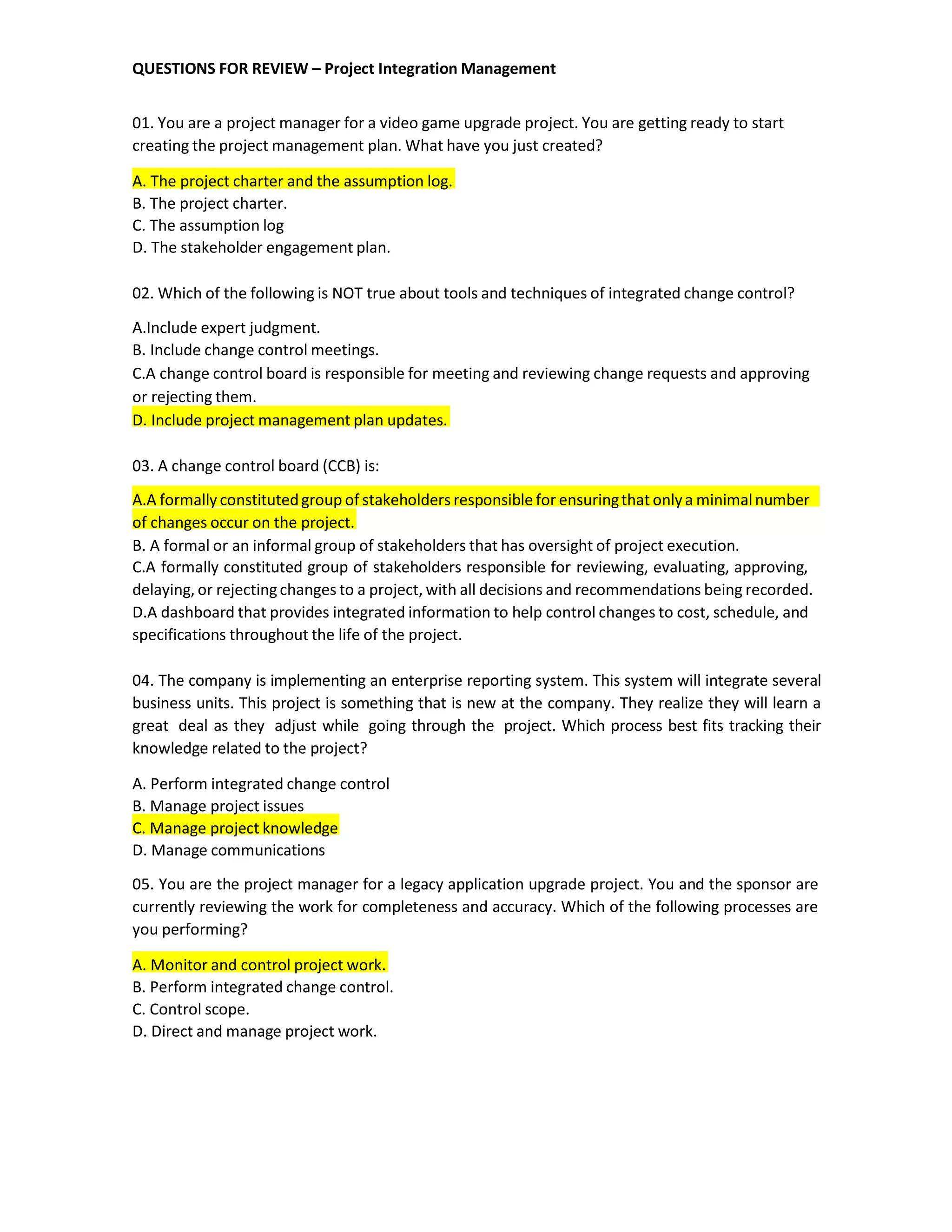
QUESTIONS FOR REVIEW – Project Integration Management
01. You are a project manager for a video game upgrade project. You are getting ready to start
creating the project management plan. What have you just created?
A. The project charter and the assumption log.
B. The project charter.
C. The assumption log
D. The stakeholder engagement plan.
02. Which of the following is NOT true about tools and techniques of integrated change control?
A.Include expert judgment.
B. Include change control meetings.
C.A change control board is responsible for meeting and reviewing change requests and approving
or rejecting them.
D. Include project management plan updates.
03. A change control board (CCB) is:
A.A formally constitutedgroup of stakeholders responsible for ensuringthat onlya minimalnumber
of changes occur on the project.
B. A formal or an informal group of stakeholders that has oversight of project execution.
C.A formally constituted group of stakeholders responsible for reviewing, evaluating, approving,
delaying, or rejectingchanges to a project, with all decisions and recommendations being recorded.
D.A dashboard that provides integrated information to help control changes to cost, schedule, and
specifications throughout the life of the project.
04. The company is implementing an enterprise reporting system. This system will integrate several
business units. This project is something that is new at the company. They realize they will learn a
great deal as they adjust while going through the project. Which process best fits tracking their
knowledge related to the project?
A. Perform integrated change control
B. Manage project issues
C. Manage project knowledge
D. Manage communications
05. You are the project manager for a legacy application upgrade project. You and the sponsor are
currently reviewing the work for completeness and accuracy. Which of the following processes are
you performing?
A. Monitor and control project work.
B. Perform integrated change control.
C. Control scope.
D. Direct and manage project work.
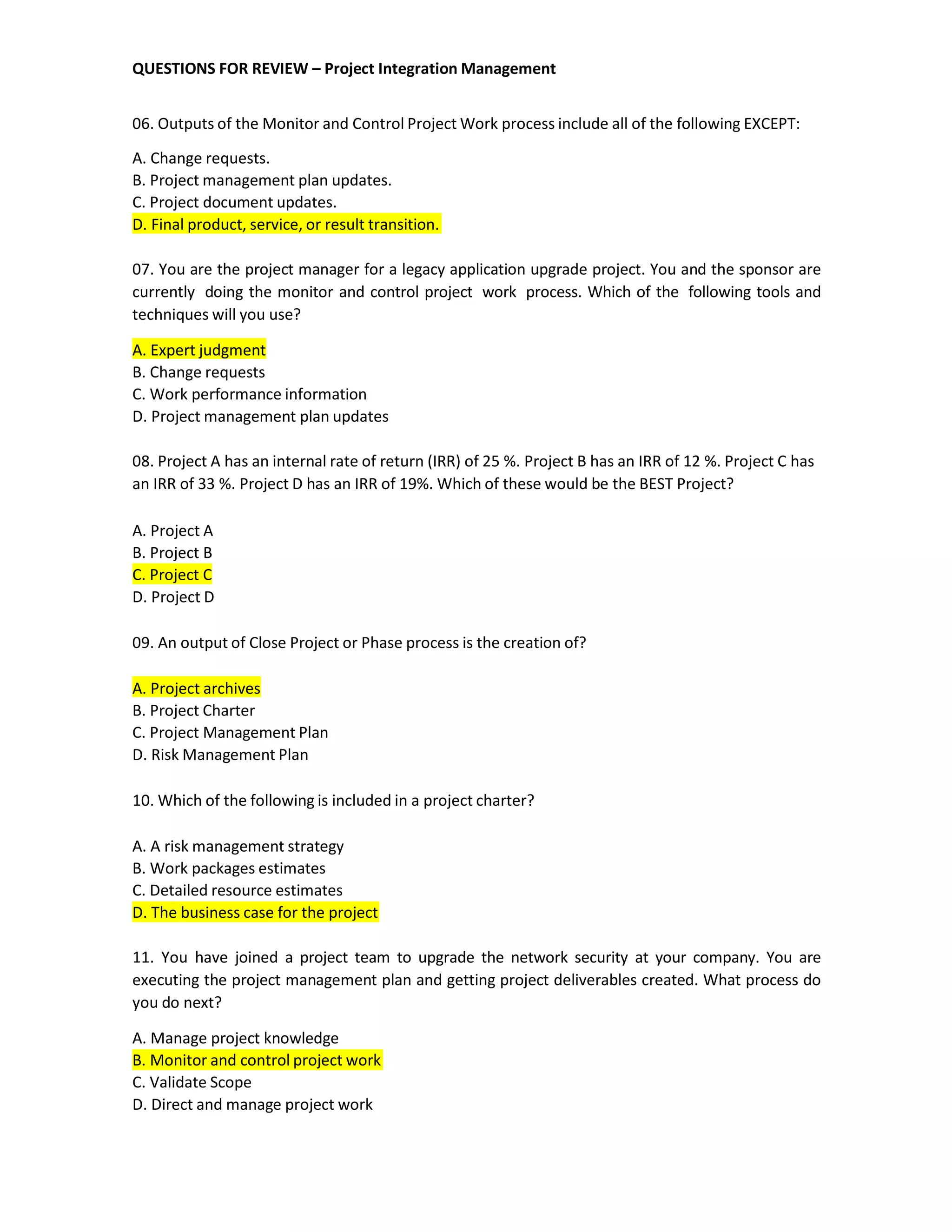
QUESTIONS FOR REVIEW – Project Integration Management
06. Outputs of the Monitor and Control Project Work process include all of the following EXCEPT:
A. Change requests.
B. Project management plan updates.
C. Project document updates.
D. Final product, service, or result transition.
07. You are the project manager for a legacy application upgrade project. You and the sponsor are
currently doing the monitor and control project work process. Which of the following tools and
techniques will you use?
A. Expert judgment
B. Change requests
C. Work performance information
D. Project management plan updates
08. Project A has an internal rate of return (IRR) of 25 %. Project B has an IRR of 12 %. Project C has
an IRR of 33 %. Project D has an IRR of 19%. Which of these would be the BEST Project?
A. Project A
B. Project B
C. Project C
D. Project D
09. An output of Close Project or Phase process is the creation of?
A. Project archives
B. Project Charter
C. Project Management Plan
D. Risk Management Plan
10. Which of the following is included in a project charter?
A. A risk management strategy
B. Work packages estimates
C. Detailed resource estimates
D. The business case for the project
11. You have joined a project team to upgrade the network security at your company. You are
executing the project management plan and getting project deliverables created. What process do
you do next?
A. Manage project knowledge
B. Monitor and control project work
C. Validate Scope
D. Direct and manage project work
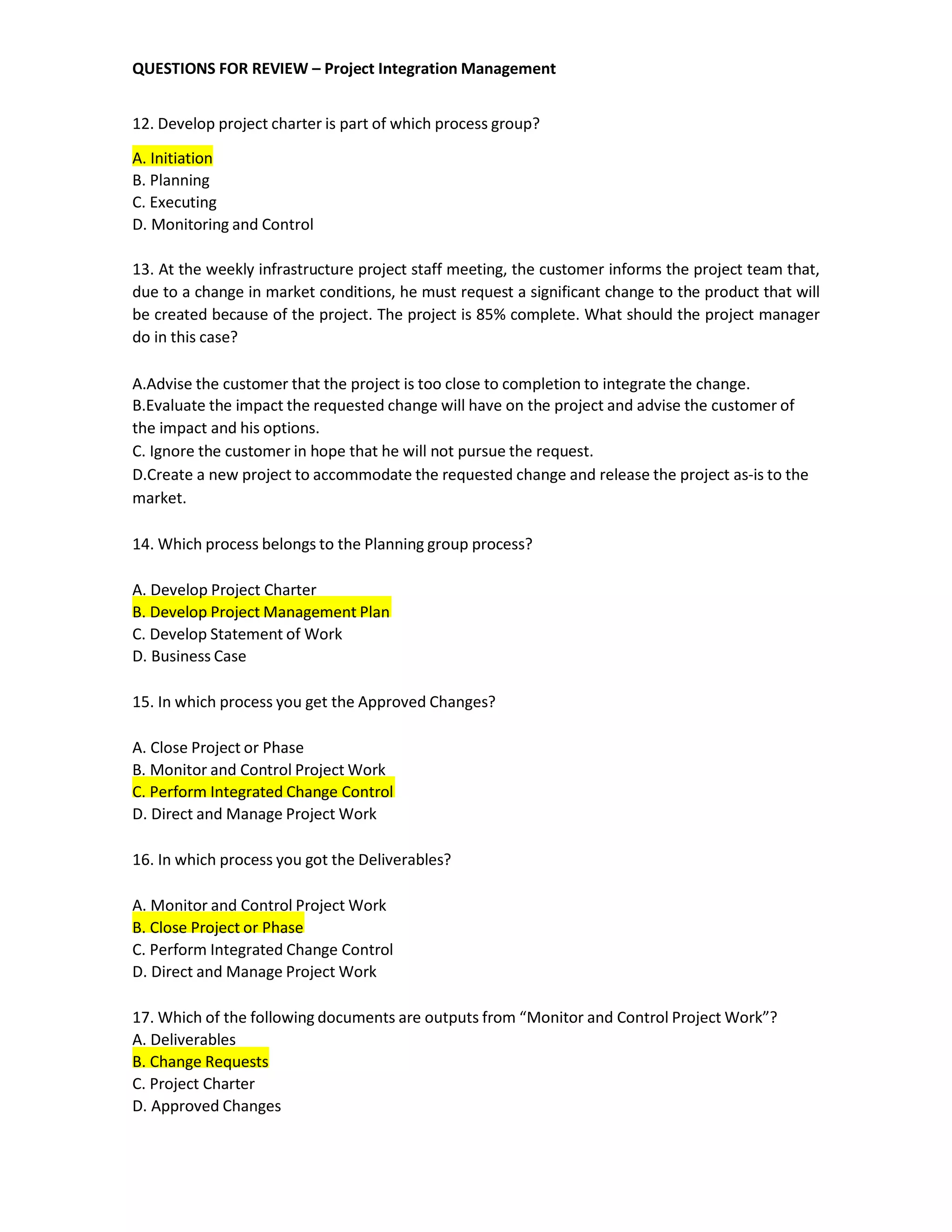
QUESTIONS FOR REVIEW – Project Integration Management
12. Develop project charter is part of which process group?
A. Initiation
B. Planning
C. Executing
D. Monitoring and Control
13. At the weekly infrastructure project staff meeting, the customer informs the project team that,
due to a change in market conditions, he must request a significant change to the product that will
be created because of the project. The project is 85% complete. What should the project manager
do in this case?
A.Advise the customer that the project is too close to completion to integrate the change.
B.Evaluate the impact the requested change will have on the project and advise the customer of
the impact and his options.
C. Ignore the customer in hope that he will not pursue the request.
D.Create a new project to accommodate the requested change and release the project as-is to the
market.
14. Which process belongs to the Planning group process?
A. Develop Project Charter
B. Develop Project Management Plan
C. Develop Statement of Work
D. Business Case
15. In which process you get the Approved Changes?
A. Close Project or Phase
B. Monitor and Control Project Work
C. Perform Integrated Change Control
D. Direct and Manage Project Work
16. In which process you got the Deliverables?
A. Monitor and Control Project Work
B. Close Project or Phase
C. Perform Integrated Change Control
D. Direct and Manage Project Work
17. Which of the following documents are outputs from “Monitor and Control Project Work”?
A. Deliverables
B. Change Requests
C. Project Charter
D. Approved Changes
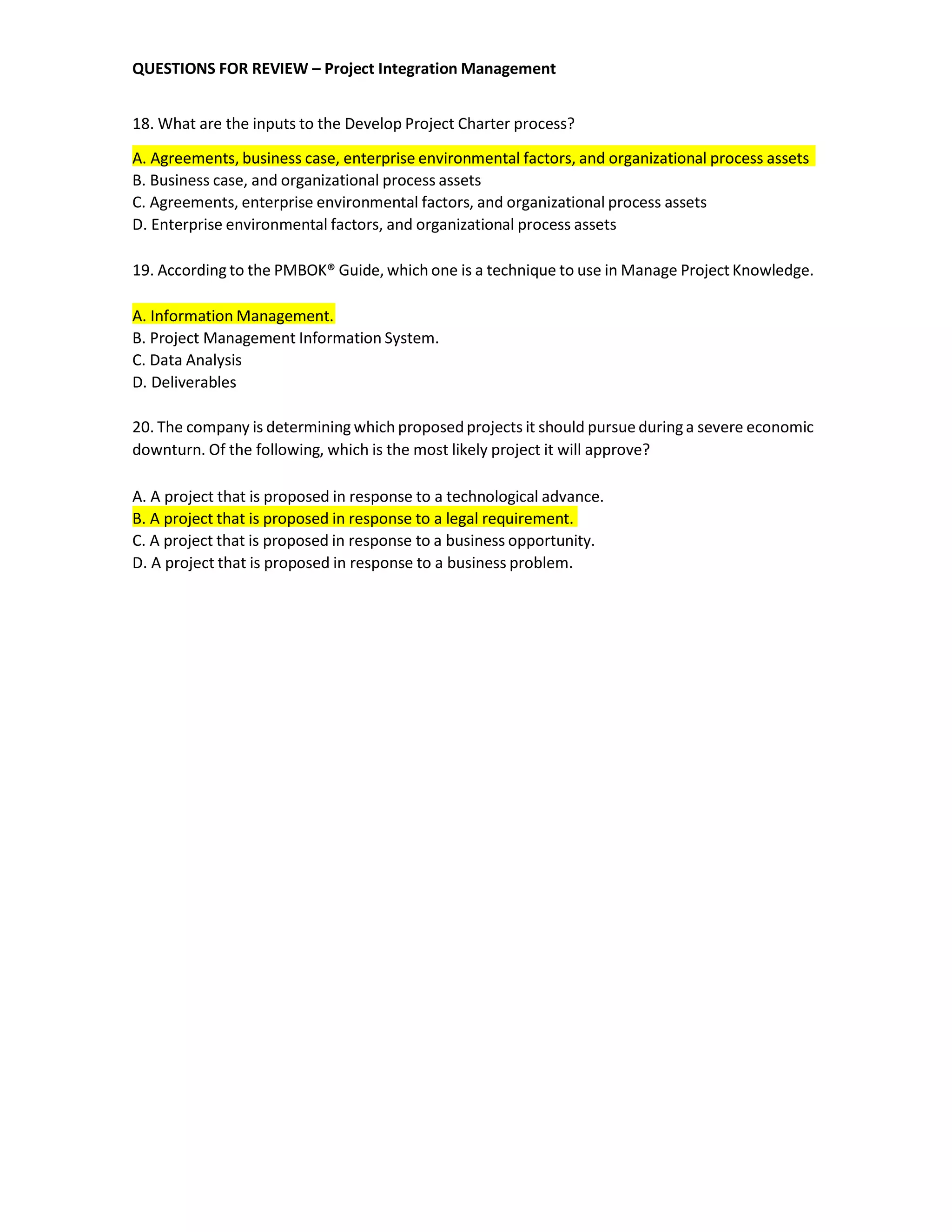
QUESTIONS FOR REVIEW – Project Integration Management
18. What are the inputs to the Develop Project Charter process?
A. Agreements, business case, enterprise environmental factors, and organizational process assets
B. Business case, and organizational process assets
C. Agreements, enterprise environmental factors, and organizational process assets
D. Enterprise environmental factors, and organizational process assets
19. According to the PMBOK® Guide, which one is a technique to use in Manage Project Knowledge.
A. Information Management.
B. Project Management Information System.
C. Data Analysis
D. Deliverables
20. The company is determining which proposedprojects it should pursue duringa severe economic
downturn. Of the following, which is the most likely project it will approve?
A. A project that is proposed in response to a technological advance.
B. A project that is proposed in response to a legal requirement.
C. A project that is proposed in response to a business opportunity.
D. A project that is proposed in response to a business problem.
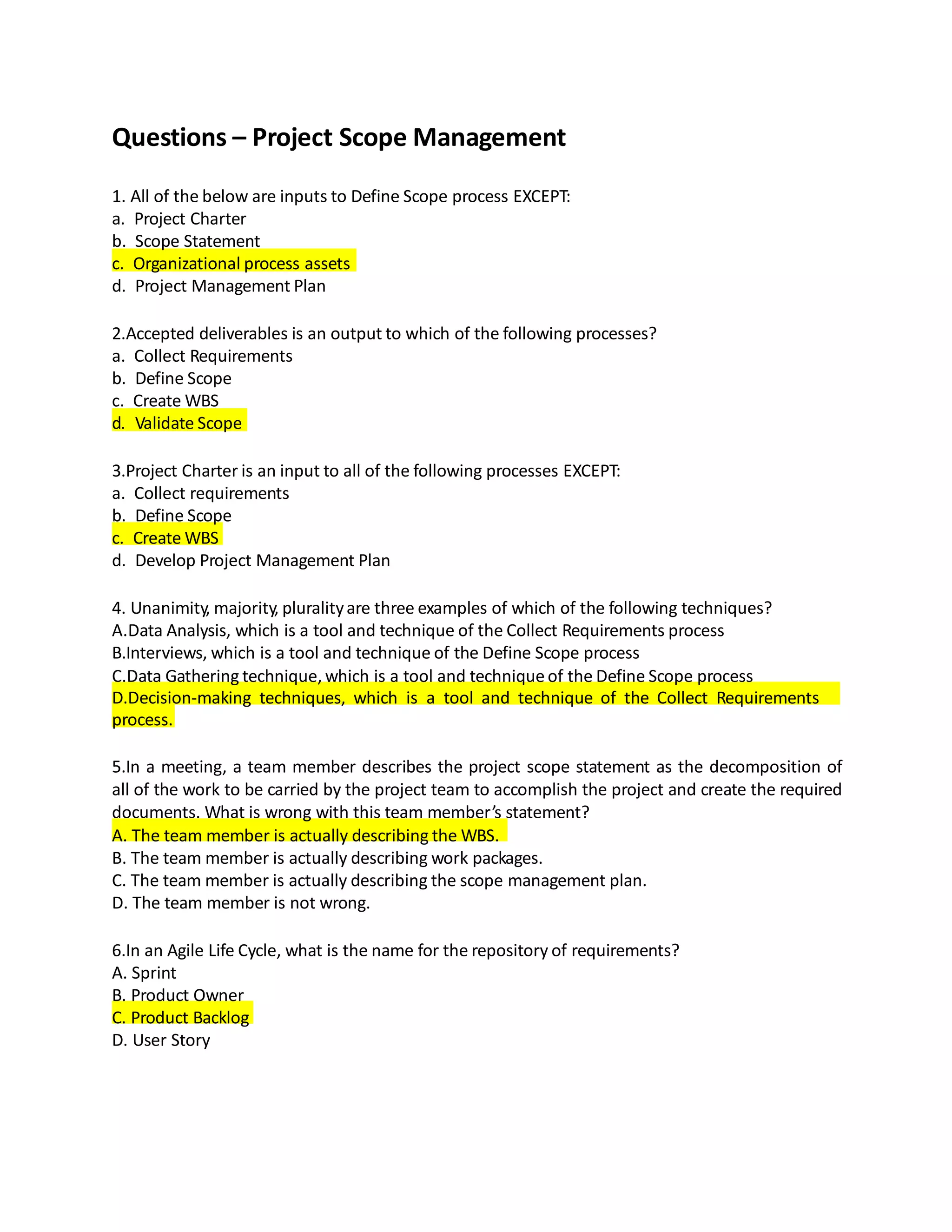
Questions – Project Scope Management
1. All of the below are inputs to Define Scope process EXCEPT:
a. Project Charter
b. Scope Statement
c. Organizational process assets
d. Project Management Plan
2.Accepted deliverables is an output to which of the following processes?
a. Collect Requirements
b. Define Scope
c. Create WBS
d. Validate Scope
3.Project Charter is an input to all of the following processes EXCEPT:
a. Collect requirements
b. Define Scope
c. Create WBS
d. Develop Project Management Plan
4. Unanimity, majority, pluralityare three examples of which of the following techniques?
A.Data Analysis, which is a tool and technique of the Collect Requirements process
B.Interviews, which is a tool and technique of the Define Scope process
C.Data Gathering technique, which is a tool and technique of the Define Scope process
D.Decision-making techniques, which is a tool and technique of the Collect Requirements
process.
5.In a meeting, a team member describes the project scope statement as the decomposition of
all of the work to be carried by the project team to accomplish the project and create the required
documents. What is wrong with this team member’s statement?
A. The team member is actually describing the WBS.
B. The team member is actually describing work packages.
C. The team member is actually describing the scope management plan.
D. The team member is not wrong.
6.In an Agile Life Cycle, what is the name for the repository of requirements?
A. Sprint
B. Product Owner
C. Product Backlog
D. User Story
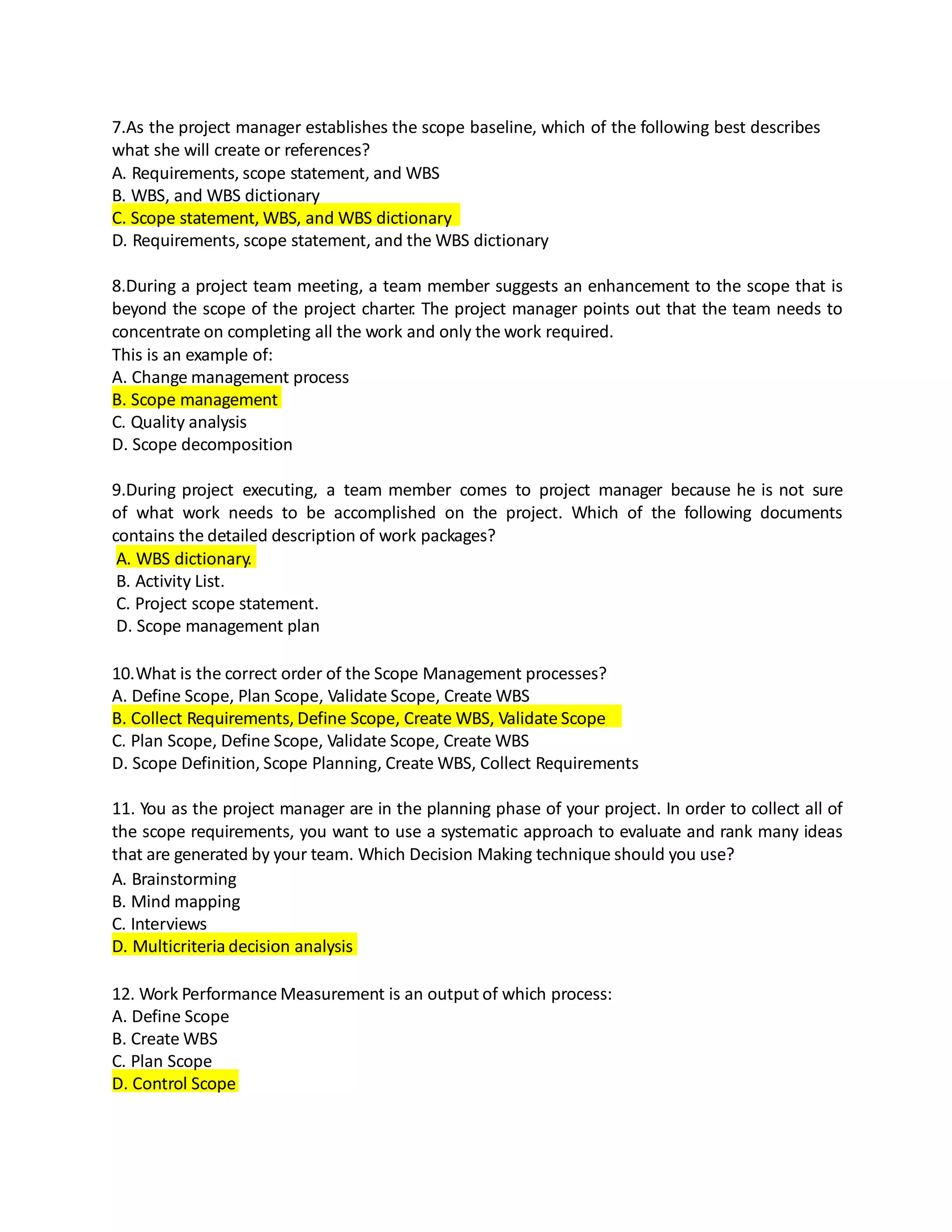
7.As the project manager establishes the scope baseline, which of the following best describes
what she will create or references?
A. Requirements, scope statement, and WBS
B. WBS, and WBS dictionary
C. Scope statement, WBS, and WBS dictionary
D. Requirements, scope statement, and the WBS dictionary
8.During a project team meeting, a team member suggests an enhancement to the scope that is
beyond the scope of the project charter. The project manager points out that the team needs to
concentrate on completing all the work and only the work required.
This is an example of:
A. Change management process
B. Scope management
C. Quality analysis
D. Scope decomposition
9.During project executing, a team member comes to project manager because he is not sure
of what work needs to be accomplished on the project. Which of the following documents
contains the detailed description of work packages?
A. WBS dictionary.
B. Activity List.
C. Project scope statement.
D. Scope management plan
10.What is the correct order of the Scope Management processes?
A. Define Scope, Plan Scope, Validate Scope, Create WBS
B. Collect Requirements, Define Scope, Create WBS, Validate Scope
C. Plan Scope, Define Scope, Validate Scope, Create WBS
D. Scope Definition, Scope Planning, Create WBS, Collect Requirements
11. You as the project manager are in the planning phase of your project. In order to collect all of
the scope requirements, you want to use a systematic approach to evaluate and rank many ideas
that are generated by your team. Which Decision Making technique should you use?
A. Brainstorming
B. Mind mapping
C. Interviews
D. Multicriteria decision analysis
12. Work Performance Measurement is an output of which process:
A. Define Scope
B. Create WBS
C. Plan Scope
D. Control Scope
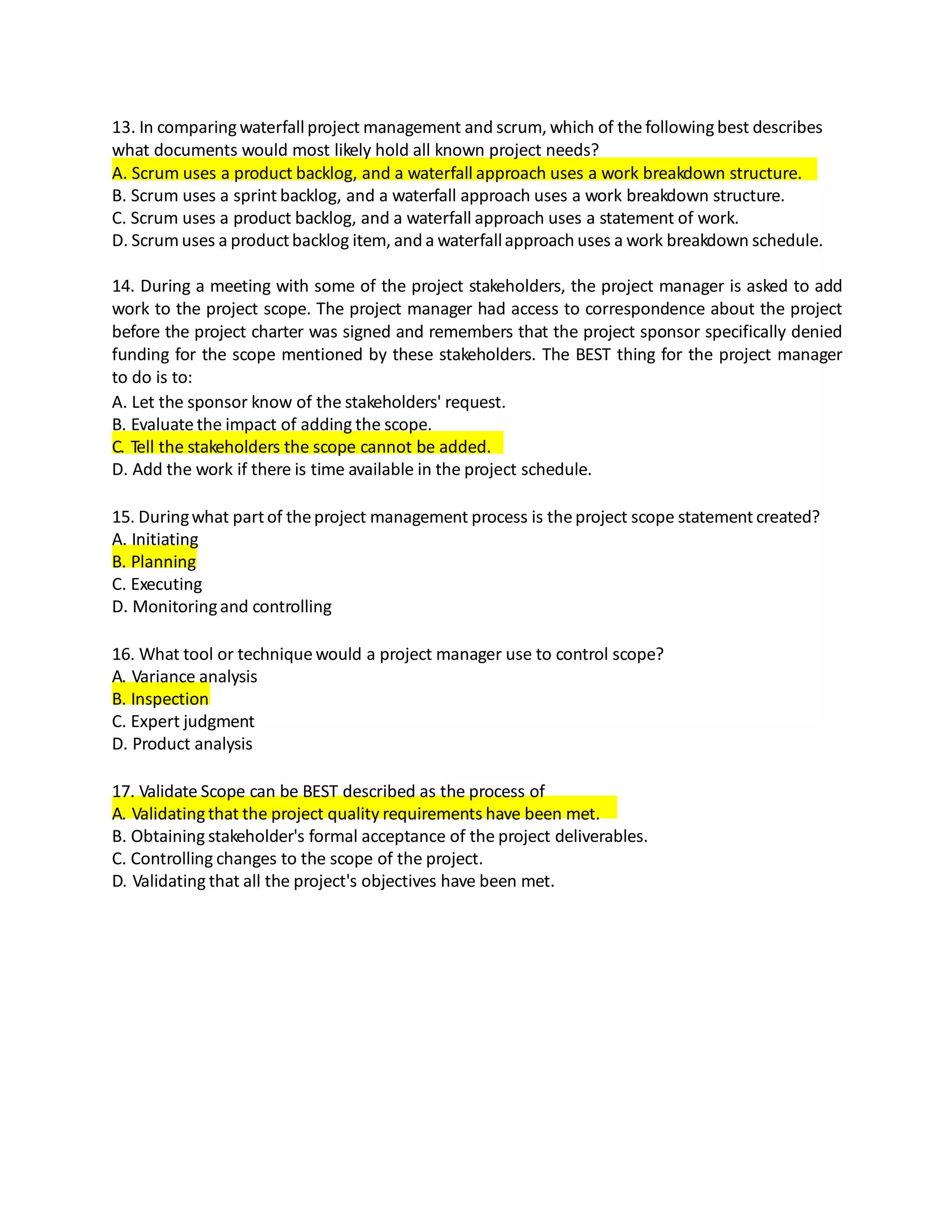
13. In comparingwaterfall project management and scrum, which of the followingbest describes
what documents would most likely hold all known project needs?
A. Scrum uses a product backlog, and a waterfall approach uses a work breakdown structure.
B. Scrum uses a sprint backlog, and a waterfall approach uses a work breakdown structure.
C. Scrum uses a product backlog, and a waterfall approach uses a statement of work.
D. Scrum uses a productbacklog item, and a waterfallapproach uses a work breakdown schedule.
14. During a meeting with some of the project stakeholders, the project manager is asked to add
work to the project scope. The project manager had access to correspondence about the project
before the project charter was signed and remembers that the project sponsor specifically denied
funding for the scope mentioned by these stakeholders. The BEST thing for the project manager
to do is to:
A. Let the sponsor know of the stakeholders' request.
B. Evaluate the impact of adding the scope.
C. Tell the stakeholders the scope cannot be added.
D. Add the work if there is time available in the project schedule.
15. Duringwhat partof theproject management process is theproject scope statement created?
A. Initiating
B. Planning
C. Executing
D. Monitoringand controlling
16. What tool or technique would a project manager use to control scope?
A. Variance analysis
B. Inspection
C. Expert judgment
D. Product analysis
17. Validate Scope can be BEST described as the process of
A. Validatingthat the project quality requirements have been met.
B. Obtaining stakeholder's formal acceptance of the project deliverables.
C. Controlling changes to the scope of the project.
D. Validating that all the project's objectives have been met.
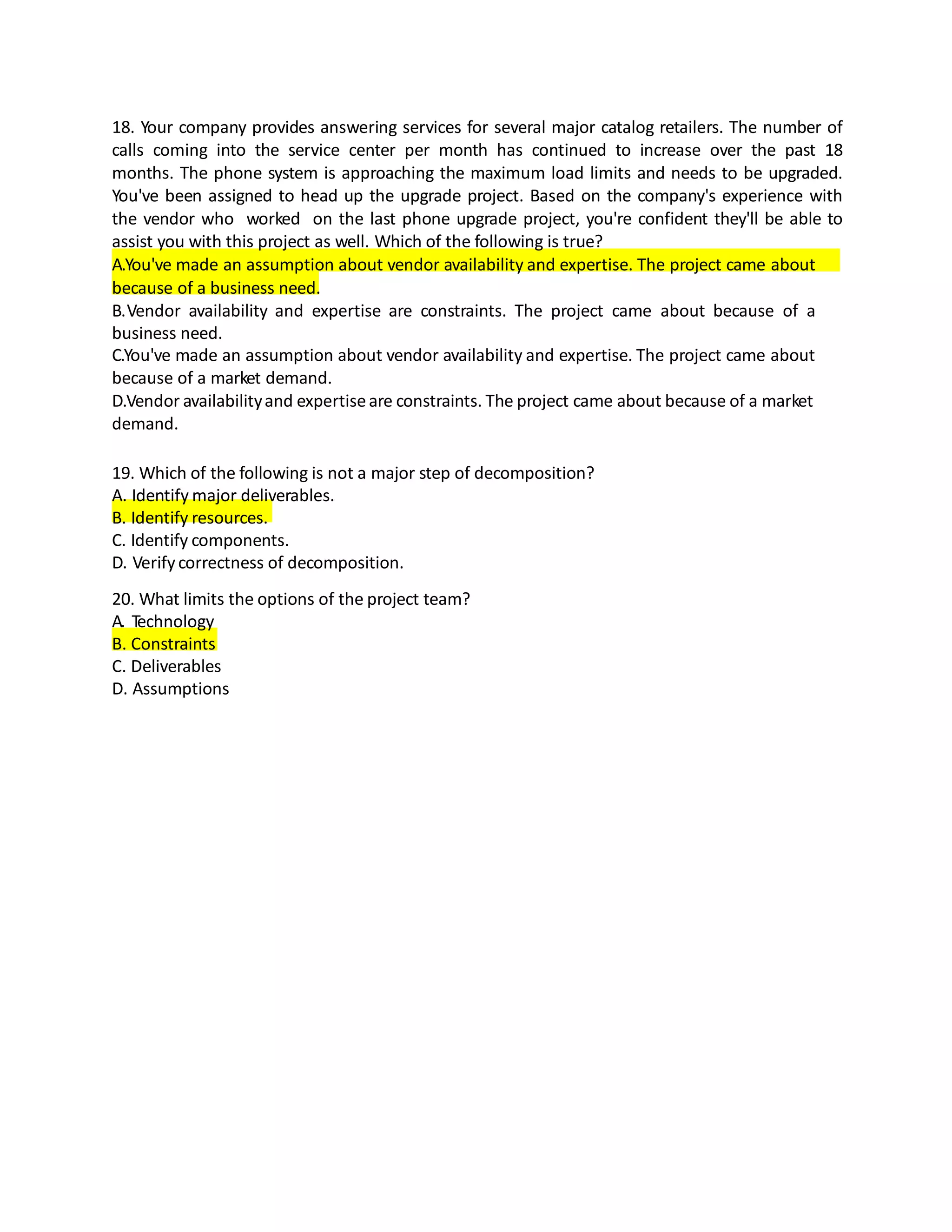
18. Your company provides answering services for several major catalog retailers. The number of
calls coming into the service center per month has continued to increase over the past 18
months. The phone system is approaching the maximum load limits and needs to be upgraded.
You've been assigned to head up the upgrade project. Based on the company's experience with
the vendor who worked on the last phone upgrade project, you're confident they'll be able to
assist you with this project as well. Which of the following is true?
A.You've made an assumption about vendor availability and expertise. The project came about
because of a business need.
B.Vendor availability and expertise are constraints. The project came about because of a
business need.
C.You've made an assumption about vendor availability and expertise. The project came about
because of a market demand.
D.Vendor availabilityand expertiseare constraints. The project came about because of a market
demand.
19. Which of the following is not a major step of decomposition?
A. Identify major deliverables.
B. Identify resources.
C. Identify components.
D. Verifycorrectness of decomposition.
20. What limits the options of the project team?
A. Technology
B. Constraints
C. Deliverables
D. Assumptions
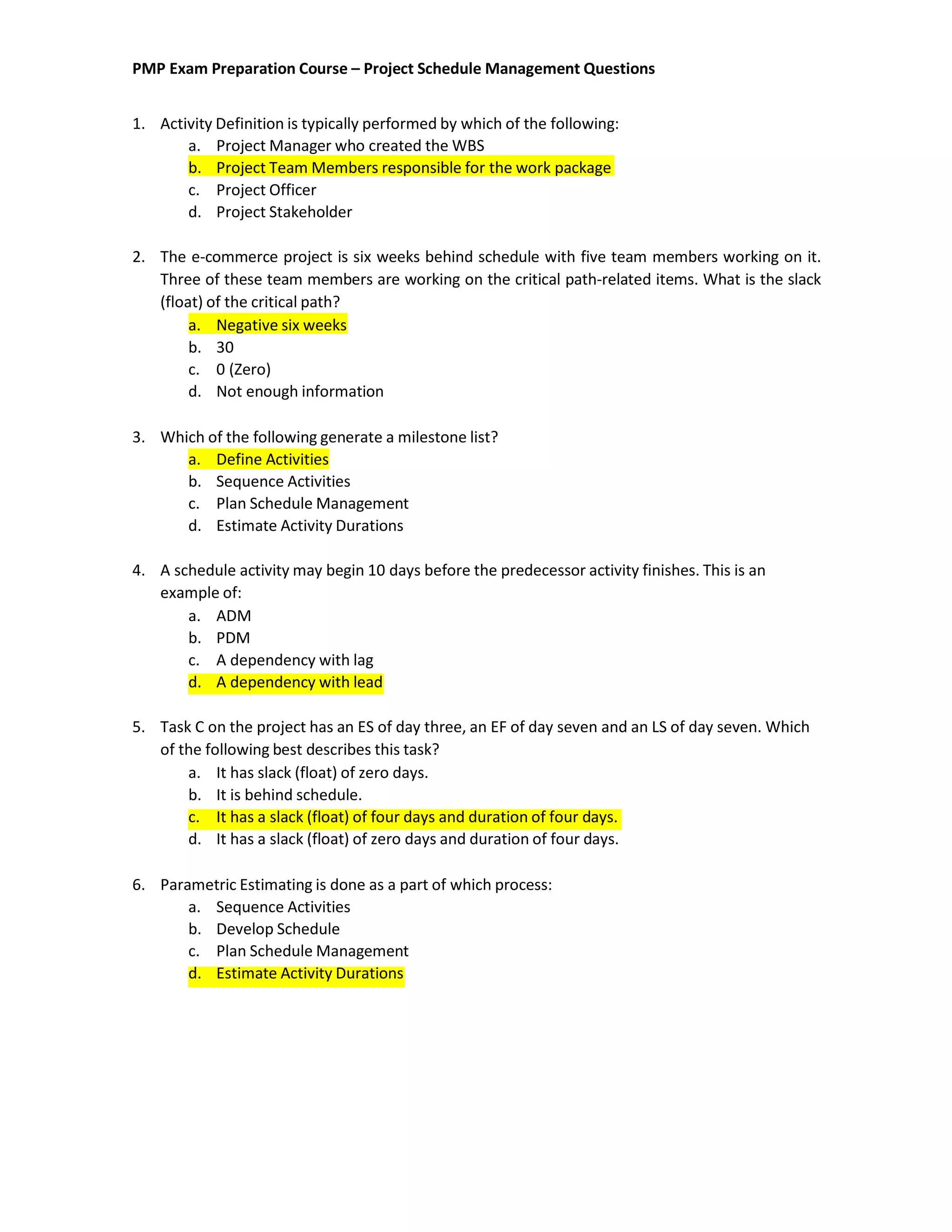
PMP Exam Preparation Course – Project Schedule Management Questions
1. Activity Definition is typically performed by which of the following:
a. Project Manager who created the WBS
b. Project Team Members responsible for the work package
c. Project Officer
d. Project Stakeholder
2. The e-commerce project is six weeks behind schedule with five team members working on it.
Three of these team members are working on the critical path-related items. What is the slack
(float) of the critical path?
a. Negative six weeks
b. 30
c. 0 (Zero)
d. Not enough information
3. Which of the following generate a milestone list?
a. Define Activities
b. Sequence Activities
c. Plan Schedule Management
d. Estimate Activity Durations
4. A schedule activity may begin 10 days before the predecessor activity finishes. This is an
example of:
a. ADM
b. PDM
c. A dependency with lag
d. A dependency with lead
5. Task C on the project has an ES of day three, an EF of day seven and an LS of day seven. Which
of the following best describes this task?
a. It has slack (float) of zero days.
b. It is behind schedule.
c. It has a slack (float) of four days and duration of four days.
d. It has a slack (float) of zero days and duration of four days.
6. Parametric Estimating is done as a part of which process:
a. Sequence Activities
b. Develop Schedule
c. Plan Schedule Management
d. Estimate Activity Durations
PMP Exam Preparation Course – Project Schedule Management Questions
7. Which of the following is NOT an input to the Sequence Activities process?
a. Scope Baseline
b. Activity Attributes
c. Activity List
d. Change Requests
8. Which of the following is a technique for Sequence Activities?
a. Precedence Diagramming Method [PDM]
b. Project Schedule Network Diagram
c. Rolling Wave Planning
d. Analogous Estimating
9. Which of the following duration estimate types is most likely to be used where there is minimal
information known about the project?
a. Bottom-Up
b. Parametric
c. Top-Down
d. Three-Point
10. You are the project manager for a cell site upgrade project. You have just performed the
sequence activities process. What do you create next?
a. Duration estimates
b. Activity lists
c. Resource estimates
d. Work packages
11. The project team is working together on detailed planning. They have had some issues coming
to the same opinion, so they are creating a project schedule network diagram. What will this
show the team?
a. The sequencing of the activities on the project
b. The decomposition of the work of the project
c. The schedule
d. The duration estimates of the project.
12. You are the project manager for a mortgage regulatory application project. You have just
created the activity list and milestone list. What process preceded this work?
a. Sequence Activities
b. Define Activities
c. Plan Schedule Management
d. Estimate Activity Durations
PMP Exam Preparation Course – Project Schedule Management Questions
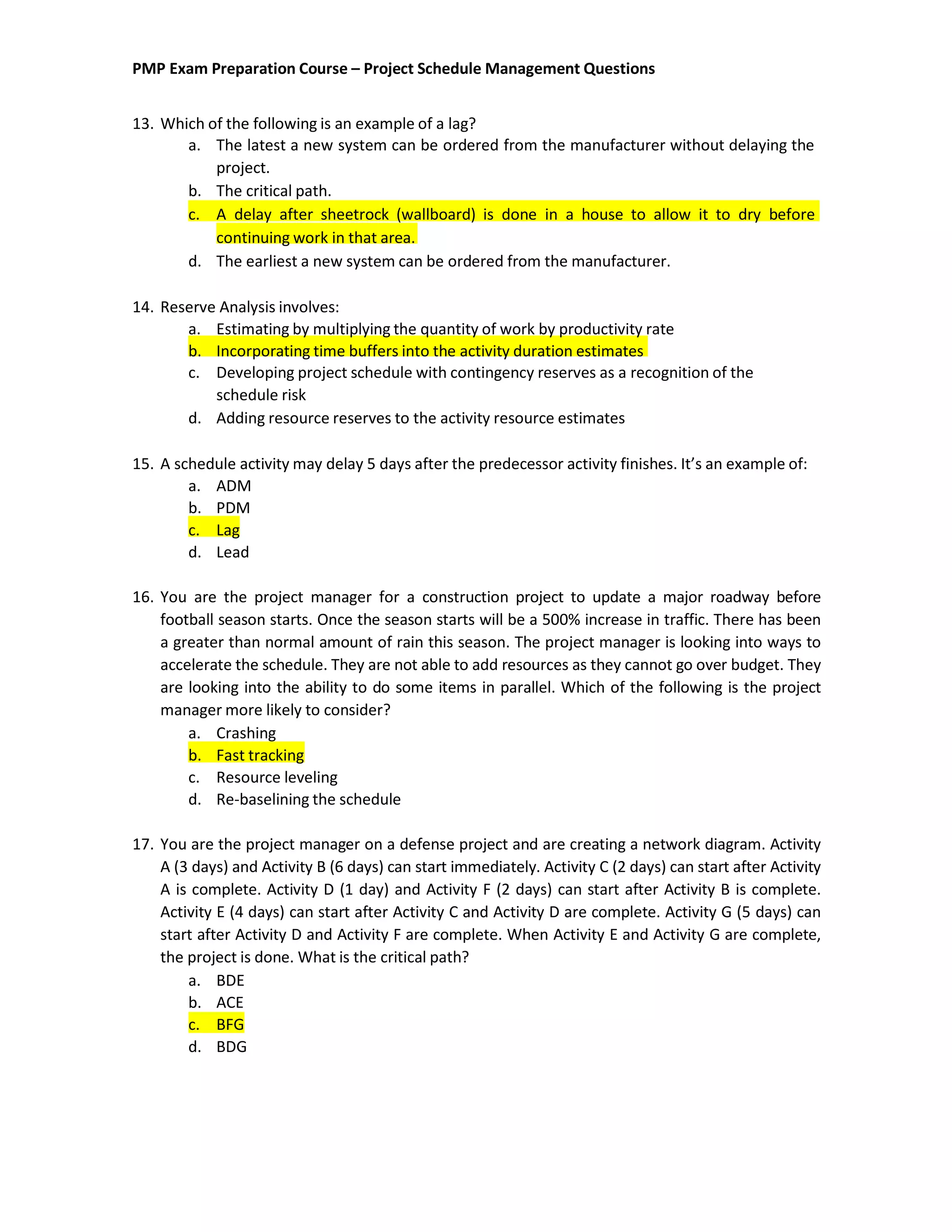
13. Which of the following is an example of a lag?
a. The latest a new system can be ordered from the manufacturer without delaying the
project.
b. The critical path.
c. A delay after sheetrock (wallboard) is done in a house to allow it to dry before
continuing work in that area.
d. The earliest a new system can be ordered from the manufacturer.
14. Reserve Analysis involves:
a. Estimating by multiplying the quantity of work by productivity rate
b. Incorporating time buffers into the activity duration estimates
c. Developing project schedule with contingency reserves as a recognition of the
schedule risk
d. Adding resource reserves to the activity resource estimates
15. A schedule activity may delay 5 days after the predecessor activity finishes. It’s an example of:
a. ADM
b. PDM
c. Lag
d. Lead
16. You are the project manager for a construction project to update a major roadway before
football season starts. Once the season starts will be a 500% increase in traffic. There has been
a greater than normal amount of rain this season. The project manager is looking into ways to
accelerate the schedule. They are not able to add resources as they cannot go over budget. They
are looking into the ability to do some items in parallel. Which of the following is the project
manager more likely to consider?
a. Crashing
b. Fast tracking
c. Resource leveling
d. Re-baselining the schedule
17. You are the project manager on a defense project and are creating a network diagram. Activity
A (3 days) and Activity B (6 days) can start immediately. Activity C (2 days) can start after Activity
A is complete. Activity D (1 day) and Activity F (2 days) can start after Activity B is complete.
Activity E (4 days) can start after Activity C and Activity D are complete. Activity G (5 days) can
start after Activity D and Activity F are complete. When Activity E and Activity G are complete,
the project is done. What is the critical path?
a. BDE
b. ACE
c. BFG
d. BDG
PMP Exam Preparation Course – Project Schedule Management Questions
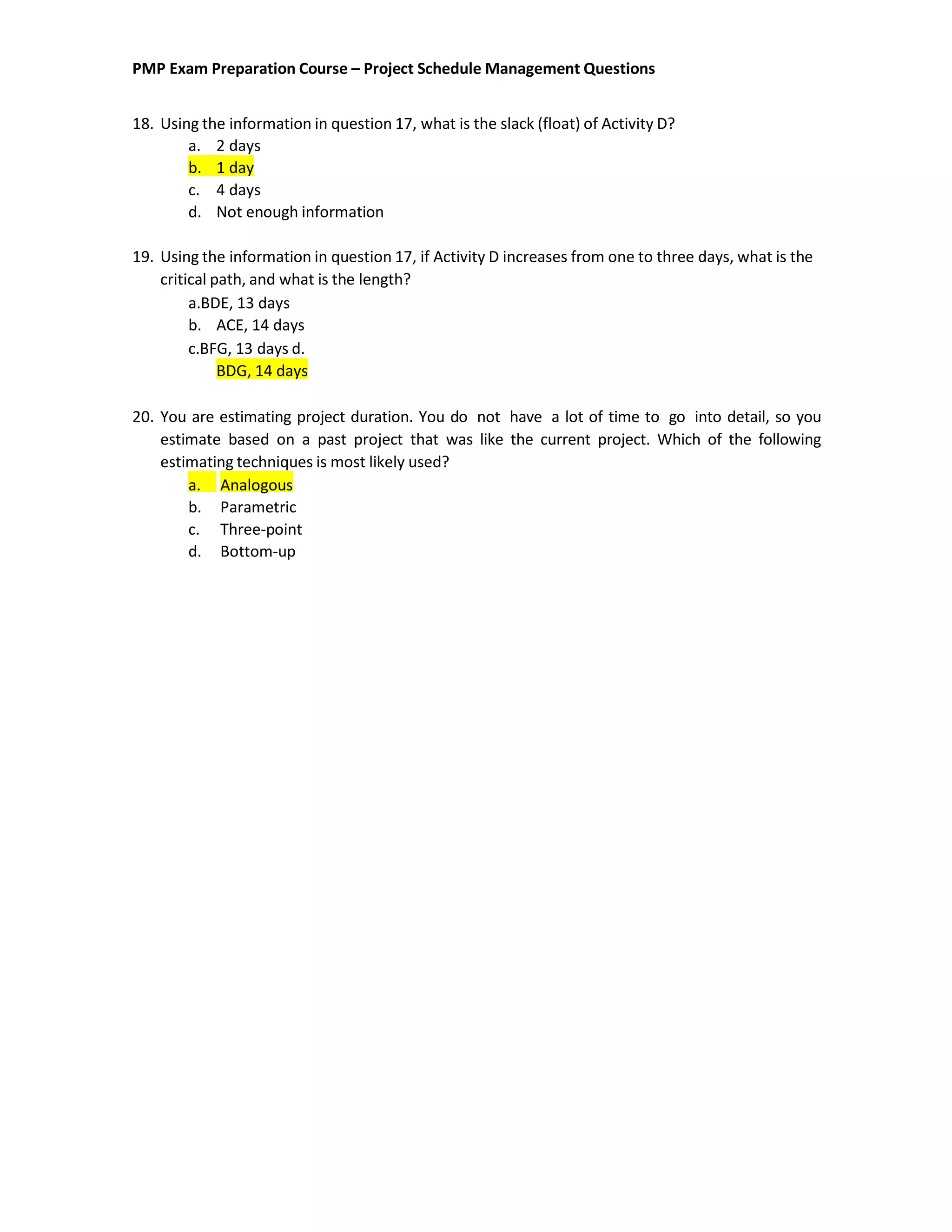
18. Using the information in question 17, what is the slack (float) of Activity D?
a. 2 days
b. 1 day
c. 4 days
d. Not enough information
19. Using the information in question 17, if Activity D increases from one to three days, what is the
critical path, and what is the length?
a.BDE, 13 days
b. ACE, 14 days
c.BFG, 13 days d.
BDG, 14 days
20. You are estimating project duration. You do not have a lot of time to go into detail, so you
estimate based on a past project that was like the current project. Which of the following
estimating techniques is most likely used?
a. Analogous
b. Parametric
c. Three-point
d. Bottom-up
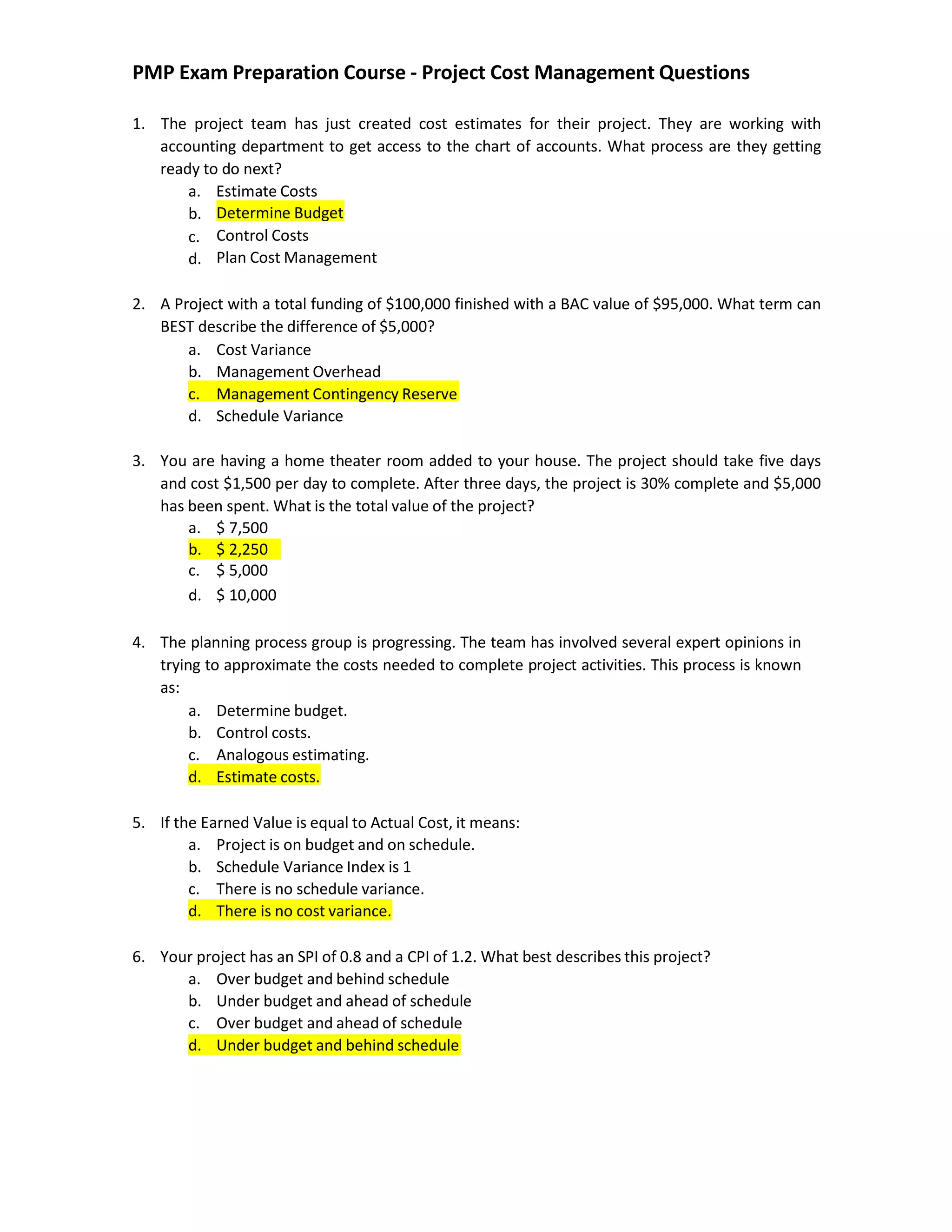
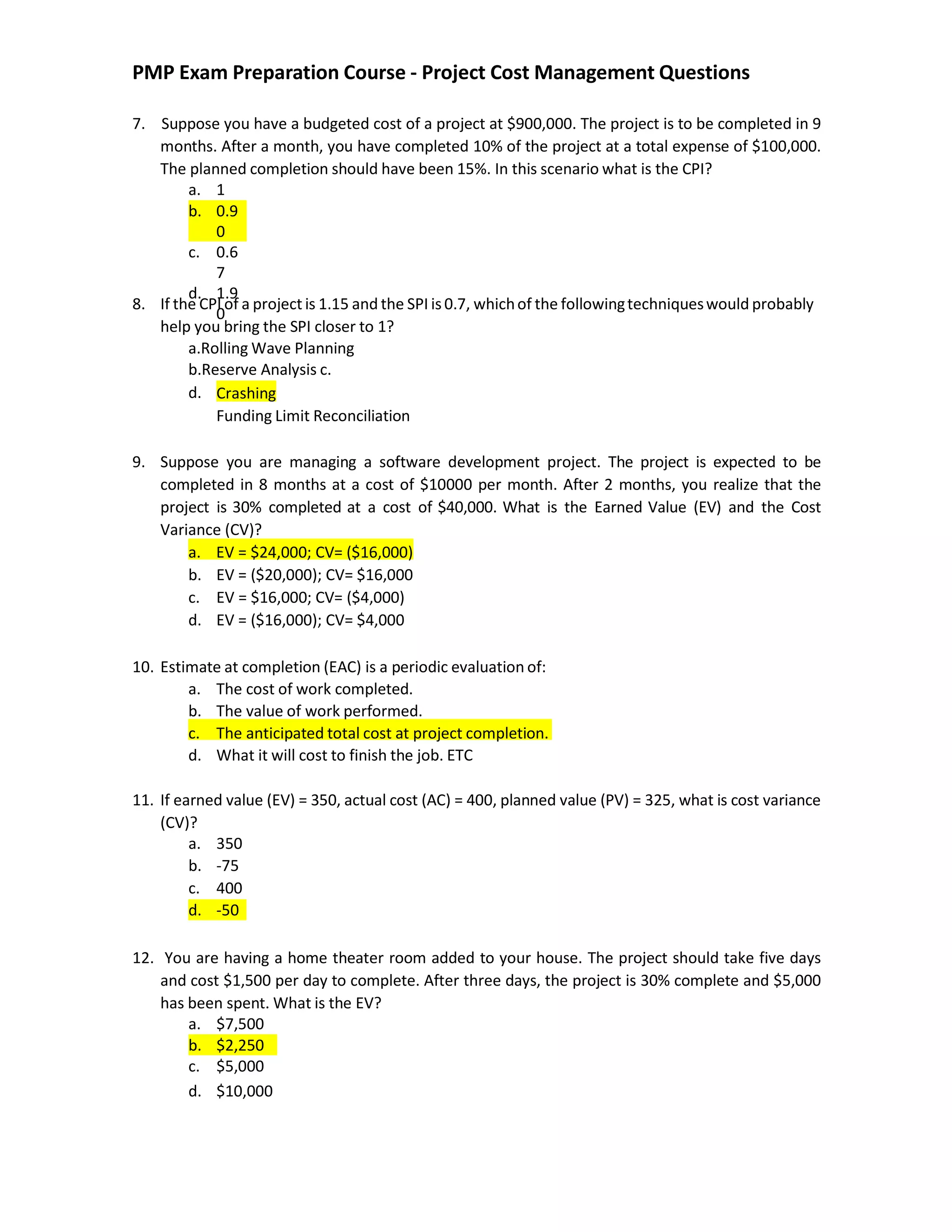
PMP Exam Preparation Course - Project Cost Management Questions
1. The project team has just created cost estimates for their project. They are working with
accounting department to get access to the chart of accounts. What process are they getting
ready to do next?
a. Estimate Costs
b.
c.
d.
Determine Budget
Control Costs
Plan Cost Management
2. A Project with a total funding of $100,000 finished with a BAC value of $95,000. What term can
BEST describe the difference of $5,000?
a. Cost Variance
b. Management Overhead
c. Management Contingency Reserve
d. Schedule Variance
3. You are having a home theater room added to your house. The project should take five days
and cost $1,500 per day to complete. After three days, the project is 30% complete and $5,000
has been spent. What is the total value of the project?
4. The planning process group is progressing. The team has involved several expert opinions in
trying to approximate the costs needed to complete project activities. This process is known
as:
a. Determine budget.
b. Control costs.
c. Analogous estimating.
d. Estimate costs.
5. If the Earned Value is equal to Actual Cost, it means:
a. Project is on budget and on schedule.
b. Schedule Variance Index is 1
c. There is no schedule variance.
d. There is no cost variance.
6. Your project has an SPI of 0.8 and a CPI of 1.2. What best describes this project?
a. Over budget and behind schedule
b. Under budget and ahead of schedule
c. Over budget and ahead of schedule
d. Under budget and behind schedule
a. $ 7,500
b. $ 2,250
c. $ 5,000
d. $ 10,000
PMP Exam Preparation Course - Project Cost Management Questions
7. Suppose you have a budgeted cost of a project at $900,000. The project is to be completed in 9
months. After a month, you have completed 10% of the project at a total expense of $100,000.
The planned completion should have been 15%. In this scenario what is the CPI?
8. If the CPI of a project is 1.15 and the SPI is 0.7, whichof the followingtechniqueswould probably
help you bring the SPI closer to 1?
a.Rolling Wave Planning
b.Reserve Analysis c.
d. Crashing
Funding Limit Reconciliation
9. Suppose you are managing a software development project. The project is expected to be
completed in 8 months at a cost of $10000 per month. After 2 months, you realize that the
project is 30% completed at a cost of $40,000. What is the Earned Value (EV) and the Cost
Variance (CV)?
a. EV = $24,000; CV= ($16,000)
b. EV = ($20,000); CV= $16,000
c. EV = $16,000; CV= ($4,000)
d. EV = ($16,000); CV= $4,000
10. Estimate at completion (EAC) is a periodic evaluation of:
a. The cost of work completed.
b. The value of work performed.
c. The anticipated total cost at project completion.
d. What it will cost to finish the job. ETC
11. If earned value (EV) = 350, actual cost (AC) = 400, planned value (PV) = 325, what is cost variance
(CV)?
12. You are having a home theater room added to your house. The project should take five days
and cost $1,500 per day to complete. After three days, the project is 30% complete and $5,000
has been spent. What is the EV?
a. 1
b. 0.9
0
c. 0.6
7
d. 1.9
0
a. 350
b. -75
c. 400
d. -50
a. $7,500
b. $2,250
c. $5,000
d. $10,000
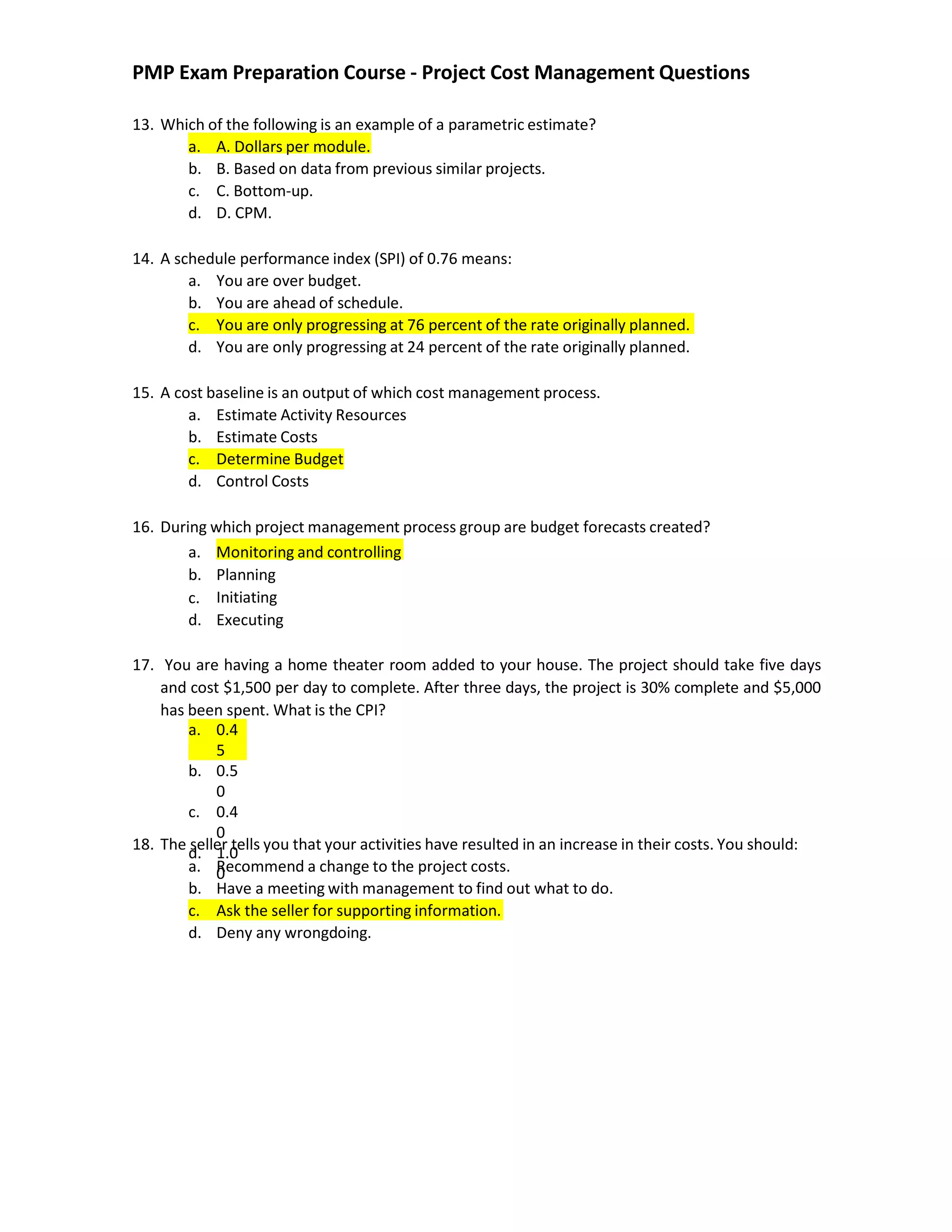
PMP Exam Preparation Course - Project Cost Management Questions
13. Which of the following is an example of a parametric estimate?
a. A. Dollars per module.
b. B. Based on data from previous similar projects.
c. C. Bottom-up.
d. D. CPM.
14. A schedule performance index (SPI) of 0.76 means:
a. You are over budget.
b. You are ahead of schedule.
c. You are only progressing at 76 percent of the rate originally planned.
d. You are only progressing at 24 percent of the rate originally planned.
15. A cost baseline is an output of which cost management process.
a. Estimate Activity Resources
b. Estimate Costs
c. Determine Budget
d. Control Costs
16. During which project management process group are budget forecasts created?
a. Monitoring and controlling
b.
c.
d.
Planning
Initiating
Executing
17. You are having a home theater room added to your house. The project should take five days
and cost $1,500 per day to complete. After three days, the project is 30% complete and $5,000
has been spent. What is the CPI?
18. The seller tells you that your activities have resulted in an increase in their costs. You should:
a. Recommend a change to the project costs.
b. Have a meeting with management to find out what to do.
c. Ask the seller for supporting information.
d. Deny any wrongdoing.
a. 0.4
5
b. 0.5
0
c. 0.4
0
d. 1.0
0
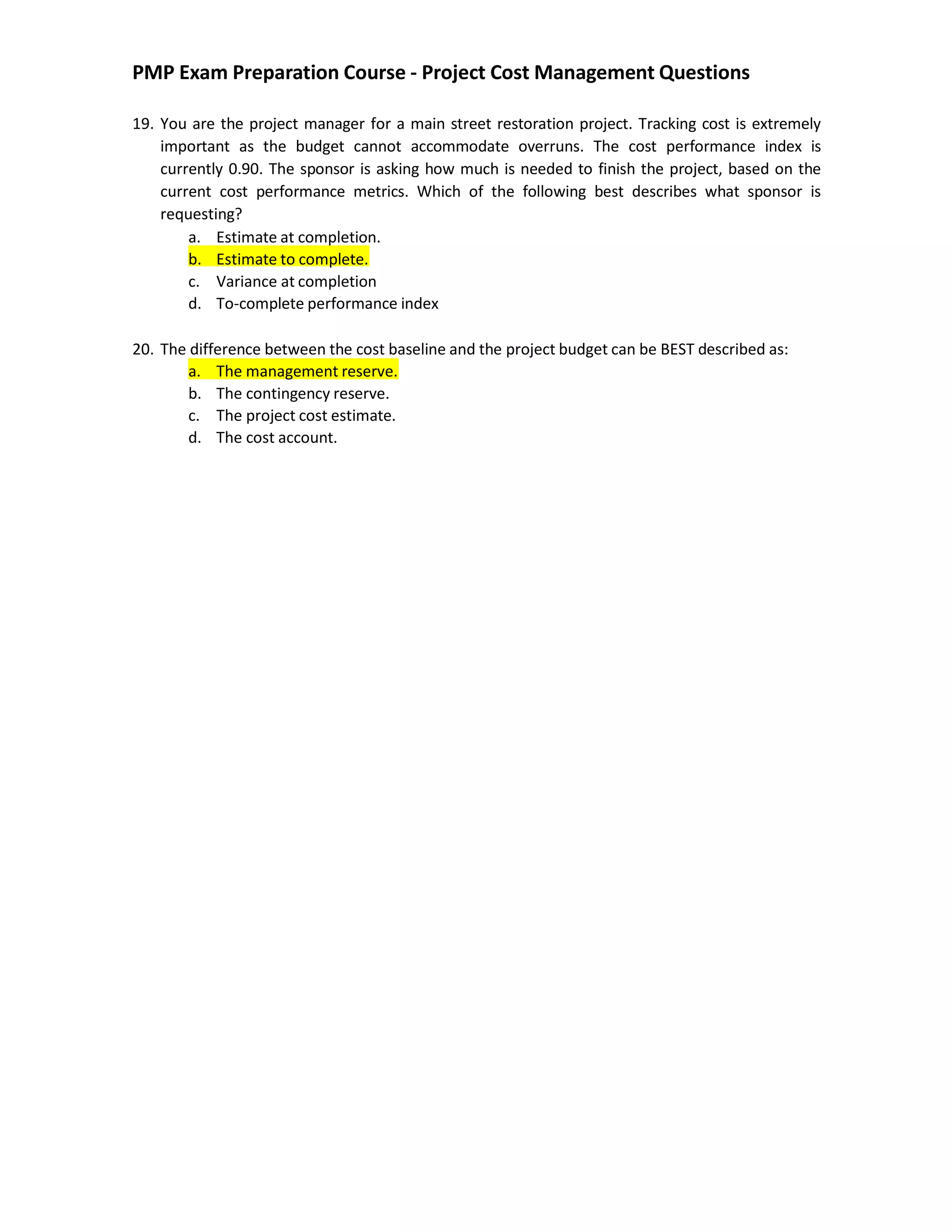
PMP Exam Preparation Course - Project Cost Management Questions
19. You are the project manager for a main street restoration project. Tracking cost is extremely
important as the budget cannot accommodate overruns. The cost performance index is
currently 0.90. The sponsor is asking how much is needed to finish the project, based on the
current cost performance metrics. Which of the following best describes what sponsor is
requesting?
a. Estimate at completion.
b. Estimate to complete.
c. Variance at completion
d. To-complete performance index
20. The difference between the cost baseline and the project budget can be BEST described as:
a. The management reserve.
b. The contingency reserve.
c. The project cost estimate.
d. The cost account.
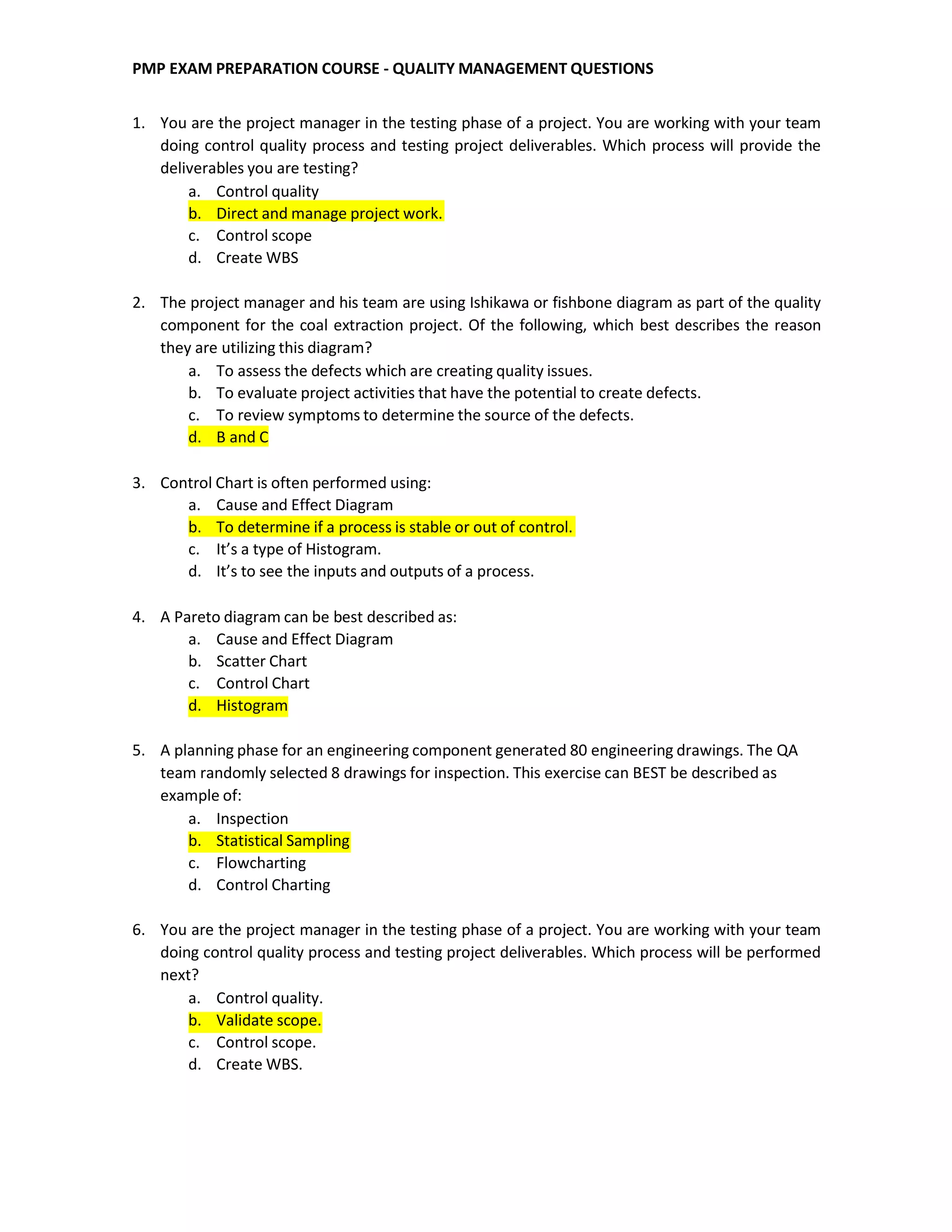
PMP EXAM PREPARATION COURSE - QUALITY MANAGEMENT QUESTIONS
1. You are the project manager in the testing phase of a project. You are working with your team
doing control quality process and testing project deliverables. Which process will provide the
deliverables you are testing?
a. Control quality
b. Direct and manage project work.
c. Control scope
d. Create WBS
2. The project manager and his team are using Ishikawa or fishbone diagram as part of the quality
component for the coal extraction project. Of the following, which best describes the reason
they are utilizing this diagram?
a. To assess the defects which are creating quality issues.
b. To evaluate project activities that have the potential to create defects.
c. To review symptoms to determine the source of the defects.
d. B and C
3. Control Chart is often performed using:
a. Cause and Effect Diagram
b. To determine if a process is stable or out of control.
c. It’s a type of Histogram.
d. It’s to see the inputs and outputs of a process.
4. A Pareto diagram can be best described as:
a. Cause and Effect Diagram
b. Scatter Chart
c. Control Chart
d. Histogram
5. A planning phase for an engineering component generated 80 engineering drawings. The QA
team randomly selected 8 drawings for inspection. This exercise can BEST be described as
example of:
a. Inspection
b. Statistical Sampling
c. Flowcharting
d. Control Charting
6. You are the project manager in the testing phase of a project. You are working with your team
doing control quality process and testing project deliverables. Which process will be performed
next?
a. Control quality.
b. Validate scope.
c. Control scope.
d. Create WBS.
PMP EXAM PREPARATION COURSE - QUALITY MANAGEMENT QUESTIONS
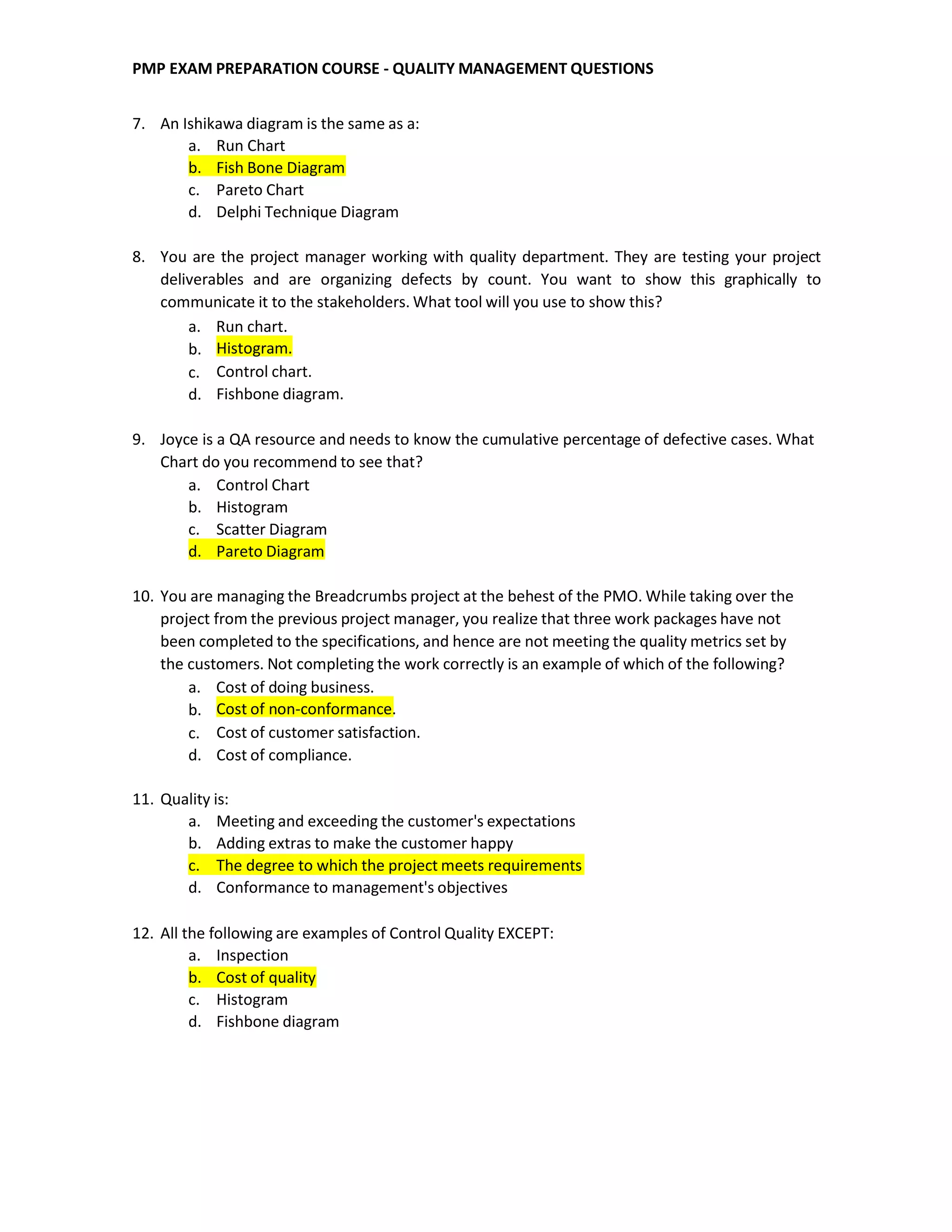
7. An Ishikawa diagram is the same as a:
a. Run Chart
b. Fish Bone Diagram
c. Pareto Chart
d. Delphi Technique Diagram
8. You are the project manager working with quality department. They are testing your project
deliverables and are organizing defects by count. You want to show this graphically to
communicate it to the stakeholders. What tool will you use to show this?
a. Run chart.
b.
c.
d.
Histogram.
Control chart.
Fishbone diagram.
9. Joyce is a QA resource and needs to know the cumulative percentage of defective cases. What
Chart do you recommend to see that?
a. Control Chart
b. Histogram
c. Scatter Diagram
d. Pareto Diagram
10. You are managing the Breadcrumbs project at the behest of the PMO. While taking over the
project from the previous project manager, you realize that three work packages have not
been completed to the specifications, and hence are not meeting the quality metrics set by
the customers. Not completing the work correctly is an example of which of the following?
a. Cost of doing business.
b.
c.
d.
Cost of non-conformance.
Cost of customer satisfaction.
Cost of compliance.
11. Quality is:
a. Meeting and exceeding the customer's expectations
b. Adding extras to make the customer happy
c. The degree to which the project meets requirements
d. Conformance to management's objectives
12. All the following are examples of Control Quality EXCEPT:
a. Inspection
b. Cost of quality
c. Histogram
d. Fishbone diagram
PMP EXAM PREPARATION COURSE - QUALITY MANAGEMENT QUESTIONS
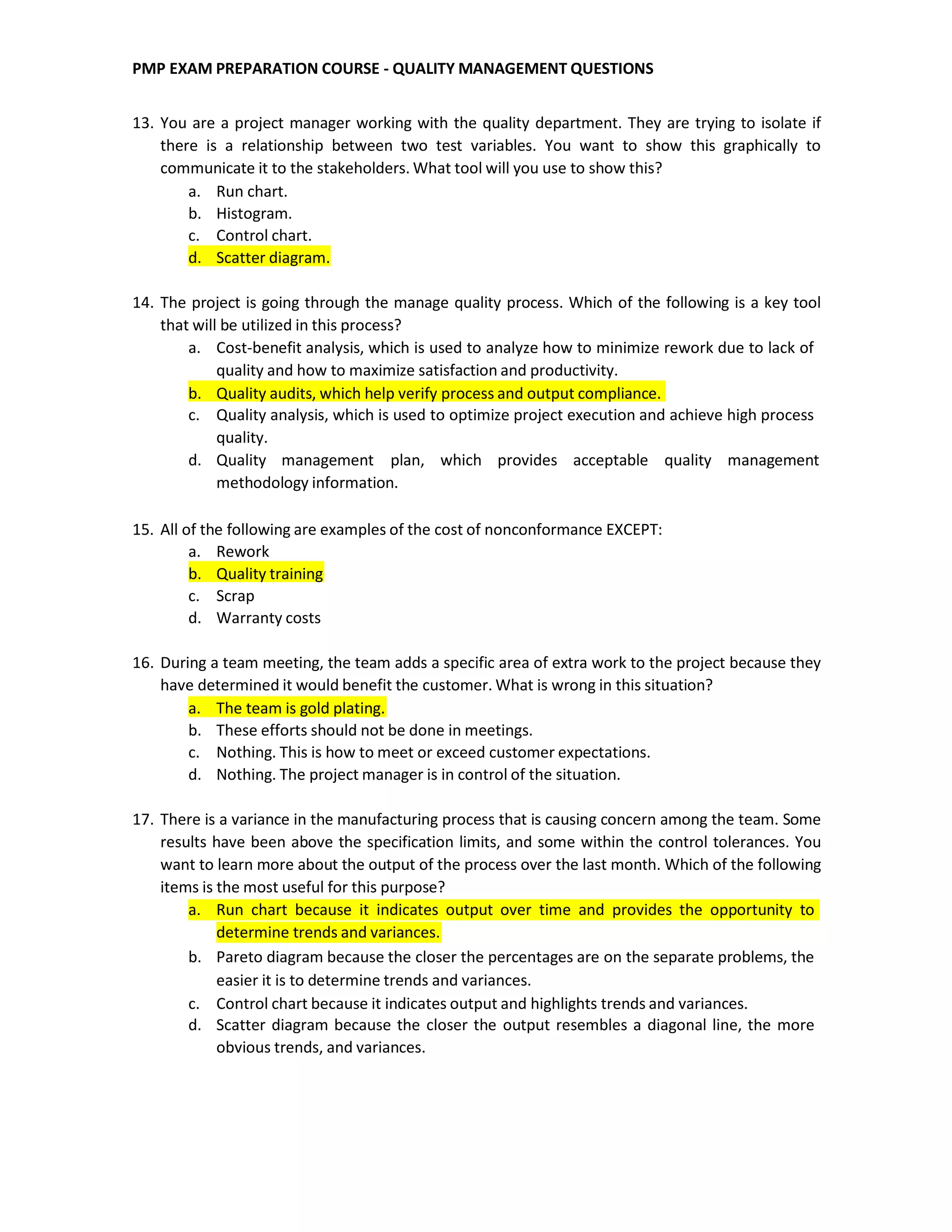
13. You are a project manager working with the quality department. They are trying to isolate if
there is a relationship between two test variables. You want to show this graphically to
communicate it to the stakeholders. What tool will you use to show this?
a. Run chart.
b. Histogram.
c. Control chart.
d. Scatter diagram.
14. The project is going through the manage quality process. Which of the following is a key tool
that will be utilized in this process?
a. Cost-benefit analysis, which is used to analyze how to minimize rework due to lack of
quality and how to maximize satisfaction and productivity.
b. Quality audits, which help verify process and output compliance.
c. Quality analysis, which is used to optimize project execution and achieve high process
quality.
d. Quality management plan, which provides acceptable quality management
methodology information.
15. All of the following are examples of the cost of nonconformance EXCEPT:
a. Rework
b. Quality training
c. Scrap
d. Warranty costs
16. During a team meeting, the team adds a specific area of extra work to the project because they
have determined it would benefit the customer. What is wrong in this situation?
a. The team is gold plating.
b. These efforts should not be done in meetings.
c. Nothing. This is how to meet or exceed customer expectations.
d. Nothing. The project manager is in control of the situation.
17. There is a variance in the manufacturing process that is causing concern among the team. Some
results have been above the specification limits, and some within the control tolerances. You
want to learn more about the output of the process over the last month. Which of the following
items is the most useful for this purpose?
a. Run chart because it indicates output over time and provides the opportunity to
determine trends and variances.
b. Pareto diagram because the closer the percentages are on the separate problems, the
easier it is to determine trends and variances.
c. Control chart because it indicates output and highlights trends and variances.
d. Scatter diagram because the closer the output resembles a diagonal line, the more
obvious trends, and variances.
PMP EXAM PREPARATION COURSE - QUALITY MANAGEMENT QUESTIONS
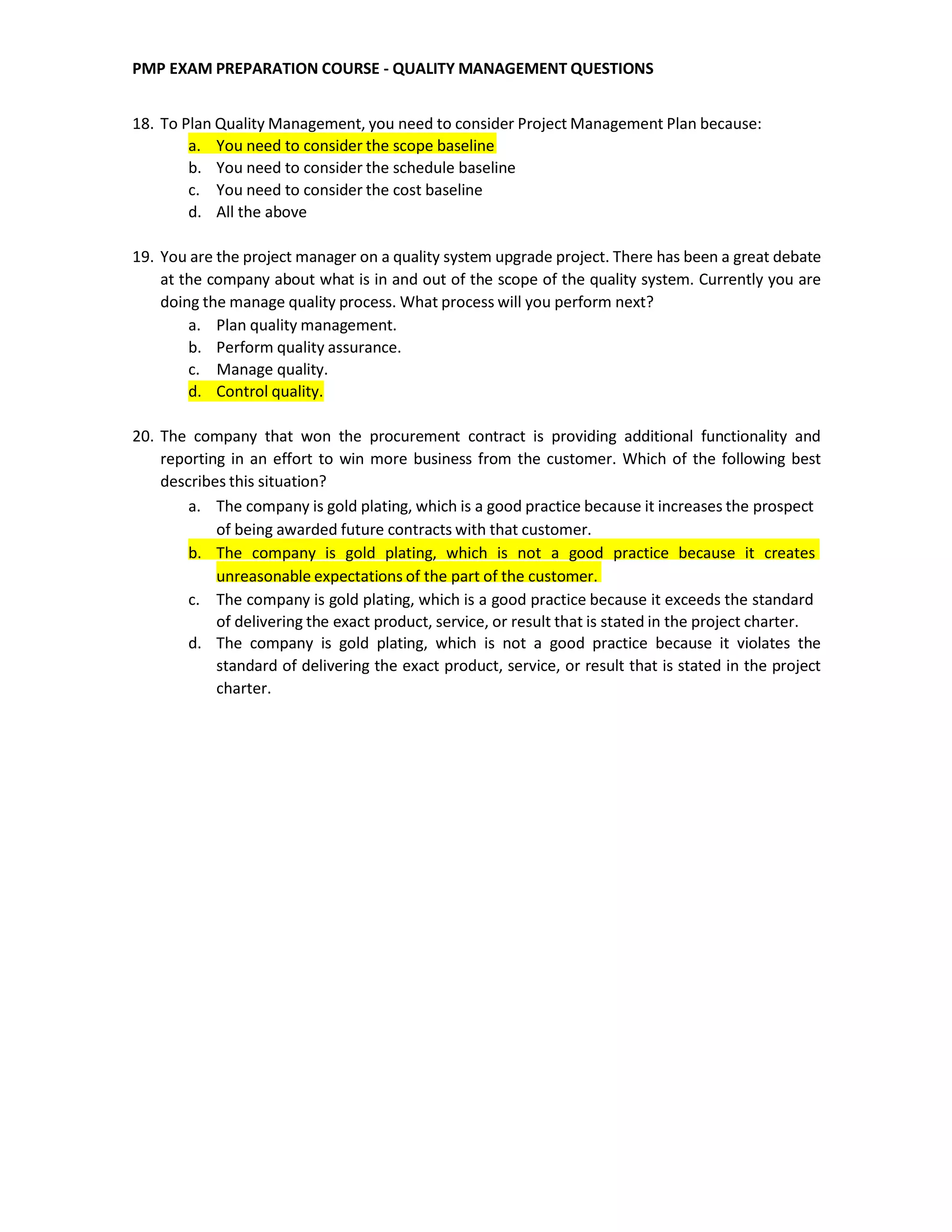
18. To Plan Quality Management, you need to consider Project Management Plan because:
a. You need to consider the scope baseline
b. You need to consider the schedule baseline
c. You need to consider the cost baseline
d. All the above
19. You are the project manager on a quality system upgrade project. There has been a great debate
at the company about what is in and out of the scope of the quality system. Currently you are
doing the manage quality process. What process will you perform next?
a. Plan quality management.
b. Perform quality assurance.
c. Manage quality.
d. Control quality.
20. The company that won the procurement contract is providing additional functionality and
reporting in an effort to win more business from the customer. Which of the following best
describes this situation?
a. The company is gold plating, which is a good practice because it increases the prospect
of being awarded future contracts with that customer.
b. The company is gold plating, which is not a good practice because it creates
unreasonable expectations of the part of the customer.
c. The company is gold plating, which is a good practice because it exceeds the standard
of delivering the exact product, service, or result that is stated in the project charter.
d. The company is gold plating, which is not a good practice because it violates the
standard of delivering the exact product, service, or result that is stated in the project
charter.
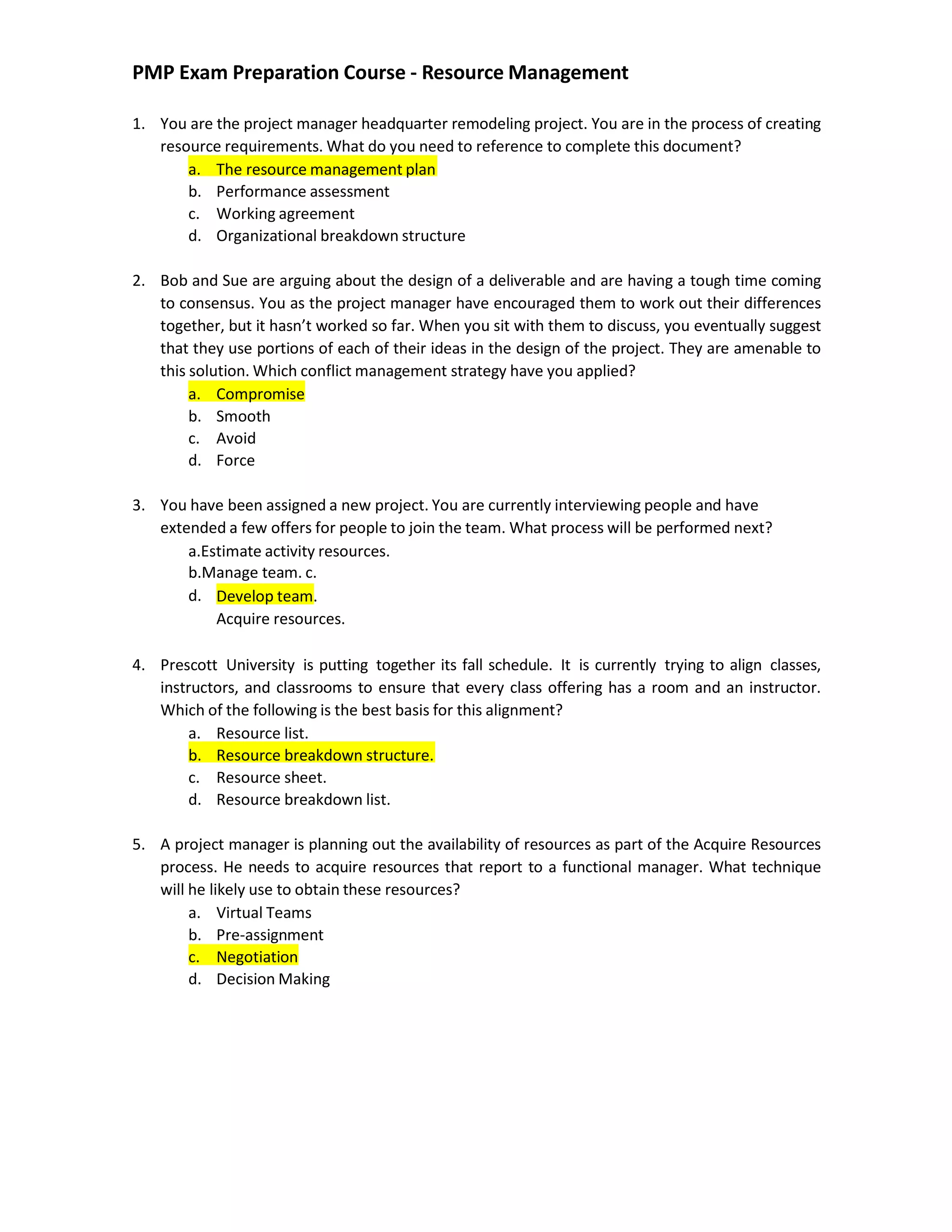
PMP Exam Preparation Course - Resource Management
1. You are the project manager headquarter remodeling project. You are in the process of creating
resource requirements. What do you need to reference to complete this document?
a. The resource management plan
b. Performance assessment
c. Working agreement
d. Organizational breakdown structure
2. Bob and Sue are arguing about the design of a deliverable and are having a tough time coming
to consensus. You as the project manager have encouraged them to work out their differences
together, but it hasn’t worked so far. When you sit with them to discuss, you eventually suggest
that they use portions of each of their ideas in the design of the project. They are amenable to
this solution. Which conflict management strategy have you applied?
a. Compromise
b. Smooth
c. Avoid
d. Force
3. You have been assigned a new project. You are currently interviewing people and have
extended a few offers for people to join the team. What process will be performed next?
a.Estimate activity resources.
b.Manage team. c.
d. Develop team.
Acquire resources.
4. Prescott University is putting together its fall schedule. It is currently trying to align classes,
instructors, and classrooms to ensure that every class offering has a room and an instructor.
Which of the following is the best basis for this alignment?
a. Resource list.
b. Resource breakdown structure.
c. Resource sheet.
d. Resource breakdown list.
5. A project manager is planning out the availability of resources as part of the Acquire Resources
process. He needs to acquire resources that report to a functional manager. What technique
will he likely use to obtain these resources?
a. Virtual Teams
b. Pre-assignment
c. Negotiation
d. Decision Making
PMP Exam Preparation Course - Resource Management
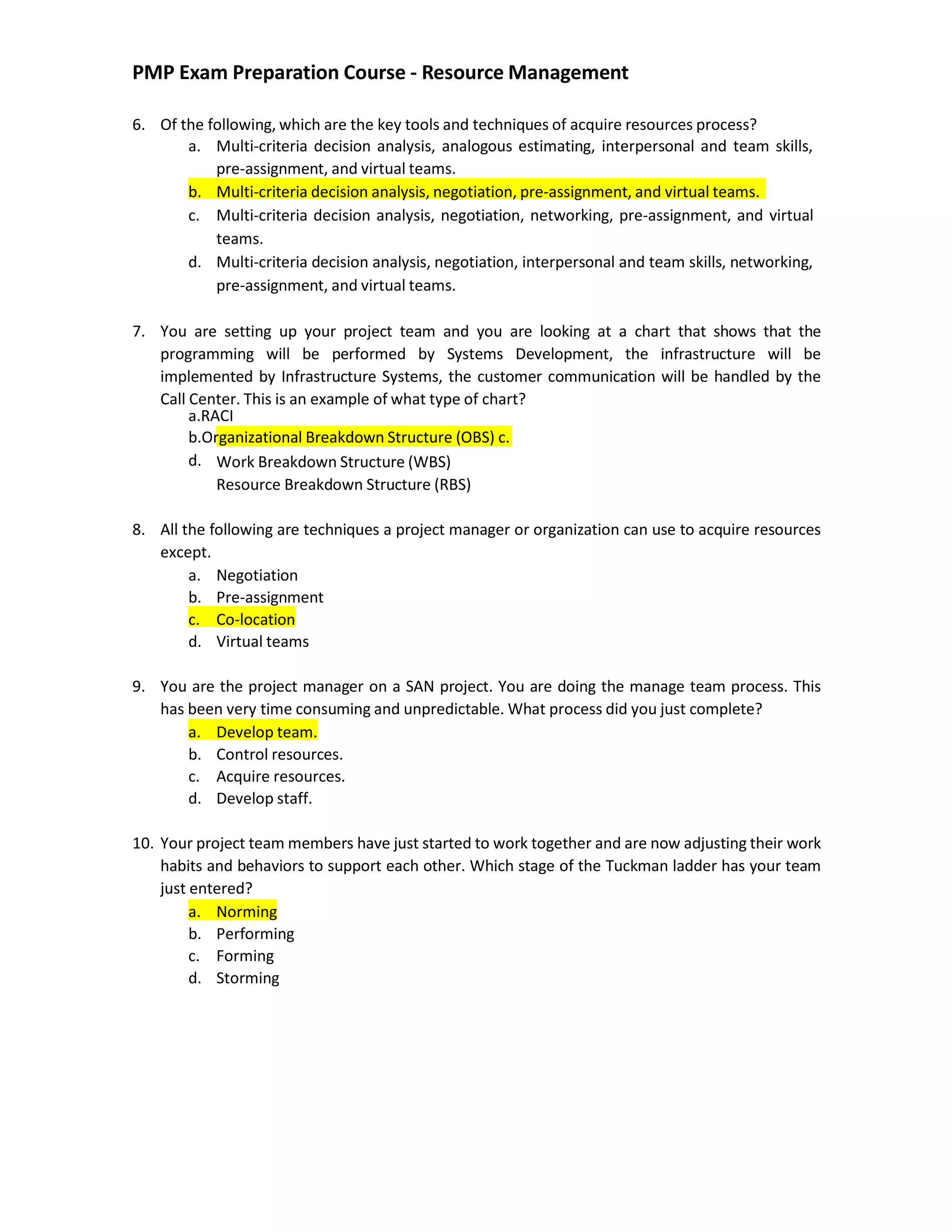
6. Of the following, which are the key tools and techniques of acquire resources process?
a. Multi-criteria decision analysis, analogous estimating, interpersonal and team skills,
pre-assignment, and virtual teams.
b. Multi-criteria decision analysis, negotiation, pre-assignment, and virtual teams.
c. Multi-criteria decision analysis, negotiation, networking, pre-assignment, and virtual
teams.
d. Multi-criteria decision analysis, negotiation, interpersonal and team skills, networking,
pre-assignment, and virtual teams.
7. You are setting up your project team and you are looking at a chart that shows that the
programming will be performed by Systems Development, the infrastructure will be
implemented by Infrastructure Systems, the customer communication will be handled by the
Call Center. This is an example of what type of chart?
a.RACI
b.Organizational Breakdown Structure (OBS) c.
d. Work Breakdown Structure (WBS)
Resource Breakdown Structure (RBS)
8. All the following are techniques a project manager or organization can use to acquire resources
except.
a. Negotiation
b. Pre-assignment
c. Co-location
d. Virtual teams
9. You are the project manager on a SAN project. You are doing the manage team process. This
has been very time consuming and unpredictable. What process did you just complete?
a. Develop team.
b. Control resources.
c. Acquire resources.
d. Develop staff.
10. Your project team members have just started to work together and are now adjusting their work
habits and behaviors to support each other. Which stage of the Tuckman ladder has your team
just entered?
a. Norming
b. Performing
c. Forming
d. Storming
PMP Exam Preparation Course - Resource Management
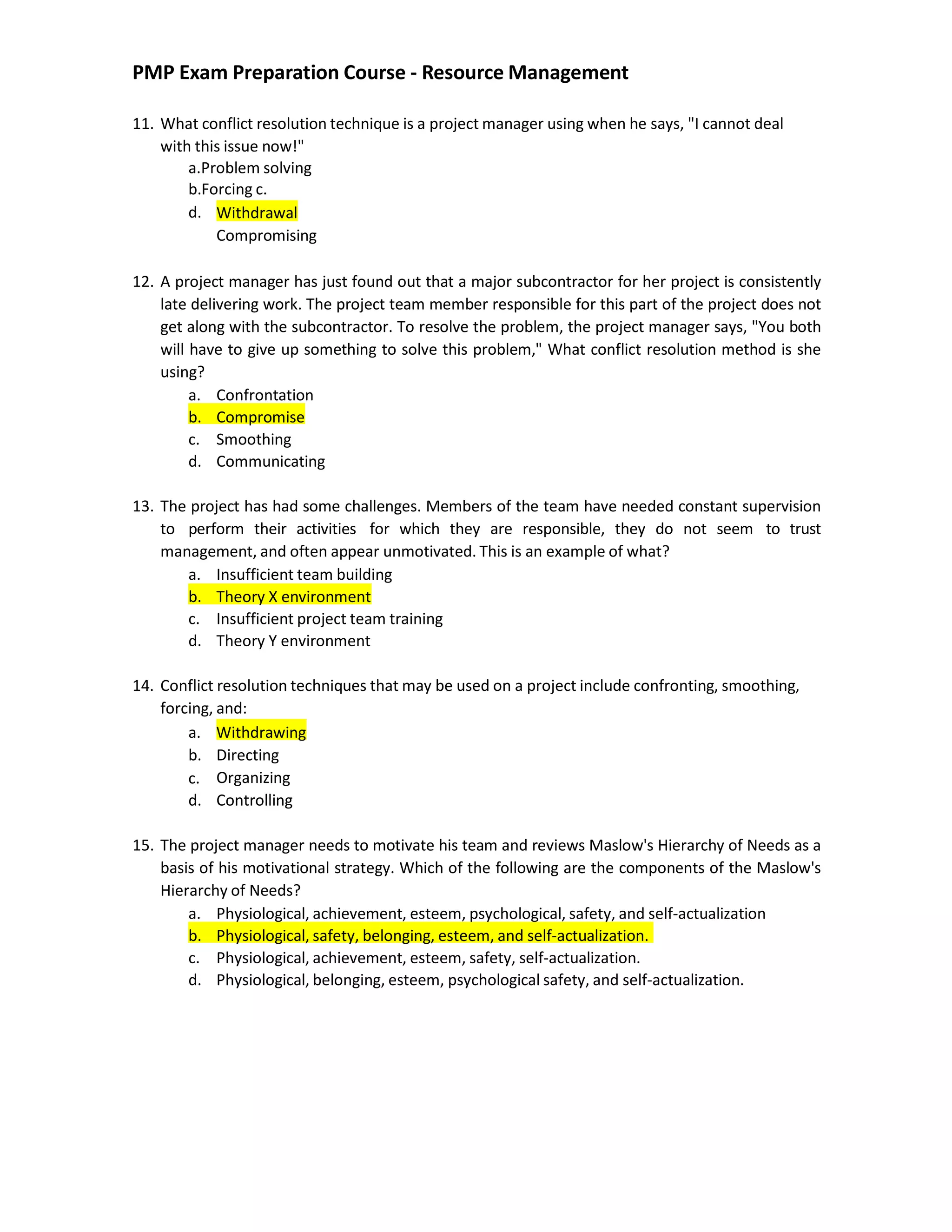
11. What conflict resolution technique is a project manager using when he says, "I cannot deal
with this issue now!"
a.Problem solving
b.Forcing c.
d. Withdrawal
Compromising
12. A project manager has just found out that a major subcontractor for her project is consistently
late delivering work. The project team member responsible for this part of the project does not
get along with the subcontractor. To resolve the problem, the project manager says, "You both
will have to give up something to solve this problem," What conflict resolution method is she
using?
a. Confrontation
b. Compromise
c. Smoothing
d. Communicating
13. The project has had some challenges. Members of the team have needed constant supervision
to perform their activities for which they are responsible, they do not seem to trust
management, and often appear unmotivated. This is an example of what?
a. Insufficient team building
b. Theory X environment
c. Insufficient project team training
d. Theory Y environment
14. Conflict resolution techniques that may be used on a project include confronting, smoothing,
forcing, and:
a. Withdrawing
b.
c.
d.
Directing
Organizing
Controlling
15. The project manager needs to motivate his team and reviews Maslow's Hierarchy of Needs as a
basis of his motivational strategy. Which of the following are the components of the Maslow's
Hierarchy of Needs?
a. Physiological, achievement, esteem, psychological, safety, and self-actualization
b. Physiological, safety, belonging, esteem, and self-actualization.
c. Physiological, achievement, esteem, safety, self-actualization.
d. Physiological, belonging, esteem, psychological safety, and self-actualization.
PMP Exam Preparation Course - Resource Management
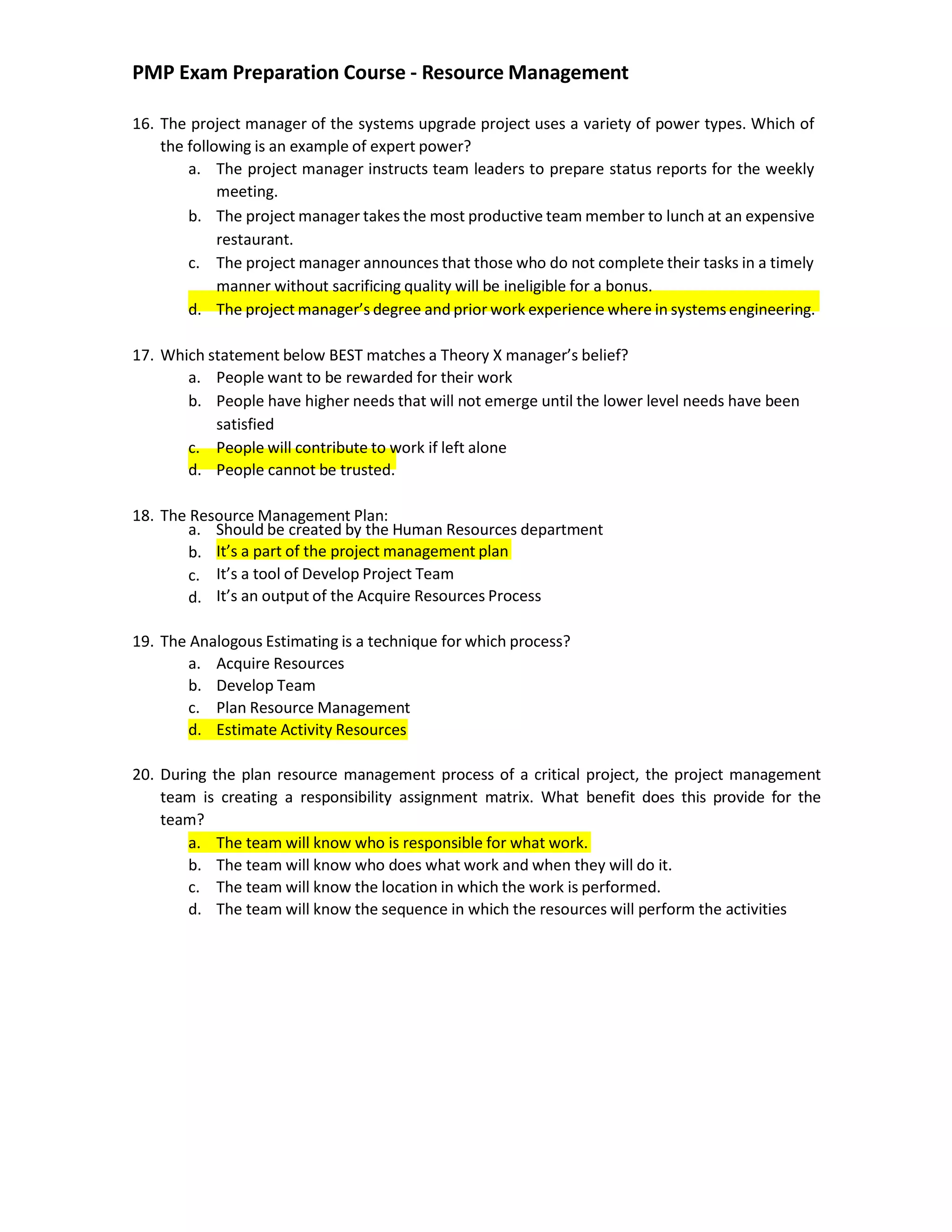
16. The project manager of the systems upgrade project uses a variety of power types. Which of
the following is an example of expert power?
a. The project manager instructs team leaders to prepare status reports for the weekly
meeting.
b. The project manager takes the most productive team member to lunch at an expensive
restaurant.
c. The project manager announces that those who do not complete their tasks in a timely
manner without sacrificing quality will be ineligible for a bonus.
d. The project manager’s degree and prior work experience where in systems engineering.
17. Which statement below BEST matches a Theory X manager’s belief?
a. People want to be rewarded for their work
b. People have higher needs that will not emerge until the lower level needs have been
satisfied
c. People will contribute to work if left alone
d. People cannot be trusted.
18. The Resource Management Plan:
a. Should be created by the Human Resources department
b.
c.
d.
It’s a part of the project management plan
It’s a tool of Develop Project Team
It’s an output of the Acquire Resources Process
19. The Analogous Estimating is a technique for which process?
a. Acquire Resources
b. Develop Team
c. Plan Resource Management
d. Estimate Activity Resources
20. During the plan resource management process of a critical project, the project management
team is creating a responsibility assignment matrix. What benefit does this provide for the
team?
a. The team will know who is responsible for what work.
b. The team will know who does what work and when they will do it.
c. The team will know the location in which the work is performed.
d. The team will know the sequence in which the resources will perform the activities
Exam Preparation PMP Exam - Project Communications Management - Questions
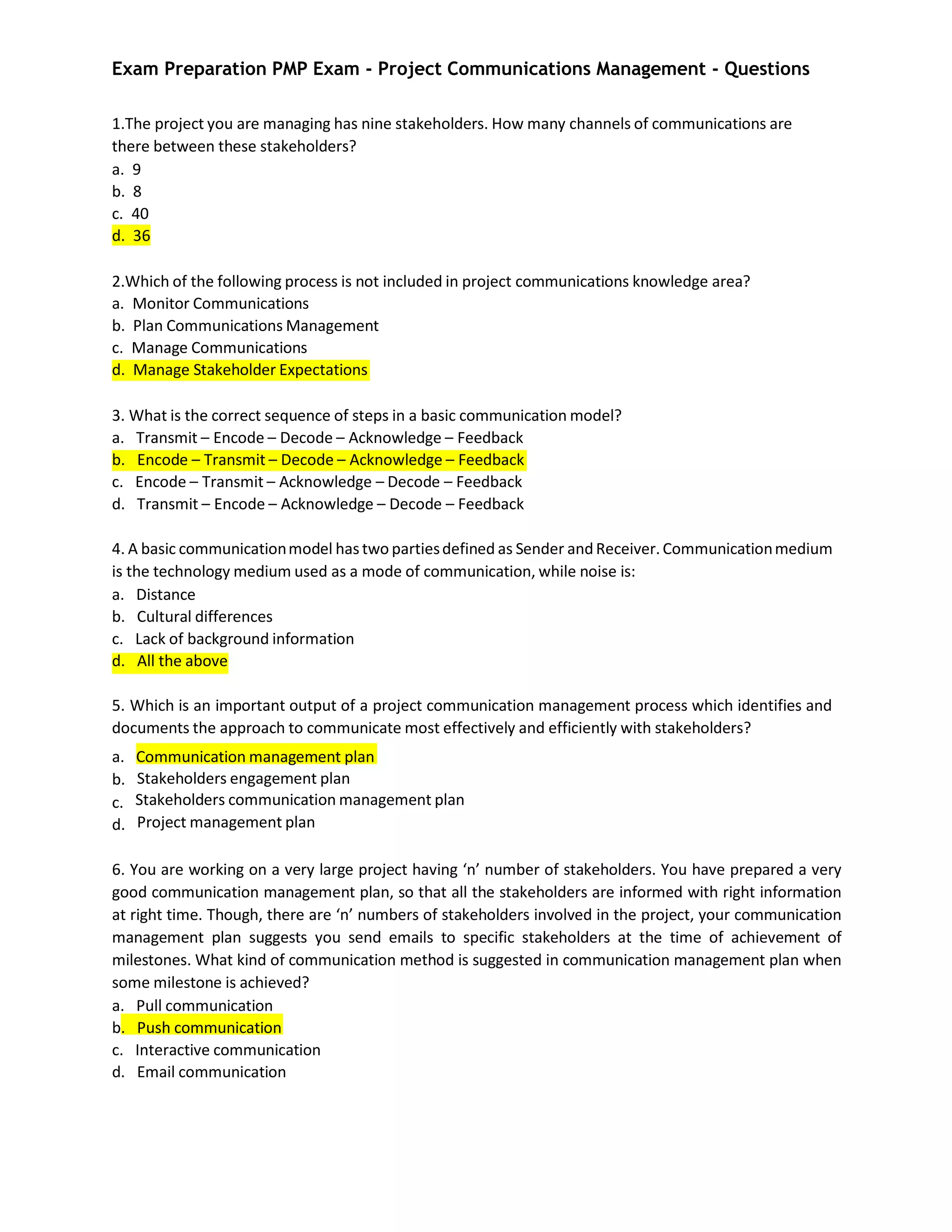
1.The project you are managing has nine stakeholders. How many channels of communications are
there between these stakeholders?
a. 9
b. 8
c. 40
d. 36
2.Which of the following process is not included in project communications knowledge area?
a. Monitor Communications
b. Plan Communications Management
c. Manage Communications
d. Manage Stakeholder Expectations
3. What is the correct sequence of steps in a basic communication model?
a. Transmit – Encode – Decode – Acknowledge – Feedback
b. Encode – Transmit – Decode – Acknowledge – Feedback
c. Encode – Transmit – Acknowledge – Decode – Feedback
d. Transmit – Encode – Acknowledge – Decode – Feedback
4. A basic communicationmodel has two partiesdefined as Sender andReceiver. Communicationmedium
is the technology medium used as a mode of communication, while noise is:
a. Distance
b. Cultural differences
c. Lack of background information
d. All the above
5. Which is an important output of a project communication management process which identifies and
documents the approach to communicate most effectively and efficiently with stakeholders?
a. Communication management plan
b.
c.
d.
Stakeholders engagement plan
Stakeholders communication management plan
Project management plan
6. You are working on a very large project having ‘n’ number of stakeholders. You have prepared a very
good communication management plan, so that all the stakeholders are informed with right information
at right time. Though, there are ‘n’ numbers of stakeholders involved in the project, your communication
management plan suggests you send emails to specific stakeholders at the time of achievement of
milestones. What kind of communication method is suggested in communication management plan when
some milestone is achieved?
a. Pull communication
b. Push communication
c. Interactive communication
d. Email communication
Exam Preparation PMP Exam - Project Communications Management - Questions
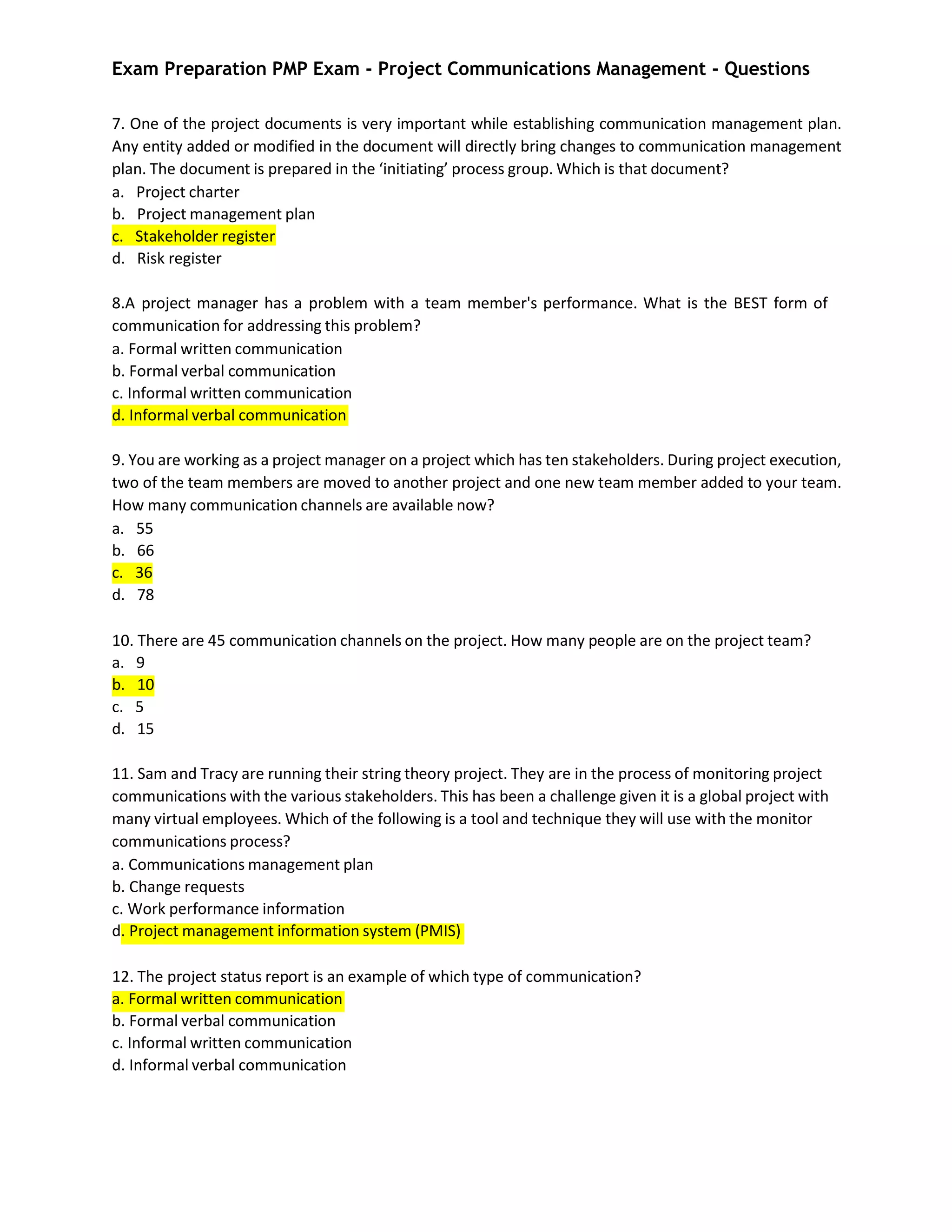
7. One of the project documents is very important while establishing communication management plan.
Any entity added or modified in the document will directly bring changes to communication management
plan. The document is prepared in the ‘initiating’ process group. Which is that document?
a. Project charter
b. Project management plan
c. Stakeholder register
d. Risk register
8.A project manager has a problem with a team member's performance. What is the BEST form of
communication for addressing this problem?
a. Formal written communication
b. Formal verbal communication
c. Informal written communication
d. Informal verbal communication
9. You are working as a project manager on a project which has ten stakeholders. During project execution,
two of the team members are moved to another project and one new team member added to your team.
How many communication channels are available now?
a. 55
b. 66
c. 36
d. 78
10. There are 45 communication channels on the project. How many people are on the project team?
a. 9
b. 10
c. 5
d. 15
11. Sam and Tracy are running their string theory project. They are in the process of monitoring project
communications with the various stakeholders. This has been a challenge given it is a global project with
many virtual employees. Which of the following is a tool and technique they will use with the monitor
communications process?
a. Communications management plan
b. Change requests
c. Work performance information
d. Project management information system (PMIS)
12. The project status report is an example of which type of communication?
a. Formal written communication
b. Formal verbal communication
c. Informal written communication
d. Informal verbal communication
Exam Preparation PMP Exam - Project Communications Management - Questions
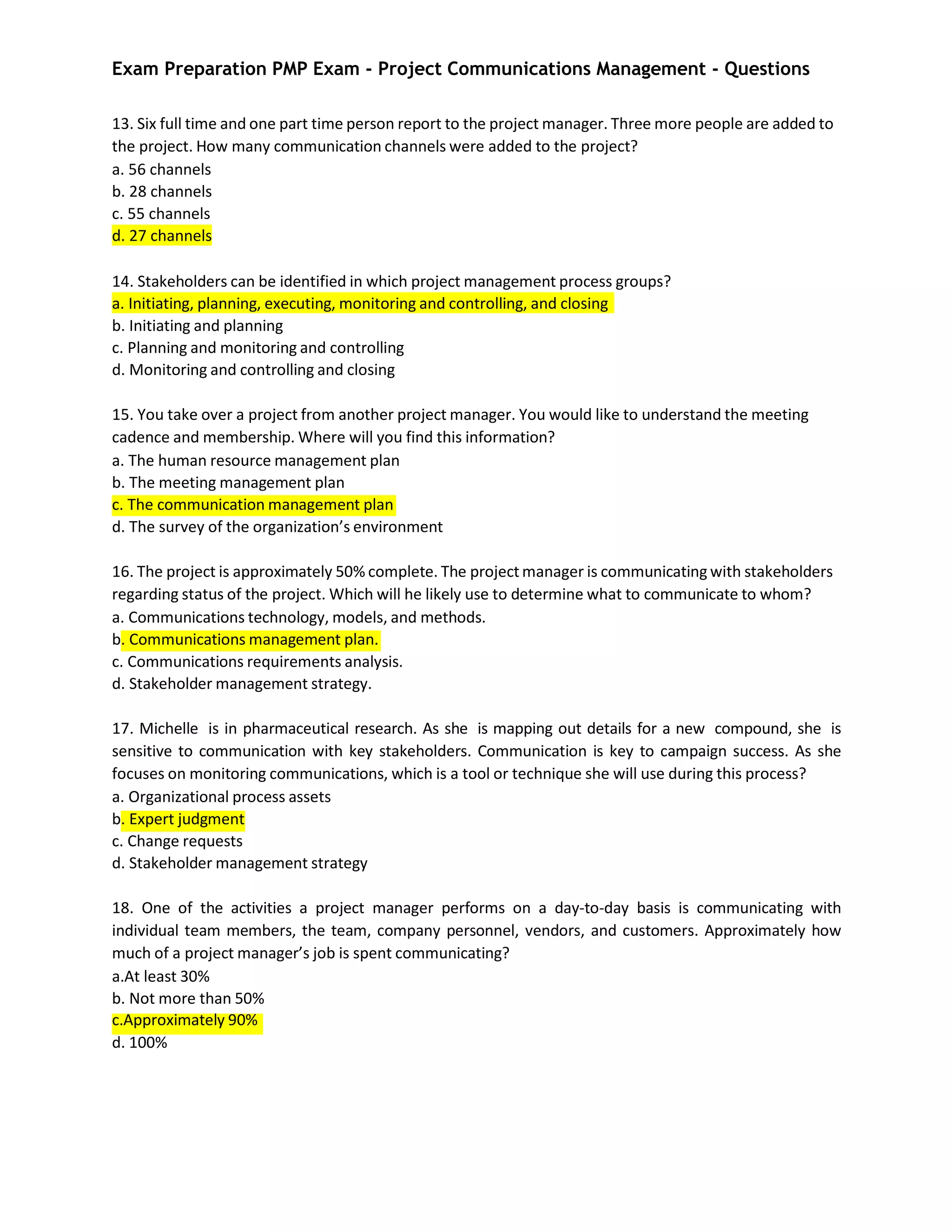
13. Six full time and one part time person report to the project manager. Three more people are added to
the project. How many communication channels were added to the project?
a. 56 channels
b. 28 channels
c. 55 channels
d. 27 channels
14. Stakeholders can be identified in which project management process groups?
a. Initiating, planning, executing, monitoring and controlling, and closing
b. Initiating and planning
c. Planning and monitoring and controlling
d. Monitoring and controlling and closing
15. You take over a project from another project manager. You would like to understand the meeting
cadence and membership. Where will you find this information?
a. The human resource management plan
b. The meeting management plan
c. The communication management plan
d. The survey of the organization’s environment
16. The project is approximately 50% complete. The project manager is communicating with stakeholders
regarding status of the project. Which will he likely use to determine what to communicate to whom?
a. Communications technology, models, and methods.
b. Communications management plan.
c. Communications requirements analysis.
d. Stakeholder management strategy.
17. Michelle is in pharmaceutical research. As she is mapping out details for a new compound, she is
sensitive to communication with key stakeholders. Communication is key to campaign success. As she
focuses on monitoring communications, which is a tool or technique she will use during this process?
a. Organizational process assets
b. Expert judgment
c. Change requests
d. Stakeholder management strategy
18. One of the activities a project manager performs on a day-to-day basis is communicating with
individual team members, the team, company personnel, vendors, and customers. Approximately how
much of a project manager’s job is spent communicating?
a.At least 30%
b. Not more than 50%
c.Approximately 90%
d. 100%
Exam Preparation PMP Exam - Project Communications Management - Questions
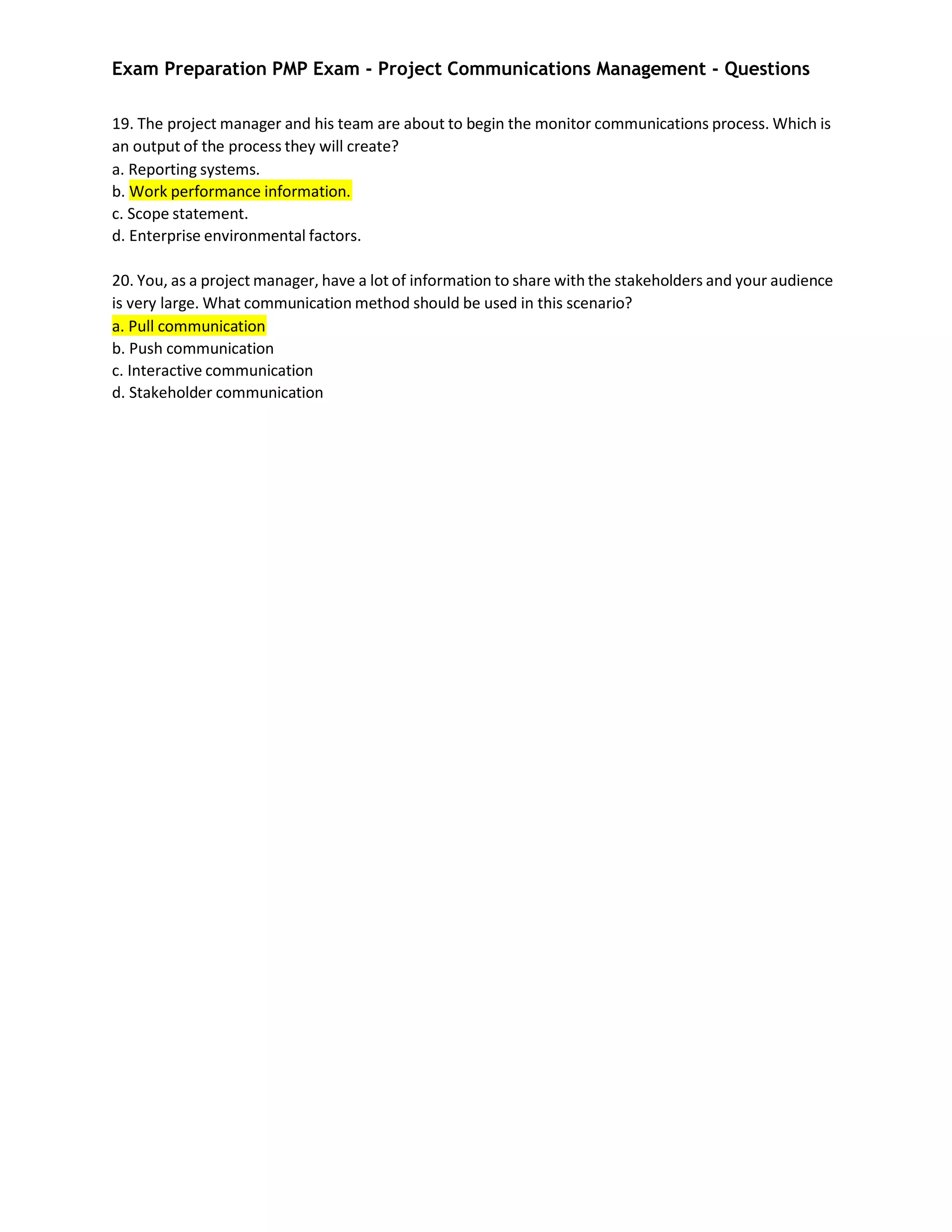
19. The project manager and his team are about to begin the monitor communications process. Which is
an output of the process they will create?
a. Reporting systems.
b. Work performance information.
c. Scope statement.
d. Enterprise environmental factors.
20. You, as a project manager, have a lot of information to share with the stakeholders and your audience
is very large. What communication method should be used in this scenario?
a. Pull communication
b. Push communication
c. Interactive communication
d. Stakeholder communication
PMP Exam Preparation Course - Risk Management Questions
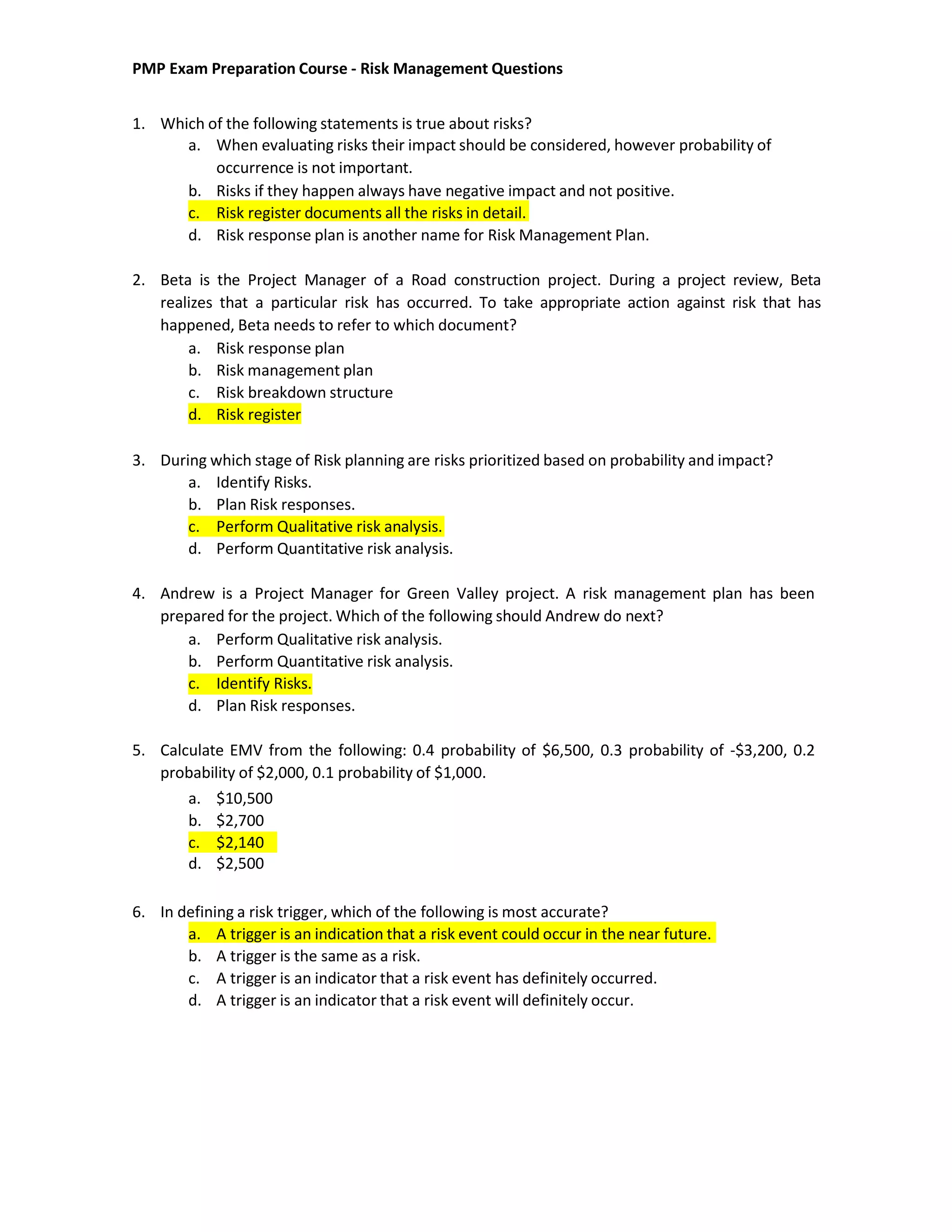
1. Which of the following statements is true about risks?
a. When evaluating risks their impact should be considered, however probability of
occurrence is not important.
b. Risks if they happen always have negative impact and not positive.
c. Risk register documents all the risks in detail.
d. Risk response plan is another name for Risk Management Plan.
2. Beta is the Project Manager of a Road construction project. During a project review, Beta
realizes that a particular risk has occurred. To take appropriate action against risk that has
happened, Beta needs to refer to which document?
a. Risk response plan
b. Risk management plan
c. Risk breakdown structure
d. Risk register
3. During which stage of Risk planning are risks prioritized based on probability and impact?
a. Identify Risks.
b. Plan Risk responses.
c. Perform Qualitative risk analysis.
d. Perform Quantitative risk analysis.
4. Andrew is a Project Manager for Green Valley project. A risk management plan has been
prepared for the project. Which of the following should Andrew do next?
a. Perform Qualitative risk analysis.
b. Perform Quantitative risk analysis.
c. Identify Risks.
d. Plan Risk responses.
5. Calculate EMV from the following: 0.4 probability of $6,500, 0.3 probability of -$3,200, 0.2
probability of $2,000, 0.1 probability of $1,000.
6. In defining a risk trigger, which of the following is most accurate?
a. A trigger is an indication that a risk event could occur in the near future.
b. A trigger is the same as a risk.
c. A trigger is an indicator that a risk event has definitely occurred.
d. A trigger is an indicator that a risk event will definitely occur.
a. $10,500
b. $2,700
c. $2,140
d. $2,500
PMP Exam Preparation Course - Risk Management Questions
7. You are the project manager on a server infrastructure project. You have just started creating
the risk register. What process did you just complete?
a. Identify risks.
b. Plan risk management.
c. Perform qualitative risk analysis.
d. Implement risk responses.
8. Overtime associated with the execution effort of a project is estimated at 120 hours with
probability 0.5, 250 hours with probability 0.6, and 300 hours with probability 0.3. What is the
value of the amount of overtime?
a. 300 hours
b. 670 hours
c. 250 hours
d. 100 hours
9. Perform qualitative risk analysis uses a variety of tools for analysis. Which of the following is
most closely associated with this process?
a. A probability and impact matrix.
b. The expected monetary value (EMV) formula.
c. Templates for work-around documentation.
d. Risk trigger determination.
10. If a project has a 60 percent chance of a $100,000 profit and a 40 percent chance of a $100,000
loss, the expected monetary value for the project is:
a.$100,000 profit b.
$60,000 loss
c. $20,000 profit
d. $40,000 loss
11. If a risk has a 20 percent chance of happening in a given month, and the project is expected to
last five months, what is the probability that this risk event will occur during the fourth month
of the project?
a. Less than 1 percent
b. 20 percent
c. 60 percent
d. 80 percent
12. Risks will be identified during which risk management process(es)?
a. Perform Quantitative Risk Analysis and Identify Risks
b. Identify Risks and Monitor Risks
c. Perform Qualitative Risk Analysis and Monitor and Control Risks
d. Identify Risks
PMP Exam Preparation Course - Risk Management Questions
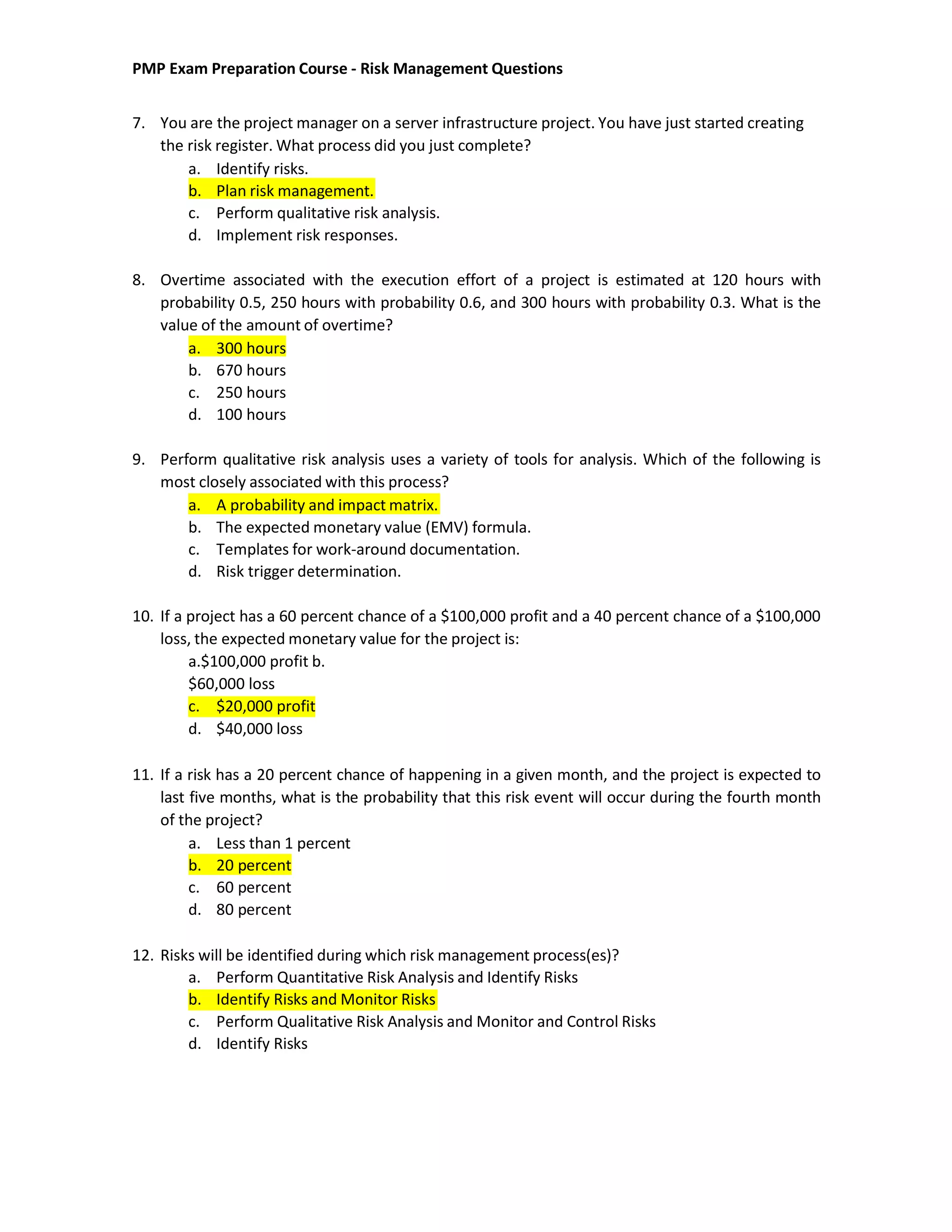
13. Purchasing insurance is BEST considered an example of risk:
a. Mitigation
b. Transfer
c. Acceptance
d. Avoidance
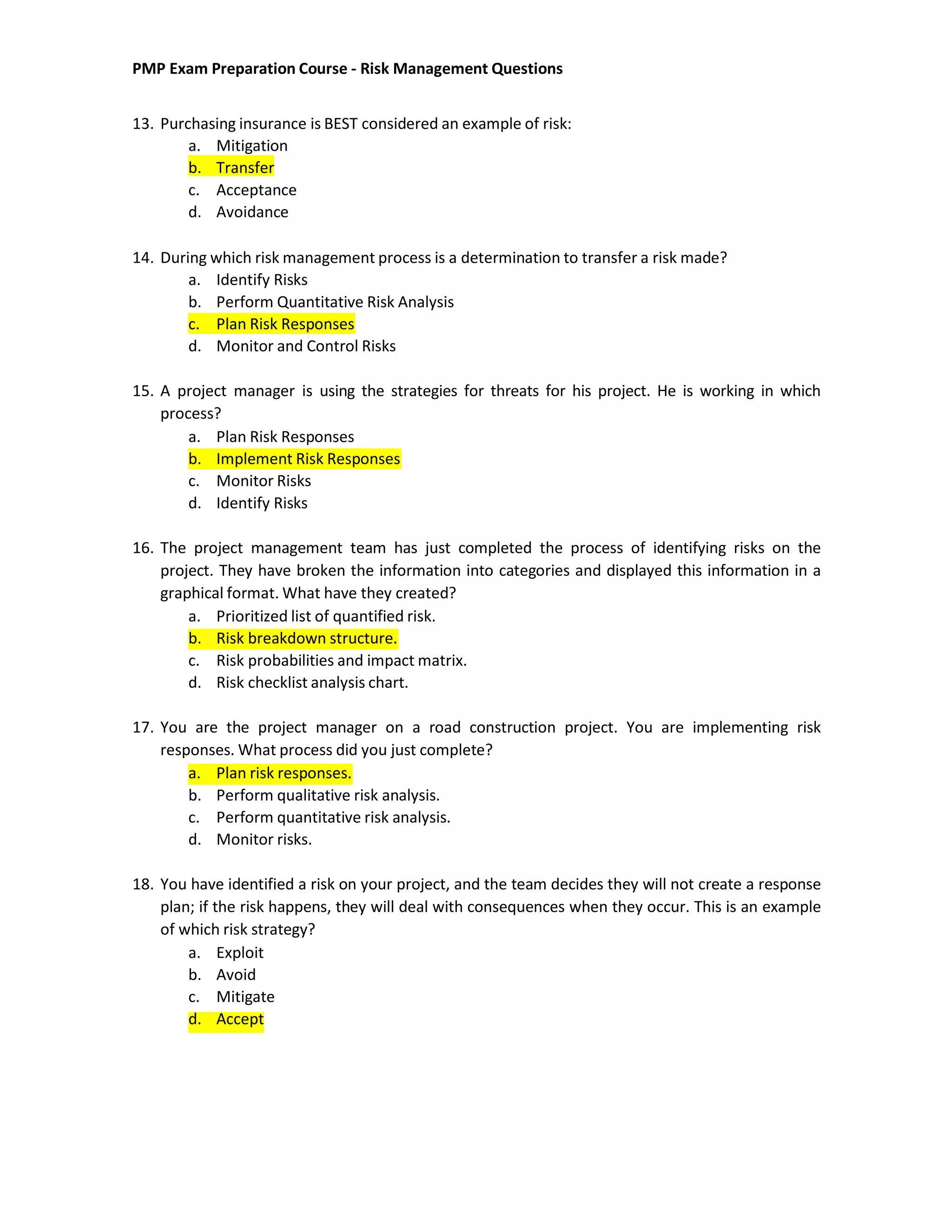
14. During which risk management process is a determination to transfer a risk made?
a. Identify Risks
b. Perform Quantitative Risk Analysis
c. Plan Risk Responses
d. Monitor and Control Risks
15. A project manager is using the strategies for threats for his project. He is working in which
process?
a. Plan Risk Responses
b. Implement Risk Responses
c. Monitor Risks
d. Identify Risks
16. The project management team has just completed the process of identifying risks on the
project. They have broken the information into categories and displayed this information in a
graphical format. What have they created?
a. Prioritized list of quantified risk.
b. Risk breakdown structure.
c. Risk probabilities and impact matrix.
d. Risk checklist analysis chart.
17. You are the project manager on a road construction project. You are implementing risk
responses. What process did you just complete?
a. Plan risk responses.
b. Perform qualitative risk analysis.
c. Perform quantitative risk analysis.
d. Monitor risks.
18. You have identified a risk on your project, and the team decides they will not create a response
plan; if the risk happens, they will deal with consequences when they occur. This is an example
of which risk strategy?
a. Exploit
b. Avoid
c. Mitigate
d. Accept
PMP Exam Preparation Course - Risk Management Questions
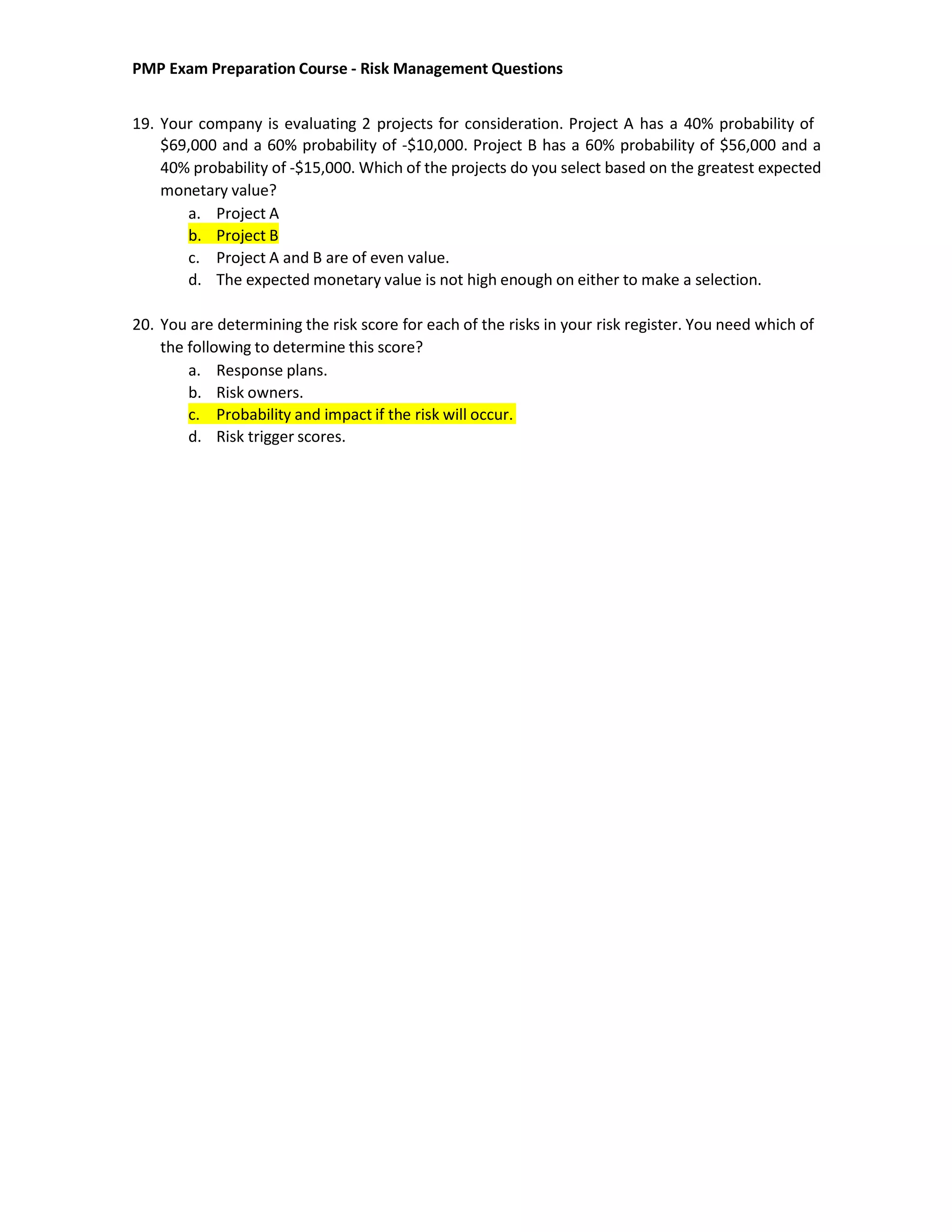
19. Your company is evaluating 2 projects for consideration. Project A has a 40% probability of
$69,000 and a 60% probability of -$10,000. Project B has a 60% probability of $56,000 and a
40% probability of -$15,000. Which of the projects do you select based on the greatest expected
monetary value?
a. Project A
b. Project B
c. Project A and B are of even value.
d. The expected monetary value is not high enough on either to make a selection.
20. You are determining the risk score for each of the risks in your risk register. You need which of
the following to determine this score?
a. Response plans.
b. Risk owners.
c. Probability and impact if the risk will occur.
d. Risk trigger scores.
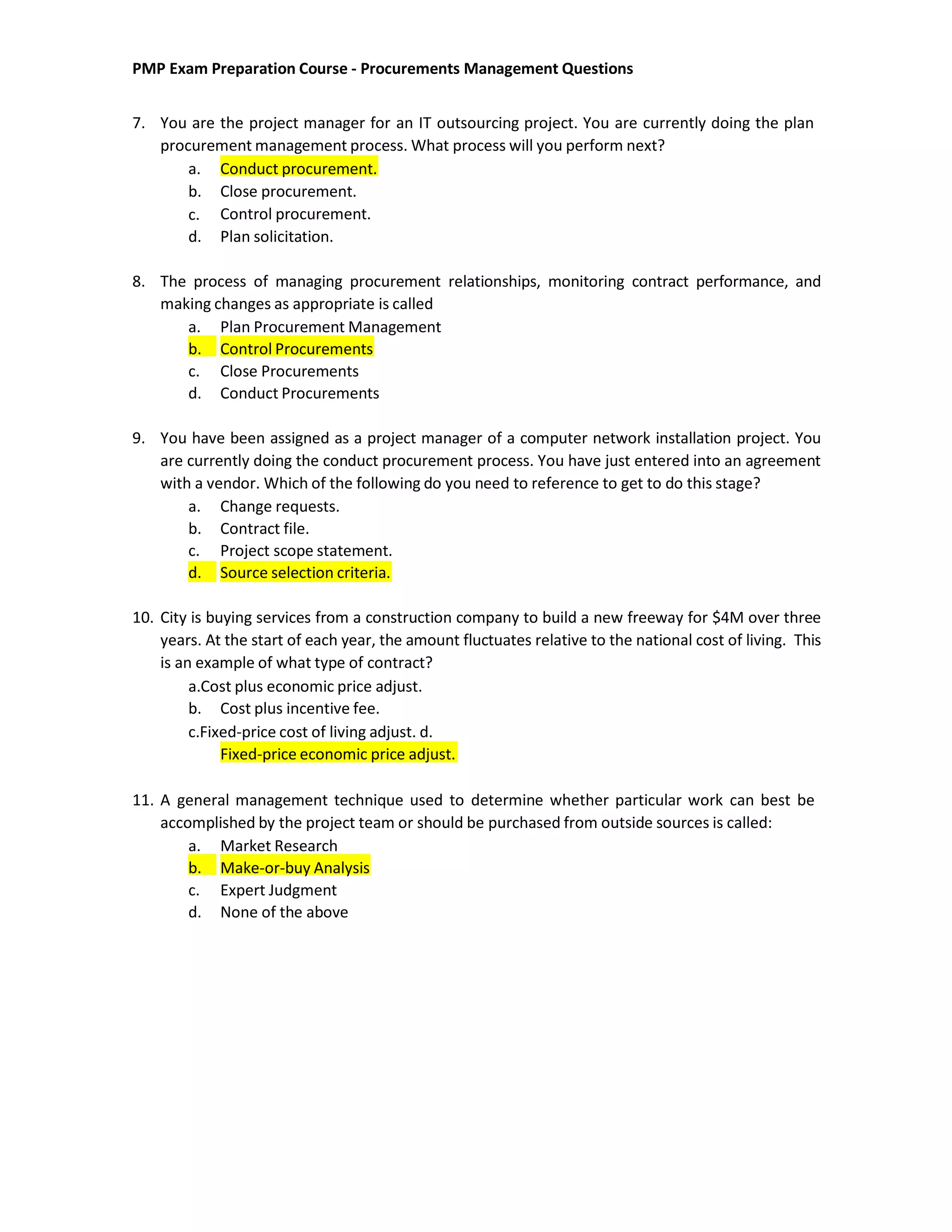
PMP Exam Preparation Course - Procurements Management Questions
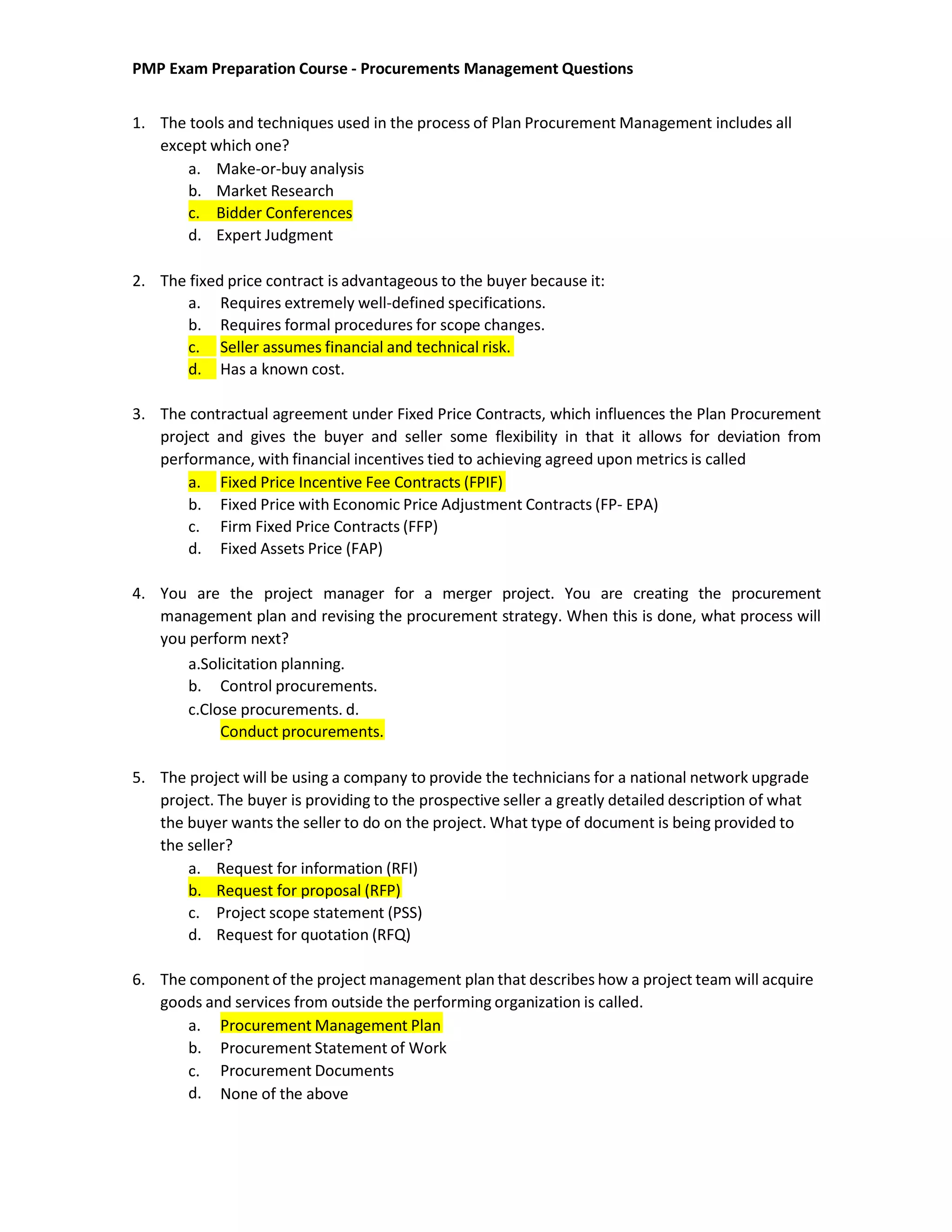
1. The tools and techniques used in the process of Plan Procurement Management includes all
except which one?
a. Make-or-buy analysis
b. Market Research
c. Bidder Conferences
d. Expert Judgment
2. The fixed price contract is advantageous to the buyer because it:
a. Requires extremely well-defined specifications.
b. Requires formal procedures for scope changes.
c. Seller assumes financial and technical risk.
d. Has a known cost.
3. The contractual agreement under Fixed Price Contracts, which influences the Plan Procurement
project and gives the buyer and seller some flexibility in that it allows for deviation from
performance, with financial incentives tied to achieving agreed upon metrics is called
a. Fixed Price Incentive Fee Contracts (FPIF)
b. Fixed Price with Economic Price Adjustment Contracts (FP- EPA)
c. Firm Fixed Price Contracts (FFP)
d. Fixed Assets Price (FAP)
4. You are the project manager for a merger project. You are creating the procurement
management plan and revising the procurement strategy. When this is done, what process will
you perform next?
a.Solicitation planning.
b. Control procurements.
c.Close procurements. d.
Conduct procurements.
5. The project will be using a company to provide the technicians for a national network upgrade
project. The buyer is providing to the prospective seller a greatly detailed description of what
the buyer wants the seller to do on the project. What type of document is being provided to
the seller?
a. Request for information (RFI)
b. Request for proposal (RFP)
c. Project scope statement (PSS)
d. Request for quotation (RFQ)
6. The component of the project management plan that describes how a project team will acquire
goods and services from outside the performing organization is called.
a. Procurement Management Plan
b.
c.
d.
Procurement Statement of Work
Procurement Documents
None of the above
PMP Exam Preparation Course - Procurements Management Questions
7. You are the project manager for an IT outsourcing project. You are currently doing the plan
procurement management process. What process will you perform next?
a. Conduct procurement.
b.
c.
d.
Close procurement.
Control procurement.
Plan solicitation.
8. The process of managing procurement relationships, monitoring contract performance, and
making changes as appropriate is called
a. Plan Procurement Management
b. Control Procurements
c. Close Procurements
d. Conduct Procurements
9. You have been assigned as a project manager of a computer network installation project. You
are currently doing the conduct procurement process. You have just entered into an agreement
with a vendor. Which of the following do you need to reference to get to do this stage?
a. Change requests.
b. Contract file.
c. Project scope statement.
d. Source selection criteria.
10. City is buying services from a construction company to build a new freeway for $4M over three
years. At the start of each year, the amount fluctuates relative to the national cost of living. This
is an example of what type of contract?
a.Cost plus economic price adjust.
b. Cost plus incentive fee.
c.Fixed-price cost of living adjust. d.
Fixed-price economic price adjust.
11. A general management technique used to determine whether particular work can best be
accomplished by the project team or should be purchased from outside sources is called:
a. Market Research
b. Make-or-buy Analysis
c. Expert Judgment
d. None of the above
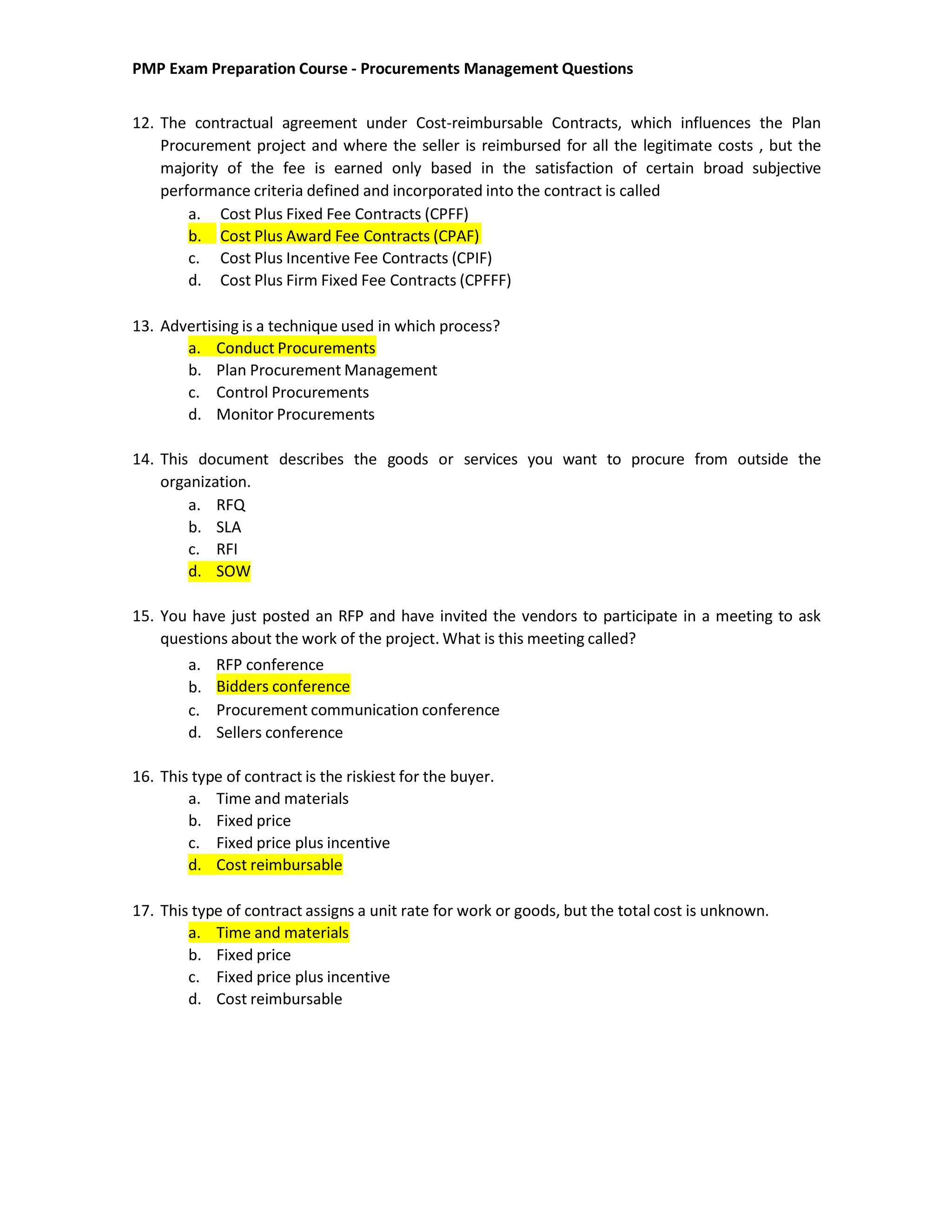
PMP Exam Preparation Course - Procurements Management Questions
12. The contractual agreement under Cost-reimbursable Contracts, which influences the Plan
Procurement project and where the seller is reimbursed for all the legitimate costs , but the
majority of the fee is earned only based in the satisfaction of certain broad subjective
performance criteria defined and incorporated into the contract is called
a. Cost Plus Fixed Fee Contracts (CPFF)
b. Cost Plus Award Fee Contracts (CPAF)
c. Cost Plus Incentive Fee Contracts (CPIF)
d. Cost Plus Firm Fixed Fee Contracts (CPFFF)
13. Advertising is a technique used in which process?
a. Conduct Procurements
b. Plan Procurement Management
c. Control Procurements
d. Monitor Procurements
14. This document describes the goods or services you want to procure from outside the
organization.
a. RFQ
b. SLA
c. RFI
d. SOW
15. You have just posted an RFP and have invited the vendors to participate in a meeting to ask
questions about the work of the project. What is this meeting called?
a. RFP conference
b.
c.
d.
Bidders conference
Procurement communication conference
Sellers conference
16. This type of contract is the riskiest for the buyer.
a. Time and materials
b. Fixed price
c. Fixed price plus incentive
d. Cost reimbursable
17. This type of contract assigns a unit rate for work or goods, but the total cost is unknown.
a. Time and materials
b. Fixed price
c. Fixed price plus incentive
d. Cost reimbursable
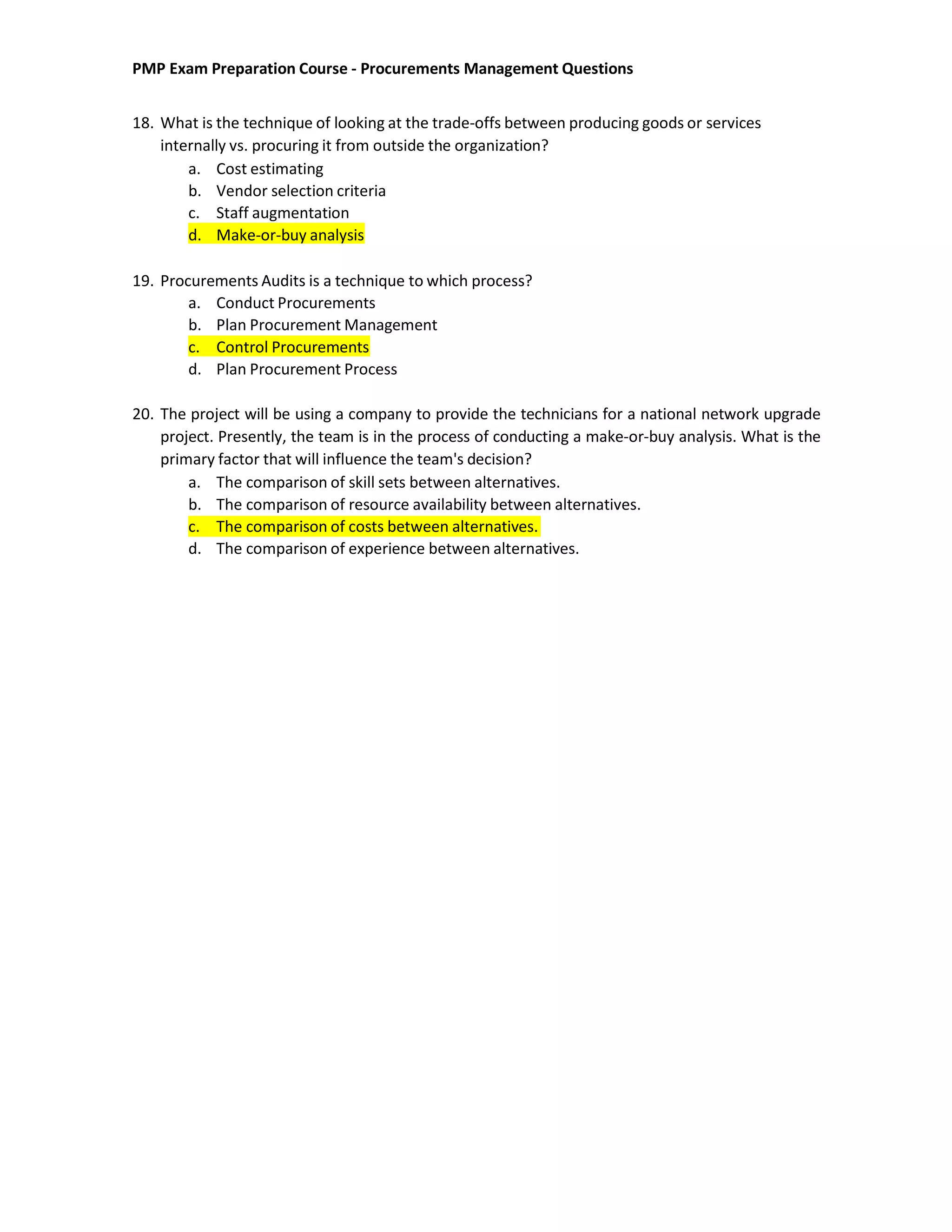
PMP Exam Preparation Course - Procurements Management Questions
18. What is the technique of looking at the trade-offs between producing goods or services
internally vs. procuring it from outside the organization?
a. Cost estimating
b. Vendor selection criteria
c. Staff augmentation
d. Make-or-buy analysis
19. Procurements Audits is a technique to which process?
a. Conduct Procurements
b. Plan Procurement Management
c. Control Procurements
d. Plan Procurement Process
20. The project will be using a company to provide the technicians for a national network upgrade
project. Presently, the team is in the process of conducting a make-or-buy analysis. What is the
primary factor that will influence the team's decision?
a. The comparison of skill sets between alternatives.
b. The comparison of resource availability between alternatives.
c. The comparison of costs between alternatives.
d. The comparison of experience between alternatives.
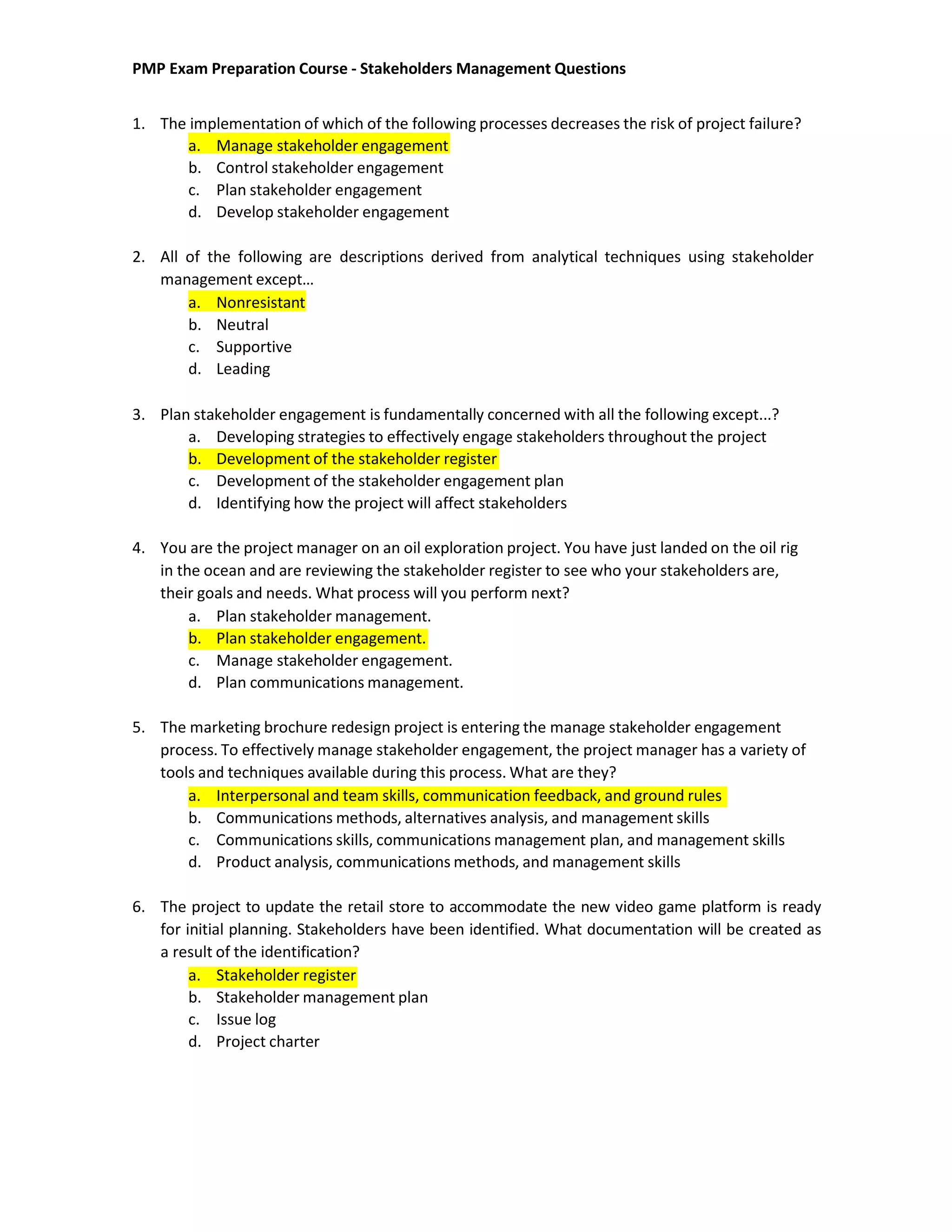
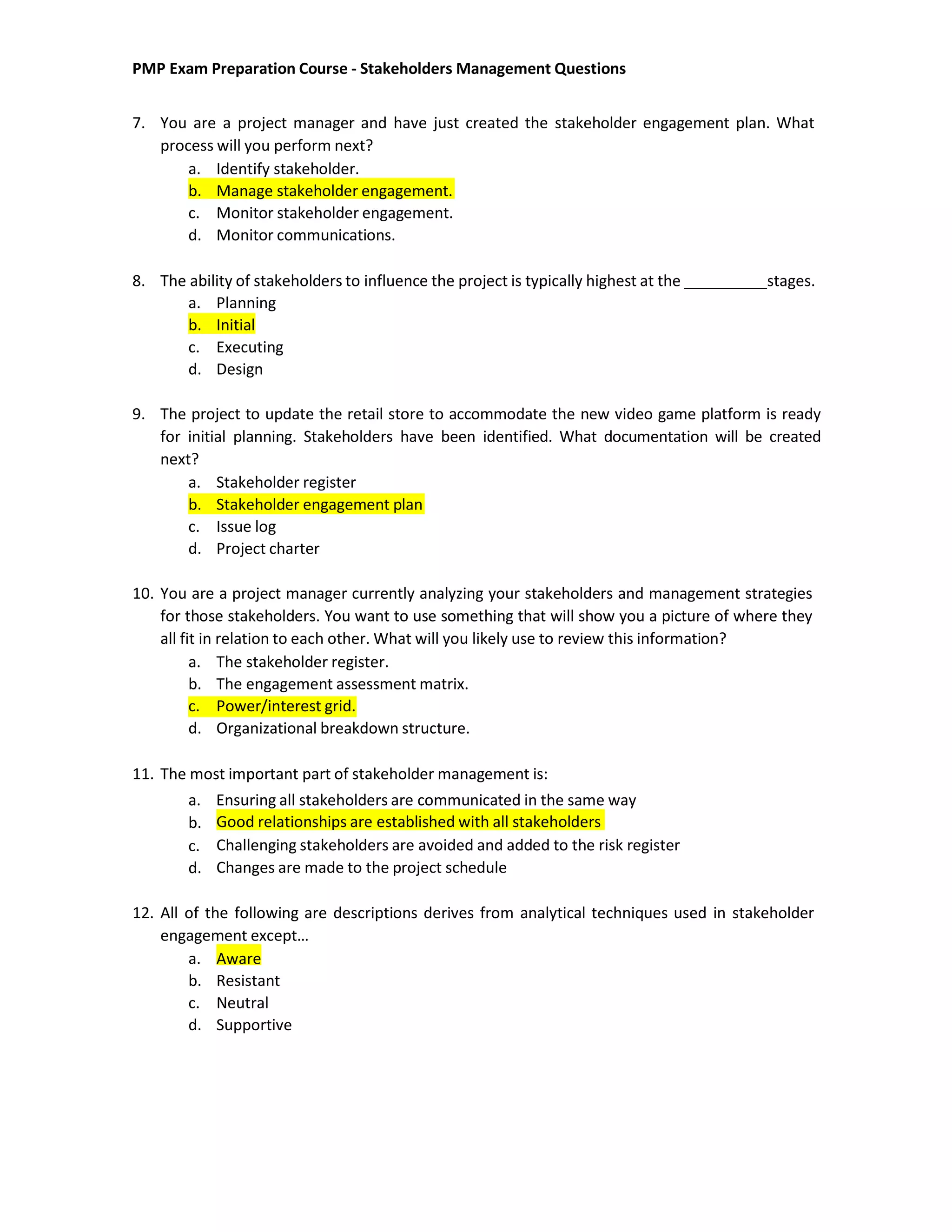
PMP Exam Preparation Course - Stakeholders Management Questions
1. The implementation of which of the following processes decreases the risk of project failure?
a. Manage stakeholder engagement
b. Control stakeholder engagement
c. Plan stakeholder engagement
d. Develop stakeholder engagement
2. All of the following are descriptions derived from analytical techniques using stakeholder
management except…
a. Nonresistant
b. Neutral
c. Supportive
d. Leading
3. Plan stakeholder engagement is fundamentally concerned with all the following except...?
a. Developing strategies to effectively engage stakeholders throughout the project
b. Development of the stakeholder register
c. Development of the stakeholder engagement plan
d. Identifying how the project will affect stakeholders
4. You are the project manager on an oil exploration project. You have just landed on the oil rig
in the ocean and are reviewing the stakeholder register to see who your stakeholders are,
their goals and needs. What process will you perform next?
a. Plan stakeholder management.
b. Plan stakeholder engagement.
c. Manage stakeholder engagement.
d. Plan communications management.
5. The marketing brochure redesign project is entering the manage stakeholder engagement
process. To effectively manage stakeholder engagement, the project manager has a variety of
tools and techniques available during this process. What are they?
a. Interpersonal and team skills, communication feedback, and ground rules
b. Communications methods, alternatives analysis, and management skills
c. Communications skills, communications management plan, and management skills
d. Product analysis, communications methods, and management skills
6. The project to update the retail store to accommodate the new video game platform is ready
for initial planning. Stakeholders have been identified. What documentation will be created as
a result of the identification?
a. Stakeholder register
b. Stakeholder management plan
c. Issue log
d. Project charter
PMP Exam Preparation Course - Stakeholders Management Questions
7. You are a project manager and have just created the stakeholder engagement plan. What
process will you perform next?
a. Identify stakeholder.
b. Manage stakeholder engagement.
c. Monitor stakeholder engagement.
d. Monitor communications.
8. The ability of stakeholders to influence the project is typically highest at the stages.
a. Planning
b. Initial
c. Executing
d. Design
9. The project to update the retail store to accommodate the new video game platform is ready
for initial planning. Stakeholders have been identified. What documentation will be created
next?
a. Stakeholder register
b. Stakeholder engagement plan
c. Issue log
d. Project charter
10. You are a project manager currently analyzing your stakeholders and management strategies
for those stakeholders. You want to use something that will show you a picture of where they
all fit in relation to each other. What will you likely use to review this information?
a. The stakeholder register.
b. The engagement assessment matrix.
c. Power/interest grid.
d. Organizational breakdown structure.
11. The most important part of stakeholder management is:
a. Ensuring all stakeholders are communicated in the same way
b.
c.
d.
Good relationships are established with all stakeholders
Challenging stakeholders are avoided and added to the risk register
Changes are made to the project schedule
12. All of the following are descriptions derives from analytical techniques used in stakeholder
engagement except…
a. Aware
b. Resistant
c. Neutral
d. Supportive
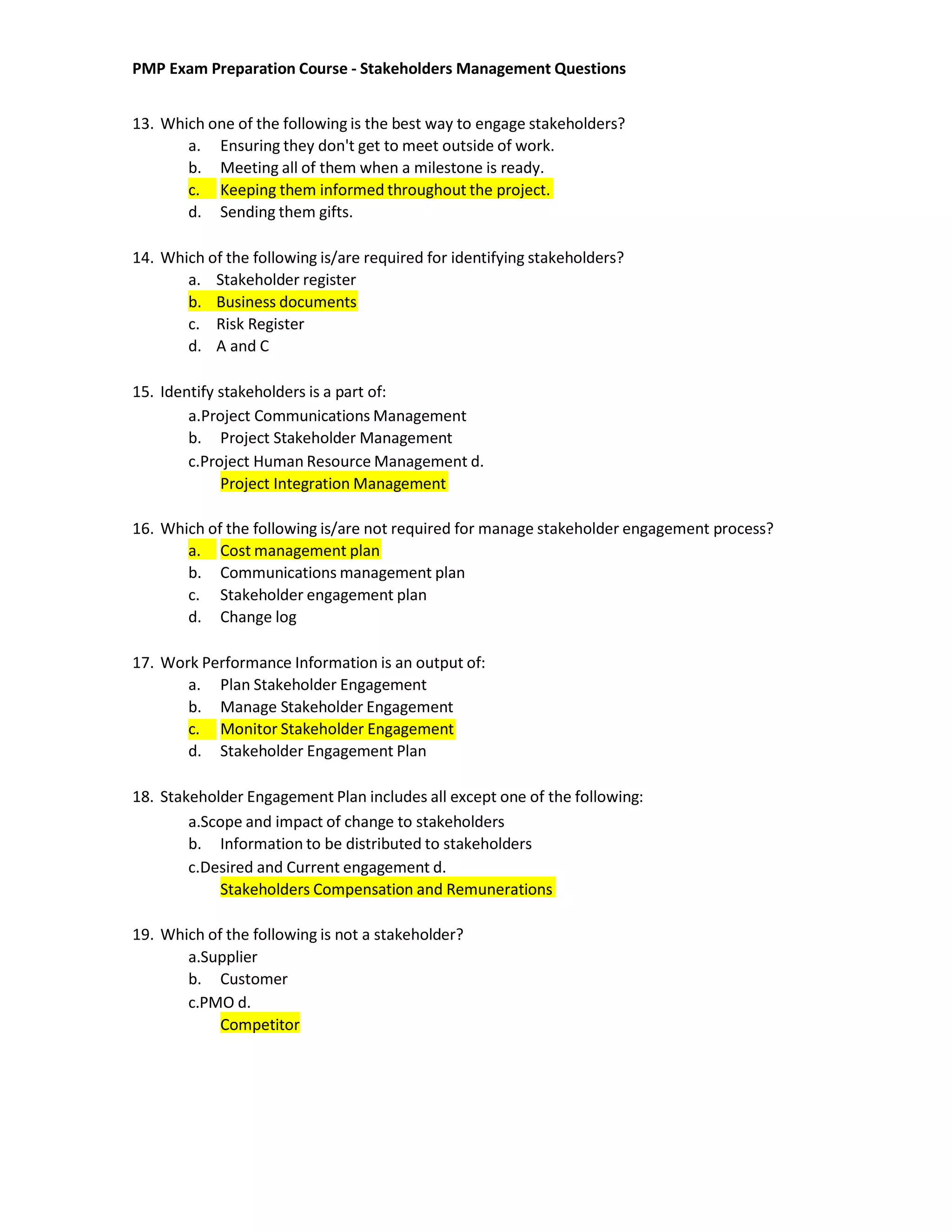
PMP Exam Preparation Course - Stakeholders Management Questions
13. Which one of the following is the best way to engage stakeholders?
a. Ensuring they don't get to meet outside of work.
b. Meeting all of them when a milestone is ready.
c. Keeping them informed throughout the project.
d. Sending them gifts.
14. Which of the following is/are required for identifying stakeholders?
a. Stakeholder register
b. Business documents
c. Risk Register
d. A and C
15. Identify stakeholders is a part of:
a.Project Communications Management
b. Project Stakeholder Management
c.Project Human Resource Management d.
Project Integration Management
16. Which of the following is/are not required for manage stakeholder engagement process?
a. Cost management plan
b. Communications management plan
c. Stakeholder engagement plan
d. Change log
17. Work Performance Information is an output of:
a. Plan Stakeholder Engagement
b. Manage Stakeholder Engagement
c. Monitor Stakeholder Engagement
d. Stakeholder Engagement Plan
18. Stakeholder Engagement Plan includes all except one of the following:
a.Scope and impact of change to stakeholders
b. Information to be distributed to stakeholders
c.Desired and Current engagement d.
Stakeholders Compensation and Remunerations
19. Which of the following is not a stakeholder?
a.Supplier
b. Customer
c.PMO d.
Competitor
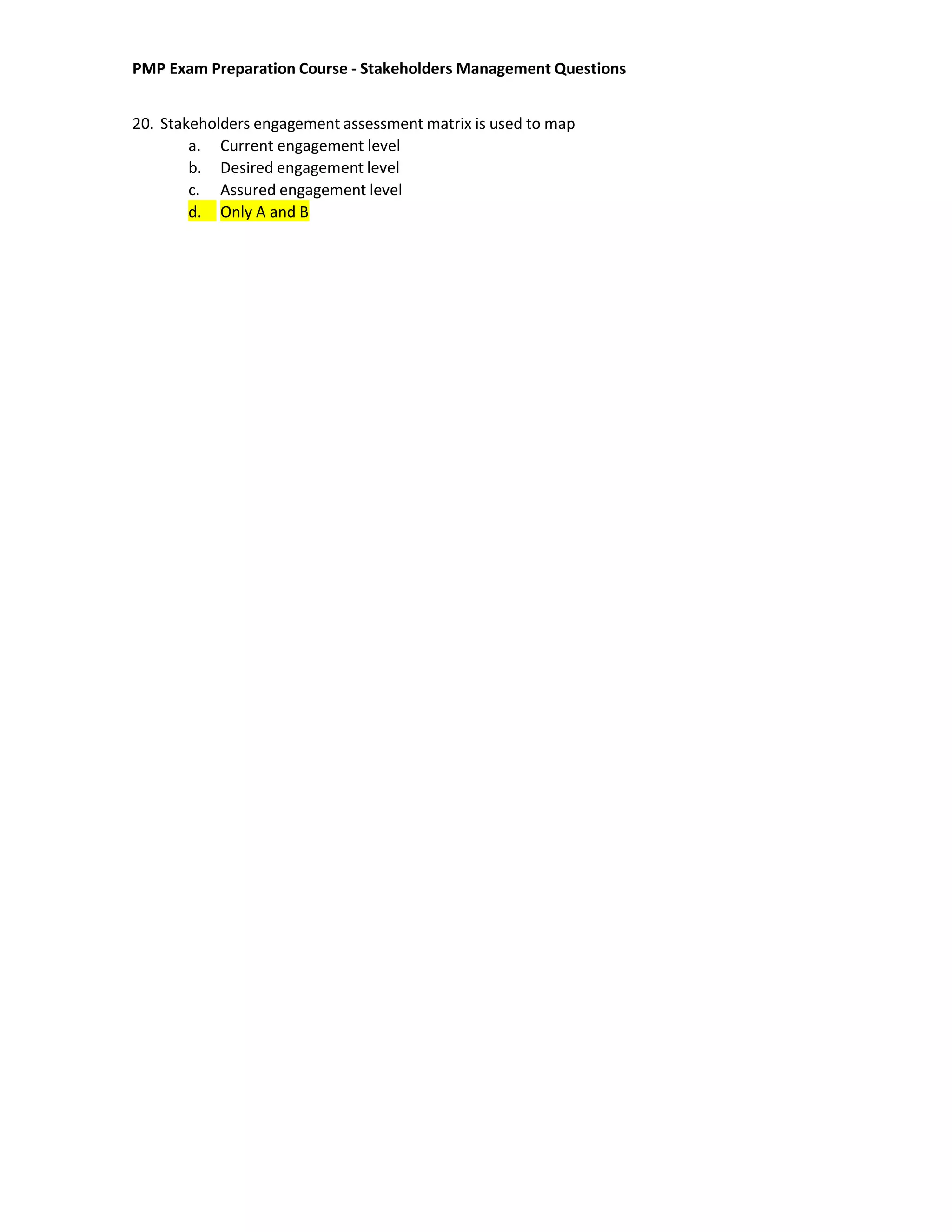
PMP Exam Preparation Course - Stakeholders Management Questions
20. Stakeholders engagement assessment matrix is used to map
a. Current engagement level
b. Desired engagement level
c. Assured engagement level
d. Only A and B

Pmp Questions Complete

  • 1.
    QUESTIONS FOR PROJECTMANAGEMENT FRAMEWORK – PMP Course 1. Which of the following is NOT a characteristic of a project? A. Constrained by limited resources B. Planned, executed, and controlled C. Creates a unique product or service D. Ongoing and repetitive 2. In a kick-off meeting for your project, you provided information to your team members about the different process groups to be followed in the project. According to PMI, which are the project management process groups? A. Conceptualizing, Initiating, Executing, Monitoring and Controlling, and Closing B. C. D. Initiating, Planning, Executing, Monitoring and Controlling, and Closing Initiating, Verifying, Executing, Monitoring and Controlling, and Closing Initiating, Planning, Executing, Controlling, and Administrative Closure 3. You are managing the release of a new drug in the market. Your role is that of a: A. Functional Manager, because you have good functional knowledge of the pharmaceutical industry B. Project Manager, because you are creating a unique product within specific time schedules C. Operations Manager, because you have to do several repetitive tasks D. Program Manager, because you have to manage several projects to do your job effectively 4. You are working in the Project Management Office (PMO) of your organization. Your job responsibility is to: A. Manage the operational activities in the company B. Manage human resource and risk management issues for individual projects C. Provide support functions to project managers in the form of training, providing software, standardizing policies, etc. D. Provide subject matter expertise in the functional areas of the project 5. You are the project manager in a company where you have maximum authority. To which organizational structure does your company belong? A. Functional B. Weak Matrix C. Strong Matrix D. Projectized (Project-Oriented) 6. Matrix organizations exhibit features of both projectized and functional organizations. In a weak matrix organization, the role of a project manager may be that of a: A. Coordinator B. Manager with considerable authority C. Support person D. Functional manager
  • 2.
    QUESTIONS FOR PROJECTMANAGEMENT FRAMEWORK – PMP Course 7. You have recently joined as a project manager in a company where they follow a projectized organizational structure. All your team members work in the same office where you have a lot of independence and authority. Which of the following is NOT an advantage of a projectized organizational structure? A. Loyalty to the project B. C. D. Home for the team members after the project is completed Effective communication Efficiency in project organization 8. Which of the following statements is NOT true about a project life cycle? A. All project life cycles are usually identical. B. The level of risk is highest at the start of the project and decreases as the project progresses. C. The ability of the stakeholders to influence the final characteristics is highest at the start and gets progressively lower as the project continues. D. Cost and staffing requirements usually peak during the intermediate phases. 9. Almost all projects are planned and implemented in a social, economic, or environmental context, and have intended and unintended positive or negative impacts. In this context, which of the following statements about Enterprise Environmental Factors is NOT true? A. Neither promote nor hold back the project management processes B. May restrict the project management processes C. May promote the project management processes D. May either promote or hold back the project management processes 10. PMOs provide a consultative role to projects by supplying templates, best practices, training, access to information and lessons learned from other projects. This type of PMO serves as a project repository. What type of PMO is this? A. Directive B. C. D. Controlling Supportive Monitoring 11. It refers to conditions, not under the control of the project team, that influence, constrain, or direct the project. A. Corporate Knowledge Base B. Organizational Process Assets C. Enterprise Environmental Factors D. None of the above. 12. This is an example of EEF (Enterprise Environmental Factors) A. Templates B. Organizational Culture C. Political climate D. B and C.
  • 3.
    QUESTIONS FOR PROJECTMANAGEMENT FRAMEWORK – PMP Course 13. Which of the following is NOT a characteristic of a project life cycle? A. Stakeholder influence, risk, and uncertainty are highest at the start of the project. B. Ability of the stakeholders to influence final characteristics of the project`s product increases as the project progresses. C. The project life cycle determines which transitional actions at the beginning and end of the project are included, so that the project can be linked to the ongoing operations of the performing organization. D. Stakeholder influence, risk, and uncertainty decrease as the project progresses. 14. You are working as a portfolio manager. Which of the following are you responsible for managing? A. Project interdependencies B. Projects and programs C. Projects, programs, and operations D. Functional work and operations 15. You are responsible for the development and launch of a NASA satellite. Your role is that of a: A.Project Manager B.Project Coordinator C. D. Program Manager Functional Manager 16. Which of the following is NOT a Project Management Knowledge Area? A. Project Integration Management B. Project Procurement Management C. Project Configuration Management D. Project Communications Management 17. Which of the following is not an example of a project? A. Develop a new product or service or result B. Change the password of a user for logging into a bank website C. Run a campaign for political office D. Implement a new business procedure or process 18. Your director has appointed you as a portfolio manager in the company. Your responsibility as a portfolio manager is to: A. Select and support projects or program investments B. C. D. Manage groups of projects in a coordinated way Create a unique product, service, or result Ensure that customer requirements are satisfied through progressive elaboration of projects
  • 4.
    QUESTIONS FOR PROJECTMANAGEMENT FRAMEWORK – PMP Course 19. It is a competency of the Project Manager A. Influencing B. Communication C. Performance D. Coaching 20. This is an example of OPA (Organizational Process Assets) A. Templates B. Change Control Procedures C. Historical Information D. Lessons learned knowledge bases E. All the above
  • 5.
    QUESTIONS FOR REVIEW– Project Integration Management 01. You are a project manager for a video game upgrade project. You are getting ready to start creating the project management plan. What have you just created? A. The project charter and the assumption log. B. The project charter. C. The assumption log D. The stakeholder engagement plan. 02. Which of the following is NOT true about tools and techniques of integrated change control? A.Include expert judgment. B. Include change control meetings. C.A change control board is responsible for meeting and reviewing change requests and approving or rejecting them. D. Include project management plan updates. 03. A change control board (CCB) is: A.A formally constitutedgroup of stakeholders responsible for ensuringthat onlya minimalnumber of changes occur on the project. B. A formal or an informal group of stakeholders that has oversight of project execution. C.A formally constituted group of stakeholders responsible for reviewing, evaluating, approving, delaying, or rejectingchanges to a project, with all decisions and recommendations being recorded. D.A dashboard that provides integrated information to help control changes to cost, schedule, and specifications throughout the life of the project. 04. The company is implementing an enterprise reporting system. This system will integrate several business units. This project is something that is new at the company. They realize they will learn a great deal as they adjust while going through the project. Which process best fits tracking their knowledge related to the project? A. Perform integrated change control B. Manage project issues C. Manage project knowledge D. Manage communications 05. You are the project manager for a legacy application upgrade project. You and the sponsor are currently reviewing the work for completeness and accuracy. Which of the following processes are you performing? A. Monitor and control project work. B. Perform integrated change control. C. Control scope. D. Direct and manage project work.
  • 6.
    QUESTIONS FOR REVIEW– Project Integration Management 06. Outputs of the Monitor and Control Project Work process include all of the following EXCEPT: A. Change requests. B. Project management plan updates. C. Project document updates. D. Final product, service, or result transition. 07. You are the project manager for a legacy application upgrade project. You and the sponsor are currently doing the monitor and control project work process. Which of the following tools and techniques will you use? A. Expert judgment B. Change requests C. Work performance information D. Project management plan updates 08. Project A has an internal rate of return (IRR) of 25 %. Project B has an IRR of 12 %. Project C has an IRR of 33 %. Project D has an IRR of 19%. Which of these would be the BEST Project? A. Project A B. Project B C. Project C D. Project D 09. An output of Close Project or Phase process is the creation of? A. Project archives B. Project Charter C. Project Management Plan D. Risk Management Plan 10. Which of the following is included in a project charter? A. A risk management strategy B. Work packages estimates C. Detailed resource estimates D. The business case for the project 11. You have joined a project team to upgrade the network security at your company. You are executing the project management plan and getting project deliverables created. What process do you do next? A. Manage project knowledge B. Monitor and control project work C. Validate Scope D. Direct and manage project work
  • 7.
    QUESTIONS FOR REVIEW– Project Integration Management 12. Develop project charter is part of which process group? A. Initiation B. Planning C. Executing D. Monitoring and Control 13. At the weekly infrastructure project staff meeting, the customer informs the project team that, due to a change in market conditions, he must request a significant change to the product that will be created because of the project. The project is 85% complete. What should the project manager do in this case? A.Advise the customer that the project is too close to completion to integrate the change. B.Evaluate the impact the requested change will have on the project and advise the customer of the impact and his options. C. Ignore the customer in hope that he will not pursue the request. D.Create a new project to accommodate the requested change and release the project as-is to the market. 14. Which process belongs to the Planning group process? A. Develop Project Charter B. Develop Project Management Plan C. Develop Statement of Work D. Business Case 15. In which process you get the Approved Changes? A. Close Project or Phase B. Monitor and Control Project Work C. Perform Integrated Change Control D. Direct and Manage Project Work 16. In which process you got the Deliverables? A. Monitor and Control Project Work B. Close Project or Phase C. Perform Integrated Change Control D. Direct and Manage Project Work 17. Which of the following documents are outputs from “Monitor and Control Project Work”? A. Deliverables B. Change Requests C. Project Charter D. Approved Changes
  • 8.
    QUESTIONS FOR REVIEW– Project Integration Management 18. What are the inputs to the Develop Project Charter process? A. Agreements, business case, enterprise environmental factors, and organizational process assets B. Business case, and organizational process assets C. Agreements, enterprise environmental factors, and organizational process assets D. Enterprise environmental factors, and organizational process assets 19. According to the PMBOK® Guide, which one is a technique to use in Manage Project Knowledge. A. Information Management. B. Project Management Information System. C. Data Analysis D. Deliverables 20. The company is determining which proposedprojects it should pursue duringa severe economic downturn. Of the following, which is the most likely project it will approve? A. A project that is proposed in response to a technological advance. B. A project that is proposed in response to a legal requirement. C. A project that is proposed in response to a business opportunity. D. A project that is proposed in response to a business problem.
  • 9.
    Questions – ProjectScope Management 1. All of the below are inputs to Define Scope process EXCEPT: a. Project Charter b. Scope Statement c. Organizational process assets d. Project Management Plan 2.Accepted deliverables is an output to which of the following processes? a. Collect Requirements b. Define Scope c. Create WBS d. Validate Scope 3.Project Charter is an input to all of the following processes EXCEPT: a. Collect requirements b. Define Scope c. Create WBS d. Develop Project Management Plan 4. Unanimity, majority, pluralityare three examples of which of the following techniques? A.Data Analysis, which is a tool and technique of the Collect Requirements process B.Interviews, which is a tool and technique of the Define Scope process C.Data Gathering technique, which is a tool and technique of the Define Scope process D.Decision-making techniques, which is a tool and technique of the Collect Requirements process. 5.In a meeting, a team member describes the project scope statement as the decomposition of all of the work to be carried by the project team to accomplish the project and create the required documents. What is wrong with this team member’s statement? A. The team member is actually describing the WBS. B. The team member is actually describing work packages. C. The team member is actually describing the scope management plan. D. The team member is not wrong. 6.In an Agile Life Cycle, what is the name for the repository of requirements? A. Sprint B. Product Owner C. Product Backlog D. User Story
  • 10.
    7.As the projectmanager establishes the scope baseline, which of the following best describes what she will create or references? A. Requirements, scope statement, and WBS B. WBS, and WBS dictionary C. Scope statement, WBS, and WBS dictionary D. Requirements, scope statement, and the WBS dictionary 8.During a project team meeting, a team member suggests an enhancement to the scope that is beyond the scope of the project charter. The project manager points out that the team needs to concentrate on completing all the work and only the work required. This is an example of: A. Change management process B. Scope management C. Quality analysis D. Scope decomposition 9.During project executing, a team member comes to project manager because he is not sure of what work needs to be accomplished on the project. Which of the following documents contains the detailed description of work packages? A. WBS dictionary. B. Activity List. C. Project scope statement. D. Scope management plan 10.What is the correct order of the Scope Management processes? A. Define Scope, Plan Scope, Validate Scope, Create WBS B. Collect Requirements, Define Scope, Create WBS, Validate Scope C. Plan Scope, Define Scope, Validate Scope, Create WBS D. Scope Definition, Scope Planning, Create WBS, Collect Requirements 11. You as the project manager are in the planning phase of your project. In order to collect all of the scope requirements, you want to use a systematic approach to evaluate and rank many ideas that are generated by your team. Which Decision Making technique should you use? A. Brainstorming B. Mind mapping C. Interviews D. Multicriteria decision analysis 12. Work Performance Measurement is an output of which process: A. Define Scope B. Create WBS C. Plan Scope D. Control Scope
  • 11.
    13. In comparingwaterfallproject management and scrum, which of the followingbest describes what documents would most likely hold all known project needs? A. Scrum uses a product backlog, and a waterfall approach uses a work breakdown structure. B. Scrum uses a sprint backlog, and a waterfall approach uses a work breakdown structure. C. Scrum uses a product backlog, and a waterfall approach uses a statement of work. D. Scrum uses a productbacklog item, and a waterfallapproach uses a work breakdown schedule. 14. During a meeting with some of the project stakeholders, the project manager is asked to add work to the project scope. The project manager had access to correspondence about the project before the project charter was signed and remembers that the project sponsor specifically denied funding for the scope mentioned by these stakeholders. The BEST thing for the project manager to do is to: A. Let the sponsor know of the stakeholders' request. B. Evaluate the impact of adding the scope. C. Tell the stakeholders the scope cannot be added. D. Add the work if there is time available in the project schedule. 15. Duringwhat partof theproject management process is theproject scope statement created? A. Initiating B. Planning C. Executing D. Monitoringand controlling 16. What tool or technique would a project manager use to control scope? A. Variance analysis B. Inspection C. Expert judgment D. Product analysis 17. Validate Scope can be BEST described as the process of A. Validatingthat the project quality requirements have been met. B. Obtaining stakeholder's formal acceptance of the project deliverables. C. Controlling changes to the scope of the project. D. Validating that all the project's objectives have been met.
  • 12.
    18. Your companyprovides answering services for several major catalog retailers. The number of calls coming into the service center per month has continued to increase over the past 18 months. The phone system is approaching the maximum load limits and needs to be upgraded. You've been assigned to head up the upgrade project. Based on the company's experience with the vendor who worked on the last phone upgrade project, you're confident they'll be able to assist you with this project as well. Which of the following is true? A.You've made an assumption about vendor availability and expertise. The project came about because of a business need. B.Vendor availability and expertise are constraints. The project came about because of a business need. C.You've made an assumption about vendor availability and expertise. The project came about because of a market demand. D.Vendor availabilityand expertiseare constraints. The project came about because of a market demand. 19. Which of the following is not a major step of decomposition? A. Identify major deliverables. B. Identify resources. C. Identify components. D. Verifycorrectness of decomposition. 20. What limits the options of the project team? A. Technology B. Constraints C. Deliverables D. Assumptions
  • 13.
    PMP Exam PreparationCourse – Project Schedule Management Questions 1. Activity Definition is typically performed by which of the following: a. Project Manager who created the WBS b. Project Team Members responsible for the work package c. Project Officer d. Project Stakeholder 2. The e-commerce project is six weeks behind schedule with five team members working on it. Three of these team members are working on the critical path-related items. What is the slack (float) of the critical path? a. Negative six weeks b. 30 c. 0 (Zero) d. Not enough information 3. Which of the following generate a milestone list? a. Define Activities b. Sequence Activities c. Plan Schedule Management d. Estimate Activity Durations 4. A schedule activity may begin 10 days before the predecessor activity finishes. This is an example of: a. ADM b. PDM c. A dependency with lag d. A dependency with lead 5. Task C on the project has an ES of day three, an EF of day seven and an LS of day seven. Which of the following best describes this task? a. It has slack (float) of zero days. b. It is behind schedule. c. It has a slack (float) of four days and duration of four days. d. It has a slack (float) of zero days and duration of four days. 6. Parametric Estimating is done as a part of which process: a. Sequence Activities b. Develop Schedule c. Plan Schedule Management d. Estimate Activity Durations
  • 14.
    PMP Exam PreparationCourse – Project Schedule Management Questions 7. Which of the following is NOT an input to the Sequence Activities process? a. Scope Baseline b. Activity Attributes c. Activity List d. Change Requests 8. Which of the following is a technique for Sequence Activities? a. Precedence Diagramming Method [PDM] b. Project Schedule Network Diagram c. Rolling Wave Planning d. Analogous Estimating 9. Which of the following duration estimate types is most likely to be used where there is minimal information known about the project? a. Bottom-Up b. Parametric c. Top-Down d. Three-Point 10. You are the project manager for a cell site upgrade project. You have just performed the sequence activities process. What do you create next? a. Duration estimates b. Activity lists c. Resource estimates d. Work packages 11. The project team is working together on detailed planning. They have had some issues coming to the same opinion, so they are creating a project schedule network diagram. What will this show the team? a. The sequencing of the activities on the project b. The decomposition of the work of the project c. The schedule d. The duration estimates of the project. 12. You are the project manager for a mortgage regulatory application project. You have just created the activity list and milestone list. What process preceded this work? a. Sequence Activities b. Define Activities c. Plan Schedule Management d. Estimate Activity Durations
  • 15.
    PMP Exam PreparationCourse – Project Schedule Management Questions 13. Which of the following is an example of a lag? a. The latest a new system can be ordered from the manufacturer without delaying the project. b. The critical path. c. A delay after sheetrock (wallboard) is done in a house to allow it to dry before continuing work in that area. d. The earliest a new system can be ordered from the manufacturer. 14. Reserve Analysis involves: a. Estimating by multiplying the quantity of work by productivity rate b. Incorporating time buffers into the activity duration estimates c. Developing project schedule with contingency reserves as a recognition of the schedule risk d. Adding resource reserves to the activity resource estimates 15. A schedule activity may delay 5 days after the predecessor activity finishes. It’s an example of: a. ADM b. PDM c. Lag d. Lead 16. You are the project manager for a construction project to update a major roadway before football season starts. Once the season starts will be a 500% increase in traffic. There has been a greater than normal amount of rain this season. The project manager is looking into ways to accelerate the schedule. They are not able to add resources as they cannot go over budget. They are looking into the ability to do some items in parallel. Which of the following is the project manager more likely to consider? a. Crashing b. Fast tracking c. Resource leveling d. Re-baselining the schedule 17. You are the project manager on a defense project and are creating a network diagram. Activity A (3 days) and Activity B (6 days) can start immediately. Activity C (2 days) can start after Activity A is complete. Activity D (1 day) and Activity F (2 days) can start after Activity B is complete. Activity E (4 days) can start after Activity C and Activity D are complete. Activity G (5 days) can start after Activity D and Activity F are complete. When Activity E and Activity G are complete, the project is done. What is the critical path? a. BDE b. ACE c. BFG d. BDG
  • 16.
    PMP Exam PreparationCourse – Project Schedule Management Questions 18. Using the information in question 17, what is the slack (float) of Activity D? a. 2 days b. 1 day c. 4 days d. Not enough information 19. Using the information in question 17, if Activity D increases from one to three days, what is the critical path, and what is the length? a.BDE, 13 days b. ACE, 14 days c.BFG, 13 days d. BDG, 14 days 20. You are estimating project duration. You do not have a lot of time to go into detail, so you estimate based on a past project that was like the current project. Which of the following estimating techniques is most likely used? a. Analogous b. Parametric c. Three-point d. Bottom-up
  • 17.
    PMP Exam PreparationCourse - Project Cost Management Questions 1. The project team has just created cost estimates for their project. They are working with accounting department to get access to the chart of accounts. What process are they getting ready to do next? a. Estimate Costs b. c. d. Determine Budget Control Costs Plan Cost Management 2. A Project with a total funding of $100,000 finished with a BAC value of $95,000. What term can BEST describe the difference of $5,000? a. Cost Variance b. Management Overhead c. Management Contingency Reserve d. Schedule Variance 3. You are having a home theater room added to your house. The project should take five days and cost $1,500 per day to complete. After three days, the project is 30% complete and $5,000 has been spent. What is the total value of the project? 4. The planning process group is progressing. The team has involved several expert opinions in trying to approximate the costs needed to complete project activities. This process is known as: a. Determine budget. b. Control costs. c. Analogous estimating. d. Estimate costs. 5. If the Earned Value is equal to Actual Cost, it means: a. Project is on budget and on schedule. b. Schedule Variance Index is 1 c. There is no schedule variance. d. There is no cost variance. 6. Your project has an SPI of 0.8 and a CPI of 1.2. What best describes this project? a. Over budget and behind schedule b. Under budget and ahead of schedule c. Over budget and ahead of schedule d. Under budget and behind schedule a. $ 7,500 b. $ 2,250 c. $ 5,000 d. $ 10,000
  • 18.
    PMP Exam PreparationCourse - Project Cost Management Questions 7. Suppose you have a budgeted cost of a project at $900,000. The project is to be completed in 9 months. After a month, you have completed 10% of the project at a total expense of $100,000. The planned completion should have been 15%. In this scenario what is the CPI? 8. If the CPI of a project is 1.15 and the SPI is 0.7, whichof the followingtechniqueswould probably help you bring the SPI closer to 1? a.Rolling Wave Planning b.Reserve Analysis c. d. Crashing Funding Limit Reconciliation 9. Suppose you are managing a software development project. The project is expected to be completed in 8 months at a cost of $10000 per month. After 2 months, you realize that the project is 30% completed at a cost of $40,000. What is the Earned Value (EV) and the Cost Variance (CV)? a. EV = $24,000; CV= ($16,000) b. EV = ($20,000); CV= $16,000 c. EV = $16,000; CV= ($4,000) d. EV = ($16,000); CV= $4,000 10. Estimate at completion (EAC) is a periodic evaluation of: a. The cost of work completed. b. The value of work performed. c. The anticipated total cost at project completion. d. What it will cost to finish the job. ETC 11. If earned value (EV) = 350, actual cost (AC) = 400, planned value (PV) = 325, what is cost variance (CV)? 12. You are having a home theater room added to your house. The project should take five days and cost $1,500 per day to complete. After three days, the project is 30% complete and $5,000 has been spent. What is the EV? a. 1 b. 0.9 0 c. 0.6 7 d. 1.9 0 a. 350 b. -75 c. 400 d. -50 a. $7,500 b. $2,250 c. $5,000 d. $10,000
  • 19.
    PMP Exam PreparationCourse - Project Cost Management Questions 13. Which of the following is an example of a parametric estimate? a. A. Dollars per module. b. B. Based on data from previous similar projects. c. C. Bottom-up. d. D. CPM. 14. A schedule performance index (SPI) of 0.76 means: a. You are over budget. b. You are ahead of schedule. c. You are only progressing at 76 percent of the rate originally planned. d. You are only progressing at 24 percent of the rate originally planned. 15. A cost baseline is an output of which cost management process. a. Estimate Activity Resources b. Estimate Costs c. Determine Budget d. Control Costs 16. During which project management process group are budget forecasts created? a. Monitoring and controlling b. c. d. Planning Initiating Executing 17. You are having a home theater room added to your house. The project should take five days and cost $1,500 per day to complete. After three days, the project is 30% complete and $5,000 has been spent. What is the CPI? 18. The seller tells you that your activities have resulted in an increase in their costs. You should: a. Recommend a change to the project costs. b. Have a meeting with management to find out what to do. c. Ask the seller for supporting information. d. Deny any wrongdoing. a. 0.4 5 b. 0.5 0 c. 0.4 0 d. 1.0 0
  • 20.
    PMP Exam PreparationCourse - Project Cost Management Questions 19. You are the project manager for a main street restoration project. Tracking cost is extremely important as the budget cannot accommodate overruns. The cost performance index is currently 0.90. The sponsor is asking how much is needed to finish the project, based on the current cost performance metrics. Which of the following best describes what sponsor is requesting? a. Estimate at completion. b. Estimate to complete. c. Variance at completion d. To-complete performance index 20. The difference between the cost baseline and the project budget can be BEST described as: a. The management reserve. b. The contingency reserve. c. The project cost estimate. d. The cost account.
  • 21.
    PMP EXAM PREPARATIONCOURSE - QUALITY MANAGEMENT QUESTIONS 1. You are the project manager in the testing phase of a project. You are working with your team doing control quality process and testing project deliverables. Which process will provide the deliverables you are testing? a. Control quality b. Direct and manage project work. c. Control scope d. Create WBS 2. The project manager and his team are using Ishikawa or fishbone diagram as part of the quality component for the coal extraction project. Of the following, which best describes the reason they are utilizing this diagram? a. To assess the defects which are creating quality issues. b. To evaluate project activities that have the potential to create defects. c. To review symptoms to determine the source of the defects. d. B and C 3. Control Chart is often performed using: a. Cause and Effect Diagram b. To determine if a process is stable or out of control. c. It’s a type of Histogram. d. It’s to see the inputs and outputs of a process. 4. A Pareto diagram can be best described as: a. Cause and Effect Diagram b. Scatter Chart c. Control Chart d. Histogram 5. A planning phase for an engineering component generated 80 engineering drawings. The QA team randomly selected 8 drawings for inspection. This exercise can BEST be described as example of: a. Inspection b. Statistical Sampling c. Flowcharting d. Control Charting 6. You are the project manager in the testing phase of a project. You are working with your team doing control quality process and testing project deliverables. Which process will be performed next? a. Control quality. b. Validate scope. c. Control scope. d. Create WBS.
  • 22.
    PMP EXAM PREPARATIONCOURSE - QUALITY MANAGEMENT QUESTIONS 7. An Ishikawa diagram is the same as a: a. Run Chart b. Fish Bone Diagram c. Pareto Chart d. Delphi Technique Diagram 8. You are the project manager working with quality department. They are testing your project deliverables and are organizing defects by count. You want to show this graphically to communicate it to the stakeholders. What tool will you use to show this? a. Run chart. b. c. d. Histogram. Control chart. Fishbone diagram. 9. Joyce is a QA resource and needs to know the cumulative percentage of defective cases. What Chart do you recommend to see that? a. Control Chart b. Histogram c. Scatter Diagram d. Pareto Diagram 10. You are managing the Breadcrumbs project at the behest of the PMO. While taking over the project from the previous project manager, you realize that three work packages have not been completed to the specifications, and hence are not meeting the quality metrics set by the customers. Not completing the work correctly is an example of which of the following? a. Cost of doing business. b. c. d. Cost of non-conformance. Cost of customer satisfaction. Cost of compliance. 11. Quality is: a. Meeting and exceeding the customer's expectations b. Adding extras to make the customer happy c. The degree to which the project meets requirements d. Conformance to management's objectives 12. All the following are examples of Control Quality EXCEPT: a. Inspection b. Cost of quality c. Histogram d. Fishbone diagram
  • 23.
    PMP EXAM PREPARATIONCOURSE - QUALITY MANAGEMENT QUESTIONS 13. You are a project manager working with the quality department. They are trying to isolate if there is a relationship between two test variables. You want to show this graphically to communicate it to the stakeholders. What tool will you use to show this? a. Run chart. b. Histogram. c. Control chart. d. Scatter diagram. 14. The project is going through the manage quality process. Which of the following is a key tool that will be utilized in this process? a. Cost-benefit analysis, which is used to analyze how to minimize rework due to lack of quality and how to maximize satisfaction and productivity. b. Quality audits, which help verify process and output compliance. c. Quality analysis, which is used to optimize project execution and achieve high process quality. d. Quality management plan, which provides acceptable quality management methodology information. 15. All of the following are examples of the cost of nonconformance EXCEPT: a. Rework b. Quality training c. Scrap d. Warranty costs 16. During a team meeting, the team adds a specific area of extra work to the project because they have determined it would benefit the customer. What is wrong in this situation? a. The team is gold plating. b. These efforts should not be done in meetings. c. Nothing. This is how to meet or exceed customer expectations. d. Nothing. The project manager is in control of the situation. 17. There is a variance in the manufacturing process that is causing concern among the team. Some results have been above the specification limits, and some within the control tolerances. You want to learn more about the output of the process over the last month. Which of the following items is the most useful for this purpose? a. Run chart because it indicates output over time and provides the opportunity to determine trends and variances. b. Pareto diagram because the closer the percentages are on the separate problems, the easier it is to determine trends and variances. c. Control chart because it indicates output and highlights trends and variances. d. Scatter diagram because the closer the output resembles a diagonal line, the more obvious trends, and variances.
  • 24.
    PMP EXAM PREPARATIONCOURSE - QUALITY MANAGEMENT QUESTIONS 18. To Plan Quality Management, you need to consider Project Management Plan because: a. You need to consider the scope baseline b. You need to consider the schedule baseline c. You need to consider the cost baseline d. All the above 19. You are the project manager on a quality system upgrade project. There has been a great debate at the company about what is in and out of the scope of the quality system. Currently you are doing the manage quality process. What process will you perform next? a. Plan quality management. b. Perform quality assurance. c. Manage quality. d. Control quality. 20. The company that won the procurement contract is providing additional functionality and reporting in an effort to win more business from the customer. Which of the following best describes this situation? a. The company is gold plating, which is a good practice because it increases the prospect of being awarded future contracts with that customer. b. The company is gold plating, which is not a good practice because it creates unreasonable expectations of the part of the customer. c. The company is gold plating, which is a good practice because it exceeds the standard of delivering the exact product, service, or result that is stated in the project charter. d. The company is gold plating, which is not a good practice because it violates the standard of delivering the exact product, service, or result that is stated in the project charter.
  • 25.
    PMP Exam PreparationCourse - Resource Management 1. You are the project manager headquarter remodeling project. You are in the process of creating resource requirements. What do you need to reference to complete this document? a. The resource management plan b. Performance assessment c. Working agreement d. Organizational breakdown structure 2. Bob and Sue are arguing about the design of a deliverable and are having a tough time coming to consensus. You as the project manager have encouraged them to work out their differences together, but it hasn’t worked so far. When you sit with them to discuss, you eventually suggest that they use portions of each of their ideas in the design of the project. They are amenable to this solution. Which conflict management strategy have you applied? a. Compromise b. Smooth c. Avoid d. Force 3. You have been assigned a new project. You are currently interviewing people and have extended a few offers for people to join the team. What process will be performed next? a.Estimate activity resources. b.Manage team. c. d. Develop team. Acquire resources. 4. Prescott University is putting together its fall schedule. It is currently trying to align classes, instructors, and classrooms to ensure that every class offering has a room and an instructor. Which of the following is the best basis for this alignment? a. Resource list. b. Resource breakdown structure. c. Resource sheet. d. Resource breakdown list. 5. A project manager is planning out the availability of resources as part of the Acquire Resources process. He needs to acquire resources that report to a functional manager. What technique will he likely use to obtain these resources? a. Virtual Teams b. Pre-assignment c. Negotiation d. Decision Making
  • 26.
    PMP Exam PreparationCourse - Resource Management 6. Of the following, which are the key tools and techniques of acquire resources process? a. Multi-criteria decision analysis, analogous estimating, interpersonal and team skills, pre-assignment, and virtual teams. b. Multi-criteria decision analysis, negotiation, pre-assignment, and virtual teams. c. Multi-criteria decision analysis, negotiation, networking, pre-assignment, and virtual teams. d. Multi-criteria decision analysis, negotiation, interpersonal and team skills, networking, pre-assignment, and virtual teams. 7. You are setting up your project team and you are looking at a chart that shows that the programming will be performed by Systems Development, the infrastructure will be implemented by Infrastructure Systems, the customer communication will be handled by the Call Center. This is an example of what type of chart? a.RACI b.Organizational Breakdown Structure (OBS) c. d. Work Breakdown Structure (WBS) Resource Breakdown Structure (RBS) 8. All the following are techniques a project manager or organization can use to acquire resources except. a. Negotiation b. Pre-assignment c. Co-location d. Virtual teams 9. You are the project manager on a SAN project. You are doing the manage team process. This has been very time consuming and unpredictable. What process did you just complete? a. Develop team. b. Control resources. c. Acquire resources. d. Develop staff. 10. Your project team members have just started to work together and are now adjusting their work habits and behaviors to support each other. Which stage of the Tuckman ladder has your team just entered? a. Norming b. Performing c. Forming d. Storming
  • 27.
    PMP Exam PreparationCourse - Resource Management 11. What conflict resolution technique is a project manager using when he says, "I cannot deal with this issue now!" a.Problem solving b.Forcing c. d. Withdrawal Compromising 12. A project manager has just found out that a major subcontractor for her project is consistently late delivering work. The project team member responsible for this part of the project does not get along with the subcontractor. To resolve the problem, the project manager says, "You both will have to give up something to solve this problem," What conflict resolution method is she using? a. Confrontation b. Compromise c. Smoothing d. Communicating 13. The project has had some challenges. Members of the team have needed constant supervision to perform their activities for which they are responsible, they do not seem to trust management, and often appear unmotivated. This is an example of what? a. Insufficient team building b. Theory X environment c. Insufficient project team training d. Theory Y environment 14. Conflict resolution techniques that may be used on a project include confronting, smoothing, forcing, and: a. Withdrawing b. c. d. Directing Organizing Controlling 15. The project manager needs to motivate his team and reviews Maslow's Hierarchy of Needs as a basis of his motivational strategy. Which of the following are the components of the Maslow's Hierarchy of Needs? a. Physiological, achievement, esteem, psychological, safety, and self-actualization b. Physiological, safety, belonging, esteem, and self-actualization. c. Physiological, achievement, esteem, safety, self-actualization. d. Physiological, belonging, esteem, psychological safety, and self-actualization.
  • 28.
    PMP Exam PreparationCourse - Resource Management 16. The project manager of the systems upgrade project uses a variety of power types. Which of the following is an example of expert power? a. The project manager instructs team leaders to prepare status reports for the weekly meeting. b. The project manager takes the most productive team member to lunch at an expensive restaurant. c. The project manager announces that those who do not complete their tasks in a timely manner without sacrificing quality will be ineligible for a bonus. d. The project manager’s degree and prior work experience where in systems engineering. 17. Which statement below BEST matches a Theory X manager’s belief? a. People want to be rewarded for their work b. People have higher needs that will not emerge until the lower level needs have been satisfied c. People will contribute to work if left alone d. People cannot be trusted. 18. The Resource Management Plan: a. Should be created by the Human Resources department b. c. d. It’s a part of the project management plan It’s a tool of Develop Project Team It’s an output of the Acquire Resources Process 19. The Analogous Estimating is a technique for which process? a. Acquire Resources b. Develop Team c. Plan Resource Management d. Estimate Activity Resources 20. During the plan resource management process of a critical project, the project management team is creating a responsibility assignment matrix. What benefit does this provide for the team? a. The team will know who is responsible for what work. b. The team will know who does what work and when they will do it. c. The team will know the location in which the work is performed. d. The team will know the sequence in which the resources will perform the activities
  • 29.
    Exam Preparation PMPExam - Project Communications Management - Questions 1.The project you are managing has nine stakeholders. How many channels of communications are there between these stakeholders? a. 9 b. 8 c. 40 d. 36 2.Which of the following process is not included in project communications knowledge area? a. Monitor Communications b. Plan Communications Management c. Manage Communications d. Manage Stakeholder Expectations 3. What is the correct sequence of steps in a basic communication model? a. Transmit – Encode – Decode – Acknowledge – Feedback b. Encode – Transmit – Decode – Acknowledge – Feedback c. Encode – Transmit – Acknowledge – Decode – Feedback d. Transmit – Encode – Acknowledge – Decode – Feedback 4. A basic communicationmodel has two partiesdefined as Sender andReceiver. Communicationmedium is the technology medium used as a mode of communication, while noise is: a. Distance b. Cultural differences c. Lack of background information d. All the above 5. Which is an important output of a project communication management process which identifies and documents the approach to communicate most effectively and efficiently with stakeholders? a. Communication management plan b. c. d. Stakeholders engagement plan Stakeholders communication management plan Project management plan 6. You are working on a very large project having ‘n’ number of stakeholders. You have prepared a very good communication management plan, so that all the stakeholders are informed with right information at right time. Though, there are ‘n’ numbers of stakeholders involved in the project, your communication management plan suggests you send emails to specific stakeholders at the time of achievement of milestones. What kind of communication method is suggested in communication management plan when some milestone is achieved? a. Pull communication b. Push communication c. Interactive communication d. Email communication
  • 30.
    Exam Preparation PMPExam - Project Communications Management - Questions 7. One of the project documents is very important while establishing communication management plan. Any entity added or modified in the document will directly bring changes to communication management plan. The document is prepared in the ‘initiating’ process group. Which is that document? a. Project charter b. Project management plan c. Stakeholder register d. Risk register 8.A project manager has a problem with a team member's performance. What is the BEST form of communication for addressing this problem? a. Formal written communication b. Formal verbal communication c. Informal written communication d. Informal verbal communication 9. You are working as a project manager on a project which has ten stakeholders. During project execution, two of the team members are moved to another project and one new team member added to your team. How many communication channels are available now? a. 55 b. 66 c. 36 d. 78 10. There are 45 communication channels on the project. How many people are on the project team? a. 9 b. 10 c. 5 d. 15 11. Sam and Tracy are running their string theory project. They are in the process of monitoring project communications with the various stakeholders. This has been a challenge given it is a global project with many virtual employees. Which of the following is a tool and technique they will use with the monitor communications process? a. Communications management plan b. Change requests c. Work performance information d. Project management information system (PMIS) 12. The project status report is an example of which type of communication? a. Formal written communication b. Formal verbal communication c. Informal written communication d. Informal verbal communication
  • 31.
    Exam Preparation PMPExam - Project Communications Management - Questions 13. Six full time and one part time person report to the project manager. Three more people are added to the project. How many communication channels were added to the project? a. 56 channels b. 28 channels c. 55 channels d. 27 channels 14. Stakeholders can be identified in which project management process groups? a. Initiating, planning, executing, monitoring and controlling, and closing b. Initiating and planning c. Planning and monitoring and controlling d. Monitoring and controlling and closing 15. You take over a project from another project manager. You would like to understand the meeting cadence and membership. Where will you find this information? a. The human resource management plan b. The meeting management plan c. The communication management plan d. The survey of the organization’s environment 16. The project is approximately 50% complete. The project manager is communicating with stakeholders regarding status of the project. Which will he likely use to determine what to communicate to whom? a. Communications technology, models, and methods. b. Communications management plan. c. Communications requirements analysis. d. Stakeholder management strategy. 17. Michelle is in pharmaceutical research. As she is mapping out details for a new compound, she is sensitive to communication with key stakeholders. Communication is key to campaign success. As she focuses on monitoring communications, which is a tool or technique she will use during this process? a. Organizational process assets b. Expert judgment c. Change requests d. Stakeholder management strategy 18. One of the activities a project manager performs on a day-to-day basis is communicating with individual team members, the team, company personnel, vendors, and customers. Approximately how much of a project manager’s job is spent communicating? a.At least 30% b. Not more than 50% c.Approximately 90% d. 100%
  • 32.
    Exam Preparation PMPExam - Project Communications Management - Questions 19. The project manager and his team are about to begin the monitor communications process. Which is an output of the process they will create? a. Reporting systems. b. Work performance information. c. Scope statement. d. Enterprise environmental factors. 20. You, as a project manager, have a lot of information to share with the stakeholders and your audience is very large. What communication method should be used in this scenario? a. Pull communication b. Push communication c. Interactive communication d. Stakeholder communication
  • 33.
    PMP Exam PreparationCourse - Risk Management Questions 1. Which of the following statements is true about risks? a. When evaluating risks their impact should be considered, however probability of occurrence is not important. b. Risks if they happen always have negative impact and not positive. c. Risk register documents all the risks in detail. d. Risk response plan is another name for Risk Management Plan. 2. Beta is the Project Manager of a Road construction project. During a project review, Beta realizes that a particular risk has occurred. To take appropriate action against risk that has happened, Beta needs to refer to which document? a. Risk response plan b. Risk management plan c. Risk breakdown structure d. Risk register 3. During which stage of Risk planning are risks prioritized based on probability and impact? a. Identify Risks. b. Plan Risk responses. c. Perform Qualitative risk analysis. d. Perform Quantitative risk analysis. 4. Andrew is a Project Manager for Green Valley project. A risk management plan has been prepared for the project. Which of the following should Andrew do next? a. Perform Qualitative risk analysis. b. Perform Quantitative risk analysis. c. Identify Risks. d. Plan Risk responses. 5. Calculate EMV from the following: 0.4 probability of $6,500, 0.3 probability of -$3,200, 0.2 probability of $2,000, 0.1 probability of $1,000. 6. In defining a risk trigger, which of the following is most accurate? a. A trigger is an indication that a risk event could occur in the near future. b. A trigger is the same as a risk. c. A trigger is an indicator that a risk event has definitely occurred. d. A trigger is an indicator that a risk event will definitely occur. a. $10,500 b. $2,700 c. $2,140 d. $2,500
  • 34.
    PMP Exam PreparationCourse - Risk Management Questions 7. You are the project manager on a server infrastructure project. You have just started creating the risk register. What process did you just complete? a. Identify risks. b. Plan risk management. c. Perform qualitative risk analysis. d. Implement risk responses. 8. Overtime associated with the execution effort of a project is estimated at 120 hours with probability 0.5, 250 hours with probability 0.6, and 300 hours with probability 0.3. What is the value of the amount of overtime? a. 300 hours b. 670 hours c. 250 hours d. 100 hours 9. Perform qualitative risk analysis uses a variety of tools for analysis. Which of the following is most closely associated with this process? a. A probability and impact matrix. b. The expected monetary value (EMV) formula. c. Templates for work-around documentation. d. Risk trigger determination. 10. If a project has a 60 percent chance of a $100,000 profit and a 40 percent chance of a $100,000 loss, the expected monetary value for the project is: a.$100,000 profit b. $60,000 loss c. $20,000 profit d. $40,000 loss 11. If a risk has a 20 percent chance of happening in a given month, and the project is expected to last five months, what is the probability that this risk event will occur during the fourth month of the project? a. Less than 1 percent b. 20 percent c. 60 percent d. 80 percent 12. Risks will be identified during which risk management process(es)? a. Perform Quantitative Risk Analysis and Identify Risks b. Identify Risks and Monitor Risks c. Perform Qualitative Risk Analysis and Monitor and Control Risks d. Identify Risks
  • 35.
    PMP Exam PreparationCourse - Risk Management Questions 13. Purchasing insurance is BEST considered an example of risk: a. Mitigation b. Transfer c. Acceptance d. Avoidance 14. During which risk management process is a determination to transfer a risk made? a. Identify Risks b. Perform Quantitative Risk Analysis c. Plan Risk Responses d. Monitor and Control Risks 15. A project manager is using the strategies for threats for his project. He is working in which process? a. Plan Risk Responses b. Implement Risk Responses c. Monitor Risks d. Identify Risks 16. The project management team has just completed the process of identifying risks on the project. They have broken the information into categories and displayed this information in a graphical format. What have they created? a. Prioritized list of quantified risk. b. Risk breakdown structure. c. Risk probabilities and impact matrix. d. Risk checklist analysis chart. 17. You are the project manager on a road construction project. You are implementing risk responses. What process did you just complete? a. Plan risk responses. b. Perform qualitative risk analysis. c. Perform quantitative risk analysis. d. Monitor risks. 18. You have identified a risk on your project, and the team decides they will not create a response plan; if the risk happens, they will deal with consequences when they occur. This is an example of which risk strategy? a. Exploit b. Avoid c. Mitigate d. Accept
  • 36.
    PMP Exam PreparationCourse - Risk Management Questions 19. Your company is evaluating 2 projects for consideration. Project A has a 40% probability of $69,000 and a 60% probability of -$10,000. Project B has a 60% probability of $56,000 and a 40% probability of -$15,000. Which of the projects do you select based on the greatest expected monetary value? a. Project A b. Project B c. Project A and B are of even value. d. The expected monetary value is not high enough on either to make a selection. 20. You are determining the risk score for each of the risks in your risk register. You need which of the following to determine this score? a. Response plans. b. Risk owners. c. Probability and impact if the risk will occur. d. Risk trigger scores.
  • 37.
    PMP Exam PreparationCourse - Procurements Management Questions 1. The tools and techniques used in the process of Plan Procurement Management includes all except which one? a. Make-or-buy analysis b. Market Research c. Bidder Conferences d. Expert Judgment 2. The fixed price contract is advantageous to the buyer because it: a. Requires extremely well-defined specifications. b. Requires formal procedures for scope changes. c. Seller assumes financial and technical risk. d. Has a known cost. 3. The contractual agreement under Fixed Price Contracts, which influences the Plan Procurement project and gives the buyer and seller some flexibility in that it allows for deviation from performance, with financial incentives tied to achieving agreed upon metrics is called a. Fixed Price Incentive Fee Contracts (FPIF) b. Fixed Price with Economic Price Adjustment Contracts (FP- EPA) c. Firm Fixed Price Contracts (FFP) d. Fixed Assets Price (FAP) 4. You are the project manager for a merger project. You are creating the procurement management plan and revising the procurement strategy. When this is done, what process will you perform next? a.Solicitation planning. b. Control procurements. c.Close procurements. d. Conduct procurements. 5. The project will be using a company to provide the technicians for a national network upgrade project. The buyer is providing to the prospective seller a greatly detailed description of what the buyer wants the seller to do on the project. What type of document is being provided to the seller? a. Request for information (RFI) b. Request for proposal (RFP) c. Project scope statement (PSS) d. Request for quotation (RFQ) 6. The component of the project management plan that describes how a project team will acquire goods and services from outside the performing organization is called. a. Procurement Management Plan b. c. d. Procurement Statement of Work Procurement Documents None of the above
  • 38.
    PMP Exam PreparationCourse - Procurements Management Questions 7. You are the project manager for an IT outsourcing project. You are currently doing the plan procurement management process. What process will you perform next? a. Conduct procurement. b. c. d. Close procurement. Control procurement. Plan solicitation. 8. The process of managing procurement relationships, monitoring contract performance, and making changes as appropriate is called a. Plan Procurement Management b. Control Procurements c. Close Procurements d. Conduct Procurements 9. You have been assigned as a project manager of a computer network installation project. You are currently doing the conduct procurement process. You have just entered into an agreement with a vendor. Which of the following do you need to reference to get to do this stage? a. Change requests. b. Contract file. c. Project scope statement. d. Source selection criteria. 10. City is buying services from a construction company to build a new freeway for $4M over three years. At the start of each year, the amount fluctuates relative to the national cost of living. This is an example of what type of contract? a.Cost plus economic price adjust. b. Cost plus incentive fee. c.Fixed-price cost of living adjust. d. Fixed-price economic price adjust. 11. A general management technique used to determine whether particular work can best be accomplished by the project team or should be purchased from outside sources is called: a. Market Research b. Make-or-buy Analysis c. Expert Judgment d. None of the above
  • 39.
    PMP Exam PreparationCourse - Procurements Management Questions 12. The contractual agreement under Cost-reimbursable Contracts, which influences the Plan Procurement project and where the seller is reimbursed for all the legitimate costs , but the majority of the fee is earned only based in the satisfaction of certain broad subjective performance criteria defined and incorporated into the contract is called a. Cost Plus Fixed Fee Contracts (CPFF) b. Cost Plus Award Fee Contracts (CPAF) c. Cost Plus Incentive Fee Contracts (CPIF) d. Cost Plus Firm Fixed Fee Contracts (CPFFF) 13. Advertising is a technique used in which process? a. Conduct Procurements b. Plan Procurement Management c. Control Procurements d. Monitor Procurements 14. This document describes the goods or services you want to procure from outside the organization. a. RFQ b. SLA c. RFI d. SOW 15. You have just posted an RFP and have invited the vendors to participate in a meeting to ask questions about the work of the project. What is this meeting called? a. RFP conference b. c. d. Bidders conference Procurement communication conference Sellers conference 16. This type of contract is the riskiest for the buyer. a. Time and materials b. Fixed price c. Fixed price plus incentive d. Cost reimbursable 17. This type of contract assigns a unit rate for work or goods, but the total cost is unknown. a. Time and materials b. Fixed price c. Fixed price plus incentive d. Cost reimbursable
  • 40.
    PMP Exam PreparationCourse - Procurements Management Questions 18. What is the technique of looking at the trade-offs between producing goods or services internally vs. procuring it from outside the organization? a. Cost estimating b. Vendor selection criteria c. Staff augmentation d. Make-or-buy analysis 19. Procurements Audits is a technique to which process? a. Conduct Procurements b. Plan Procurement Management c. Control Procurements d. Plan Procurement Process 20. The project will be using a company to provide the technicians for a national network upgrade project. Presently, the team is in the process of conducting a make-or-buy analysis. What is the primary factor that will influence the team's decision? a. The comparison of skill sets between alternatives. b. The comparison of resource availability between alternatives. c. The comparison of costs between alternatives. d. The comparison of experience between alternatives.
  • 41.
    PMP Exam PreparationCourse - Stakeholders Management Questions 1. The implementation of which of the following processes decreases the risk of project failure? a. Manage stakeholder engagement b. Control stakeholder engagement c. Plan stakeholder engagement d. Develop stakeholder engagement 2. All of the following are descriptions derived from analytical techniques using stakeholder management except… a. Nonresistant b. Neutral c. Supportive d. Leading 3. Plan stakeholder engagement is fundamentally concerned with all the following except...? a. Developing strategies to effectively engage stakeholders throughout the project b. Development of the stakeholder register c. Development of the stakeholder engagement plan d. Identifying how the project will affect stakeholders 4. You are the project manager on an oil exploration project. You have just landed on the oil rig in the ocean and are reviewing the stakeholder register to see who your stakeholders are, their goals and needs. What process will you perform next? a. Plan stakeholder management. b. Plan stakeholder engagement. c. Manage stakeholder engagement. d. Plan communications management. 5. The marketing brochure redesign project is entering the manage stakeholder engagement process. To effectively manage stakeholder engagement, the project manager has a variety of tools and techniques available during this process. What are they? a. Interpersonal and team skills, communication feedback, and ground rules b. Communications methods, alternatives analysis, and management skills c. Communications skills, communications management plan, and management skills d. Product analysis, communications methods, and management skills 6. The project to update the retail store to accommodate the new video game platform is ready for initial planning. Stakeholders have been identified. What documentation will be created as a result of the identification? a. Stakeholder register b. Stakeholder management plan c. Issue log d. Project charter
  • 42.
    PMP Exam PreparationCourse - Stakeholders Management Questions 7. You are a project manager and have just created the stakeholder engagement plan. What process will you perform next? a. Identify stakeholder. b. Manage stakeholder engagement. c. Monitor stakeholder engagement. d. Monitor communications. 8. The ability of stakeholders to influence the project is typically highest at the stages. a. Planning b. Initial c. Executing d. Design 9. The project to update the retail store to accommodate the new video game platform is ready for initial planning. Stakeholders have been identified. What documentation will be created next? a. Stakeholder register b. Stakeholder engagement plan c. Issue log d. Project charter 10. You are a project manager currently analyzing your stakeholders and management strategies for those stakeholders. You want to use something that will show you a picture of where they all fit in relation to each other. What will you likely use to review this information? a. The stakeholder register. b. The engagement assessment matrix. c. Power/interest grid. d. Organizational breakdown structure. 11. The most important part of stakeholder management is: a. Ensuring all stakeholders are communicated in the same way b. c. d. Good relationships are established with all stakeholders Challenging stakeholders are avoided and added to the risk register Changes are made to the project schedule 12. All of the following are descriptions derives from analytical techniques used in stakeholder engagement except… a. Aware b. Resistant c. Neutral d. Supportive
  • 43.
    PMP Exam PreparationCourse - Stakeholders Management Questions 13. Which one of the following is the best way to engage stakeholders? a. Ensuring they don't get to meet outside of work. b. Meeting all of them when a milestone is ready. c. Keeping them informed throughout the project. d. Sending them gifts. 14. Which of the following is/are required for identifying stakeholders? a. Stakeholder register b. Business documents c. Risk Register d. A and C 15. Identify stakeholders is a part of: a.Project Communications Management b. Project Stakeholder Management c.Project Human Resource Management d. Project Integration Management 16. Which of the following is/are not required for manage stakeholder engagement process? a. Cost management plan b. Communications management plan c. Stakeholder engagement plan d. Change log 17. Work Performance Information is an output of: a. Plan Stakeholder Engagement b. Manage Stakeholder Engagement c. Monitor Stakeholder Engagement d. Stakeholder Engagement Plan 18. Stakeholder Engagement Plan includes all except one of the following: a.Scope and impact of change to stakeholders b. Information to be distributed to stakeholders c.Desired and Current engagement d. Stakeholders Compensation and Remunerations 19. Which of the following is not a stakeholder? a.Supplier b. Customer c.PMO d. Competitor
  • 44.
    PMP Exam PreparationCourse - Stakeholders Management Questions 20. Stakeholders engagement assessment matrix is used to map a. Current engagement level b. Desired engagement level c. Assured engagement level d. Only A and B