A8A6113D7A4D366390D1D14498E883F7
Administering Relational Databases Azure_Oct2020
Number: DP-300
Passing Score: 850
Time Limit: 120 min
File Version: 1.0
DP-300
Administering Relational Databases on Microsoft Azure
Version 1.0
This file was created using VCE Simulator from Avanset.com
A8A6113D7A4D366390D1D14498E883F7
Plan and Implement Data Platform Resources
Testlet 1
This is a case study. Case studies are not timed separately. You can use as much exam time as you would like to
complete each case. However, there may be additional case studies and sections on this exam. You must manage your
time to ensure that you are able to complete all questions included on this exam in the time provided.
To answer the questions included in a case study, you will need to reference information that is provided in the case study.
Case studies might contain exhibits and other resources that provide more information about the scenario that is described
in the case study. Each question is independent of the other questions in this case study.
At the end of this case study, a review screen will appear. This screen allows you to review your answers and to make
changes before you move to the next section of the exam. After you begin a new section, you cannot return to this section.
To start the case study
To display the first question in this case study, click the Next button. Use the buttons in the left pane to explore the content
of the case study before you answer the questions. Clicking these buttons displays information such as business
requirements, existing environment, and problem statements. If the case study has an All Information tab, note that the
information displayed is identical to the information displayed on the subsequent tabs. When you are ready to answer a
question, click the Question button to return to the question.
Existing Environment
Network Environment
The manufacturing and research datacenters connect to the primary datacenter by using a VPN.
The primary datacenter has an ExpressRoute connection that uses both Microsoft peering and private peering. The private
peering connects to an Azure virtual network named HubVNet.
Identity Environment
Litware has a hybrid Azure Active Directory (Azure AD) deployment that uses a domain named litwareinc.com. All Azure
subscriptions are associated to the litwareinc.com Azure AD tenant.
Database Environment
The sales department has the following database workload:
An on-premises named SERVER1 hosts an instance of Microsoft SQL Server 2012 and two 1-TB databases.
A logical server named SalesSrv01A contains a geo-replicated Azure SQL database named SalesSQLDb1.
SalesSQLDb1 is in an elastic pool named SalesSQLDb1Pool. SalesSQLDb1 uses database firewall rules and contained
database users.
An application named SalesSQLDb1App1 uses SalesSQLDb1.
The manufacturing office contains two on-premises SQL Server 2016 servers named SERVER2 and SERVER3. The
servers are nodes in the same Always On availability group. The availability group contains a database named
ManufacturingSQLDb1
Database administrators have two Azure virtual machines in HubVnet named VM1 and VM2 that run Windows Server 2019
and are used to manage all the Azure databases.
Licensing Agreement
Litware is a Microsoft Volume Licensing customer that has License Mobility through Software Assurance.
Current Problems
SalesSQLDb1 experiences performance issues that are likely due to out-of-date statistics and frequent blocking queries.
Requirements
A8A6113D7A4D366390D1D14498E883F7
Planned Changes
Litware plans to implement the following changes:
Implement 30 new databases in Azure, which will be used by time-sensitive manufacturing apps that have varying usage
patterns. Each database will be approximately 20 GB.
Create a new Azure SQL database named ResearchDB1 on a logical server named ResearchSrv01. ResearchDB1 will
contain Personally Identifiable Information (PII) data.
Develop an app named ResearchApp1 that will be used by the research department to populate and access
ResearchDB1.
Migrate ManufacturingSQLDb1 to the Azure virtual machine platform.
Migrate the SERVER1 databases to the Azure SQL Database platform.
Technical Requirements
Litware identifies the following technical requirements:
Maintenance tasks must be automated.
The 30 new databases must scale automatically.
The use of an on-premises infrastructure must be minimized.
Azure Hybrid Use Benefits must be leveraged for Azure SQL Database deployments.
All SQL Server and Azure SQL Database metrics related to CPU and storage usage and limits must be analyzed by
using Azure built-in functionality.
Security and Compliance Requirements
Litware identifies the following security and compliance requirements:
Store encryption keys in Azure Key Vault.
Retain backups of the PII data for two months.
Encrypt the PII data at rest, in transit, and in use.
Use the principle of least privilege whenever possible.
Authenticate database users by using Active Directory credentials.
Protect Azure SQL Database instances by using database-level firewall rules.
Ensure that all databases hosted in Azure are accessible from VM1 and VM2 without relying on public endpoints.
Business Requirements
Litware identifies the following business requirements:
Meet an SLA of 99.99% availability for all Azure deployments.
Minimize downtime during the migration of the SERVER1 databases.
Use the Azure Hybrid Use Benefits when migrating workloads to Azure.
Once all requirements are met, minimize costs whenever possible.
QUESTION 1
HOTSPOT
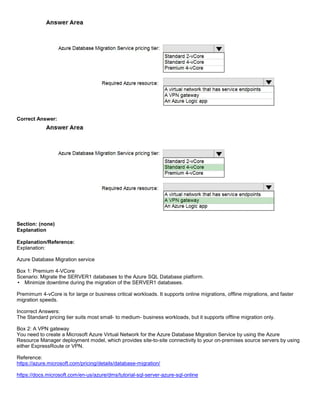
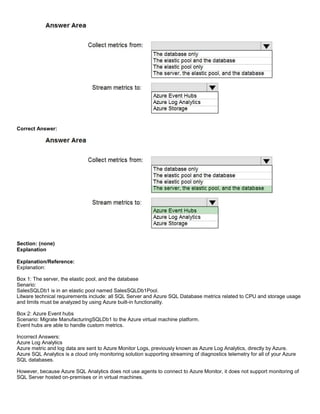
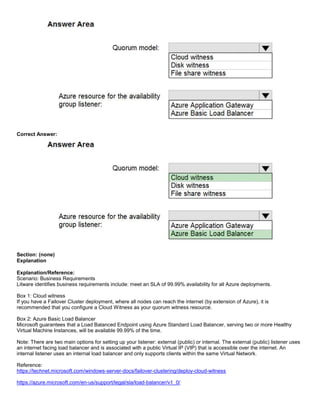
You are planning the migration of the SERVER1 databases. The solution must meet the business requirements.
What should you include in the migration plan? To answer, select the appropriate options in the answer area.
NOTE: Each correct selection is worth one point.
Hot Area:
A8A6113D7A4D366390D1D14498E883F7
Correct Answer:
Section: (none)
Explanation
Explanation/Reference:
Explanation:
Azure Database Migration service
Box 1: Premium 4-VCore
Scenario: Migrate the SERVER1 databases to the Azure SQL Database platform.
Minimize downtime during the migration of the SERVER1 databases.
Premimum 4-vCore is for large or business critical workloads. It supports online migrations, offline migrations, and faster
migration speeds.
Incorrect Answers:
The Standard pricing tier suits most small- to medium- business workloads, but it supports offline migration only.
Box 2: A VPN gateway
You need to create a Microsoft Azure Virtual Network for the Azure Database Migration Service by using the Azure
Resource Manager deployment model, which provides site-to-site connectivity to your on-premises source servers by using
either ExpressRoute or VPN.
Reference:
https://azure.microsoft.com/pricing/details/database-migration/
https://docs.microsoft.com/en-us/azure/dms/tutorial-sql-server-azure-sql-online
A8A6113D7A4D366390D1D14498E883F7
Plan and Implement Data Platform Resources
Question Set 2
QUESTION 1
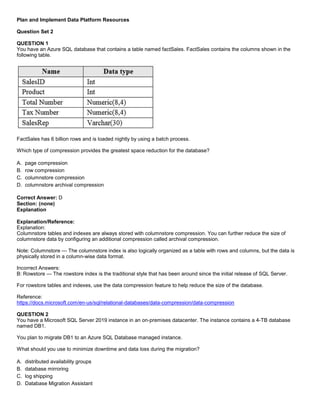
You have an Azure SQL database that contains a table named factSales. FactSales contains the columns shown in the
following table.
FactSales has 6 billion rows and is loaded nightly by using a batch process.
Which type of compression provides the greatest space reduction for the database?
A. page compression
B. row compression
C. columnstore compression
D. columnstore archival compression
Correct Answer: D
Section: (none)
Explanation
Explanation/Reference:
Explanation:
Columnstore tables and indexes are always stored with columnstore compression. You can further reduce the size of
columnstore data by configuring an additional compression called archival compression.
Note: Columnstore — The columnstore index is also logically organized as a table with rows and columns, but the data is
physically stored in a column-wise data format.
Incorrect Answers:
B: Rowstore — The rowstore index is the traditional style that has been around since the initial release of SQL Server.
For rowstore tables and indexes, use the data compression feature to help reduce the size of the database.
Reference:
https://docs.microsoft.com/en-us/sql/relational-databases/data-compression/data-compression
QUESTION 2
You have a Microsoft SQL Server 2019 instance in an on-premises datacenter. The instance contains a 4-TB database
named DB1.
You plan to migrate DB1 to an Azure SQL Database managed instance.
What should you use to minimize downtime and data loss during the migration?
A. distributed availability groups
B. database mirroring
C. log shipping
D. Database Migration Assistant
A8A6113D7A4D366390D1D14498E883F7
Correct Answer: A
Section: (none)
Explanation
Explanation/Reference:
Explanation:
The Data Migration Assistant (DMA) helps you upgrade to a modern data platform by detecting compatibility issues that can
impact database functionality in your new version of SQL Server or Azure SQL Database. DMA recommends performance
and reliability improvements for your target environment and allows you to move your schema, data, and uncontained
objects from your source server to your target server.
Note: SQL Managed Instance supports the following database migration options (currently these are the only supported
migration methods):
Azure Database Migration Service - migration with near-zero downtime.
Native RESTORE DATABASE FROM URL - uses native backups from SQL Server and requires some downtime.
Reference:
https://docs.microsoft.com/en-us/sql/dma/dma-overview
QUESTION 3
HOTSPOT
You have an on-premises Microsoft SQL Server 2016 server named Server1 that contains a database named DB1.
You need to perform an online migration of DB1 to an Azure SQL Database managed instance by using Azure Database
Migration Service.
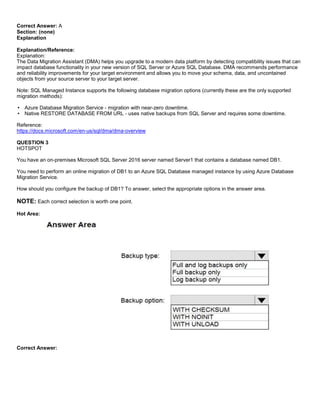
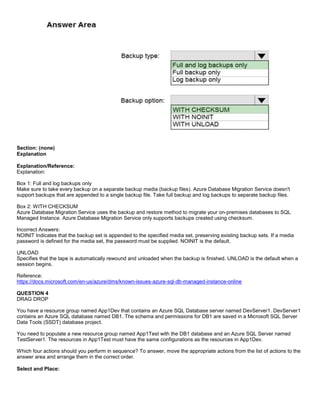
How should you configure the backup of DB1? To answer, select the appropriate options in the answer area.
NOTE: Each correct selection is worth one point.
Hot Area:
Correct Answer:
A8A6113D7A4D366390D1D14498E883F7
Section: (none)
Explanation
Explanation/Reference:
Explanation:
Box 1: Full and log backups only
Make sure to take every backup on a separate backup media (backup files). Azure Database Migration Service doesn't
support backups that are appended to a single backup file. Take full backup and log backups to separate backup files.
Box 2: WITH CHECKSUM
Azure Database Migration Service uses the backup and restore method to migrate your on-premises databases to SQL
Managed Instance. Azure Database Migration Service only supports backups created using checksum.
Incorrect Answers:
NOINIT Indicates that the backup set is appended to the specified media set, preserving existing backup sets. If a media
password is defined for the media set, the password must be supplied. NOINIT is the default.
UNLOAD
Specifies that the tape is automatically rewound and unloaded when the backup is finished. UNLOAD is the default when a
session begins.
Reference:
https://docs.microsoft.com/en-us/azure/dms/known-issues-azure-sql-db-managed-instance-online
QUESTION 4
DRAG DROP
You have a resource group named App1Dev that contains an Azure SQL Database server named DevServer1. DevServer1
contains an Azure SQL database named DB1. The schema and permissions for DB1 are saved in a Microsoft SQL Server
Data Tools (SSDT) database project.
You need to populate a new resource group named App1Test with the DB1 database and an Azure SQL Server named
TestServer1. The resources in App1Test must have the same configurations as the resources in App1Dev.
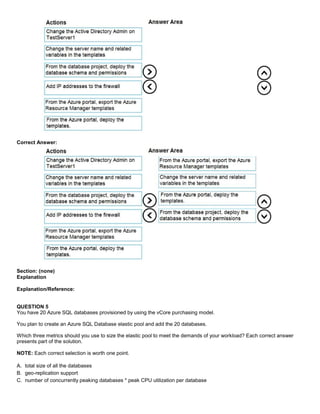
Which four actions should you perform in sequence? To answer, move the appropriate actions from the list of actions to the
answer area and arrange them in the correct order.
Select and Place:
A8A6113D7A4D366390D1D14498E883F7
Correct Answer:
Section: (none)
Explanation
Explanation/Reference:
QUESTION 5
You have 20 Azure SQL databases provisioned by using the vCore purchasing model.
You plan to create an Azure SQL Database elastic pool and add the 20 databases.
Which three metrics should you use to size the elastic pool to meet the demands of your workload? Each correct answer
presents part of the solution.
NOTE: Each correct selection is worth one point.
A. total size of all the databases
B. geo-replication support
C. number of concurrently peaking databases * peak CPU utilization per database
A8A6113D7A4D366390D1D14498E883F7
D. maximum number of concurrent sessions for all the databases
E. total number of databases * average CPU utilization per database
Correct Answer: ACE
Section: (none)
Explanation
Explanation/Reference:
Explanation:
CE: Estimate the vCores needed for the pool as follows:
For vCore-based purchasing model: MAX(<Total number of DBs X average vCore utilization per DB>, <Number of
concurrently peaking DBs X Peak vCore utilization per DB)
A: Estimate the storage space needed for the pool by adding the number of bytes needed for all the databases in the pool.
Reference:
https://docs.microsoft.com/en-us/azure/azure-sql/database/elastic-pool-overview
QUESTION 6
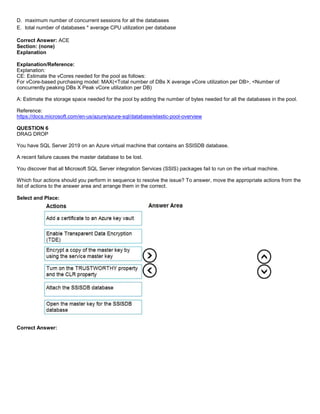
DRAG DROP
You have SQL Server 2019 on an Azure virtual machine that contains an SSISDB database.
A recent failure causes the master database to be lost.
You discover that all Microsoft SQL Server integration Services (SSIS) packages fail to run on the virtual machine.
Which four actions should you perform in sequence to resolve the issue? To answer, move the appropriate actions from the
list of actions to the answer area and arrange them in the correct.
Select and Place:
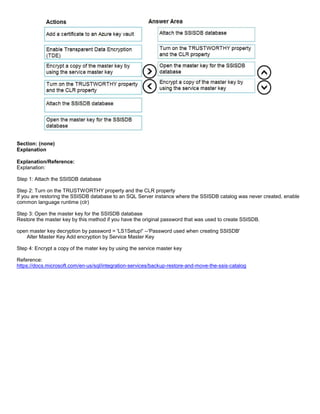
Correct Answer:
A8A6113D7A4D366390D1D14498E883F7
Section: (none)
Explanation
Explanation/Reference:
Explanation:
Step 1: Attach the SSISDB database
Step 2: Turn on the TRUSTWORTHY property and the CLR property
If you are restoring the SSISDB database to an SQL Server instance where the SSISDB catalog was never created, enable
common language runtime (clr)
Step 3: Open the master key for the SSISDB database
Restore the master key by this method if you have the original password that was used to create SSISDB.
open master key decryption by password = 'LS1Setup!' --'Password used when creating SSISDB'
Alter Master Key Add encryption by Service Master Key
Step 4: Encrypt a copy of the mater key by using the service master key
Reference:
https://docs.microsoft.com/en-us/sql/integration-services/backup-restore-and-move-the-ssis-catalog
A8A6113D7A4D366390D1D14498E883F7
Implement a Secure Environment
Testlet 1
This is a case study. Case studies are not timed separately. You can use as much exam time as you would like to
complete each case. However, there may be additional case studies and sections on this exam. You must manage your
time to ensure that you are able to complete all questions included on this exam in the time provided.
To answer the questions included in a case study, you will need to reference information that is provided in the case study.
Case studies might contain exhibits and other resources that provide more information about the scenario that is described
in the case study. Each question is independent of the other questions in this case study.
At the end of this case study, a review screen will appear. This screen allows you to review your answers and to make
changes before you move to the next section of the exam. After you begin a new section, you cannot return to this section.
To start the case study
To display the first question in this case study, click the Next button. Use the buttons in the left pane to explore the content
of the case study before you answer the questions. Clicking these buttons displays information such as business
requirements, existing environment, and problem statements. If the case study has an All Information tab, note that the
information displayed is identical to the information displayed on the subsequent tabs. When you are ready to answer a
question, click the Question button to return to the question.
Existing Environment
Network Environment
The manufacturing and research datacenters connect to the primary datacenter by using a VPN.
The primary datacenter has an ExpressRoute connection that uses both Microsoft peering and private peering. The private
peering connects to an Azure virtual network named HubVNet.
Identity Environment
Litware has a hybrid Azure Active Directory (Azure AD) deployment that uses a domain named litwareinc.com. All Azure
subscriptions are associated to the litwareinc.com Azure AD tenant.
Database Environment
The sales department has the following database workload:
An on-premises named SERVER1 hosts an instance of Microsoft SQL Server 2012 and two 1-TB databases.
A logical server named SalesSrv01A contains a geo-replicated Azure SQL database named SalesSQLDb1.
SalesSQLDb1 is in an elastic pool named SalesSQLDb1Pool. SalesSQLDb1 uses database firewall rules and contained
database users.
An application named SalesSQLDb1App1 uses SalesSQLDb1.
The manufacturing office contains two on-premises SQL Server 2016 servers named SERVER2 and SERVER3. The
servers are nodes in the same Always On availability group. The availability group contains a database named
ManufacturingSQLDb1
Database administrators have two Azure virtual machines in HubVnet named VM1 and VM2 that run Windows Server 2019
and are used to manage all the Azure databases.
Licensing Agreement
Litware is a Microsoft Volume Licensing customer that has License Mobility through Software Assurance.
Current Problems
SalesSQLDb1 experiences performance issues that are likely due to out-of-date statistics and frequent blocking queries.
Requirements
A8A6113D7A4D366390D1D14498E883F7
Planned Changes
Litware plans to implement the following changes:
Implement 30 new databases in Azure, which will be used by time-sensitive manufacturing apps that have varying usage
patterns. Each database will be approximately 20 GB.
Create a new Azure SQL database named ResearchDB1 on a logical server named ResearchSrv01. ResearchDB1 will
contain Personally Identifiable Information (PII) data.
Develop an app named ResearchApp1 that will be used by the research department to populate and access
ResearchDB1.
Migrate ManufacturingSQLDb1 to the Azure virtual machine platform.
Migrate the SERVER1 databases to the Azure SQL Database platform.
Technical Requirements
Litware identifies the following technical requirements:
Maintenance tasks must be automated.
The 30 new databases must scale automatically.
The use of an on-premises infrastructure must be minimized.
Azure Hybrid Use Benefits must be leveraged for Azure SQL Database deployments.
All SQL Server and Azure SQL Database metrics related to CPU and storage usage and limits must be analyzed by
using Azure built-in functionality.
Security and Compliance Requirements
Litware identifies the following security and compliance requirements:
Store encryption keys in Azure Key Vault.
Retain backups of the PII data for two months.
Encrypt the PII data at rest, in transit, and in use.
Use the principle of least privilege whenever possible.
Authenticate database users by using Active Directory credentials.
Protect Azure SQL Database instances by using database-level firewall rules.
Ensure that all databases hosted in Azure are accessible from VM1 and VM2 without relying on public endpoints.
Business Requirements
Litware identifies the following business requirements:
Meet an SLA of 99.99% availability for all Azure deployments.
Minimize downtime during the migration of the SERVER1 databases.
Use the Azure Hybrid Use Benefits when migrating workloads to Azure.
Once all requirements are met, minimize costs whenever possible.
QUESTION 1
DRAG DROP
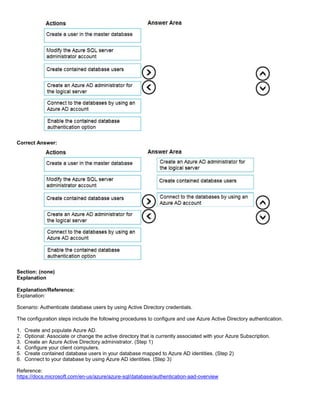
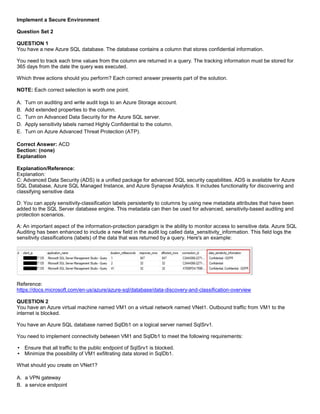
You need to configure user authentication for the SERVER1 databases. The solution must meet the security and
compliance requirements.
Which three actions should you perform in sequence? To answer, move the appropriate actions from the list of actions to
the answer area and arrange them in the correct order.
Select and Place:
A8A6113D7A4D366390D1D14498E883F7
Correct Answer:
Section: (none)
Explanation
Explanation/Reference:
Explanation:
Scenario: Authenticate database users by using Active Directory credentials.
The configuration steps include the following procedures to configure and use Azure Active Directory authentication.
1. Create and populate Azure AD.
2. Optional: Associate or change the active directory that is currently associated with your Azure Subscription.
3. Create an Azure Active Directory administrator. (Step 1)
4. Configure your client computers.
5. Create contained database users in your database mapped to Azure AD identities. (Step 2)
6. Connect to your database by using Azure AD identities. (Step 3)
Reference:
https://docs.microsoft.com/en-us/azure/azure-sql/database/authentication-aad-overview
A8A6113D7A4D366390D1D14498E883F7
Implement a Secure Environment
Question Set 2
QUESTION 1
You have a new Azure SQL database. The database contains a column that stores confidential information.
You need to track each time values from the column are returned in a query. The tracking information must be stored for
365 days from the date the query was executed.
Which three actions should you perform? Each correct answer presents part of the solution.
NOTE: Each correct selection is worth one point.
A. Turn on auditing and write audit logs to an Azure Storage account.
B. Add extended properties to the column.
C. Turn on Advanced Data Security for the Azure SQL server.
D. Apply sensitivity labels named Highly Confidential to the column.
E. Turn on Azure Advanced Threat Protection (ATP).
Correct Answer: ACD
Section: (none)
Explanation
Explanation/Reference:
Explanation:
C: Advanced Data Security (ADS) is a unified package for advanced SQL security capabilities. ADS is available for Azure
SQL Database, Azure SQL Managed Instance, and Azure Synapse Analytics. It includes functionality for discovering and
classifying sensitive data
D: You can apply sensitivity-classification labels persistently to columns by using new metadata attributes that have been
added to the SQL Server database engine. This metadata can then be used for advanced, sensitivity-based auditing and
protection scenarios.
A: An important aspect of the information-protection paradigm is the ability to monitor access to sensitive data. Azure SQL
Auditing has been enhanced to include a new field in the audit log called data_sensitivity_information. This field logs the
sensitivity classifications (labels) of the data that was returned by a query. Here's an example:
Reference:
https://docs.microsoft.com/en-us/azure/azure-sql/database/data-discovery-and-classification-overview
QUESTION 2
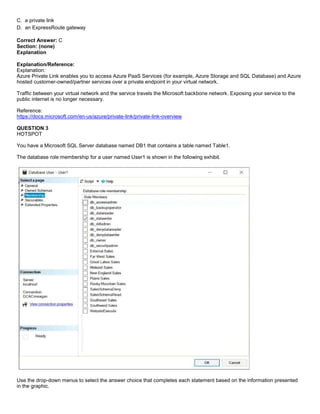
You have an Azure virtual machine named VM1 on a virtual network named VNet1. Outbound traffic from VM1 to the
internet is blocked.
You have an Azure SQL database named SqlDb1 on a logical server named SqlSrv1.
You need to implement connectivity between VM1 and SqlDb1 to meet the following requirements:
Ensure that all traffic to the public endpoint of SqlSrv1 is blocked.
Minimize the possibility of VM1 exfiltrating data stored in SqlDb1.
What should you create on VNet1?
A. a VPN gateway
B. a service endpoint
A8A6113D7A4D366390D1D14498E883F7
C. a private link
D. an ExpressRoute gateway
Correct Answer: C
Section: (none)
Explanation
Explanation/Reference:
Explanation:
Azure Private Link enables you to access Azure PaaS Services (for example, Azure Storage and SQL Database) and Azure
hosted customer-owned/partner services over a private endpoint in your virtual network.
Traffic between your virtual network and the service travels the Microsoft backbone network. Exposing your service to the
public internet is no longer necessary.
Reference:
https://docs.microsoft.com/en-us/azure/private-link/private-link-overview
QUESTION 3
HOTSPOT
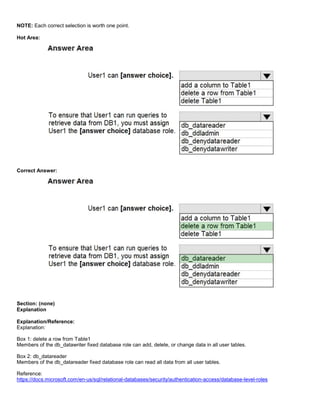
You have a Microsoft SQL Server database named DB1 that contains a table named Table1.
The database role membership for a user named User1 is shown in the following exhibit.
Use the drop-down menus to select the answer choice that completes each statement based on the information presented
in the graphic.
A8A6113D7A4D366390D1D14498E883F7
NOTE: Each correct selection is worth one point.
Hot Area:
Correct Answer:
Section: (none)
Explanation
Explanation/Reference:
Explanation:
Box 1: delete a row from Table1
Members of the db_datawriter fixed database role can add, delete, or change data in all user tables.
Box 2: db_datareader
Members of the db_datareader fixed database role can read all data from all user tables.
Reference:
https://docs.microsoft.com/en-us/sql/relational-databases/security/authentication-access/database-level-roles
A8A6113D7A4D366390D1D14498E883F7
QUESTION 4
DRAG DROP
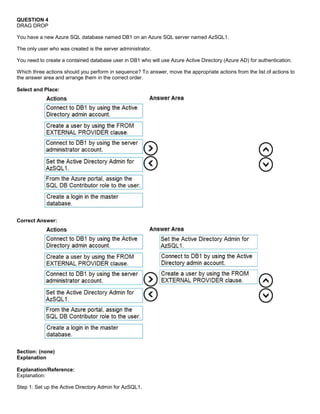
You have a new Azure SQL database named DB1 on an Azure SQL server named AzSQL1.
The only user who was created is the server administrator.
You need to create a contained database user in DB1 who will use Azure Active Directory (Azure AD) for authentication.
Which three actions should you perform in sequence? To answer, move the appropriate actions from the list of actions to
the answer area and arrange them in the correct order.
Select and Place:
Correct Answer:
Section: (none)
Explanation
Explanation/Reference:
Explanation:
Step 1: Set up the Active Directory Admin for AzSQL1.
A8A6113D7A4D366390D1D14498E883F7
Step 2: Connect to DB1 by using the server administrator.
Sign into your managed instance with an Azure AD login granted with the sysadmin role.
Step 3: Create a user by using the FROM EXTERNAL PROVIDER clause.
FROM EXTERNAL PROVIDER is available for creating server-level Azure AD logins in SQL Database managed instance.
Azure AD logins allow database-level Azure AD principals to be mapped to server-level Azure AD logins. To create an
Azure AD user from an Azure AD login use the following syntax:
CREATE USER [AAD_principal] FROM LOGIN [Azure AD login]
Reference:
https://docs.microsoft.com/en-us/sql/t-sql/statements/create-user-transact-sql
QUESTION 5
HOTSPOT
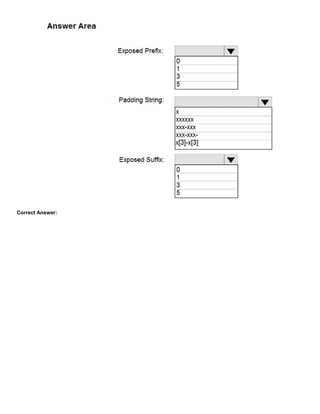
You have an Azure SQL database that contains a table named Customer. Customer has the columns shown in the following
table.
You plan to implement a dynamic data mask for the Customer_Phone column. The mask must meet the following
requirements:
The first six numerals of each customer’s phone number must be masked.
The last four digits of each customer’s phone number must be visible.
Hyphens must be preserved and displayed.
How should you configure the dynamic data mask? To answer, select the appropriate options in the answer area.
Hot Area:
A8A6113D7A4D366390D1D14498E883F7
Correct Answer:
A8A6113D7A4D366390D1D14498E883F7
Section: (none)
Explanation
Explanation/Reference:
Explanation:
Box 1: 0
Custom String : Masking method that exposes the first and last letters and adds a custom padding string in the middle.
prefix,[padding],suffix
Box 2: xxx-xxx
Box 3: 5
Reference:
https://docs.microsoft.com/en-us/sql/relational-databases/security/dynamic-data-masking
QUESTION 6
DRAG DROP
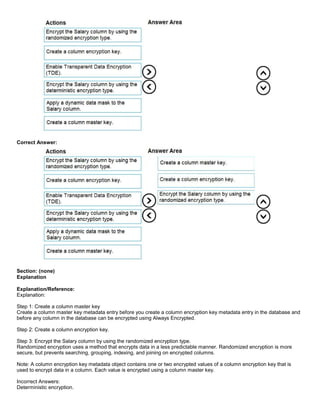
You have an Azure SQL database that contains a table named Employees. Employees contains a column named Salary.
You need to encrypt the Salary column. The solution must prevent database administrators from reading the data in the
Salary column and must provide the most secure encryption.
Which three actions should you perform in sequence? To answer, move the appropriate actions from the list of actions to
the answer area and arrange them in the correct order.
Select and Place:
A8A6113D7A4D366390D1D14498E883F7
Correct Answer:
Section: (none)
Explanation
Explanation/Reference:
Explanation:
Step 1: Create a column master key
Create a column master key metadata entry before you create a column encryption key metadata entry in the database and
before any column in the database can be encrypted using Always Encrypted.
Step 2: Create a column encryption key.
Step 3: Encrypt the Salary column by using the randomized encryption type.
Randomized encryption uses a method that encrypts data in a less predictable manner. Randomized encryption is more
secure, but prevents searching, grouping, indexing, and joining on encrypted columns.
Note: A column encryption key metadata object contains one or two encrypted values of a column encryption key that is
used to encrypt data in a column. Each value is encrypted using a column master key.
Incorrect Answers:
Deterministic encryption.
A8A6113D7A4D366390D1D14498E883F7
Deterministic encryption always generates the same encrypted value for any given plain text value. Using deterministic
encryption allows point lookups, equality joins, grouping and indexing on encrypted columns. However, it may also allow
unauthorized users to guess information about encrypted values by examining patterns in the encrypted column, especially
if there's a small set of possible encrypted values, such as True/False, or North/South/East/West region.
Reference:
https://docs.microsoft.com/en-us/sql/relational-databases/security/encryption/always-encrypted-database-engine
A8A6113D7A4D366390D1D14498E883F7
Monitor and Optimize Operational Resources
Testlet 1
This is a case study. Case studies are not timed separately. You can use as much exam time as you would like to
complete each case. However, there may be additional case studies and sections on this exam. You must manage your
time to ensure that you are able to complete all questions included on this exam in the time provided.
To answer the questions included in a case study, you will need to reference information that is provided in the case study.
Case studies might contain exhibits and other resources that provide more information about the scenario that is described
in the case study. Each question is independent of the other questions in this case study.
At the end of this case study, a review screen will appear. This screen allows you to review your answers and to make
changes before you move to the next section of the exam. After you begin a new section, you cannot return to this section.
To start the case study
To display the first question in this case study, click the Next button. Use the buttons in the left pane to explore the content
of the case study before you answer the questions. Clicking these buttons displays information such as business
requirements, existing environment, and problem statements. If the case study has an All Information tab, note that the
information displayed is identical to the information displayed on the subsequent tabs. When you are ready to answer a
question, click the Question button to return to the question.
Existing Environment
Network Environment
The manufacturing and research datacenters connect to the primary datacenter by using a VPN.
The primary datacenter has an ExpressRoute connection that uses both Microsoft peering and private peering. The private
peering connects to an Azure virtual network named HubVNet.
Identity Environment
Litware has a hybrid Azure Active Directory (Azure AD) deployment that uses a domain named litwareinc.com. All Azure
subscriptions are associated to the litwareinc.com Azure AD tenant.
Database Environment
The sales department has the following database workload:
An on-premises named SERVER1 hosts an instance of Microsoft SQL Server 2012 and two 1-TB databases.
A logical server named SalesSrv01A contains a geo-replicated Azure SQL database named SalesSQLDb1.
SalesSQLDb1 is in an elastic pool named SalesSQLDb1Pool. SalesSQLDb1 uses database firewall rules and contained
database users.
An application named SalesSQLDb1App1 uses SalesSQLDb1.
The manufacturing office contains two on-premises SQL Server 2016 servers named SERVER2 and SERVER3. The
servers are nodes in the same Always On availability group. The availability group contains a database named
ManufacturingSQLDb1
Database administrators have two Azure virtual machines in HubVnet named VM1 and VM2 that run Windows Server 2019
and are used to manage all the Azure databases.
Licensing Agreement
Litware is a Microsoft Volume Licensing customer that has License Mobility through Software Assurance.
Current Problems
SalesSQLDb1 experiences performance issues that are likely due to out-of-date statistics and frequent blocking queries.
Requirements
A8A6113D7A4D366390D1D14498E883F7
Planned Changes
Litware plans to implement the following changes:
Implement 30 new databases in Azure, which will be used by time-sensitive manufacturing apps that have varying usage
patterns. Each database will be approximately 20 GB.
Create a new Azure SQL database named ResearchDB1 on a logical server named ResearchSrv01. ResearchDB1 will
contain Personally Identifiable Information (PII) data.
Develop an app named ResearchApp1 that will be used by the research department to populate and access
ResearchDB1.
Migrate ManufacturingSQLDb1 to the Azure virtual machine platform.
Migrate the SERVER1 databases to the Azure SQL Database platform.
Technical Requirements
Litware identifies the following technical requirements:
Maintenance tasks must be automated.
The 30 new databases must scale automatically.
The use of an on-premises infrastructure must be minimized.
Azure Hybrid Use Benefits must be leveraged for Azure SQL Database deployments.
All SQL Server and Azure SQL Database metrics related to CPU and storage usage and limits must be analyzed by
using Azure built-in functionality.
Security and Compliance Requirements
Litware identifies the following security and compliance requirements:
Store encryption keys in Azure Key Vault.
Retain backups of the PII data for two months.
Encrypt the PII data at rest, in transit, and in use.
Use the principle of least privilege whenever possible.
Authenticate database users by using Active Directory credentials.
Protect Azure SQL Database instances by using database-level firewall rules.
Ensure that all databases hosted in Azure are accessible from VM1 and VM2 without relying on public endpoints.
Business Requirements
Litware identifies the following business requirements:
Meet an SLA of 99.99% availability for all Azure deployments.
Minimize downtime during the migration of the SERVER1 databases.
Use the Azure Hybrid Use Benefits when migrating workloads to Azure.
Once all requirements are met, minimize costs whenever possible.
QUESTION 1
HOTSPOT
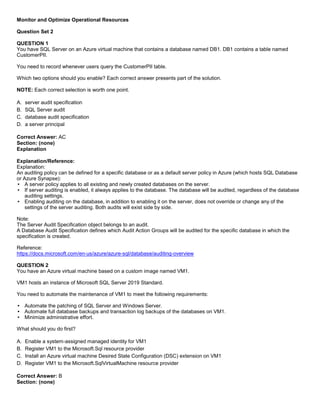
You need to implement the monitoring of SalesSQLDb1. The solution must meet the technical requirements.
How should you collect and stream metrics? To answer, select the appropriate options in the answer area.
NOTE: Each correct selection is worth one point.
Hot Area:
A8A6113D7A4D366390D1D14498E883F7
Correct Answer:
Section: (none)
Explanation
Explanation/Reference:
Explanation:
Box 1: The server, the elastic pool, and the database
Senario:
SalesSQLDb1 is in an elastic pool named SalesSQLDb1Pool.
Litware technical requirements include: all SQL Server and Azure SQL Database metrics related to CPU and storage usage
and limits must be analyzed by using Azure built-in functionality.
Box 2: Azure Event hubs
Scenario: Migrate ManufacturingSQLDb1 to the Azure virtual machine platform.
Event hubs are able to handle custom metrics.
Incorrect Answers:
Azure Log Analytics
Azure metric and log data are sent to Azure Monitor Logs, previously known as Azure Log Analytics, directly by Azure.
Azure SQL Analytics is a cloud only monitoring solution supporting streaming of diagnostics telemetry for all of your Azure
SQL databases.
However, because Azure SQL Analytics does not use agents to connect to Azure Monitor, it does not support monitoring of
SQL Server hosted on-premises or in virtual machines.
A8A6113D7A4D366390D1D14498E883F7
Monitor and Optimize Operational Resources
Question Set 2
QUESTION 1
You have SQL Server on an Azure virtual machine that contains a database named DB1. DB1 contains a table named
CustomerPII.
You need to record whenever users query the CustomerPII table.
Which two options should you enable? Each correct answer presents part of the solution.
NOTE: Each correct selection is worth one point.
A. server audit specification
B. SQL Server audit
C. database audit specification
D. a server principal
Correct Answer: AC
Section: (none)
Explanation
Explanation/Reference:
Explanation:
An auditing policy can be defined for a specific database or as a default server policy in Azure (which hosts SQL Database
or Azure Synapse):
A server policy applies to all existing and newly created databases on the server.
If server auditing is enabled, it always applies to the database. The database will be audited, regardless of the database
auditing settings.
Enabling auditing on the database, in addition to enabling it on the server, does not override or change any of the
settings of the server auditing. Both audits will exist side by side.
Note:
The Server Audit Specification object belongs to an audit.
A Database Audit Specification defines which Audit Action Groups will be audited for the specific database in which the
specification is created.
Reference:
https://docs.microsoft.com/en-us/azure/azure-sql/database/auditing-overview
QUESTION 2
You have an Azure virtual machine based on a custom image named VM1.
VM1 hosts an instance of Microsoft SQL Server 2019 Standard.
You need to automate the maintenance of VM1 to meet the following requirements:
Automate the patching of SQL Server and Windows Server.
Automate full database backups and transaction log backups of the databases on VM1.
Minimize administrative effort.
What should you do first?
A. Enable a system-assigned managed identity for VM1
B. Register VM1 to the Microsoft.Sql resource provider
C. Install an Azure virtual machine Desired State Configuration (DSC) extension on VM1
D. Register VM1 to the Microsoft.SqlVirtualMachine resource provider
Correct Answer: B
Section: (none)
A8A6113D7A4D366390D1D14498E883F7
Explanation
Explanation/Reference:
Explanation:
Automated Patching depends on the SQL Server infrastructure as a service (IaaS) Agent Extension. The SQL Server IaaS
Agent Extension (SqlIaasExtension) runs on Azure virtual machines to automate administration tasks. The SQL Server IaaS
extension is installed when you register your SQL Server VM with the SQL Server VM resource provider.
Reference:
https://docs.microsoft.com/en-us/azure/azure-sql/virtual-machines/windows/sql-server-iaas-agent-extension-automate-
management
QUESTION 3
You receive numerous alerts from Azure Monitor for an Azure SQL database.
You need to reduce the number of alerts. You must only receive alerts if there is a significant change in usage patterns for
an extended period.
Which two actions should you perform? Each correct answer presents part of the solution.
NOTE: Each correct selection is worth one point.
A. Set Threshold Sensitivity to High
B. Set the Alert logic threshold to Dynamic
C. Set the Alert logic threshold to Static
D. Set Threshold Sensitivity to Low
E. Set Force Plan to On
Correct Answer: BD
Section: (none)
Explanation
Explanation/Reference:
Explanation:
B: Dynamic Thresholds continuously learns the data of the metric series and tries to model it using a set of algorithms and
methods. It detects patterns in the data such as seasonality (Hourly / Daily / Weekly), and is able to handle noisy metrics
(such as machine CPU or memory) as well as metrics with low dispersion (such as availability and error rate).
D: Alert threshold sensitivity is a high-level concept that controls the amount of deviation from metric behavior required to
trigger an alert.
Low – The thresholds will be loose with more distance from metric series pattern. An alert rule will only trigger on large
deviations, resulting in fewer alerts.
Incorrect Answers:
A: High – The thresholds will be tight and close to the metric series pattern. An alert rule will be triggered on the smallest
deviation, resulting in more alerts.
Reference:
https://docs.microsoft.com/en-us/azure/azure-monitor/platform/alerts-dynamic-thresholds
QUESTION 4
You have an Azure SQL database named sqldb1.
You need to minimize the amount of space by the data and log files of sqldb1.
What should you run?
A. DBCC SHRINKDATABASE
B. sp_clean_db_free_space
C. sp_clean_db_file_free_space
D. DBCC SHRINKFILE
A8A6113D7A4D366390D1D14498E883F7
Correct Answer: A
Section: (none)
Explanation
Explanation/Reference:
Explanation:
DBCC SHRINKDATABASE shrinks the size of the data and log files in the specified database.
Incorrect Answers:
D: To shrink one data or log file at a time for a specific database, execute the DBCC SHRINKFILE command.
Reference:
https://docs.microsoft.com/en-us/sql/t-sql/database-console-commands/dbcc-shrinkdatabase-transact-sql
QUESTION 5
You have an Azure SQL Database server named sqlsrv1 that hosts 10 Azure SQL databases.
The databases perform slower than expected.
You need to identify whether the performance issue relates to the use of tempdb on sqlsrv1.
What should you do?
A. Run Query Store-based queries
B. Review information provided by SQL Server Profiler-based traces
C. Review information provided by Query Performance Insight
D. Run dynamic management view-based queries
Correct Answer: D
Section: (none)
Explanation
Explanation/Reference:
Explanation:
The diagnostics log outputs tempDB contention details. You can use the information as the starting point for
troubleshooting.
You can use the Intelligent Insights performance diagnostics log of Azure SQL Database to troubleshoot performance
issues.
Reference:
https://docs.microsoft.com/en-us/azure/azure-sql/database/intelligent-insights-troubleshoot-performance#tempdb-
contention
https://docs.microsoft.com/en-us/azure/azure-sql/database/intelligent-insights-use-diagnostics-log
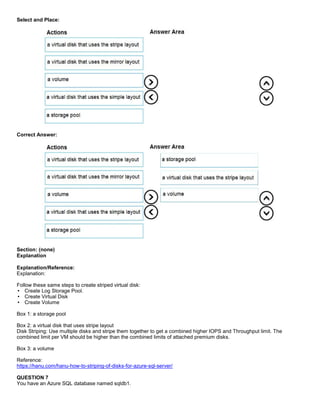
QUESTION 6
DRAG DROP
You are building an Azure virtual machine.
You allocate two 1-TiB, P30 premium storage disks to the virtual machine. Each disk provides 5,000 IOPS.
You plan to migrate an on-premises instance of Microsoft SQL Server to the virtual machine. The instance has a database
that contains a 1.2-TiB data file. The database requires 10,000 IOPS.
You need to configure storage for the virtual machine to support the database.
Which three objects should you create in sequence? To answer, move the appropriate objects from the list of objects to the
answer area and arrange them in the correct order.
A8A6113D7A4D366390D1D14498E883F7
Select and Place:
Correct Answer:
Section: (none)
Explanation
Explanation/Reference:
Explanation:
Follow these same steps to create striped virtual disk:
Create Log Storage Pool.
Create Virtual Disk
Create Volume
Box 1: a storage pool
Box 2: a virtual disk that uses stripe layout
Disk Striping: Use multiple disks and stripe them together to get a combined higher IOPS and Throughput limit. The
combined limit per VM should be higher than the combined limits of attached premium disks.
Box 3: a volume
Reference:
https://hanu.com/hanu-how-to-striping-of-disks-for-azure-sql-server/
QUESTION 7
You have an Azure SQL database named sqldb1.
A8A6113D7A4D366390D1D14498E883F7
You need to minimize the possibility of Query Store transitioning to a read-only state.
What should you do?
A. Double the value of Data Flush interval
B. Decrease by half the value of Data Flush Interval
C. Double the value of Statistics Collection Interval
D. Decrease by half the value of Statistics Collection interval
Correct Answer: B
Section: (none)
Explanation
Explanation/Reference:
Explanation:
The Max Size (MB) limit isn't strictly enforced. Storage size is checked only when Query Store writes data to disk. This
interval is set by the Data Flush Interval (Minutes) option. If Query Store has breached the maximum size limit between
storage size checks, it transitions to read-only mode.
Incorrect Answers:
C: Statistics Collection Interval: Defines the level of granularity for the collected runtime statistic, expressed in minutes. The
default is 60 minutes. Consider using a lower value if you require finer granularity or less time to detect and mitigate issues.
Keep in mind that the value directly affects the size of Query Store data.
Reference:
https://docs.microsoft.com/en-us/sql/relational-databases/performance/best-practice-with-the-query-store
QUESTION 8
You have SQL Server 2019 on an Azure virtual machine that runs Windows Server 2019. The virtual machine has 4 vCPUs
and 28 GB of memory.
You scale up the virtual machine to 16 vCPUSs and 64 GB of memory.
You need to provide the lowest latency for tempdb.
What is the total number of data files that tempdb should contain?
A. 2
B. 4
C. 8
D. 64
Correct Answer: D
Section: (none)
Explanation
Explanation/Reference:
Explanation:
The number of files depends on the number of (logical) processors on the machine. As a general rule, if the number of
logical processors is less than or equal to eight, use the same number of data files as logical processors. If the number of
logical processors is greater than eight, use eight data files and then if contention continues, increase the number of data
files by multiples of 4 until the contention is reduced to acceptable levels or make changes to the workload/code.
Reference:
https://docs.microsoft.com/en-us/sql/relational-databases/databases/tempdb-database
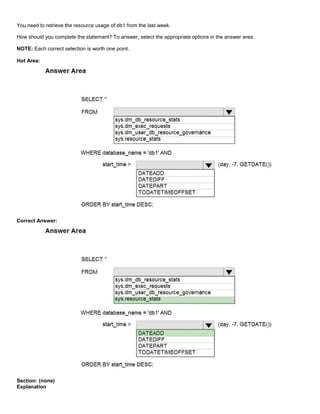
QUESTION 9
HOTSPOT
You have an Azure SQL database named db1.
A8A6113D7A4D366390D1D14498E883F7
You need to retrieve the resource usage of db1 from the last week.
How should you complete the statement? To answer, select the appropriate options in the answer area.
NOTE: Each correct selection is worth one point.
Hot Area:
Correct Answer:
Section: (none)
Explanation
A8A6113D7A4D366390D1D14498E883F7
Explanation/Reference:
Explanation:
Box 1: sys.resource_stats
sys.resource_stats returns CPU usage and storage data for an Azure SQL Database. It has database_name and start_time
columns.
Box 2: DateAdd
The following example returns all databases that are averaging at least 80% of compute utilization over the last one week.
DECLARE @s datetime;
DECLARE @e datetime;
SET @s= DateAdd(d,-7,GetUTCDate());
SET @e= GETUTCDATE();
SELECT database_name, AVG(avg_cpu_percent) AS Average_Compute_Utilization
FROM sys.resource_stats
WHERE start_time BETWEEN @s AND @e
GROUP BY database_name
HAVING AVG(avg_cpu_percent) >= 80
Incorrect Answers:
sys.dm_exec_requests:
sys.dm_exec_requests returns information about each request that is executing in SQL Server. It does not have a column
named database_name.
sys.dm_db_resource_stats:
sys.dm_db_resource_stats does not have any start_time column.
Note: sys.dm_db_resource_stats returns CPU, I/O, and memory consumption for an Azure SQL Database database. One
row exists for every 15 seconds, even if there is no activity in the database. Historical data is maintained for approximately
one hour.
Sys.dm_user_db_resource_governance returns actual configuration and capacity settings used by resource governance
mechanisms in the current database or elastic pool. It does not have any start_time column.
Reference:
https://docs.microsoft.com/en-us/sql/relational-databases/system-catalog-views/sys-resource-stats-azure-sql-database
A8A6113D7A4D366390D1D14498E883F7
Optimize Query Performance
Testlet 1
This is a case study. Case studies are not timed separately. You can use as much exam time as you would like to
complete each case. However, there may be additional case studies and sections on this exam. You must manage your
time to ensure that you are able to complete all questions included on this exam in the time provided.
To answer the questions included in a case study, you will need to reference information that is provided in the case study.
Case studies might contain exhibits and other resources that provide more information about the scenario that is described
in the case study. Each question is independent of the other questions in this case study.
At the end of this case study, a review screen will appear. This screen allows you to review your answers and to make
changes before you move to the next section of the exam. After you begin a new section, you cannot return to this section.
To start the case study
To display the first question in this case study, click the Next button. Use the buttons in the left pane to explore the content
of the case study before you answer the questions. Clicking these buttons displays information such as business
requirements, existing environment, and problem statements. If the case study has an All Information tab, note that the
information displayed is identical to the information displayed on the subsequent tabs. When you are ready to answer a
question, click the Question button to return to the question.
Existing Environment
Network Environment
The manufacturing and research datacenters connect to the primary datacenter by using a VPN.
The primary datacenter has an ExpressRoute connection that uses both Microsoft peering and private peering. The private
peering connects to an Azure virtual network named HubVNet.
Identity Environment
Litware has a hybrid Azure Active Directory (Azure AD) deployment that uses a domain named litwareinc.com. All Azure
subscriptions are associated to the litwareinc.com Azure AD tenant.
Database Environment
The sales department has the following database workload:
An on-premises named SERVER1 hosts an instance of Microsoft SQL Server 2012 and two 1-TB databases.
A logical server named SalesSrv01A contains a geo-replicated Azure SQL database named SalesSQLDb1.
SalesSQLDb1 is in an elastic pool named SalesSQLDb1Pool. SalesSQLDb1 uses database firewall rules and contained
database users.
An application named SalesSQLDb1App1 uses SalesSQLDb1.
The manufacturing office contains two on-premises SQL Server 2016 servers named SERVER2 and SERVER3. The
servers are nodes in the same Always On availability group. The availability group contains a database named
ManufacturingSQLDb1
Database administrators have two Azure virtual machines in HubVnet named VM1 and VM2 that run Windows Server 2019
and are used to manage all the Azure databases.
Licensing Agreement
Litware is a Microsoft Volume Licensing customer that has License Mobility through Software Assurance.
Current Problems
SalesSQLDb1 experiences performance issues that are likely due to out-of-date statistics and frequent blocking queries.
Requirements
A8A6113D7A4D366390D1D14498E883F7
Planned Changes
Litware plans to implement the following changes:
Implement 30 new databases in Azure, which will be used by time-sensitive manufacturing apps that have varying usage
patterns. Each database will be approximately 20 GB.
Create a new Azure SQL database named ResearchDB1 on a logical server named ResearchSrv01. ResearchDB1 will
contain Personally Identifiable Information (PII) data.
Develop an app named ResearchApp1 that will be used by the research department to populate and access
ResearchDB1.
Migrate ManufacturingSQLDb1 to the Azure virtual machine platform.
Migrate the SERVER1 databases to the Azure SQL Database platform.
Technical Requirements
Litware identifies the following technical requirements:
Maintenance tasks must be automated.
The 30 new databases must scale automatically.
The use of an on-premises infrastructure must be minimized.
Azure Hybrid Use Benefits must be leveraged for Azure SQL Database deployments.
All SQL Server and Azure SQL Database metrics related to CPU and storage usage and limits must be analyzed by
using Azure built-in functionality.
Security and Compliance Requirements
Litware identifies the following security and compliance requirements:
Store encryption keys in Azure Key Vault.
Retain backups of the PII data for two months.
Encrypt the PII data at rest, in transit, and in use.
Use the principle of least privilege whenever possible.
Authenticate database users by using Active Directory credentials.
Protect Azure SQL Database instances by using database-level firewall rules.
Ensure that all databases hosted in Azure are accessible from VM1 and VM2 without relying on public endpoints.
Business Requirements
Litware identifies the following business requirements:
Meet an SLA of 99.99% availability for all Azure deployments.
Minimize downtime during the migration of the SERVER1 databases.
Use the Azure Hybrid Use Benefits when migrating workloads to Azure.
Once all requirements are met, minimize costs whenever possible.
QUESTION 1
You need to identify the cause of the performance issues on SalesSQLDb1.
Which two dynamic management views should you use? Each correct answer presents part of the solution.
NOTE: Each correct selection is worth one point.
A. sys.dm_pdw_nodes_tran_locks
B. sys.dm_exec_compute_node_errors
C. sys.dm_exec_requests
D. sys.dm_cdc_errors
E. sys.dm_pdw_nodes_os_wait_stats
F. sys.dm_tran_locks
Correct Answer: AE
Section: (none)
A8A6113D7A4D366390D1D14498E883F7
Explanation
Explanation/Reference:
Explanation:
SalesSQLDb1 experiences performance issues that are likely due to out-of-date statistics and frequent blocking queries.
A: Use sys.dm_pdw_nodes_tran_locks instead of sys.dm_tran_locks from Azure Synapse Analytics (SQL Data Warehouse)
or Parallel Data Warehouse.
E: Example:
The following query will show blocking information.
SELECT
t1.resource_type,
t1.resource_database_id,
t1.resource_associated_entity_id,
t1.request_mode,
t1.request_session_id,
t2.blocking_session_id
FROM sys.dm_tran_locks as t1
INNER JOIN sys.dm_os_waiting_tasks as t2
ON t1.lock_owner_address = t2.resource_address;
Note: Depending on the system you’re working with you can access these wait statistics from one of three locations:
sys.dm_os_wait_stats: for SQL Server
sys.dm_db_wait_stats: for Azure SQL Database
sys.dm_pdw_nodes_os_wait_stats: for Azure SQL Data Warehouse
Incorrect Answers:
F: sys.dm_tran_locks returns information about currently active lock manager resources in SQL Server 2019 (15.x). Each
row represents a currently active request to the lock manager for a lock that has been granted or is waiting to be granted.
Instead use sys.dm_pdw_nodes_tran_locks.
Reference:
https://docs.microsoft.com/en-us/sql/relational-databases/system-dynamic-management-views/sys-dm-tran-locks-transact-
sql
A8A6113D7A4D366390D1D14498E883F7
Optimize Query Performance
Question Set 2
QUESTION 1
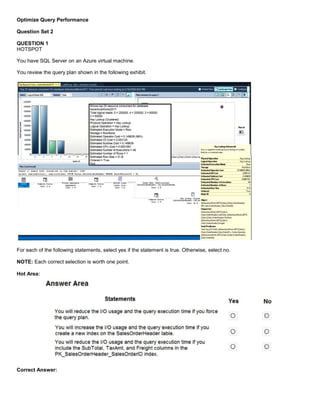
HOTSPOT
You have SQL Server on an Azure virtual machine.
You review the query plan shown in the following exhibit.
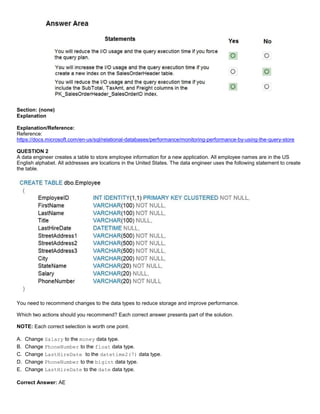
For each of the following statements, select yes if the statement is true. Otherwise, select no.
NOTE: Each correct selection is worth one point.
Hot Area:
Correct Answer:
A8A6113D7A4D366390D1D14498E883F7
Section: (none)
Explanation
Explanation/Reference:
Reference:
https://docs.microsoft.com/en-us/sql/relational-databases/performance/monitoring-performance-by-using-the-query-store
QUESTION 2
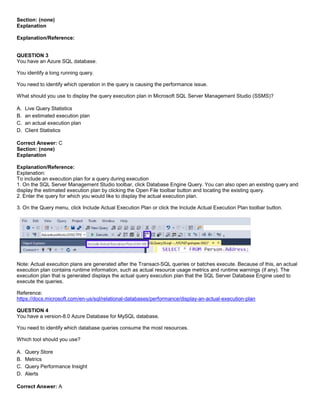
A data engineer creates a table to store employee information for a new application. All employee names are in the US
English alphabet. All addresses are locations in the United States. The data engineer uses the following statement to create
the table.
You need to recommend changes to the data types to reduce storage and improve performance.
Which two actions should you recommend? Each correct answer presents part of the solution.
NOTE: Each correct selection is worth one point.
A. Change Salary to the money data type.
B. Change PhoneNumber to the float data type.
C. Change LastHireDate to the datetime2(7) data type.
D. Change PhoneNumber to the bigint data type.
E. Change LastHireDate to the date data type.
Correct Answer: AE
A8A6113D7A4D366390D1D14498E883F7
Section: (none)
Explanation
Explanation/Reference:
QUESTION 3
You have an Azure SQL database.
You identify a long running query.
You need to identify which operation in the query is causing the performance issue.
What should you use to display the query execution plan in Microsoft SQL Server Management Studio (SSMS)?
A. Live Query Statistics
B. an estimated execution plan
C. an actual execution plan
D. Client Statistics
Correct Answer: C
Section: (none)
Explanation
Explanation/Reference:
Explanation:
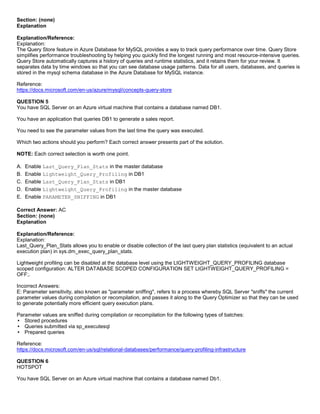
To include an execution plan for a query during execution
1. On the SQL Server Management Studio toolbar, click Database Engine Query. You can also open an existing query and
display the estimated execution plan by clicking the Open File toolbar button and locating the existing query.
2. Enter the query for which you would like to display the actual execution plan.
3. On the Query menu, click Include Actual Execution Plan or click the Include Actual Execution Plan toolbar button.
Note: Actual execution plans are generated after the Transact-SQL queries or batches execute. Because of this, an actual
execution plan contains runtime information, such as actual resource usage metrics and runtime warnings (if any). The
execution plan that is generated displays the actual query execution plan that the SQL Server Database Engine used to
execute the queries.
Reference:
https://docs.microsoft.com/en-us/sql/relational-databases/performance/display-an-actual-execution-plan
QUESTION 4
You have a version-8.0 Azure Database for MySQL database.
You need to identify which database queries consume the most resources.
Which tool should you use?
A. Query Store
B. Metrics
C. Query Performance Insight
D. Alerts
Correct Answer: A
A8A6113D7A4D366390D1D14498E883F7
Section: (none)
Explanation
Explanation/Reference:
Explanation:
The Query Store feature in Azure Database for MySQL provides a way to track query performance over time. Query Store
simplifies performance troubleshooting by helping you quickly find the longest running and most resource-intensive queries.
Query Store automatically captures a history of queries and runtime statistics, and it retains them for your review. It
separates data by time windows so that you can see database usage patterns. Data for all users, databases, and queries is
stored in the mysql schema database in the Azure Database for MySQL instance.
Reference:
https://docs.microsoft.com/en-us/azure/mysql/concepts-query-store
QUESTION 5
You have SQL Server on an Azure virtual machine that contains a database named DB1.
You have an application that queries DB1 to generate a sales report.
You need to see the parameter values from the last time the query was executed.
Which two actions should you perform? Each correct answer presents part of the solution.
NOTE: Each correct selection is worth one point.
A. Enable Last_Query_Plan_Stats in the master database
B. Enable Lightweight_Query_Profiling in DB1
C. Enable Last_Query_Plan_Stats in DB1
D. Enable Lightweight_Query_Profiling in the master database
E. Enable PARAMETER_SNIFFING in DB1
Correct Answer: AC
Section: (none)
Explanation
Explanation/Reference:
Explanation:
Last_Query_Plan_Stats allows you to enable or disable collection of the last query plan statistics (equivalent to an actual
execution plan) in sys.dm_exec_query_plan_stats.
Lightweight profiling can be disabled at the database level using the LIGHTWEIGHT_QUERY_PROFILING database
scoped configuration: ALTER DATABASE SCOPED CONFIGURATION SET LIGHTWEIGHT_QUERY_PROFILING =
OFF;.
Incorrect Answers:
E: Parameter sensitivity, also known as "parameter sniffing", refers to a process whereby SQL Server "sniffs" the current
parameter values during compilation or recompilation, and passes it along to the Query Optimizer so that they can be used
to generate potentially more efficient query execution plans.
Parameter values are sniffed during compilation or recompilation for the following types of batches:
Stored procedures
Queries submitted via sp_executesql
Prepared queries
Reference:
https://docs.microsoft.com/en-us/sql/relational-databases/performance/query-profiling-infrastructure
QUESTION 6
HOTSPOT
You have SQL Server on an Azure virtual machine that contains a database named Db1.
A8A6113D7A4D366390D1D14498E883F7
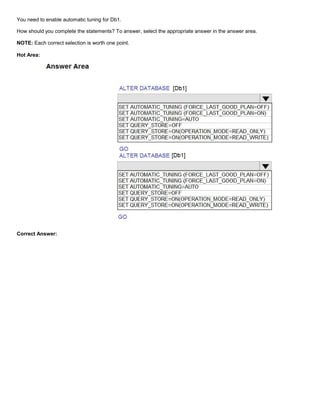
You need to enable automatic tuning for Db1.
How should you complete the statements? To answer, select the appropriate answer in the answer area.
NOTE: Each correct selection is worth one point.
Hot Area:
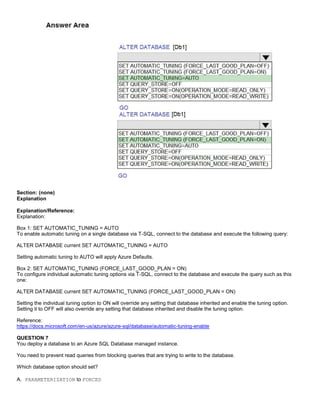
Correct Answer:
A8A6113D7A4D366390D1D14498E883F7
Section: (none)
Explanation
Explanation/Reference:
Explanation:
Box 1: SET AUTOMATIC_TUNING = AUTO
To enable automatic tuning on a single database via T-SQL, connect to the database and execute the following query:
ALTER DATABASE current SET AUTOMATIC_TUNING = AUTO
Setting automatic tuning to AUTO will apply Azure Defaults.
Box 2: SET AUTOMATIC_TUNING (FORCE_LAST_GOOD_PLAN = ON)
To configure individual automatic tuning options via T-SQL, connect to the database and execute the query such as this
one:
ALTER DATABASE current SET AUTOMATIC_TUNING (FORCE_LAST_GOOD_PLAN = ON)
Setting the individual tuning option to ON will override any setting that database inherited and enable the tuning option.
Setting it to OFF will also override any setting that database inherited and disable the tuning option.
Reference:
https://docs.microsoft.com/en-us/azure/azure-sql/database/automatic-tuning-enable
QUESTION 7
You deploy a database to an Azure SQL Database managed instance.
You need to prevent read queries from blocking queries that are trying to write to the database.
Which database option should set?
A. PARAMETERIZATION to FORCED
A8A6113D7A4D366390D1D14498E883F7
B. PARAMETERIZATION to SIMPLE
C. Delayed Durability to Forced
D. READ_COMMITTED_SNAPSHOT to ON
Correct Answer: D
Section: (none)
Explanation
Explanation/Reference:
Explanation:
In SQL Server, you can also minimize locking contention while protecting transactions from dirty reads of uncommitted data
modifications using either:
The READ COMMITTED isolation level with the READ_COMMITTED_SNAPSHOT database option set to ON.
The SNAPSHOT isolation level.
If READ_COMMITTED_SNAPSHOT is set to ON (the default on SQL Azure Database), the Database Engine uses row
versioning to present each statement with a transactionally consistent snapshot of the data as it existed at the start of the
statement. Locks are not used to protect the data from updates by other transactions.
Incorrect Answers:
A: When the PARAMETERIZATION database option is set to SIMPLE, the SQL Server query optimizer may choose to
parameterize the queries. This means that any literal values that are contained in a query are substituted with parameters.
This process is referred to as simple parameterization. When SIMPLE parameterization is in effect, you cannot control
which queries are parameterized and which queries are not.
B: You can specify that all queries in a database be parameterized by setting the PARAMETERIZATION database option to
FORCED. This process is referred to as forced parameterization.
C: Delayed transaction durability is accomplished using asynchronous log writes to disk. Transaction log records are kept in
a buffer and written to disk when the buffer fills or a buffer flushing event takes place. Delayed transaction durability reduces
both latency and contention within the system.
Some of the cases in which you could benefit from using delayed transaction durability are:
You can tolerate some data loss.
You are experiencing a bottleneck on transaction log writes.
Your workloads have a high contention rate.
Reference:
https://docs.microsoft.com/en-us/sql/t-sql/statements/set-transaction-isolation-level-transact-sql
QUESTION 8
You have an Azure SQL database.
You discover that the plan cache is full of compiled plans that were used only once.
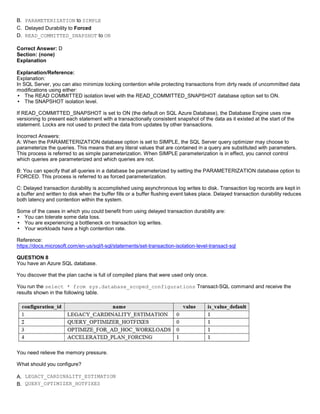
You run the select * from sys.database_scoped_configurations Transact-SQL command and receive the
results shown in the following table.
You need relieve the memory pressure.
What should you configure?
A. LEGACY_CARDINALITY_ESTIMATION
B. QUERY_OPTIMIZER_HOTFIXES
A8A6113D7A4D366390D1D14498E883F7
C. OPTIMIZE_FOR_AD_HOC_WORKLOADS
D. ACCELERATED_PLAN_FORCING
Correct Answer: C
Section: (none)
Explanation
Explanation/Reference:
Explanation:
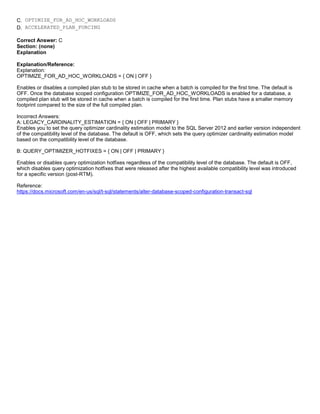
OPTIMIZE_FOR_AD_HOC_WORKLOADS = { ON | OFF }
Enables or disables a compiled plan stub to be stored in cache when a batch is compiled for the first time. The default is
OFF. Once the database scoped configuration OPTIMIZE_FOR_AD_HOC_WORKLOADS is enabled for a database, a
compiled plan stub will be stored in cache when a batch is compiled for the first time. Plan stubs have a smaller memory
footprint compared to the size of the full compiled plan.
Incorrect Answers:
A: LEGACY_CARDINALITY_ESTIMATION = { ON | OFF | PRIMARY }
Enables you to set the query optimizer cardinality estimation model to the SQL Server 2012 and earlier version independent
of the compatibility level of the database. The default is OFF, which sets the query optimizer cardinality estimation model
based on the compatibility level of the database.
B: QUERY_OPTIMIZER_HOTFIXES = { ON | OFF | PRIMARY }
Enables or disables query optimization hotfixes regardless of the compatibility level of the database. The default is OFF,
which disables query optimization hotfixes that were released after the highest available compatibility level was introduced
for a specific version (post-RTM).
Reference:
https://docs.microsoft.com/en-us/sql/t-sql/statements/alter-database-scoped-configuration-transact-sql
A8A6113D7A4D366390D1D14498E883F7
Perform Automation of Tasks
Question Set 1
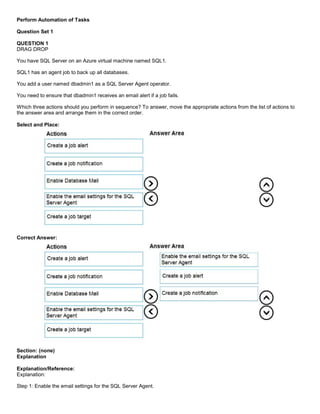
QUESTION 1
DRAG DROP
You have SQL Server on an Azure virtual machine named SQL1.
SQL1 has an agent job to back up all databases.
You add a user named dbadmin1 as a SQL Server Agent operator.
You need to ensure that dbadmin1 receives an email alert if a job fails.
Which three actions should you perform in sequence? To answer, move the appropriate actions from the list of actions to
the answer area and arrange them in the correct order.
Select and Place:
Correct Answer:
Section: (none)
Explanation
Explanation/Reference:
Explanation:
Step 1: Enable the email settings for the SQL Server Agent.
A8A6113D7A4D366390D1D14498E883F7
To send a notification in response to an alert, you must first configure SQL Server Agent to send mail.
Step 2: Create a job alert
Step 3: Create a job notification
Example:
-- adds an e-mail notification for the specified alert (Test Alert)
-- This example assumes that Test Alert already exists
-- and that François Ajenstat is a valid operator name.
USE msdb ;
GO
EXEC dbo.sp_add_notification
@alert_name = N'Test Alert',
@operator_name = N'François Ajenstat',
@notification_method = 1 ;
GO
Reference:
https://docs.microsoft.com/en-us/sql/ssms/agent/notify-an-operator-of-job-status
https://docs.microsoft.com/en-us/sql/ssms/agent/assign-alerts-to-an-operator
QUESTION 2
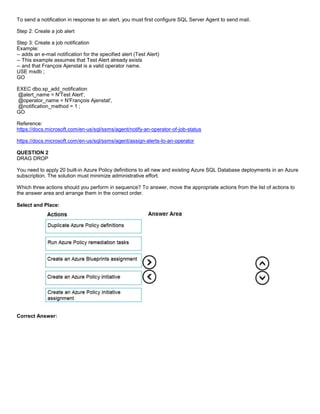
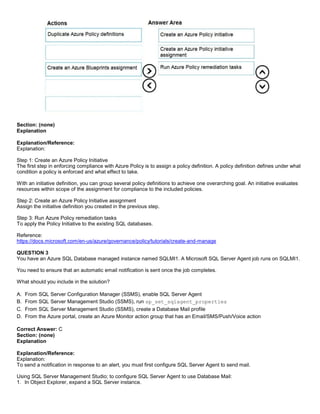
DRAG DROP
You need to apply 20 built-in Azure Policy definitions to all new and existing Azure SQL Database deployments in an Azure
subscription. The solution must minimize administrative effort.
Which three actions should you perform in sequence? To answer, move the appropriate actions from the list of actions to
the answer area and arrange them in the correct order.
Select and Place:
Correct Answer:
A8A6113D7A4D366390D1D14498E883F7
Section: (none)
Explanation
Explanation/Reference:
Explanation:
Step 1: Create an Azure Policy Initiative
The first step in enforcing compliance with Azure Policy is to assign a policy definition. A policy definition defines under what
condition a policy is enforced and what effect to take.
With an initiative definition, you can group several policy definitions to achieve one overarching goal. An initiative evaluates
resources within scope of the assignment for compliance to the included policies.
Step 2: Create an Azure Policy Initiative assignment
Assign the initiative definition you created in the previous step.
Step 3: Run Azure Policy remediation tasks
To apply the Policy Initiative to the existing SQL databases.
Reference:
https://docs.microsoft.com/en-us/azure/governance/policy/tutorials/create-and-manage
QUESTION 3
You have an Azure SQL Database managed instance named SQLMI1. A Microsoft SQL Server Agent job runs on SQLMI1.
You need to ensure that an automatic email notification is sent once the job completes.
What should you include in the solution?
A. From SQL Server Configuration Manager (SSMS), enable SQL Server Agent
B. From SQL Server Management Studio (SSMS), run sp_set_sqlagent_properties
C. From SQL Server Management Studio (SSMS), create a Database Mail profile
D. From the Azure portal, create an Azure Monitor action group that has an Email/SMS/Push/Voice action
Correct Answer: C
Section: (none)
Explanation
Explanation/Reference:
Explanation:
To send a notification in response to an alert, you must first configure SQL Server Agent to send mail.
Using SQL Server Management Studio; to configure SQL Server Agent to use Database Mail:
1. In Object Explorer, expand a SQL Server instance.
A8A6113D7A4D366390D1D14498E883F7
2. Right-click SQL Server Agent, and then click Properties.
3. Click Alert System.
4. Select Enable Mail Profile.
5. In the Mail system list, select Database Mail.
6. In the Mail profile list, select a mail profile for Database Mail.
7. Restart SQL Server Agent.
Note: Prerequisites include:
Enable Database Mail.
Create a Database Mail account for the SQL Server Agent service account to use.
Create a Database Mail profile for the SQL Server Agent service account to use and add the user to the
DatabaseMailUserRole in the msdb database.
Set the profile as the default profile for the msdb database.
Reference:
https://docs.microsoft.com/en-us/sql/relational-databases/database-mail/configure-sql-server-agent-mail-to-use-database-
mail
A8A6113D7A4D366390D1D14498E883F7
Plan and Implement a High Availability and Disaster Recovery (HADR) Environment
Testlet 1
This is a case study. Case studies are not timed separately. You can use as much exam time as you would like to
complete each case. However, there may be additional case studies and sections on this exam. You must manage your
time to ensure that you are able to complete all questions included on this exam in the time provided.
To answer the questions included in a case study, you will need to reference information that is provided in the case study.
Case studies might contain exhibits and other resources that provide more information about the scenario that is described
in the case study. Each question is independent of the other questions in this case study.
At the end of this case study, a review screen will appear. This screen allows you to review your answers and to make
changes before you move to the next section of the exam. After you begin a new section, you cannot return to this section.
To start the case study
To display the first question in this case study, click the Next button. Use the buttons in the left pane to explore the content
of the case study before you answer the questions. Clicking these buttons displays information such as business
requirements, existing environment, and problem statements. If the case study has an All Information tab, note that the
information displayed is identical to the information displayed on the subsequent tabs. When you are ready to answer a
question, click the Question button to return to the question.
Existing Environment
Network Environment
The manufacturing and research datacenters connect to the primary datacenter by using a VPN.
The primary datacenter has an ExpressRoute connection that uses both Microsoft peering and private peering. The private
peering connects to an Azure virtual network named HubVNet.
Identity Environment
Litware has a hybrid Azure Active Directory (Azure AD) deployment that uses a domain named litwareinc.com. All Azure
subscriptions are associated to the litwareinc.com Azure AD tenant.
Database Environment
The sales department has the following database workload:
An on-premises named SERVER1 hosts an instance of Microsoft SQL Server 2012 and two 1-TB databases.
A logical server named SalesSrv01A contains a geo-replicated Azure SQL database named SalesSQLDb1.
SalesSQLDb1 is in an elastic pool named SalesSQLDb1Pool. SalesSQLDb1 uses database firewall rules and contained
database users.
An application named SalesSQLDb1App1 uses SalesSQLDb1.
The manufacturing office contains two on-premises SQL Server 2016 servers named SERVER2 and SERVER3. The
servers are nodes in the same Always On availability group. The availability group contains a database named
ManufacturingSQLDb1
Database administrators have two Azure virtual machines in HubVnet named VM1 and VM2 that run Windows Server 2019
and are used to manage all the Azure databases.
Licensing Agreement
Litware is a Microsoft Volume Licensing customer that has License Mobility through Software Assurance.
Current Problems
SalesSQLDb1 experiences performance issues that are likely due to out-of-date statistics and frequent blocking queries.
Requirements
A8A6113D7A4D366390D1D14498E883F7
Planned Changes
Litware plans to implement the following changes:
Implement 30 new databases in Azure, which will be used by time-sensitive manufacturing apps that have varying usage
patterns. Each database will be approximately 20 GB.
Create a new Azure SQL database named ResearchDB1 on a logical server named ResearchSrv01. ResearchDB1 will
contain Personally Identifiable Information (PII) data.
Develop an app named ResearchApp1 that will be used by the research department to populate and access
ResearchDB1.
Migrate ManufacturingSQLDb1 to the Azure virtual machine platform.
Migrate the SERVER1 databases to the Azure SQL Database platform.
Technical Requirements
Litware identifies the following technical requirements:
Maintenance tasks must be automated.
The 30 new databases must scale automatically.
The use of an on-premises infrastructure must be minimized.
Azure Hybrid Use Benefits must be leveraged for Azure SQL Database deployments.
All SQL Server and Azure SQL Database metrics related to CPU and storage usage and limits must be analyzed by
using Azure built-in functionality.
Security and Compliance Requirements
Litware identifies the following security and compliance requirements:
Store encryption keys in Azure Key Vault.
Retain backups of the PII data for two months.
Encrypt the PII data at rest, in transit, and in use.
Use the principle of least privilege whenever possible.
Authenticate database users by using Active Directory credentials.
Protect Azure SQL Database instances by using database-level firewall rules.
Ensure that all databases hosted in Azure are accessible from VM1 and VM2 without relying on public endpoints.
Business Requirements
Litware identifies the following business requirements:
Meet an SLA of 99.99% availability for all Azure deployments.
Minimize downtime during the migration of the SERVER1 databases.
Use the Azure Hybrid Use Benefits when migrating workloads to Azure.
Once all requirements are met, minimize costs whenever possible.
QUESTION 1
HOTSPOT
You need to recommend a configuration for ManufacturingSQLDb1 after the migration to Azure. The solution must meet the
business requirements.
What should you include in the recommendation? To answer, select the appropriate options in the answer area.
NOTE: Each correct selection is worth one point.
Hot Area:
A8A6113D7A4D366390D1D14498E883F7
Correct Answer:
Section: (none)
Explanation
Explanation/Reference:
Scenario: Business Requirements
Litware identifies business requirements include: meet an SLA of 99.99% availability for all Azure deployments.
Box 1: Cloud witness
If you have a Failover Cluster deployment, where all nodes can reach the internet (by extension of Azure), it is
recommended that you configure a Cloud Witness as your quorum witness resource.
Box 2: Azure Basic Load Balancer
Microsoft guarantees that a Load Balanced Endpoint using Azure Standard Load Balancer, serving two or more Healthy
Virtual Machine Instances, will be available 99.99% of the time.
Note: There are two main options for setting up your listener: external (public) or internal. The external (public) listener uses
an internet facing load balancer and is associated with a public Virtual IP (VIP) that is accessible over the internet. An
internal listener uses an internal load balancer and only supports clients within the same Virtual Network.
Reference:
https://technet.microsoft.com/windows-server-docs/failover-clustering/deploy-cloud-witness
https://azure.microsoft.com/en-us/support/legal/sla/load-balancer/v1_0/
A8A6113D7A4D366390D1D14498E883F7
Plan and Implement a High Availability and Disaster Recovery (HADR) Environment
Question Set 2
QUESTION 1
Note: This question is part of a series of questions that present the same scenario. Each question in the series
contains a unique solution that might meet the stated goals. Some question sets might have more than one correct
solution, while others might not have a correct solution.
After you answer a question in this section, you will NOT be able to return to it. As a result, these questions will
not appear in the review screen.
You have an Azure SQL database named Sales.
You need to implement disaster recovery for Sales to meet the following requirements:
During normal operations, provide at least two readable copies of Sales.
Ensure that Sales remains available if a datacenter fails.
Solution: You deploy an Azure SQL database that uses the Business Critical service tier and Availability Zones.
Does this meet the goal?
A. Yes
B. No
Correct Answer: A
Section: (none)
Explanation
Explanation/Reference:
Explanation:
Premium and Business Critical service tiers leverage the Premium availability model, which integrates compute resources
(sqlservr.exe process) and storage (locally attached SSD) on a single node. High availability is achieved by replicating both
compute and storage to additional nodes creating a three to four-node cluster.
By default, the cluster of nodes for the premium availability model is created in the same datacenter. With the introduction of
Azure Availability Zones, SQL Database can place different replicas of the Business Critical database to different availability
zones in the same region. To eliminate a single point of failure, the control ring is also duplicated across multiple zones as
three gateway rings (GW).
Reference:
https://docs.microsoft.com/en-us/azure/azure-sql/database/high-availability-sla
QUESTION 2
Note: This question is part of a series of questions that present the same scenario. Each question in the series
contains a unique solution that might meet the stated goals. Some question sets might have more than one correct
solution, while others might not have a correct solution.
After you answer a question in this section, you will NOT be able to return to it. As a result, these questions will
not appear in the review screen.
You have an Azure SQL database named Sales.
You need to implement disaster recovery for Sales to meet the following requirements:
During normal operations, provide at least two readable copies of Sales.
Ensure that Sales remains available if a datacenter fails.
Solution: You deploy an Azure SQL database that uses the General Purpose service tier and failover groups.
Does this meet the goal?
A8A6113D7A4D366390D1D14498E883F7
A. Yes
B. No
Correct Answer: B
Section: (none)
Explanation
Explanation/Reference:
Explanation:
Instead deploy an Azure SQL database that uses the Business Critical service tier and Availability Zones.
Note: Premium and Business Critical service tiers leverage the Premium availability model, which integrates compute
resources (sqlservr.exe process) and storage (locally attached SSD) on a single node. High availability is achieved by
replicating both compute and storage to additional nodes creating a three to four-node cluster.
By default, the cluster of nodes for the premium availability model is created in the same datacenter. With the introduction of
Azure Availability Zones, SQL Database can place different replicas of the Business Critical database to different availability
zones in the same region. To eliminate a single point of failure, the control ring is also duplicated across multiple zones as
three gateway rings (GW).
Reference:
https://docs.microsoft.com/en-us/azure/azure-sql/database/high-availability-sla
QUESTION 3
Note: This question is part of a series of questions that present the same scenario. Each question in the series
contains a unique solution that might meet the stated goals. Some question sets might have more than one correct
solution, while others might not have a correct solution.
After you answer a question in this section, you will NOT be able to return to it. As a result, these questions will
not appear in the review screen.
You have two Azure SQL Database servers named Server1 and Server2. Each server contains an Azure SQL database
named Database1.
You need to restore Database1 from Server1 to Server2. The solution must replace the existing Database1 on Server2.
Solution: From the Azure portal, you delete Database1 from Server2, and then you create a new database on Server2 by
using the backup of Database1 from Server1.
Does this meet the goal?
A. Yes
B. No
Correct Answer: B
Section: (none)
Explanation
Explanation/Reference:
Explanation:
Instead restore Database1 from Server1 to the Server2 by using the RESTORE Transact-SQL command and the
REPLACE option.
Note: REPLACE should be used rarely and only after careful consideration. Restore normally prevents accidentally
overwriting a database with a different database. If the database specified in a RESTORE statement already exists on the
current server and the specified database family GUID differs from the database family GUID recorded in the backup set,
the database is not restored. This is an important safeguard.
Reference:
https://docs.microsoft.com/en-us/sql/t-sql/statements/restore-statements-transact-sql
QUESTION 4
A8A6113D7A4D366390D1D14498E883F7
Note: This question is part of a series of questions that present the same scenario. Each question in the series
contains a unique solution that might meet the stated goals. Some question sets might have more than one correct
solution, while others might not have a correct solution.
After you answer a question in this section, you will NOT be able to return to it. As a result, these questions will
not appear in the review screen.
You have two Azure SQL Database servers named Server1 and Server2. Each server contains an Azure SQL database
named Database1.
You need to restore Database1 from Server1 to Server2. The solution must replace the existing Database1 on Server2.
Solution: You run the Remove-AzSqlDatabase PowerShell cmdlet for Database1 on Server2. You run the Restore-
AzSqlDatabase PowerShell cmdlet for Database1 on Server2.
Does this meet the goal?
A. Yes
B. No
Correct Answer: B
Section: (none)
Explanation
Explanation/Reference:
Explanation:
Instead restore Database1 from Server1 to the Server2 by using the RESTORE Transact-SQL command and the
REPLACE option.
Note: REPLACE should be used rarely and only after careful consideration. Restore normally prevents accidentally
overwriting a database with a different database. If the database specified in a RESTORE statement already exists on the
current server and the specified database family GUID differs from the database family GUID recorded in the backup set,
the database is not restored. This is an important safeguard.
Reference:
https://docs.microsoft.com/en-us/sql/t-sql/statements/restore-statements-transact-sql
QUESTION 5
Note: This question is part of a series of questions that present the same scenario. Each question in the series
contains a unique solution that might meet the stated goals. Some question sets might have more than one correct
solution, while others might not have a correct solution.
After you answer a question in this section, you will NOT be able to return to it. As a result, these questions will
not appear in the review screen.
You have two Azure SQL Database servers named Server1 and Server2. Each server contains an Azure SQL database
named Database1.
You need to restore Database1 from Server1 to Server2. The solution must replace the existing Database1 on Server2.
Solution: You restore Database1 from Server1 to the Server2 by using the RESTORE Transact-SQL command and the
REPLACE option.
Does this meet the goal?
A. Yes
B. No
Correct Answer: A
Section: (none)
Explanation
A8A6113D7A4D366390D1D14498E883F7
Explanation/Reference:
Explanation:
The REPLACE option overrides several important safety checks that restore normally performs. The overridden checks are
as follows:
Restoring over an existing database with a backup taken of another database.
With the REPLACE option, restore allows you to overwrite an existing database with whatever database is in the backup
set, even if the specified database name differs from the database name recorded in the backup set. This can result in
accidentally overwriting a database by a different database.
Reference:
https://docs.microsoft.com/en-us/sql/t-sql/statements/restore-statements-transact-sql
QUESTION 6
You have an Always On availability group deployed to Azure virtual machines. The availability group contains a database
named DB1 and has two nodes named SQL1 and SQL2. SQL1 is the primary replica.
You need to initiate a full backup of DB1 on SQL2.
Which statement should you run?
A. BACKUP DATABASE DB1 TO URL='https://mystorageaccount.blob.core.windows.net/mycontainer/
DB1.bak' with (Differential, STATS=5, COMPRESSION);
B. BACKUP DATABASE DB1 TO URL='https://mystorageaccount.blob.core.windows.net/mycontainer/
DB1.bak' with (COPY_ONLY, STATS=5, COMPRESSION);
C. BACKUP DATABASE DB1 TO URL='https://mystorageaccount.blob.core.windows.net/mycontainer/
DB1.bak' with (File_Snapshot, STATS=5, COMPRESSION);
D. BACKUP DATABASE DB1 TO URL='https://mystorageaccount.blob.core.windows.net/mycontainer/
DB1.bak' with (NoInit, STATS=5, COMPRESSION);
Correct Answer: B
Section: (none)
Explanation
Explanation/Reference:
Explanation:
BACKUP DATABASE supports only copy-only full backups of databases, files, or filegroups when it's executed on
secondary replicas. Copy-only backups don't impact the log chain or clear the differential bitmap.
Incorrect Answers:
A: Differential backups are not supported on secondary replicas. The software displays this error because the secondary
replicas support copy-only database backups.
Reference:
https://docs.microsoft.com/en-us/sql/database-engine/availability-groups/windows/active-secondaries-backup-on-
secondary-replicas-always-on-availability-groups
QUESTION 7
You plan to move two 100-GB databases to Azure.
You need to dynamically scale resources consumption based on workloads. The solution must minimize downtime during
scaling operations.
What should you use?
A. An Azure SQL Database elastic pool
B. SQL Server on Azure virtual machines
C. an Azure SQL Database managed instance
D. Azure SQL databases
Correct Answer: A
Section: (none)
A8A6113D7A4D366390D1D14498E883F7
Explanation
Explanation/Reference:
Explanation:
Azure SQL Database elastic pools are a simple, cost-effective solution for managing and scaling multiple databases that
have varying and unpredictable usage demands. The databases in an elastic pool are on a single server and share a set
number of resources at a set price.
Reference:
https://docs.microsoft.com/en-us/azure/azure-sql/database/elastic-pool-overview
QUESTION 8
You have 10 Azure virtual machines that have SQL Server installed.
You need to implement a backup strategy to ensure that you can restore specific databases to other SQL Server instances.
The solution must provide centralized management of the backups.
What should you include in the backup strategy?
A. Automated Backup in the SQL virtual machine settings
B. Azure Backup
C. Azure Site Recovery
D. SQL Server Agent jobs
Correct Answer: B
Section: (none)
Explanation
Explanation/Reference:
Explanation:
Azure Backup provides an Enterprise class backup capability for SQL Server on Azure VMs. All backups are stored and
managed in a Recovery Services vault. There are several advantages that this solution provides, especially for Enterprises.
Reference:
https://docs.microsoft.com/en-us/azure/azure-sql/virtual-machines/windows/backup-restore#azbackup
QUESTION 9
You need to recommend an availability strategy for an Azure SQL database. The strategy must meet the following
requirements:
Support failovers that do not require client applications to change their connection strings.
Replicate the database to a secondary Azure region.
Support failover to the secondary region.
What should you include in the recommendation?
A. failover groups
B. transactional replication
C. Availability Zones
D. geo-replication
Correct Answer: D
Section: (none)
Explanation
Explanation/Reference:
Explanation:
Active geo-replication is an Azure SQL Database feature that allows you to create readable secondary databases of
individual databases on a server in the same or different data center (region).
Incorrect Answers:
A8A6113D7A4D366390D1D14498E883F7
C: Availability Zones are unique physical locations within a region. Each zone is made up of one or more datacenters
equipped with independent power, cooling, and networking.
Reference:
https://docs.microsoft.com/en-us/azure/azure-sql/database/active-geo-replication-overview
QUESTION 10
DRAG DROP
You have SQL Server on an Azure virtual machine that contains a database named DB1. DB1 is 30 TB and has a 1-GB
daily rate of change.
You back up the database by using a Microsoft SQL Server Agent job that runs Transact-SQL commands. You perform a
weekly full backup on Sunday, daily differential backups at 01:00, and transaction log backups every five minutes.
The database fails on Wednesday at 10:00.
Which three backups should you restore in sequence? To answer, move the appropriate backups from the list of backups to
the answer area and arrange them in the correct order.
Select and Place:
Correct Answer:
A8A6113D7A4D366390D1D14498E883F7
Section: (none)
Explanation
Explanation/Reference:
QUESTION 11
You are building a database backup solution for a SQL Server database hosted on an Azure virtual machine.
In the event of an Azure regional outage, you need to be able to restore the database backups. The solution must minimize
costs.
Which type of storage accounts should you use for the backups?
A. locally-redundant storage (LRS)
B. read-access geo-redundant storage (RA-GRS)
C. zone-redundant storage (ZRS)
D. geo-redundant storage
Correct Answer: B
Section: (none)
Explanation
Explanation/Reference:
Explanation:
Geo-redundant storage (with GRS or GZRS) replicates your data to another physical location in the secondary region to
protect against regional outages. However, that data is available to be read only if the customer or Microsoft initiates a
failover from the primary to secondary region. When you enable read access to the secondary region, your data is available
to be read if the primary region becomes unavailable. For read access to the secondary region, enable read-access geo-
redundant storage (RA-GRS) or read-access geo-zone-redundant storage (RA-GZRS).
Incorrect Answers:
A: Locally redundant storage (LRS) copies your data synchronously three times within a single physical location in the
primary region. LRS is the least expensive replication option, but is not recommended for applications requiring high
availability.
C: Zone-redundant storage (ZRS) copies your data synchronously across three Azure availability zones in the primary
region.
A8A6113D7A4D366390D1D14498E883F7
D: Geo-redundant storage (with GRS or GZRS) replicates your data to another physical location in the secondary region to
protect against regional outages. However, that data is available to be read only if the customer or Microsoft initiates a
failover from the primary to secondary region.
Reference:
https://docs.microsoft.com/en-us/azure/storage/common/storage-redundancy
QUESTION 12
You have SQL Server on Azure virtual machines in an availability group.
You have a database named DB1 that is NOT in the availability group.
You create a full database backup of DB1.
You need to add DB1 to the availability group.
Which restore option should you use on the secondary replica?
A. Restore with Recovery
B. Restore with Norecovery
C. Restore with Standby
Correct Answer: B
Section: (none)
Explanation
Explanation/Reference:
Explanation:
Prepare a secondary database for an Always On availability group requires two steps:
1. Restore a recent database backup of the primary database and subsequent log backups onto each server instance that
hosts the secondary replica, using RESTORE WITH NORECOVERY
2. Join the restored database to the availability group.
Reference:
https://docs.microsoft.com/en-us/sql/database-engine/availability-groups/windows/manually-prepare-a-secondary-database-
for-an-availability-group-sql-server
QUESTION 13
You are planning disaster recovery for the failover group of an Azure SQL Database managed instance.
Your company’s SLA requires that the database in the failover group become available as quickly as possible if a major
outage occurs.
You set the Read/Write failover policy to Automatic.
What are two results of the configuration? Each correct answer presents a complete solution.
NOTE: Each correct selection is worth one point.
A. In the event of a datacenter or Azure regional outage, the databases will fail over automatically.
B. In the event of an outage, the databases in the primary instance will fail over immediately.
C. In the event of an outage, you can selectively fail over individual databases.
D. In the event of an outage, you can set a different grace period to fail over each database.
E. In the event of an outage, the minimum delay for the databases to fail over in the primary instance will be one hour.
Correct Answer: AE
Section: (none)
Explanation
Explanation/Reference:
A8A6113D7A4D366390D1D14498E883F7
Explanation:
A: Auto-failover groups allow you to manage replication and failover of a group of databases on a server or all databases in
a managed instance to another region.
E: Because verification of the scale of the outage and how quickly it can be mitigated involves human actions by the
operations team, the grace period cannot be set below one hour. This limitation applies to all databases in the failover group
regardless of their data synchronization state.
Incorrect Answers:
C: individual SQL Managed Instance databases cannot be added to or removed from a failover group.
Reference:
https://docs.microsoft.com/en-us/azure/azure-sql/database/auto-failover-group-overview
QUESTION 14
You have an Azure SQL database named DB1.
You need to ensure that DB1 will support automatic failover without data loss if a datacenter fails. The solution must
minimize costs.
Which deployment option and pricing tier should you configure?
A. Azure SQL Database Premium
B. Azure SQL Database serverless
C. Azure SQL Database managed instance Business Critical
D. Azure SQL Database Standard
Correct Answer: A
Section: (none)
Explanation
Explanation/Reference:
Explanation:
By default, the cluster of nodes for the premium availability model is created in the same datacenter. With the introduction of
Azure Availability Zones, SQL Database can place different replicas of the Business Critical database to different availability
zones in the same region. To eliminate a single point of failure, the control ring is also duplicated across multiple zones as
three gateway rings (GW). The routing to a specific gateway ring is controlled by Azure Traffic Manager (ATM). Because the
zone redundant configuration in the Premium or Business Critical service tiers does not create additional database
redundancy, you can enable it at no extra cost. By selecting a zone redundant configuration, you can make your Premium or
Business Critical databases resilient to a much larger set of failures, including catastrophic datacenter outages, without any
changes to the application logic. You can also convert any existing Premium or Business Critical databases or pools to the
zone redundant configuration.
Incorrect Answers:
C. This feature is not available in SQL Managed Instance.
Reference:
https://docs.microsoft.com/en-us/azure/azure-sql/database/high-availability-sla
QUESTION 15
Note: This question is part of a series of questions that present the same scenario. Each question in the series
contains a unique solution that might meet the stated goals. Some question sets might have more than one correct
solution, while others might not have a correct solution.
After you answer a question in this section, you will NOT be able to return to it. As a result, these questions will
not appear in the review screen.
You have an Azure SQL database named Sales.
You need to implement disaster recovery for Sales to meet the following requirements:
During normal operations, provide at least two readable copies of Sales.
Ensure that Sales remains available if a datacenter fails.
A8A6113D7A4D366390D1D14498E883F7
Solution: You deploy an Azure SQL database that uses the General Purpose service tier and geo-replication.
Does this meet the goal?
A. Yes
B. No
Correct Answer: B
Section: (none)
Explanation
Explanation/Reference:
Explanation:
Instead deploy an Azure SQL database that uses the Business Critical service tier and Availability Zones.
Note: Premium and Business Critical service tiers leverage the Premium availability model, which integrates compute
resources (sqlservr.exe process) and storage (locally attached SSD) on a single node. High availability is achieved by
replicating both compute and storage to additional nodes creating a three to four-node cluster.
By default, the cluster of nodes for the premium availability model is created in the same datacenter. With the introduction of
Azure Availability Zones, SQL Database can place different replicas of the Business Critical database to different availability
zones in the same region. To eliminate a single point of failure, the control ring is also duplicated across multiple zones as
three gateway rings (GW).
Reference:
https://docs.microsoft.com/en-us/azure/azure-sql/database/high-availability-sla
A8A6113D7A4D366390D1D14498E883F7
Perform Administration by Using T-SQL
Testlet 1
This is a case study. Case studies are not timed separately. You can use as much exam time as you would like to
complete each case. However, there may be additional case studies and sections on this exam. You must manage your
time to ensure that you are able to complete all questions included on this exam in the time provided.
To answer the questions included in a case study, you will need to reference information that is provided in the case study.
Case studies might contain exhibits and other resources that provide more information about the scenario that is described
in the case study. Each question is independent of the other questions in this case study.
At the end of this case study, a review screen will appear. This screen allows you to review your answers and to make
changes before you move to the next section of the exam. After you begin a new section, you cannot return to this section.
To start the case study
To display the first question in this case study, click the Next button. Use the buttons in the left pane to explore the content
of the case study before you answer the questions. Clicking these buttons displays information such as business
requirements, existing environment, and problem statements. If the case study has an All Information tab, note that the
information displayed is identical to the information displayed on the subsequent tabs. When you are ready to answer a
question, click the Question button to return to the question.
Existing Environment
Network Environment
The manufacturing and research datacenters connect to the primary datacenter by using a VPN.
The primary datacenter has an ExpressRoute connection that uses both Microsoft peering and private peering. The private
peering connects to an Azure virtual network named HubVNet.
Identity Environment
Litware has a hybrid Azure Active Directory (Azure AD) deployment that uses a domain named litwareinc.com. All Azure
subscriptions are associated to the litwareinc.com Azure AD tenant.
Database Environment
The sales department has the following database workload:
An on-premises named SERVER1 hosts an instance of Microsoft SQL Server 2012 and two 1-TB databases.
A logical server named SalesSrv01A contains a geo-replicated Azure SQL database named SalesSQLDb1.
SalesSQLDb1 is in an elastic pool named SalesSQLDb1Pool. SalesSQLDb1 uses database firewall rules and contained
database users.
An application named SalesSQLDb1App1 uses SalesSQLDb1.
The manufacturing office contains two on-premises SQL Server 2016 servers named SERVER2 and SERVER3. The
servers are nodes in the same Always On availability group. The availability group contains a database named
ManufacturingSQLDb1
Database administrators have two Azure virtual machines in HubVnet named VM1 and VM2 that run Windows Server 2019
and are used to manage all the Azure databases.
Licensing Agreement
Litware is a Microsoft Volume Licensing customer that has License Mobility through Software Assurance.
Current Problems
SalesSQLDb1 experiences performance issues that are likely due to out-of-date statistics and frequent blocking queries.
Requirements
A8A6113D7A4D366390D1D14498E883F7
Planned Changes
Litware plans to implement the following changes:
Implement 30 new databases in Azure, which will be used by time-sensitive manufacturing apps that have varying usage
patterns. Each database will be approximately 20 GB.
Create a new Azure SQL database named ResearchDB1 on a logical server named ResearchSrv01. ResearchDB1 will
contain Personally Identifiable Information (PII) data.
Develop an app named ResearchApp1 that will be used by the research department to populate and access
ResearchDB1.
Migrate ManufacturingSQLDb1 to the Azure virtual machine platform.
Migrate the SERVER1 databases to the Azure SQL Database platform.
Technical Requirements
Litware identifies the following technical requirements:
Maintenance tasks must be automated.
The 30 new databases must scale automatically.
The use of an on-premises infrastructure must be minimized.
Azure Hybrid Use Benefits must be leveraged for Azure SQL Database deployments.
All SQL Server and Azure SQL Database metrics related to CPU and storage usage and limits must be analyzed by
using Azure built-in functionality.
Security and Compliance Requirements
Litware identifies the following security and compliance requirements:
Store encryption keys in Azure Key Vault.
Retain backups of the PII data for two months.
Encrypt the PII data at rest, in transit, and in use.
Use the principle of least privilege whenever possible.
Authenticate database users by using Active Directory credentials.
Protect Azure SQL Database instances by using database-level firewall rules.
Ensure that all databases hosted in Azure are accessible from VM1 and VM2 without relying on public endpoints.
Business Requirements
Litware identifies the following business requirements:
Meet an SLA of 99.99% availability for all Azure deployments.
Minimize downtime during the migration of the SERVER1 databases.
Use the Azure Hybrid Use Benefits when migrating workloads to Azure.
Once all requirements are met, minimize costs whenever possible.
QUESTION 1
You need to implement authentication for ResearchDB1. The solution must meet the security and compliance requirements.
What should you run as part of the implementation?
A. CREATE LOGIN and the FROM WINDOWS clause
B. CREATE USER and the FROM CERTIFICATE clause
C. CREATE USER and the FROM LOGIN clause
D. CREATE USER and the ASYMMETRIC KEY clause
E. CREATE USER and the FROM EXTERNAL PROVIDER clause
Correct Answer: E
Section: (none)
Explanation
Explanation/Reference:
A8A6113D7A4D366390D1D14498E883F7
Explanation:
Scenario: Authenticate database users by using Active Directory credentials.
(Create a new Azure SQL database named ResearchDB1 on a logical server named ResearchSrv01.)
Authenticate the user in SQL Database or SQL Data Warehouse based on an Azure Active Directory user:
CREATE USER [Fritz@contoso.com] FROM EXTERNAL PROVIDER;
Reference:
https://docs.microsoft.com/en-us/sql/t-sql/statements/create-user-transact-sql
A8A6113D7A4D366390D1D14498E883F7
Perform Administration by Using T-SQL
Question Set 2
QUESTION 1
You have an Azure SQL database named DB3.
You need to provide a user named DevUser with the ability to view the properties of DB3 from Microsoft SQL Server
Management Studio (SSMS) as shown in the exhibit. (Click the Exhibit tab.)
Which Transact-SQL command should you run?
A. GRANT SHOWPLAN TO DevUser
B. GRANT VIEW DEFINITION TO DevUser
C. GRANT VIEW DATABASE STATE TO DevUser
D. GRANT SELECT TO DevUser
Correct Answer: C
Section: (none)
Explanation
Explanation/Reference:
Explanation:
The exhibits displays Database [State] properties.
To query a dynamic management view or function requires SELECT permission on object and VIEW SERVER STATE or
VIEW DATABASE STATE permission.
A8A6113D7A4D366390D1D14498E883F7
Reference:
https://docs.microsoft.com/en-us/sql/relational-databases/databases/database-properties-options-page
QUESTION 2
HOTSPOT
You have SQL Server on an Azure virtual machine that contains a database named DB1.
The database reports a CHECKSUM error.
You need to recover the database.
How should you complete the statements? To answer, select the appropriate options in the answer area.
NOTE: Each correct selection is worth one point.
Hot Area:
Correct Answer:
A8A6113D7A4D366390D1D14498E883F7
Section: (none)
Explanation
Explanation/Reference:
Explanation:
Box 1: SINGLE_USER
The specified database must be in single-user mode to use one of the following repair options.
Box 2: REPAIR_ALLOW_DATA_LOSS
REPAIR_ALLOW_DATA_LOSS tries to repair all reported errors. These repairs can cause some data loss.
Note: The REPAIR_ALLOW_DATA_LOSS option is a supported feature but it may not always be the best option for
bringing a database to a physically consistent state. If successful, the REPAIR_ALLOW_DATA_LOSS option may result in
some data loss. In fact, it may result in more data lost than if a user were to restore the database from the last known good
backup.
Incorrect Answers:
REPAIR_FAST
Maintains syntax for backward compatibility only. No repair actions are performed.
Box 3: MULTI_USER
MULTI_USER
All users that have the appropriate permissions to connect to the database are allowed.
Reference:
https://docs.microsoft.com/en-us/sql/t-sql/database-console-commands/dbcc-checkdb-transact-sql
QUESTION 3
HOTSPOT
You have an Azure SQL Database managed instance named sqldbmi1 that contains a database name Sales.
You need to initiate a backup of Sales.
How should you complete the Transact-SQL statement? To answer, select the appropriate options in the answer area.
NOTE: Each correct selection is worth one point.
A8A6113D7A4D366390D1D14498E883F7
Hot Area:
Correct Answer:
Section: (none)
Explanation
Explanation/Reference:
Explanation:
Box 1: TO URL = 'https://storage1.blob.core.windows.net/blob1/Sales.bak'
Native database backup in Azure SQL Managed Instance.
You can backup any database using standard BACKUP T-SQL command:
BACKUP DATABASE tpcc2501
TO URL = 'https://myacc.blob.core.windows.net/testcontainer/tpcc2501.bak'
WITH COPY_ONLY
A8A6113D7A4D366390D1D14498E883F7
Box 2: WITH COPY_ONLY
Reference:
https://techcommunity.microsoft.com/t5/azure-sql-database/native-database-backup-in-azure-sql-managed-instance/ba-
p/386154

DP-300 Administering Relational Databases Azure_Oct2020

  • 1.
    A8A6113D7A4D366390D1D14498E883F7 Administering Relational DatabasesAzure_Oct2020 Number: DP-300 Passing Score: 850 Time Limit: 120 min File Version: 1.0 DP-300 Administering Relational Databases on Microsoft Azure Version 1.0 This file was created using VCE Simulator from Avanset.com
  • 2.
    A8A6113D7A4D366390D1D14498E883F7 Plan and ImplementData Platform Resources Testlet 1 This is a case study. Case studies are not timed separately. You can use as much exam time as you would like to complete each case. However, there may be additional case studies and sections on this exam. You must manage your time to ensure that you are able to complete all questions included on this exam in the time provided. To answer the questions included in a case study, you will need to reference information that is provided in the case study. Case studies might contain exhibits and other resources that provide more information about the scenario that is described in the case study. Each question is independent of the other questions in this case study. At the end of this case study, a review screen will appear. This screen allows you to review your answers and to make changes before you move to the next section of the exam. After you begin a new section, you cannot return to this section. To start the case study To display the first question in this case study, click the Next button. Use the buttons in the left pane to explore the content of the case study before you answer the questions. Clicking these buttons displays information such as business requirements, existing environment, and problem statements. If the case study has an All Information tab, note that the information displayed is identical to the information displayed on the subsequent tabs. When you are ready to answer a question, click the Question button to return to the question. Existing Environment Network Environment The manufacturing and research datacenters connect to the primary datacenter by using a VPN. The primary datacenter has an ExpressRoute connection that uses both Microsoft peering and private peering. The private peering connects to an Azure virtual network named HubVNet. Identity Environment Litware has a hybrid Azure Active Directory (Azure AD) deployment that uses a domain named litwareinc.com. All Azure subscriptions are associated to the litwareinc.com Azure AD tenant. Database Environment The sales department has the following database workload: An on-premises named SERVER1 hosts an instance of Microsoft SQL Server 2012 and two 1-TB databases. A logical server named SalesSrv01A contains a geo-replicated Azure SQL database named SalesSQLDb1. SalesSQLDb1 is in an elastic pool named SalesSQLDb1Pool. SalesSQLDb1 uses database firewall rules and contained database users. An application named SalesSQLDb1App1 uses SalesSQLDb1. The manufacturing office contains two on-premises SQL Server 2016 servers named SERVER2 and SERVER3. The servers are nodes in the same Always On availability group. The availability group contains a database named ManufacturingSQLDb1 Database administrators have two Azure virtual machines in HubVnet named VM1 and VM2 that run Windows Server 2019 and are used to manage all the Azure databases. Licensing Agreement Litware is a Microsoft Volume Licensing customer that has License Mobility through Software Assurance. Current Problems SalesSQLDb1 experiences performance issues that are likely due to out-of-date statistics and frequent blocking queries. Requirements
  • 3.
    A8A6113D7A4D366390D1D14498E883F7 Planned Changes Litware plansto implement the following changes: Implement 30 new databases in Azure, which will be used by time-sensitive manufacturing apps that have varying usage patterns. Each database will be approximately 20 GB. Create a new Azure SQL database named ResearchDB1 on a logical server named ResearchSrv01. ResearchDB1 will contain Personally Identifiable Information (PII) data. Develop an app named ResearchApp1 that will be used by the research department to populate and access ResearchDB1. Migrate ManufacturingSQLDb1 to the Azure virtual machine platform. Migrate the SERVER1 databases to the Azure SQL Database platform. Technical Requirements Litware identifies the following technical requirements: Maintenance tasks must be automated. The 30 new databases must scale automatically. The use of an on-premises infrastructure must be minimized. Azure Hybrid Use Benefits must be leveraged for Azure SQL Database deployments. All SQL Server and Azure SQL Database metrics related to CPU and storage usage and limits must be analyzed by using Azure built-in functionality. Security and Compliance Requirements Litware identifies the following security and compliance requirements: Store encryption keys in Azure Key Vault. Retain backups of the PII data for two months. Encrypt the PII data at rest, in transit, and in use. Use the principle of least privilege whenever possible. Authenticate database users by using Active Directory credentials. Protect Azure SQL Database instances by using database-level firewall rules. Ensure that all databases hosted in Azure are accessible from VM1 and VM2 without relying on public endpoints. Business Requirements Litware identifies the following business requirements: Meet an SLA of 99.99% availability for all Azure deployments. Minimize downtime during the migration of the SERVER1 databases. Use the Azure Hybrid Use Benefits when migrating workloads to Azure. Once all requirements are met, minimize costs whenever possible. QUESTION 1 HOTSPOT You are planning the migration of the SERVER1 databases. The solution must meet the business requirements. What should you include in the migration plan? To answer, select the appropriate options in the answer area. NOTE: Each correct selection is worth one point. Hot Area:
  • 4.
    A8A6113D7A4D366390D1D14498E883F7 Correct Answer: Section: (none) Explanation Explanation/Reference: Explanation: AzureDatabase Migration service Box 1: Premium 4-VCore Scenario: Migrate the SERVER1 databases to the Azure SQL Database platform. Minimize downtime during the migration of the SERVER1 databases. Premimum 4-vCore is for large or business critical workloads. It supports online migrations, offline migrations, and faster migration speeds. Incorrect Answers: The Standard pricing tier suits most small- to medium- business workloads, but it supports offline migration only. Box 2: A VPN gateway You need to create a Microsoft Azure Virtual Network for the Azure Database Migration Service by using the Azure Resource Manager deployment model, which provides site-to-site connectivity to your on-premises source servers by using either ExpressRoute or VPN. Reference: https://azure.microsoft.com/pricing/details/database-migration/ https://docs.microsoft.com/en-us/azure/dms/tutorial-sql-server-azure-sql-online
  • 5.
    A8A6113D7A4D366390D1D14498E883F7 Plan and ImplementData Platform Resources Question Set 2 QUESTION 1 You have an Azure SQL database that contains a table named factSales. FactSales contains the columns shown in the following table. FactSales has 6 billion rows and is loaded nightly by using a batch process. Which type of compression provides the greatest space reduction for the database? A. page compression B. row compression C. columnstore compression D. columnstore archival compression Correct Answer: D Section: (none) Explanation Explanation/Reference: Explanation: Columnstore tables and indexes are always stored with columnstore compression. You can further reduce the size of columnstore data by configuring an additional compression called archival compression. Note: Columnstore — The columnstore index is also logically organized as a table with rows and columns, but the data is physically stored in a column-wise data format. Incorrect Answers: B: Rowstore — The rowstore index is the traditional style that has been around since the initial release of SQL Server. For rowstore tables and indexes, use the data compression feature to help reduce the size of the database. Reference: https://docs.microsoft.com/en-us/sql/relational-databases/data-compression/data-compression QUESTION 2 You have a Microsoft SQL Server 2019 instance in an on-premises datacenter. The instance contains a 4-TB database named DB1. You plan to migrate DB1 to an Azure SQL Database managed instance. What should you use to minimize downtime and data loss during the migration? A. distributed availability groups B. database mirroring C. log shipping D. Database Migration Assistant
  • 6.
    A8A6113D7A4D366390D1D14498E883F7 Correct Answer: A Section:(none) Explanation Explanation/Reference: Explanation: The Data Migration Assistant (DMA) helps you upgrade to a modern data platform by detecting compatibility issues that can impact database functionality in your new version of SQL Server or Azure SQL Database. DMA recommends performance and reliability improvements for your target environment and allows you to move your schema, data, and uncontained objects from your source server to your target server. Note: SQL Managed Instance supports the following database migration options (currently these are the only supported migration methods): Azure Database Migration Service - migration with near-zero downtime. Native RESTORE DATABASE FROM URL - uses native backups from SQL Server and requires some downtime. Reference: https://docs.microsoft.com/en-us/sql/dma/dma-overview QUESTION 3 HOTSPOT You have an on-premises Microsoft SQL Server 2016 server named Server1 that contains a database named DB1. You need to perform an online migration of DB1 to an Azure SQL Database managed instance by using Azure Database Migration Service. How should you configure the backup of DB1? To answer, select the appropriate options in the answer area. NOTE: Each correct selection is worth one point. Hot Area: Correct Answer:
  • 7.
    A8A6113D7A4D366390D1D14498E883F7 Section: (none) Explanation Explanation/Reference: Explanation: Box 1:Full and log backups only Make sure to take every backup on a separate backup media (backup files). Azure Database Migration Service doesn't support backups that are appended to a single backup file. Take full backup and log backups to separate backup files. Box 2: WITH CHECKSUM Azure Database Migration Service uses the backup and restore method to migrate your on-premises databases to SQL Managed Instance. Azure Database Migration Service only supports backups created using checksum. Incorrect Answers: NOINIT Indicates that the backup set is appended to the specified media set, preserving existing backup sets. If a media password is defined for the media set, the password must be supplied. NOINIT is the default. UNLOAD Specifies that the tape is automatically rewound and unloaded when the backup is finished. UNLOAD is the default when a session begins. Reference: https://docs.microsoft.com/en-us/azure/dms/known-issues-azure-sql-db-managed-instance-online QUESTION 4 DRAG DROP You have a resource group named App1Dev that contains an Azure SQL Database server named DevServer1. DevServer1 contains an Azure SQL database named DB1. The schema and permissions for DB1 are saved in a Microsoft SQL Server Data Tools (SSDT) database project. You need to populate a new resource group named App1Test with the DB1 database and an Azure SQL Server named TestServer1. The resources in App1Test must have the same configurations as the resources in App1Dev. Which four actions should you perform in sequence? To answer, move the appropriate actions from the list of actions to the answer area and arrange them in the correct order. Select and Place:
  • 8.
    A8A6113D7A4D366390D1D14498E883F7 Correct Answer: Section: (none) Explanation Explanation/Reference: QUESTION5 You have 20 Azure SQL databases provisioned by using the vCore purchasing model. You plan to create an Azure SQL Database elastic pool and add the 20 databases. Which three metrics should you use to size the elastic pool to meet the demands of your workload? Each correct answer presents part of the solution. NOTE: Each correct selection is worth one point. A. total size of all the databases B. geo-replication support C. number of concurrently peaking databases * peak CPU utilization per database
  • 9.
    A8A6113D7A4D366390D1D14498E883F7 D. maximum numberof concurrent sessions for all the databases E. total number of databases * average CPU utilization per database Correct Answer: ACE Section: (none) Explanation Explanation/Reference: Explanation: CE: Estimate the vCores needed for the pool as follows: For vCore-based purchasing model: MAX(<Total number of DBs X average vCore utilization per DB>, <Number of concurrently peaking DBs X Peak vCore utilization per DB) A: Estimate the storage space needed for the pool by adding the number of bytes needed for all the databases in the pool. Reference: https://docs.microsoft.com/en-us/azure/azure-sql/database/elastic-pool-overview QUESTION 6 DRAG DROP You have SQL Server 2019 on an Azure virtual machine that contains an SSISDB database. A recent failure causes the master database to be lost. You discover that all Microsoft SQL Server integration Services (SSIS) packages fail to run on the virtual machine. Which four actions should you perform in sequence to resolve the issue? To answer, move the appropriate actions from the list of actions to the answer area and arrange them in the correct. Select and Place: Correct Answer:
  • 10.
    A8A6113D7A4D366390D1D14498E883F7 Section: (none) Explanation Explanation/Reference: Explanation: Step 1:Attach the SSISDB database Step 2: Turn on the TRUSTWORTHY property and the CLR property If you are restoring the SSISDB database to an SQL Server instance where the SSISDB catalog was never created, enable common language runtime (clr) Step 3: Open the master key for the SSISDB database Restore the master key by this method if you have the original password that was used to create SSISDB. open master key decryption by password = 'LS1Setup!' --'Password used when creating SSISDB' Alter Master Key Add encryption by Service Master Key Step 4: Encrypt a copy of the mater key by using the service master key Reference: https://docs.microsoft.com/en-us/sql/integration-services/backup-restore-and-move-the-ssis-catalog
  • 11.
    A8A6113D7A4D366390D1D14498E883F7 Implement a SecureEnvironment Testlet 1 This is a case study. Case studies are not timed separately. You can use as much exam time as you would like to complete each case. However, there may be additional case studies and sections on this exam. You must manage your time to ensure that you are able to complete all questions included on this exam in the time provided. To answer the questions included in a case study, you will need to reference information that is provided in the case study. Case studies might contain exhibits and other resources that provide more information about the scenario that is described in the case study. Each question is independent of the other questions in this case study. At the end of this case study, a review screen will appear. This screen allows you to review your answers and to make changes before you move to the next section of the exam. After you begin a new section, you cannot return to this section. To start the case study To display the first question in this case study, click the Next button. Use the buttons in the left pane to explore the content of the case study before you answer the questions. Clicking these buttons displays information such as business requirements, existing environment, and problem statements. If the case study has an All Information tab, note that the information displayed is identical to the information displayed on the subsequent tabs. When you are ready to answer a question, click the Question button to return to the question. Existing Environment Network Environment The manufacturing and research datacenters connect to the primary datacenter by using a VPN. The primary datacenter has an ExpressRoute connection that uses both Microsoft peering and private peering. The private peering connects to an Azure virtual network named HubVNet. Identity Environment Litware has a hybrid Azure Active Directory (Azure AD) deployment that uses a domain named litwareinc.com. All Azure subscriptions are associated to the litwareinc.com Azure AD tenant. Database Environment The sales department has the following database workload: An on-premises named SERVER1 hosts an instance of Microsoft SQL Server 2012 and two 1-TB databases. A logical server named SalesSrv01A contains a geo-replicated Azure SQL database named SalesSQLDb1. SalesSQLDb1 is in an elastic pool named SalesSQLDb1Pool. SalesSQLDb1 uses database firewall rules and contained database users. An application named SalesSQLDb1App1 uses SalesSQLDb1. The manufacturing office contains two on-premises SQL Server 2016 servers named SERVER2 and SERVER3. The servers are nodes in the same Always On availability group. The availability group contains a database named ManufacturingSQLDb1 Database administrators have two Azure virtual machines in HubVnet named VM1 and VM2 that run Windows Server 2019 and are used to manage all the Azure databases. Licensing Agreement Litware is a Microsoft Volume Licensing customer that has License Mobility through Software Assurance. Current Problems SalesSQLDb1 experiences performance issues that are likely due to out-of-date statistics and frequent blocking queries. Requirements
  • 12.
    A8A6113D7A4D366390D1D14498E883F7 Planned Changes Litware plansto implement the following changes: Implement 30 new databases in Azure, which will be used by time-sensitive manufacturing apps that have varying usage patterns. Each database will be approximately 20 GB. Create a new Azure SQL database named ResearchDB1 on a logical server named ResearchSrv01. ResearchDB1 will contain Personally Identifiable Information (PII) data. Develop an app named ResearchApp1 that will be used by the research department to populate and access ResearchDB1. Migrate ManufacturingSQLDb1 to the Azure virtual machine platform. Migrate the SERVER1 databases to the Azure SQL Database platform. Technical Requirements Litware identifies the following technical requirements: Maintenance tasks must be automated. The 30 new databases must scale automatically. The use of an on-premises infrastructure must be minimized. Azure Hybrid Use Benefits must be leveraged for Azure SQL Database deployments. All SQL Server and Azure SQL Database metrics related to CPU and storage usage and limits must be analyzed by using Azure built-in functionality. Security and Compliance Requirements Litware identifies the following security and compliance requirements: Store encryption keys in Azure Key Vault. Retain backups of the PII data for two months. Encrypt the PII data at rest, in transit, and in use. Use the principle of least privilege whenever possible. Authenticate database users by using Active Directory credentials. Protect Azure SQL Database instances by using database-level firewall rules. Ensure that all databases hosted in Azure are accessible from VM1 and VM2 without relying on public endpoints. Business Requirements Litware identifies the following business requirements: Meet an SLA of 99.99% availability for all Azure deployments. Minimize downtime during the migration of the SERVER1 databases. Use the Azure Hybrid Use Benefits when migrating workloads to Azure. Once all requirements are met, minimize costs whenever possible. QUESTION 1 DRAG DROP You need to configure user authentication for the SERVER1 databases. The solution must meet the security and compliance requirements. Which three actions should you perform in sequence? To answer, move the appropriate actions from the list of actions to the answer area and arrange them in the correct order. Select and Place:
  • 13.
    A8A6113D7A4D366390D1D14498E883F7 Correct Answer: Section: (none) Explanation Explanation/Reference: Explanation: Scenario:Authenticate database users by using Active Directory credentials. The configuration steps include the following procedures to configure and use Azure Active Directory authentication. 1. Create and populate Azure AD. 2. Optional: Associate or change the active directory that is currently associated with your Azure Subscription. 3. Create an Azure Active Directory administrator. (Step 1) 4. Configure your client computers. 5. Create contained database users in your database mapped to Azure AD identities. (Step 2) 6. Connect to your database by using Azure AD identities. (Step 3) Reference: https://docs.microsoft.com/en-us/azure/azure-sql/database/authentication-aad-overview
  • 14.
    A8A6113D7A4D366390D1D14498E883F7 Implement a SecureEnvironment Question Set 2 QUESTION 1 You have a new Azure SQL database. The database contains a column that stores confidential information. You need to track each time values from the column are returned in a query. The tracking information must be stored for 365 days from the date the query was executed. Which three actions should you perform? Each correct answer presents part of the solution. NOTE: Each correct selection is worth one point. A. Turn on auditing and write audit logs to an Azure Storage account. B. Add extended properties to the column. C. Turn on Advanced Data Security for the Azure SQL server. D. Apply sensitivity labels named Highly Confidential to the column. E. Turn on Azure Advanced Threat Protection (ATP). Correct Answer: ACD Section: (none) Explanation Explanation/Reference: Explanation: C: Advanced Data Security (ADS) is a unified package for advanced SQL security capabilities. ADS is available for Azure SQL Database, Azure SQL Managed Instance, and Azure Synapse Analytics. It includes functionality for discovering and classifying sensitive data D: You can apply sensitivity-classification labels persistently to columns by using new metadata attributes that have been added to the SQL Server database engine. This metadata can then be used for advanced, sensitivity-based auditing and protection scenarios. A: An important aspect of the information-protection paradigm is the ability to monitor access to sensitive data. Azure SQL Auditing has been enhanced to include a new field in the audit log called data_sensitivity_information. This field logs the sensitivity classifications (labels) of the data that was returned by a query. Here's an example: Reference: https://docs.microsoft.com/en-us/azure/azure-sql/database/data-discovery-and-classification-overview QUESTION 2 You have an Azure virtual machine named VM1 on a virtual network named VNet1. Outbound traffic from VM1 to the internet is blocked. You have an Azure SQL database named SqlDb1 on a logical server named SqlSrv1. You need to implement connectivity between VM1 and SqlDb1 to meet the following requirements: Ensure that all traffic to the public endpoint of SqlSrv1 is blocked. Minimize the possibility of VM1 exfiltrating data stored in SqlDb1. What should you create on VNet1? A. a VPN gateway B. a service endpoint
  • 15.
    A8A6113D7A4D366390D1D14498E883F7 C. a privatelink D. an ExpressRoute gateway Correct Answer: C Section: (none) Explanation Explanation/Reference: Explanation: Azure Private Link enables you to access Azure PaaS Services (for example, Azure Storage and SQL Database) and Azure hosted customer-owned/partner services over a private endpoint in your virtual network. Traffic between your virtual network and the service travels the Microsoft backbone network. Exposing your service to the public internet is no longer necessary. Reference: https://docs.microsoft.com/en-us/azure/private-link/private-link-overview QUESTION 3 HOTSPOT You have a Microsoft SQL Server database named DB1 that contains a table named Table1. The database role membership for a user named User1 is shown in the following exhibit. Use the drop-down menus to select the answer choice that completes each statement based on the information presented in the graphic.
  • 16.
    A8A6113D7A4D366390D1D14498E883F7 NOTE: Each correctselection is worth one point. Hot Area: Correct Answer: Section: (none) Explanation Explanation/Reference: Explanation: Box 1: delete a row from Table1 Members of the db_datawriter fixed database role can add, delete, or change data in all user tables. Box 2: db_datareader Members of the db_datareader fixed database role can read all data from all user tables. Reference: https://docs.microsoft.com/en-us/sql/relational-databases/security/authentication-access/database-level-roles
  • 17.
    A8A6113D7A4D366390D1D14498E883F7 QUESTION 4 DRAG DROP Youhave a new Azure SQL database named DB1 on an Azure SQL server named AzSQL1. The only user who was created is the server administrator. You need to create a contained database user in DB1 who will use Azure Active Directory (Azure AD) for authentication. Which three actions should you perform in sequence? To answer, move the appropriate actions from the list of actions to the answer area and arrange them in the correct order. Select and Place: Correct Answer: Section: (none) Explanation Explanation/Reference: Explanation: Step 1: Set up the Active Directory Admin for AzSQL1.
  • 18.
    A8A6113D7A4D366390D1D14498E883F7 Step 2: Connectto DB1 by using the server administrator. Sign into your managed instance with an Azure AD login granted with the sysadmin role. Step 3: Create a user by using the FROM EXTERNAL PROVIDER clause. FROM EXTERNAL PROVIDER is available for creating server-level Azure AD logins in SQL Database managed instance. Azure AD logins allow database-level Azure AD principals to be mapped to server-level Azure AD logins. To create an Azure AD user from an Azure AD login use the following syntax: CREATE USER [AAD_principal] FROM LOGIN [Azure AD login] Reference: https://docs.microsoft.com/en-us/sql/t-sql/statements/create-user-transact-sql QUESTION 5 HOTSPOT You have an Azure SQL database that contains a table named Customer. Customer has the columns shown in the following table. You plan to implement a dynamic data mask for the Customer_Phone column. The mask must meet the following requirements: The first six numerals of each customer’s phone number must be masked. The last four digits of each customer’s phone number must be visible. Hyphens must be preserved and displayed. How should you configure the dynamic data mask? To answer, select the appropriate options in the answer area. Hot Area:
  • 19.
  • 20.
    A8A6113D7A4D366390D1D14498E883F7 Section: (none) Explanation Explanation/Reference: Explanation: Box 1:0 Custom String : Masking method that exposes the first and last letters and adds a custom padding string in the middle. prefix,[padding],suffix Box 2: xxx-xxx Box 3: 5 Reference: https://docs.microsoft.com/en-us/sql/relational-databases/security/dynamic-data-masking QUESTION 6 DRAG DROP You have an Azure SQL database that contains a table named Employees. Employees contains a column named Salary. You need to encrypt the Salary column. The solution must prevent database administrators from reading the data in the Salary column and must provide the most secure encryption. Which three actions should you perform in sequence? To answer, move the appropriate actions from the list of actions to the answer area and arrange them in the correct order. Select and Place:
  • 21.
    A8A6113D7A4D366390D1D14498E883F7 Correct Answer: Section: (none) Explanation Explanation/Reference: Explanation: Step1: Create a column master key Create a column master key metadata entry before you create a column encryption key metadata entry in the database and before any column in the database can be encrypted using Always Encrypted. Step 2: Create a column encryption key. Step 3: Encrypt the Salary column by using the randomized encryption type. Randomized encryption uses a method that encrypts data in a less predictable manner. Randomized encryption is more secure, but prevents searching, grouping, indexing, and joining on encrypted columns. Note: A column encryption key metadata object contains one or two encrypted values of a column encryption key that is used to encrypt data in a column. Each value is encrypted using a column master key. Incorrect Answers: Deterministic encryption.
  • 22.
    A8A6113D7A4D366390D1D14498E883F7 Deterministic encryption alwaysgenerates the same encrypted value for any given plain text value. Using deterministic encryption allows point lookups, equality joins, grouping and indexing on encrypted columns. However, it may also allow unauthorized users to guess information about encrypted values by examining patterns in the encrypted column, especially if there's a small set of possible encrypted values, such as True/False, or North/South/East/West region. Reference: https://docs.microsoft.com/en-us/sql/relational-databases/security/encryption/always-encrypted-database-engine
  • 23.
    A8A6113D7A4D366390D1D14498E883F7 Monitor and OptimizeOperational Resources Testlet 1 This is a case study. Case studies are not timed separately. You can use as much exam time as you would like to complete each case. However, there may be additional case studies and sections on this exam. You must manage your time to ensure that you are able to complete all questions included on this exam in the time provided. To answer the questions included in a case study, you will need to reference information that is provided in the case study. Case studies might contain exhibits and other resources that provide more information about the scenario that is described in the case study. Each question is independent of the other questions in this case study. At the end of this case study, a review screen will appear. This screen allows you to review your answers and to make changes before you move to the next section of the exam. After you begin a new section, you cannot return to this section. To start the case study To display the first question in this case study, click the Next button. Use the buttons in the left pane to explore the content of the case study before you answer the questions. Clicking these buttons displays information such as business requirements, existing environment, and problem statements. If the case study has an All Information tab, note that the information displayed is identical to the information displayed on the subsequent tabs. When you are ready to answer a question, click the Question button to return to the question. Existing Environment Network Environment The manufacturing and research datacenters connect to the primary datacenter by using a VPN. The primary datacenter has an ExpressRoute connection that uses both Microsoft peering and private peering. The private peering connects to an Azure virtual network named HubVNet. Identity Environment Litware has a hybrid Azure Active Directory (Azure AD) deployment that uses a domain named litwareinc.com. All Azure subscriptions are associated to the litwareinc.com Azure AD tenant. Database Environment The sales department has the following database workload: An on-premises named SERVER1 hosts an instance of Microsoft SQL Server 2012 and two 1-TB databases. A logical server named SalesSrv01A contains a geo-replicated Azure SQL database named SalesSQLDb1. SalesSQLDb1 is in an elastic pool named SalesSQLDb1Pool. SalesSQLDb1 uses database firewall rules and contained database users. An application named SalesSQLDb1App1 uses SalesSQLDb1. The manufacturing office contains two on-premises SQL Server 2016 servers named SERVER2 and SERVER3. The servers are nodes in the same Always On availability group. The availability group contains a database named ManufacturingSQLDb1 Database administrators have two Azure virtual machines in HubVnet named VM1 and VM2 that run Windows Server 2019 and are used to manage all the Azure databases. Licensing Agreement Litware is a Microsoft Volume Licensing customer that has License Mobility through Software Assurance. Current Problems SalesSQLDb1 experiences performance issues that are likely due to out-of-date statistics and frequent blocking queries. Requirements
  • 24.
    A8A6113D7A4D366390D1D14498E883F7 Planned Changes Litware plansto implement the following changes: Implement 30 new databases in Azure, which will be used by time-sensitive manufacturing apps that have varying usage patterns. Each database will be approximately 20 GB. Create a new Azure SQL database named ResearchDB1 on a logical server named ResearchSrv01. ResearchDB1 will contain Personally Identifiable Information (PII) data. Develop an app named ResearchApp1 that will be used by the research department to populate and access ResearchDB1. Migrate ManufacturingSQLDb1 to the Azure virtual machine platform. Migrate the SERVER1 databases to the Azure SQL Database platform. Technical Requirements Litware identifies the following technical requirements: Maintenance tasks must be automated. The 30 new databases must scale automatically. The use of an on-premises infrastructure must be minimized. Azure Hybrid Use Benefits must be leveraged for Azure SQL Database deployments. All SQL Server and Azure SQL Database metrics related to CPU and storage usage and limits must be analyzed by using Azure built-in functionality. Security and Compliance Requirements Litware identifies the following security and compliance requirements: Store encryption keys in Azure Key Vault. Retain backups of the PII data for two months. Encrypt the PII data at rest, in transit, and in use. Use the principle of least privilege whenever possible. Authenticate database users by using Active Directory credentials. Protect Azure SQL Database instances by using database-level firewall rules. Ensure that all databases hosted in Azure are accessible from VM1 and VM2 without relying on public endpoints. Business Requirements Litware identifies the following business requirements: Meet an SLA of 99.99% availability for all Azure deployments. Minimize downtime during the migration of the SERVER1 databases. Use the Azure Hybrid Use Benefits when migrating workloads to Azure. Once all requirements are met, minimize costs whenever possible. QUESTION 1 HOTSPOT You need to implement the monitoring of SalesSQLDb1. The solution must meet the technical requirements. How should you collect and stream metrics? To answer, select the appropriate options in the answer area. NOTE: Each correct selection is worth one point. Hot Area:
  • 25.
    A8A6113D7A4D366390D1D14498E883F7 Correct Answer: Section: (none) Explanation Explanation/Reference: Explanation: Box1: The server, the elastic pool, and the database Senario: SalesSQLDb1 is in an elastic pool named SalesSQLDb1Pool. Litware technical requirements include: all SQL Server and Azure SQL Database metrics related to CPU and storage usage and limits must be analyzed by using Azure built-in functionality. Box 2: Azure Event hubs Scenario: Migrate ManufacturingSQLDb1 to the Azure virtual machine platform. Event hubs are able to handle custom metrics. Incorrect Answers: Azure Log Analytics Azure metric and log data are sent to Azure Monitor Logs, previously known as Azure Log Analytics, directly by Azure. Azure SQL Analytics is a cloud only monitoring solution supporting streaming of diagnostics telemetry for all of your Azure SQL databases. However, because Azure SQL Analytics does not use agents to connect to Azure Monitor, it does not support monitoring of SQL Server hosted on-premises or in virtual machines.
  • 26.
    A8A6113D7A4D366390D1D14498E883F7 Monitor and OptimizeOperational Resources Question Set 2 QUESTION 1 You have SQL Server on an Azure virtual machine that contains a database named DB1. DB1 contains a table named CustomerPII. You need to record whenever users query the CustomerPII table. Which two options should you enable? Each correct answer presents part of the solution. NOTE: Each correct selection is worth one point. A. server audit specification B. SQL Server audit C. database audit specification D. a server principal Correct Answer: AC Section: (none) Explanation Explanation/Reference: Explanation: An auditing policy can be defined for a specific database or as a default server policy in Azure (which hosts SQL Database or Azure Synapse): A server policy applies to all existing and newly created databases on the server. If server auditing is enabled, it always applies to the database. The database will be audited, regardless of the database auditing settings. Enabling auditing on the database, in addition to enabling it on the server, does not override or change any of the settings of the server auditing. Both audits will exist side by side. Note: The Server Audit Specification object belongs to an audit. A Database Audit Specification defines which Audit Action Groups will be audited for the specific database in which the specification is created. Reference: https://docs.microsoft.com/en-us/azure/azure-sql/database/auditing-overview QUESTION 2 You have an Azure virtual machine based on a custom image named VM1. VM1 hosts an instance of Microsoft SQL Server 2019 Standard. You need to automate the maintenance of VM1 to meet the following requirements: Automate the patching of SQL Server and Windows Server. Automate full database backups and transaction log backups of the databases on VM1. Minimize administrative effort. What should you do first? A. Enable a system-assigned managed identity for VM1 B. Register VM1 to the Microsoft.Sql resource provider C. Install an Azure virtual machine Desired State Configuration (DSC) extension on VM1 D. Register VM1 to the Microsoft.SqlVirtualMachine resource provider Correct Answer: B Section: (none)
  • 27.
    A8A6113D7A4D366390D1D14498E883F7 Explanation Explanation/Reference: Explanation: Automated Patching dependson the SQL Server infrastructure as a service (IaaS) Agent Extension. The SQL Server IaaS Agent Extension (SqlIaasExtension) runs on Azure virtual machines to automate administration tasks. The SQL Server IaaS extension is installed when you register your SQL Server VM with the SQL Server VM resource provider. Reference: https://docs.microsoft.com/en-us/azure/azure-sql/virtual-machines/windows/sql-server-iaas-agent-extension-automate- management QUESTION 3 You receive numerous alerts from Azure Monitor for an Azure SQL database. You need to reduce the number of alerts. You must only receive alerts if there is a significant change in usage patterns for an extended period. Which two actions should you perform? Each correct answer presents part of the solution. NOTE: Each correct selection is worth one point. A. Set Threshold Sensitivity to High B. Set the Alert logic threshold to Dynamic C. Set the Alert logic threshold to Static D. Set Threshold Sensitivity to Low E. Set Force Plan to On Correct Answer: BD Section: (none) Explanation Explanation/Reference: Explanation: B: Dynamic Thresholds continuously learns the data of the metric series and tries to model it using a set of algorithms and methods. It detects patterns in the data such as seasonality (Hourly / Daily / Weekly), and is able to handle noisy metrics (such as machine CPU or memory) as well as metrics with low dispersion (such as availability and error rate). D: Alert threshold sensitivity is a high-level concept that controls the amount of deviation from metric behavior required to trigger an alert. Low – The thresholds will be loose with more distance from metric series pattern. An alert rule will only trigger on large deviations, resulting in fewer alerts. Incorrect Answers: A: High – The thresholds will be tight and close to the metric series pattern. An alert rule will be triggered on the smallest deviation, resulting in more alerts. Reference: https://docs.microsoft.com/en-us/azure/azure-monitor/platform/alerts-dynamic-thresholds QUESTION 4 You have an Azure SQL database named sqldb1. You need to minimize the amount of space by the data and log files of sqldb1. What should you run? A. DBCC SHRINKDATABASE B. sp_clean_db_free_space C. sp_clean_db_file_free_space D. DBCC SHRINKFILE
  • 28.
    A8A6113D7A4D366390D1D14498E883F7 Correct Answer: A Section:(none) Explanation Explanation/Reference: Explanation: DBCC SHRINKDATABASE shrinks the size of the data and log files in the specified database. Incorrect Answers: D: To shrink one data or log file at a time for a specific database, execute the DBCC SHRINKFILE command. Reference: https://docs.microsoft.com/en-us/sql/t-sql/database-console-commands/dbcc-shrinkdatabase-transact-sql QUESTION 5 You have an Azure SQL Database server named sqlsrv1 that hosts 10 Azure SQL databases. The databases perform slower than expected. You need to identify whether the performance issue relates to the use of tempdb on sqlsrv1. What should you do? A. Run Query Store-based queries B. Review information provided by SQL Server Profiler-based traces C. Review information provided by Query Performance Insight D. Run dynamic management view-based queries Correct Answer: D Section: (none) Explanation Explanation/Reference: Explanation: The diagnostics log outputs tempDB contention details. You can use the information as the starting point for troubleshooting. You can use the Intelligent Insights performance diagnostics log of Azure SQL Database to troubleshoot performance issues. Reference: https://docs.microsoft.com/en-us/azure/azure-sql/database/intelligent-insights-troubleshoot-performance#tempdb- contention https://docs.microsoft.com/en-us/azure/azure-sql/database/intelligent-insights-use-diagnostics-log QUESTION 6 DRAG DROP You are building an Azure virtual machine. You allocate two 1-TiB, P30 premium storage disks to the virtual machine. Each disk provides 5,000 IOPS. You plan to migrate an on-premises instance of Microsoft SQL Server to the virtual machine. The instance has a database that contains a 1.2-TiB data file. The database requires 10,000 IOPS. You need to configure storage for the virtual machine to support the database. Which three objects should you create in sequence? To answer, move the appropriate objects from the list of objects to the answer area and arrange them in the correct order.
  • 29.
    A8A6113D7A4D366390D1D14498E883F7 Select and Place: CorrectAnswer: Section: (none) Explanation Explanation/Reference: Explanation: Follow these same steps to create striped virtual disk: Create Log Storage Pool. Create Virtual Disk Create Volume Box 1: a storage pool Box 2: a virtual disk that uses stripe layout Disk Striping: Use multiple disks and stripe them together to get a combined higher IOPS and Throughput limit. The combined limit per VM should be higher than the combined limits of attached premium disks. Box 3: a volume Reference: https://hanu.com/hanu-how-to-striping-of-disks-for-azure-sql-server/ QUESTION 7 You have an Azure SQL database named sqldb1.
  • 30.
    A8A6113D7A4D366390D1D14498E883F7 You need tominimize the possibility of Query Store transitioning to a read-only state. What should you do? A. Double the value of Data Flush interval B. Decrease by half the value of Data Flush Interval C. Double the value of Statistics Collection Interval D. Decrease by half the value of Statistics Collection interval Correct Answer: B Section: (none) Explanation Explanation/Reference: Explanation: The Max Size (MB) limit isn't strictly enforced. Storage size is checked only when Query Store writes data to disk. This interval is set by the Data Flush Interval (Minutes) option. If Query Store has breached the maximum size limit between storage size checks, it transitions to read-only mode. Incorrect Answers: C: Statistics Collection Interval: Defines the level of granularity for the collected runtime statistic, expressed in minutes. The default is 60 minutes. Consider using a lower value if you require finer granularity or less time to detect and mitigate issues. Keep in mind that the value directly affects the size of Query Store data. Reference: https://docs.microsoft.com/en-us/sql/relational-databases/performance/best-practice-with-the-query-store QUESTION 8 You have SQL Server 2019 on an Azure virtual machine that runs Windows Server 2019. The virtual machine has 4 vCPUs and 28 GB of memory. You scale up the virtual machine to 16 vCPUSs and 64 GB of memory. You need to provide the lowest latency for tempdb. What is the total number of data files that tempdb should contain? A. 2 B. 4 C. 8 D. 64 Correct Answer: D Section: (none) Explanation Explanation/Reference: Explanation: The number of files depends on the number of (logical) processors on the machine. As a general rule, if the number of logical processors is less than or equal to eight, use the same number of data files as logical processors. If the number of logical processors is greater than eight, use eight data files and then if contention continues, increase the number of data files by multiples of 4 until the contention is reduced to acceptable levels or make changes to the workload/code. Reference: https://docs.microsoft.com/en-us/sql/relational-databases/databases/tempdb-database QUESTION 9 HOTSPOT You have an Azure SQL database named db1.
  • 31.
    A8A6113D7A4D366390D1D14498E883F7 You need toretrieve the resource usage of db1 from the last week. How should you complete the statement? To answer, select the appropriate options in the answer area. NOTE: Each correct selection is worth one point. Hot Area: Correct Answer: Section: (none) Explanation
  • 32.
    A8A6113D7A4D366390D1D14498E883F7 Explanation/Reference: Explanation: Box 1: sys.resource_stats sys.resource_statsreturns CPU usage and storage data for an Azure SQL Database. It has database_name and start_time columns. Box 2: DateAdd The following example returns all databases that are averaging at least 80% of compute utilization over the last one week. DECLARE @s datetime; DECLARE @e datetime; SET @s= DateAdd(d,-7,GetUTCDate()); SET @e= GETUTCDATE(); SELECT database_name, AVG(avg_cpu_percent) AS Average_Compute_Utilization FROM sys.resource_stats WHERE start_time BETWEEN @s AND @e GROUP BY database_name HAVING AVG(avg_cpu_percent) >= 80 Incorrect Answers: sys.dm_exec_requests: sys.dm_exec_requests returns information about each request that is executing in SQL Server. It does not have a column named database_name. sys.dm_db_resource_stats: sys.dm_db_resource_stats does not have any start_time column. Note: sys.dm_db_resource_stats returns CPU, I/O, and memory consumption for an Azure SQL Database database. One row exists for every 15 seconds, even if there is no activity in the database. Historical data is maintained for approximately one hour. Sys.dm_user_db_resource_governance returns actual configuration and capacity settings used by resource governance mechanisms in the current database or elastic pool. It does not have any start_time column. Reference: https://docs.microsoft.com/en-us/sql/relational-databases/system-catalog-views/sys-resource-stats-azure-sql-database
  • 33.
    A8A6113D7A4D366390D1D14498E883F7 Optimize Query Performance Testlet1 This is a case study. Case studies are not timed separately. You can use as much exam time as you would like to complete each case. However, there may be additional case studies and sections on this exam. You must manage your time to ensure that you are able to complete all questions included on this exam in the time provided. To answer the questions included in a case study, you will need to reference information that is provided in the case study. Case studies might contain exhibits and other resources that provide more information about the scenario that is described in the case study. Each question is independent of the other questions in this case study. At the end of this case study, a review screen will appear. This screen allows you to review your answers and to make changes before you move to the next section of the exam. After you begin a new section, you cannot return to this section. To start the case study To display the first question in this case study, click the Next button. Use the buttons in the left pane to explore the content of the case study before you answer the questions. Clicking these buttons displays information such as business requirements, existing environment, and problem statements. If the case study has an All Information tab, note that the information displayed is identical to the information displayed on the subsequent tabs. When you are ready to answer a question, click the Question button to return to the question. Existing Environment Network Environment The manufacturing and research datacenters connect to the primary datacenter by using a VPN. The primary datacenter has an ExpressRoute connection that uses both Microsoft peering and private peering. The private peering connects to an Azure virtual network named HubVNet. Identity Environment Litware has a hybrid Azure Active Directory (Azure AD) deployment that uses a domain named litwareinc.com. All Azure subscriptions are associated to the litwareinc.com Azure AD tenant. Database Environment The sales department has the following database workload: An on-premises named SERVER1 hosts an instance of Microsoft SQL Server 2012 and two 1-TB databases. A logical server named SalesSrv01A contains a geo-replicated Azure SQL database named SalesSQLDb1. SalesSQLDb1 is in an elastic pool named SalesSQLDb1Pool. SalesSQLDb1 uses database firewall rules and contained database users. An application named SalesSQLDb1App1 uses SalesSQLDb1. The manufacturing office contains two on-premises SQL Server 2016 servers named SERVER2 and SERVER3. The servers are nodes in the same Always On availability group. The availability group contains a database named ManufacturingSQLDb1 Database administrators have two Azure virtual machines in HubVnet named VM1 and VM2 that run Windows Server 2019 and are used to manage all the Azure databases. Licensing Agreement Litware is a Microsoft Volume Licensing customer that has License Mobility through Software Assurance. Current Problems SalesSQLDb1 experiences performance issues that are likely due to out-of-date statistics and frequent blocking queries. Requirements
  • 34.
    A8A6113D7A4D366390D1D14498E883F7 Planned Changes Litware plansto implement the following changes: Implement 30 new databases in Azure, which will be used by time-sensitive manufacturing apps that have varying usage patterns. Each database will be approximately 20 GB. Create a new Azure SQL database named ResearchDB1 on a logical server named ResearchSrv01. ResearchDB1 will contain Personally Identifiable Information (PII) data. Develop an app named ResearchApp1 that will be used by the research department to populate and access ResearchDB1. Migrate ManufacturingSQLDb1 to the Azure virtual machine platform. Migrate the SERVER1 databases to the Azure SQL Database platform. Technical Requirements Litware identifies the following technical requirements: Maintenance tasks must be automated. The 30 new databases must scale automatically. The use of an on-premises infrastructure must be minimized. Azure Hybrid Use Benefits must be leveraged for Azure SQL Database deployments. All SQL Server and Azure SQL Database metrics related to CPU and storage usage and limits must be analyzed by using Azure built-in functionality. Security and Compliance Requirements Litware identifies the following security and compliance requirements: Store encryption keys in Azure Key Vault. Retain backups of the PII data for two months. Encrypt the PII data at rest, in transit, and in use. Use the principle of least privilege whenever possible. Authenticate database users by using Active Directory credentials. Protect Azure SQL Database instances by using database-level firewall rules. Ensure that all databases hosted in Azure are accessible from VM1 and VM2 without relying on public endpoints. Business Requirements Litware identifies the following business requirements: Meet an SLA of 99.99% availability for all Azure deployments. Minimize downtime during the migration of the SERVER1 databases. Use the Azure Hybrid Use Benefits when migrating workloads to Azure. Once all requirements are met, minimize costs whenever possible. QUESTION 1 You need to identify the cause of the performance issues on SalesSQLDb1. Which two dynamic management views should you use? Each correct answer presents part of the solution. NOTE: Each correct selection is worth one point. A. sys.dm_pdw_nodes_tran_locks B. sys.dm_exec_compute_node_errors C. sys.dm_exec_requests D. sys.dm_cdc_errors E. sys.dm_pdw_nodes_os_wait_stats F. sys.dm_tran_locks Correct Answer: AE Section: (none)
  • 35.
    A8A6113D7A4D366390D1D14498E883F7 Explanation Explanation/Reference: Explanation: SalesSQLDb1 experiences performanceissues that are likely due to out-of-date statistics and frequent blocking queries. A: Use sys.dm_pdw_nodes_tran_locks instead of sys.dm_tran_locks from Azure Synapse Analytics (SQL Data Warehouse) or Parallel Data Warehouse. E: Example: The following query will show blocking information. SELECT t1.resource_type, t1.resource_database_id, t1.resource_associated_entity_id, t1.request_mode, t1.request_session_id, t2.blocking_session_id FROM sys.dm_tran_locks as t1 INNER JOIN sys.dm_os_waiting_tasks as t2 ON t1.lock_owner_address = t2.resource_address; Note: Depending on the system you’re working with you can access these wait statistics from one of three locations: sys.dm_os_wait_stats: for SQL Server sys.dm_db_wait_stats: for Azure SQL Database sys.dm_pdw_nodes_os_wait_stats: for Azure SQL Data Warehouse Incorrect Answers: F: sys.dm_tran_locks returns information about currently active lock manager resources in SQL Server 2019 (15.x). Each row represents a currently active request to the lock manager for a lock that has been granted or is waiting to be granted. Instead use sys.dm_pdw_nodes_tran_locks. Reference: https://docs.microsoft.com/en-us/sql/relational-databases/system-dynamic-management-views/sys-dm-tran-locks-transact- sql
  • 36.
    A8A6113D7A4D366390D1D14498E883F7 Optimize Query Performance QuestionSet 2 QUESTION 1 HOTSPOT You have SQL Server on an Azure virtual machine. You review the query plan shown in the following exhibit. For each of the following statements, select yes if the statement is true. Otherwise, select no. NOTE: Each correct selection is worth one point. Hot Area: Correct Answer:
  • 37.
    A8A6113D7A4D366390D1D14498E883F7 Section: (none) Explanation Explanation/Reference: Reference: https://docs.microsoft.com/en-us/sql/relational-databases/performance/monitoring-performance-by-using-the-query-store QUESTION 2 Adata engineer creates a table to store employee information for a new application. All employee names are in the US English alphabet. All addresses are locations in the United States. The data engineer uses the following statement to create the table. You need to recommend changes to the data types to reduce storage and improve performance. Which two actions should you recommend? Each correct answer presents part of the solution. NOTE: Each correct selection is worth one point. A. Change Salary to the money data type. B. Change PhoneNumber to the float data type. C. Change LastHireDate to the datetime2(7) data type. D. Change PhoneNumber to the bigint data type. E. Change LastHireDate to the date data type. Correct Answer: AE
  • 38.
    A8A6113D7A4D366390D1D14498E883F7 Section: (none) Explanation Explanation/Reference: QUESTION 3 Youhave an Azure SQL database. You identify a long running query. You need to identify which operation in the query is causing the performance issue. What should you use to display the query execution plan in Microsoft SQL Server Management Studio (SSMS)? A. Live Query Statistics B. an estimated execution plan C. an actual execution plan D. Client Statistics Correct Answer: C Section: (none) Explanation Explanation/Reference: Explanation: To include an execution plan for a query during execution 1. On the SQL Server Management Studio toolbar, click Database Engine Query. You can also open an existing query and display the estimated execution plan by clicking the Open File toolbar button and locating the existing query. 2. Enter the query for which you would like to display the actual execution plan. 3. On the Query menu, click Include Actual Execution Plan or click the Include Actual Execution Plan toolbar button. Note: Actual execution plans are generated after the Transact-SQL queries or batches execute. Because of this, an actual execution plan contains runtime information, such as actual resource usage metrics and runtime warnings (if any). The execution plan that is generated displays the actual query execution plan that the SQL Server Database Engine used to execute the queries. Reference: https://docs.microsoft.com/en-us/sql/relational-databases/performance/display-an-actual-execution-plan QUESTION 4 You have a version-8.0 Azure Database for MySQL database. You need to identify which database queries consume the most resources. Which tool should you use? A. Query Store B. Metrics C. Query Performance Insight D. Alerts Correct Answer: A
  • 39.
    A8A6113D7A4D366390D1D14498E883F7 Section: (none) Explanation Explanation/Reference: Explanation: The QueryStore feature in Azure Database for MySQL provides a way to track query performance over time. Query Store simplifies performance troubleshooting by helping you quickly find the longest running and most resource-intensive queries. Query Store automatically captures a history of queries and runtime statistics, and it retains them for your review. It separates data by time windows so that you can see database usage patterns. Data for all users, databases, and queries is stored in the mysql schema database in the Azure Database for MySQL instance. Reference: https://docs.microsoft.com/en-us/azure/mysql/concepts-query-store QUESTION 5 You have SQL Server on an Azure virtual machine that contains a database named DB1. You have an application that queries DB1 to generate a sales report. You need to see the parameter values from the last time the query was executed. Which two actions should you perform? Each correct answer presents part of the solution. NOTE: Each correct selection is worth one point. A. Enable Last_Query_Plan_Stats in the master database B. Enable Lightweight_Query_Profiling in DB1 C. Enable Last_Query_Plan_Stats in DB1 D. Enable Lightweight_Query_Profiling in the master database E. Enable PARAMETER_SNIFFING in DB1 Correct Answer: AC Section: (none) Explanation Explanation/Reference: Explanation: Last_Query_Plan_Stats allows you to enable or disable collection of the last query plan statistics (equivalent to an actual execution plan) in sys.dm_exec_query_plan_stats. Lightweight profiling can be disabled at the database level using the LIGHTWEIGHT_QUERY_PROFILING database scoped configuration: ALTER DATABASE SCOPED CONFIGURATION SET LIGHTWEIGHT_QUERY_PROFILING = OFF;. Incorrect Answers: E: Parameter sensitivity, also known as "parameter sniffing", refers to a process whereby SQL Server "sniffs" the current parameter values during compilation or recompilation, and passes it along to the Query Optimizer so that they can be used to generate potentially more efficient query execution plans. Parameter values are sniffed during compilation or recompilation for the following types of batches: Stored procedures Queries submitted via sp_executesql Prepared queries Reference: https://docs.microsoft.com/en-us/sql/relational-databases/performance/query-profiling-infrastructure QUESTION 6 HOTSPOT You have SQL Server on an Azure virtual machine that contains a database named Db1.
  • 40.
    A8A6113D7A4D366390D1D14498E883F7 You need toenable automatic tuning for Db1. How should you complete the statements? To answer, select the appropriate answer in the answer area. NOTE: Each correct selection is worth one point. Hot Area: Correct Answer:
  • 41.
    A8A6113D7A4D366390D1D14498E883F7 Section: (none) Explanation Explanation/Reference: Explanation: Box 1:SET AUTOMATIC_TUNING = AUTO To enable automatic tuning on a single database via T-SQL, connect to the database and execute the following query: ALTER DATABASE current SET AUTOMATIC_TUNING = AUTO Setting automatic tuning to AUTO will apply Azure Defaults. Box 2: SET AUTOMATIC_TUNING (FORCE_LAST_GOOD_PLAN = ON) To configure individual automatic tuning options via T-SQL, connect to the database and execute the query such as this one: ALTER DATABASE current SET AUTOMATIC_TUNING (FORCE_LAST_GOOD_PLAN = ON) Setting the individual tuning option to ON will override any setting that database inherited and enable the tuning option. Setting it to OFF will also override any setting that database inherited and disable the tuning option. Reference: https://docs.microsoft.com/en-us/azure/azure-sql/database/automatic-tuning-enable QUESTION 7 You deploy a database to an Azure SQL Database managed instance. You need to prevent read queries from blocking queries that are trying to write to the database. Which database option should set? A. PARAMETERIZATION to FORCED
  • 42.
    A8A6113D7A4D366390D1D14498E883F7 B. PARAMETERIZATION toSIMPLE C. Delayed Durability to Forced D. READ_COMMITTED_SNAPSHOT to ON Correct Answer: D Section: (none) Explanation Explanation/Reference: Explanation: In SQL Server, you can also minimize locking contention while protecting transactions from dirty reads of uncommitted data modifications using either: The READ COMMITTED isolation level with the READ_COMMITTED_SNAPSHOT database option set to ON. The SNAPSHOT isolation level. If READ_COMMITTED_SNAPSHOT is set to ON (the default on SQL Azure Database), the Database Engine uses row versioning to present each statement with a transactionally consistent snapshot of the data as it existed at the start of the statement. Locks are not used to protect the data from updates by other transactions. Incorrect Answers: A: When the PARAMETERIZATION database option is set to SIMPLE, the SQL Server query optimizer may choose to parameterize the queries. This means that any literal values that are contained in a query are substituted with parameters. This process is referred to as simple parameterization. When SIMPLE parameterization is in effect, you cannot control which queries are parameterized and which queries are not. B: You can specify that all queries in a database be parameterized by setting the PARAMETERIZATION database option to FORCED. This process is referred to as forced parameterization. C: Delayed transaction durability is accomplished using asynchronous log writes to disk. Transaction log records are kept in a buffer and written to disk when the buffer fills or a buffer flushing event takes place. Delayed transaction durability reduces both latency and contention within the system. Some of the cases in which you could benefit from using delayed transaction durability are: You can tolerate some data loss. You are experiencing a bottleneck on transaction log writes. Your workloads have a high contention rate. Reference: https://docs.microsoft.com/en-us/sql/t-sql/statements/set-transaction-isolation-level-transact-sql QUESTION 8 You have an Azure SQL database. You discover that the plan cache is full of compiled plans that were used only once. You run the select * from sys.database_scoped_configurations Transact-SQL command and receive the results shown in the following table. You need relieve the memory pressure. What should you configure? A. LEGACY_CARDINALITY_ESTIMATION B. QUERY_OPTIMIZER_HOTFIXES
  • 43.
    A8A6113D7A4D366390D1D14498E883F7 C. OPTIMIZE_FOR_AD_HOC_WORKLOADS D. ACCELERATED_PLAN_FORCING CorrectAnswer: C Section: (none) Explanation Explanation/Reference: Explanation: OPTIMIZE_FOR_AD_HOC_WORKLOADS = { ON | OFF } Enables or disables a compiled plan stub to be stored in cache when a batch is compiled for the first time. The default is OFF. Once the database scoped configuration OPTIMIZE_FOR_AD_HOC_WORKLOADS is enabled for a database, a compiled plan stub will be stored in cache when a batch is compiled for the first time. Plan stubs have a smaller memory footprint compared to the size of the full compiled plan. Incorrect Answers: A: LEGACY_CARDINALITY_ESTIMATION = { ON | OFF | PRIMARY } Enables you to set the query optimizer cardinality estimation model to the SQL Server 2012 and earlier version independent of the compatibility level of the database. The default is OFF, which sets the query optimizer cardinality estimation model based on the compatibility level of the database. B: QUERY_OPTIMIZER_HOTFIXES = { ON | OFF | PRIMARY } Enables or disables query optimization hotfixes regardless of the compatibility level of the database. The default is OFF, which disables query optimization hotfixes that were released after the highest available compatibility level was introduced for a specific version (post-RTM). Reference: https://docs.microsoft.com/en-us/sql/t-sql/statements/alter-database-scoped-configuration-transact-sql
  • 44.
    A8A6113D7A4D366390D1D14498E883F7 Perform Automation ofTasks Question Set 1 QUESTION 1 DRAG DROP You have SQL Server on an Azure virtual machine named SQL1. SQL1 has an agent job to back up all databases. You add a user named dbadmin1 as a SQL Server Agent operator. You need to ensure that dbadmin1 receives an email alert if a job fails. Which three actions should you perform in sequence? To answer, move the appropriate actions from the list of actions to the answer area and arrange them in the correct order. Select and Place: Correct Answer: Section: (none) Explanation Explanation/Reference: Explanation: Step 1: Enable the email settings for the SQL Server Agent.
  • 45.
    A8A6113D7A4D366390D1D14498E883F7 To send anotification in response to an alert, you must first configure SQL Server Agent to send mail. Step 2: Create a job alert Step 3: Create a job notification Example: -- adds an e-mail notification for the specified alert (Test Alert) -- This example assumes that Test Alert already exists -- and that François Ajenstat is a valid operator name. USE msdb ; GO EXEC dbo.sp_add_notification @alert_name = N'Test Alert', @operator_name = N'François Ajenstat', @notification_method = 1 ; GO Reference: https://docs.microsoft.com/en-us/sql/ssms/agent/notify-an-operator-of-job-status https://docs.microsoft.com/en-us/sql/ssms/agent/assign-alerts-to-an-operator QUESTION 2 DRAG DROP You need to apply 20 built-in Azure Policy definitions to all new and existing Azure SQL Database deployments in an Azure subscription. The solution must minimize administrative effort. Which three actions should you perform in sequence? To answer, move the appropriate actions from the list of actions to the answer area and arrange them in the correct order. Select and Place: Correct Answer:
  • 46.
    A8A6113D7A4D366390D1D14498E883F7 Section: (none) Explanation Explanation/Reference: Explanation: Step 1:Create an Azure Policy Initiative The first step in enforcing compliance with Azure Policy is to assign a policy definition. A policy definition defines under what condition a policy is enforced and what effect to take. With an initiative definition, you can group several policy definitions to achieve one overarching goal. An initiative evaluates resources within scope of the assignment for compliance to the included policies. Step 2: Create an Azure Policy Initiative assignment Assign the initiative definition you created in the previous step. Step 3: Run Azure Policy remediation tasks To apply the Policy Initiative to the existing SQL databases. Reference: https://docs.microsoft.com/en-us/azure/governance/policy/tutorials/create-and-manage QUESTION 3 You have an Azure SQL Database managed instance named SQLMI1. A Microsoft SQL Server Agent job runs on SQLMI1. You need to ensure that an automatic email notification is sent once the job completes. What should you include in the solution? A. From SQL Server Configuration Manager (SSMS), enable SQL Server Agent B. From SQL Server Management Studio (SSMS), run sp_set_sqlagent_properties C. From SQL Server Management Studio (SSMS), create a Database Mail profile D. From the Azure portal, create an Azure Monitor action group that has an Email/SMS/Push/Voice action Correct Answer: C Section: (none) Explanation Explanation/Reference: Explanation: To send a notification in response to an alert, you must first configure SQL Server Agent to send mail. Using SQL Server Management Studio; to configure SQL Server Agent to use Database Mail: 1. In Object Explorer, expand a SQL Server instance.
  • 47.
    A8A6113D7A4D366390D1D14498E883F7 2. Right-click SQLServer Agent, and then click Properties. 3. Click Alert System. 4. Select Enable Mail Profile. 5. In the Mail system list, select Database Mail. 6. In the Mail profile list, select a mail profile for Database Mail. 7. Restart SQL Server Agent. Note: Prerequisites include: Enable Database Mail. Create a Database Mail account for the SQL Server Agent service account to use. Create a Database Mail profile for the SQL Server Agent service account to use and add the user to the DatabaseMailUserRole in the msdb database. Set the profile as the default profile for the msdb database. Reference: https://docs.microsoft.com/en-us/sql/relational-databases/database-mail/configure-sql-server-agent-mail-to-use-database- mail
  • 48.
    A8A6113D7A4D366390D1D14498E883F7 Plan and Implementa High Availability and Disaster Recovery (HADR) Environment Testlet 1 This is a case study. Case studies are not timed separately. You can use as much exam time as you would like to complete each case. However, there may be additional case studies and sections on this exam. You must manage your time to ensure that you are able to complete all questions included on this exam in the time provided. To answer the questions included in a case study, you will need to reference information that is provided in the case study. Case studies might contain exhibits and other resources that provide more information about the scenario that is described in the case study. Each question is independent of the other questions in this case study. At the end of this case study, a review screen will appear. This screen allows you to review your answers and to make changes before you move to the next section of the exam. After you begin a new section, you cannot return to this section. To start the case study To display the first question in this case study, click the Next button. Use the buttons in the left pane to explore the content of the case study before you answer the questions. Clicking these buttons displays information such as business requirements, existing environment, and problem statements. If the case study has an All Information tab, note that the information displayed is identical to the information displayed on the subsequent tabs. When you are ready to answer a question, click the Question button to return to the question. Existing Environment Network Environment The manufacturing and research datacenters connect to the primary datacenter by using a VPN. The primary datacenter has an ExpressRoute connection that uses both Microsoft peering and private peering. The private peering connects to an Azure virtual network named HubVNet. Identity Environment Litware has a hybrid Azure Active Directory (Azure AD) deployment that uses a domain named litwareinc.com. All Azure subscriptions are associated to the litwareinc.com Azure AD tenant. Database Environment The sales department has the following database workload: An on-premises named SERVER1 hosts an instance of Microsoft SQL Server 2012 and two 1-TB databases. A logical server named SalesSrv01A contains a geo-replicated Azure SQL database named SalesSQLDb1. SalesSQLDb1 is in an elastic pool named SalesSQLDb1Pool. SalesSQLDb1 uses database firewall rules and contained database users. An application named SalesSQLDb1App1 uses SalesSQLDb1. The manufacturing office contains two on-premises SQL Server 2016 servers named SERVER2 and SERVER3. The servers are nodes in the same Always On availability group. The availability group contains a database named ManufacturingSQLDb1 Database administrators have two Azure virtual machines in HubVnet named VM1 and VM2 that run Windows Server 2019 and are used to manage all the Azure databases. Licensing Agreement Litware is a Microsoft Volume Licensing customer that has License Mobility through Software Assurance. Current Problems SalesSQLDb1 experiences performance issues that are likely due to out-of-date statistics and frequent blocking queries. Requirements
  • 49.
    A8A6113D7A4D366390D1D14498E883F7 Planned Changes Litware plansto implement the following changes: Implement 30 new databases in Azure, which will be used by time-sensitive manufacturing apps that have varying usage patterns. Each database will be approximately 20 GB. Create a new Azure SQL database named ResearchDB1 on a logical server named ResearchSrv01. ResearchDB1 will contain Personally Identifiable Information (PII) data. Develop an app named ResearchApp1 that will be used by the research department to populate and access ResearchDB1. Migrate ManufacturingSQLDb1 to the Azure virtual machine platform. Migrate the SERVER1 databases to the Azure SQL Database platform. Technical Requirements Litware identifies the following technical requirements: Maintenance tasks must be automated. The 30 new databases must scale automatically. The use of an on-premises infrastructure must be minimized. Azure Hybrid Use Benefits must be leveraged for Azure SQL Database deployments. All SQL Server and Azure SQL Database metrics related to CPU and storage usage and limits must be analyzed by using Azure built-in functionality. Security and Compliance Requirements Litware identifies the following security and compliance requirements: Store encryption keys in Azure Key Vault. Retain backups of the PII data for two months. Encrypt the PII data at rest, in transit, and in use. Use the principle of least privilege whenever possible. Authenticate database users by using Active Directory credentials. Protect Azure SQL Database instances by using database-level firewall rules. Ensure that all databases hosted in Azure are accessible from VM1 and VM2 without relying on public endpoints. Business Requirements Litware identifies the following business requirements: Meet an SLA of 99.99% availability for all Azure deployments. Minimize downtime during the migration of the SERVER1 databases. Use the Azure Hybrid Use Benefits when migrating workloads to Azure. Once all requirements are met, minimize costs whenever possible. QUESTION 1 HOTSPOT You need to recommend a configuration for ManufacturingSQLDb1 after the migration to Azure. The solution must meet the business requirements. What should you include in the recommendation? To answer, select the appropriate options in the answer area. NOTE: Each correct selection is worth one point. Hot Area:
  • 50.
    A8A6113D7A4D366390D1D14498E883F7 Correct Answer: Section: (none) Explanation Explanation/Reference: Scenario:Business Requirements Litware identifies business requirements include: meet an SLA of 99.99% availability for all Azure deployments. Box 1: Cloud witness If you have a Failover Cluster deployment, where all nodes can reach the internet (by extension of Azure), it is recommended that you configure a Cloud Witness as your quorum witness resource. Box 2: Azure Basic Load Balancer Microsoft guarantees that a Load Balanced Endpoint using Azure Standard Load Balancer, serving two or more Healthy Virtual Machine Instances, will be available 99.99% of the time. Note: There are two main options for setting up your listener: external (public) or internal. The external (public) listener uses an internet facing load balancer and is associated with a public Virtual IP (VIP) that is accessible over the internet. An internal listener uses an internal load balancer and only supports clients within the same Virtual Network. Reference: https://technet.microsoft.com/windows-server-docs/failover-clustering/deploy-cloud-witness https://azure.microsoft.com/en-us/support/legal/sla/load-balancer/v1_0/
  • 51.
    A8A6113D7A4D366390D1D14498E883F7 Plan and Implementa High Availability and Disaster Recovery (HADR) Environment Question Set 2 QUESTION 1 Note: This question is part of a series of questions that present the same scenario. Each question in the series contains a unique solution that might meet the stated goals. Some question sets might have more than one correct solution, while others might not have a correct solution. After you answer a question in this section, you will NOT be able to return to it. As a result, these questions will not appear in the review screen. You have an Azure SQL database named Sales. You need to implement disaster recovery for Sales to meet the following requirements: During normal operations, provide at least two readable copies of Sales. Ensure that Sales remains available if a datacenter fails. Solution: You deploy an Azure SQL database that uses the Business Critical service tier and Availability Zones. Does this meet the goal? A. Yes B. No Correct Answer: A Section: (none) Explanation Explanation/Reference: Explanation: Premium and Business Critical service tiers leverage the Premium availability model, which integrates compute resources (sqlservr.exe process) and storage (locally attached SSD) on a single node. High availability is achieved by replicating both compute and storage to additional nodes creating a three to four-node cluster. By default, the cluster of nodes for the premium availability model is created in the same datacenter. With the introduction of Azure Availability Zones, SQL Database can place different replicas of the Business Critical database to different availability zones in the same region. To eliminate a single point of failure, the control ring is also duplicated across multiple zones as three gateway rings (GW). Reference: https://docs.microsoft.com/en-us/azure/azure-sql/database/high-availability-sla QUESTION 2 Note: This question is part of a series of questions that present the same scenario. Each question in the series contains a unique solution that might meet the stated goals. Some question sets might have more than one correct solution, while others might not have a correct solution. After you answer a question in this section, you will NOT be able to return to it. As a result, these questions will not appear in the review screen. You have an Azure SQL database named Sales. You need to implement disaster recovery for Sales to meet the following requirements: During normal operations, provide at least two readable copies of Sales. Ensure that Sales remains available if a datacenter fails. Solution: You deploy an Azure SQL database that uses the General Purpose service tier and failover groups. Does this meet the goal?
  • 52.
    A8A6113D7A4D366390D1D14498E883F7 A. Yes B. No CorrectAnswer: B Section: (none) Explanation Explanation/Reference: Explanation: Instead deploy an Azure SQL database that uses the Business Critical service tier and Availability Zones. Note: Premium and Business Critical service tiers leverage the Premium availability model, which integrates compute resources (sqlservr.exe process) and storage (locally attached SSD) on a single node. High availability is achieved by replicating both compute and storage to additional nodes creating a three to four-node cluster. By default, the cluster of nodes for the premium availability model is created in the same datacenter. With the introduction of Azure Availability Zones, SQL Database can place different replicas of the Business Critical database to different availability zones in the same region. To eliminate a single point of failure, the control ring is also duplicated across multiple zones as three gateway rings (GW). Reference: https://docs.microsoft.com/en-us/azure/azure-sql/database/high-availability-sla QUESTION 3 Note: This question is part of a series of questions that present the same scenario. Each question in the series contains a unique solution that might meet the stated goals. Some question sets might have more than one correct solution, while others might not have a correct solution. After you answer a question in this section, you will NOT be able to return to it. As a result, these questions will not appear in the review screen. You have two Azure SQL Database servers named Server1 and Server2. Each server contains an Azure SQL database named Database1. You need to restore Database1 from Server1 to Server2. The solution must replace the existing Database1 on Server2. Solution: From the Azure portal, you delete Database1 from Server2, and then you create a new database on Server2 by using the backup of Database1 from Server1. Does this meet the goal? A. Yes B. No Correct Answer: B Section: (none) Explanation Explanation/Reference: Explanation: Instead restore Database1 from Server1 to the Server2 by using the RESTORE Transact-SQL command and the REPLACE option. Note: REPLACE should be used rarely and only after careful consideration. Restore normally prevents accidentally overwriting a database with a different database. If the database specified in a RESTORE statement already exists on the current server and the specified database family GUID differs from the database family GUID recorded in the backup set, the database is not restored. This is an important safeguard. Reference: https://docs.microsoft.com/en-us/sql/t-sql/statements/restore-statements-transact-sql QUESTION 4
  • 53.
    A8A6113D7A4D366390D1D14498E883F7 Note: This questionis part of a series of questions that present the same scenario. Each question in the series contains a unique solution that might meet the stated goals. Some question sets might have more than one correct solution, while others might not have a correct solution. After you answer a question in this section, you will NOT be able to return to it. As a result, these questions will not appear in the review screen. You have two Azure SQL Database servers named Server1 and Server2. Each server contains an Azure SQL database named Database1. You need to restore Database1 from Server1 to Server2. The solution must replace the existing Database1 on Server2. Solution: You run the Remove-AzSqlDatabase PowerShell cmdlet for Database1 on Server2. You run the Restore- AzSqlDatabase PowerShell cmdlet for Database1 on Server2. Does this meet the goal? A. Yes B. No Correct Answer: B Section: (none) Explanation Explanation/Reference: Explanation: Instead restore Database1 from Server1 to the Server2 by using the RESTORE Transact-SQL command and the REPLACE option. Note: REPLACE should be used rarely and only after careful consideration. Restore normally prevents accidentally overwriting a database with a different database. If the database specified in a RESTORE statement already exists on the current server and the specified database family GUID differs from the database family GUID recorded in the backup set, the database is not restored. This is an important safeguard. Reference: https://docs.microsoft.com/en-us/sql/t-sql/statements/restore-statements-transact-sql QUESTION 5 Note: This question is part of a series of questions that present the same scenario. Each question in the series contains a unique solution that might meet the stated goals. Some question sets might have more than one correct solution, while others might not have a correct solution. After you answer a question in this section, you will NOT be able to return to it. As a result, these questions will not appear in the review screen. You have two Azure SQL Database servers named Server1 and Server2. Each server contains an Azure SQL database named Database1. You need to restore Database1 from Server1 to Server2. The solution must replace the existing Database1 on Server2. Solution: You restore Database1 from Server1 to the Server2 by using the RESTORE Transact-SQL command and the REPLACE option. Does this meet the goal? A. Yes B. No Correct Answer: A Section: (none) Explanation
  • 54.
    A8A6113D7A4D366390D1D14498E883F7 Explanation/Reference: Explanation: The REPLACE optionoverrides several important safety checks that restore normally performs. The overridden checks are as follows: Restoring over an existing database with a backup taken of another database. With the REPLACE option, restore allows you to overwrite an existing database with whatever database is in the backup set, even if the specified database name differs from the database name recorded in the backup set. This can result in accidentally overwriting a database by a different database. Reference: https://docs.microsoft.com/en-us/sql/t-sql/statements/restore-statements-transact-sql QUESTION 6 You have an Always On availability group deployed to Azure virtual machines. The availability group contains a database named DB1 and has two nodes named SQL1 and SQL2. SQL1 is the primary replica. You need to initiate a full backup of DB1 on SQL2. Which statement should you run? A. BACKUP DATABASE DB1 TO URL='https://mystorageaccount.blob.core.windows.net/mycontainer/ DB1.bak' with (Differential, STATS=5, COMPRESSION); B. BACKUP DATABASE DB1 TO URL='https://mystorageaccount.blob.core.windows.net/mycontainer/ DB1.bak' with (COPY_ONLY, STATS=5, COMPRESSION); C. BACKUP DATABASE DB1 TO URL='https://mystorageaccount.blob.core.windows.net/mycontainer/ DB1.bak' with (File_Snapshot, STATS=5, COMPRESSION); D. BACKUP DATABASE DB1 TO URL='https://mystorageaccount.blob.core.windows.net/mycontainer/ DB1.bak' with (NoInit, STATS=5, COMPRESSION); Correct Answer: B Section: (none) Explanation Explanation/Reference: Explanation: BACKUP DATABASE supports only copy-only full backups of databases, files, or filegroups when it's executed on secondary replicas. Copy-only backups don't impact the log chain or clear the differential bitmap. Incorrect Answers: A: Differential backups are not supported on secondary replicas. The software displays this error because the secondary replicas support copy-only database backups. Reference: https://docs.microsoft.com/en-us/sql/database-engine/availability-groups/windows/active-secondaries-backup-on- secondary-replicas-always-on-availability-groups QUESTION 7 You plan to move two 100-GB databases to Azure. You need to dynamically scale resources consumption based on workloads. The solution must minimize downtime during scaling operations. What should you use? A. An Azure SQL Database elastic pool B. SQL Server on Azure virtual machines C. an Azure SQL Database managed instance D. Azure SQL databases Correct Answer: A Section: (none)
  • 55.
    A8A6113D7A4D366390D1D14498E883F7 Explanation Explanation/Reference: Explanation: Azure SQL Databaseelastic pools are a simple, cost-effective solution for managing and scaling multiple databases that have varying and unpredictable usage demands. The databases in an elastic pool are on a single server and share a set number of resources at a set price. Reference: https://docs.microsoft.com/en-us/azure/azure-sql/database/elastic-pool-overview QUESTION 8 You have 10 Azure virtual machines that have SQL Server installed. You need to implement a backup strategy to ensure that you can restore specific databases to other SQL Server instances. The solution must provide centralized management of the backups. What should you include in the backup strategy? A. Automated Backup in the SQL virtual machine settings B. Azure Backup C. Azure Site Recovery D. SQL Server Agent jobs Correct Answer: B Section: (none) Explanation Explanation/Reference: Explanation: Azure Backup provides an Enterprise class backup capability for SQL Server on Azure VMs. All backups are stored and managed in a Recovery Services vault. There are several advantages that this solution provides, especially for Enterprises. Reference: https://docs.microsoft.com/en-us/azure/azure-sql/virtual-machines/windows/backup-restore#azbackup QUESTION 9 You need to recommend an availability strategy for an Azure SQL database. The strategy must meet the following requirements: Support failovers that do not require client applications to change their connection strings. Replicate the database to a secondary Azure region. Support failover to the secondary region. What should you include in the recommendation? A. failover groups B. transactional replication C. Availability Zones D. geo-replication Correct Answer: D Section: (none) Explanation Explanation/Reference: Explanation: Active geo-replication is an Azure SQL Database feature that allows you to create readable secondary databases of individual databases on a server in the same or different data center (region). Incorrect Answers:
  • 56.
    A8A6113D7A4D366390D1D14498E883F7 C: Availability Zonesare unique physical locations within a region. Each zone is made up of one or more datacenters equipped with independent power, cooling, and networking. Reference: https://docs.microsoft.com/en-us/azure/azure-sql/database/active-geo-replication-overview QUESTION 10 DRAG DROP You have SQL Server on an Azure virtual machine that contains a database named DB1. DB1 is 30 TB and has a 1-GB daily rate of change. You back up the database by using a Microsoft SQL Server Agent job that runs Transact-SQL commands. You perform a weekly full backup on Sunday, daily differential backups at 01:00, and transaction log backups every five minutes. The database fails on Wednesday at 10:00. Which three backups should you restore in sequence? To answer, move the appropriate backups from the list of backups to the answer area and arrange them in the correct order. Select and Place: Correct Answer:
  • 57.
    A8A6113D7A4D366390D1D14498E883F7 Section: (none) Explanation Explanation/Reference: QUESTION 11 Youare building a database backup solution for a SQL Server database hosted on an Azure virtual machine. In the event of an Azure regional outage, you need to be able to restore the database backups. The solution must minimize costs. Which type of storage accounts should you use for the backups? A. locally-redundant storage (LRS) B. read-access geo-redundant storage (RA-GRS) C. zone-redundant storage (ZRS) D. geo-redundant storage Correct Answer: B Section: (none) Explanation Explanation/Reference: Explanation: Geo-redundant storage (with GRS or GZRS) replicates your data to another physical location in the secondary region to protect against regional outages. However, that data is available to be read only if the customer or Microsoft initiates a failover from the primary to secondary region. When you enable read access to the secondary region, your data is available to be read if the primary region becomes unavailable. For read access to the secondary region, enable read-access geo- redundant storage (RA-GRS) or read-access geo-zone-redundant storage (RA-GZRS). Incorrect Answers: A: Locally redundant storage (LRS) copies your data synchronously three times within a single physical location in the primary region. LRS is the least expensive replication option, but is not recommended for applications requiring high availability. C: Zone-redundant storage (ZRS) copies your data synchronously across three Azure availability zones in the primary region.
  • 58.
    A8A6113D7A4D366390D1D14498E883F7 D: Geo-redundant storage(with GRS or GZRS) replicates your data to another physical location in the secondary region to protect against regional outages. However, that data is available to be read only if the customer or Microsoft initiates a failover from the primary to secondary region. Reference: https://docs.microsoft.com/en-us/azure/storage/common/storage-redundancy QUESTION 12 You have SQL Server on Azure virtual machines in an availability group. You have a database named DB1 that is NOT in the availability group. You create a full database backup of DB1. You need to add DB1 to the availability group. Which restore option should you use on the secondary replica? A. Restore with Recovery B. Restore with Norecovery C. Restore with Standby Correct Answer: B Section: (none) Explanation Explanation/Reference: Explanation: Prepare a secondary database for an Always On availability group requires two steps: 1. Restore a recent database backup of the primary database and subsequent log backups onto each server instance that hosts the secondary replica, using RESTORE WITH NORECOVERY 2. Join the restored database to the availability group. Reference: https://docs.microsoft.com/en-us/sql/database-engine/availability-groups/windows/manually-prepare-a-secondary-database- for-an-availability-group-sql-server QUESTION 13 You are planning disaster recovery for the failover group of an Azure SQL Database managed instance. Your company’s SLA requires that the database in the failover group become available as quickly as possible if a major outage occurs. You set the Read/Write failover policy to Automatic. What are two results of the configuration? Each correct answer presents a complete solution. NOTE: Each correct selection is worth one point. A. In the event of a datacenter or Azure regional outage, the databases will fail over automatically. B. In the event of an outage, the databases in the primary instance will fail over immediately. C. In the event of an outage, you can selectively fail over individual databases. D. In the event of an outage, you can set a different grace period to fail over each database. E. In the event of an outage, the minimum delay for the databases to fail over in the primary instance will be one hour. Correct Answer: AE Section: (none) Explanation Explanation/Reference:
  • 59.
    A8A6113D7A4D366390D1D14498E883F7 Explanation: A: Auto-failover groupsallow you to manage replication and failover of a group of databases on a server or all databases in a managed instance to another region. E: Because verification of the scale of the outage and how quickly it can be mitigated involves human actions by the operations team, the grace period cannot be set below one hour. This limitation applies to all databases in the failover group regardless of their data synchronization state. Incorrect Answers: C: individual SQL Managed Instance databases cannot be added to or removed from a failover group. Reference: https://docs.microsoft.com/en-us/azure/azure-sql/database/auto-failover-group-overview QUESTION 14 You have an Azure SQL database named DB1. You need to ensure that DB1 will support automatic failover without data loss if a datacenter fails. The solution must minimize costs. Which deployment option and pricing tier should you configure? A. Azure SQL Database Premium B. Azure SQL Database serverless C. Azure SQL Database managed instance Business Critical D. Azure SQL Database Standard Correct Answer: A Section: (none) Explanation Explanation/Reference: Explanation: By default, the cluster of nodes for the premium availability model is created in the same datacenter. With the introduction of Azure Availability Zones, SQL Database can place different replicas of the Business Critical database to different availability zones in the same region. To eliminate a single point of failure, the control ring is also duplicated across multiple zones as three gateway rings (GW). The routing to a specific gateway ring is controlled by Azure Traffic Manager (ATM). Because the zone redundant configuration in the Premium or Business Critical service tiers does not create additional database redundancy, you can enable it at no extra cost. By selecting a zone redundant configuration, you can make your Premium or Business Critical databases resilient to a much larger set of failures, including catastrophic datacenter outages, without any changes to the application logic. You can also convert any existing Premium or Business Critical databases or pools to the zone redundant configuration. Incorrect Answers: C. This feature is not available in SQL Managed Instance. Reference: https://docs.microsoft.com/en-us/azure/azure-sql/database/high-availability-sla QUESTION 15 Note: This question is part of a series of questions that present the same scenario. Each question in the series contains a unique solution that might meet the stated goals. Some question sets might have more than one correct solution, while others might not have a correct solution. After you answer a question in this section, you will NOT be able to return to it. As a result, these questions will not appear in the review screen. You have an Azure SQL database named Sales. You need to implement disaster recovery for Sales to meet the following requirements: During normal operations, provide at least two readable copies of Sales. Ensure that Sales remains available if a datacenter fails.
  • 60.
    A8A6113D7A4D366390D1D14498E883F7 Solution: You deployan Azure SQL database that uses the General Purpose service tier and geo-replication. Does this meet the goal? A. Yes B. No Correct Answer: B Section: (none) Explanation Explanation/Reference: Explanation: Instead deploy an Azure SQL database that uses the Business Critical service tier and Availability Zones. Note: Premium and Business Critical service tiers leverage the Premium availability model, which integrates compute resources (sqlservr.exe process) and storage (locally attached SSD) on a single node. High availability is achieved by replicating both compute and storage to additional nodes creating a three to four-node cluster. By default, the cluster of nodes for the premium availability model is created in the same datacenter. With the introduction of Azure Availability Zones, SQL Database can place different replicas of the Business Critical database to different availability zones in the same region. To eliminate a single point of failure, the control ring is also duplicated across multiple zones as three gateway rings (GW). Reference: https://docs.microsoft.com/en-us/azure/azure-sql/database/high-availability-sla
  • 61.
    A8A6113D7A4D366390D1D14498E883F7 Perform Administration byUsing T-SQL Testlet 1 This is a case study. Case studies are not timed separately. You can use as much exam time as you would like to complete each case. However, there may be additional case studies and sections on this exam. You must manage your time to ensure that you are able to complete all questions included on this exam in the time provided. To answer the questions included in a case study, you will need to reference information that is provided in the case study. Case studies might contain exhibits and other resources that provide more information about the scenario that is described in the case study. Each question is independent of the other questions in this case study. At the end of this case study, a review screen will appear. This screen allows you to review your answers and to make changes before you move to the next section of the exam. After you begin a new section, you cannot return to this section. To start the case study To display the first question in this case study, click the Next button. Use the buttons in the left pane to explore the content of the case study before you answer the questions. Clicking these buttons displays information such as business requirements, existing environment, and problem statements. If the case study has an All Information tab, note that the information displayed is identical to the information displayed on the subsequent tabs. When you are ready to answer a question, click the Question button to return to the question. Existing Environment Network Environment The manufacturing and research datacenters connect to the primary datacenter by using a VPN. The primary datacenter has an ExpressRoute connection that uses both Microsoft peering and private peering. The private peering connects to an Azure virtual network named HubVNet. Identity Environment Litware has a hybrid Azure Active Directory (Azure AD) deployment that uses a domain named litwareinc.com. All Azure subscriptions are associated to the litwareinc.com Azure AD tenant. Database Environment The sales department has the following database workload: An on-premises named SERVER1 hosts an instance of Microsoft SQL Server 2012 and two 1-TB databases. A logical server named SalesSrv01A contains a geo-replicated Azure SQL database named SalesSQLDb1. SalesSQLDb1 is in an elastic pool named SalesSQLDb1Pool. SalesSQLDb1 uses database firewall rules and contained database users. An application named SalesSQLDb1App1 uses SalesSQLDb1. The manufacturing office contains two on-premises SQL Server 2016 servers named SERVER2 and SERVER3. The servers are nodes in the same Always On availability group. The availability group contains a database named ManufacturingSQLDb1 Database administrators have two Azure virtual machines in HubVnet named VM1 and VM2 that run Windows Server 2019 and are used to manage all the Azure databases. Licensing Agreement Litware is a Microsoft Volume Licensing customer that has License Mobility through Software Assurance. Current Problems SalesSQLDb1 experiences performance issues that are likely due to out-of-date statistics and frequent blocking queries. Requirements
  • 62.
    A8A6113D7A4D366390D1D14498E883F7 Planned Changes Litware plansto implement the following changes: Implement 30 new databases in Azure, which will be used by time-sensitive manufacturing apps that have varying usage patterns. Each database will be approximately 20 GB. Create a new Azure SQL database named ResearchDB1 on a logical server named ResearchSrv01. ResearchDB1 will contain Personally Identifiable Information (PII) data. Develop an app named ResearchApp1 that will be used by the research department to populate and access ResearchDB1. Migrate ManufacturingSQLDb1 to the Azure virtual machine platform. Migrate the SERVER1 databases to the Azure SQL Database platform. Technical Requirements Litware identifies the following technical requirements: Maintenance tasks must be automated. The 30 new databases must scale automatically. The use of an on-premises infrastructure must be minimized. Azure Hybrid Use Benefits must be leveraged for Azure SQL Database deployments. All SQL Server and Azure SQL Database metrics related to CPU and storage usage and limits must be analyzed by using Azure built-in functionality. Security and Compliance Requirements Litware identifies the following security and compliance requirements: Store encryption keys in Azure Key Vault. Retain backups of the PII data for two months. Encrypt the PII data at rest, in transit, and in use. Use the principle of least privilege whenever possible. Authenticate database users by using Active Directory credentials. Protect Azure SQL Database instances by using database-level firewall rules. Ensure that all databases hosted in Azure are accessible from VM1 and VM2 without relying on public endpoints. Business Requirements Litware identifies the following business requirements: Meet an SLA of 99.99% availability for all Azure deployments. Minimize downtime during the migration of the SERVER1 databases. Use the Azure Hybrid Use Benefits when migrating workloads to Azure. Once all requirements are met, minimize costs whenever possible. QUESTION 1 You need to implement authentication for ResearchDB1. The solution must meet the security and compliance requirements. What should you run as part of the implementation? A. CREATE LOGIN and the FROM WINDOWS clause B. CREATE USER and the FROM CERTIFICATE clause C. CREATE USER and the FROM LOGIN clause D. CREATE USER and the ASYMMETRIC KEY clause E. CREATE USER and the FROM EXTERNAL PROVIDER clause Correct Answer: E Section: (none) Explanation Explanation/Reference:
  • 63.
    A8A6113D7A4D366390D1D14498E883F7 Explanation: Scenario: Authenticate databaseusers by using Active Directory credentials. (Create a new Azure SQL database named ResearchDB1 on a logical server named ResearchSrv01.) Authenticate the user in SQL Database or SQL Data Warehouse based on an Azure Active Directory user: CREATE USER [Fritz@contoso.com] FROM EXTERNAL PROVIDER; Reference: https://docs.microsoft.com/en-us/sql/t-sql/statements/create-user-transact-sql
  • 64.
    A8A6113D7A4D366390D1D14498E883F7 Perform Administration byUsing T-SQL Question Set 2 QUESTION 1 You have an Azure SQL database named DB3. You need to provide a user named DevUser with the ability to view the properties of DB3 from Microsoft SQL Server Management Studio (SSMS) as shown in the exhibit. (Click the Exhibit tab.) Which Transact-SQL command should you run? A. GRANT SHOWPLAN TO DevUser B. GRANT VIEW DEFINITION TO DevUser C. GRANT VIEW DATABASE STATE TO DevUser D. GRANT SELECT TO DevUser Correct Answer: C Section: (none) Explanation Explanation/Reference: Explanation: The exhibits displays Database [State] properties. To query a dynamic management view or function requires SELECT permission on object and VIEW SERVER STATE or VIEW DATABASE STATE permission.
  • 65.
    A8A6113D7A4D366390D1D14498E883F7 Reference: https://docs.microsoft.com/en-us/sql/relational-databases/databases/database-properties-options-page QUESTION 2 HOTSPOT You haveSQL Server on an Azure virtual machine that contains a database named DB1. The database reports a CHECKSUM error. You need to recover the database. How should you complete the statements? To answer, select the appropriate options in the answer area. NOTE: Each correct selection is worth one point. Hot Area: Correct Answer:
  • 66.
    A8A6113D7A4D366390D1D14498E883F7 Section: (none) Explanation Explanation/Reference: Explanation: Box 1:SINGLE_USER The specified database must be in single-user mode to use one of the following repair options. Box 2: REPAIR_ALLOW_DATA_LOSS REPAIR_ALLOW_DATA_LOSS tries to repair all reported errors. These repairs can cause some data loss. Note: The REPAIR_ALLOW_DATA_LOSS option is a supported feature but it may not always be the best option for bringing a database to a physically consistent state. If successful, the REPAIR_ALLOW_DATA_LOSS option may result in some data loss. In fact, it may result in more data lost than if a user were to restore the database from the last known good backup. Incorrect Answers: REPAIR_FAST Maintains syntax for backward compatibility only. No repair actions are performed. Box 3: MULTI_USER MULTI_USER All users that have the appropriate permissions to connect to the database are allowed. Reference: https://docs.microsoft.com/en-us/sql/t-sql/database-console-commands/dbcc-checkdb-transact-sql QUESTION 3 HOTSPOT You have an Azure SQL Database managed instance named sqldbmi1 that contains a database name Sales. You need to initiate a backup of Sales. How should you complete the Transact-SQL statement? To answer, select the appropriate options in the answer area. NOTE: Each correct selection is worth one point.
  • 67.
    A8A6113D7A4D366390D1D14498E883F7 Hot Area: Correct Answer: Section:(none) Explanation Explanation/Reference: Explanation: Box 1: TO URL = 'https://storage1.blob.core.windows.net/blob1/Sales.bak' Native database backup in Azure SQL Managed Instance. You can backup any database using standard BACKUP T-SQL command: BACKUP DATABASE tpcc2501 TO URL = 'https://myacc.blob.core.windows.net/testcontainer/tpcc2501.bak' WITH COPY_ONLY
  • 68.
    A8A6113D7A4D366390D1D14498E883F7 Box 2: WITHCOPY_ONLY Reference: https://techcommunity.microsoft.com/t5/azure-sql-database/native-database-backup-in-azure-sql-managed-instance/ba- p/386154