Project Management Framework
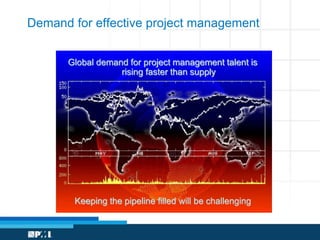
Demand for effective project management 
Global demand for project management talent is 
rising faster than supply 
Keeping the pipeline filled will be challenging
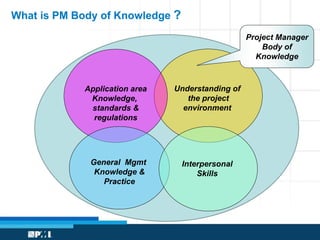
Understanding of 
the project 
environment 
What is PM Body of Knowledge ? 
Application area 
Knowledge, 
standards & 
regulations 
General Mgmt 
Knowledge & 
Practice 
Project Manager 
Body of 
Knowledge 
Interpersonal 
Skills
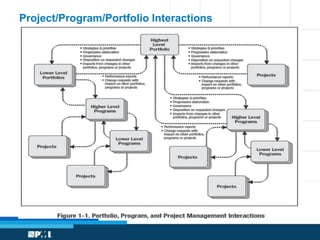
Project/Program/Portfolio Interactions
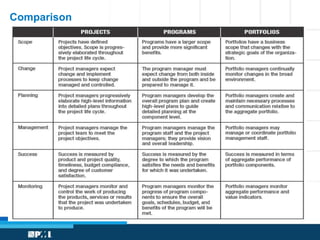
Comparison
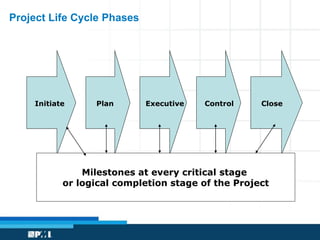
Project Life Cycle Phases 
Initiate Plan Executive Control Close 
Milestones at every critical stage 
or logical completion stage of the Project
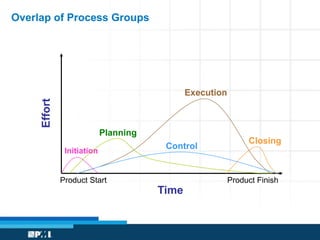
Overlap of Process Groups 
Execution 
Control 
Time 
Effort 
Planning 
Initiation 
Closing 
Product Start Product Finish
Project Processes 
Closure 
Processes 
Initiation 
Processes 
Controlling 
Processes 
Executing 
Processes 
Planning 
Processes
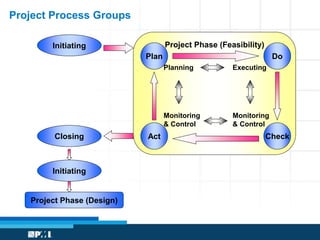
Project Process Groups 
Initiating 
Closing 
Initiating 
Project Phase (Design) 
Project Phase (Feasibility) 
Plan 
Do 
Planning 
Executing 
Monitoring 
& Control 
Monitoring 
& Control 
Act Check
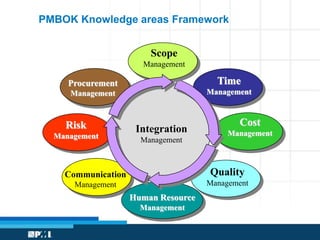
PMBOK Knowledge areas Framework 
Cost 
Management 
Quality 
Management 
Communication 
Management 
Time 
Management 
Scope 
Management 
Human Resource 
Management 
Procurement 
Management 
Risk 
Management 
Integration 
Management
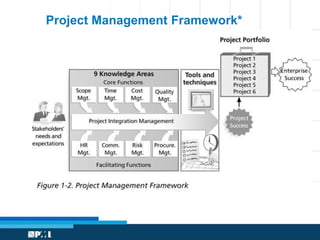
Project Management Framework*
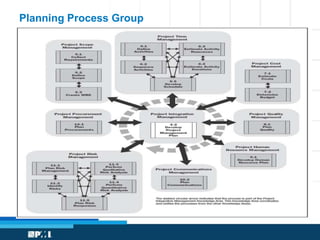
Planning Process Group
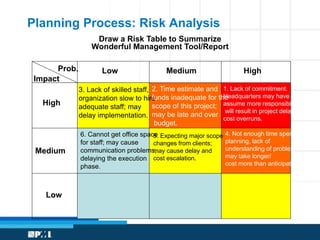
Planning Process: Risk Analysis 
Draw a Risk Table to Summarize 
Wonderful Management Tool/Report 
Prob. 
Impact 
High 
Medium 
Low 
Low Medium High 
2. Time estimate and 
funds inadequate for the 
scope of this project; 
may be late and over 
budget. 
3. Lack of skilled staff, 
organization slow to hire 
adequate staff; may 
delay implementation. 
1. Lack of commitment. 
Headquarters may have to 
assume more responsibility; 
will result in project delay, 
cost overruns. 
6. Cannot get office space 
for staff; may cause 
communication problems, 
delaying the execution 
phase. 
5. Expecting major scope 
changes from clients; 
may cause delay and 
cost escalation. 
4. Not enough time spent 
planning, lack of 
understanding of problem; 
may take longer/ 
cost more than anticipated.
Projects Artifacts: WBS - Typical Tasks 
Detailed WBS Example 
for procuring an 
Equipment System
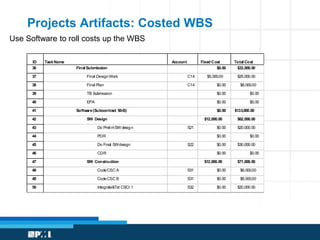
Projects Artifacts: Costed WBS 
Use Software to roll costs up the WBS 
ID Task Name Account Fixed Cost Total Cost Payment 
36 Final Submission $0.00 $33,000.00 $0.00 
37 Final Design Work C14 $5,000.00 $25,000.00 $0.00 
38 Final Plan C14 $0.00 $8,000.00 $0.00 
39 TB Submission $0.00 $0.00 $0.00 
40 EPA $0.00 $0.00 $40,000.00 
41 Software (Subcontract 50-B) $0.00 $133,000.00 $0.00 
42 SW Design $12,000.00 $62,000.00 $0.00 
43 Do Prelim SW design S21 $0.00 $20,000.00 $0.00 
44 PDR $0.00 $0.00 $0.00 
45 Do Final SW design S22 $0.00 $30,000.00 $0.00 
46 CDR $0.00 $0.00 $70,000.00 
47 SW Construction $12,000.00 $71,000.00 $0.00 
48 Code CSC A S31 $0.00 $6,000.00 $0.00 
49 Code CSC B S31 $0.00 $8,000.00 $0.00 
50 Integrate&Tst CSCI 1 S32 $0.00 $20,000.00 $0.00
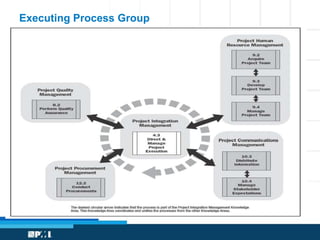
Executing Process Group
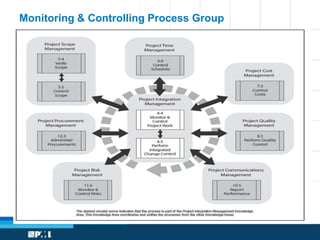
Monitoring & Controlling Process Group
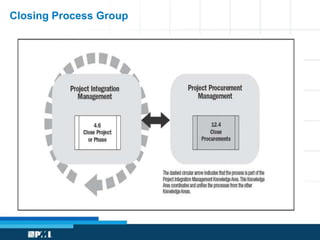
Closing Process Group
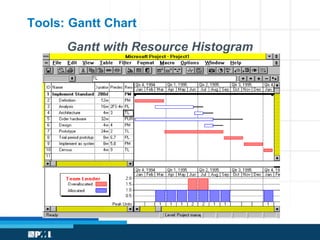
Tools: Gantt Chart 
Gantt with Resource Histogram
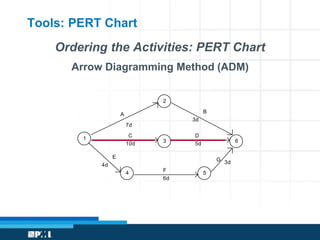
Tools: PERT Chart 
Ordering the Activities: PERT Chart 
Arrow Diagramming Method (ADM) 
1 
2 
3 
4 5 
6 
A 
C 
E 
B 
D 
F 
G 
7d 
3d 
4d 
6d 
3d 
10d 5d
Tools: Critical Path Method (CPM) 
• The critical path are the tasks that have the longest 
path. 
• Tasks are performed in parallel or one task is 
completed before the next one can begin. 
• This graph shows why if one task is not completed on 
time can impact or cause delays to the schedule. Could 
cause a major problem to the outcome of the project.
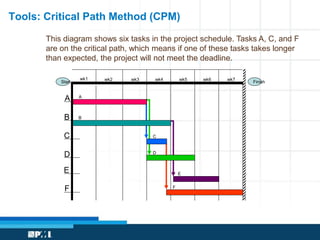
Tools: Critical Path Method (CPM) 
This diagram shows six tasks in the project schedule. Tasks A, C, and F 
are on the critical path, which means if one of these tasks takes longer 
than expected, the project will not meet the deadline. 
Start Finish 
A 
B 
C 
D 
E 
F 
wk1 wk2 wk3 wk4 wk5 wk6 wk7 
A 
B 
C 
D 
E 
F
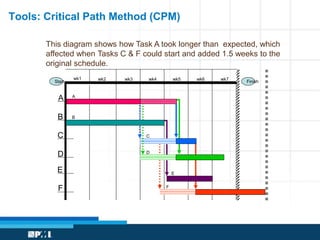
Tools: Critical Path Method (CPM) 
This diagram shows how Task A took longer than expected, which 
affected when Tasks C & F could start and added 1.5 weeks to the 
original schedule. 
Start Finish 
A 
B 
C 
D 
E 
F 
wk1 wk2 wk3 wk4 wk5 wk6 wk7 
A 
B 
C 
D 
E 
F
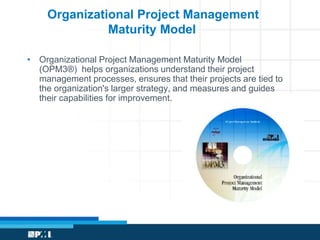
Organizational Project Management 
Maturity Model 
• Organizational Project Management Maturity Model 
(OPM3®) helps organizations understand their project 
management processes, ensures that their projects are tied to 
the organization's larger strategy, and measures and guides 
their capabilities for improvement.
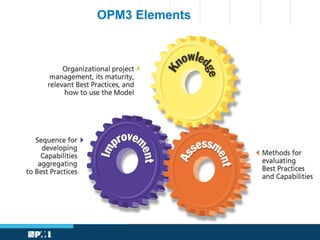
OPM3 Elements
Best Practices: What the Winners Do* 
• Recent research findings show that companies that excel in 
project delivery capability: 
– Build an integrated project management toolbox (use 
standard/advanced PM tools, lots of templates) 
– Grow competent project leaders, emphasizing business and 
soft skills 
– Develop streamlined, consistent project delivery processes 
– Install a sound but comprehensive set of project 
performance metrics 
*Milosevic, Dragan, Portland State University, “Delivering Projects: 
What the Winners Do,” PMI Conference Proceedings, November 2001
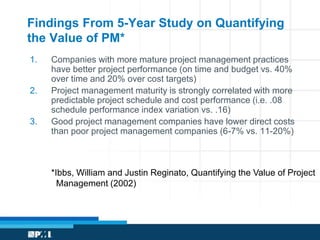
Findings From 5-Year Study on Quantifying 
the Value of PM* 
1. Companies with more mature project management practices 
have better project performance (on time and budget vs. 40% 
over time and 20% over cost targets) 
2. Project management maturity is strongly correlated with more 
predictable project schedule and cost performance (i.e. .08 
schedule performance index variation vs. .16) 
3. Good project management companies have lower direct costs 
than poor project management companies (6-7% vs. 11-20%) 
*Ibbs, William and Justin Reginato, Quantifying the Value of Project 
Management (2002)
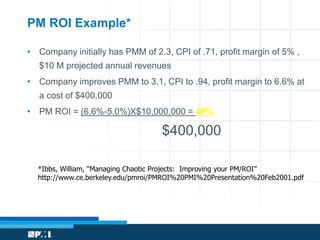
PM ROI Example* 
• Company initially has PMM of 2.3, CPI of .71, profit margin of 5% , 
$10 M projected annual revenues 
• Company improves PMM to 3.1, CPI to .94, profit margin to 6.6% at 
a cost of $400,000 
• PM ROI = (6.6%-5.0%)X$10,000,000 = 40% 
$400,000 
*Ibbs, William, “Managing Chaotic Projects: Improving your PM/ROI” 
http://www.ce.berkeley.edu/pmroi/PMROI%20PMI%20Presentation%20Feb2001.pdf
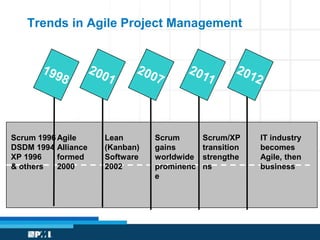
Trends in Agile Project Management 
Scrum 1996 
DSDM 1994 
XP 1996 
& others 
Lean 
(Kanban) 
Software 
2002 
Agile 
Alliance 
formed 
2000 
Scrum/XP 
transition 
strengthe 
ns 
IT industry 
becomes 
Agile, then 
business 
Scrum 
gains 
worldwide 
prominenc 
e
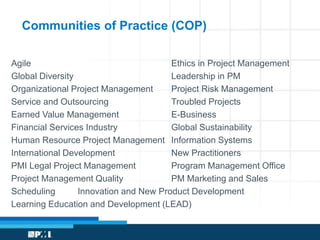
Communities of Practice (COP) 
Agile Ethics in Project Management 
Global Diversity Leadership in PM 
Organizational Project Management Project Risk Management 
Service and Outsourcing Troubled Projects 
Earned Value Management E-Business 
Financial Services Industry Global Sustainability 
Human Resource Project Management Information Systems 
International Development New Practitioners 
PMI Legal Project Management Program Management Office 
Project Management Quality PM Marketing and Sales 
Scheduling Innovation and New Product Development 
Learning Education and Development (LEAD)
PMI Certifications 
• CAPM 
• PMP 
• PgMP 
• PMI-ACP 
• RMP 
• SMP
Certified Associate in Project Management (CAPM) 
• For a person holding a minimum of a high school diploma, associate's 
degree or the global equivalent AND 
• Work Experience : Minimum of 1500 hours of team project 
management experience OR 
• Formal Education : Minimum 23 contact hours of project management 
education. 
• Fees: 
• PMI member $225 
• Nonmember $300 
• Validity: 5 years 
• 135 questions, 3 hours
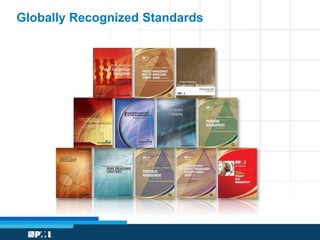
Globally Recognized Standards
Contact Information 
• Web site: www.pmipunechapter.org 
• Yahoo Group membership: 8500+ Join us at 
http://finance.groups.yahoo.com/group/pmi-pune-chapter 
• PMP / CAPM Discussion Forum 
http://finance.groups.yahoo.com/group/PMI_Pune_Exam_Forum/ 
• Seminar abstract to : programs@pmipunechapter.org 
• Newsletter Articles / Advt. to: publications@pmipunechapter.org 
• For PMP Workshop send mail to development@pmipunechapter.org 
( +91 9922909060
Thank You 
www.pmi.org 
www.pmi.org.in

Project Management Framework

  • 1.
  • 2.
    Demand for effectiveproject management Global demand for project management talent is rising faster than supply Keeping the pipeline filled will be challenging
  • 3.
    Understanding of theproject environment What is PM Body of Knowledge ? Application area Knowledge, standards & regulations General Mgmt Knowledge & Practice Project Manager Body of Knowledge Interpersonal Skills
  • 4.
  • 5.
  • 6.
    Project Life CyclePhases Initiate Plan Executive Control Close Milestones at every critical stage or logical completion stage of the Project
  • 7.
    Overlap of ProcessGroups Execution Control Time Effort Planning Initiation Closing Product Start Product Finish
  • 8.
    Project Processes Closure Processes Initiation Processes Controlling Processes Executing Processes Planning Processes
  • 9.
    Project Process Groups Initiating Closing Initiating Project Phase (Design) Project Phase (Feasibility) Plan Do Planning Executing Monitoring & Control Monitoring & Control Act Check
  • 10.
    PMBOK Knowledge areasFramework Cost Management Quality Management Communication Management Time Management Scope Management Human Resource Management Procurement Management Risk Management Integration Management
  • 11.
  • 12.
  • 13.
    Planning Process: RiskAnalysis Draw a Risk Table to Summarize Wonderful Management Tool/Report Prob. Impact High Medium Low Low Medium High 2. Time estimate and funds inadequate for the scope of this project; may be late and over budget. 3. Lack of skilled staff, organization slow to hire adequate staff; may delay implementation. 1. Lack of commitment. Headquarters may have to assume more responsibility; will result in project delay, cost overruns. 6. Cannot get office space for staff; may cause communication problems, delaying the execution phase. 5. Expecting major scope changes from clients; may cause delay and cost escalation. 4. Not enough time spent planning, lack of understanding of problem; may take longer/ cost more than anticipated.
  • 14.
    Projects Artifacts: WBS- Typical Tasks Detailed WBS Example for procuring an Equipment System
  • 15.
    Projects Artifacts: CostedWBS Use Software to roll costs up the WBS ID Task Name Account Fixed Cost Total Cost Payment 36 Final Submission $0.00 $33,000.00 $0.00 37 Final Design Work C14 $5,000.00 $25,000.00 $0.00 38 Final Plan C14 $0.00 $8,000.00 $0.00 39 TB Submission $0.00 $0.00 $0.00 40 EPA $0.00 $0.00 $40,000.00 41 Software (Subcontract 50-B) $0.00 $133,000.00 $0.00 42 SW Design $12,000.00 $62,000.00 $0.00 43 Do Prelim SW design S21 $0.00 $20,000.00 $0.00 44 PDR $0.00 $0.00 $0.00 45 Do Final SW design S22 $0.00 $30,000.00 $0.00 46 CDR $0.00 $0.00 $70,000.00 47 SW Construction $12,000.00 $71,000.00 $0.00 48 Code CSC A S31 $0.00 $6,000.00 $0.00 49 Code CSC B S31 $0.00 $8,000.00 $0.00 50 Integrate&Tst CSCI 1 S32 $0.00 $20,000.00 $0.00
  • 16.
  • 17.
  • 18.
  • 19.
    Tools: Gantt Chart Gantt with Resource Histogram
  • 20.
    Tools: PERT Chart Ordering the Activities: PERT Chart Arrow Diagramming Method (ADM) 1 2 3 4 5 6 A C E B D F G 7d 3d 4d 6d 3d 10d 5d
  • 21.
    Tools: Critical PathMethod (CPM) • The critical path are the tasks that have the longest path. • Tasks are performed in parallel or one task is completed before the next one can begin. • This graph shows why if one task is not completed on time can impact or cause delays to the schedule. Could cause a major problem to the outcome of the project.
  • 22.
    Tools: Critical PathMethod (CPM) This diagram shows six tasks in the project schedule. Tasks A, C, and F are on the critical path, which means if one of these tasks takes longer than expected, the project will not meet the deadline. Start Finish A B C D E F wk1 wk2 wk3 wk4 wk5 wk6 wk7 A B C D E F
  • 23.
    Tools: Critical PathMethod (CPM) This diagram shows how Task A took longer than expected, which affected when Tasks C & F could start and added 1.5 weeks to the original schedule. Start Finish A B C D E F wk1 wk2 wk3 wk4 wk5 wk6 wk7 A B C D E F
  • 24.
    Organizational Project Management Maturity Model • Organizational Project Management Maturity Model (OPM3®) helps organizations understand their project management processes, ensures that their projects are tied to the organization's larger strategy, and measures and guides their capabilities for improvement.
  • 25.
  • 26.
    Best Practices: Whatthe Winners Do* • Recent research findings show that companies that excel in project delivery capability: – Build an integrated project management toolbox (use standard/advanced PM tools, lots of templates) – Grow competent project leaders, emphasizing business and soft skills – Develop streamlined, consistent project delivery processes – Install a sound but comprehensive set of project performance metrics *Milosevic, Dragan, Portland State University, “Delivering Projects: What the Winners Do,” PMI Conference Proceedings, November 2001
  • 27.
    Findings From 5-YearStudy on Quantifying the Value of PM* 1. Companies with more mature project management practices have better project performance (on time and budget vs. 40% over time and 20% over cost targets) 2. Project management maturity is strongly correlated with more predictable project schedule and cost performance (i.e. .08 schedule performance index variation vs. .16) 3. Good project management companies have lower direct costs than poor project management companies (6-7% vs. 11-20%) *Ibbs, William and Justin Reginato, Quantifying the Value of Project Management (2002)
  • 28.
    PM ROI Example* • Company initially has PMM of 2.3, CPI of .71, profit margin of 5% , $10 M projected annual revenues • Company improves PMM to 3.1, CPI to .94, profit margin to 6.6% at a cost of $400,000 • PM ROI = (6.6%-5.0%)X$10,000,000 = 40% $400,000 *Ibbs, William, “Managing Chaotic Projects: Improving your PM/ROI” http://www.ce.berkeley.edu/pmroi/PMROI%20PMI%20Presentation%20Feb2001.pdf
  • 29.
    Trends in AgileProject Management Scrum 1996 DSDM 1994 XP 1996 & others Lean (Kanban) Software 2002 Agile Alliance formed 2000 Scrum/XP transition strengthe ns IT industry becomes Agile, then business Scrum gains worldwide prominenc e
  • 30.
    Communities of Practice(COP) Agile Ethics in Project Management Global Diversity Leadership in PM Organizational Project Management Project Risk Management Service and Outsourcing Troubled Projects Earned Value Management E-Business Financial Services Industry Global Sustainability Human Resource Project Management Information Systems International Development New Practitioners PMI Legal Project Management Program Management Office Project Management Quality PM Marketing and Sales Scheduling Innovation and New Product Development Learning Education and Development (LEAD)
  • 31.
    PMI Certifications •CAPM • PMP • PgMP • PMI-ACP • RMP • SMP
  • 32.
    Certified Associate inProject Management (CAPM) • For a person holding a minimum of a high school diploma, associate's degree or the global equivalent AND • Work Experience : Minimum of 1500 hours of team project management experience OR • Formal Education : Minimum 23 contact hours of project management education. • Fees: • PMI member $225 • Nonmember $300 • Validity: 5 years • 135 questions, 3 hours
  • 33.
  • 34.
    Contact Information •Web site: www.pmipunechapter.org • Yahoo Group membership: 8500+ Join us at http://finance.groups.yahoo.com/group/pmi-pune-chapter • PMP / CAPM Discussion Forum http://finance.groups.yahoo.com/group/PMI_Pune_Exam_Forum/ • Seminar abstract to : programs@pmipunechapter.org • Newsletter Articles / Advt. to: publications@pmipunechapter.org • For PMP Workshop send mail to development@pmipunechapter.org ( +91 9922909060
  • 35.
    Thank You www.pmi.org www.pmi.org.in