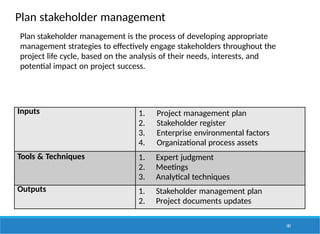
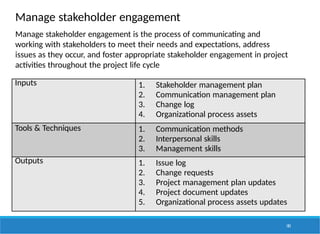
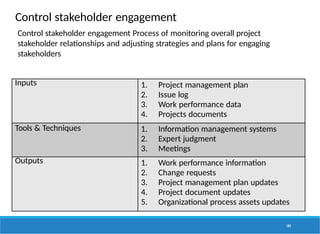
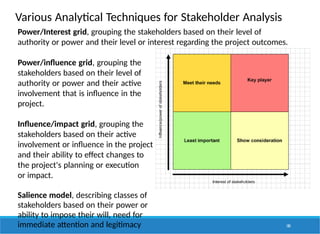
Mastering the Five Basic Requirements
of a Good Project Plan
1
INTRODUCTION TO PROJECT
MANAGEMENT & FRAMEWORK
2
Introduction to Project Management and Framework
3
Agenda of the module is to learn:
• What is a Project?
• What is a Project-Portfolio-Program management?
• Project Management Office (PMO)
• Relationships among Portfolio management, Program management, Project
management, Organizational project management, Operations
management, & Organizational strategy
• Advantages of using formal Project management
• Role, responsibilities, competencies & interpersonal skills of the project
manager
• Project leadership and creating value
• Q and A, check your learning
What is a Project?
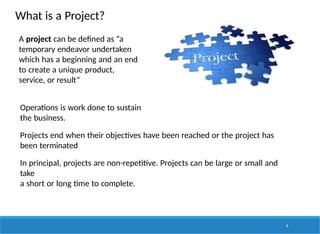
A project can be defined as “a
temporary endeavor undertaken
which has a beginning and an end
to create a unique product,
service, or result”
Operations is work done to sustain
the business.
Projects end when their objectives have been reached or the project has
been terminated
In principal, projects are non-repetitive. Projects can be large or small and
take
a short or long time to complete.
4
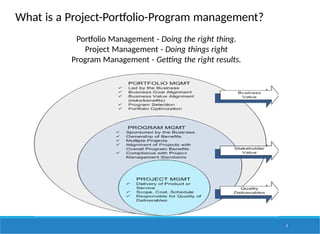
What is a Project-Portfolio-Program management?
5
Portfolio Management - Doing the right thing.
Project Management - Doing things right
Program Management - Getting the right results.
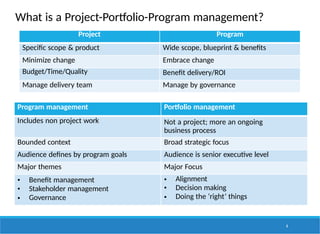
What is a Project-Portfolio-Program management?
6
Project Program
Specific scope & product Wide scope, blueprint & benefits
Minimize change Embrace change
Budget/Time/Quality Benefit delivery/ROI
Manage delivery team Manage by governance
Program management Portfolio management
Includes non project work Not a project; more an ongoing
business process
Bounded context Broad strategic focus
Audience defines by program goals Audience is senior executive level
Major themes Major Focus
• Benefit management
• Stakeholder management
• Governance
• Alignment
• Decision making
• Doing the ‘right’ things
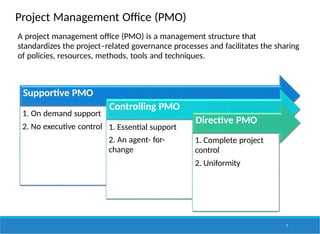
Project Management Office (PMO)
A project management office (PMO) is a management structure that
standardizes the project–related governance processes and facilitates the sharing
of policies, resources, methods, tools and techniques.
Supportive PMO
1. On demand support
2. No executive control
Controlling PMO
1. Essential support
2. An agent- for-
change
Directive PMO
1. Complete project
control
2. Uniformity
7
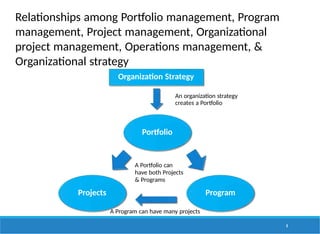
Relationships among Portfolio management, Program
management, Project management, Organizational
project management, Operations management, &
Organizational strategy
Portfolio
Projects Program
Organization Strategy
An organization strategy
creates a Portfolio
A Program can have many projects
A Portfolio can
have both Projects
& Programs
8
Advantages of using formal Project management
9
• Better control of financial, physical, and human resources
• Improved customer relations
• Shorter development times
• Lower costs
• Higher quality and increased reliability
• Higher profit margins
• Improved productivity
• Better internal coordination
• Higher worker morale (less stress)
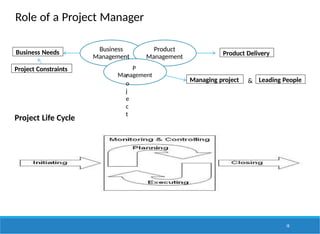
Role of a Project Manager
Product
Management
Business
Management
P
r
o
j
e
c
t
Management
Product Delivery
Business Needs
Project Constraints
Managing project Leading People
&
Project Life Cycle
10
Responsibilities of a Project Manager
11
The role of project manager comprises many responsibilities
including:
• Planning and defining scope
• Resource planning
• Activity planning and sequencing
• Developing schedules
• Time estimating
• Cost estimating
• Developing a budget
• Creating charts and schedules
• Managing risks and issues
• Risk analysis
• Controlling quality
• Customer Liaison
• Team leadership
• Documentation
• Strategic influencing
• Scalability, interoperability and portability analysis
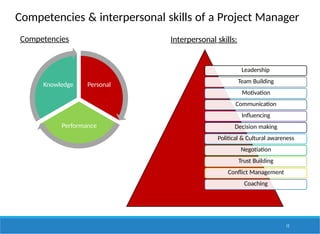
Competencies & interpersonal skills of a Project Manager
Competencies Interpersonal skills:
Personal
Performance
Knowledge
Leadership
Team Building
Motivation
Communication
Influencing
Decision making
Political & Cultural awareness
Negotiation
Trust Building
Conflict Management
Coaching
12
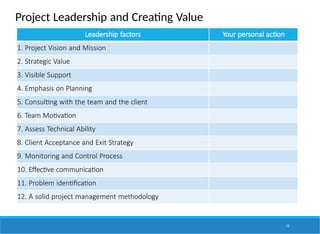
Project Leadership and Creating Value
13
Leadership factors Your personal action
1. Project Vision and Mission
2. Strategic Value
3. Visible Support
4. Emphasis on Planning
5. Consulting with the team and the client
6. Team Motivation
7. Assess Technical Ability
8. Client Acceptance and Exit Strategy
9. Monitoring and Control Process
10. Effective communication
11. Problem identification
12. A solid project management methodology
ORGANIZATIONAL INFLUENCES
& PROJECT LIFE CYCLE
14
Organizational influences and Project Life Cycle
15
Agenda of the module is to learn:
• Organizational structures
• Organizational Process assets
• Enterprise Environmental factors
• Project stakeholder & Governance
• Project life cycle
• Q and A, check your learning
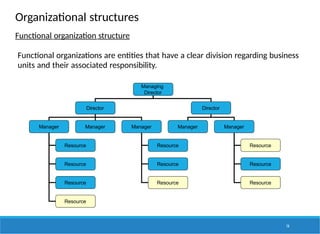
Organizational structures
Functional organization structure
Functional organizations are entities that have a clear division regarding business
units and their associated responsibility.
Managing
Director
Director Director
Manager Manager Manager Manager Manager
Resource
Resource
Resource
Resource
Resource
Resource
Resource
Resource
Resource
Resource
16
Organizational structures
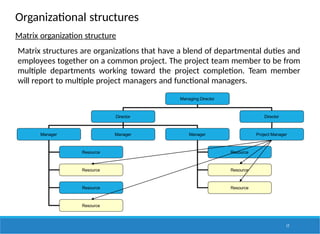
Matrix organization structure
Matrix structures are organizations that have a blend of departmental duties and
employees together on a common project. The project team member to be from
multiple departments working toward the project completion. Team member
will report to multiple project managers and functional managers.
Managing Director
Director Director
Manager Manager Manager Project Manager
Resource
Resource
Resource
Resource
Resource
Resource
Resource
17
Organizational structures
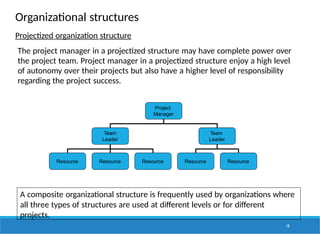
Projectized organization structure
The project manager in a projectized structure may have complete power over
the project team. Project manager in a projectized structure enjoy a high level
of autonomy over their projects but also have a higher level of responsibility
regarding the project success.
Project
Manager
Team
Leader
Team
Leader
Resource Resource Resource Resource Resource
18
A composite organizational structure is frequently used by organizations where
all three types of structures are used at different levels or for different
projects.
Organizational Process assets
Organizational process assets are the plans, processes, policies, procedures,
and knowledge bass specific to and used by the performing organization.
So Organizational Process Assets may include but not limited to all the
documents, formal and informal plans, processes, templates, policies,
procedures, plans, guidelines, knowledge base such as lessons learned
and historical data and information.
Organizational process assets may also include completed schedules, risk data,
and earned value data. Organizational process assets are inputs to most
planning processes. Throughout the project, the project team members may
update and need to add the organizational process assets as necessary.
19
Enterprise Environmental factors
Enterprise environmental factors refer to both internal and external factors that
surround or influence a project’s success. These factors may come from any or all
of the enterprises involved in the project. Enterprise environmental factors may
enhance or constrain project management options and may have a positive or
negative influence on the outcome. They are considered as inputs to most
planning processes.
20
Organizational environmental factors include the following:
• Culture and structure
• Infrastructure and resources
• Internal and external conditions
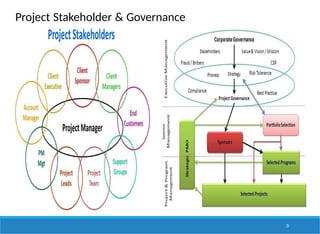
Project Stakeholder & Governance
21
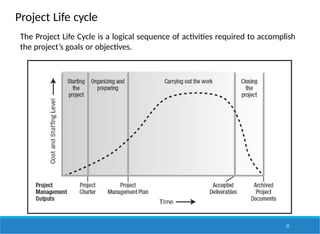
Project Life cycle
22
The Project Life Cycle is a logical sequence of activities required to accomplish
the project’s goals or objectives.
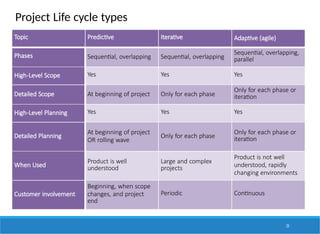
Project Life cycle types
23
Topic Predictive Iterative Adaptive (agile)
Phases Sequential, overlapping Sequential, overlapping
Sequential, overlapping,
parallel
High-Level Scope Yes Yes Yes
Detailed Scope At beginning of project Only for each phase
Only for each phase or
iteration
High-Level Planning Yes Yes Yes
Detailed Planning
At beginning of project
OR rolling wave
Only for each phase
Only for each phase or
iteration
When Used
Product is well
understood
Large and complex
projects
Product is not well
understood, rapidly
changing environments
Customer involvement
Beginning, when scope
changes, and project
end
Periodic Continuous
PROJECT MANAGEMENT
PROCESS GROUPS
24
Project Management Process Groups
25
Agenda of the module is to learn:
• Overview of PMBOK 5- 47 Processes Project
Management
• Brief about Initiating Process group
• Brief about Planning Process group
• Brief about Executing Process group
• Brief about Monitoring & Controlling Process group
• Brief about Closing Process group
• Role of Knowledge areas
• Q and A, check your learning
Overview of PMBOK 5- 47 Processes Project Management
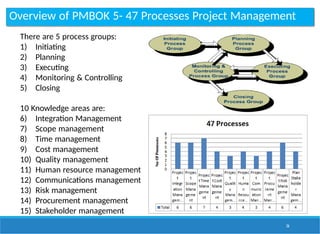
There are 5 process groups:
1) Initiating
2) Planning
3) Executing
4) Monitoring & Controlling
5) Closing
10 Knowledge areas are:
6) Integration Management
7) Scope management
8) Time management
9) Cost management
10) Quality management
11) Human resource management
12) Communications management
13) Risk management
14) Procurement management
15) Stakeholder management
26
Initiating Process group
27
The processes that facilitate the formal authorization to start a new project or
a
project phase.
Includes the following project management processes:
 Develop project charter to initiate & authorize the project.
 Identifying stakeholders by identifying all people or organizations
impacted by the project, and documenting relevant information
regarding
• Their Interests,
• Involvement, and
• Potential impact on project success.
Planning Process group
28
This process group consists of those processes that:
 establish the total scope of the project,
 define and refine the objectives, and
 develop the course of action required to attain those objectives.
The planning processes develop the project management plan and the
project documents that will be used to carry out the project such as:
 Requirements traceability matrix.
 Activity lists,
 Activity attributes,
 Risk register,
 etc
Executing Process group
29
The executing process group is where all the project work related planning
steps are put into action.
Can be thought of as the "do" component of the plan-do-check-act cycle
model. Actions during execution process:
 Manage project execution
 Develop and Manage project team
 Manage stakeholder engagement
 Implementing quality standards and assurance
 Implement training needs
 Implement approved changes
 Conduct procurement as per the plan
 Manage communications
 Update project document
Monitoring & Control Process group
30
A project needs consistent monitoring and controlling in order to stay
within scope, be completed on time and within the allocated budget.
The monitoring and controlling process group concerns two main aspects
of project management:
 Monitoring and measurement of project performance, making
adjustments as needed with the end goal of maintaining the project
on its pre-planned course.
 Providing the checks and balances needed to determine how a project
is performing.
Closing Process group
31
The closing process group formalizes acceptance of the product, service, or
result and brings the project or project phase to an orderly end.
This group includes the processes used to formally terminate all activities of a
project or a project phase, to hand over completed work products, or to close
a cancelled project or project phase.
When a project comes to an end the following may occur:
Obtain acceptance by the customer
Measure customer satisfaction
Conduct end review
Study impacts of tailoring to any process.
Finalize and implement lessons learnt
Close out procurements.
Hand over project deliverables to operations team.
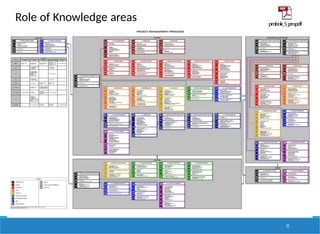
Role of Knowledge areas
32
PROJECT INTEGRATION
MANAGEMENT
33
Project Integration Management
34
Agenda of the module is to learn:
• What’s project integration management?
• Role of a project team
• Role of project sponsor
• Develop project charter
• Develop Project Management plan
• Direct and manage project work
• Monitor and control project work
• Perform integrated change control
• Close project or phase
• Inputs
• Tools and techniques
• Outputs
• Project selection methods
• Q and A, check your learning
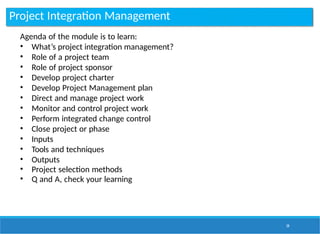
What’s project integration management?
6 Processes of
IM
Develop Project
charter
Develop PM plan
Direct & Manage
project work
Monitor & Control
project work
Perform integrated
change control
Close project or
phase
Integration
Identify
Define
Combine
Unify
Coordinate
35
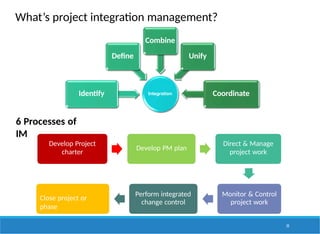
Role of a Project Team
Project
Team
Project
Manager
Other
individuals
PM Team
36
Project Communication
Day to day management of the
project
Monitoring the project’s critical path
Risk Management
Change control
Deliver project’s products
Role & responsibilities of a Project Sponsor
The Project Sponsor is the individual with overall accountability for the project.
Primary concern of the sponsor is to ensure that the project delivers the
agreed business benefits.
37
Typical responsibilities:
• ensuring that the business need is valid and correctly prioritised
• ensuring that the project is properly launched
• ensuring that the project remains a viable business proposition
• ensuring changes to the project are properly managed including risks
• establishing the project organisation, roles and reporting structure
• ensuring the project is under control
• approving key project deliverables
• initiating project reviews and supporting the process of review
• resolving issues (typically competition for resources and priority clashes) that
are beyond the control of the Project Manager
• resolving conflict and removing obstacles to progress
• overall quality of the project, both the methods used to develop it and the
end product.
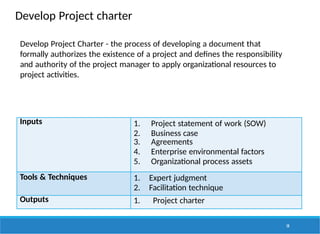
Develop Project charter
38
Inputs 1. Project statement of work (SOW)
2. Business case
3. Agreements
4. Enterprise environmental factors
5. Organizational process assets
Tools & Techniques 1. Expert judgment
2. Facilitation technique
Outputs 1. Project charter
Develop Project Charter - the process of developing a document that
formally authorizes the existence of a project and defines the responsibility
and authority of the project manager to apply organizational resources to
project activities.
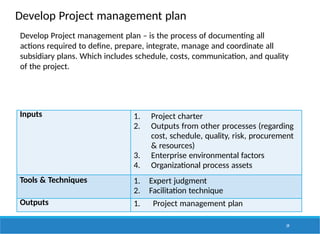
Develop Project management plan
39
Inputs 1. Project charter
2. Outputs from other processes (regarding
cost, schedule, quality, risk, procurement
& resources)
3. Enterprise environmental factors
4. Organizational process assets
Tools & Techniques 1. Expert judgment
2. Facilitation technique
Outputs 1. Project management plan
Develop Project management plan – is the process of documenting all
actions required to define, prepare, integrate, manage and coordinate all
subsidiary plans. Which includes schedule, costs, communication, and quality
of the project.
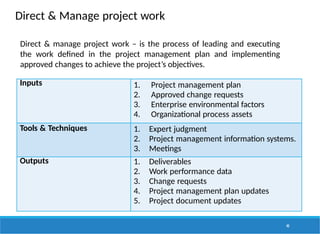
Direct & Manage project work
40
Inputs 1. Project management plan
2. Approved change requests
3. Enterprise environmental factors
4. Organizational process assets
Tools & Techniques 1. Expert judgment
2. Project management information systems.
3. Meetings
Outputs 1. Deliverables
2. Work performance data
3. Change requests
4. Project management plan updates
5. Project document updates
Direct & manage project work – is the process of leading and executing
the work defined in the project management plan and implementing
approved changes to achieve the project’s objectives.
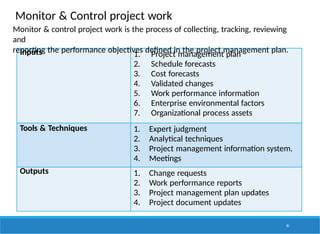
Monitor & Control project work
41
Inputs 1. Project management plan
2. Schedule forecasts
3. Cost forecasts
4. Validated changes
5. Work performance information
6. Enterprise environmental factors
7. Organizational process assets
Tools & Techniques 1. Expert judgment
2. Analytical techniques
3. Project management information system.
4. Meetings
Outputs 1. Change requests
2. Work performance reports
3. Project management plan updates
4. Project document updates
Monitor & control project work is the process of collecting, tracking, reviewing
and
reporting the performance objectives defined in the project management plan.
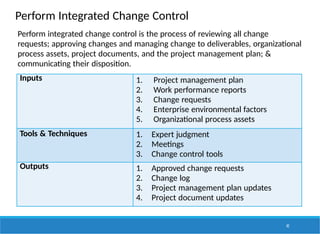
Perform Integrated Change Control
42
Inputs 1. Project management plan
2. Work performance reports
3. Change requests
4. Enterprise environmental factors
5. Organizational process assets
Tools & Techniques 1. Expert judgment
2. Meetings
3. Change control tools
Outputs 1. Approved change requests
2. Change log
3. Project management plan updates
4. Project document updates
Perform integrated change control is the process of reviewing all change
requests; approving changes and managing change to deliverables, organizational
process assets, project documents, and the project management plan; &
communicating their disposition.
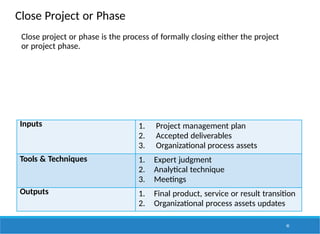
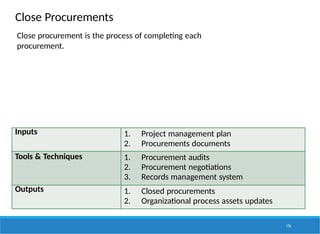
Close Project or Phase
43
Inputs 1. Project management plan
2. Accepted deliverables
3. Organizational process assets
Tools & Techniques 1. Expert judgment
2. Analytical technique
3. Meetings
Outputs 1. Final product, service or result transition
2. Organizational process assets updates
Close project or phase is the process of formally closing either the project
or project phase.
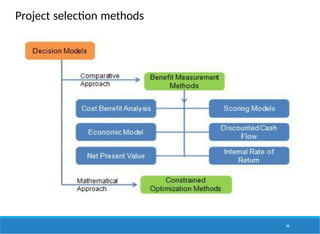
Project selection methods
44
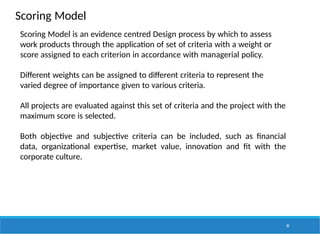
Scoring Model
45
Scoring Model is an evidence centred Design process by which to assess
work products through the application of set of criteria with a weight or
score assigned to each criterion in accordance with managerial policy.
Different weights can be assigned to different criteria to represent the
varied degree of importance given to various criteria.
All projects are evaluated against this set of criteria and the project with the
maximum score is selected.
Both objective and subjective criteria can be included, such as financial
data, organizational expertise, market value, innovation and fit with the
corporate culture.
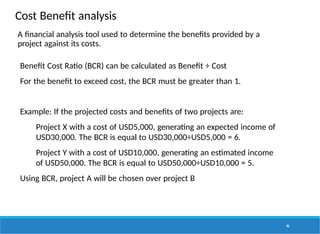
Cost Benefit analysis
46
A financial analysis tool used to determine the benefits provided by a
project against its costs.
Benefit Cost Ratio (BCR) can be calculated as Benefit ÷ Cost
For the benefit to exceed cost, the BCR must be greater than 1.
Example: If the projected costs and benefits of two projects are:
Project X with a cost of USD5,000, generating an expected income of
USD30,000. The BCR is equal to USD30,000÷USD5,000 = 6.
Project Y with a cost of USD10,000, generating an estimated income
of USD50,000. The BCR is equal to USD50,000÷USD10,000 = 5.
Using BCR, project A will be chosen over project B
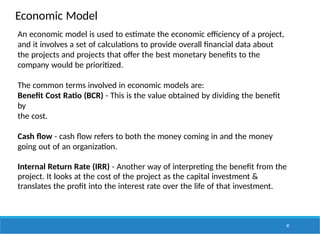
Economic Model
47
An economic model is used to estimate the economic efficiency of a project,
and it involves a set of calculations to provide overall financial data about
the projects and projects that offer the best monetary benefits to the
company would be prioritized.
The common terms involved in economic models are:
Benefit Cost Ratio (BCR) - This is the value obtained by dividing the benefit
by
the cost.
Cash flow - cash flow refers to both the money coming in and the money
going out of an organization.
Internal Return Rate (IRR) - Another way of interpreting the benefit from the
project. It looks at the cost of the project as the capital investment &
translates the profit into the interest rate over the life of that investment.
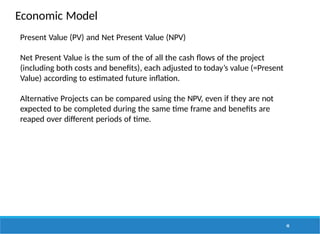
Economic Model
48
Present Value (PV) and Net Present Value (NPV)
Net Present Value is the sum of the of all the cash flows of the project
(including both costs and benefits), each adjusted to today’s value (=Present
Value) according to estimated future inflation.
Alternative Projects can be compared using the NPV, even if they are not
expected to be completed during the same time frame and benefits are
reaped over different periods of time.
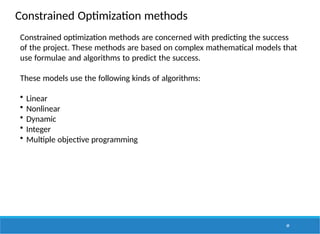
Constrained Optimization methods
49
Constrained optimization methods are concerned with predicting the success
of the project. These methods are based on complex mathematical models that
use formulae and algorithms to predict the success.
These models use the following kinds of algorithms:
• Linear
• Nonlinear
• Dynamic
• Integer
• Multiple objective programming
PROJECT SCOPE
MANAGEMENT
50
Project Scope Management
51
Agenda of the module is to learn:
• What’s project scope management?
• Product scope Vs Project Scope
• Plan scope management
• Collect requirements
• Define scope
• Create WBS
• Example of Work breakdown structure
• Validate scope
• Control scope
• Inputs
• Tools and techniques
• Outputs
• Q and A, check your learning
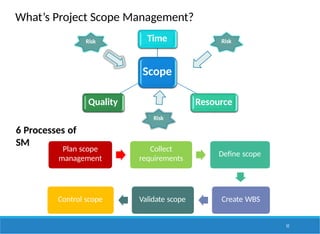
What’s Project Scope Management?
Scope
Time
Resource
Quality
Risk
Risk
Risk
6 Processes of
SM
Plan scope
management
Collect
requirements
Define scope
Create WBS
Validate scope
Control scope
52
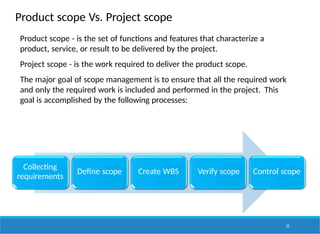
Product scope Vs. Project scope
Collecting
requirements
Define scope Create WBS Verify scope Control scope
53
Product scope - is the set of functions and features that characterize a
product, service, or result to be delivered by the project.
Project scope - is the work required to deliver the product scope.
The major goal of scope management is to ensure that all the required work
and only the required work is included and performed in the project. This
goal is accomplished by the following processes:
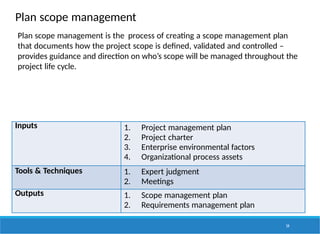
Plan scope management
54
Inputs 1. Project management plan
2. Project charter
3. Enterprise environmental factors
4. Organizational process assets
Tools & Techniques 1. Expert judgment
2. Meetings
Outputs 1. Scope management plan
2. Requirements management plan
Plan scope management is the process of creating a scope management plan
that documents how the project scope is defined, validated and controlled –
provides guidance and direction on who’s scope will be managed throughout the
project life cycle.
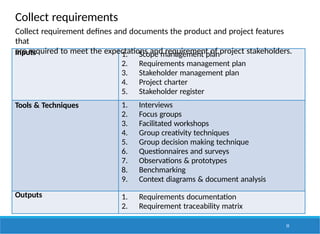
Collect requirements
55
Inputs 1. Scope management plan
2. Requirements management plan
3. Stakeholder management plan
4. Project charter
5. Stakeholder register
Tools & Techniques 1. Interviews
2. Focus groups
3. Facilitated workshops
4. Group creativity techniques
5. Group decision making technique
6. Questionnaires and surveys
7. Observations & prototypes
8. Benchmarking
9. Context diagrams & document analysis
Outputs 1. Requirements documentation
2. Requirement traceability matrix
Collect requirement defines and documents the product and project features
that
are required to meet the expectations and requirement of project stakeholders.
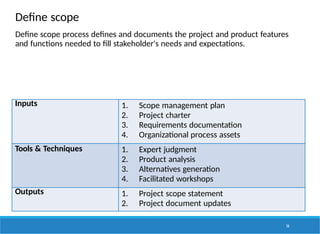
Define scope
56
Inputs 1. Scope management plan
2. Project charter
3. Requirements documentation
4. Organizational process assets
Tools & Techniques 1. Expert judgment
2. Product analysis
3. Alternatives generation
4. Facilitated workshops
Outputs 1. Project scope statement
2. Project document updates
Define scope process defines and documents the project and product features
and functions needed to fill stakeholder's needs and expectations.
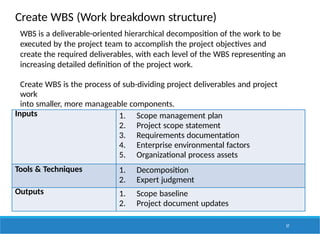
Create WBS (Work breakdown structure)
57
Inputs 1. Scope management plan
2. Project scope statement
3. Requirements documentation
4. Enterprise environmental factors
5. Organizational process assets
Tools & Techniques 1. Decomposition
2. Expert judgment
Outputs 1. Scope baseline
2. Project document updates
WBS is a deliverable-oriented hierarchical decomposition of the work to be
executed by the project team to accomplish the project objectives and
create the required deliverables, with each level of the WBS representing an
increasing detailed definition of the project work.
Create WBS is the process of sub-dividing project deliverables and project
work
into smaller, more manageable components.
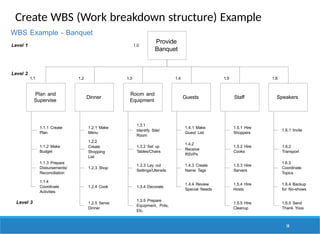
Create WBS (Work breakdown structure) Example
Provide
Banquet
Plan and
Supervise
Dinner
Room and
Equipment
Guests Staff Speakers
1.1.1 Create
Plan
58
1.1.2 Make
Budget
Activities
1.1.3 Prepare
Disbursements/
Reconciliation
1.1.4
Coordinate
1.2.1 Make
Menu
1.2.2
Create
Shopping
List
1.2.4 Cook
1.2.3 Shop
1.4.1 Make
Guest List
1.4.2
Receive
RSVPs
1.4.4 Review
Special Needs
1.4.3 Create
Name Tags
1.2.5 Serve
Dinner
1.3.1
Identify Site/
Room
1.3.2 Set up
Tables/Chairs
1.3.4 Decorate
1.3.3 Lay out
Settings/Utensils
1.3.5 Prepare
Equipment, Pots,
Etc.
1.6.1 Invite
1.6.2
Transport
1.6.4 Backup
for No-shows
1.6.3
Coordinate
Topics
1.6.5 Send
Thank Yous
1.5.1 Hire
Shoppers
1.5.2 Hire
Cooks
1.5.4 Hire
Hosts
1.5.3 Hire
Servers
1.5.5 Hire
Cleanup
1.0
1.1 1.2 1.3 1.4 1.5 1.6
Level 2
Level 3
Level 1
WBS Example - Banquet
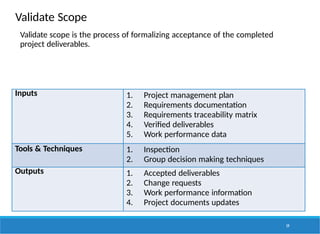
Validate Scope
59
Inputs 1. Project management plan
2. Requirements documentation
3. Requirements traceability matrix
4. Verified deliverables
5. Work performance data
Tools & Techniques 1. Inspection
2. Group decision making techniques
Outputs 1. Accepted deliverables
2. Change requests
3. Work performance information
4. Project documents updates
Validate scope is the process of formalizing acceptance of the completed
project deliverables.
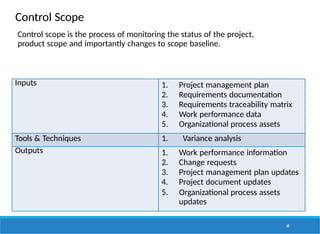
Control Scope
60
Inputs 1. Project management plan
2. Requirements documentation
3. Requirements traceability matrix
4. Work performance data
5. Organizational process assets
Tools & Techniques 1. Variance analysis
Outputs 1. Work performance information
2. Change requests
3. Project management plan updates
4. Project document updates
5. Organizational process assets
updates
Control scope is the process of monitoring the status of the project,
product scope and importantly changes to scope baseline.
PROJECT TIME
MANAGEMENT
61
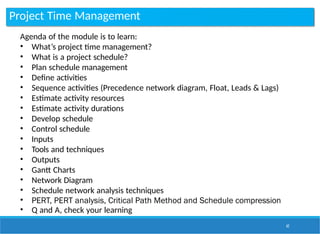
Project Time Management
62
Agenda of the module is to learn:
• What’s project time management?
• What is a project schedule?
• Plan schedule management
• Define activities
• Sequence activities (Precedence network diagram, Float, Leads & Lags)
• Estimate activity resources
• Estimate activity durations
• Develop schedule
• Control schedule
• Inputs
• Tools and techniques
• Outputs
• Gantt Charts
• Network Diagram
• Schedule network analysis techniques
• PERT, PERT analysis, Critical Path Method and Schedule compression
• Q and A, check your learning
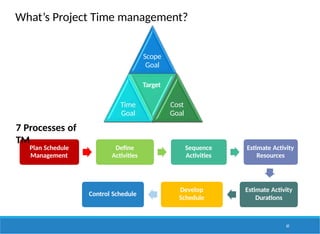
What’s Project Time management?
Time
Goal
Scope
Goal
Target
Cost
Goal
Plan Schedule
Management
Define
Activities
Sequence
Activities
Estimate Activity
Resources
Estimate Activity
Durations
Develop
Schedule
Control Schedule
63
7 Processes of
TM
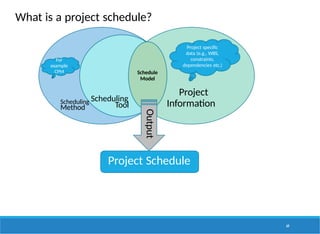
What is a project schedule?
Method
64
Scheduling Scheduling
Tool
Project
Information
Schedule
Model
Output
Project specific
data (e.g., WBS,
constraints,
dependencies etc.)
For
example
CPM
Project Schedule
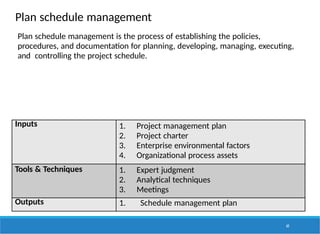
Plan schedule management
65
Inputs 1. Project management plan
2. Project charter
3. Enterprise environmental factors
4. Organizational process assets
Tools & Techniques 1. Expert judgment
2. Analytical techniques
3. Meetings
Outputs 1. Schedule management plan
Plan schedule management is the process of establishing the policies,
procedures, and documentation for planning, developing, managing, executing,
and controlling the project schedule.
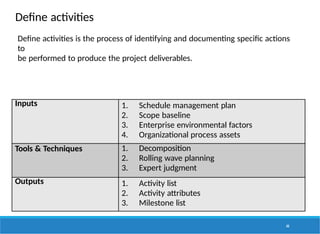
Define activities
66
Inputs 1. Schedule management plan
2. Scope baseline
3. Enterprise environmental factors
4. Organizational process assets
Tools & Techniques 1. Decomposition
2. Rolling wave planning
3. Expert judgment
Outputs 1. Activity list
2. Activity attributes
3. Milestone list
Define activities is the process of identifying and documenting specific actions
to
be performed to produce the project deliverables.
Sequence activities
67
Inputs 1. Schedule management plan
2. Activity list
3. Activity attributes
4. Milestone list
5. Project scope statement
6. Enterprise environmental factors
7. Organizational process assets
Tools & Techniques 1. Precedence diagramming
2. Dependency determination
3. Leads and lags
Outputs 1. Project schedule network
2. Project documents updates
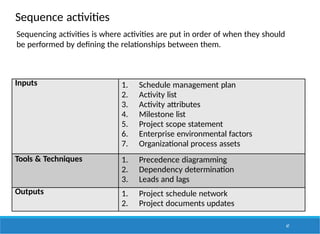
Sequencing activities is where activities are put in order of when they should
be performed by defining the relationships between them.
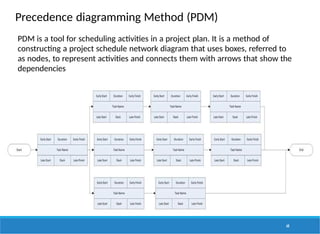
Precedence diagramming Method (PDM)
PDM is a tool for scheduling activities in a project plan. It is a method of
constructing a project schedule network diagram that uses boxes, referred to
as nodes, to represent activities and connects them with arrows that show the
dependencies
68
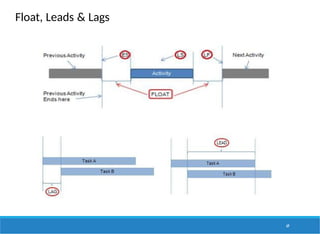
Float, Leads & Lags
69
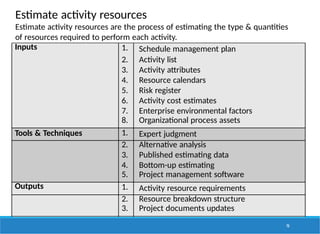
Estimate activity resources
Estimate activity resources are the process of estimating the type & quantities
of resources required to perform each activity.
Inputs 1. Schedule management plan
2. Activity list
3. Activity attributes
4. Resource calendars
5. Risk register
6. Activity cost estimates
7. Enterprise environmental factors
8. Organizational process assets
Tools & Techniques 1. Expert judgment
2. Alternative analysis
3. Published estimating data
4. Bottom-up estimating
5. Project management software
Outputs 1. Activity resource requirements
2. Resource breakdown structure
3. Project documents updates
70
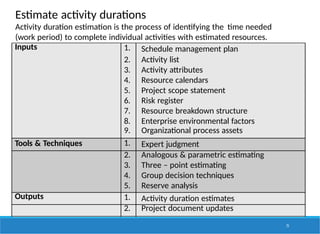
Estimate activity durations
Activity duration estimation is the process of identifying the time needed
(work period) to complete individual activities with estimated resources.
Inputs 1. Schedule management plan
2. Activity list
3. Activity attributes
4. Resource calendars
5. Project scope statement
6. Risk register
7. Resource breakdown structure
8. Enterprise environmental factors
9. Organizational process assets
Tools & Techniques 1. Expert judgment
2. Analogous & parametric estimating
3. Three – point estimating
4. Group decision techniques
5. Reserve analysis
Outputs 1. Activity duration estimates
2. Project document updates
71
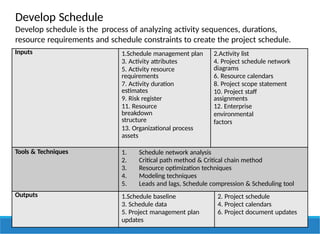
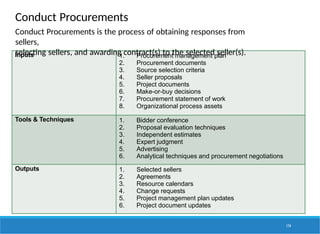
Develop Schedule
72
Inputs 1.Schedule management plan
3. Activity attributes
5. Activity resource
requirements
7. Activity duration
estimates
9. Risk register
11. Resource
breakdown
structure
13. Organizational process
assets
2.Activity list
4. Project schedule network
diagrams
6. Resource calendars
8. Project scope statement
10. Project staff
assignments
12. Enterprise
environmental
factors
Tools & Techniques 1. Schedule network analysis
2. Critical path method & Critical chain method
3. Resource optimization techniques
4. Modeling techniques
5. Leads and lags, Schedule compression & Scheduling tool
Outputs 1.Schedule baseline
3. Schedule data
5. Project management plan
updates
2. Project schedule
4. Project calendars
6. Project document updates
Develop schedule is the process of analyzing activity sequences, durations,
resource requirements and schedule constraints to create the project schedule.
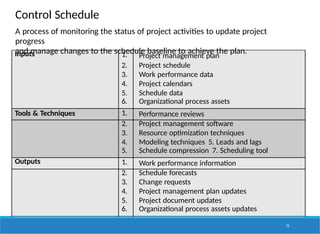
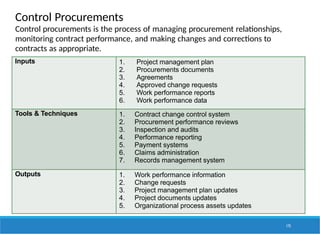
Control Schedule
Inputs 1. Project management plan
2. Project schedule
3. Work performance data
4. Project calendars
5. Schedule data
6. Organizational process assets
Tools & Techniques 1. Performance reviews
2. Project management software
3. Resource optimization techniques
4. Modeling techniques 5. Leads and lags
5. Schedule compression 7. Scheduling tool
Outputs 1. Work performance information
2. Schedule forecasts
3. Change requests
4. Project management plan updates
5. Project document updates
6. Organizational process assets updates
A process of monitoring the status of project activities to update project
progress
and manage changes to the schedule baseline to achieve the plan.
73
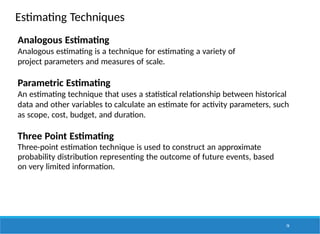
Estimating Techniques
74
Analogous Estimating
Analogous estimating is a technique for estimating a variety of
project parameters and measures of scale.
Parametric Estimating
An estimating technique that uses a statistical relationship between historical
data and other variables to calculate an estimate for activity parameters, such
as scope, cost, budget, and duration.
Three Point Estimating
Three-point estimation technique is used to construct an approximate
probability distribution representing the outcome of future events, based
on very limited information.
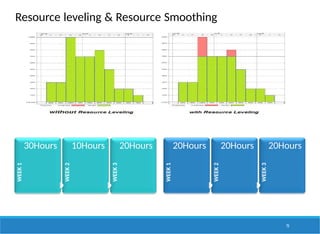
Resource leveling & Resource Smoothing
WEEK
1
30Hours
WEEK
2
10Hours
WEEK
3
20Hours
WEEK
1
75
20Hours
WEEK
2
20Hours
WEEK
3
20Hours
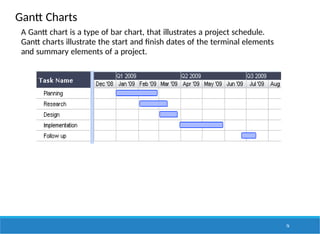
Gantt Charts
A Gantt chart is a type of bar chart, that illustrates a project schedule.
Gantt charts illustrate the start and finish dates of the terminal elements
and summary elements of a project.
76
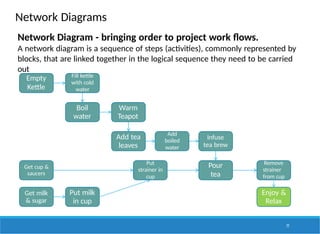
Network Diagrams
Network Diagram - bringing order to project work flows.
A network diagram is a sequence of steps (activities), commonly represented by
blocks, that are linked together in the logical sequence they need to be carried
out
Empty
Kettle
Fill kettle
with cold
water
Boil
water
Warm
Teapot
Add tea
leaves
Add
boiled
water
Infuse
tea brew
Get cup &
saucers
Get milk
& sugar
Put milk
in cup
Put
strainer in
cup
Pour
tea
Remove
strainer
from cup
Enjoy &
Relax
77
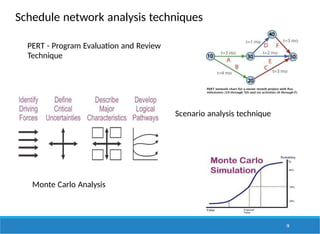
Schedule network analysis techniques
PERT - Program Evaluation and Review
Technique
78
Scenario analysis technique
Monte Carlo Analysis
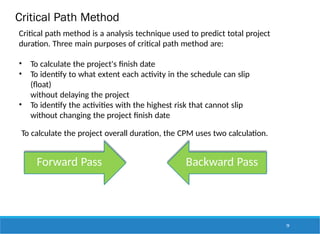
Critical Path Method
Critical path method is a analysis technique used to predict total project
duration. Three main purposes of critical path method are:
• To calculate the project's finish date
• To identify to what extent each activity in the schedule can slip
(float)
without delaying the project
• To identify the activities with the highest risk that cannot slip
without changing the project finish date
To calculate the project overall duration, the CPM uses two calculation.
Forward Pass Backward Pass
79
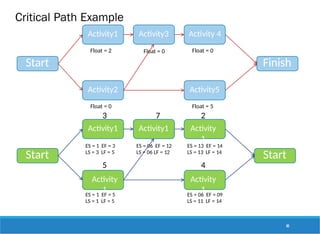
Critical Path Example
Start Finish
Activity1 Activity3 Activity 4
Activity2 Activity5
Float = 2 Float = 0 Float = 0
Start Start
Float = 0
3
Activity1
80
7
Activity1
Float = 5
2
Activity
1
5
Activity
1
4
Activity
1
ES = 1 EF = 3
LS = 3 LF = 5
ES = 1 EF = 5
LS = 1 LF = 5
ES = 13 EF = 14
LS = 13 LF = 14
ES = 06 EF = 09
LS = 11 LF = 14
ES = 06 EF = 12
LS = 06 LF = 12
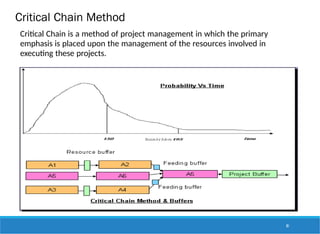
Critical Chain Method
Critical Chain is a method of project management in which the primary
emphasis is placed upon the management of the resources involved in
executing these projects.
81
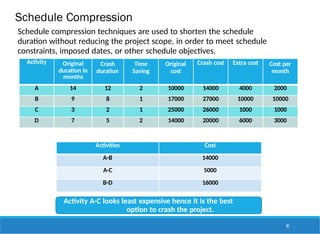
Schedule Compression
Schedule compression techniques are used to shorten the schedule
duration without reducing the project scope, in order to meet schedule
constraints, imposed dates, or other schedule objectives.
Activity Original
duration in
months
Crash
duration
Time
Saving
Original
cost
Crash cost Extra cost Cost per
month
A 14 12 2 10000 14000 4000 2000
B 9 8 1 17000 27000 10000 10000
C 3 2 1 25000 26000 1000 1000
D 7 5 2 14000 20000 6000 3000
Activities Cost
A-B 14000
A-C 5000
B-D 16000
Activity A-C looks least expensive hence it is the best
option to crash the project.
82
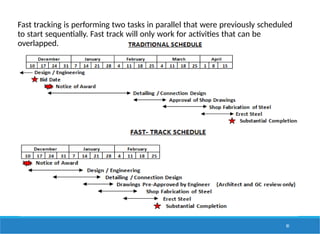
Fast tracking is performing two tasks in parallel that were previously scheduled
to start sequentially. Fast track will only work for activities that can be
overlapped.
83
PERT Analysis
PERT weighted average OT+4*MLT+PT
6
OT = Optimistic Time
MLT = Most Likely Time
PT = Pessimistic Time
Program Evaluation Review Technique is a technique for estimating that applies
a weighted average of optimistic, pessimistic, and most likely estimates when
there is uncertainty with the individual activity estimates.
Most Likely Time (MLT) Optimistic Time (OT) Pessimistic Time (PT)
84
PERT analysis steps
• Define the goal of the project and the tasks required to complete it
• Place tasks in a logical order and determine the critical path
• Calculate per activity the estimated durations using PERT =
(OT+4*MLT+PT)/6]
• Compete this calculation for all tasks; making sure to group tasks on
the critical path separately
• Calculate per activity the standard deviation (SD) (SD=PT-TO/6)
variance (V)
(V=SD2)
• Probability predictions can now be made using this information.
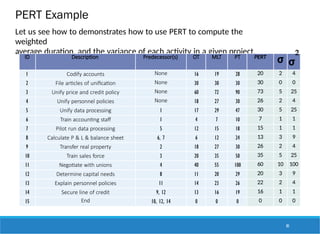
PERT Example
85
Let us see how to demonstrates how to use PERT to compute the
weighted
average duration, and the variance of each activity in a given project.
ID Description Predecessor(s) OT MLT PT PERT
σ
2
σ
1 Codify accounts None 16 19 28 20 2 4
2 File articles of unification None 30 30 30 30 0 0
3 Unify price and credit policy None 60 72 90 73 5 25
4 Unify personnel policies None 18 27 30 26 2 4
5 Unify data processing 1 17 29 47 30 5 25
6 Train accounting staff 1 4 7 10 7 1 1
7 Pilot run data processing 5 12 15 18 15 1 1
8 Calculate P & L & balance sheet 6, 7 6 12 24 13 3 9
9 Transfer real property 2 18 27 30 26 2 4
10 Train sales force 3 20 35 50 35 5 25
11 Negotiate with unions 4 40 55 100 60 10 100
12 Determine capital needs 8 11 20 29 20 3 9
13 Explain personnel policies 11 14 23 26 22 2 4
14 Secure line of credit 9, 12 13 16 19 16 1 1
15 End 10, 12, 14 0 0 0 0 0 0
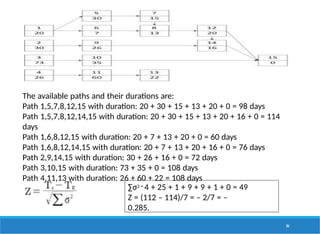
The available paths and their durations are:
Path 1,5,7,8,12,15 with duration: 20 + 30 + 15 + 13 + 20 + 0 = 98 days
Path 1,5,7,8,12,14,15 with duration: 20 + 30 + 15 + 13 + 20 + 16 + 0 = 114
days
Path 1,6,8,12,15 with duration: 20 + 7 + 13 + 20 + 0 = 60 days
Path 1,6,8,12,14,15 with duration: 20 + 7 + 13 + 20 + 16 + 0 = 76 days
Path 2,9,14,15 with duration: 30 + 26 + 16 + 0 = 72 days
Path 3,10,15 with duration: 73 + 35 + 0 = 108 days
Path 4,11,13 with duration: 26 + 60 + 22 = 108 days
∑σ2 = 4 + 25 + 1 + 9 + 9 + 1 + 0 = 49
Z = (112 – 114)/7 = – 2/7 = –
0.285.
86
PROJECT COST
MANAGEMENT
87
Project Cost Management
88
Agenda of the module is to learn:
• What’s project cost management?
• Plan cost management
• Estimate costs
• Determine budget
• Control cost
• Inputs
• Tools and techniques
• Outputs
• Earned Value Management
• Earned value management illustration
• Forecasting
• Q and A, check your learning
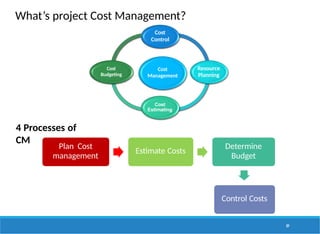
What’s project Cost Management?
Cost
Management
Cost
Control
Resource
Planning
Cost
Estimating
Cost
Budgeting
Plan Cost
management
Estimate Costs
Determine
Budget
Control Costs
89
4 Processes of
CM
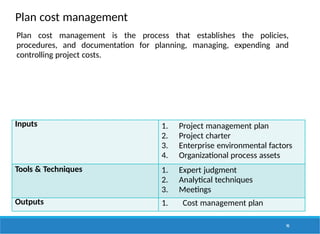
Plan cost management
90
Inputs 1. Project management plan
2. Project charter
3. Enterprise environmental factors
4. Organizational process assets
Tools & Techniques 1. Expert judgment
2. Analytical techniques
3. Meetings
Outputs 1. Cost management plan
Plan cost management is the process that establishes the policies,
procedures, and documentation for planning, managing, expending and
controlling project costs.
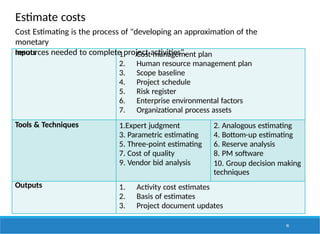
Estimate costs
91
Inputs 1. Cost management plan
2. Human resource management plan
3. Scope baseline
4. Project schedule
5. Risk register
6. Enterprise environmental factors
7. Organizational process assets
Tools & Techniques 1.Expert judgment
3. Parametric estimating
5. Three-point estimating
7. Cost of quality
9. Vendor bid analysis
2. Analogous estimating
4. Bottom-up estimating
6. Reserve analysis
8. PM software
10. Group decision making
techniques
Outputs 1. Activity cost estimates
2. Basis of estimates
3. Project document updates
Cost Estimating is the process of "developing an approximation of the
monetary
resources needed to complete project activities".
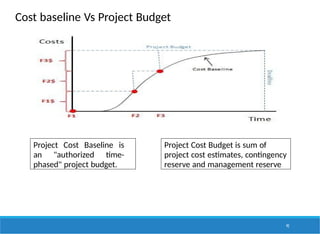
Cost baseline Vs Project Budget
Project Cost Baseline is
an "authorized time-
phased" project budget.
92
Project Cost Budget is sum of
project cost estimates, contingency
reserve and management reserve
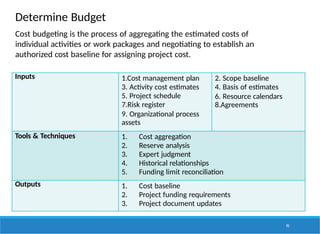
Determine Budget
93
Inputs 1.Cost management plan
3. Activity cost estimates
5. Project schedule
7.Risk register
9. Organizational process
assets
2. Scope baseline
4. Basis of estimates
6. Resource calendars
8.Agreements
Tools & Techniques 1. Cost aggregation
2. Reserve analysis
3. Expert judgment
4. Historical relationships
5. Funding limit reconciliation
Outputs 1. Cost baseline
2. Project funding requirements
3. Project document updates
Cost budgeting is the process of aggregating the estimated costs of
individual activities or work packages and negotiating to establish an
authorized cost baseline for assigning project cost.
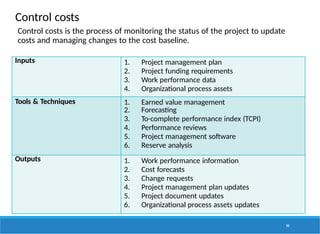
Control costs
Control costs is the process of monitoring the status of the project to update
costs and managing changes to the cost baseline.
94
Inputs 1. Project management plan
2. Project funding requirements
3. Work performance data
4. Organizational process assets
Tools & Techniques 1. Earned value management
2. Forecasting
3. To-complete performance index (TCPI)
4. Performance reviews
5. Project management software
6. Reserve analysis
Outputs 1. Work performance information
2. Cost forecasts
3. Change requests
4. Project management plan updates
5. Project document updates
6. Organizational process assets updates
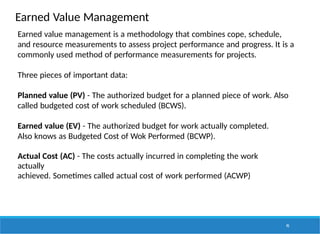
Earned Value Management
95
Earned value management is a methodology that combines cope, schedule,
and resource measurements to assess project performance and progress. It is a
commonly used method of performance measurements for projects.
Three pieces of important data:
Planned value (PV) - The authorized budget for a planned piece of work. Also
called budgeted cost of work scheduled (BCWS).
Earned value (EV) - The authorized budget for work actually completed.
Also knows as Budgeted Cost of Wok Performed (BCWP).
Actual Cost (AC) - The costs actually incurred in completing the work
actually
achieved. Sometimes called actual cost of work performed (ACWP)
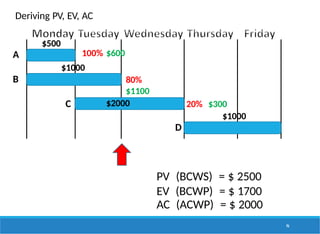
A
B
C
D
$500
$1000
100% $600
96
80%
$1100
$2000 20% $300
$1000
PV (BCWS) = $ 2500
EV (BCWP) = $ 1700
AC (ACWP) = $ 2000
Deriving PV, EV, AC
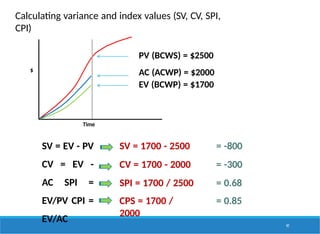
Calculating variance and index values (SV, CV, SPI,
CPI)
PV (BCWS) = $2500
AC (ACWP) = $2000
EV (BCWP) = $1700
SV = EV - PV
CV = EV -
AC SPI =
EV/PV CPI =
EV/AC
SV = 1700 - 2500
CV = 1700 - 2000
SPI = 1700 / 2500
CPS = 1700 /
2000
= -800
= -300
= 0.68
= 0.85
97
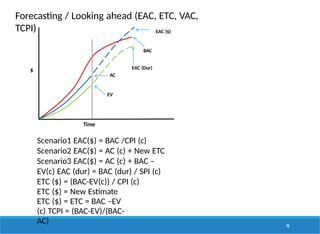
Time
$
Forecasting / Looking ahead (EAC, ETC, VAC,
TCPI)
EAC (Dur)
98
EAC ($)
BAC
AC
EV
Time
Scenario1 EAC($) = BAC /CPI (c)
Scenario2 EAC($) = AC (c) + New ETC
Scenario3 EAC($) = AC (c) + BAC –
EV(c) EAC (dur) = BAC (dur) / SPI (c)
ETC ($) = (BAC-EV(c)) / CPI (c)
ETC ($) = New Estimate
ETC ($) = ETC = BAC –EV
(c) TCPI = (BAC-EV)/(BAC-
AC)
$
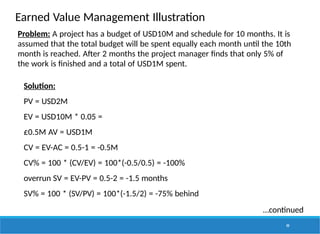
Earned Value Management Illustration
99
Problem: A project has a budget of USD10M and schedule for 10 months. It is
assumed that the total budget will be spent equally each month until the 10th
month is reached. After 2 months the project manager finds that only 5% of
the work is finished and a total of USD1M spent.
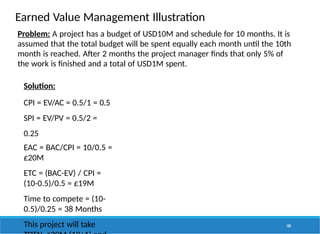
Solution:
PV = USD2M
EV = USD10M * 0.05 =
£0.5M AV = USD1M
CV = EV-AC = 0.5-1 = -0.5M
CV% = 100 * (CV/EV) = 100*(-0.5/0.5) = -100%
overrun SV = EV-PV = 0.5-2 = -1.5 months
SV% = 100 * (SV/PV) = 100*(-1.5/2) = -75% behind
…continued
Earned Value Management Illustration
100
Problem: A project has a budget of USD10M and schedule for 10 months. It is
assumed that the total budget will be spent equally each month until the 10th
month is reached. After 2 months the project manager finds that only 5% of
the work is finished and a total of USD1M spent.
Solution:
CPI = EV/AC = 0.5/1 = 0.5
SPI = EV/PV = 0.5/2 =
0.25
EAC = BAC/CPI = 10/0.5 =
£20M
ETC = (BAC-EV) / CPI =
(10-0.5)/0.5 = £19M
Time to compete = (10-
0.5)/0.25 = 38 Months
This project will take
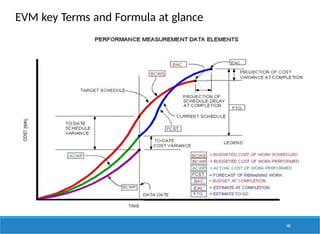
EVM key Terms and Formula at glance
101
EVM Formulas and Interpretation
102
Name Formula Interpretation
Cost variance (CV) EV – AC NEGATIVE is over budget, POSITIVE
is under budget
Schedule variance (SV) EV - PV NEGATIVE is behind schedule, POSITIVE
is ahead of schedule
Cost Performance Index
(CPI)
EV/AC I am [only] getting
cents out of every $1
Schedule Performance
Index (SPI)
EV/PV I am [only] progressing at %
of the rate originally planned
Estimate at Completion
(EAC)
BAC/CPI
AC+ETC
As of now, how much do we expect
the total project to cost. Used if past
trends are expected to continue into
future.
Actual plus a new estimate for
remaining work. Used when original
estimate was fundamentally flawed
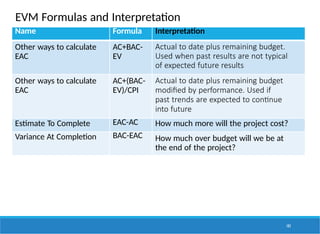
EVM Formulas and Interpretation
103
Name Formula Interpretation
Other ways to calculate
EAC
AC+BAC-
EV
Actual to date plus remaining budget.
Used when past results are not typical
of expected future results
Other ways to calculate
EAC
AC+(BAC-
EV)/CPI
Actual to date plus remaining budget
modified by performance. Used if
past trends are expected to continue
into future
Estimate To Complete EAC-AC How much more will the project cost?
Variance At Completion BAC-EAC How much over budget will we be at
the end of the project?
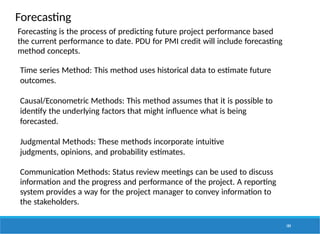
Forecasting
104
Forecasting is the process of predicting future project performance based
the current performance to date. PDU for PMI credit will include forecasting
method concepts.
Time series Method: This method uses historical data to estimate future
outcomes.
Causal/Econometric Methods: This method assumes that it is possible to
identify the underlying factors that might influence what is being
forecasted.
Judgmental Methods: These methods incorporate intuitive
judgments, opinions, and probability estimates.
Communication Methods: Status review meetings can be used to discuss
information and the progress and performance of the project. A reporting
system provides a way for the project manager to convey information to
the stakeholders.
PROJECT QUALITY
MANAGEMENT
105
Project Quality Management
106
Agenda of the module is to learn:
• What’s quality and project quality management?
• Cost of quality
• Plan quality management
• Perform quality assurance
• Control quality
• Inputs
• Tools and techniques
• Outputs
• Seven basic tools of quality
• Q and A, check your learning
What’s quality and project Quality Management?
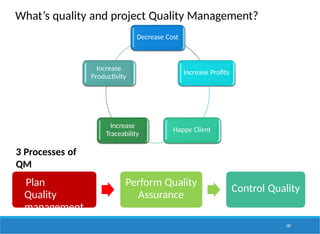
Decrease Cost
Increase Profits
Happy Client
Increase
Traceability
Increase
Productivity
Plan
Quality
management
Perform Quality
Assurance
Control Quality
107
3 Processes of
QM
Cost of quality
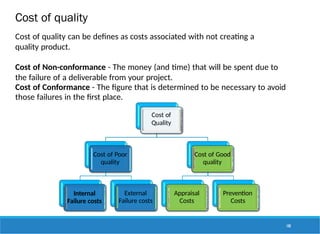
Cost of quality can be defines as costs associated with not creating a
quality product.
Cost of Non-conformance - The money (and time) that will be spent due to
the failure of a deliverable from your project.
Cost of Conformance - The figure that is determined to be necessary to avoid
those failures in the first place.
Cost of
Quality
Cost of Poor
quality
Internal
Failure costs
External
Failure costs
Cost of Good
quality
Appraisal
Costs
Prevention
Costs
108
Plan quality management
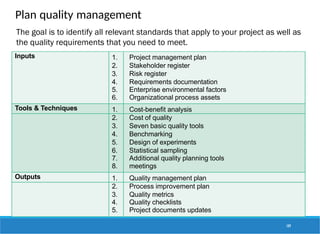
Inputs 1. Project management plan
2. Stakeholder register
3. Risk register
4. Requirements documentation
5. Enterprise environmental factors
6. Organizational process assets
Tools & Techniques 1. Cost-benefit analysis
2. Cost of quality
3. Seven basic quality tools
4. Benchmarking
5. Design of experiments
6. Statistical sampling
7. Additional quality planning tools
8. meetings
Outputs 1. Quality management plan
2. Process improvement plan
3. Quality metrics
4. Quality checklists
5. Project documents updates
The goal is to identify all relevant standards that apply to your project as well as
the quality requirements that you need to meet.
109
Perform quality assurance
110
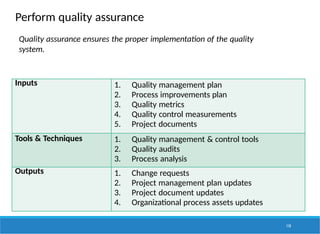
Inputs 1. Quality management plan
2. Process improvements plan
3. Quality metrics
4. Quality control measurements
5. Project documents
Tools & Techniques 1. Quality management & control tools
2. Quality audits
3. Process analysis
Outputs 1. Change requests
2. Project management plan updates
3. Project document updates
4. Organizational process assets updates
Quality assurance ensures the proper implementation of the quality
system.
Control quality
111
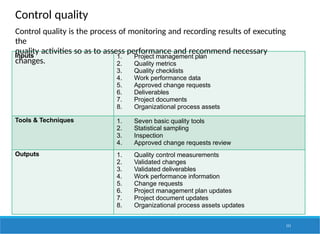
Inputs 1. Project management plan
2. Quality metrics
3. Quality checklists
4. Work performance data
5. Approved change requests
6. Deliverables
7. Project documents
8. Organizational process assets
Tools & Techniques 1. Seven basic quality tools
2. Statistical sampling
3. Inspection
4. Approved change requests review
Outputs 1. Quality control measurements
2. Validated changes
3. Validated deliverables
4. Work performance information
5. Change requests
6. Project management plan updates
7. Project document updates
8. Organizational process assets updates
Control quality is the process of monitoring and recording results of executing
the
quality activities so as to assess performance and recommend necessary
changes.
Quality Planning Vs. Quality Assurance Vs. Control Quality
112
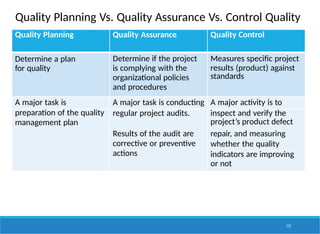
Quality Planning Quality Assurance Quality Control
Determine a plan
for quality
Determine if the project
is complying with the
organizational policies
and procedures
Measures specific project
results (product) against
standards
A major task is A major task is conducting A major activity is to
preparation of the quality
management plan
regular project audits. inspect and verify the
project’s product defect
Results of the audit are repair, and measuring
corrective or preventive
actions
whether the quality
indicators are improving
or not
Seven basic tools of quality
Do
Start
End
Decide
Do
Do
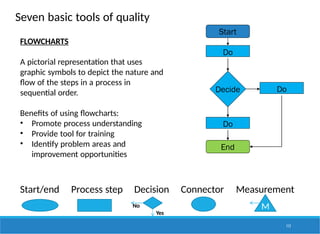
FLOWCHARTS
A pictorial representation that uses
graphic symbols to depict the nature and
flow of the steps in a process in
sequential order.
Benefits of using flowcharts:
• Promote process understanding
• Provide tool for training
• Identify problem areas and
improvement opportunities
Start/end
113
Process step Decision
No
Yes
Connector Measurement
M
Seven basic tools of quality
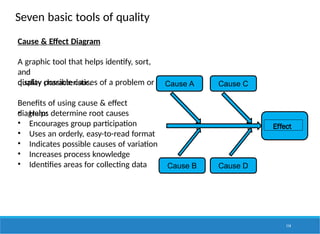
Cause & Effect Diagram
A graphic tool that helps identify, sort,
and
display possible causes of a problem or
quality characteristic.
Benefits of using cause & effect
diagram:
• Helps determine root causes
• Encourages group participation
• Uses an orderly, easy-to-read format
• Indicates possible causes of variation
• Increases process knowledge
• Identifies areas for collecting data
Cause A Cause C
Cause B Cause D
Effect
114
Seven basic tools of quality
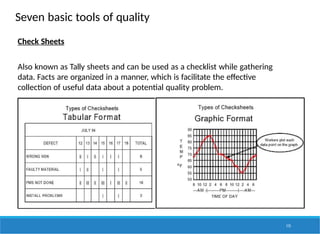
Check Sheets
Also known as Tally sheets and can be used as a checklist while gathering
data. Facts are organized in a manner, which is facilitate the effective
collection of useful data about a potential quality problem.
115
Seven basic tools of quality
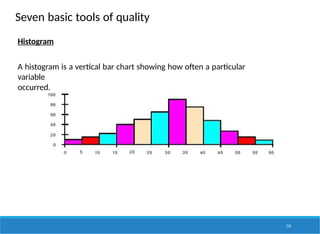
Histogram
A histogram is a vertical bar chart showing how often a particular
variable
occurred.
116
Seven basic tools of quality
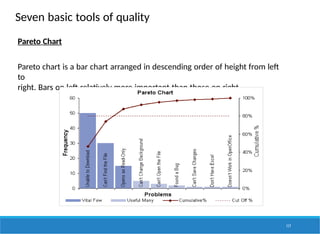
Pareto Chart
Pareto chart is a bar chart arranged in descending order of height from left
to
right. Bars on left relatively more important than those on right.
117
Seven basic tools of quality
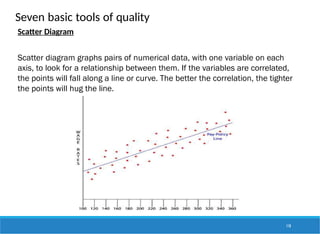
Scatter Diagram
Scatter diagram graphs pairs of numerical data, with one variable on each
axis, to look for a relationship between them. If the variables are correlated,
the points will fall along a line or curve. The better the correlation, the tighter
the points will hug the line.
118
Seven basic tools of quality
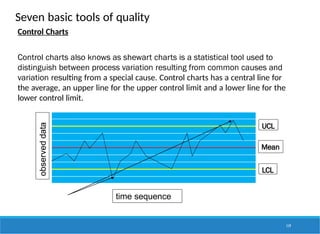
Control Charts
Control charts also knows as shewart charts is a statistical tool used to
distinguish between process variation resulting from common causes and
variation resulting from a special cause. Control charts has a central line for
the average, an upper line for the upper control limit and a lower line for the
lower control limit.
observed
data
time sequence
Mean
UCL
LCL
119
PROJECT HUMAN RESOURCE
MANAGEMENT
120
Project Human Resource Management
121
Agenda of the module is to learn:
• What’s project human resource management?
• Functional manager Vs Project manager
• Plan human resource management
• Acquire project team
• Manage project team
• Inputs
• Tools and techniques
• Outputs
• Conflict management
• Motivational theories
• Q and A, check your learning
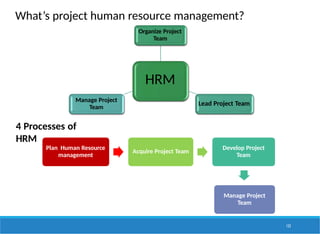
What’s project human resource management?
Plan Human Resource
management
Acquire Project Team
Develop Project
Team
Manage Project
Team
4 Processes of
HRM
HRM
Organize Project
Team
Lead Project Team
Manage Project
Team
122
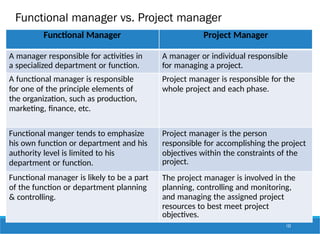
Functional manager vs. Project manager
123
Functional Manager Project Manager
A manager responsible for activities in
a specialized department or function.
A manager or individual responsible
for managing a project.
A functional manager is responsible
for one of the principle elements of
the organization, such as production,
marketing, finance, etc.
Project manager is responsible for the
whole project and each phase.
Functional manger tends to emphasize
his own function or department and his
authority level is limited to his
department or function.
Project manager is the person
responsible for accomplishing the project
objectives within the constraints of the
project.
Functional manager is likely to be a part
of the function or department planning
& controlling.
The project manager is involved in the
planning, controlling and monitoring,
and managing the assigned project
resources to best meet project
objectives.
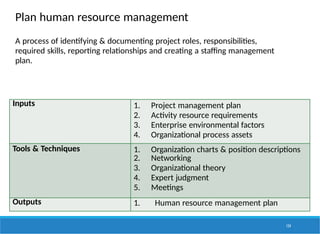
Plan human resource management
124
Inputs 1. Project management plan
2. Activity resource requirements
3. Enterprise environmental factors
4. Organizational process assets
Tools & Techniques 1. Organization charts & position descriptions
2. Networking
3. Organizational theory
4. Expert judgment
5. Meetings
Outputs 1. Human resource management plan
A process of identifying & documenting project roles, responsibilities,
required skills, reporting relationships and creating a staffing management
plan.
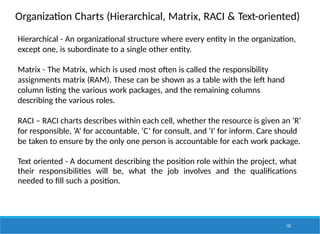
Organization Charts (Hierarchical, Matrix, RACI & Text-oriented)
125
Hierarchical - An organizational structure where every entity in the organization,
except one, is subordinate to a single other entity.
Matrix - The Matrix, which is used most often is called the responsibility
assignments matrix (RAM). These can be shown as a table with the left hand
column listing the various work packages, and the remaining columns
describing the various roles.
RACI – RACI charts describes within each cell, whether the resource is given an ‘R’
for responsible, ‘A’ for accountable, ‘C’ for consult, and ‘I’ for inform. Care should
be taken to ensure by the only one person is accountable for each work package.
Text oriented - A document describing the position role within the project, what
their responsibilities will be, what the job involves and the qualifications
needed to fill such a position.
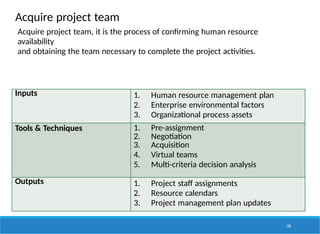
Acquire project team
126
Inputs 1. Human resource management plan
2. Enterprise environmental factors
3. Organizational process assets
Tools & Techniques 1. Pre-assignment
2. Negotiation
3. Acquisition
4. Virtual teams
5. Multi-criteria decision analysis
Outputs 1. Project staff assignments
2. Resource calendars
3. Project management plan updates
Acquire project team, it is the process of confirming human resource
availability
and obtaining the team necessary to complete the project activities.
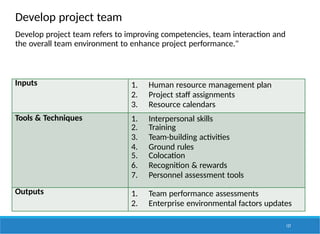
Develop project team
127
Inputs 1. Human resource management plan
2. Project staff assignments
3. Resource calendars
Tools & Techniques 1. Interpersonal skills
2. Training
3. Team-building activities
4. Ground rules
5. Colocation
6. Recognition & rewards
7. Personnel assessment tools
Outputs 1. Team performance assessments
2. Enterprise environmental factors updates
Develop project team refers to improving competencies, team interaction and
the overall team environment to enhance project performance."
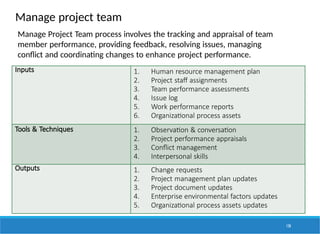
Manage project team
128
Inputs 1. Human resource management plan
2. Project staff assignments
3. Team performance assessments
4. Issue log
5. Work performance reports
6. Organizational process assets
Tools & Techniques 1. Observation & conversation
2. Project performance appraisals
3. Conflict management
4. Interpersonal skills
Outputs 1. Change requests
2. Project management plan updates
3. Project document updates
4. Enterprise environmental factors updates
5. Organizational process assets updates
Manage Project Team process involves the tracking and appraisal of team
member performance, providing feedback, resolving issues, managing
conflict and coordinating changes to enhance project performance.
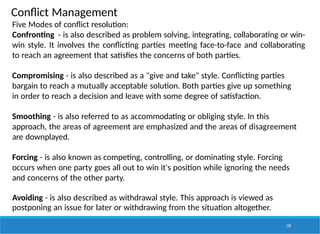
Conflict Management
129
Five Modes of conflict resolution:
Confronting - is also described as problem solving, integrating, collaborating or win-
win style. It involves the conflicting parties meeting face-to-face and collaborating
to reach an agreement that satisfies the concerns of both parties.
Compromising - is also described as a "give and take" style. Conflicting parties
bargain to reach a mutually acceptable solution. Both parties give up something
in order to reach a decision and leave with some degree of satisfaction.
Smoothing - is also referred to as accommodating or obliging style. In this
approach, the areas of agreement are emphasized and the areas of disagreement
are downplayed.
Forcing - is also known as competing, controlling, or dominating style. Forcing
occurs when one party goes all out to win it's position while ignoring the needs
and concerns of the other party.
Avoiding - is also described as withdrawal style. This approach is viewed as
postponing an issue for later or withdrawing from the situation altogether.
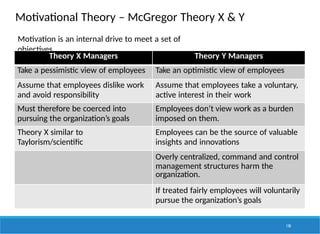
Motivational Theory – McGregor Theory X & Y
130
Motivation is an internal drive to meet a set of
objectives.
Theory X Managers Theory Y Managers
Take a pessimistic view of employees Take an optimistic view of employees
Assume that employees dislike work
and avoid responsibility
Assume that employees take a voluntary,
active interest in their work
Must therefore be coerced into
pursuing the organization’s goals
Employees don’t view work as a burden
imposed on them.
Theory X similar to
Taylorism/scientific
Employees can be the source of valuable
insights and innovations
Overly centralized, command and control
management structures harm the
organization.
If treated fairly employees will voluntarily
pursue the organization’s goals
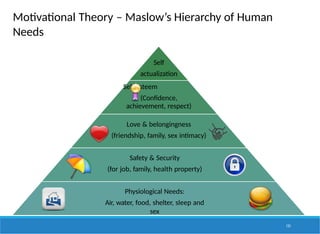
Self
actualization
Self Esteem
(Confidence,
achievement, respect)
Love & belongingness
(friendship, family, sex intimacy)
Safety & Security
(for job, family, health property)
Physiological Needs:
Air, water, food, shelter, sleep and
sex
Motivational Theory – Maslow’s Hierarchy of Human
Needs
131
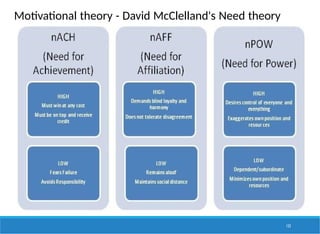
Motivational theory - David McClelland's Need theory
132
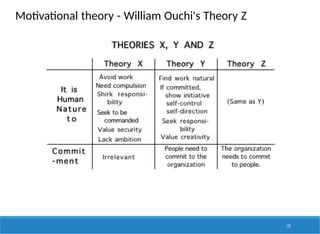
Motivational theory - William Ouchi's Theory Z
133
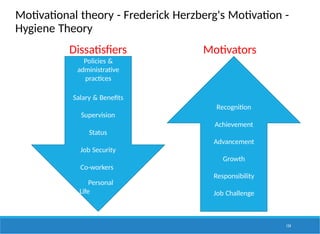
Motivational theory - Frederick Herzberg's Motivation -
Hygiene Theory
Dissatisfiers
Policies &
administrative
practices
Salary & Benefits
Supervision
Status
Job Security
Co-workers
Personal
Life
Motivators
Recognition
Achievement
Advancement
Growth
Responsibility
Job Challenge
134
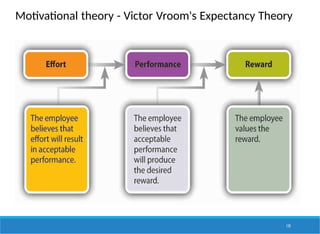
Motivational theory - Victor Vroom's Expectancy Theory
135
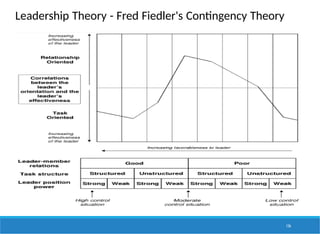
Leadership Theory - Fred Fiedler's Contingency Theory
136
PROJECT COMMUNICATION
MANAGEMENT
137
Project Communication Management
138
Agenda of the module is to learn:
• What is communication?
• Communications methods, technology and channels
• Basic communication model
• Plan communication management
• Manage communications
• Control communications
• Inputs
• Tools and techniques
• Outputs
• Q and A, check your learning
What is communication?
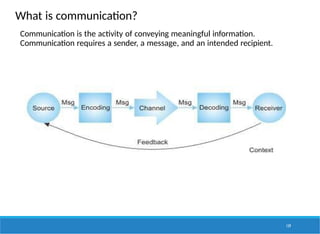
Communication is the activity of conveying meaningful information.
Communication requires a sender, a message, and an intended recipient.
139
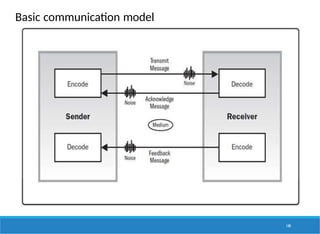
Basic communication model
140
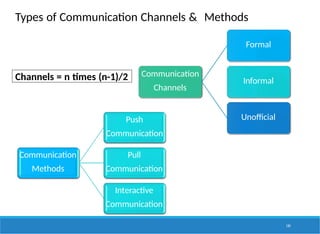
Types of Communication Channels & Methods
Communication
Channels
Formal
Informal
Unofficial
Communication
Methods
Push
Communication
Pull
Communication
Interactive
Communication
141
Channels = n times (n-1)/2
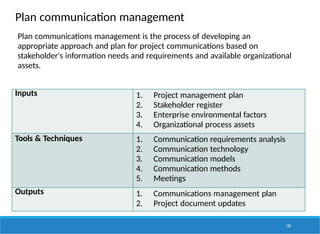
Plan communication management
142
Inputs 1. Project management plan
2. Stakeholder register
3. Enterprise environmental factors
4. Organizational process assets
Tools & Techniques 1. Communication requirements analysis
2. Communication technology
3. Communication models
4. Communication methods
5. Meetings
Outputs 1. Communications management plan
2. Project document updates
Plan communications management is the process of developing an
appropriate approach and plan for project communications based on
stakeholder's information needs and requirements and available organizational
assets.
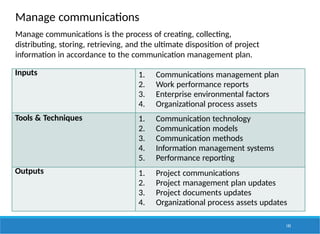
Manage communications
143
Inputs 1. Communications management plan
2. Work performance reports
3. Enterprise environmental factors
4. Organizational process assets
Tools & Techniques 1. Communication technology
2. Communication models
3. Communication methods
4. Information management systems
5. Performance reporting
Outputs 1. Project communications
2. Project management plan updates
3. Project documents updates
4. Organizational process assets updates
Manage communications is the process of creating, collecting,
distributing, storing, retrieving, and the ultimate disposition of project
information in accordance to the communication management plan.
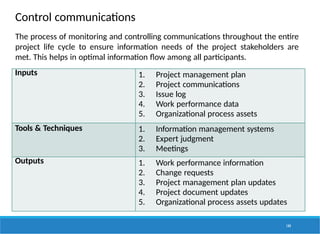
Control communications
144
Inputs 1. Project management plan
2. Project communications
3. Issue log
4. Work performance data
5. Organizational process assets
Tools & Techniques 1. Information management systems
2. Expert judgment
3. Meetings
Outputs 1. Work performance information
2. Change requests
3. Project management plan updates
4. Project document updates
5. Organizational process assets updates
The process of monitoring and controlling communications throughout the entire
project life cycle to ensure information needs of the project stakeholders are
met. This helps in optimal information flow among all participants.
PROJECT RISK
MANAGEMENT
145
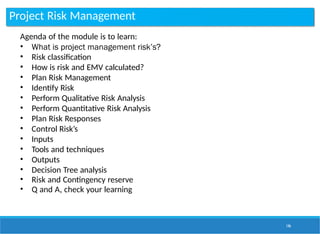
Project Risk Management
146
Agenda of the module is to learn:
• What is project management risk’s?
• Risk classification
• How is risk and EMV calculated?
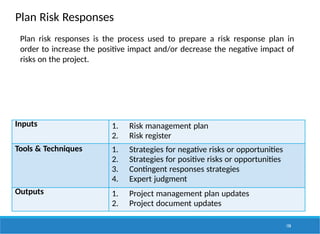
• Plan Risk Management
• Identify Risk
• Perform Qualitative Risk Analysis
• Perform Quantitative Risk Analysis
• Plan Risk Responses
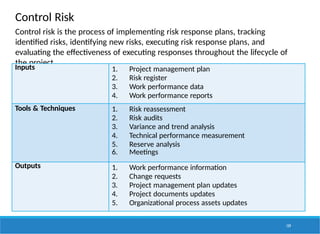
• Control Risk’s
• Inputs
• Tools and techniques
• Outputs
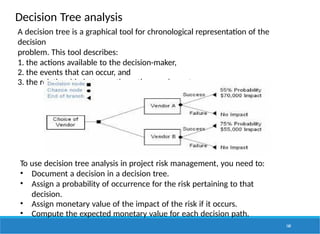
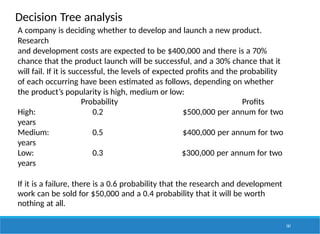
• Decision Tree analysis
• Risk and Contingency reserve
• Q and A, check your learning
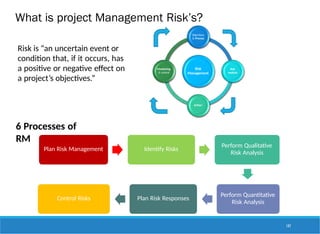
What is project Management Risk’s?
Risk
Management
Objectives
& Process
Risk
analysis
Action!
Monitoring
& control
Plan Risk Management Identify Risks
Perform Qualitative
Risk Analysis
Perform Quantitative
Risk Analysis
Plan Risk Responses
Control Risks
147
6 Processes of
RM
Risk is “an uncertain event or
condition that, if it occurs, has
a positive or negative effect on
a project’s objectives.”
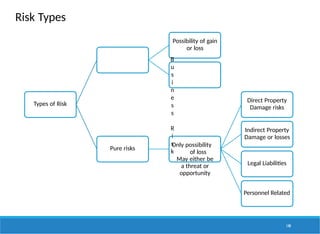
Risk Types
Types of Risk
Possibility of gain
or loss
B
u
s
i
n
e
s
s
R
i
s
k
May either be
a threat or
opportunity
Pure risks
Only possibility
of loss
Direct Property
Damage risks
Indirect Property
Damage or losses
Legal Liabilities
Personnel Related
148
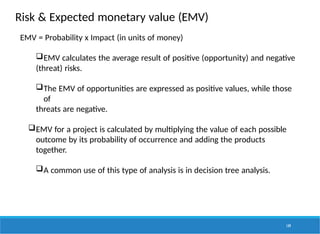
Risk & Expected monetary value (EMV)
149
EMV = Probability x Impact (in units of money)
EMV calculates the average result of positive (opportunity) and negative
(threat) risks.
The EMV of opportunities are expressed as positive values, while those
of
threats are negative.
EMV for a project is calculated by multiplying the value of each possible
outcome by its probability of occurrence and adding the products
together.
A common use of this type of analysis is in decision tree analysis.
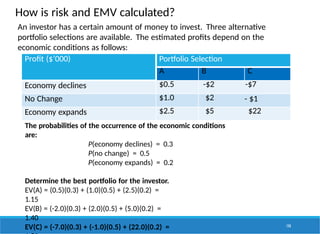
How is risk and EMV calculated?
An investor has a certain amount of money to invest. Three alternative
portfolio selections are available. The estimated profits depend on the
economic conditions as follows:
150
Profit ($’000) Portfolio Selection
A B C
Economy declines $0.5 -$2 -$7
No Change $1.0 $2 - $1
Economy expands $2.5 $5 $22
The probabilities of the occurrence of the economic conditions
are:
P(economy declines) = 0.3
P(no change) = 0.5
P(economy expands) = 0.2
Determine the best portfolio for the investor.
EV(A) = (0.5)(0.3) + (1.0)(0.5) + (2.5)(0.2) =
1.15
EV(B) = (-2.0)(0.3) + (2.0)(0.5) + (5.0)(0.2) =
1.40
EV(C) = (-7.0)(0.3) + (-1.0)(0.5) + (22.0)(0.2) =
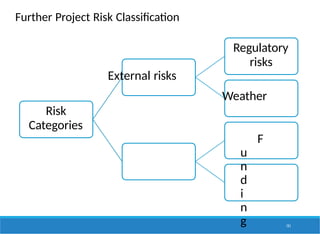
Further Project Risk Classification
Regulatory
risks
External risks
Weather
Risk
Categories
F
u
n
d
i
n
g 151
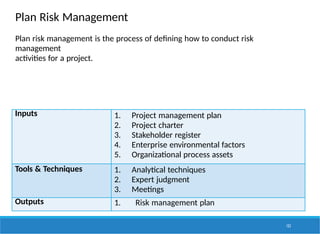
Plan Risk Management
152
Inputs 1. Project management plan
2. Project charter
3. Stakeholder register
4. Enterprise environmental factors
5. Organizational process assets
Tools & Techniques 1. Analytical techniques
2. Expert judgment
3. Meetings
Outputs 1. Risk management plan
Plan risk management is the process of defining how to conduct risk
management
activities for a project.
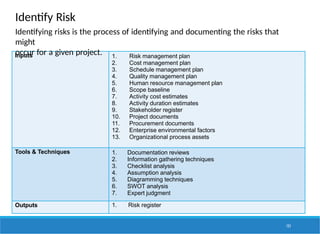
Identify Risk
153
Inputs 1. Risk management plan
2. Cost management plan
3. Schedule management plan
4. Quality management plan
5. Human resource management plan
6. Scope baseline
7. Activity cost estimates
8. Activity duration estimates
9. Stakeholder register
10. Project documents
11. Procurement documents
12. Enterprise environmental factors
13. Organizational process assets
Tools & Techniques 1. Documentation reviews
2. Information gathering techniques
3. Checklist analysis
4. Assumption analysis
5. Diagramming techniques
6. SWOT analysis
7. Expert judgment
Outputs 1. Risk register
Identifying risks is the process of identifying and documenting the risks that
might
occur for a given project.
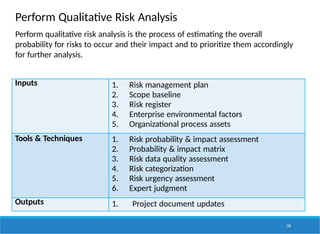
Perform Qualitative Risk Analysis
154
Inputs 1. Risk management plan
2. Scope baseline
3. Risk register
4. Enterprise environmental factors
5. Organizational process assets
Tools & Techniques 1. Risk probability & impact assessment
2. Probability & impact matrix
3. Risk data quality assessment
4. Risk categorization
5. Risk urgency assessment
6. Expert judgment
Outputs 1. Project document updates
Perform qualitative risk analysis is the process of estimating the overall
probability for risks to occur and their impact and to prioritize them accordingly
for further analysis.
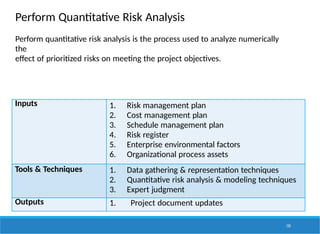
Perform Quantitative Risk Analysis
155
Inputs 1. Risk management plan
2. Cost management plan
3. Schedule management plan
4. Risk register
5. Enterprise environmental factors
6. Organizational process assets
Tools & Techniques 1. Data gathering & representation techniques
2. Quantitative risk analysis & modeling techniques
3. Expert judgment
Outputs 1. Project document updates
Perform quantitative risk analysis is the process used to analyze numerically
the
effect of prioritized risks on meeting the project objectives.
Data gathering & representation techniques
Interviews: This technique is the same as that presented in the quantitative risk
analysis, interviews with people who participated in other projects, with
stakeholders, customers, suppliers, users and risk experts may be helpful
during the risk quantitative analysis.
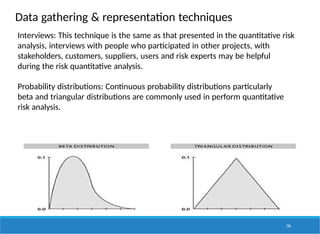
Probability distributions: Continuous probability distributions particularly
beta and triangular distributions are commonly used in perform quantitative
risk analysis.
156
Quantitative risk analysis & modeling techniques
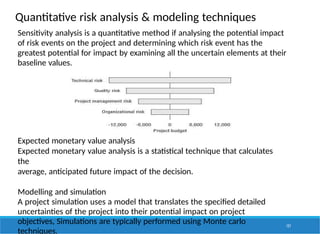
Sensitivity analysis is a quantitative method if analysing the potential impact
of risk events on the project and determining which risk event has the
greatest potential for impact by examining all the uncertain elements at their
baseline values.
Expected monetary value analysis
Expected monetary value analysis is a statistical technique that calculates
the
average, anticipated future impact of the decision.
Modelling and simulation
A project simulation uses a model that translates the specified detailed
uncertainties of the project into their potential impact on project
objectives, Simulations are typically performed using Monte carlo
techniques.
157
Plan Risk Responses
158
Inputs 1. Risk management plan
2. Risk register
Tools & Techniques 1. Strategies for negative risks or opportunities
2. Strategies for positive risks or opportunities
3. Contingent responses strategies
4. Expert judgment
Outputs 1. Project management plan updates
2. Project document updates
Plan risk responses is the process used to prepare a risk response plan in
order to increase the positive impact and/or decrease the negative impact of
risks on the project.
Control Risk
Control risk is the process of implementing risk response plans, tracking
identified risks, identifying new risks, executing risk response plans, and
evaluating the effectiveness of executing responses throughout the lifecycle of
the project.
159
Inputs 1. Project management plan
2. Risk register
3. Work performance data
4. Work performance reports
Tools & Techniques 1. Risk reassessment
2. Risk audits
3. Variance and trend analysis
4. Technical performance measurement
5. Reserve analysis
6. Meetings
Outputs 1. Work performance information
2. Change requests
3. Project management plan updates
4. Project documents updates
5. Organizational process assets updates
Decision Tree analysis
A decision tree is a graphical tool for chronological representation of the
decision
problem. This tool describes:
1. the actions available to the decision-maker,
2. the events that can occur, and
3. the relationship between the actions and events.
To use decision tree analysis in project risk management, you need to:
• Document a decision in a decision tree.
• Assign a probability of occurrence for the risk pertaining to that
decision.
• Assign monetary value of the impact of the risk if it occurs.
• Compute the expected monetary value for each decision path.
160
Decision Tree analysis
161
A company is deciding whether to develop and launch a new product.
Research
and development costs are expected to be $400,000 and there is a 70%
chance that the product launch will be successful, and a 30% chance that it
will fail. If it is successful, the levels of expected profits and the probability
of each occurring have been estimated as follows, depending on whether
the product’s popularity is high, medium or low:
Probability Profits
High: 0.2 $500,000 per annum for two
years
Medium: 0.5 $400,000 per annum for two
years
Low: 0.3 $300,000 per annum for two
years
If it is a failure, there is a 0.6 probability that the research and development
work can be sold for $50,000 and a 0.4 probability that it will be worth
nothing at all.
D
C
A
B
DO NOT DEVELOP
PRODUCT
DEVELOP
PRODUCT
$(200,00
0)
Success
0.7
Failure
0.3
High
0.2
Low
0.2
Medium
0.5
Sell Work
0.6
Worth Nothing
0.4
$0
$1,000,000
$800,000
$600,000
162
$50,000
$0
Decision Tree Example
D
C
DO NOT DEVELOP
PRODUCT
DEVELOP
PRODUCT
$(200,00
0)
Success
0.7
Failure
0.3
High
0.2
Low
0.2
Medium
0.5
Sell Work
0.6
Worth Nothing
0.4
$0
$1,000,000
$800,000
$600,000
163
$50,000
$0
EV at A = (0.2x$1,000,000) + (0.5x$800,00) + (0.3x$600,000) = $780,000
EV at B = (0.6x$50,000) + (0.4x$0) = $30,000
EV at C = (0.7x$780,000) + (0.3x$30,000) = $555,000
EV $555,000
EV $780,000
A
B
EV
$30,000
Recommendation, develop the product as the expected value of the profits is
$145,000
Risk and Contingency reserve
Budgeted Cost
Planned cost
Project
Control A/c
Works
Activities
164
Contingency reserve
Management reserve
Contingency Reserve is:
• Established to deal with unknown risks
and accepted known risks.
• Might be in the form of additional time,
money
or resources.
• Covers risk events that are not accounted for
in the project baseline for duration and cost
estimations.
• Determined by the potential impact of the risk
but should include enough to implement any
contingency plans as well as a buffer for
dealing with unidentified risks.
Risk Reserve Contingency Reserve
PROJECT PROCUREMENT
MANAGEMENT
165
Project Procurement Management
166
Agenda of the module is to learn:
• What’s project procurement management?
• What is contract?
• Plan procurement management
• Conduct procurements
• Control procurements
• Close procurements
• Inputs
• Tools and techniques
• Outputs
• Different types of contract
• Advantages and disadvantages of types of contracts
• Q and A, check your learning
What’s project procurement management?
Procurement
Procurement
Services
Contract
Management
Project
Procurement
4 Processes of PM
Plan Procurement
Management
Conduct
Procurements
Control
Procurements
Close
Procurements
167
What is contract?
168
A legally enforceable agreement between two or more parties.
Contracts contain terms and conditions that set the rights and
obligations of
the contracting parties.
The aim of a procurement contract is to obtain the services or products
as agreed in the contract to the satisfaction of all parties to the contract.
Procurement Management helps us ensure that the products and
components that we do not make ourselves, but purchase from outside the
project will not negatively impact on the quality of our project’s final product.
The procurement manager or office (contract manager) is normally
responsible for creating and managing the procurement contract.
Different types of contract
169
Fixed Price (FP or FFP - "firm fixed price") also called "Lump Sum“. The simplest
type of contract. The buyer specifies the work required and the supplier quotes
a price. The seller assumes almost all of the risks of this contract.
Time and Materials (T&M) - Also sometimes called as unit price contracts.
Simple billing at pre-negotiated rates for labor and materials on a project.
Rates normally include a certain percentage markup for overhead or profit. In
this arrangement the buyer carries most of the risk.
Cost Reimbursable (CR) – in this type of contract the buyer agrees to
reimburse the seller’s actual costs. Added to that is a fee that typically
represents the seller’s profit. In this type of contract the buyer carries most of
the risk.
Advantages and disadvantages of Fixed Price Contracts
170
Advantages of fixed price contracts:
• Less work for buyer to manage.
• The seller has a strong incentive to control costs.
• Companies normally have experience with this type of contract.
• The buyer knows the total price at project start.
Disadvantages of fixed price contracts include:
• The seller may under-price the work and try to make up profits on change
orders.
•The seller may not complete some of the contract statement of work
once
the contact becomes unprofitable for him.
•More work for the buyer to write the contract statement of work
•Can be more expensive than cost reimbursable contract.
•The seller will have to provide for risk in his price quoted.
Advantages and disadvantages of Time & Materials
171
Contracts
Advantages of time & materials contracts include:
• Quick to create
•Good choice when you are hiring "bodies" or people to augment your
staff.
Disadvantages of time & materials contracts include:
• Seller has no incentive to control cost
• Requires monitoring of daily output
• More suitable for small projects only
Advantages & disadvantages of Cost Reimbursable contracts
172
Advantages of cost reimbursable contracts include:
• Simpler contract statement of work.
•Usually requires less work to define the scope than fixed price.
•Generally lower cost than fixed price because the seller does not have to
add for risk.
Disadvantages of cost reimbursable contracts include:
• Require auditing of the seller's invoices.
• Require more work for the buyer to manage.
• Seller has only a moderate incentive to control costs.
• Total price is unknown.
Plan procurement management
173
Inputs 1. Project management plan
2. Requirements documentation
3. Risk register
4. Activity resource requirements
5. Project schedule
6. Activity cost estimates
7. Stakeholder register
8. Enterprise environmental factors
9. Organizational process assets
Tools & Techniques 1. Make-or-buy analysis
2. Expert judgment
3. Market research
4. Meetings
Outputs 1. Procurement management plan
2. Procurement statement of work
3. Procurement documents
4. Source selection criteria
5. Make-or-buy decisions
6. Change requests & Project document updates
Procurement planning is the process that enables you procure products
and services from external or internal suppliers.
Conduct Procurements
174
Inputs 1. Procurement management plan
2. Procurement documents
3. Source selection criteria
4. Seller proposals
5. Project documents
6. Make-or-buy decisions
7. Procurement statement of work
8. Organizational process assets
Tools & Techniques 1. Bidder conference
2. Proposal evaluation techniques
3. Independent estimates
4. Expert judgment
5. Advertising
6. Analytical techniques and procurement negotiations
Outputs 1. Selected sellers
2. Agreements
3. Resource calendars
4. Change requests
5. Project management plan updates
6. Project document updates
Conduct Procurements is the process of obtaining responses from
sellers,
selecting sellers, and awarding contract(s) to the selected seller(s).
Control Procurements
Control procurements is the process of managing procurement relationships,
monitoring contract performance, and making changes and corrections to
contracts as appropriate.
175
Inputs 1. Project management plan
2. Procurements documents
3. Agreements
4. Approved change requests
5. Work performance reports
6. Work performance data
Tools & Techniques 1. Contract change control system
2. Procurement performance reviews
3. Inspection and audits
4. Performance reporting
5. Payment systems
6. Claims administration
7. Records management system
Outputs 1. Work performance information
2. Change requests
3. Project management plan updates
4. Project documents updates
5. Organizational process assets updates
Close Procurements
176
Inputs 1. Project management plan
2. Procurements documents
Tools & Techniques 1. Procurement audits
2. Procurement negotiations
3. Records management system
Outputs 1. Closed procurements
2. Organizational process assets updates
Close procurement is the process of completing each
procurement.
PROJECT STAKEHOLDER
MANAGEMENT
177
Project Stakeholder Management
178
Agenda of the module is to learn:
• What’s project stakeholder management?
• What is a stakeholder register?
• Identify stakeholders
• Plan stakeholder management
• Manage stakeholder engagement
• Control stakeholder engagement
• Inputs
• Tools and techniques
• Outputs
• Various Analytical Techniques for Stakeholder Analysis
• Q and A, check your learning
What’s project Stakeholder Management?
Identify Stakeholders
Plan Stakeholder
Management
Manage Stakeholder
Engagement
Control Stakeholder
Engagement
179
4 Processes of
SM
What is a stakeholder register?
180
A Stakeholder Register is a project management document, which contains the
information about all project stakeholders. It identifies and lists the people,
groups and organizations impacted by the project.
A Stakeholder Register may have following information:
What is the name of the stakeholder?
What is the title held by the stakeholder?
What is the role of stakeholder in the project and/or in
the organization?
What is the contact information of the
stakeholder? What are his requirements from the
project?
How do the stakeholders like to communicate?
How often would the stakeholder like
communicate?
What are his expectations from the project?
How can he influence the project?
How about his interest, whether it is high, medium,
or low?
Classification information; e.g. whether he is an
Identify stakeholders
181
Inputs 1. Project charter
2. Procurement documents
3. Enterprise environmental factors
4. Organizational process assets
Tools & Techniques 1. Stakeholder analysis
2. Expert judgment
3. Meetings
Outputs 1. Stakeholder register
Identify stakeholders is the process of identifying the people, groups or
organizations that could impact or be impacted by a decision, activity, or
outcome of the project, analysing and documenting relevant information
regarding their interests, involvement, interdependencies, influence and potential
impact on project success.
Plan stakeholder management
182
Inputs 1. Project management plan
2. Stakeholder register
3. Enterprise environmental factors
4. Organizational process assets
Tools & Techniques 1. Expert judgment
2. Meetings
3. Analytical techniques
Outputs 1. Stakeholder management plan
2. Project documents updates
Plan stakeholder management is the process of developing appropriate
management strategies to effectively engage stakeholders throughout the
project life cycle, based on the analysis of their needs, interests, and
potential impact on project success.
Manage stakeholder engagement
183
Inputs 1. Stakeholder management plan
2. Communication management plan
3. Change log
4. Organizational process assets
Tools & Techniques 1. Communication methods
2. Interpersonal skills
3. Management skills
Outputs 1. Issue log
2. Change requests
3. Project management plan updates
4. Project document updates
5. Organizational process assets updates
Manage stakeholder engagement is the process of communicating and
working with stakeholders to meet their needs and expectations, address
issues as they occur, and foster appropriate stakeholder engagement in project
activities throughout the project life cycle
Control stakeholder engagement
184
Inputs 1. Project management plan
2. Issue log
3. Work performance data
4. Projects documents
Tools & Techniques 1. Information management systems
2. Expert judgment
3. Meetings
Outputs 1. Work performance information
2. Change requests
3. Project management plan updates
4. Project document updates
5. Organizational process assets updates
Control stakeholder engagement Process of monitoring overall project
stakeholder relationships and adjusting strategies and plans for engaging
stakeholders
Various Analytical Techniques for Stakeholder Analysis
Power/Interest grid, grouping the stakeholders based on their level of
authority or power and their level or interest regarding the project outcomes.
Power/influence grid, grouping the
stakeholders based on their level of
authority or power and their active
involvement that is influence in the
project.
Influence/impact grid, grouping the
stakeholders based on their active
involvement or influence in the project
and their ability to effect changes to
the project's planning or execution
or impact.
Salience model, describing classes of
stakeholders based on their power or
ability to impose their will, need for
immediate attention and legitimacy 185
PMI CODE OF ETHICS &
PROFESSIONAL CONDUCT
186
PMI Code of Ethics and Professional Conduct
187
Agenda of the module is to learn:
• Vision and Applicability
• Responsibility
• Respect
• Fairness & Honesty
• Code of Ethics
• Balance stakeholder’s interest
• Mapping The Code of ethics to the PMBOK Knowledge
Areas
Vision and Applicability
• Vision and purpose
• Persons to whom the code applies
• Structure of the code
• Values that supports this code
• Aspirational and mandatory conduct
188
Responsibility
• Description of Responsibility
• Responsibility: Aspirational Standards
• Responsibility: Mandatory Standards
• Ethics Complaints
189
Respect
• Description of Respect
• Respect: Aspirational Standards
• Respect: Mandatory Standards
190
Fairness & Honesty
• Description of fairness
• Fairness: Aspirational Standards
• Fairness: Mandatory Standards
• Favoritism and Discrimination
• Honesty
191
Code of Ethics
192
Eight guidelines to help you establish a strong ethics foundation for your
professional activities:
 Recognize that managing ethics is a process – it is the process of reflection
and dialog that produces deliverables such as codes, policies and procedures.
 The goal of an ethics management initiative is preferred behavior in the
project
environment.
 The best way to manage ethical dilemmas, like negative project risks, is
to avoid their occurrence in the first place.
 Make ethics decisions in teams, and make decisions public, as
appropriate.
 Integrate ethics management with other project practices. Define
preferred
ethical values in the project management plan.
 Use cross-functional teams to develop your ethics management plan.
Benefit from varied input.
 Value forgiveness - help project personnel recognize and address their
mistakes
and then support them to continue to try to operate ethically
 Give yourself credit for trying - attempting to operate ethically and making
Balance stakeholder’s interest
193
• Strive for fair resolution in order to satisfy competing needs and objectives.
• Follow this order to resolve conflicting objectives:
 The reason why the project was initiated
 The project charter including the project’s needs and objectives.
 The constraints.
• Review the competing needs and objectives
• Look for alternatives by crashing, fast tracking, re-estimating, brainstorming
and other related techniques.
• Hold meetings, interviews and facilitate discussions to resolve competing
objectives
• Make decisions and changes
• Bring suggested changes to the project charter to management’s attention
for approval
• Deal with problems & conflicts when they arise
Mapping The Code of ethics to the PMBOK Knowledge
194
Areas
Knowledge
areas
We
earnestly
seek to
understan
d the truth
We are truthful
in our
communications
and in our
conduct
We provide
accurate
information in
a timely
manner
We make
commitments and
promises, implied
or explicit, in good
faith
We strive to create an
environment in which
others feel safe to tell the
truth
Integration
Scope
Time
Cost
Quality
Human Resource
Communications
Risk
Procurement
Stakeholder

Mastering the Five Basic Requirements of a Good Project Plan -.pptx

  • 1.
    Mastering the FiveBasic Requirements of a Good Project Plan 1
  • 2.
  • 3.
    Introduction to ProjectManagement and Framework 3 Agenda of the module is to learn: • What is a Project? • What is a Project-Portfolio-Program management? • Project Management Office (PMO) • Relationships among Portfolio management, Program management, Project management, Organizational project management, Operations management, & Organizational strategy • Advantages of using formal Project management • Role, responsibilities, competencies & interpersonal skills of the project manager • Project leadership and creating value • Q and A, check your learning
  • 4.
    What is aProject? A project can be defined as “a temporary endeavor undertaken which has a beginning and an end to create a unique product, service, or result” Operations is work done to sustain the business. Projects end when their objectives have been reached or the project has been terminated In principal, projects are non-repetitive. Projects can be large or small and take a short or long time to complete. 4
  • 5.
    What is aProject-Portfolio-Program management? 5 Portfolio Management - Doing the right thing. Project Management - Doing things right Program Management - Getting the right results.
  • 6.
    What is aProject-Portfolio-Program management? 6 Project Program Specific scope & product Wide scope, blueprint & benefits Minimize change Embrace change Budget/Time/Quality Benefit delivery/ROI Manage delivery team Manage by governance Program management Portfolio management Includes non project work Not a project; more an ongoing business process Bounded context Broad strategic focus Audience defines by program goals Audience is senior executive level Major themes Major Focus • Benefit management • Stakeholder management • Governance • Alignment • Decision making • Doing the ‘right’ things
  • 7.
    Project Management Office(PMO) A project management office (PMO) is a management structure that standardizes the project–related governance processes and facilitates the sharing of policies, resources, methods, tools and techniques. Supportive PMO 1. On demand support 2. No executive control Controlling PMO 1. Essential support 2. An agent- for- change Directive PMO 1. Complete project control 2. Uniformity 7
  • 8.
    Relationships among Portfoliomanagement, Program management, Project management, Organizational project management, Operations management, & Organizational strategy Portfolio Projects Program Organization Strategy An organization strategy creates a Portfolio A Program can have many projects A Portfolio can have both Projects & Programs 8
  • 9.
    Advantages of usingformal Project management 9 • Better control of financial, physical, and human resources • Improved customer relations • Shorter development times • Lower costs • Higher quality and increased reliability • Higher profit margins • Improved productivity • Better internal coordination • Higher worker morale (less stress)
  • 10.
    Role of aProject Manager Product Management Business Management P r o j e c t Management Product Delivery Business Needs Project Constraints Managing project Leading People & Project Life Cycle 10
  • 11.
    Responsibilities of aProject Manager 11 The role of project manager comprises many responsibilities including: • Planning and defining scope • Resource planning • Activity planning and sequencing • Developing schedules • Time estimating • Cost estimating • Developing a budget • Creating charts and schedules • Managing risks and issues • Risk analysis • Controlling quality • Customer Liaison • Team leadership • Documentation • Strategic influencing • Scalability, interoperability and portability analysis
  • 12.
    Competencies & interpersonalskills of a Project Manager Competencies Interpersonal skills: Personal Performance Knowledge Leadership Team Building Motivation Communication Influencing Decision making Political & Cultural awareness Negotiation Trust Building Conflict Management Coaching 12
  • 13.
    Project Leadership andCreating Value 13 Leadership factors Your personal action 1. Project Vision and Mission 2. Strategic Value 3. Visible Support 4. Emphasis on Planning 5. Consulting with the team and the client 6. Team Motivation 7. Assess Technical Ability 8. Client Acceptance and Exit Strategy 9. Monitoring and Control Process 10. Effective communication 11. Problem identification 12. A solid project management methodology
  • 14.
  • 15.
    Organizational influences andProject Life Cycle 15 Agenda of the module is to learn: • Organizational structures • Organizational Process assets • Enterprise Environmental factors • Project stakeholder & Governance • Project life cycle • Q and A, check your learning
  • 16.
    Organizational structures Functional organizationstructure Functional organizations are entities that have a clear division regarding business units and their associated responsibility. Managing Director Director Director Manager Manager Manager Manager Manager Resource Resource Resource Resource Resource Resource Resource Resource Resource Resource 16
  • 17.
    Organizational structures Matrix organizationstructure Matrix structures are organizations that have a blend of departmental duties and employees together on a common project. The project team member to be from multiple departments working toward the project completion. Team member will report to multiple project managers and functional managers. Managing Director Director Director Manager Manager Manager Project Manager Resource Resource Resource Resource Resource Resource Resource 17
  • 18.
    Organizational structures Projectized organizationstructure The project manager in a projectized structure may have complete power over the project team. Project manager in a projectized structure enjoy a high level of autonomy over their projects but also have a higher level of responsibility regarding the project success. Project Manager Team Leader Team Leader Resource Resource Resource Resource Resource 18 A composite organizational structure is frequently used by organizations where all three types of structures are used at different levels or for different projects.
  • 19.
    Organizational Process assets Organizationalprocess assets are the plans, processes, policies, procedures, and knowledge bass specific to and used by the performing organization. So Organizational Process Assets may include but not limited to all the documents, formal and informal plans, processes, templates, policies, procedures, plans, guidelines, knowledge base such as lessons learned and historical data and information. Organizational process assets may also include completed schedules, risk data, and earned value data. Organizational process assets are inputs to most planning processes. Throughout the project, the project team members may update and need to add the organizational process assets as necessary. 19
  • 20.
    Enterprise Environmental factors Enterpriseenvironmental factors refer to both internal and external factors that surround or influence a project’s success. These factors may come from any or all of the enterprises involved in the project. Enterprise environmental factors may enhance or constrain project management options and may have a positive or negative influence on the outcome. They are considered as inputs to most planning processes. 20 Organizational environmental factors include the following: • Culture and structure • Infrastructure and resources • Internal and external conditions
  • 21.
    Project Stakeholder &Governance 21
  • 22.
    Project Life cycle 22 TheProject Life Cycle is a logical sequence of activities required to accomplish the project’s goals or objectives.
  • 23.
    Project Life cycletypes 23 Topic Predictive Iterative Adaptive (agile) Phases Sequential, overlapping Sequential, overlapping Sequential, overlapping, parallel High-Level Scope Yes Yes Yes Detailed Scope At beginning of project Only for each phase Only for each phase or iteration High-Level Planning Yes Yes Yes Detailed Planning At beginning of project OR rolling wave Only for each phase Only for each phase or iteration When Used Product is well understood Large and complex projects Product is not well understood, rapidly changing environments Customer involvement Beginning, when scope changes, and project end Periodic Continuous
  • 24.
  • 25.
    Project Management ProcessGroups 25 Agenda of the module is to learn: • Overview of PMBOK 5- 47 Processes Project Management • Brief about Initiating Process group • Brief about Planning Process group • Brief about Executing Process group • Brief about Monitoring & Controlling Process group • Brief about Closing Process group • Role of Knowledge areas • Q and A, check your learning
  • 26.
    Overview of PMBOK5- 47 Processes Project Management There are 5 process groups: 1) Initiating 2) Planning 3) Executing 4) Monitoring & Controlling 5) Closing 10 Knowledge areas are: 6) Integration Management 7) Scope management 8) Time management 9) Cost management 10) Quality management 11) Human resource management 12) Communications management 13) Risk management 14) Procurement management 15) Stakeholder management 26
  • 27.
    Initiating Process group 27 Theprocesses that facilitate the formal authorization to start a new project or a project phase. Includes the following project management processes:  Develop project charter to initiate & authorize the project.  Identifying stakeholders by identifying all people or organizations impacted by the project, and documenting relevant information regarding • Their Interests, • Involvement, and • Potential impact on project success.
  • 28.
    Planning Process group 28 Thisprocess group consists of those processes that:  establish the total scope of the project,  define and refine the objectives, and  develop the course of action required to attain those objectives. The planning processes develop the project management plan and the project documents that will be used to carry out the project such as:  Requirements traceability matrix.  Activity lists,  Activity attributes,  Risk register,  etc
  • 29.
    Executing Process group 29 Theexecuting process group is where all the project work related planning steps are put into action. Can be thought of as the "do" component of the plan-do-check-act cycle model. Actions during execution process:  Manage project execution  Develop and Manage project team  Manage stakeholder engagement  Implementing quality standards and assurance  Implement training needs  Implement approved changes  Conduct procurement as per the plan  Manage communications  Update project document
  • 30.
    Monitoring & ControlProcess group 30 A project needs consistent monitoring and controlling in order to stay within scope, be completed on time and within the allocated budget. The monitoring and controlling process group concerns two main aspects of project management:  Monitoring and measurement of project performance, making adjustments as needed with the end goal of maintaining the project on its pre-planned course.  Providing the checks and balances needed to determine how a project is performing.
  • 31.
    Closing Process group 31 Theclosing process group formalizes acceptance of the product, service, or result and brings the project or project phase to an orderly end. This group includes the processes used to formally terminate all activities of a project or a project phase, to hand over completed work products, or to close a cancelled project or project phase. When a project comes to an end the following may occur: Obtain acceptance by the customer Measure customer satisfaction Conduct end review Study impacts of tailoring to any process. Finalize and implement lessons learnt Close out procurements. Hand over project deliverables to operations team.
  • 32.
  • 33.
  • 34.
    Project Integration Management 34 Agendaof the module is to learn: • What’s project integration management? • Role of a project team • Role of project sponsor • Develop project charter • Develop Project Management plan • Direct and manage project work • Monitor and control project work • Perform integrated change control • Close project or phase • Inputs • Tools and techniques • Outputs • Project selection methods • Q and A, check your learning
  • 35.
    What’s project integrationmanagement? 6 Processes of IM Develop Project charter Develop PM plan Direct & Manage project work Monitor & Control project work Perform integrated change control Close project or phase Integration Identify Define Combine Unify Coordinate 35
  • 36.
    Role of aProject Team Project Team Project Manager Other individuals PM Team 36 Project Communication Day to day management of the project Monitoring the project’s critical path Risk Management Change control Deliver project’s products
  • 37.
    Role & responsibilitiesof a Project Sponsor The Project Sponsor is the individual with overall accountability for the project. Primary concern of the sponsor is to ensure that the project delivers the agreed business benefits. 37 Typical responsibilities: • ensuring that the business need is valid and correctly prioritised • ensuring that the project is properly launched • ensuring that the project remains a viable business proposition • ensuring changes to the project are properly managed including risks • establishing the project organisation, roles and reporting structure • ensuring the project is under control • approving key project deliverables • initiating project reviews and supporting the process of review • resolving issues (typically competition for resources and priority clashes) that are beyond the control of the Project Manager • resolving conflict and removing obstacles to progress • overall quality of the project, both the methods used to develop it and the end product.
  • 38.
    Develop Project charter 38 Inputs1. Project statement of work (SOW) 2. Business case 3. Agreements 4. Enterprise environmental factors 5. Organizational process assets Tools & Techniques 1. Expert judgment 2. Facilitation technique Outputs 1. Project charter Develop Project Charter - the process of developing a document that formally authorizes the existence of a project and defines the responsibility and authority of the project manager to apply organizational resources to project activities.
  • 39.
    Develop Project managementplan 39 Inputs 1. Project charter 2. Outputs from other processes (regarding cost, schedule, quality, risk, procurement & resources) 3. Enterprise environmental factors 4. Organizational process assets Tools & Techniques 1. Expert judgment 2. Facilitation technique Outputs 1. Project management plan Develop Project management plan – is the process of documenting all actions required to define, prepare, integrate, manage and coordinate all subsidiary plans. Which includes schedule, costs, communication, and quality of the project.
  • 40.
    Direct & Manageproject work 40 Inputs 1. Project management plan 2. Approved change requests 3. Enterprise environmental factors 4. Organizational process assets Tools & Techniques 1. Expert judgment 2. Project management information systems. 3. Meetings Outputs 1. Deliverables 2. Work performance data 3. Change requests 4. Project management plan updates 5. Project document updates Direct & manage project work – is the process of leading and executing the work defined in the project management plan and implementing approved changes to achieve the project’s objectives.
  • 41.
    Monitor & Controlproject work 41 Inputs 1. Project management plan 2. Schedule forecasts 3. Cost forecasts 4. Validated changes 5. Work performance information 6. Enterprise environmental factors 7. Organizational process assets Tools & Techniques 1. Expert judgment 2. Analytical techniques 3. Project management information system. 4. Meetings Outputs 1. Change requests 2. Work performance reports 3. Project management plan updates 4. Project document updates Monitor & control project work is the process of collecting, tracking, reviewing and reporting the performance objectives defined in the project management plan.
  • 42.
    Perform Integrated ChangeControl 42 Inputs 1. Project management plan 2. Work performance reports 3. Change requests 4. Enterprise environmental factors 5. Organizational process assets Tools & Techniques 1. Expert judgment 2. Meetings 3. Change control tools Outputs 1. Approved change requests 2. Change log 3. Project management plan updates 4. Project document updates Perform integrated change control is the process of reviewing all change requests; approving changes and managing change to deliverables, organizational process assets, project documents, and the project management plan; & communicating their disposition.
  • 43.
    Close Project orPhase 43 Inputs 1. Project management plan 2. Accepted deliverables 3. Organizational process assets Tools & Techniques 1. Expert judgment 2. Analytical technique 3. Meetings Outputs 1. Final product, service or result transition 2. Organizational process assets updates Close project or phase is the process of formally closing either the project or project phase.
  • 44.
  • 45.
    Scoring Model 45 Scoring Modelis an evidence centred Design process by which to assess work products through the application of set of criteria with a weight or score assigned to each criterion in accordance with managerial policy. Different weights can be assigned to different criteria to represent the varied degree of importance given to various criteria. All projects are evaluated against this set of criteria and the project with the maximum score is selected. Both objective and subjective criteria can be included, such as financial data, organizational expertise, market value, innovation and fit with the corporate culture.
  • 46.
    Cost Benefit analysis 46 Afinancial analysis tool used to determine the benefits provided by a project against its costs. Benefit Cost Ratio (BCR) can be calculated as Benefit ÷ Cost For the benefit to exceed cost, the BCR must be greater than 1. Example: If the projected costs and benefits of two projects are: Project X with a cost of USD5,000, generating an expected income of USD30,000. The BCR is equal to USD30,000÷USD5,000 = 6. Project Y with a cost of USD10,000, generating an estimated income of USD50,000. The BCR is equal to USD50,000÷USD10,000 = 5. Using BCR, project A will be chosen over project B
  • 47.
    Economic Model 47 An economicmodel is used to estimate the economic efficiency of a project, and it involves a set of calculations to provide overall financial data about the projects and projects that offer the best monetary benefits to the company would be prioritized. The common terms involved in economic models are: Benefit Cost Ratio (BCR) - This is the value obtained by dividing the benefit by the cost. Cash flow - cash flow refers to both the money coming in and the money going out of an organization. Internal Return Rate (IRR) - Another way of interpreting the benefit from the project. It looks at the cost of the project as the capital investment & translates the profit into the interest rate over the life of that investment.
  • 48.
    Economic Model 48 Present Value(PV) and Net Present Value (NPV) Net Present Value is the sum of the of all the cash flows of the project (including both costs and benefits), each adjusted to today’s value (=Present Value) according to estimated future inflation. Alternative Projects can be compared using the NPV, even if they are not expected to be completed during the same time frame and benefits are reaped over different periods of time.
  • 49.
    Constrained Optimization methods 49 Constrainedoptimization methods are concerned with predicting the success of the project. These methods are based on complex mathematical models that use formulae and algorithms to predict the success. These models use the following kinds of algorithms: • Linear • Nonlinear • Dynamic • Integer • Multiple objective programming
  • 50.
  • 51.
    Project Scope Management 51 Agendaof the module is to learn: • What’s project scope management? • Product scope Vs Project Scope • Plan scope management • Collect requirements • Define scope • Create WBS • Example of Work breakdown structure • Validate scope • Control scope • Inputs • Tools and techniques • Outputs • Q and A, check your learning
  • 52.
    What’s Project ScopeManagement? Scope Time Resource Quality Risk Risk Risk 6 Processes of SM Plan scope management Collect requirements Define scope Create WBS Validate scope Control scope 52
  • 53.
    Product scope Vs.Project scope Collecting requirements Define scope Create WBS Verify scope Control scope 53 Product scope - is the set of functions and features that characterize a product, service, or result to be delivered by the project. Project scope - is the work required to deliver the product scope. The major goal of scope management is to ensure that all the required work and only the required work is included and performed in the project. This goal is accomplished by the following processes:
  • 54.
    Plan scope management 54 Inputs1. Project management plan 2. Project charter 3. Enterprise environmental factors 4. Organizational process assets Tools & Techniques 1. Expert judgment 2. Meetings Outputs 1. Scope management plan 2. Requirements management plan Plan scope management is the process of creating a scope management plan that documents how the project scope is defined, validated and controlled – provides guidance and direction on who’s scope will be managed throughout the project life cycle.
  • 55.
    Collect requirements 55 Inputs 1.Scope management plan 2. Requirements management plan 3. Stakeholder management plan 4. Project charter 5. Stakeholder register Tools & Techniques 1. Interviews 2. Focus groups 3. Facilitated workshops 4. Group creativity techniques 5. Group decision making technique 6. Questionnaires and surveys 7. Observations & prototypes 8. Benchmarking 9. Context diagrams & document analysis Outputs 1. Requirements documentation 2. Requirement traceability matrix Collect requirement defines and documents the product and project features that are required to meet the expectations and requirement of project stakeholders.
  • 56.
    Define scope 56 Inputs 1.Scope management plan 2. Project charter 3. Requirements documentation 4. Organizational process assets Tools & Techniques 1. Expert judgment 2. Product analysis 3. Alternatives generation 4. Facilitated workshops Outputs 1. Project scope statement 2. Project document updates Define scope process defines and documents the project and product features and functions needed to fill stakeholder's needs and expectations.
  • 57.
    Create WBS (Workbreakdown structure) 57 Inputs 1. Scope management plan 2. Project scope statement 3. Requirements documentation 4. Enterprise environmental factors 5. Organizational process assets Tools & Techniques 1. Decomposition 2. Expert judgment Outputs 1. Scope baseline 2. Project document updates WBS is a deliverable-oriented hierarchical decomposition of the work to be executed by the project team to accomplish the project objectives and create the required deliverables, with each level of the WBS representing an increasing detailed definition of the project work. Create WBS is the process of sub-dividing project deliverables and project work into smaller, more manageable components.
  • 58.
    Create WBS (Workbreakdown structure) Example Provide Banquet Plan and Supervise Dinner Room and Equipment Guests Staff Speakers 1.1.1 Create Plan 58 1.1.2 Make Budget Activities 1.1.3 Prepare Disbursements/ Reconciliation 1.1.4 Coordinate 1.2.1 Make Menu 1.2.2 Create Shopping List 1.2.4 Cook 1.2.3 Shop 1.4.1 Make Guest List 1.4.2 Receive RSVPs 1.4.4 Review Special Needs 1.4.3 Create Name Tags 1.2.5 Serve Dinner 1.3.1 Identify Site/ Room 1.3.2 Set up Tables/Chairs 1.3.4 Decorate 1.3.3 Lay out Settings/Utensils 1.3.5 Prepare Equipment, Pots, Etc. 1.6.1 Invite 1.6.2 Transport 1.6.4 Backup for No-shows 1.6.3 Coordinate Topics 1.6.5 Send Thank Yous 1.5.1 Hire Shoppers 1.5.2 Hire Cooks 1.5.4 Hire Hosts 1.5.3 Hire Servers 1.5.5 Hire Cleanup 1.0 1.1 1.2 1.3 1.4 1.5 1.6 Level 2 Level 3 Level 1 WBS Example - Banquet
  • 59.
    Validate Scope 59 Inputs 1.Project management plan 2. Requirements documentation 3. Requirements traceability matrix 4. Verified deliverables 5. Work performance data Tools & Techniques 1. Inspection 2. Group decision making techniques Outputs 1. Accepted deliverables 2. Change requests 3. Work performance information 4. Project documents updates Validate scope is the process of formalizing acceptance of the completed project deliverables.
  • 60.
    Control Scope 60 Inputs 1.Project management plan 2. Requirements documentation 3. Requirements traceability matrix 4. Work performance data 5. Organizational process assets Tools & Techniques 1. Variance analysis Outputs 1. Work performance information 2. Change requests 3. Project management plan updates 4. Project document updates 5. Organizational process assets updates Control scope is the process of monitoring the status of the project, product scope and importantly changes to scope baseline.
  • 61.
  • 62.
    Project Time Management 62 Agendaof the module is to learn: • What’s project time management? • What is a project schedule? • Plan schedule management • Define activities • Sequence activities (Precedence network diagram, Float, Leads & Lags) • Estimate activity resources • Estimate activity durations • Develop schedule • Control schedule • Inputs • Tools and techniques • Outputs • Gantt Charts • Network Diagram • Schedule network analysis techniques • PERT, PERT analysis, Critical Path Method and Schedule compression • Q and A, check your learning
  • 63.
    What’s Project Timemanagement? Time Goal Scope Goal Target Cost Goal Plan Schedule Management Define Activities Sequence Activities Estimate Activity Resources Estimate Activity Durations Develop Schedule Control Schedule 63 7 Processes of TM
  • 64.
    What is aproject schedule? Method 64 Scheduling Scheduling Tool Project Information Schedule Model Output Project specific data (e.g., WBS, constraints, dependencies etc.) For example CPM Project Schedule
  • 65.
    Plan schedule management 65 Inputs1. Project management plan 2. Project charter 3. Enterprise environmental factors 4. Organizational process assets Tools & Techniques 1. Expert judgment 2. Analytical techniques 3. Meetings Outputs 1. Schedule management plan Plan schedule management is the process of establishing the policies, procedures, and documentation for planning, developing, managing, executing, and controlling the project schedule.
  • 66.
    Define activities 66 Inputs 1.Schedule management plan 2. Scope baseline 3. Enterprise environmental factors 4. Organizational process assets Tools & Techniques 1. Decomposition 2. Rolling wave planning 3. Expert judgment Outputs 1. Activity list 2. Activity attributes 3. Milestone list Define activities is the process of identifying and documenting specific actions to be performed to produce the project deliverables.
  • 67.
    Sequence activities 67 Inputs 1.Schedule management plan 2. Activity list 3. Activity attributes 4. Milestone list 5. Project scope statement 6. Enterprise environmental factors 7. Organizational process assets Tools & Techniques 1. Precedence diagramming 2. Dependency determination 3. Leads and lags Outputs 1. Project schedule network 2. Project documents updates Sequencing activities is where activities are put in order of when they should be performed by defining the relationships between them.
  • 68.
    Precedence diagramming Method(PDM) PDM is a tool for scheduling activities in a project plan. It is a method of constructing a project schedule network diagram that uses boxes, referred to as nodes, to represent activities and connects them with arrows that show the dependencies 68
  • 69.
  • 70.
    Estimate activity resources Estimateactivity resources are the process of estimating the type & quantities of resources required to perform each activity. Inputs 1. Schedule management plan 2. Activity list 3. Activity attributes 4. Resource calendars 5. Risk register 6. Activity cost estimates 7. Enterprise environmental factors 8. Organizational process assets Tools & Techniques 1. Expert judgment 2. Alternative analysis 3. Published estimating data 4. Bottom-up estimating 5. Project management software Outputs 1. Activity resource requirements 2. Resource breakdown structure 3. Project documents updates 70
  • 71.
    Estimate activity durations Activityduration estimation is the process of identifying the time needed (work period) to complete individual activities with estimated resources. Inputs 1. Schedule management plan 2. Activity list 3. Activity attributes 4. Resource calendars 5. Project scope statement 6. Risk register 7. Resource breakdown structure 8. Enterprise environmental factors 9. Organizational process assets Tools & Techniques 1. Expert judgment 2. Analogous & parametric estimating 3. Three – point estimating 4. Group decision techniques 5. Reserve analysis Outputs 1. Activity duration estimates 2. Project document updates 71
  • 72.
    Develop Schedule 72 Inputs 1.Schedulemanagement plan 3. Activity attributes 5. Activity resource requirements 7. Activity duration estimates 9. Risk register 11. Resource breakdown structure 13. Organizational process assets 2.Activity list 4. Project schedule network diagrams 6. Resource calendars 8. Project scope statement 10. Project staff assignments 12. Enterprise environmental factors Tools & Techniques 1. Schedule network analysis 2. Critical path method & Critical chain method 3. Resource optimization techniques 4. Modeling techniques 5. Leads and lags, Schedule compression & Scheduling tool Outputs 1.Schedule baseline 3. Schedule data 5. Project management plan updates 2. Project schedule 4. Project calendars 6. Project document updates Develop schedule is the process of analyzing activity sequences, durations, resource requirements and schedule constraints to create the project schedule.
  • 73.
    Control Schedule Inputs 1.Project management plan 2. Project schedule 3. Work performance data 4. Project calendars 5. Schedule data 6. Organizational process assets Tools & Techniques 1. Performance reviews 2. Project management software 3. Resource optimization techniques 4. Modeling techniques 5. Leads and lags 5. Schedule compression 7. Scheduling tool Outputs 1. Work performance information 2. Schedule forecasts 3. Change requests 4. Project management plan updates 5. Project document updates 6. Organizational process assets updates A process of monitoring the status of project activities to update project progress and manage changes to the schedule baseline to achieve the plan. 73
  • 74.
    Estimating Techniques 74 Analogous Estimating Analogousestimating is a technique for estimating a variety of project parameters and measures of scale. Parametric Estimating An estimating technique that uses a statistical relationship between historical data and other variables to calculate an estimate for activity parameters, such as scope, cost, budget, and duration. Three Point Estimating Three-point estimation technique is used to construct an approximate probability distribution representing the outcome of future events, based on very limited information.
  • 75.
    Resource leveling &Resource Smoothing WEEK 1 30Hours WEEK 2 10Hours WEEK 3 20Hours WEEK 1 75 20Hours WEEK 2 20Hours WEEK 3 20Hours
  • 76.
    Gantt Charts A Ganttchart is a type of bar chart, that illustrates a project schedule. Gantt charts illustrate the start and finish dates of the terminal elements and summary elements of a project. 76
  • 77.
    Network Diagrams Network Diagram- bringing order to project work flows. A network diagram is a sequence of steps (activities), commonly represented by blocks, that are linked together in the logical sequence they need to be carried out Empty Kettle Fill kettle with cold water Boil water Warm Teapot Add tea leaves Add boiled water Infuse tea brew Get cup & saucers Get milk & sugar Put milk in cup Put strainer in cup Pour tea Remove strainer from cup Enjoy & Relax 77
  • 78.
    Schedule network analysistechniques PERT - Program Evaluation and Review Technique 78 Scenario analysis technique Monte Carlo Analysis
  • 79.
    Critical Path Method Criticalpath method is a analysis technique used to predict total project duration. Three main purposes of critical path method are: • To calculate the project's finish date • To identify to what extent each activity in the schedule can slip (float) without delaying the project • To identify the activities with the highest risk that cannot slip without changing the project finish date To calculate the project overall duration, the CPM uses two calculation. Forward Pass Backward Pass 79
  • 80.
    Critical Path Example StartFinish Activity1 Activity3 Activity 4 Activity2 Activity5 Float = 2 Float = 0 Float = 0 Start Start Float = 0 3 Activity1 80 7 Activity1 Float = 5 2 Activity 1 5 Activity 1 4 Activity 1 ES = 1 EF = 3 LS = 3 LF = 5 ES = 1 EF = 5 LS = 1 LF = 5 ES = 13 EF = 14 LS = 13 LF = 14 ES = 06 EF = 09 LS = 11 LF = 14 ES = 06 EF = 12 LS = 06 LF = 12
  • 81.
    Critical Chain Method CriticalChain is a method of project management in which the primary emphasis is placed upon the management of the resources involved in executing these projects. 81
  • 82.
    Schedule Compression Schedule compressiontechniques are used to shorten the schedule duration without reducing the project scope, in order to meet schedule constraints, imposed dates, or other schedule objectives. Activity Original duration in months Crash duration Time Saving Original cost Crash cost Extra cost Cost per month A 14 12 2 10000 14000 4000 2000 B 9 8 1 17000 27000 10000 10000 C 3 2 1 25000 26000 1000 1000 D 7 5 2 14000 20000 6000 3000 Activities Cost A-B 14000 A-C 5000 B-D 16000 Activity A-C looks least expensive hence it is the best option to crash the project. 82
  • 83.
    Fast tracking isperforming two tasks in parallel that were previously scheduled to start sequentially. Fast track will only work for activities that can be overlapped. 83
  • 84.
    PERT Analysis PERT weightedaverage OT+4*MLT+PT 6 OT = Optimistic Time MLT = Most Likely Time PT = Pessimistic Time Program Evaluation Review Technique is a technique for estimating that applies a weighted average of optimistic, pessimistic, and most likely estimates when there is uncertainty with the individual activity estimates. Most Likely Time (MLT) Optimistic Time (OT) Pessimistic Time (PT) 84 PERT analysis steps • Define the goal of the project and the tasks required to complete it • Place tasks in a logical order and determine the critical path • Calculate per activity the estimated durations using PERT = (OT+4*MLT+PT)/6] • Compete this calculation for all tasks; making sure to group tasks on the critical path separately • Calculate per activity the standard deviation (SD) (SD=PT-TO/6) variance (V) (V=SD2) • Probability predictions can now be made using this information.
  • 85.
    PERT Example 85 Let ussee how to demonstrates how to use PERT to compute the weighted average duration, and the variance of each activity in a given project. ID Description Predecessor(s) OT MLT PT PERT σ 2 σ 1 Codify accounts None 16 19 28 20 2 4 2 File articles of unification None 30 30 30 30 0 0 3 Unify price and credit policy None 60 72 90 73 5 25 4 Unify personnel policies None 18 27 30 26 2 4 5 Unify data processing 1 17 29 47 30 5 25 6 Train accounting staff 1 4 7 10 7 1 1 7 Pilot run data processing 5 12 15 18 15 1 1 8 Calculate P & L & balance sheet 6, 7 6 12 24 13 3 9 9 Transfer real property 2 18 27 30 26 2 4 10 Train sales force 3 20 35 50 35 5 25 11 Negotiate with unions 4 40 55 100 60 10 100 12 Determine capital needs 8 11 20 29 20 3 9 13 Explain personnel policies 11 14 23 26 22 2 4 14 Secure line of credit 9, 12 13 16 19 16 1 1 15 End 10, 12, 14 0 0 0 0 0 0
  • 86.
    The available pathsand their durations are: Path 1,5,7,8,12,15 with duration: 20 + 30 + 15 + 13 + 20 + 0 = 98 days Path 1,5,7,8,12,14,15 with duration: 20 + 30 + 15 + 13 + 20 + 16 + 0 = 114 days Path 1,6,8,12,15 with duration: 20 + 7 + 13 + 20 + 0 = 60 days Path 1,6,8,12,14,15 with duration: 20 + 7 + 13 + 20 + 16 + 0 = 76 days Path 2,9,14,15 with duration: 30 + 26 + 16 + 0 = 72 days Path 3,10,15 with duration: 73 + 35 + 0 = 108 days Path 4,11,13 with duration: 26 + 60 + 22 = 108 days ∑σ2 = 4 + 25 + 1 + 9 + 9 + 1 + 0 = 49 Z = (112 – 114)/7 = – 2/7 = – 0.285. 86
  • 87.
  • 88.
    Project Cost Management 88 Agendaof the module is to learn: • What’s project cost management? • Plan cost management • Estimate costs • Determine budget • Control cost • Inputs • Tools and techniques • Outputs • Earned Value Management • Earned value management illustration • Forecasting • Q and A, check your learning
  • 89.
    What’s project CostManagement? Cost Management Cost Control Resource Planning Cost Estimating Cost Budgeting Plan Cost management Estimate Costs Determine Budget Control Costs 89 4 Processes of CM
  • 90.
    Plan cost management 90 Inputs1. Project management plan 2. Project charter 3. Enterprise environmental factors 4. Organizational process assets Tools & Techniques 1. Expert judgment 2. Analytical techniques 3. Meetings Outputs 1. Cost management plan Plan cost management is the process that establishes the policies, procedures, and documentation for planning, managing, expending and controlling project costs.
  • 91.
    Estimate costs 91 Inputs 1.Cost management plan 2. Human resource management plan 3. Scope baseline 4. Project schedule 5. Risk register 6. Enterprise environmental factors 7. Organizational process assets Tools & Techniques 1.Expert judgment 3. Parametric estimating 5. Three-point estimating 7. Cost of quality 9. Vendor bid analysis 2. Analogous estimating 4. Bottom-up estimating 6. Reserve analysis 8. PM software 10. Group decision making techniques Outputs 1. Activity cost estimates 2. Basis of estimates 3. Project document updates Cost Estimating is the process of "developing an approximation of the monetary resources needed to complete project activities".
  • 92.
    Cost baseline VsProject Budget Project Cost Baseline is an "authorized time- phased" project budget. 92 Project Cost Budget is sum of project cost estimates, contingency reserve and management reserve
  • 93.
    Determine Budget 93 Inputs 1.Costmanagement plan 3. Activity cost estimates 5. Project schedule 7.Risk register 9. Organizational process assets 2. Scope baseline 4. Basis of estimates 6. Resource calendars 8.Agreements Tools & Techniques 1. Cost aggregation 2. Reserve analysis 3. Expert judgment 4. Historical relationships 5. Funding limit reconciliation Outputs 1. Cost baseline 2. Project funding requirements 3. Project document updates Cost budgeting is the process of aggregating the estimated costs of individual activities or work packages and negotiating to establish an authorized cost baseline for assigning project cost.
  • 94.
    Control costs Control costsis the process of monitoring the status of the project to update costs and managing changes to the cost baseline. 94 Inputs 1. Project management plan 2. Project funding requirements 3. Work performance data 4. Organizational process assets Tools & Techniques 1. Earned value management 2. Forecasting 3. To-complete performance index (TCPI) 4. Performance reviews 5. Project management software 6. Reserve analysis Outputs 1. Work performance information 2. Cost forecasts 3. Change requests 4. Project management plan updates 5. Project document updates 6. Organizational process assets updates
  • 95.
    Earned Value Management 95 Earnedvalue management is a methodology that combines cope, schedule, and resource measurements to assess project performance and progress. It is a commonly used method of performance measurements for projects. Three pieces of important data: Planned value (PV) - The authorized budget for a planned piece of work. Also called budgeted cost of work scheduled (BCWS). Earned value (EV) - The authorized budget for work actually completed. Also knows as Budgeted Cost of Wok Performed (BCWP). Actual Cost (AC) - The costs actually incurred in completing the work actually achieved. Sometimes called actual cost of work performed (ACWP)
  • 96.
    A B C D $500 $1000 100% $600 96 80% $1100 $2000 20%$300 $1000 PV (BCWS) = $ 2500 EV (BCWP) = $ 1700 AC (ACWP) = $ 2000 Deriving PV, EV, AC
  • 97.
    Calculating variance andindex values (SV, CV, SPI, CPI) PV (BCWS) = $2500 AC (ACWP) = $2000 EV (BCWP) = $1700 SV = EV - PV CV = EV - AC SPI = EV/PV CPI = EV/AC SV = 1700 - 2500 CV = 1700 - 2000 SPI = 1700 / 2500 CPS = 1700 / 2000 = -800 = -300 = 0.68 = 0.85 97 Time $
  • 98.
    Forecasting / Lookingahead (EAC, ETC, VAC, TCPI) EAC (Dur) 98 EAC ($) BAC AC EV Time Scenario1 EAC($) = BAC /CPI (c) Scenario2 EAC($) = AC (c) + New ETC Scenario3 EAC($) = AC (c) + BAC – EV(c) EAC (dur) = BAC (dur) / SPI (c) ETC ($) = (BAC-EV(c)) / CPI (c) ETC ($) = New Estimate ETC ($) = ETC = BAC –EV (c) TCPI = (BAC-EV)/(BAC- AC) $
  • 99.
    Earned Value ManagementIllustration 99 Problem: A project has a budget of USD10M and schedule for 10 months. It is assumed that the total budget will be spent equally each month until the 10th month is reached. After 2 months the project manager finds that only 5% of the work is finished and a total of USD1M spent. Solution: PV = USD2M EV = USD10M * 0.05 = £0.5M AV = USD1M CV = EV-AC = 0.5-1 = -0.5M CV% = 100 * (CV/EV) = 100*(-0.5/0.5) = -100% overrun SV = EV-PV = 0.5-2 = -1.5 months SV% = 100 * (SV/PV) = 100*(-1.5/2) = -75% behind …continued
  • 100.
    Earned Value ManagementIllustration 100 Problem: A project has a budget of USD10M and schedule for 10 months. It is assumed that the total budget will be spent equally each month until the 10th month is reached. After 2 months the project manager finds that only 5% of the work is finished and a total of USD1M spent. Solution: CPI = EV/AC = 0.5/1 = 0.5 SPI = EV/PV = 0.5/2 = 0.25 EAC = BAC/CPI = 10/0.5 = £20M ETC = (BAC-EV) / CPI = (10-0.5)/0.5 = £19M Time to compete = (10- 0.5)/0.25 = 38 Months This project will take
  • 101.
    EVM key Termsand Formula at glance 101
  • 102.
    EVM Formulas andInterpretation 102 Name Formula Interpretation Cost variance (CV) EV – AC NEGATIVE is over budget, POSITIVE is under budget Schedule variance (SV) EV - PV NEGATIVE is behind schedule, POSITIVE is ahead of schedule Cost Performance Index (CPI) EV/AC I am [only] getting cents out of every $1 Schedule Performance Index (SPI) EV/PV I am [only] progressing at % of the rate originally planned Estimate at Completion (EAC) BAC/CPI AC+ETC As of now, how much do we expect the total project to cost. Used if past trends are expected to continue into future. Actual plus a new estimate for remaining work. Used when original estimate was fundamentally flawed
  • 103.
    EVM Formulas andInterpretation 103 Name Formula Interpretation Other ways to calculate EAC AC+BAC- EV Actual to date plus remaining budget. Used when past results are not typical of expected future results Other ways to calculate EAC AC+(BAC- EV)/CPI Actual to date plus remaining budget modified by performance. Used if past trends are expected to continue into future Estimate To Complete EAC-AC How much more will the project cost? Variance At Completion BAC-EAC How much over budget will we be at the end of the project?
  • 104.
    Forecasting 104 Forecasting is theprocess of predicting future project performance based the current performance to date. PDU for PMI credit will include forecasting method concepts. Time series Method: This method uses historical data to estimate future outcomes. Causal/Econometric Methods: This method assumes that it is possible to identify the underlying factors that might influence what is being forecasted. Judgmental Methods: These methods incorporate intuitive judgments, opinions, and probability estimates. Communication Methods: Status review meetings can be used to discuss information and the progress and performance of the project. A reporting system provides a way for the project manager to convey information to the stakeholders.
  • 105.
  • 106.
    Project Quality Management 106 Agendaof the module is to learn: • What’s quality and project quality management? • Cost of quality • Plan quality management • Perform quality assurance • Control quality • Inputs • Tools and techniques • Outputs • Seven basic tools of quality • Q and A, check your learning
  • 107.
    What’s quality andproject Quality Management? Decrease Cost Increase Profits Happy Client Increase Traceability Increase Productivity Plan Quality management Perform Quality Assurance Control Quality 107 3 Processes of QM
  • 108.
    Cost of quality Costof quality can be defines as costs associated with not creating a quality product. Cost of Non-conformance - The money (and time) that will be spent due to the failure of a deliverable from your project. Cost of Conformance - The figure that is determined to be necessary to avoid those failures in the first place. Cost of Quality Cost of Poor quality Internal Failure costs External Failure costs Cost of Good quality Appraisal Costs Prevention Costs 108
  • 109.
    Plan quality management Inputs1. Project management plan 2. Stakeholder register 3. Risk register 4. Requirements documentation 5. Enterprise environmental factors 6. Organizational process assets Tools & Techniques 1. Cost-benefit analysis 2. Cost of quality 3. Seven basic quality tools 4. Benchmarking 5. Design of experiments 6. Statistical sampling 7. Additional quality planning tools 8. meetings Outputs 1. Quality management plan 2. Process improvement plan 3. Quality metrics 4. Quality checklists 5. Project documents updates The goal is to identify all relevant standards that apply to your project as well as the quality requirements that you need to meet. 109
  • 110.
    Perform quality assurance 110 Inputs1. Quality management plan 2. Process improvements plan 3. Quality metrics 4. Quality control measurements 5. Project documents Tools & Techniques 1. Quality management & control tools 2. Quality audits 3. Process analysis Outputs 1. Change requests 2. Project management plan updates 3. Project document updates 4. Organizational process assets updates Quality assurance ensures the proper implementation of the quality system.
  • 111.
    Control quality 111 Inputs 1.Project management plan 2. Quality metrics 3. Quality checklists 4. Work performance data 5. Approved change requests 6. Deliverables 7. Project documents 8. Organizational process assets Tools & Techniques 1. Seven basic quality tools 2. Statistical sampling 3. Inspection 4. Approved change requests review Outputs 1. Quality control measurements 2. Validated changes 3. Validated deliverables 4. Work performance information 5. Change requests 6. Project management plan updates 7. Project document updates 8. Organizational process assets updates Control quality is the process of monitoring and recording results of executing the quality activities so as to assess performance and recommend necessary changes.
  • 112.
    Quality Planning Vs.Quality Assurance Vs. Control Quality 112 Quality Planning Quality Assurance Quality Control Determine a plan for quality Determine if the project is complying with the organizational policies and procedures Measures specific project results (product) against standards A major task is A major task is conducting A major activity is to preparation of the quality management plan regular project audits. inspect and verify the project’s product defect Results of the audit are repair, and measuring corrective or preventive actions whether the quality indicators are improving or not
  • 113.
    Seven basic toolsof quality Do Start End Decide Do Do FLOWCHARTS A pictorial representation that uses graphic symbols to depict the nature and flow of the steps in a process in sequential order. Benefits of using flowcharts: • Promote process understanding • Provide tool for training • Identify problem areas and improvement opportunities Start/end 113 Process step Decision No Yes Connector Measurement M
  • 114.
    Seven basic toolsof quality Cause & Effect Diagram A graphic tool that helps identify, sort, and display possible causes of a problem or quality characteristic. Benefits of using cause & effect diagram: • Helps determine root causes • Encourages group participation • Uses an orderly, easy-to-read format • Indicates possible causes of variation • Increases process knowledge • Identifies areas for collecting data Cause A Cause C Cause B Cause D Effect 114
  • 115.
    Seven basic toolsof quality Check Sheets Also known as Tally sheets and can be used as a checklist while gathering data. Facts are organized in a manner, which is facilitate the effective collection of useful data about a potential quality problem. 115
  • 116.
    Seven basic toolsof quality Histogram A histogram is a vertical bar chart showing how often a particular variable occurred. 116
  • 117.
    Seven basic toolsof quality Pareto Chart Pareto chart is a bar chart arranged in descending order of height from left to right. Bars on left relatively more important than those on right. 117
  • 118.
    Seven basic toolsof quality Scatter Diagram Scatter diagram graphs pairs of numerical data, with one variable on each axis, to look for a relationship between them. If the variables are correlated, the points will fall along a line or curve. The better the correlation, the tighter the points will hug the line. 118
  • 119.
    Seven basic toolsof quality Control Charts Control charts also knows as shewart charts is a statistical tool used to distinguish between process variation resulting from common causes and variation resulting from a special cause. Control charts has a central line for the average, an upper line for the upper control limit and a lower line for the lower control limit. observed data time sequence Mean UCL LCL 119
  • 120.
  • 121.
    Project Human ResourceManagement 121 Agenda of the module is to learn: • What’s project human resource management? • Functional manager Vs Project manager • Plan human resource management • Acquire project team • Manage project team • Inputs • Tools and techniques • Outputs • Conflict management • Motivational theories • Q and A, check your learning
  • 122.
    What’s project humanresource management? Plan Human Resource management Acquire Project Team Develop Project Team Manage Project Team 4 Processes of HRM HRM Organize Project Team Lead Project Team Manage Project Team 122
  • 123.
    Functional manager vs.Project manager 123 Functional Manager Project Manager A manager responsible for activities in a specialized department or function. A manager or individual responsible for managing a project. A functional manager is responsible for one of the principle elements of the organization, such as production, marketing, finance, etc. Project manager is responsible for the whole project and each phase. Functional manger tends to emphasize his own function or department and his authority level is limited to his department or function. Project manager is the person responsible for accomplishing the project objectives within the constraints of the project. Functional manager is likely to be a part of the function or department planning & controlling. The project manager is involved in the planning, controlling and monitoring, and managing the assigned project resources to best meet project objectives.
  • 124.
    Plan human resourcemanagement 124 Inputs 1. Project management plan 2. Activity resource requirements 3. Enterprise environmental factors 4. Organizational process assets Tools & Techniques 1. Organization charts & position descriptions 2. Networking 3. Organizational theory 4. Expert judgment 5. Meetings Outputs 1. Human resource management plan A process of identifying & documenting project roles, responsibilities, required skills, reporting relationships and creating a staffing management plan.
  • 125.
    Organization Charts (Hierarchical,Matrix, RACI & Text-oriented) 125 Hierarchical - An organizational structure where every entity in the organization, except one, is subordinate to a single other entity. Matrix - The Matrix, which is used most often is called the responsibility assignments matrix (RAM). These can be shown as a table with the left hand column listing the various work packages, and the remaining columns describing the various roles. RACI – RACI charts describes within each cell, whether the resource is given an ‘R’ for responsible, ‘A’ for accountable, ‘C’ for consult, and ‘I’ for inform. Care should be taken to ensure by the only one person is accountable for each work package. Text oriented - A document describing the position role within the project, what their responsibilities will be, what the job involves and the qualifications needed to fill such a position.
  • 126.
    Acquire project team 126 Inputs1. Human resource management plan 2. Enterprise environmental factors 3. Organizational process assets Tools & Techniques 1. Pre-assignment 2. Negotiation 3. Acquisition 4. Virtual teams 5. Multi-criteria decision analysis Outputs 1. Project staff assignments 2. Resource calendars 3. Project management plan updates Acquire project team, it is the process of confirming human resource availability and obtaining the team necessary to complete the project activities.
  • 127.
    Develop project team 127 Inputs1. Human resource management plan 2. Project staff assignments 3. Resource calendars Tools & Techniques 1. Interpersonal skills 2. Training 3. Team-building activities 4. Ground rules 5. Colocation 6. Recognition & rewards 7. Personnel assessment tools Outputs 1. Team performance assessments 2. Enterprise environmental factors updates Develop project team refers to improving competencies, team interaction and the overall team environment to enhance project performance."
  • 128.
    Manage project team 128 Inputs1. Human resource management plan 2. Project staff assignments 3. Team performance assessments 4. Issue log 5. Work performance reports 6. Organizational process assets Tools & Techniques 1. Observation & conversation 2. Project performance appraisals 3. Conflict management 4. Interpersonal skills Outputs 1. Change requests 2. Project management plan updates 3. Project document updates 4. Enterprise environmental factors updates 5. Organizational process assets updates Manage Project Team process involves the tracking and appraisal of team member performance, providing feedback, resolving issues, managing conflict and coordinating changes to enhance project performance.
  • 129.
    Conflict Management 129 Five Modesof conflict resolution: Confronting - is also described as problem solving, integrating, collaborating or win- win style. It involves the conflicting parties meeting face-to-face and collaborating to reach an agreement that satisfies the concerns of both parties. Compromising - is also described as a "give and take" style. Conflicting parties bargain to reach a mutually acceptable solution. Both parties give up something in order to reach a decision and leave with some degree of satisfaction. Smoothing - is also referred to as accommodating or obliging style. In this approach, the areas of agreement are emphasized and the areas of disagreement are downplayed. Forcing - is also known as competing, controlling, or dominating style. Forcing occurs when one party goes all out to win it's position while ignoring the needs and concerns of the other party. Avoiding - is also described as withdrawal style. This approach is viewed as postponing an issue for later or withdrawing from the situation altogether.
  • 130.
    Motivational Theory –McGregor Theory X & Y 130 Motivation is an internal drive to meet a set of objectives. Theory X Managers Theory Y Managers Take a pessimistic view of employees Take an optimistic view of employees Assume that employees dislike work and avoid responsibility Assume that employees take a voluntary, active interest in their work Must therefore be coerced into pursuing the organization’s goals Employees don’t view work as a burden imposed on them. Theory X similar to Taylorism/scientific Employees can be the source of valuable insights and innovations Overly centralized, command and control management structures harm the organization. If treated fairly employees will voluntarily pursue the organization’s goals
  • 131.
    Self actualization Self Esteem (Confidence, achievement, respect) Love& belongingness (friendship, family, sex intimacy) Safety & Security (for job, family, health property) Physiological Needs: Air, water, food, shelter, sleep and sex Motivational Theory – Maslow’s Hierarchy of Human Needs 131
  • 132.
    Motivational theory -David McClelland's Need theory 132
  • 133.
    Motivational theory -William Ouchi's Theory Z 133
  • 134.
    Motivational theory -Frederick Herzberg's Motivation - Hygiene Theory Dissatisfiers Policies & administrative practices Salary & Benefits Supervision Status Job Security Co-workers Personal Life Motivators Recognition Achievement Advancement Growth Responsibility Job Challenge 134
  • 135.
    Motivational theory -Victor Vroom's Expectancy Theory 135
  • 136.
    Leadership Theory -Fred Fiedler's Contingency Theory 136
  • 137.
  • 138.
    Project Communication Management 138 Agendaof the module is to learn: • What is communication? • Communications methods, technology and channels • Basic communication model • Plan communication management • Manage communications • Control communications • Inputs • Tools and techniques • Outputs • Q and A, check your learning
  • 139.
    What is communication? Communicationis the activity of conveying meaningful information. Communication requires a sender, a message, and an intended recipient. 139
  • 140.
  • 141.
    Types of CommunicationChannels & Methods Communication Channels Formal Informal Unofficial Communication Methods Push Communication Pull Communication Interactive Communication 141 Channels = n times (n-1)/2
  • 142.
    Plan communication management 142 Inputs1. Project management plan 2. Stakeholder register 3. Enterprise environmental factors 4. Organizational process assets Tools & Techniques 1. Communication requirements analysis 2. Communication technology 3. Communication models 4. Communication methods 5. Meetings Outputs 1. Communications management plan 2. Project document updates Plan communications management is the process of developing an appropriate approach and plan for project communications based on stakeholder's information needs and requirements and available organizational assets.
  • 143.
    Manage communications 143 Inputs 1.Communications management plan 2. Work performance reports 3. Enterprise environmental factors 4. Organizational process assets Tools & Techniques 1. Communication technology 2. Communication models 3. Communication methods 4. Information management systems 5. Performance reporting Outputs 1. Project communications 2. Project management plan updates 3. Project documents updates 4. Organizational process assets updates Manage communications is the process of creating, collecting, distributing, storing, retrieving, and the ultimate disposition of project information in accordance to the communication management plan.
  • 144.
    Control communications 144 Inputs 1.Project management plan 2. Project communications 3. Issue log 4. Work performance data 5. Organizational process assets Tools & Techniques 1. Information management systems 2. Expert judgment 3. Meetings Outputs 1. Work performance information 2. Change requests 3. Project management plan updates 4. Project document updates 5. Organizational process assets updates The process of monitoring and controlling communications throughout the entire project life cycle to ensure information needs of the project stakeholders are met. This helps in optimal information flow among all participants.
  • 145.
  • 146.
    Project Risk Management 146 Agendaof the module is to learn: • What is project management risk’s? • Risk classification • How is risk and EMV calculated? • Plan Risk Management • Identify Risk • Perform Qualitative Risk Analysis • Perform Quantitative Risk Analysis • Plan Risk Responses • Control Risk’s • Inputs • Tools and techniques • Outputs • Decision Tree analysis • Risk and Contingency reserve • Q and A, check your learning
  • 147.
    What is projectManagement Risk’s? Risk Management Objectives & Process Risk analysis Action! Monitoring & control Plan Risk Management Identify Risks Perform Qualitative Risk Analysis Perform Quantitative Risk Analysis Plan Risk Responses Control Risks 147 6 Processes of RM Risk is “an uncertain event or condition that, if it occurs, has a positive or negative effect on a project’s objectives.”
  • 148.
    Risk Types Types ofRisk Possibility of gain or loss B u s i n e s s R i s k May either be a threat or opportunity Pure risks Only possibility of loss Direct Property Damage risks Indirect Property Damage or losses Legal Liabilities Personnel Related 148
  • 149.
    Risk & Expectedmonetary value (EMV) 149 EMV = Probability x Impact (in units of money) EMV calculates the average result of positive (opportunity) and negative (threat) risks. The EMV of opportunities are expressed as positive values, while those of threats are negative. EMV for a project is calculated by multiplying the value of each possible outcome by its probability of occurrence and adding the products together. A common use of this type of analysis is in decision tree analysis.
  • 150.
    How is riskand EMV calculated? An investor has a certain amount of money to invest. Three alternative portfolio selections are available. The estimated profits depend on the economic conditions as follows: 150 Profit ($’000) Portfolio Selection A B C Economy declines $0.5 -$2 -$7 No Change $1.0 $2 - $1 Economy expands $2.5 $5 $22 The probabilities of the occurrence of the economic conditions are: P(economy declines) = 0.3 P(no change) = 0.5 P(economy expands) = 0.2 Determine the best portfolio for the investor. EV(A) = (0.5)(0.3) + (1.0)(0.5) + (2.5)(0.2) = 1.15 EV(B) = (-2.0)(0.3) + (2.0)(0.5) + (5.0)(0.2) = 1.40 EV(C) = (-7.0)(0.3) + (-1.0)(0.5) + (22.0)(0.2) =
  • 151.
    Further Project RiskClassification Regulatory risks External risks Weather Risk Categories F u n d i n g 151
  • 152.
    Plan Risk Management 152 Inputs1. Project management plan 2. Project charter 3. Stakeholder register 4. Enterprise environmental factors 5. Organizational process assets Tools & Techniques 1. Analytical techniques 2. Expert judgment 3. Meetings Outputs 1. Risk management plan Plan risk management is the process of defining how to conduct risk management activities for a project.
  • 153.
    Identify Risk 153 Inputs 1.Risk management plan 2. Cost management plan 3. Schedule management plan 4. Quality management plan 5. Human resource management plan 6. Scope baseline 7. Activity cost estimates 8. Activity duration estimates 9. Stakeholder register 10. Project documents 11. Procurement documents 12. Enterprise environmental factors 13. Organizational process assets Tools & Techniques 1. Documentation reviews 2. Information gathering techniques 3. Checklist analysis 4. Assumption analysis 5. Diagramming techniques 6. SWOT analysis 7. Expert judgment Outputs 1. Risk register Identifying risks is the process of identifying and documenting the risks that might occur for a given project.
  • 154.
    Perform Qualitative RiskAnalysis 154 Inputs 1. Risk management plan 2. Scope baseline 3. Risk register 4. Enterprise environmental factors 5. Organizational process assets Tools & Techniques 1. Risk probability & impact assessment 2. Probability & impact matrix 3. Risk data quality assessment 4. Risk categorization 5. Risk urgency assessment 6. Expert judgment Outputs 1. Project document updates Perform qualitative risk analysis is the process of estimating the overall probability for risks to occur and their impact and to prioritize them accordingly for further analysis.
  • 155.
    Perform Quantitative RiskAnalysis 155 Inputs 1. Risk management plan 2. Cost management plan 3. Schedule management plan 4. Risk register 5. Enterprise environmental factors 6. Organizational process assets Tools & Techniques 1. Data gathering & representation techniques 2. Quantitative risk analysis & modeling techniques 3. Expert judgment Outputs 1. Project document updates Perform quantitative risk analysis is the process used to analyze numerically the effect of prioritized risks on meeting the project objectives.
  • 156.
    Data gathering &representation techniques Interviews: This technique is the same as that presented in the quantitative risk analysis, interviews with people who participated in other projects, with stakeholders, customers, suppliers, users and risk experts may be helpful during the risk quantitative analysis. Probability distributions: Continuous probability distributions particularly beta and triangular distributions are commonly used in perform quantitative risk analysis. 156
  • 157.
    Quantitative risk analysis& modeling techniques Sensitivity analysis is a quantitative method if analysing the potential impact of risk events on the project and determining which risk event has the greatest potential for impact by examining all the uncertain elements at their baseline values. Expected monetary value analysis Expected monetary value analysis is a statistical technique that calculates the average, anticipated future impact of the decision. Modelling and simulation A project simulation uses a model that translates the specified detailed uncertainties of the project into their potential impact on project objectives, Simulations are typically performed using Monte carlo techniques. 157
  • 158.
    Plan Risk Responses 158 Inputs1. Risk management plan 2. Risk register Tools & Techniques 1. Strategies for negative risks or opportunities 2. Strategies for positive risks or opportunities 3. Contingent responses strategies 4. Expert judgment Outputs 1. Project management plan updates 2. Project document updates Plan risk responses is the process used to prepare a risk response plan in order to increase the positive impact and/or decrease the negative impact of risks on the project.
  • 159.
    Control Risk Control riskis the process of implementing risk response plans, tracking identified risks, identifying new risks, executing risk response plans, and evaluating the effectiveness of executing responses throughout the lifecycle of the project. 159 Inputs 1. Project management plan 2. Risk register 3. Work performance data 4. Work performance reports Tools & Techniques 1. Risk reassessment 2. Risk audits 3. Variance and trend analysis 4. Technical performance measurement 5. Reserve analysis 6. Meetings Outputs 1. Work performance information 2. Change requests 3. Project management plan updates 4. Project documents updates 5. Organizational process assets updates
  • 160.
    Decision Tree analysis Adecision tree is a graphical tool for chronological representation of the decision problem. This tool describes: 1. the actions available to the decision-maker, 2. the events that can occur, and 3. the relationship between the actions and events. To use decision tree analysis in project risk management, you need to: • Document a decision in a decision tree. • Assign a probability of occurrence for the risk pertaining to that decision. • Assign monetary value of the impact of the risk if it occurs. • Compute the expected monetary value for each decision path. 160
  • 161.
    Decision Tree analysis 161 Acompany is deciding whether to develop and launch a new product. Research and development costs are expected to be $400,000 and there is a 70% chance that the product launch will be successful, and a 30% chance that it will fail. If it is successful, the levels of expected profits and the probability of each occurring have been estimated as follows, depending on whether the product’s popularity is high, medium or low: Probability Profits High: 0.2 $500,000 per annum for two years Medium: 0.5 $400,000 per annum for two years Low: 0.3 $300,000 per annum for two years If it is a failure, there is a 0.6 probability that the research and development work can be sold for $50,000 and a 0.4 probability that it will be worth nothing at all.
  • 162.
    D C A B DO NOT DEVELOP PRODUCT DEVELOP PRODUCT $(200,00 0) Success 0.7 Failure 0.3 High 0.2 Low 0.2 Medium 0.5 SellWork 0.6 Worth Nothing 0.4 $0 $1,000,000 $800,000 $600,000 162 $50,000 $0 Decision Tree Example
  • 163.
    D C DO NOT DEVELOP PRODUCT DEVELOP PRODUCT $(200,00 0) Success 0.7 Failure 0.3 High 0.2 Low 0.2 Medium 0.5 SellWork 0.6 Worth Nothing 0.4 $0 $1,000,000 $800,000 $600,000 163 $50,000 $0 EV at A = (0.2x$1,000,000) + (0.5x$800,00) + (0.3x$600,000) = $780,000 EV at B = (0.6x$50,000) + (0.4x$0) = $30,000 EV at C = (0.7x$780,000) + (0.3x$30,000) = $555,000 EV $555,000 EV $780,000 A B EV $30,000 Recommendation, develop the product as the expected value of the profits is $145,000
  • 164.
    Risk and Contingencyreserve Budgeted Cost Planned cost Project Control A/c Works Activities 164 Contingency reserve Management reserve Contingency Reserve is: • Established to deal with unknown risks and accepted known risks. • Might be in the form of additional time, money or resources. • Covers risk events that are not accounted for in the project baseline for duration and cost estimations. • Determined by the potential impact of the risk but should include enough to implement any contingency plans as well as a buffer for dealing with unidentified risks. Risk Reserve Contingency Reserve
  • 165.
  • 166.
    Project Procurement Management 166 Agendaof the module is to learn: • What’s project procurement management? • What is contract? • Plan procurement management • Conduct procurements • Control procurements • Close procurements • Inputs • Tools and techniques • Outputs • Different types of contract • Advantages and disadvantages of types of contracts • Q and A, check your learning
  • 167.
    What’s project procurementmanagement? Procurement Procurement Services Contract Management Project Procurement 4 Processes of PM Plan Procurement Management Conduct Procurements Control Procurements Close Procurements 167
  • 168.
    What is contract? 168 Alegally enforceable agreement between two or more parties. Contracts contain terms and conditions that set the rights and obligations of the contracting parties. The aim of a procurement contract is to obtain the services or products as agreed in the contract to the satisfaction of all parties to the contract. Procurement Management helps us ensure that the products and components that we do not make ourselves, but purchase from outside the project will not negatively impact on the quality of our project’s final product. The procurement manager or office (contract manager) is normally responsible for creating and managing the procurement contract.
  • 169.
    Different types ofcontract 169 Fixed Price (FP or FFP - "firm fixed price") also called "Lump Sum“. The simplest type of contract. The buyer specifies the work required and the supplier quotes a price. The seller assumes almost all of the risks of this contract. Time and Materials (T&M) - Also sometimes called as unit price contracts. Simple billing at pre-negotiated rates for labor and materials on a project. Rates normally include a certain percentage markup for overhead or profit. In this arrangement the buyer carries most of the risk. Cost Reimbursable (CR) – in this type of contract the buyer agrees to reimburse the seller’s actual costs. Added to that is a fee that typically represents the seller’s profit. In this type of contract the buyer carries most of the risk.
  • 170.
    Advantages and disadvantagesof Fixed Price Contracts 170 Advantages of fixed price contracts: • Less work for buyer to manage. • The seller has a strong incentive to control costs. • Companies normally have experience with this type of contract. • The buyer knows the total price at project start. Disadvantages of fixed price contracts include: • The seller may under-price the work and try to make up profits on change orders. •The seller may not complete some of the contract statement of work once the contact becomes unprofitable for him. •More work for the buyer to write the contract statement of work •Can be more expensive than cost reimbursable contract. •The seller will have to provide for risk in his price quoted.
  • 171.
    Advantages and disadvantagesof Time & Materials 171 Contracts Advantages of time & materials contracts include: • Quick to create •Good choice when you are hiring "bodies" or people to augment your staff. Disadvantages of time & materials contracts include: • Seller has no incentive to control cost • Requires monitoring of daily output • More suitable for small projects only
  • 172.
    Advantages & disadvantagesof Cost Reimbursable contracts 172 Advantages of cost reimbursable contracts include: • Simpler contract statement of work. •Usually requires less work to define the scope than fixed price. •Generally lower cost than fixed price because the seller does not have to add for risk. Disadvantages of cost reimbursable contracts include: • Require auditing of the seller's invoices. • Require more work for the buyer to manage. • Seller has only a moderate incentive to control costs. • Total price is unknown.
  • 173.
    Plan procurement management 173 Inputs1. Project management plan 2. Requirements documentation 3. Risk register 4. Activity resource requirements 5. Project schedule 6. Activity cost estimates 7. Stakeholder register 8. Enterprise environmental factors 9. Organizational process assets Tools & Techniques 1. Make-or-buy analysis 2. Expert judgment 3. Market research 4. Meetings Outputs 1. Procurement management plan 2. Procurement statement of work 3. Procurement documents 4. Source selection criteria 5. Make-or-buy decisions 6. Change requests & Project document updates Procurement planning is the process that enables you procure products and services from external or internal suppliers.
  • 174.
    Conduct Procurements 174 Inputs 1.Procurement management plan 2. Procurement documents 3. Source selection criteria 4. Seller proposals 5. Project documents 6. Make-or-buy decisions 7. Procurement statement of work 8. Organizational process assets Tools & Techniques 1. Bidder conference 2. Proposal evaluation techniques 3. Independent estimates 4. Expert judgment 5. Advertising 6. Analytical techniques and procurement negotiations Outputs 1. Selected sellers 2. Agreements 3. Resource calendars 4. Change requests 5. Project management plan updates 6. Project document updates Conduct Procurements is the process of obtaining responses from sellers, selecting sellers, and awarding contract(s) to the selected seller(s).
  • 175.
    Control Procurements Control procurementsis the process of managing procurement relationships, monitoring contract performance, and making changes and corrections to contracts as appropriate. 175 Inputs 1. Project management plan 2. Procurements documents 3. Agreements 4. Approved change requests 5. Work performance reports 6. Work performance data Tools & Techniques 1. Contract change control system 2. Procurement performance reviews 3. Inspection and audits 4. Performance reporting 5. Payment systems 6. Claims administration 7. Records management system Outputs 1. Work performance information 2. Change requests 3. Project management plan updates 4. Project documents updates 5. Organizational process assets updates
  • 176.
    Close Procurements 176 Inputs 1.Project management plan 2. Procurements documents Tools & Techniques 1. Procurement audits 2. Procurement negotiations 3. Records management system Outputs 1. Closed procurements 2. Organizational process assets updates Close procurement is the process of completing each procurement.
  • 177.
  • 178.
    Project Stakeholder Management 178 Agendaof the module is to learn: • What’s project stakeholder management? • What is a stakeholder register? • Identify stakeholders • Plan stakeholder management • Manage stakeholder engagement • Control stakeholder engagement • Inputs • Tools and techniques • Outputs • Various Analytical Techniques for Stakeholder Analysis • Q and A, check your learning
  • 179.
    What’s project StakeholderManagement? Identify Stakeholders Plan Stakeholder Management Manage Stakeholder Engagement Control Stakeholder Engagement 179 4 Processes of SM
  • 180.
    What is astakeholder register? 180 A Stakeholder Register is a project management document, which contains the information about all project stakeholders. It identifies and lists the people, groups and organizations impacted by the project. A Stakeholder Register may have following information: What is the name of the stakeholder? What is the title held by the stakeholder? What is the role of stakeholder in the project and/or in the organization? What is the contact information of the stakeholder? What are his requirements from the project? How do the stakeholders like to communicate? How often would the stakeholder like communicate? What are his expectations from the project? How can he influence the project? How about his interest, whether it is high, medium, or low? Classification information; e.g. whether he is an
  • 181.
    Identify stakeholders 181 Inputs 1.Project charter 2. Procurement documents 3. Enterprise environmental factors 4. Organizational process assets Tools & Techniques 1. Stakeholder analysis 2. Expert judgment 3. Meetings Outputs 1. Stakeholder register Identify stakeholders is the process of identifying the people, groups or organizations that could impact or be impacted by a decision, activity, or outcome of the project, analysing and documenting relevant information regarding their interests, involvement, interdependencies, influence and potential impact on project success.
  • 182.
    Plan stakeholder management 182 Inputs1. Project management plan 2. Stakeholder register 3. Enterprise environmental factors 4. Organizational process assets Tools & Techniques 1. Expert judgment 2. Meetings 3. Analytical techniques Outputs 1. Stakeholder management plan 2. Project documents updates Plan stakeholder management is the process of developing appropriate management strategies to effectively engage stakeholders throughout the project life cycle, based on the analysis of their needs, interests, and potential impact on project success.
  • 183.
    Manage stakeholder engagement 183 Inputs1. Stakeholder management plan 2. Communication management plan 3. Change log 4. Organizational process assets Tools & Techniques 1. Communication methods 2. Interpersonal skills 3. Management skills Outputs 1. Issue log 2. Change requests 3. Project management plan updates 4. Project document updates 5. Organizational process assets updates Manage stakeholder engagement is the process of communicating and working with stakeholders to meet their needs and expectations, address issues as they occur, and foster appropriate stakeholder engagement in project activities throughout the project life cycle
  • 184.
    Control stakeholder engagement 184 Inputs1. Project management plan 2. Issue log 3. Work performance data 4. Projects documents Tools & Techniques 1. Information management systems 2. Expert judgment 3. Meetings Outputs 1. Work performance information 2. Change requests 3. Project management plan updates 4. Project document updates 5. Organizational process assets updates Control stakeholder engagement Process of monitoring overall project stakeholder relationships and adjusting strategies and plans for engaging stakeholders
  • 185.
    Various Analytical Techniquesfor Stakeholder Analysis Power/Interest grid, grouping the stakeholders based on their level of authority or power and their level or interest regarding the project outcomes. Power/influence grid, grouping the stakeholders based on their level of authority or power and their active involvement that is influence in the project. Influence/impact grid, grouping the stakeholders based on their active involvement or influence in the project and their ability to effect changes to the project's planning or execution or impact. Salience model, describing classes of stakeholders based on their power or ability to impose their will, need for immediate attention and legitimacy 185
  • 186.
    PMI CODE OFETHICS & PROFESSIONAL CONDUCT 186
  • 187.
    PMI Code ofEthics and Professional Conduct 187 Agenda of the module is to learn: • Vision and Applicability • Responsibility • Respect • Fairness & Honesty • Code of Ethics • Balance stakeholder’s interest • Mapping The Code of ethics to the PMBOK Knowledge Areas
  • 188.
    Vision and Applicability •Vision and purpose • Persons to whom the code applies • Structure of the code • Values that supports this code • Aspirational and mandatory conduct 188
  • 189.
    Responsibility • Description ofResponsibility • Responsibility: Aspirational Standards • Responsibility: Mandatory Standards • Ethics Complaints 189
  • 190.
    Respect • Description ofRespect • Respect: Aspirational Standards • Respect: Mandatory Standards 190
  • 191.
    Fairness & Honesty •Description of fairness • Fairness: Aspirational Standards • Fairness: Mandatory Standards • Favoritism and Discrimination • Honesty 191
  • 192.
    Code of Ethics 192 Eightguidelines to help you establish a strong ethics foundation for your professional activities:  Recognize that managing ethics is a process – it is the process of reflection and dialog that produces deliverables such as codes, policies and procedures.  The goal of an ethics management initiative is preferred behavior in the project environment.  The best way to manage ethical dilemmas, like negative project risks, is to avoid their occurrence in the first place.  Make ethics decisions in teams, and make decisions public, as appropriate.  Integrate ethics management with other project practices. Define preferred ethical values in the project management plan.  Use cross-functional teams to develop your ethics management plan. Benefit from varied input.  Value forgiveness - help project personnel recognize and address their mistakes and then support them to continue to try to operate ethically  Give yourself credit for trying - attempting to operate ethically and making
  • 193.
    Balance stakeholder’s interest 193 •Strive for fair resolution in order to satisfy competing needs and objectives. • Follow this order to resolve conflicting objectives:  The reason why the project was initiated  The project charter including the project’s needs and objectives.  The constraints. • Review the competing needs and objectives • Look for alternatives by crashing, fast tracking, re-estimating, brainstorming and other related techniques. • Hold meetings, interviews and facilitate discussions to resolve competing objectives • Make decisions and changes • Bring suggested changes to the project charter to management’s attention for approval • Deal with problems & conflicts when they arise
  • 194.
    Mapping The Codeof ethics to the PMBOK Knowledge 194 Areas Knowledge areas We earnestly seek to understan d the truth We are truthful in our communications and in our conduct We provide accurate information in a timely manner We make commitments and promises, implied or explicit, in good faith We strive to create an environment in which others feel safe to tell the truth Integration Scope Time Cost Quality Human Resource Communications Risk Procurement Stakeholder