CHROMOSOMAL
ABERRATION
Cytogenetics
o Karyotype – microscopic examination of
chromosome
Main feature to identify and classify chromosomes
1. Size
2. Location of the centromere
3. Banding patterns
G-Banded Metaphase Chromosome
Chromosomal Aberration
o is substantial changes in
chromosome structure
o typically affect multiple
genes (loci)
o due to error in cell division
(non-disjunction of
chromosomes and
chromatids), maternal age
or environment
Meiotic Nondisjunction Generates Aneuploidies
abnormal
gametes
Zygotic Ploidy Zygotic Ploidy
Types of Chromosomal Abnormalities
o aneuploidy
o polyploidy
Numerical
Abnormalities
Structural
Abnormalities
o deletion
o duplication
o inversion
o translocation
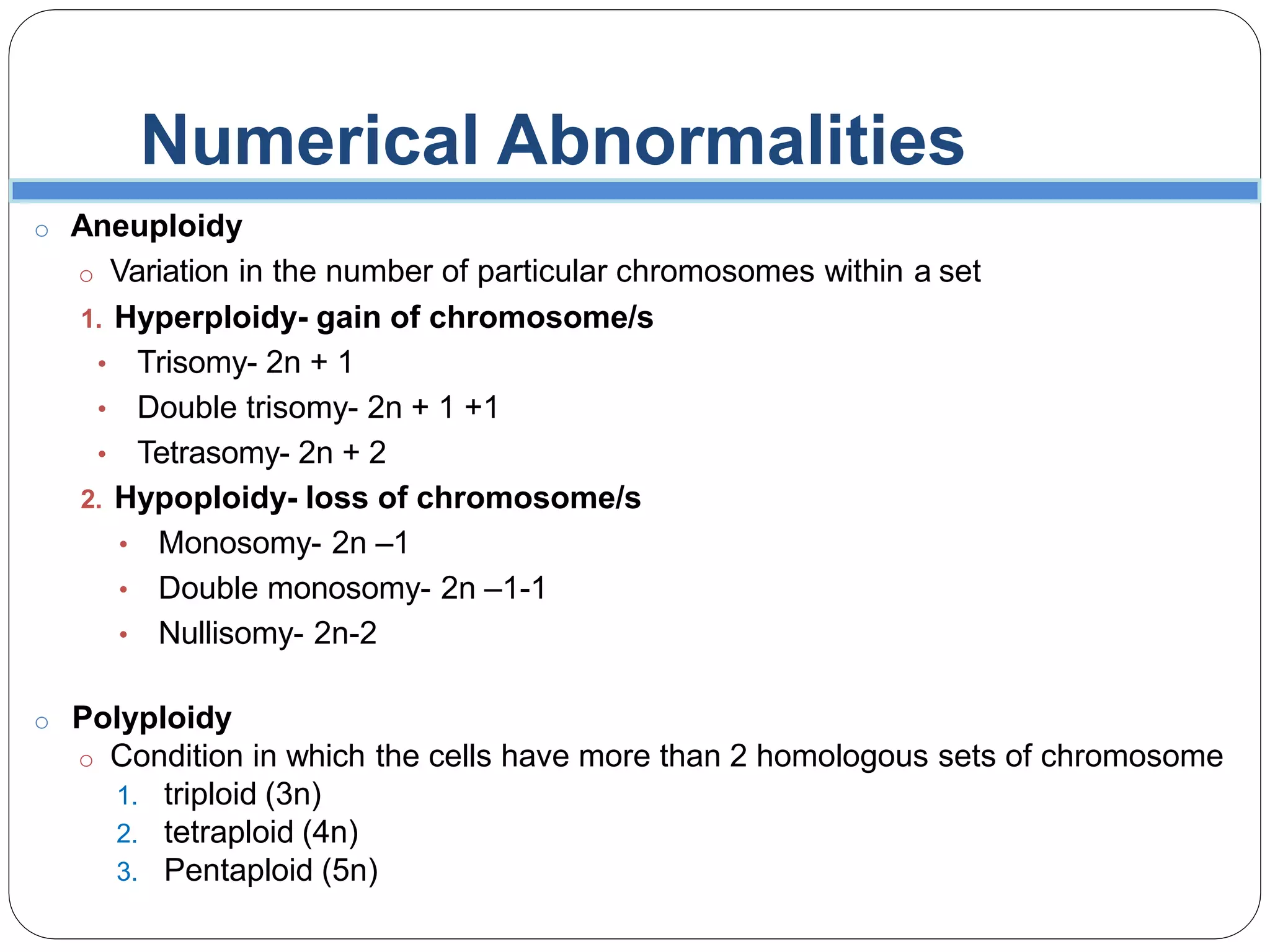
Numerical Abnormalities
o Aneuploidy
o Variation in the number of particular chromosomes within a set
1. Hyperploidy- gain of chromosome/s
• Trisomy- 2n + 1
• Double trisomy- 2n + 1 +1
• Tetrasomy- 2n + 2
2. Hypoploidy- loss of chromosome/s
• Monosomy- 2n –1
• Double monosomy- 2n –1-1
• Nullisomy- 2n-2
o Polyploidy
o Condition in which the cells have more than 2 homologous sets of chromosome
1. triploid (3n)
2. tetraploid (4n)
3. Pentaploid (5n)
o Aneuploidy of sex
chromosome
o Occurs in 1 in 500-1000
o Sterile
o No obvious facial
dysmorphy
o Narrower shoulders and
wider hips
Klinefelter Syndrome – 47, XXY
o Smaller testes and penis
o Decreased sexual
interest
o Weaker bones
o Lower energy
o Breast growth
o Less facial and body hair
o Reduced muscle tone
Klinefelter Syndrome – 47, XXY
Turner Syndrome – 47, X
o Aneuploidy of the sex
chromosome
o demonstrate visuospatial
deficits including poor
handwriting and likely
underdeveloped
arithmetic skills
Patau’s Syndrome - Trisomy 13
o Severe intellectual
disability
o Physical abnormalities in
in many parts of the
body
o Heart defects, brain and
spinal cord abnormalities
Patau’s Syndrome - Trisomy 13
o Very small or poorly
developed eyes
(micropthalmia)
o Extra fingers or toes
o Weak muscle tone
(hypotonia)
Edward’s Syndrome – Trisomy 18
o intestines protruding
outside the body
o intellectual disabilities
o delayed development
o feeding and breathing
difficulties
Edward’s Syndrome – Trisomy 18
muscle
causes
disorder
multiple
o Arthrogryposis - a
that
joint
contractures at birth
Down Syndrome - Trisomy 21
o physical growth delays
o severe degree of
intellectual disability
o short stature
o delayed mental and
social development
o Impulsive behavior
o Poor judgment
o Short attention span
o Slow learning
Down Syndrome - Trisomy 21
o Sleep apnea - sleep
disorder characterized
by pauses in breathing
or instances of shallow
or infrequent breathing
during sleep
o Dementia - decline in
mental ability severe
enough to interfere with
daily life, memory loss
o Hypothyroidism - under
active thyroid
Condition
Aneuploid Condition in Humans
Frequency Syndrome Characteristics
Trisomy 21 Mental retardation, abnormal pattern
of palm creases,slanted eyes,
flattened face, short stature
Trisomy 18 Mental and physical retardation,
facial abnormalities, extreme muscle
tone, early death
Trisomy 13 Mental and physical retardation, wide
variety of defects in organs, large
triangular nose, early death
XXY Sexual immaturity (no sperm), breast
swelling
XYY Tall
XXX Tall and thin, menstrual irregularity
X0
Autosomal
1/800 Down
1/6,000 Edward
1/15,000 Patau
Sex Chromosome
1/1,000 (males) Klinefelter
1/1,000 (males) Jacob
1/1,500 (females) Metafemale
1/1,500 (females) turner Short stature, webbed neck, sexualy
undeveloped
Effects of Nullisomics
• dwarf
• less tillering
• female fertile
• male sterile
• awnless
Nullisomics-Mutants of the Ear in
Wheat (Triticum aestivum)
Ear shape of the wild type (WT) and of
several mutants lacking single pairs of
chromosomes (nullisomics). Due to the
hexaploidy, the lack of a pair of
chromosomes is tolerated. The effects
are usually different though stunted
growth is usually one of them.
Polyploidy
- with more than 2 sets of genome
o most common in plants which are asexually propagated
and infrequent in animals
o for sexually reproducing organisms, sex chromosome
balance must be maintained
Detection:
• change in morphology
• change in fertility
• change in interspecific cross ability
Triploid Plants (3n)
Tetraploid Plants (4n)
Benefit of Odd Ploidy-Induced Sterility
 Seedless fruit
 watermelons and bananas
 asexually propagated by human via cuttings
 Seedless flowers
 Marigold flowering plants
 Prevention of cross pollination of transgenic
plants
Structural Abnormalities
Deletion
Duplication
Inversion
Translocation
Amount of genetic
information in the
chromosome can
change.
The genetic material
remains the same but
it is rearrange.
Deletion
o Loss of a region of chromosome
o A chromosomal deficiency occurs when a chromosome breaks
and a fragment is lost
 Phenotypic
consequences of
deficiency depends
on
 Size of the deletion
 Functions of the
genes deleted
 Phenotypic effect of
deletions usually
detrimental
Deficiencies
Interstitial
Terminal
Two types of deletion
Cri-du-chat Syndrome
o High-pitched cry
o intellectual disability
o delayed development
o small head size
o low birth weight
o weak muscle tone in
infant
DiGeorge Syndrome
o deletion in long arm of
chromosome #22
o congenital heart disease
o Cyanosis
o learning difficulties
o psychiatric disorders
Angelman Syndrome
o deletion in chromosome
#15
o uncontrolled laughter
o no speech development
Duplication
o A chromosomal duplication is usually caused by
abnormal events during recombination
Duplication
o Small duplications often
are not accompanied by a
phenotypic effect
o Large duplications
produce phenotypes
through imbalanced gene
dosage
o tend to be less
detrimental
o constitute a major force of
genome evolution.
Direct Inverted
Inversion
o A segment of chromosome that is flipped relative to that in the
homologue
o Two breaks in one chromosome
o The fragment generated rotates 180o and reinserts into the
chromosome
Pericentric -
involves p and q
arm
Paracentric -
involves only
one arm
Inversion
o arise from chromosome entanglements and breakages during
meiotic prophase; also from recombination between
transposable elements
o Cause linear rearrangement of genes in a chromosome
o In inversion heterozygotes , a loop forms from the pairing of
the inverted and non-inverted regions
Translocation
o When a segment of one chromosome becomes
attached to another
o In reciprocal translocations two non-homologous
chromosomes exchange genetic material
o Usually generate so-called balanced translocations
o Usually without phenotypic consequences
o Although can result in position effect
Reciprocal Translocation
• Involves two chromosomes
• One break in each chromosome
• The two chromosomes exchange broken segments
Robertsonian Translocation
• Named after W. R. B. Robertson who
first identified them in grasshoppers in
1916
• Most common structural chromosome
abnormality in humans
– Frequency = 1/1000 livebirths
• Involves two acrocentric
chromosomes
• Two types
– Homologous acrocentrics involved
– Non-Homologous acrocentrics
involved
+ =
lost
+ =
lost
Robertsonian Translocation
 This translocation occurs as such
 Breaks occur at the extreme ends
of the short arms of two non-
homologous acrocentric
chromosomes
 The small acentric fragments are
lost
 The larger fragments fuse at their
centromeic regions to form a single
chromosome
 This type of translocation is the most
common type of chromosomal
rearrangement in humans
Isochromosome & Ring Chromosome
o Mirror image chromosome
o Loss of one arm with
duplication of other
Loss of p-arm Duplication of q-arm
o Breaks occur in both arms of a
chromosome.
o The two broken ends anneal; the two
acentric fragments are lost.
o Results in double deletion (in p and in q).
o Epilepsy, mental retardation and
craniofacial abnormalities

chromosomalaberration-liwalug-150705204324-lva1-app6892.pptx

  • 1.
  • 2.
    Cytogenetics o Karyotype –microscopic examination of chromosome Main feature to identify and classify chromosomes 1. Size 2. Location of the centromere 3. Banding patterns
  • 3.
  • 4.
    Chromosomal Aberration o issubstantial changes in chromosome structure o typically affect multiple genes (loci) o due to error in cell division (non-disjunction of chromosomes and chromatids), maternal age or environment
  • 5.
    Meiotic Nondisjunction GeneratesAneuploidies abnormal gametes Zygotic Ploidy Zygotic Ploidy
  • 6.
    Types of ChromosomalAbnormalities o aneuploidy o polyploidy Numerical Abnormalities Structural Abnormalities o deletion o duplication o inversion o translocation
  • 7.
    Numerical Abnormalities o Aneuploidy oVariation in the number of particular chromosomes within a set 1. Hyperploidy- gain of chromosome/s • Trisomy- 2n + 1 • Double trisomy- 2n + 1 +1 • Tetrasomy- 2n + 2 2. Hypoploidy- loss of chromosome/s • Monosomy- 2n –1 • Double monosomy- 2n –1-1 • Nullisomy- 2n-2 o Polyploidy o Condition in which the cells have more than 2 homologous sets of chromosome 1. triploid (3n) 2. tetraploid (4n) 3. Pentaploid (5n)
  • 10.
    o Aneuploidy ofsex chromosome o Occurs in 1 in 500-1000 o Sterile o No obvious facial dysmorphy o Narrower shoulders and wider hips Klinefelter Syndrome – 47, XXY
  • 11.
    o Smaller testesand penis o Decreased sexual interest o Weaker bones o Lower energy o Breast growth o Less facial and body hair o Reduced muscle tone Klinefelter Syndrome – 47, XXY
  • 12.
    Turner Syndrome –47, X o Aneuploidy of the sex chromosome o demonstrate visuospatial deficits including poor handwriting and likely underdeveloped arithmetic skills
  • 13.
    Patau’s Syndrome -Trisomy 13 o Severe intellectual disability o Physical abnormalities in in many parts of the body o Heart defects, brain and spinal cord abnormalities
  • 14.
    Patau’s Syndrome -Trisomy 13 o Very small or poorly developed eyes (micropthalmia) o Extra fingers or toes o Weak muscle tone (hypotonia)
  • 15.
    Edward’s Syndrome –Trisomy 18 o intestines protruding outside the body o intellectual disabilities o delayed development o feeding and breathing difficulties
  • 16.
    Edward’s Syndrome –Trisomy 18 muscle causes disorder multiple o Arthrogryposis - a that joint contractures at birth
  • 17.
    Down Syndrome -Trisomy 21 o physical growth delays o severe degree of intellectual disability o short stature o delayed mental and social development o Impulsive behavior o Poor judgment o Short attention span o Slow learning
  • 18.
    Down Syndrome -Trisomy 21 o Sleep apnea - sleep disorder characterized by pauses in breathing or instances of shallow or infrequent breathing during sleep o Dementia - decline in mental ability severe enough to interfere with daily life, memory loss o Hypothyroidism - under active thyroid
  • 19.
    Condition Aneuploid Condition inHumans Frequency Syndrome Characteristics Trisomy 21 Mental retardation, abnormal pattern of palm creases,slanted eyes, flattened face, short stature Trisomy 18 Mental and physical retardation, facial abnormalities, extreme muscle tone, early death Trisomy 13 Mental and physical retardation, wide variety of defects in organs, large triangular nose, early death XXY Sexual immaturity (no sperm), breast swelling XYY Tall XXX Tall and thin, menstrual irregularity X0 Autosomal 1/800 Down 1/6,000 Edward 1/15,000 Patau Sex Chromosome 1/1,000 (males) Klinefelter 1/1,000 (males) Jacob 1/1,500 (females) Metafemale 1/1,500 (females) turner Short stature, webbed neck, sexualy undeveloped
  • 20.
    Effects of Nullisomics •dwarf • less tillering • female fertile • male sterile • awnless Nullisomics-Mutants of the Ear in Wheat (Triticum aestivum) Ear shape of the wild type (WT) and of several mutants lacking single pairs of chromosomes (nullisomics). Due to the hexaploidy, the lack of a pair of chromosomes is tolerated. The effects are usually different though stunted growth is usually one of them.
  • 21.
    Polyploidy - with morethan 2 sets of genome o most common in plants which are asexually propagated and infrequent in animals o for sexually reproducing organisms, sex chromosome balance must be maintained Detection: • change in morphology • change in fertility • change in interspecific cross ability
  • 22.
  • 23.
    Benefit of OddPloidy-Induced Sterility  Seedless fruit  watermelons and bananas  asexually propagated by human via cuttings  Seedless flowers  Marigold flowering plants  Prevention of cross pollination of transgenic plants
  • 24.
    Structural Abnormalities Deletion Duplication Inversion Translocation Amount ofgenetic information in the chromosome can change. The genetic material remains the same but it is rearrange.
  • 25.
    Deletion o Loss ofa region of chromosome o A chromosomal deficiency occurs when a chromosome breaks and a fragment is lost
  • 26.
     Phenotypic consequences of deficiencydepends on  Size of the deletion  Functions of the genes deleted  Phenotypic effect of deletions usually detrimental Deficiencies Interstitial Terminal Two types of deletion
  • 27.
    Cri-du-chat Syndrome o High-pitchedcry o intellectual disability o delayed development o small head size o low birth weight o weak muscle tone in infant
  • 28.
    DiGeorge Syndrome o deletionin long arm of chromosome #22 o congenital heart disease o Cyanosis o learning difficulties o psychiatric disorders
  • 29.
    Angelman Syndrome o deletionin chromosome #15 o uncontrolled laughter o no speech development
  • 30.
    Duplication o A chromosomalduplication is usually caused by abnormal events during recombination
  • 31.
    Duplication o Small duplicationsoften are not accompanied by a phenotypic effect o Large duplications produce phenotypes through imbalanced gene dosage o tend to be less detrimental o constitute a major force of genome evolution. Direct Inverted
  • 32.
    Inversion o A segmentof chromosome that is flipped relative to that in the homologue o Two breaks in one chromosome o The fragment generated rotates 180o and reinserts into the chromosome Pericentric - involves p and q arm Paracentric - involves only one arm
  • 33.
    Inversion o arise fromchromosome entanglements and breakages during meiotic prophase; also from recombination between transposable elements o Cause linear rearrangement of genes in a chromosome o In inversion heterozygotes , a loop forms from the pairing of the inverted and non-inverted regions
  • 34.
    Translocation o When asegment of one chromosome becomes attached to another o In reciprocal translocations two non-homologous chromosomes exchange genetic material o Usually generate so-called balanced translocations o Usually without phenotypic consequences o Although can result in position effect
  • 35.
    Reciprocal Translocation • Involvestwo chromosomes • One break in each chromosome • The two chromosomes exchange broken segments
  • 36.
    Robertsonian Translocation • Namedafter W. R. B. Robertson who first identified them in grasshoppers in 1916 • Most common structural chromosome abnormality in humans – Frequency = 1/1000 livebirths • Involves two acrocentric chromosomes • Two types – Homologous acrocentrics involved – Non-Homologous acrocentrics involved + = lost + = lost
  • 37.
    Robertsonian Translocation  Thistranslocation occurs as such  Breaks occur at the extreme ends of the short arms of two non- homologous acrocentric chromosomes  The small acentric fragments are lost  The larger fragments fuse at their centromeic regions to form a single chromosome  This type of translocation is the most common type of chromosomal rearrangement in humans
  • 38.
    Isochromosome & RingChromosome o Mirror image chromosome o Loss of one arm with duplication of other Loss of p-arm Duplication of q-arm o Breaks occur in both arms of a chromosome. o The two broken ends anneal; the two acentric fragments are lost. o Results in double deletion (in p and in q). o Epilepsy, mental retardation and craniofacial abnormalities