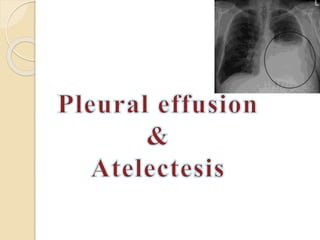
Pleural effusion
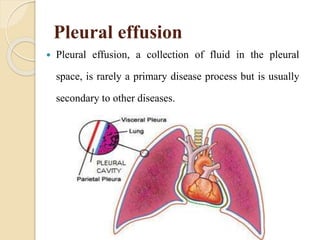
 Pleural effusion, a collection of fluid in the pleural
space, is rarely a primary disease process but is usually
secondary to other diseases.
Causes
Pleural effusion may be a complication of :-
 Heart failure,
 Tuberculosis,
 Pneumonia,
 Pulmonary infections,
 Nephritic syndrome,
 Connective tissue disease,
 Pulmonary embolism, and
 Neoplasm (tumor).
Pathophysiology
The effusion can be composed of a relatively clear fluid, or it can
be bloody or purulent.
An effusion of clear fluid may be a transudate or an exudate.
(Transudate is fluid pushed through the capillary due to high
pressure within the capillary. Exudate is fluid that leaks
around the cells of the capillaries caused by inflammation.)
A transudate (filtrates of plasma that move across intact capillary
walls) occurs when factors influencing the formation and re-
absorption of pleural fluid are altered, usually by imbalances in
hydrostatic or oncotic pressures.
Continued..
The finding of a transudative effusion generally implies that
the pleural membranes are not diseased.
The most common cause of a transudative effusion is heart
failure.
An exudates (extravasation of fluid into tissues or a cavity)
usually results from inflammation by bacterial products
or tumors involving the pleural surfaces.
Clinical Manifestations
 Pneumonia causes fever, chills,
 Pleuritic chest pain,
 Malignant effusion may result in dyspnea
and coughing.
 A large pleural effusion causes shortness of
breath.
Assessment and Diagnostic
Findings
 Assessment of the area of the pleural effusion
reveals decreased or absent breath sounds,
decreased fremitus, and a dull, flat sound
when percussed.
 In an extremely large pleural effusion, the
assessment reveals a patient in acute
respiratory distress.
Continued..
 Tracheal deviation away from the affected side may
also be noted.
 Physical examination, chest x-ray, chest CT scan,
and thoracentesis confirm the presence of fluid.
 In some instances, a lateral decubitus x-ray is
obtained.
 A pleural effusion can be diagnosed because this
position allows for the “layering out” of the fluid,
and an air–fluid line is visible
Continued..
 Pleural fluid analysis by bacterial culture,
Gram stain, acid fast bacillus stain (for TB),
red and white blood cell counts, chemistry
studies (glucose, amylase, lactic
dehydrogenase, protein), cytologic analysis for
malignant cells, and pH.
Medical management
 The objectives of treatment :
 discover the underlying cause
 to prevent re accumulation of fluid, and to relieve
discomfort, dyspnea, and respiratory compromise.
 Specific treatment is directed at the underlying
cause (eg, heart failure, pneumonia, lung cancer,
cirrhosis).
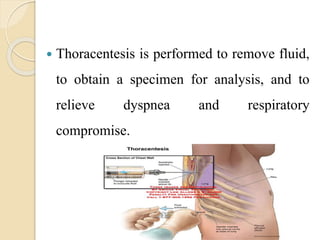
 Thoracentesis is performed to remove fluid,
to obtain a specimen for analysis, and to
relieve dyspnea and respiratory
compromise.
CONTINUED..
 Repeated thoracenteses result in pain, depletion of
protein and electrolytes, and sometimes
pneumothorax.
 Once the pleural space is adequately drained, a
chemical pleurodesis may be performed to obliterate
the pleural space and prevent reaccumulation of fluid
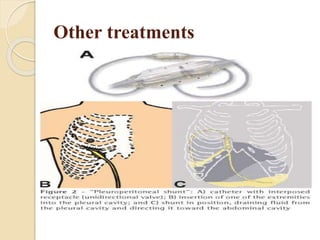
Other treatments
 Surgical pleurectomy
 Insertion of a small catheter attached to a
drainage bottle for outpatient management
 Implantation of a Pleura peritoneal shunt
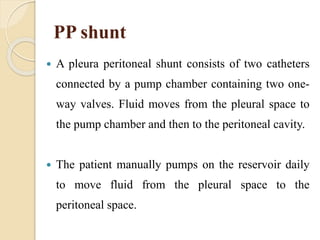
PP shunt
 A pleura peritoneal shunt consists of two catheters
connected by a pump chamber containing two one-
way valves. Fluid moves from the pleural space to
the pump chamber and then to the peritoneal cavity.
 The patient manually pumps on the reservoir daily
to move fluid from the pleural space to the
peritoneal space.
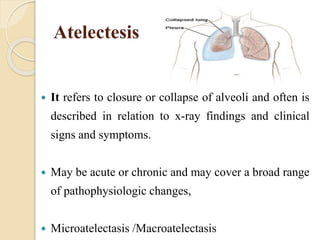
Atelectesis
 It refers to closure or collapse of alveoli and often is
described in relation to x-ray findings and clinical
signs and symptoms.
 May be acute or chronic and may cover a broad range
of pathophysiologic changes,
 Microatelectasis /Macroatelectasis
Continued..
 Excess secretions or mucus plugs may also cause
obstruction of airflow and result in atelectasis in an area
of the lung.
 Atelectasis also is observed in patients with a chronic
airway obstruction that impedes or blocks air flow to an
area of the lung
 Atelectasis resulting from bronchial obstruction by
secretions may occur in patients with impaired cough
mechanisms (eg, postoperative, musculoskeletal or
neurologic disorders) or in debilitated, bedridden patients.
 Atelectasis may also result from excessive pressure
on the lung tissue, which restricts normal lung
expansion on inspiration.
 Such pressure may be produced by fluid
accumulating within the pleural space (pleural
effusion), air in the pleural space (pneumothorax),
or blood in the pleural space (hemothorax).
Pathophysiology
 Following obstruction of bronchus the blood
circulating absorbs gas from alveoli
 Lead to retraction of lungs
 Blood perfuses unventillated lung
 Results in arterial hypoximea
 Uninvolved surrounding lung distends displacing
surrounding structures
 Mediastinal shift
Clinical manifestations
 Fever is universally cited as a clinical sign of
atelectasis,
 marked respiratory distress in In acute
atelectasis involving a large amount of lung
tissue (lobar atelectasis),
 Dyspnea, tachycardia, tachypnea, pleural pain,
and central cyanosis
Assessment and Diagnostic
Findings
 Decreased breath sounds and crackles are heard
over the affected area.
 In addition, chest x-ray findings may reveal patchy
infiltrates or consolidated areas.
 Pulse oximetry (SpO2) may demonstrate a low
saturation of hemoglobin with oxygen (less than
90%) or a lower-than-normal partial pressure of
arterial oxygen (PaO2).
CONTINUED..
 Cough, Sputum Production, And Low-grade Fever.
 Dyspnea,
 Tachycardia,tachypnea
 Pleural Pain
 Central Cyanosis
Management
 First line measures:
 frequent turning, early ambulation, lung
volume expansion maneuvers (eg, deep-
breathing exercises, incentive spirometry),
and coughing
Other treatments such as positive expiratory
pressure or PEP therapy (a simple mask and one
way valve system that provides varying amounts of
expiratory resistance [usually 5 to 15 cm H2O])
Continuous or intermittent positive pressure-
breathing (IPPB)
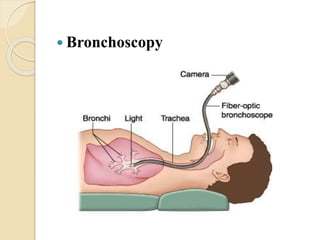
 Bronchoscopy
Continued..
 Chest physical therapy to mobilize secretions.
 Nebulizer treatments with a bronchodilator medication or
sodium bicarbonate.
 Endotracheal intubation and mechanical ventilation
may be necessary.
 With a large pleural effusion that is compressing lung
tissue and causing alveolar collapse, treatment may
include thoracentesis,
 removal of the fluid by needle aspiration, or insertion of
a chest tube.
Continued..
 Management of chronic atelectasis focuses on
removing the cause of the obstruction of the
airways or the compression of the lung tissue.
 Bronchoscopy may be used to open an airway
obstructed by lung cancer or a nonmalignant
lesion, and the procedure may involve
cryotherapy or laser therapy.
Nursing management
 Nursing Assessment
 Obtain history of previous pulmonary
condition.
 Assess patient for dyspnea and tachypnea.
 Auscultate and percuss lungs for abnormalities
 Presence of respiratory secretions
Nursing diagnosis
1. Ineffective Breathing Pattern related to collection of fluid in
pleural space
2. Ineffective tissue perfusion related to decreased lung compliance
secondary to disease condition as evidenced by decreased SPO2.
3. Altered body temperature related to infection secondary to
disease condition as evidenced by patient’s body temperature
(38.6 degree Celsius).
4. Self care deficit related to critical condition of health and
mechanical ventilator secondary to sedation.
5. Anxiety related to unknown outcome.
Continued..
6. Knowledge deficient regarding condition, treatment
and self-care.
7. Risk for impaired skin integrity related to prolonged
immobility secondary to disease condition.
8. Risk for infection related to invasive procedures as
well as invasive and non invasive lines.
9. Anticipatory grieving related to perceived impending
death of the patient.
Maintaining Normal Breathing
Pattern
• Observe patient's breathing pattern, oxygen saturation,
and other vital signs, for evidence of improvement or
deterioration
• Administered oxygen as indicated by dyspnea and
hypoxemia.
• Mechanical ventilator parameters were monitored
• Patient was positioned in propped up position.
Maintain effective and patent airway
Interventions
 The patient’s respiratory status was assessed
 Auscultation of breath sounds done.
 Signs of cyanosis, dyspnea and hypoxia
observed.
 Patient’s ABG levels monitored regularly.
 Patient kept in a propped up or Fowler’s
position.
Continued..
 Humidification provided.
 Chest physiotherapy was provided to the
patient
 Suctioning was done under aseptic
techniques.
Maintaining effective tissue
perfusion
 The patient’s respiratory status was assessed.
 Auscultation of breath sounds was done.
 Signs of cyanosis, dyspnea and hypoxia observed.
 Patient’s ABG levels were monitored regularly.
 Vital signs monitored regularly.
 Patient kept in a propped up position.
 Ventilator circuits checked for any leakage.
 Adequate hyper-oxygenation done prior to and after
suctioning.
Reduce fever
 Vital signs monitored regularly.
 Blood investigations (TLC, Blood CS and ET
aspirate) were sent as prescribed.
 Sponging done.
 Cool environment was maintained
 Administered antipyretic and antibiotics as
prescribed.
Continued..
 I.V. tubing/lines were changed according
to hospital protocol.
 Hydration of the patient was maintained
via feed
 Temperature reassessed every 2 hourly.
To reduce anxiety
 Anxiety level along with previous coping mechanism of the
family was assessed
 Established trusting relationship with family
 Family encouraged to ask questions & clarify doubts
 Family provided explanation in simple words
 Importance and rationale for ventilation and ET insertion was
explained.
 Family members involved in plan of care.
 Diversional activities encouraged.
To maintain skin integrity
 Assessment of the patient’s skin was done
carefully for signs of infection, inflammation, and
breakdown.
 Patient’s position changed every 2 hours.
 Skin care and back care provided.
 Soiled linen and clothes were changed
accordingly
 Nutritional status of the patient was maintained
References
 Woods S.L.et al. Cardiac nursing . Lippincott Williams & Wilkins. 2000
 Lippincott Manual of Nursing Practice. 8th edition. Lippincott Williams &
Wilkins Publishers; 2010. p. 68, 328-332, 361.
 Smeltznner SC, Bare BG, Hinkle JL, Cheever KH. Brunner & Suddarth’s
Textbook of Medical-Surgical Nursing. 11th edition. Lippincott Williams &
Wilkins Publishers; 2008. p. 789-805.
 Longo et al.Harrisons principles of internal medicine.18(2):2012
 Chintamoni Lewis LS et al.Lewis’s medical surgical nursing:assessment
and management of clinical problems.7. New delhi.ELSEVIER;2011

Pleural effusion

  • 2.
    Pleural effusion  Pleuraleffusion, a collection of fluid in the pleural space, is rarely a primary disease process but is usually secondary to other diseases.
  • 3.
    Causes Pleural effusion maybe a complication of :-  Heart failure,  Tuberculosis,  Pneumonia,  Pulmonary infections,  Nephritic syndrome,  Connective tissue disease,  Pulmonary embolism, and  Neoplasm (tumor).
  • 4.
    Pathophysiology The effusion canbe composed of a relatively clear fluid, or it can be bloody or purulent. An effusion of clear fluid may be a transudate or an exudate. (Transudate is fluid pushed through the capillary due to high pressure within the capillary. Exudate is fluid that leaks around the cells of the capillaries caused by inflammation.) A transudate (filtrates of plasma that move across intact capillary walls) occurs when factors influencing the formation and re- absorption of pleural fluid are altered, usually by imbalances in hydrostatic or oncotic pressures.
  • 5.
    Continued.. The finding ofa transudative effusion generally implies that the pleural membranes are not diseased. The most common cause of a transudative effusion is heart failure. An exudates (extravasation of fluid into tissues or a cavity) usually results from inflammation by bacterial products or tumors involving the pleural surfaces.
  • 6.
    Clinical Manifestations  Pneumoniacauses fever, chills,  Pleuritic chest pain,  Malignant effusion may result in dyspnea and coughing.  A large pleural effusion causes shortness of breath.
  • 7.
    Assessment and Diagnostic Findings Assessment of the area of the pleural effusion reveals decreased or absent breath sounds, decreased fremitus, and a dull, flat sound when percussed.  In an extremely large pleural effusion, the assessment reveals a patient in acute respiratory distress.
  • 8.
    Continued..  Tracheal deviationaway from the affected side may also be noted.  Physical examination, chest x-ray, chest CT scan, and thoracentesis confirm the presence of fluid.  In some instances, a lateral decubitus x-ray is obtained.  A pleural effusion can be diagnosed because this position allows for the “layering out” of the fluid, and an air–fluid line is visible
  • 9.
    Continued..  Pleural fluidanalysis by bacterial culture, Gram stain, acid fast bacillus stain (for TB), red and white blood cell counts, chemistry studies (glucose, amylase, lactic dehydrogenase, protein), cytologic analysis for malignant cells, and pH.
  • 10.
    Medical management  Theobjectives of treatment :  discover the underlying cause  to prevent re accumulation of fluid, and to relieve discomfort, dyspnea, and respiratory compromise.  Specific treatment is directed at the underlying cause (eg, heart failure, pneumonia, lung cancer, cirrhosis).
  • 11.
     Thoracentesis isperformed to remove fluid, to obtain a specimen for analysis, and to relieve dyspnea and respiratory compromise.
  • 12.
    CONTINUED..  Repeated thoracentesesresult in pain, depletion of protein and electrolytes, and sometimes pneumothorax.  Once the pleural space is adequately drained, a chemical pleurodesis may be performed to obliterate the pleural space and prevent reaccumulation of fluid
  • 13.
    Other treatments  Surgicalpleurectomy  Insertion of a small catheter attached to a drainage bottle for outpatient management  Implantation of a Pleura peritoneal shunt
  • 14.
    PP shunt  Apleura peritoneal shunt consists of two catheters connected by a pump chamber containing two one- way valves. Fluid moves from the pleural space to the pump chamber and then to the peritoneal cavity.  The patient manually pumps on the reservoir daily to move fluid from the pleural space to the peritoneal space.
  • 15.
    Atelectesis  It refersto closure or collapse of alveoli and often is described in relation to x-ray findings and clinical signs and symptoms.  May be acute or chronic and may cover a broad range of pathophysiologic changes,  Microatelectasis /Macroatelectasis
  • 16.
    Continued..  Excess secretionsor mucus plugs may also cause obstruction of airflow and result in atelectasis in an area of the lung.  Atelectasis also is observed in patients with a chronic airway obstruction that impedes or blocks air flow to an area of the lung  Atelectasis resulting from bronchial obstruction by secretions may occur in patients with impaired cough mechanisms (eg, postoperative, musculoskeletal or neurologic disorders) or in debilitated, bedridden patients.
  • 17.
     Atelectasis mayalso result from excessive pressure on the lung tissue, which restricts normal lung expansion on inspiration.  Such pressure may be produced by fluid accumulating within the pleural space (pleural effusion), air in the pleural space (pneumothorax), or blood in the pleural space (hemothorax).
  • 18.
    Pathophysiology  Following obstructionof bronchus the blood circulating absorbs gas from alveoli  Lead to retraction of lungs  Blood perfuses unventillated lung  Results in arterial hypoximea  Uninvolved surrounding lung distends displacing surrounding structures  Mediastinal shift
  • 19.
    Clinical manifestations  Feveris universally cited as a clinical sign of atelectasis,  marked respiratory distress in In acute atelectasis involving a large amount of lung tissue (lobar atelectasis),  Dyspnea, tachycardia, tachypnea, pleural pain, and central cyanosis
  • 20.
    Assessment and Diagnostic Findings Decreased breath sounds and crackles are heard over the affected area.  In addition, chest x-ray findings may reveal patchy infiltrates or consolidated areas.  Pulse oximetry (SpO2) may demonstrate a low saturation of hemoglobin with oxygen (less than 90%) or a lower-than-normal partial pressure of arterial oxygen (PaO2).
  • 21.
    CONTINUED..  Cough, SputumProduction, And Low-grade Fever.  Dyspnea,  Tachycardia,tachypnea  Pleural Pain  Central Cyanosis
  • 22.
    Management  First linemeasures:  frequent turning, early ambulation, lung volume expansion maneuvers (eg, deep- breathing exercises, incentive spirometry), and coughing
  • 23.
    Other treatments suchas positive expiratory pressure or PEP therapy (a simple mask and one way valve system that provides varying amounts of expiratory resistance [usually 5 to 15 cm H2O]) Continuous or intermittent positive pressure- breathing (IPPB)
  • 24.
  • 25.
    Continued..  Chest physicaltherapy to mobilize secretions.  Nebulizer treatments with a bronchodilator medication or sodium bicarbonate.  Endotracheal intubation and mechanical ventilation may be necessary.  With a large pleural effusion that is compressing lung tissue and causing alveolar collapse, treatment may include thoracentesis,  removal of the fluid by needle aspiration, or insertion of a chest tube.
  • 26.
    Continued..  Management ofchronic atelectasis focuses on removing the cause of the obstruction of the airways or the compression of the lung tissue.  Bronchoscopy may be used to open an airway obstructed by lung cancer or a nonmalignant lesion, and the procedure may involve cryotherapy or laser therapy.
  • 27.
    Nursing management  NursingAssessment  Obtain history of previous pulmonary condition.  Assess patient for dyspnea and tachypnea.  Auscultate and percuss lungs for abnormalities  Presence of respiratory secretions
  • 28.
    Nursing diagnosis 1. IneffectiveBreathing Pattern related to collection of fluid in pleural space 2. Ineffective tissue perfusion related to decreased lung compliance secondary to disease condition as evidenced by decreased SPO2. 3. Altered body temperature related to infection secondary to disease condition as evidenced by patient’s body temperature (38.6 degree Celsius). 4. Self care deficit related to critical condition of health and mechanical ventilator secondary to sedation. 5. Anxiety related to unknown outcome.
  • 29.
    Continued.. 6. Knowledge deficientregarding condition, treatment and self-care. 7. Risk for impaired skin integrity related to prolonged immobility secondary to disease condition. 8. Risk for infection related to invasive procedures as well as invasive and non invasive lines. 9. Anticipatory grieving related to perceived impending death of the patient.
  • 30.
    Maintaining Normal Breathing Pattern •Observe patient's breathing pattern, oxygen saturation, and other vital signs, for evidence of improvement or deterioration • Administered oxygen as indicated by dyspnea and hypoxemia. • Mechanical ventilator parameters were monitored • Patient was positioned in propped up position.
  • 31.
    Maintain effective andpatent airway Interventions  The patient’s respiratory status was assessed  Auscultation of breath sounds done.  Signs of cyanosis, dyspnea and hypoxia observed.  Patient’s ABG levels monitored regularly.  Patient kept in a propped up or Fowler’s position.
  • 32.
    Continued..  Humidification provided. Chest physiotherapy was provided to the patient  Suctioning was done under aseptic techniques.
  • 33.
    Maintaining effective tissue perfusion The patient’s respiratory status was assessed.  Auscultation of breath sounds was done.  Signs of cyanosis, dyspnea and hypoxia observed.  Patient’s ABG levels were monitored regularly.  Vital signs monitored regularly.  Patient kept in a propped up position.  Ventilator circuits checked for any leakage.  Adequate hyper-oxygenation done prior to and after suctioning.
  • 34.
    Reduce fever  Vitalsigns monitored regularly.  Blood investigations (TLC, Blood CS and ET aspirate) were sent as prescribed.  Sponging done.  Cool environment was maintained  Administered antipyretic and antibiotics as prescribed.
  • 35.
    Continued..  I.V. tubing/lineswere changed according to hospital protocol.  Hydration of the patient was maintained via feed  Temperature reassessed every 2 hourly.
  • 36.
    To reduce anxiety Anxiety level along with previous coping mechanism of the family was assessed  Established trusting relationship with family  Family encouraged to ask questions & clarify doubts  Family provided explanation in simple words  Importance and rationale for ventilation and ET insertion was explained.  Family members involved in plan of care.  Diversional activities encouraged.
  • 37.
    To maintain skinintegrity  Assessment of the patient’s skin was done carefully for signs of infection, inflammation, and breakdown.  Patient’s position changed every 2 hours.  Skin care and back care provided.  Soiled linen and clothes were changed accordingly  Nutritional status of the patient was maintained
  • 38.
    References  Woods S.L.etal. Cardiac nursing . Lippincott Williams & Wilkins. 2000  Lippincott Manual of Nursing Practice. 8th edition. Lippincott Williams & Wilkins Publishers; 2010. p. 68, 328-332, 361.  Smeltznner SC, Bare BG, Hinkle JL, Cheever KH. Brunner & Suddarth’s Textbook of Medical-Surgical Nursing. 11th edition. Lippincott Williams & Wilkins Publishers; 2008. p. 789-805.  Longo et al.Harrisons principles of internal medicine.18(2):2012  Chintamoni Lewis LS et al.Lewis’s medical surgical nursing:assessment and management of clinical problems.7. New delhi.ELSEVIER;2011

Editor's Notes

  • #9 For this x-ray, the patient lies on the affected side in a side-lying position.