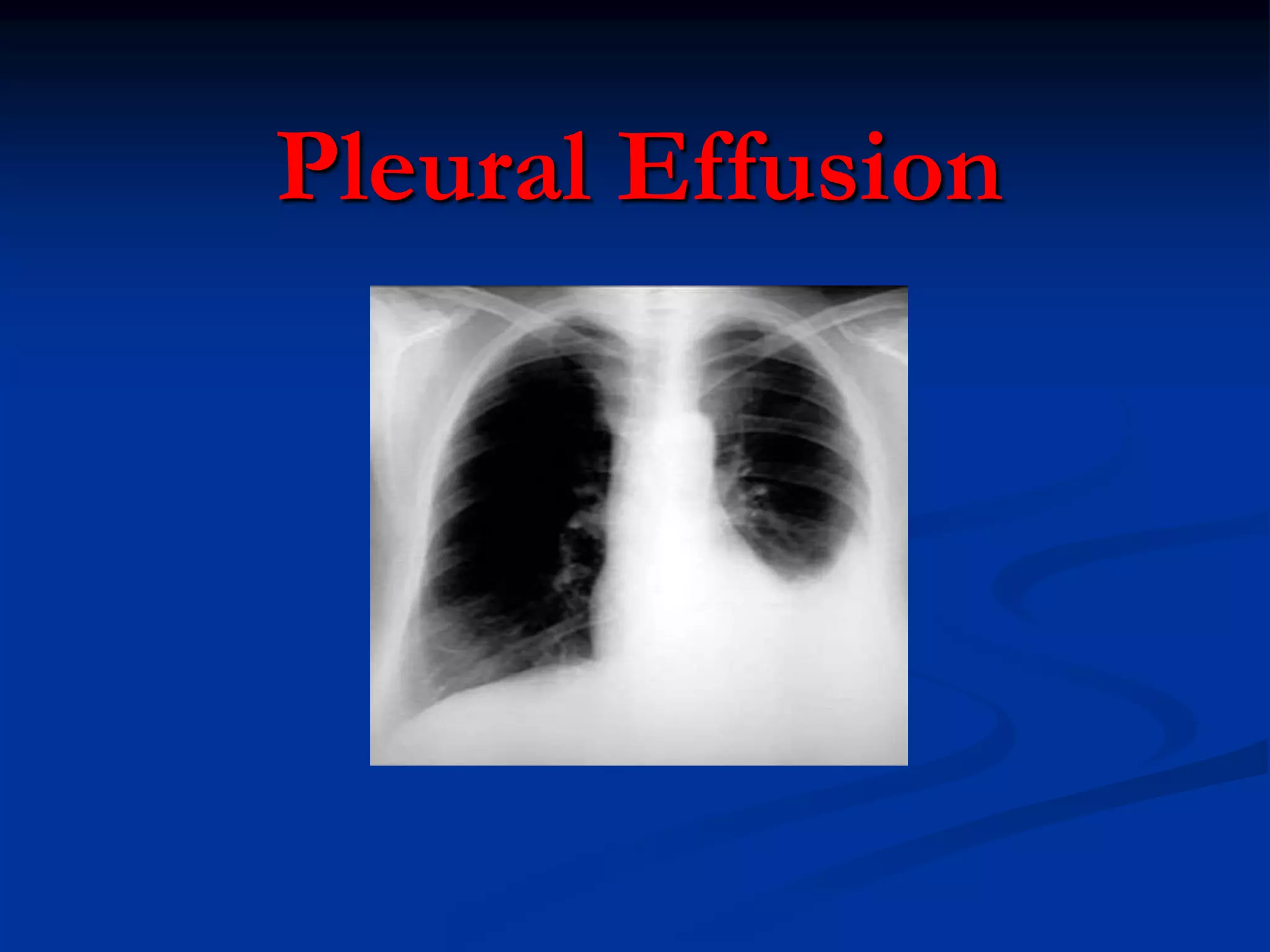
Pleural Effusion
PLEURA
2
Parietal pleura
, and ribs.
Visceral pleura
envelope all surfaces
of.
Hilum
where pulmonary vessels, bronchi, and nerves
enter the lung tissue, the parietal pleura is
continuous with the visceral pleura.
PLEURAL EFFUSION
Normally the pleural space contains:
• 3.5 to 7.0 ml of clear liquid
• low protein content
• small number of mononuclear cells
Pleural effusion: presence of large amount of fluid
in the pleural space irrespective of the underlying
causes
• The rate of fluid formation is 0.02 ml/kg/hour.
• The rate of fluid clearance is 0.2 ml/kg/hour.
PLEURAL FLUID FORMATION AND ABSORTION
6
Starling’s Law
Fluid movement
Starling’s law :
L . A [ (PCAP – PPl) – (CAP – Pl) ]
L: Filtration coefficient
A: Surface area
Cap: Capillary
Pl: Pleural
Pleural Space
Intercostal
Micro vessels
PLEURAL FLUID
VEIN
ARTERY
LYMPHATICS TO
MEDIASTINAL
NODES
STOMA
?
Bronchial Micro vessels
VEIN
ARTERY
VISCERAL PLEURAL
PARIETAL PLEURAL
PLEURAL SPACE
Pleural Fluid Formation and Absorption
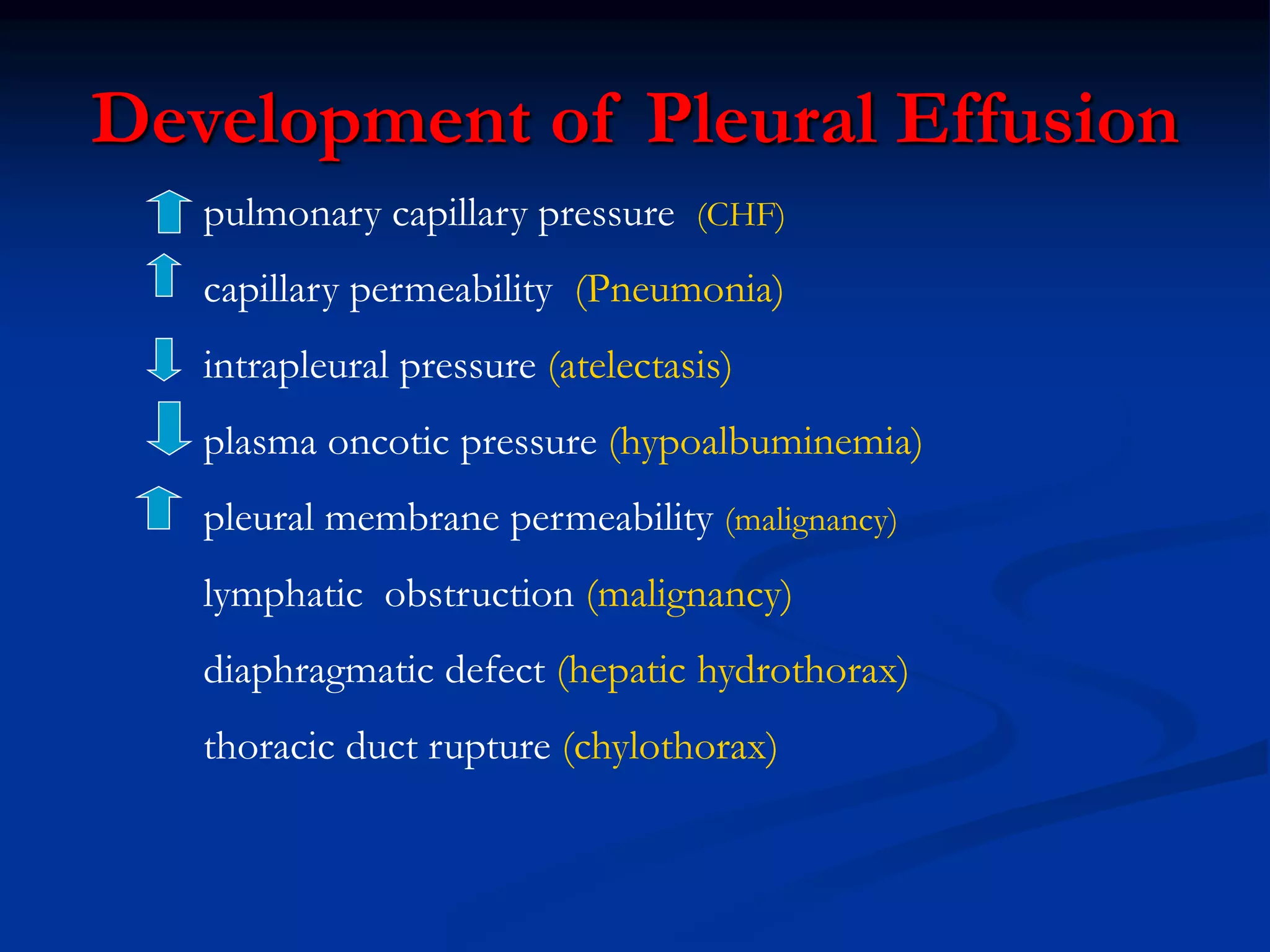
Development of Pleural Effusion
pulmonary capillary pressure (CHF)
capillary permeability (Pneumonia)
intrapleural pressure (atelectasis)
plasma oncotic pressure (hypoalbuminemia)
pleural membrane permeability (malignancy)
lymphatic obstruction (malignancy)
diaphragmatic defect (hepatic hydrothorax)
thoracic duct rupture (chylothorax)
Other causes of pleural effusion: nephrotic syndrome, TB, collagen vascular disease,
urinothorax, SVC syndrome, Meigs syndrome, rheumatoid arthritis, pancreatitis, yellow-
nail syndrome, drugs
key symptom shortness of breath
Fluid filling the pleural space makes it hard for the lungs to fully expand, causing the
patient to take many breaths so as to get enough oxygen.
If parietal pleura is irritated mild pain or a sharp stabbing
pleuritic type of pain.
Some patients will have a dry cough.
symptom
Symptoms
Symptoms
Occasionally ------> no symptoms at all.
 This is more likely when the effusion collects gradually
 Chest examination will reveal stony dullness, and decrease/absent breath
sounds
Pleural Effusion
 Pleural effusion is an abnormal accumulation
of fluid in the pleural space. The 5 major types
of pleural effusion are:
 Transudate,
 Exudate,
 Empyema,
 Hemorrhagic pleural effusion or hemothorax and
 Chylous or chyliform effusion.
Evaluation
 History:
dyspnea
pleuritic chest pain
cough
fever
hemoptysis
wt. loss
trauma
hx cancer
cardiac surgery
 Physical:
Dullness to percussion
Decreased breath sounds
Absent tactile fremitus
Light. NEJM 2002; 346:1971
Annual incidence in the US
Causes of Pleural Effusion
Other causes of pleural effusion: nephrotic syndrome, TB, collagen vascular disease,
urinothorax, SVC syndrome, Meigs syndrome, rheumatoid arthritis, pancreatitis, yellow-
nail syndrome, drugs
Chest Xray
Chest X-Ray
PA
Lateral decubitus
Pleural effusion
Pleural effusion
Thoracentesis
Indications for thoracentesis
 Effusions larger than 1cm height of unknown
origin
 No need for thoracentesis for patient with
obvious cause (CHF with bilateral effusions).
However:
 In heart failure: febrile/pleuritic pain, unilateral, no
cardiomegaly, no response to diuresis
Pleural fluid analysis
Appearance
Bloody Hct <1% not significant, 1-20%= CA, PE, Trauma
>50% serum Hct = hemothorax
Cloudy trig level >110mg/dl = chylothorax
Putrid odor stain and culture = infection?
Transudate vs Exudate?
Exudate v Transudate
Patient’s serum protein is normal
 Pleural protein is less than 25 g/l =Transudate
 Pleural Protein more than35 g/l.= Exudate
 If not, Light’s criteria
Light’s Criteria
Pleural fluid is exudate if one or more:
Pleural fluid protein:serum protein > 0.5
Pleural fluid LDH:serum LDH > 0.6
Pleural fluid LDH > 2/3 upper limit nl serum
LDH
Transudate
CHF
Cirrhosis
Nephrotic syndrome
Exudate
Pneumonia
Malignancy
Pulmonary Embolism
Exudative Effusion
 Cell count - Neutrophil predom acute pleural process (pneumonia, PE)
- Lymphocytic predom chronic process (Cancer, TB,
CABG)
 Culture/stain- infected fluid
 Glucose- low level (<60mg/dl)(pneumonia, CA)
 Cytology- malignancy (non-dx- thoracoscopy)
 pH- parapneumonic <7.2 -must drain fluid
malignant < 7.2 –poor prognosis
EXUDATIVE EFFUSIONS
 Lymphocytic (> 50%)
 CA (30-35%)
 TB (15-20%)
 Sarcoidosis
 PMNs
 Empyema
 Parapneumonic
 Rheumatoid
 Pulmonary infarction
 PMN or Lymphocytic
 PE
 Conn tissue disease
 Post-cardiac injury
 Eosinophilic (> 10%)
 Trauma
 PTX
 CA
 Asbestos, parasites
 Pneumonia
 RBC > 100,000/mm
 CA
 Trauma
 Pulmonary infarction
EXUDATIVE EFFUSIONS
Other Tests
 Suspected TB
 Adenosine deaminase (> 50 IU/L)
 B2 - microglobulin
 Lysozyme III (> 20mcg/mL)
 PCR (Sens 100%, Spec 95%)
 AFB (smear 10-20%; cx 25-50%)
 PPD
 Suspected Rheumatoid
 Pleural RF
 Low glucose
 Suspected SLE
 Serum Complement
 Pleural ANA
 LE cells prep?
 Suspected Pneumonia
 pH
 Suspected Pancreatitis
 Pleural Amylase
Malignant Effusions
 Clinical features suggestive of malignacy:
Symptoms> 1mo, absence of fever, blood-tinged fluid, chest CT
suggesting malignancy
 Lung >breast > lymphoma/leukemia
 metastatic adenocarcinoma positive cytology 70%
 Lymphoma 25-50%
 Mesothelioma 10%
 Squamous Cell Carcinoma 20%
 Sarcoma within pleura 25%
 Pleural fluid: bloody, lymphocytic, decreased or nl glucose and pH, cytology
Treatment
 Thoracentesis – then treat underlying disease
 Uncomplicated pneumonia – antibiotics
 Hemithorax involved/empyema – tube
thoracostomy +/- VATS
 Malignant effusion- chest tube +/- pleurodesis
(sclerosants)
VATS
UNDIAGNOSED PLEURAL
EFFUSIONS
 15-20% of effusions
 Careful review of history, PE, meds, risk factors
 Consider occult abdominal process
 Consider PE
UNDIAGNOSED PLEURAL
EFFUSIONS
Cont’d
 Risk factors for TB or malignant effusion
 Weight loss > 4.5 kg (10 pounds)
 Fever > 38 C
 Positive PPD
 Large effusion (> 1/2 hemithorax)
 < 95% lymphs in pleural fluid
 If ANY factor present, evaluate for TB, CA
BEYOND THORACENTESIS
 Pleural Biopsy
 Most helpful in evaluating for TB
 Limited utility for CA
 Thoracoscopy
 Most helpful in evaluating for malignancy
Treatment
 Thoracentesis – then treat underlying disease
 Uncomplicated pneumonia – antibiotics
 Hemithorax involved/empyema – tube
thoracostomy +/- VATS
 Malignant effusion- chest tube +/- pleurodesis
(sclerosants)
VATS
Indications for Chest Tube
 Empyema
 Complicated parapneumonic effusion PH <7.2
 Hemothorax
 Malignant effusion- chest tube +/- pleurodesis
(sclerosants)
Pleural Biopsy
 Most helpful in
evaluating for TB
 Limited utility for CA
Thoracoscopy
12-PLEURAL EFFUSION.ppt

12-PLEURAL EFFUSION.ppt

  • 1.
  • 2.
  • 3.
    Parietal pleura , andribs. Visceral pleura envelope all surfaces of. Hilum where pulmonary vessels, bronchi, and nerves enter the lung tissue, the parietal pleura is continuous with the visceral pleura.
  • 4.
    PLEURAL EFFUSION Normally thepleural space contains: • 3.5 to 7.0 ml of clear liquid • low protein content • small number of mononuclear cells Pleural effusion: presence of large amount of fluid in the pleural space irrespective of the underlying causes
  • 5.
    • The rateof fluid formation is 0.02 ml/kg/hour. • The rate of fluid clearance is 0.2 ml/kg/hour. PLEURAL FLUID FORMATION AND ABSORTION
  • 6.
    6 Starling’s Law Fluid movement Starling’slaw : L . A [ (PCAP – PPl) – (CAP – Pl) ] L: Filtration coefficient A: Surface area Cap: Capillary Pl: Pleural
  • 7.
    Pleural Space Intercostal Micro vessels PLEURALFLUID VEIN ARTERY LYMPHATICS TO MEDIASTINAL NODES STOMA ? Bronchial Micro vessels VEIN ARTERY VISCERAL PLEURAL PARIETAL PLEURAL PLEURAL SPACE Pleural Fluid Formation and Absorption
  • 8.
    Development of PleuralEffusion pulmonary capillary pressure (CHF) capillary permeability (Pneumonia) intrapleural pressure (atelectasis) plasma oncotic pressure (hypoalbuminemia) pleural membrane permeability (malignancy) lymphatic obstruction (malignancy) diaphragmatic defect (hepatic hydrothorax) thoracic duct rupture (chylothorax)
  • 9.
    Other causes ofpleural effusion: nephrotic syndrome, TB, collagen vascular disease, urinothorax, SVC syndrome, Meigs syndrome, rheumatoid arthritis, pancreatitis, yellow- nail syndrome, drugs
  • 10.
    key symptom shortnessof breath Fluid filling the pleural space makes it hard for the lungs to fully expand, causing the patient to take many breaths so as to get enough oxygen. If parietal pleura is irritated mild pain or a sharp stabbing pleuritic type of pain. Some patients will have a dry cough. symptom Symptoms
  • 11.
    Symptoms Occasionally ------> nosymptoms at all.  This is more likely when the effusion collects gradually  Chest examination will reveal stony dullness, and decrease/absent breath sounds
  • 12.
    Pleural Effusion  Pleuraleffusion is an abnormal accumulation of fluid in the pleural space. The 5 major types of pleural effusion are:  Transudate,  Exudate,  Empyema,  Hemorrhagic pleural effusion or hemothorax and  Chylous or chyliform effusion.
  • 13.
    Evaluation  History: dyspnea pleuritic chestpain cough fever hemoptysis wt. loss trauma hx cancer cardiac surgery  Physical: Dullness to percussion Decreased breath sounds Absent tactile fremitus
  • 14.
    Light. NEJM 2002;346:1971 Annual incidence in the US Causes of Pleural Effusion Other causes of pleural effusion: nephrotic syndrome, TB, collagen vascular disease, urinothorax, SVC syndrome, Meigs syndrome, rheumatoid arthritis, pancreatitis, yellow- nail syndrome, drugs
  • 15.
  • 16.
  • 17.
  • 18.
  • 19.
  • 20.
    Indications for thoracentesis Effusions larger than 1cm height of unknown origin  No need for thoracentesis for patient with obvious cause (CHF with bilateral effusions). However:  In heart failure: febrile/pleuritic pain, unilateral, no cardiomegaly, no response to diuresis
  • 21.
    Pleural fluid analysis Appearance BloodyHct <1% not significant, 1-20%= CA, PE, Trauma >50% serum Hct = hemothorax Cloudy trig level >110mg/dl = chylothorax Putrid odor stain and culture = infection? Transudate vs Exudate?
  • 22.
    Exudate v Transudate Patient’sserum protein is normal  Pleural protein is less than 25 g/l =Transudate  Pleural Protein more than35 g/l.= Exudate  If not, Light’s criteria
  • 23.
    Light’s Criteria Pleural fluidis exudate if one or more: Pleural fluid protein:serum protein > 0.5 Pleural fluid LDH:serum LDH > 0.6 Pleural fluid LDH > 2/3 upper limit nl serum LDH Transudate CHF Cirrhosis Nephrotic syndrome Exudate Pneumonia Malignancy Pulmonary Embolism
  • 24.
    Exudative Effusion  Cellcount - Neutrophil predom acute pleural process (pneumonia, PE) - Lymphocytic predom chronic process (Cancer, TB, CABG)  Culture/stain- infected fluid  Glucose- low level (<60mg/dl)(pneumonia, CA)  Cytology- malignancy (non-dx- thoracoscopy)  pH- parapneumonic <7.2 -must drain fluid malignant < 7.2 –poor prognosis
  • 25.
    EXUDATIVE EFFUSIONS  Lymphocytic(> 50%)  CA (30-35%)  TB (15-20%)  Sarcoidosis  PMNs  Empyema  Parapneumonic  Rheumatoid  Pulmonary infarction  PMN or Lymphocytic  PE  Conn tissue disease  Post-cardiac injury  Eosinophilic (> 10%)  Trauma  PTX  CA  Asbestos, parasites  Pneumonia  RBC > 100,000/mm  CA  Trauma  Pulmonary infarction
  • 26.
    EXUDATIVE EFFUSIONS Other Tests Suspected TB  Adenosine deaminase (> 50 IU/L)  B2 - microglobulin  Lysozyme III (> 20mcg/mL)  PCR (Sens 100%, Spec 95%)  AFB (smear 10-20%; cx 25-50%)  PPD  Suspected Rheumatoid  Pleural RF  Low glucose  Suspected SLE  Serum Complement  Pleural ANA  LE cells prep?  Suspected Pneumonia  pH  Suspected Pancreatitis  Pleural Amylase
  • 27.
    Malignant Effusions  Clinicalfeatures suggestive of malignacy: Symptoms> 1mo, absence of fever, blood-tinged fluid, chest CT suggesting malignancy  Lung >breast > lymphoma/leukemia  metastatic adenocarcinoma positive cytology 70%  Lymphoma 25-50%  Mesothelioma 10%  Squamous Cell Carcinoma 20%  Sarcoma within pleura 25%  Pleural fluid: bloody, lymphocytic, decreased or nl glucose and pH, cytology
  • 28.
    Treatment  Thoracentesis –then treat underlying disease  Uncomplicated pneumonia – antibiotics  Hemithorax involved/empyema – tube thoracostomy +/- VATS  Malignant effusion- chest tube +/- pleurodesis (sclerosants) VATS
  • 29.
    UNDIAGNOSED PLEURAL EFFUSIONS  15-20%of effusions  Careful review of history, PE, meds, risk factors  Consider occult abdominal process  Consider PE
  • 30.
    UNDIAGNOSED PLEURAL EFFUSIONS Cont’d  Riskfactors for TB or malignant effusion  Weight loss > 4.5 kg (10 pounds)  Fever > 38 C  Positive PPD  Large effusion (> 1/2 hemithorax)  < 95% lymphs in pleural fluid  If ANY factor present, evaluate for TB, CA
  • 31.
    BEYOND THORACENTESIS  PleuralBiopsy  Most helpful in evaluating for TB  Limited utility for CA  Thoracoscopy  Most helpful in evaluating for malignancy
  • 32.
    Treatment  Thoracentesis –then treat underlying disease  Uncomplicated pneumonia – antibiotics  Hemithorax involved/empyema – tube thoracostomy +/- VATS  Malignant effusion- chest tube +/- pleurodesis (sclerosants) VATS
  • 33.
    Indications for ChestTube  Empyema  Complicated parapneumonic effusion PH <7.2  Hemothorax  Malignant effusion- chest tube +/- pleurodesis (sclerosants)
  • 35.
    Pleural Biopsy  Mosthelpful in evaluating for TB  Limited utility for CA
  • 36.