Acoelomorpha and
Platyhelminthes
Acoelomorpha
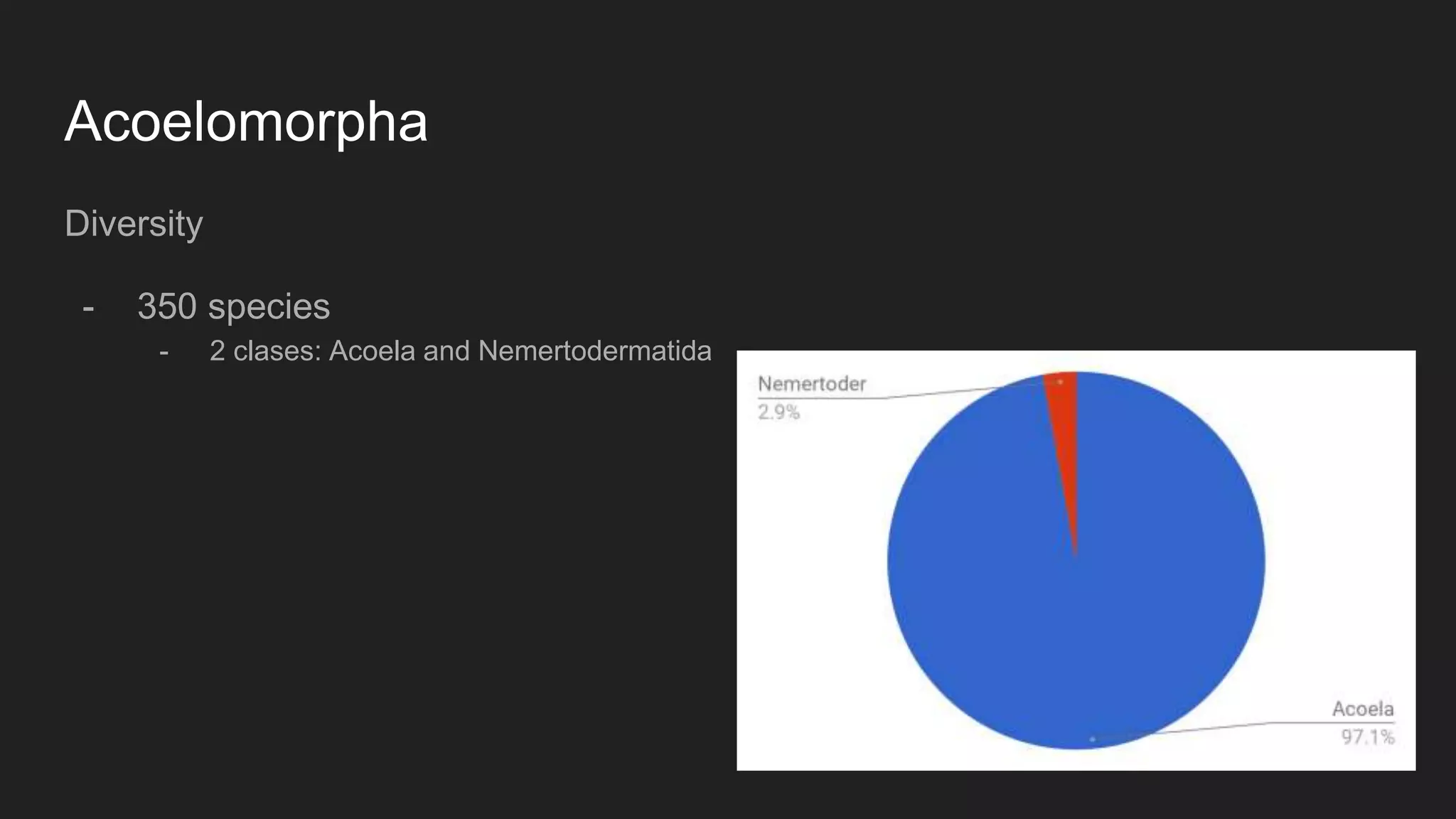
Diversity
- 350 species
- 2 clases: Acoela and Nemertodermatida
Acoelomorpha
Acoelomorpha
Where found?
- Typically in marine sediments
- Some are pelagic (inhabit open ocean)
- Some live in brackish water
Acoelomorpha
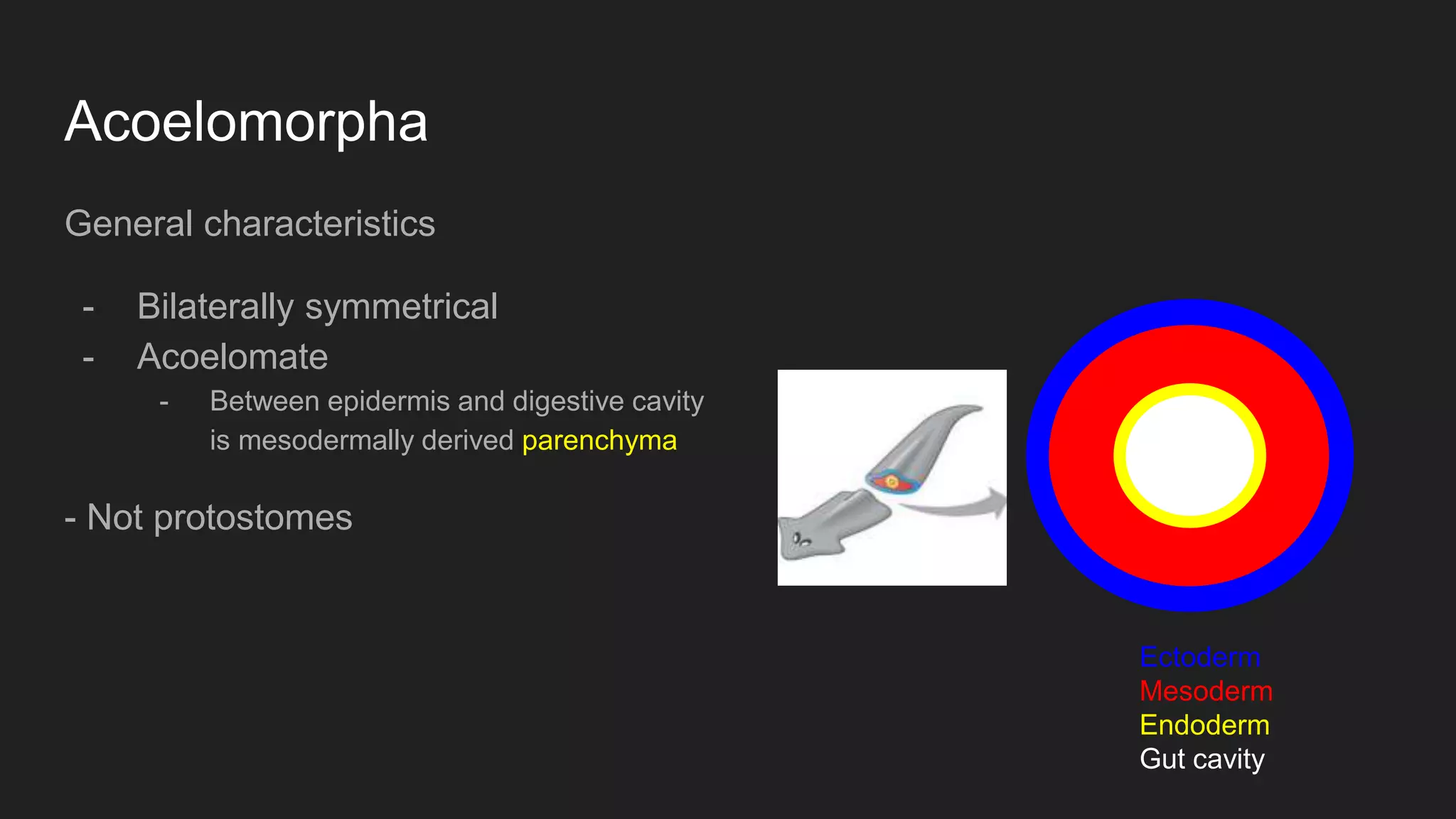
General characteristics
- Bilaterally symmetrical
- Acoelomate
- Between epidermis and digestive cavity
is mesodermally derived parenchyma
- Not protostomes
Ectoderm
Mesoderm
Endoderm
Gut cavity
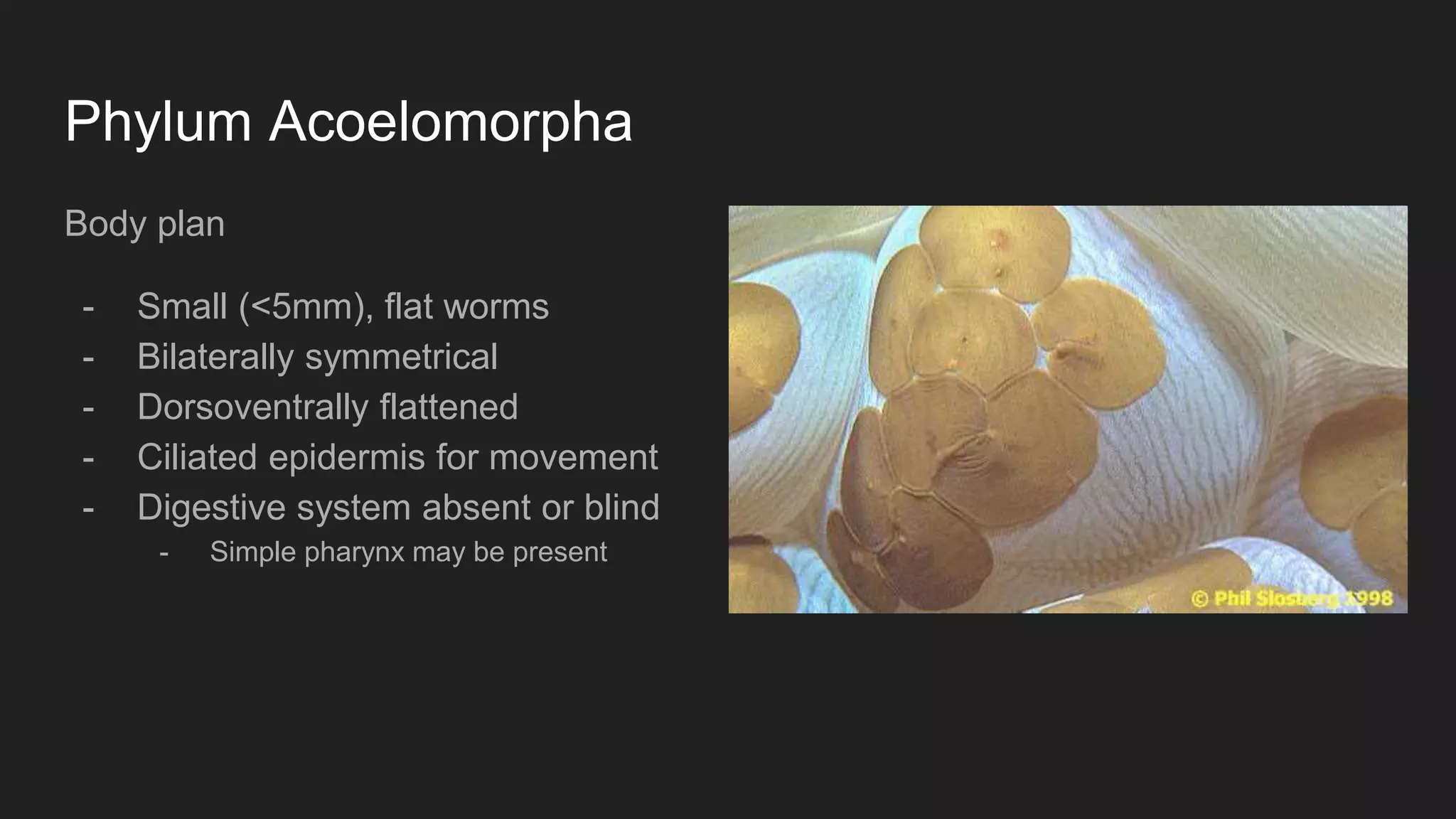
Phylum Acoelomorpha
Body plan
- Small (<5mm), flat worms
- Bilaterally symmetrical
- Dorsoventrally flattened
- Ciliated epidermis for movement
- Digestive system absent or blind
- Simple pharynx may be present
Phylum Acoelomorpha
Homeostatic structures and functions
- No respiratory system
- No circulatory system
- No osmoregulation
- No excretion
- All achieved by diffusion
- Nervous system
- Sense organs include statocysts and ocelli
- Diffuse system of anterior neurons
- Not quite a ganglion
Phylum Acoelomorpha
Reproduction
- Monoecious
- Eggs are produced
- Cleavage is spiral (duet-spiral)
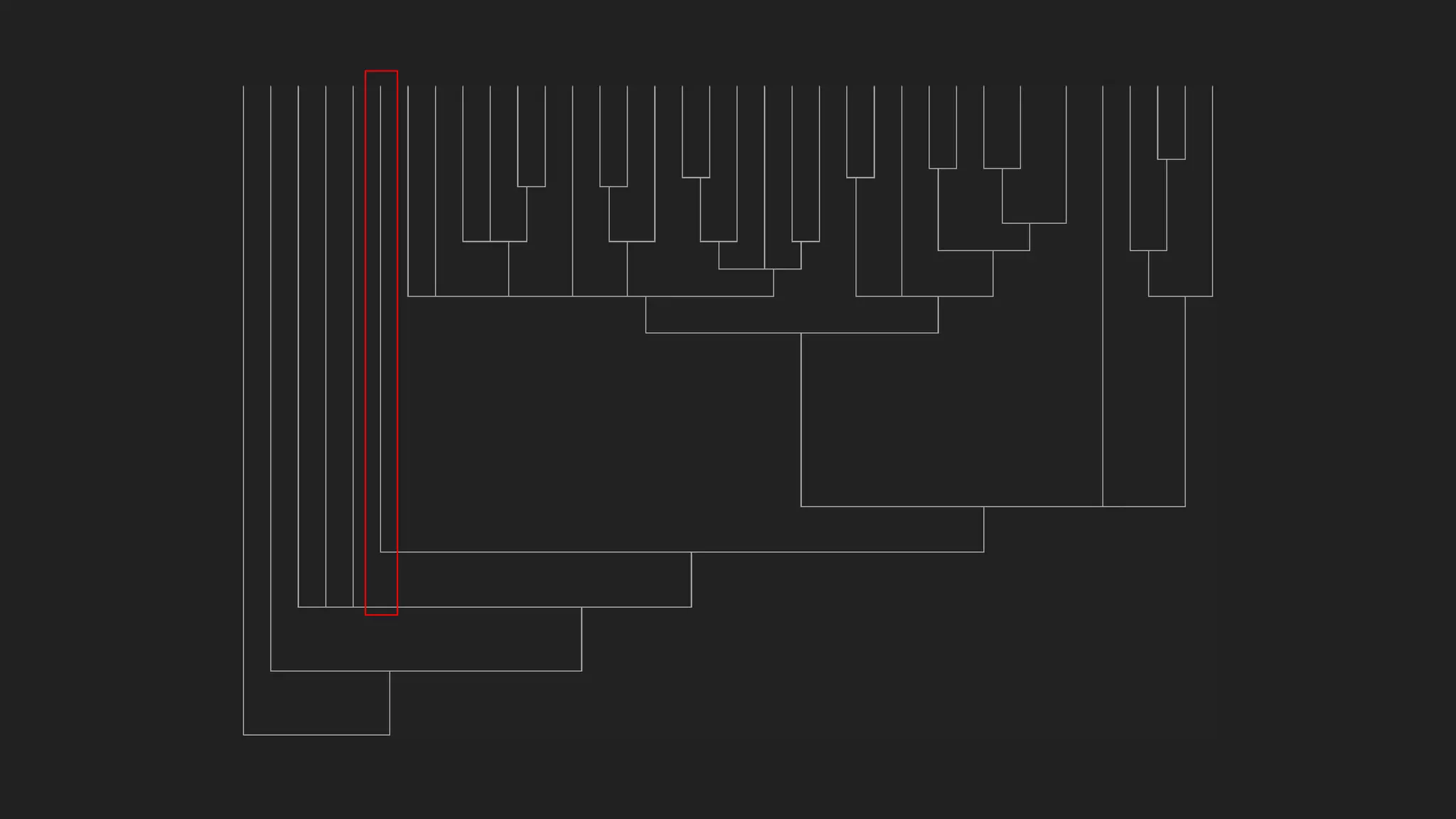
Protostomia
Division into Protostomia or Deuterostomia is largely based on development
- Fate of the balstopore
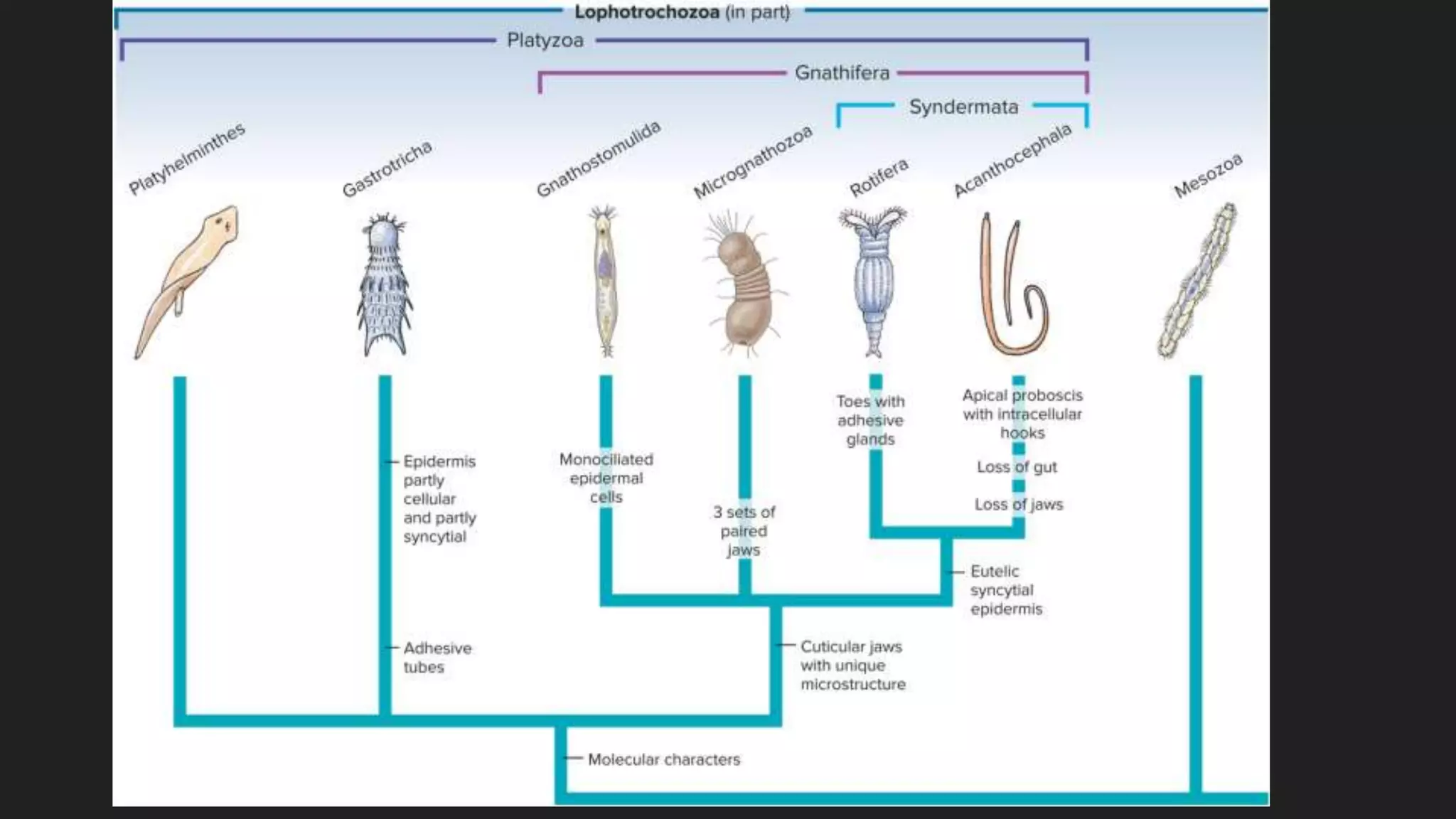
Within the Protostomia are two large clades
- Lophotrochozoa and Ecdysozoa
- Members of the Lophotrochozoa share either a horseshoe-shaped feeding structure
(lophophore) or a larval stage known as the trochophore.
Phylum Platyhelminthes
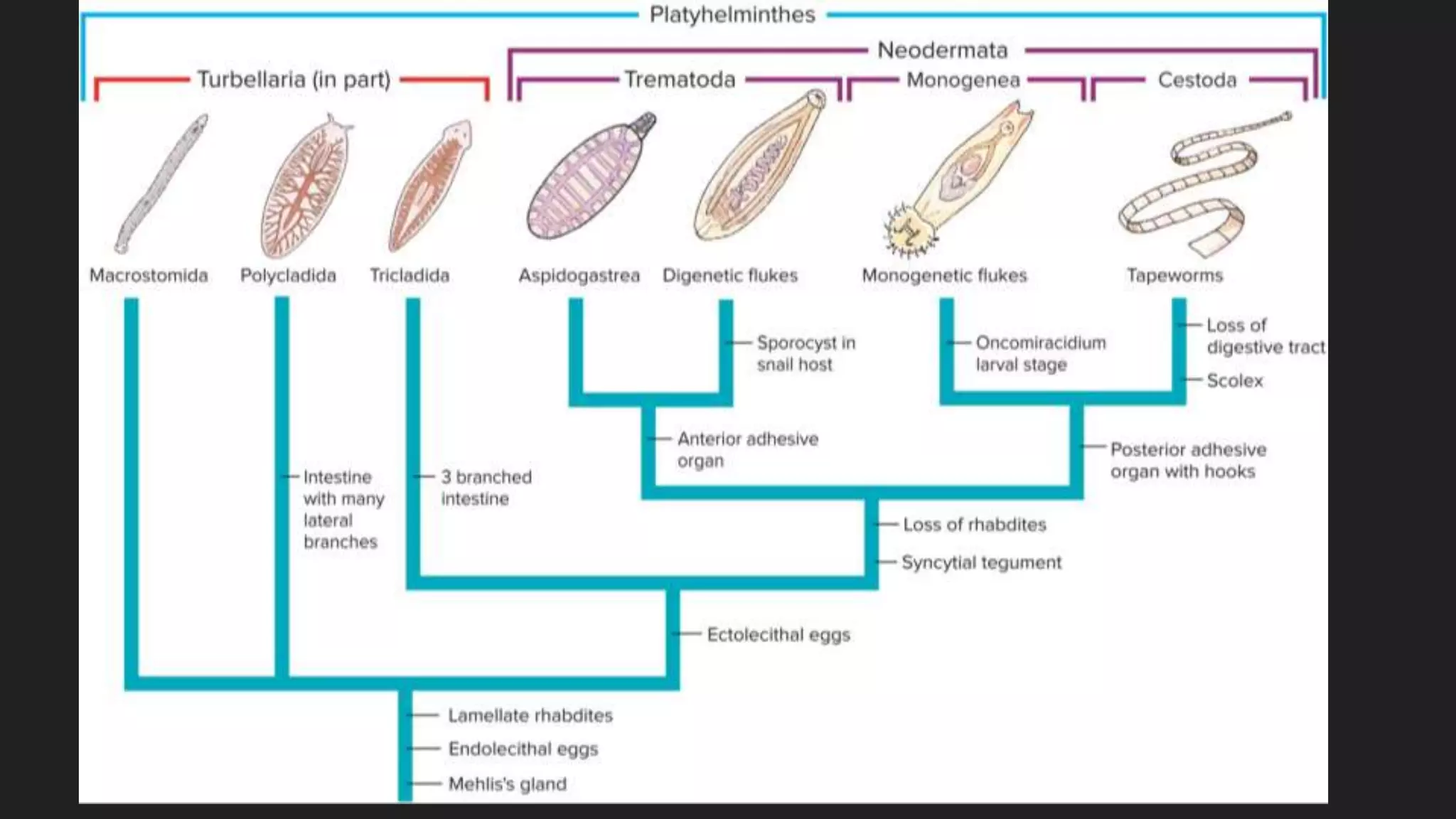
Diversity
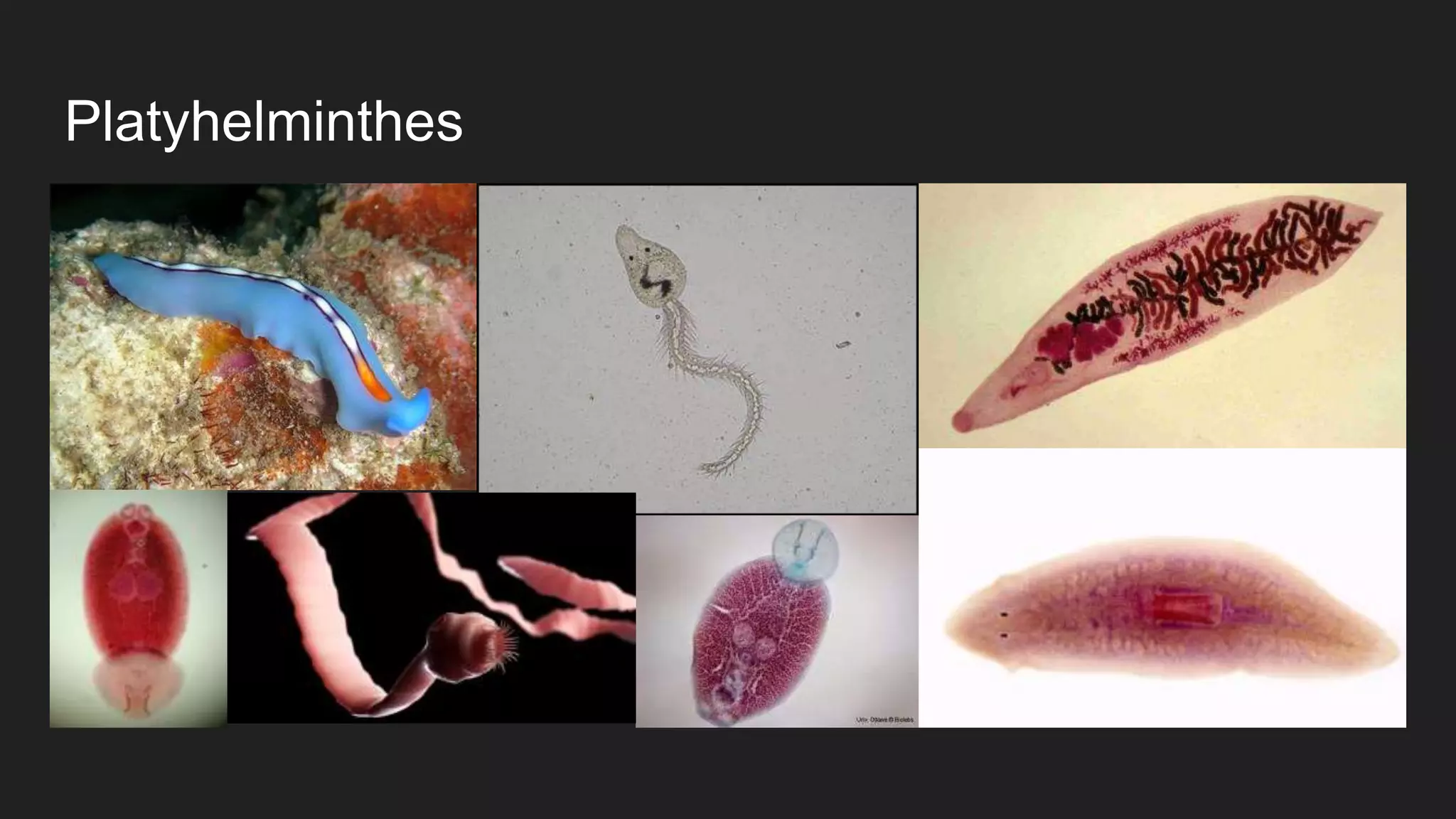
- 20,000 - 30,000 species?
- Turbellaria
- Trematoda
- Monogena
- Cestoda
Platyhelminthes
Platyhelminthes
Where found?
- Turbellarians are mostly free-living
- Inhabit fresh and marine waters; terrestrial in moist climates
- Trematodes, Monogens, and Cestodes are all parasitic
- Inhabit different regions of the body
- Many inhabit different hosts during development
Platyhelminthes
General characters
- Difficult to generalize across the phylum
- Acoelomate (triploblastic)
- Protostomes
- Bilateral symmetry
- Dorsoventrally flattened
Platyhelminthes
General characters
Epidermis and muscles
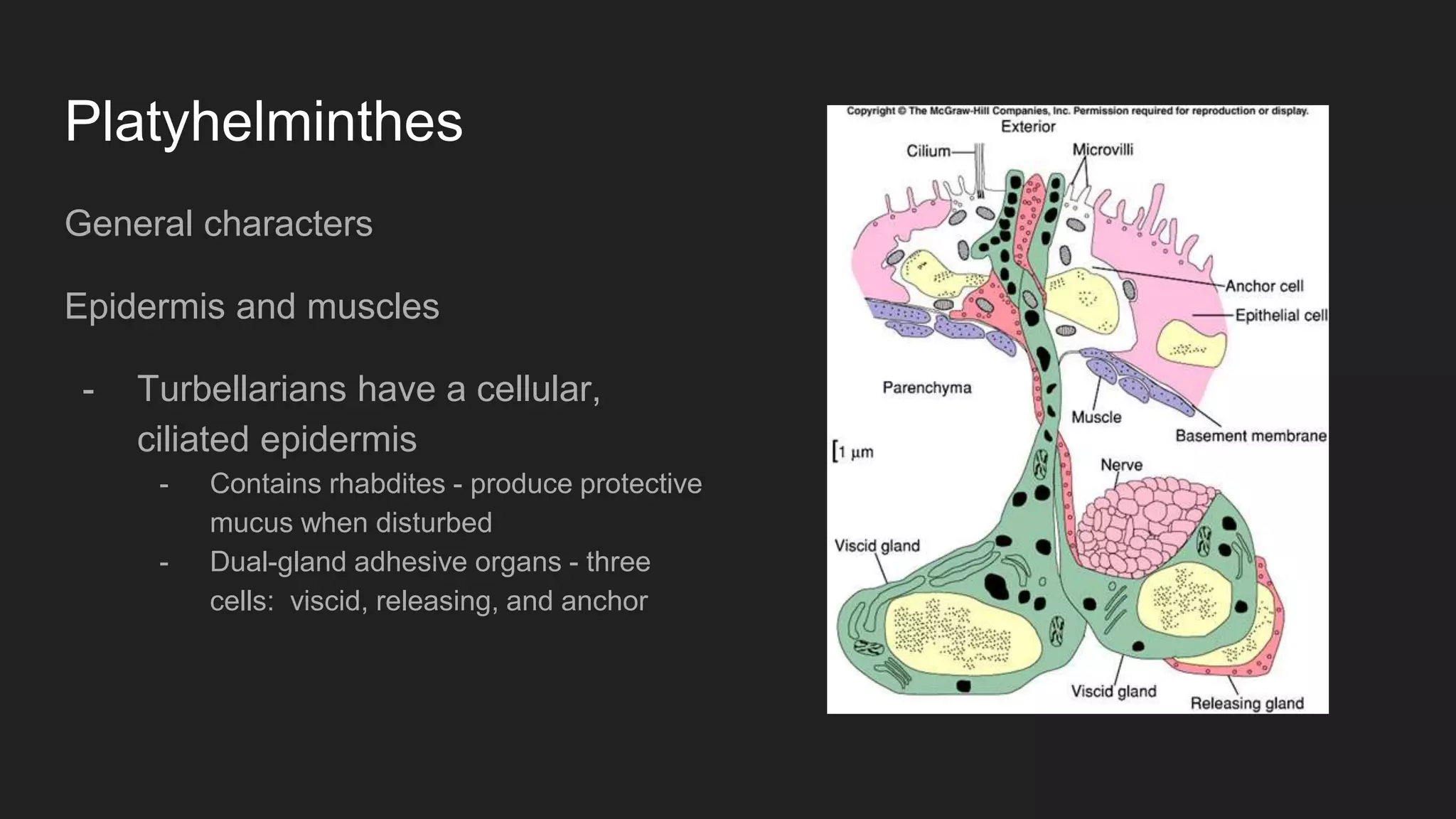
- Turbellarians have a cellular,
ciliated epidermis
- Contains rhabdites - produce protective
mucus when disturbed
- Dual-gland adhesive organs - three
cells: viscid, releasing, and anchor
Platyhelminthes
General characters
Epidermis and muscles
- Turbellarians have a cellular,
ciliated epidermis
- Contains rhabdites - produce protective
mucus when disturbed
- Dual-gland adhesive organs - three
cells: viscid, releasing, and anchor
Platyhelminthes
General characters
Epidermis and muscles
- Trematodes, Monogenes, and
Cestodes all have syncytial
tegument
- Many nuclei enclosed within single cell
membrane
- Thought to aid against host defenses
Platyhelminthes
General characters
Epidermis and muscles
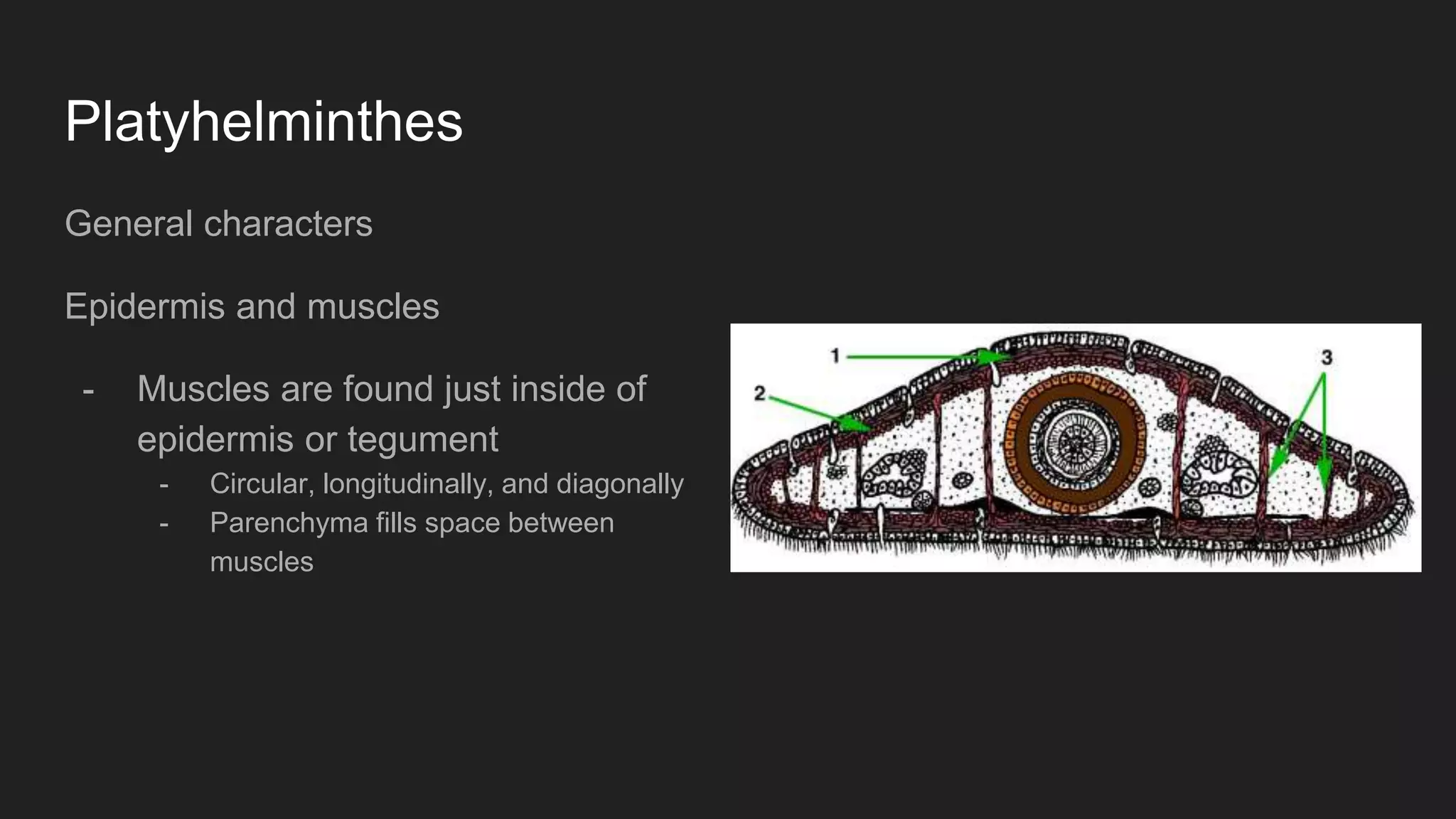
- Muscles are found just inside of
epidermis or tegument
- Circular, longitudinally, and diagonally
- Parenchyma fills space between
muscles
Platyhelminthes
General characters
Nutrition and Digestion
- Generally, platyhelminths have a mouth, pharynx, and intestine
- Turbellarians have a pharynx capable of being extended from the body
- Most are predaceous and ensnare prey in mucus before consuming
- Utilize both intracellular and extracellular digestion
- Gut is blind; undigested food exits through mouth
Platyhelminthes
General characters
Nutrition and Digestion
- Monogenes and trematodes also possess a mouth, but pharynx not
extensible
- Graze on host cells, cellular debris, and body fluids
- Blind gut
Platyhelminthes
General characters
Nutrition and Digestion
- Cestodes have no digestive system
- Absorb nutrients from their host via diffusion
Platyhelminthes
General characters
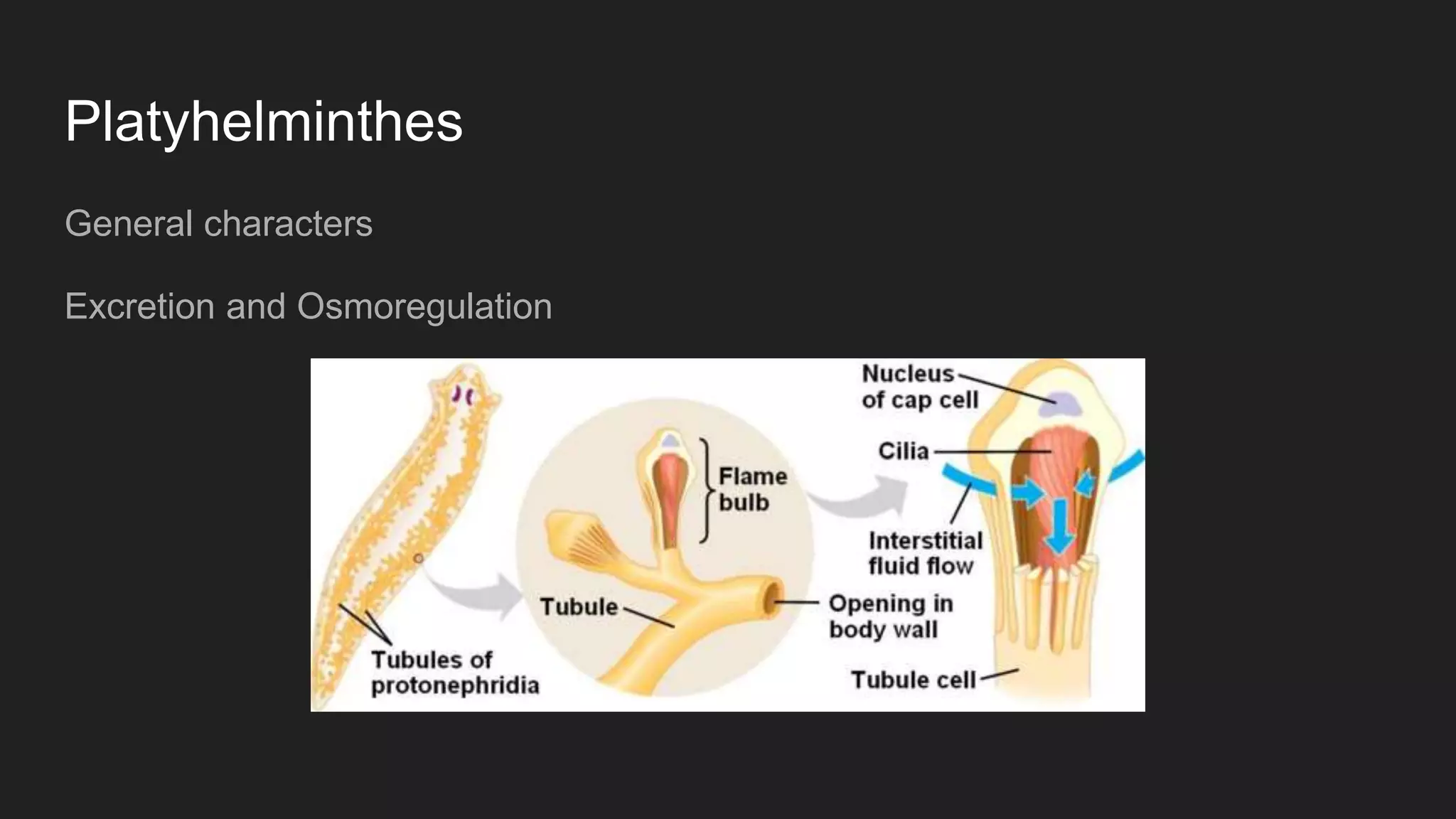
Excretion and Osmoregulation
- Excretion for wastes; osmoregulation for water balance
- Turbellarians, trematodes, and monogenes utilize protonephridia (flame cells)
- Mostly osmoregulatory
- Reduced or absent in marine forms that do not have to cope with excess water
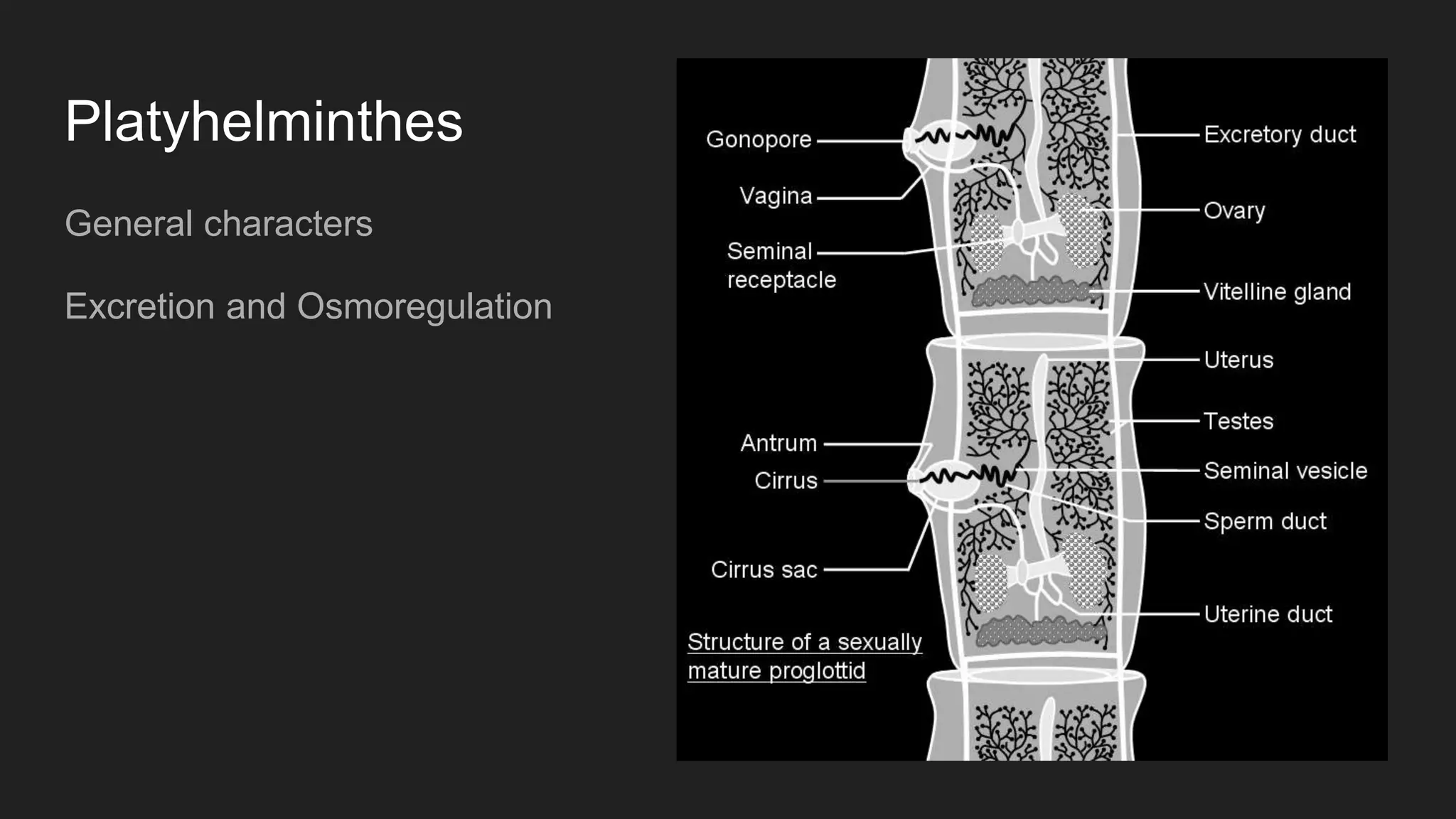
- Cestodes have excretory canals that run the length of the body
Platyhelminthes
General characters
Excretion and Osmoregulation
Platyhelminthes
General characters
Excretion and Osmoregulation
Platyhelminthes
General Characteristics
Nervous System
- Some turbellarians have a nervous system analogous to a nerve net.
- More advanced nervous systems consist of longitudinal nerve cords
- Brain is bilobed mass of ganglion cells
- Some specialization among neurons: sensory, motor, and association
Platyhelminthes
General Characteristics
Sense organs
- Ocelli are present in all but cestodes
- Tactile cells and chemoreceptors are abundant.
- Statocysts are present in some.
Platyhelminthes
General Characteristics
Reproduction
- All are monoecious; most practice cross-fertilization
- Turbellarians
- Both asexual (fragmentation) and sexual
- Trematodes
- Utilize multiple hosts with several life stages
- Monogenes
- Single host
- Cestodes
- Utilize multiple hosts
Platyhelminthes
Class Turbellaria
- Mostly free-living
- Marine, fresh, and terrestrial
environments
- Extreme powers of regeneration
Platyhelminthes
Class Turbellaria
Platyhelminthes
Class Trematoda
- All parasitic flukes; almost all parasitize vertebrates
- Leaf-like with one or more suckers for attachment
- Structures aiding parasitic lifestyle
- Penetration and cyst glands
- Organs for adhesion (suckers and hooks)
- Increased reproductive capacity
Platyhelminthes
Class Trematoda
- Clonorchis spp.
- Most important liver fluke
- Important in SE Asia
Platyhelminthes
Class Trematoda
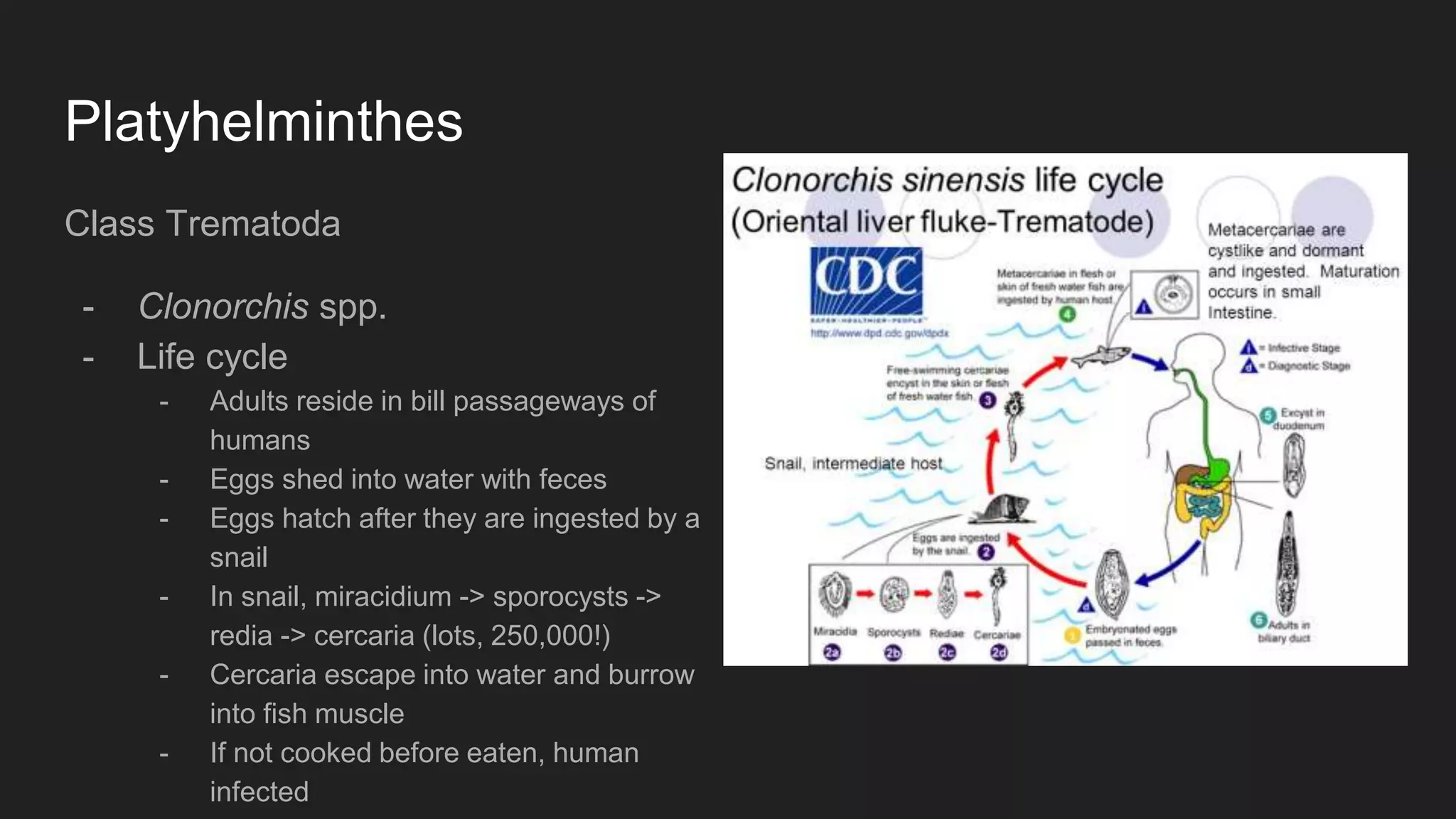
- Clonorchis spp.
- Life cycle
- Adults reside in bill passageways of
humans
- Eggs shed into water with feces
- Eggs hatch after they are ingested by a
snail
- In snail, miracidium -> sporocysts ->
redia -> cercaria (lots, 250,000!)
- Cercaria escape into water and burrow
into fish muscle
- If not cooked before eaten, human
infected
Platyhelminthes
Class Trematoda
- Schistosoma spp.: blood fluke
- Africa, SE Asia, S. America, Middle
East, West Indies
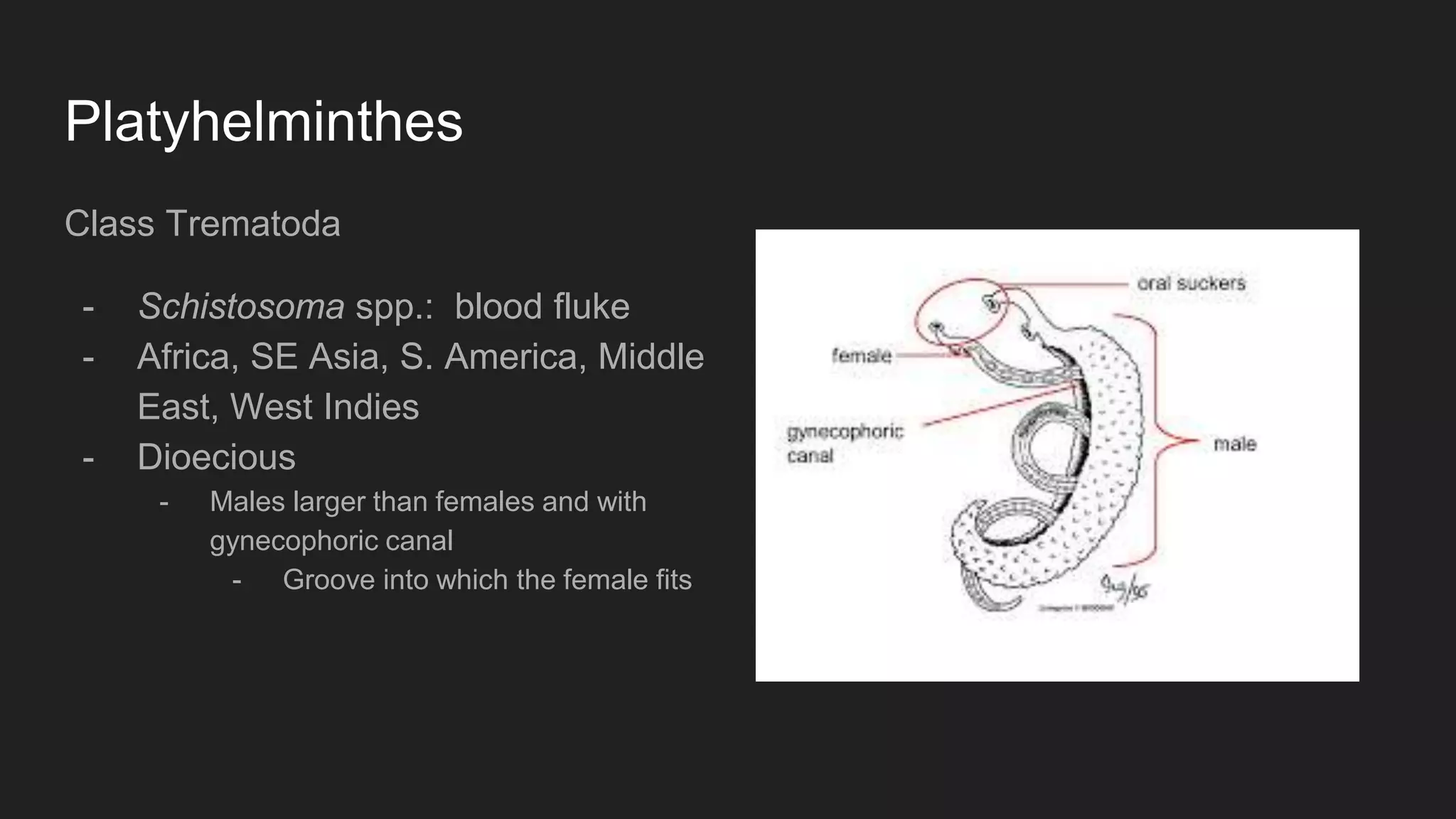
- Dioecious
- Males larger than females and with
gynecophoric canal
- Groove into which the female fits
Platyhelminthes
Class Trematoda
- Schistosoma spp.: blood fluke
- Life cycle
- Eggs shed with feces or urine
- Hatch in water as miracidia
- Must find snail
- In snail transform into sporocysts
- Sporocysts give rise to cercariae
- Cercariae escape snail and bore into
human skin
Platyhelminthes
Class Monogenea
- All parasitic, but mostly
ectoparasitic
- Parasitize gills and external
surfaces of fish
- Appear not to cause much damage
to host
- True outside of very high fish densities;
not true with high densities
- Attachment by opisthaptor
Platyhelminthes
Class Cestoda
- Long, flat bodies
- Scolex for attachment
- Linear series of reproductive units (proglottids)
- Digestive system lacking
- Surface covered with projections similar to microvilli (increases surface area)
- Require at least two hosts
Platyhelminthes
Class Cestoda
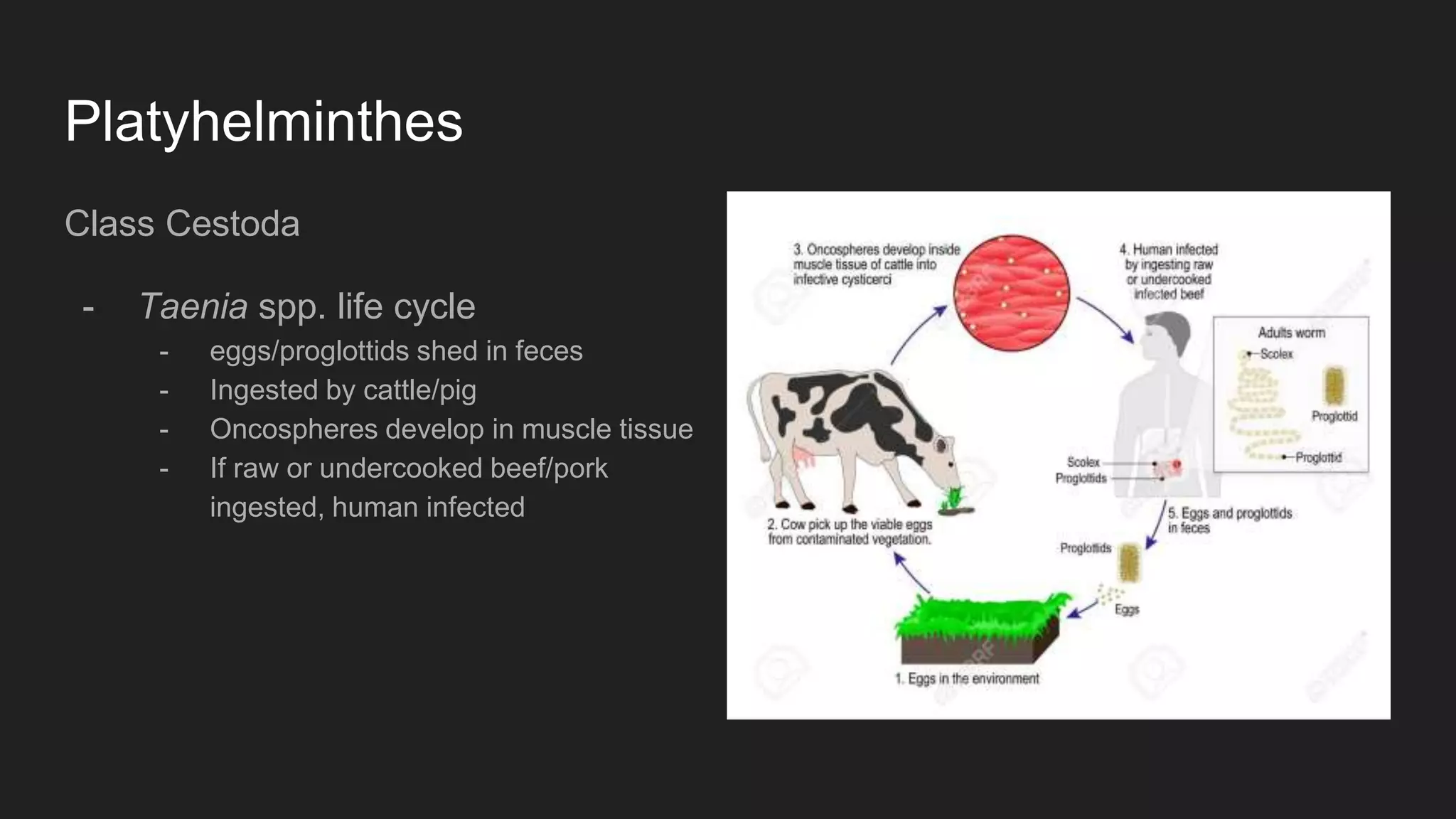
- Taenia spp. life cycle
- eggs/proglottids shed in feces
- Ingested by cattle/pig
- Oncospheres develop in muscle tissue
- If raw or undercooked beef/pork
ingested, human infected
Platyhelminthes
Class Cestoda
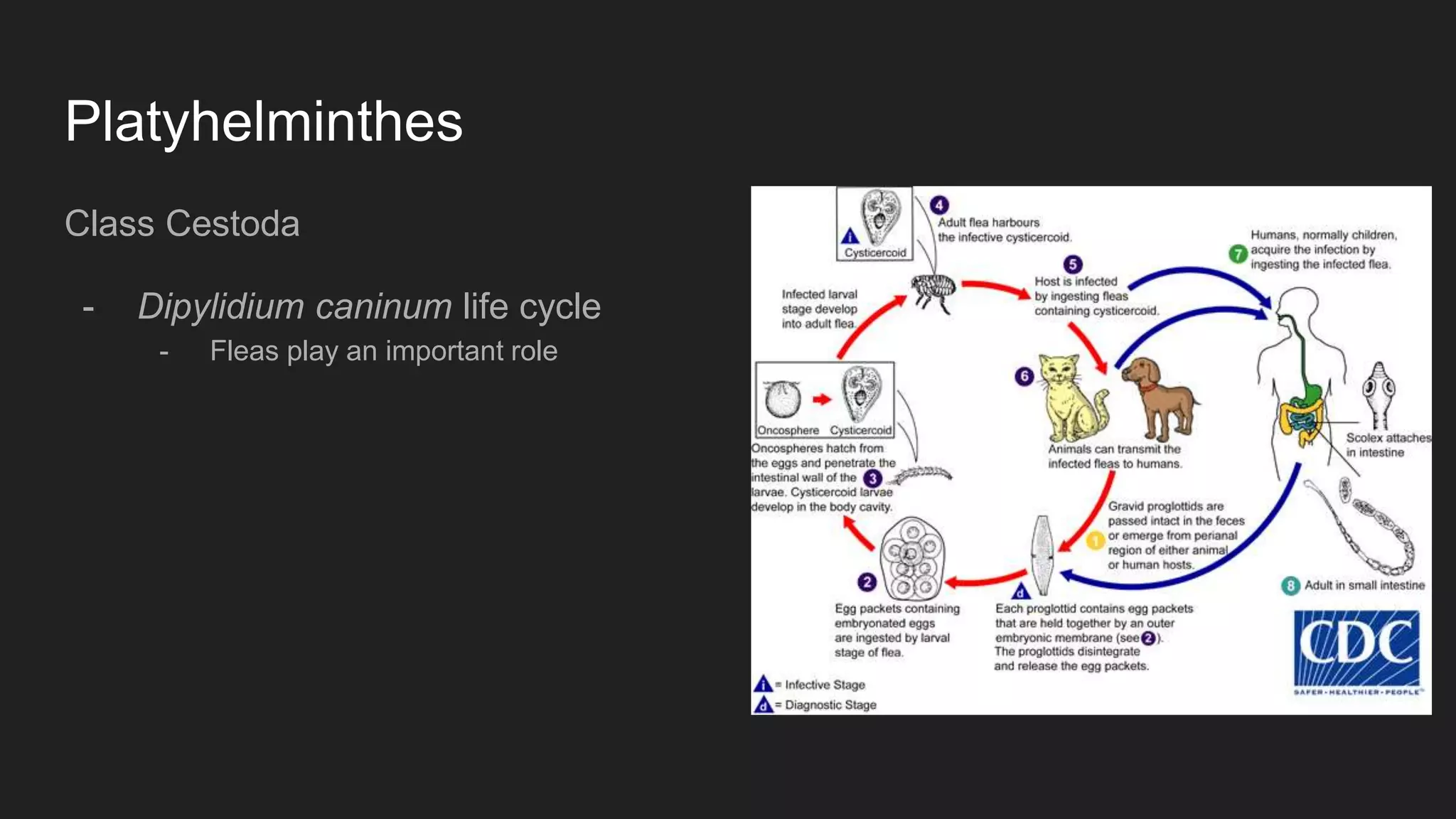
- Dipylidium caninum life cycle
- Fleas play an important role

Acoelomorpha and platyhelminthes