E=MC2
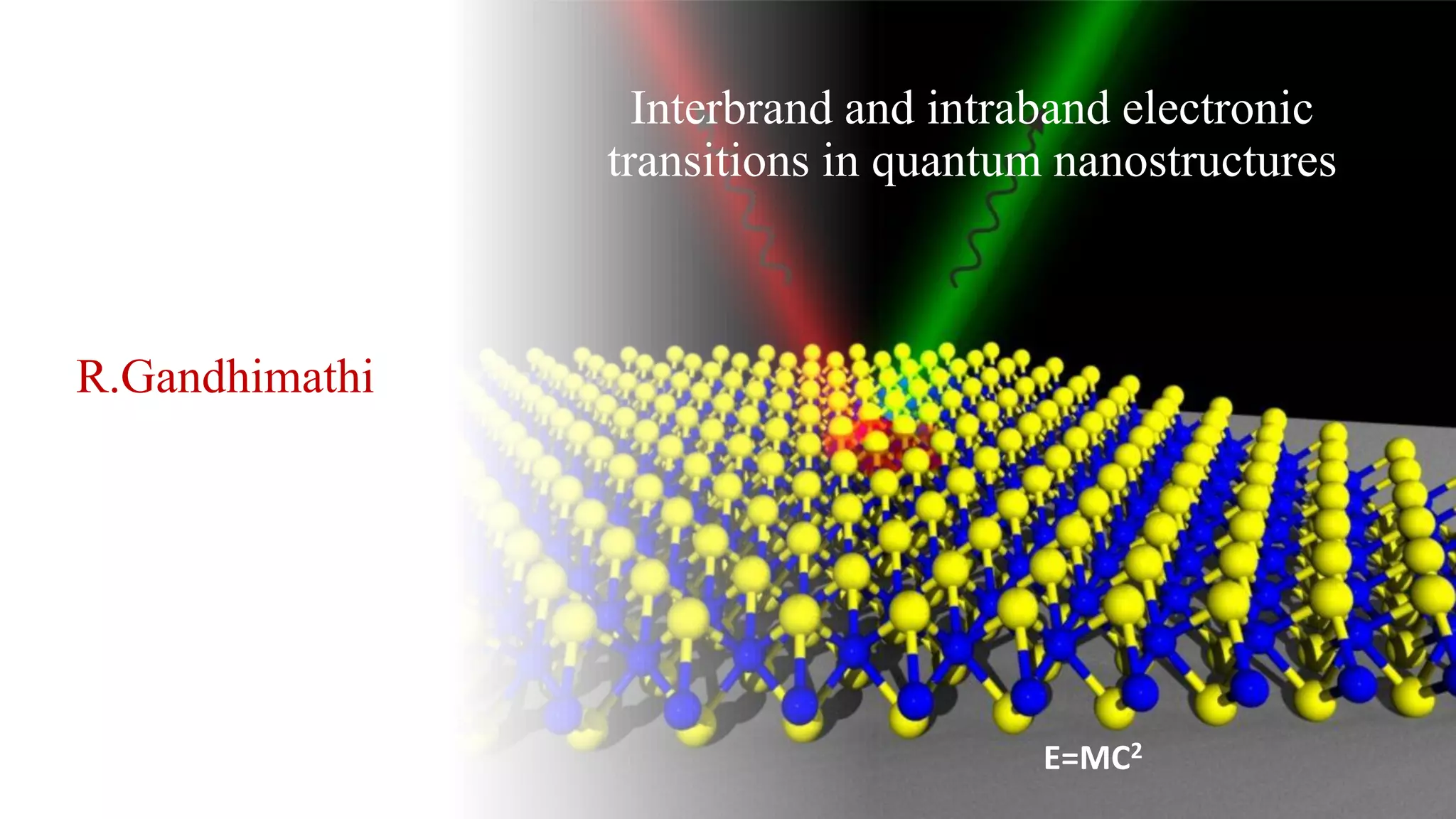
Interbrand and intraband electronic
transitions in quantum nanostructures
R.Gandhimathi
Semiconductor
light sources
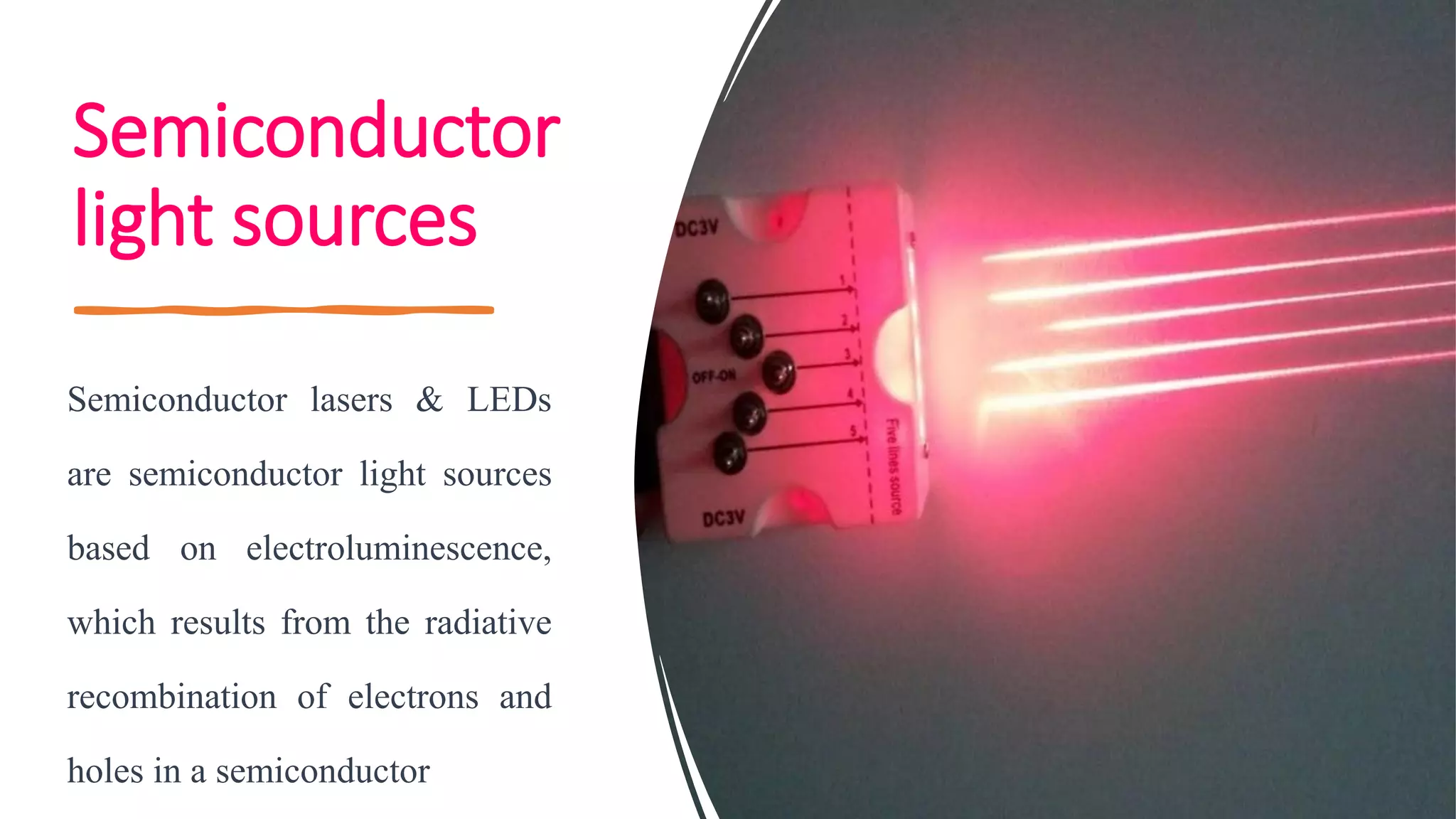
Semiconductor lasers & LEDs
are semiconductor light sources
based on electroluminescence,
which results from the radiative
recombination of electrons and
holes in a semiconductor
Optical properties of
Quantum nanostructures
• Interaction of EM radiation
with matter or Photon-electron
interaction determines the optical
properties (emission, absorption,
and scattering) of bulk as well as
nano structured materials
• Study of interaction of
radiation with matter helps to
understand the interband
transition of electrons in quantum
nanostructures
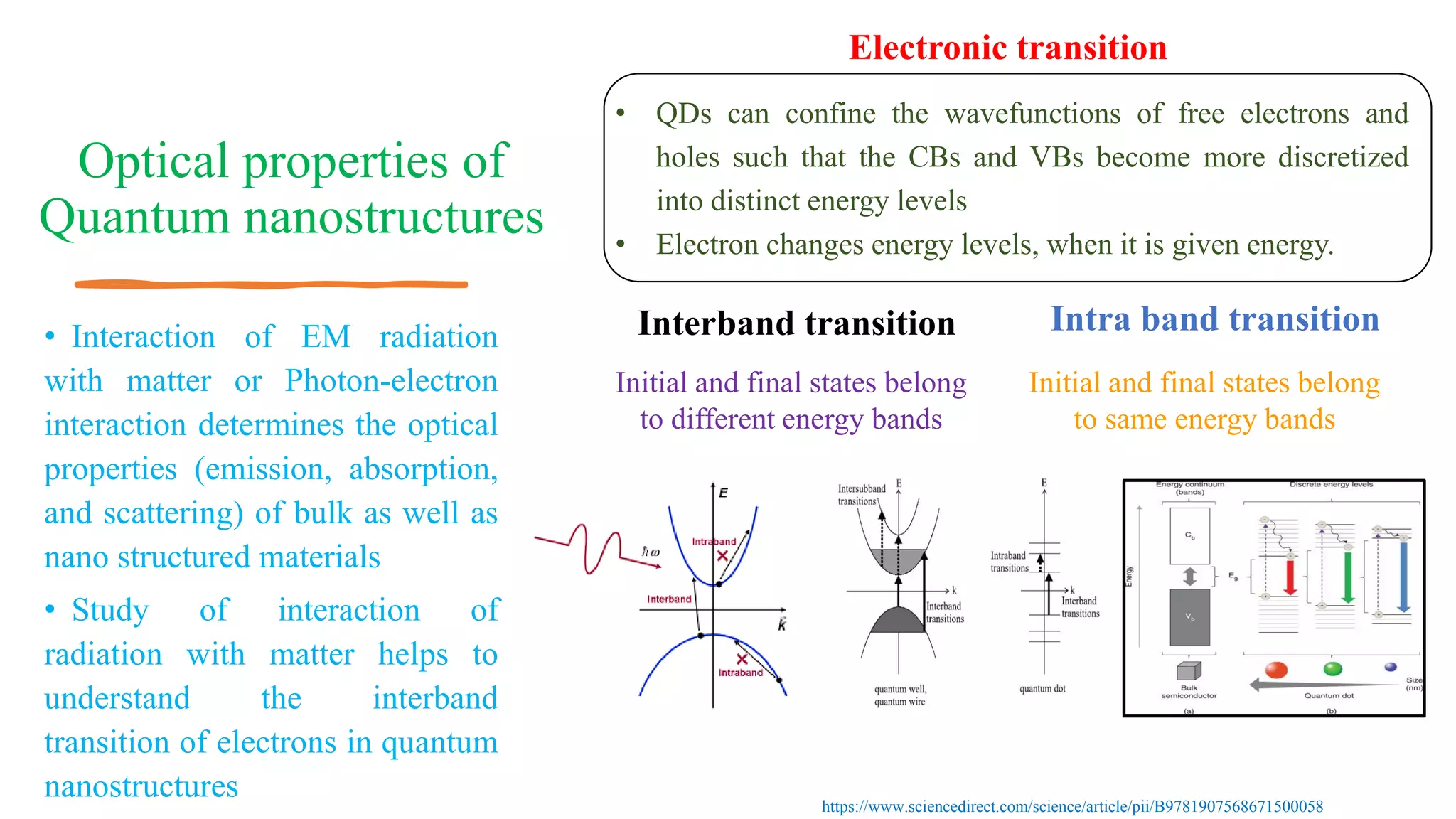
Initial and final states belong
to different energy bands
Interband transition Intra band transition
Initial and final states belong
to same energy bands
• QDs can confine the wavefunctions of free electrons and
holes such that the CBs and VBs become more discretized
into distinct energy levels
• Electron changes energy levels, when it is given energy.
Electronic transition
https://www.sciencedirect.com/science/article/pii/B9781907568671500058
https://www.google.com/books/edition/Physics_of_Semiconductors_and_Nanostruct/cCGeDwAAQB
AJ?hl=en&gbpv=1&dq=Interband+and+intraband+transition+in+Qds&pg=PR12&printsec=frontcover
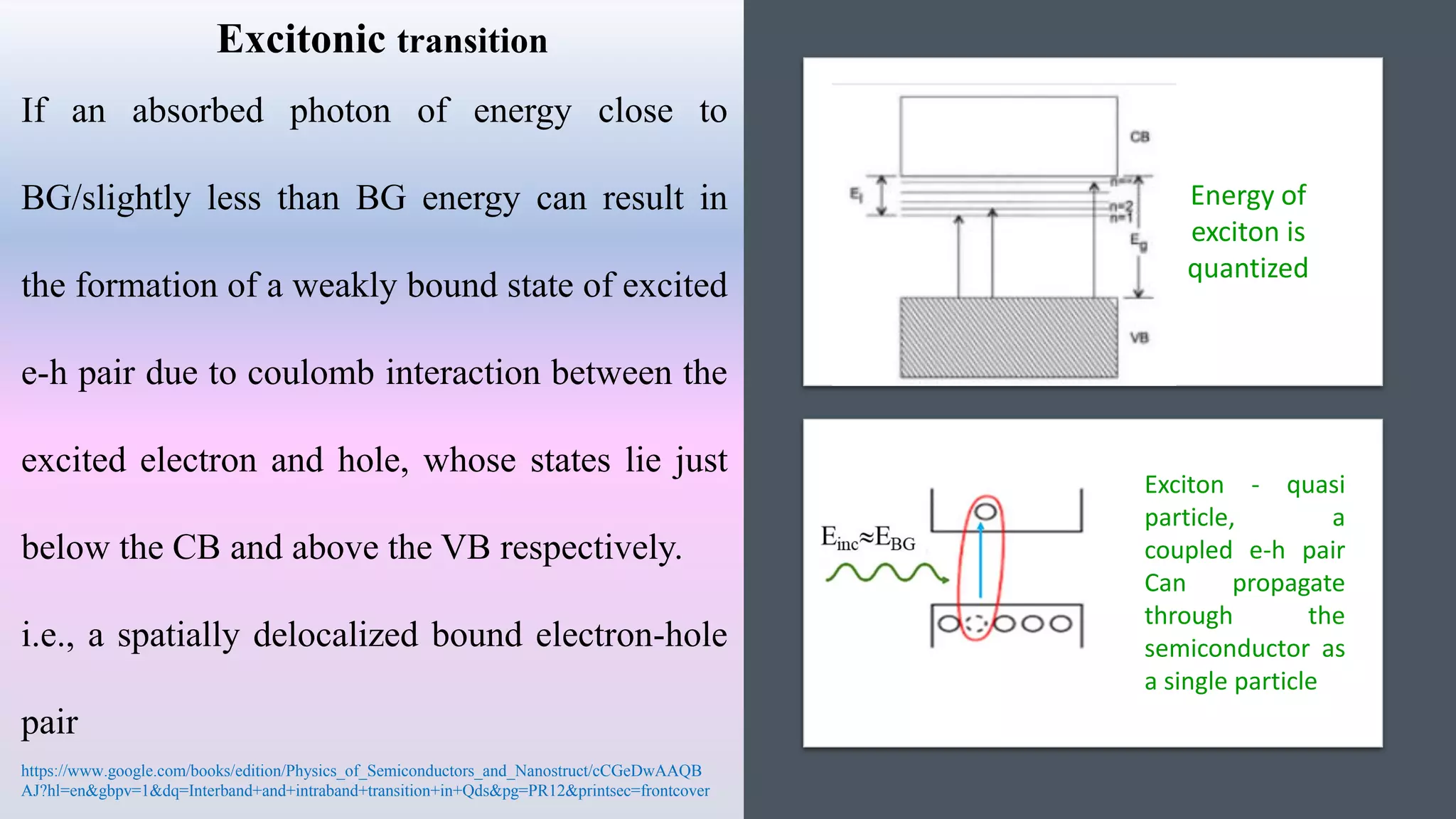
If an absorbed photon of energy close to
BG/slightly less than BG energy can result in
the formation of a weakly bound state of excited
e-h pair due to coulomb interaction between the
excited electron and hole, whose states lie just
below the CB and above the VB respectively.
i.e., a spatially delocalized bound electron-hole
pair
Exciton - quasi
particle, a
coupled e-h pair
Can propagate
through the
semiconductor as
a single particle
Excitonic transition
Energy of
exciton is
quantized
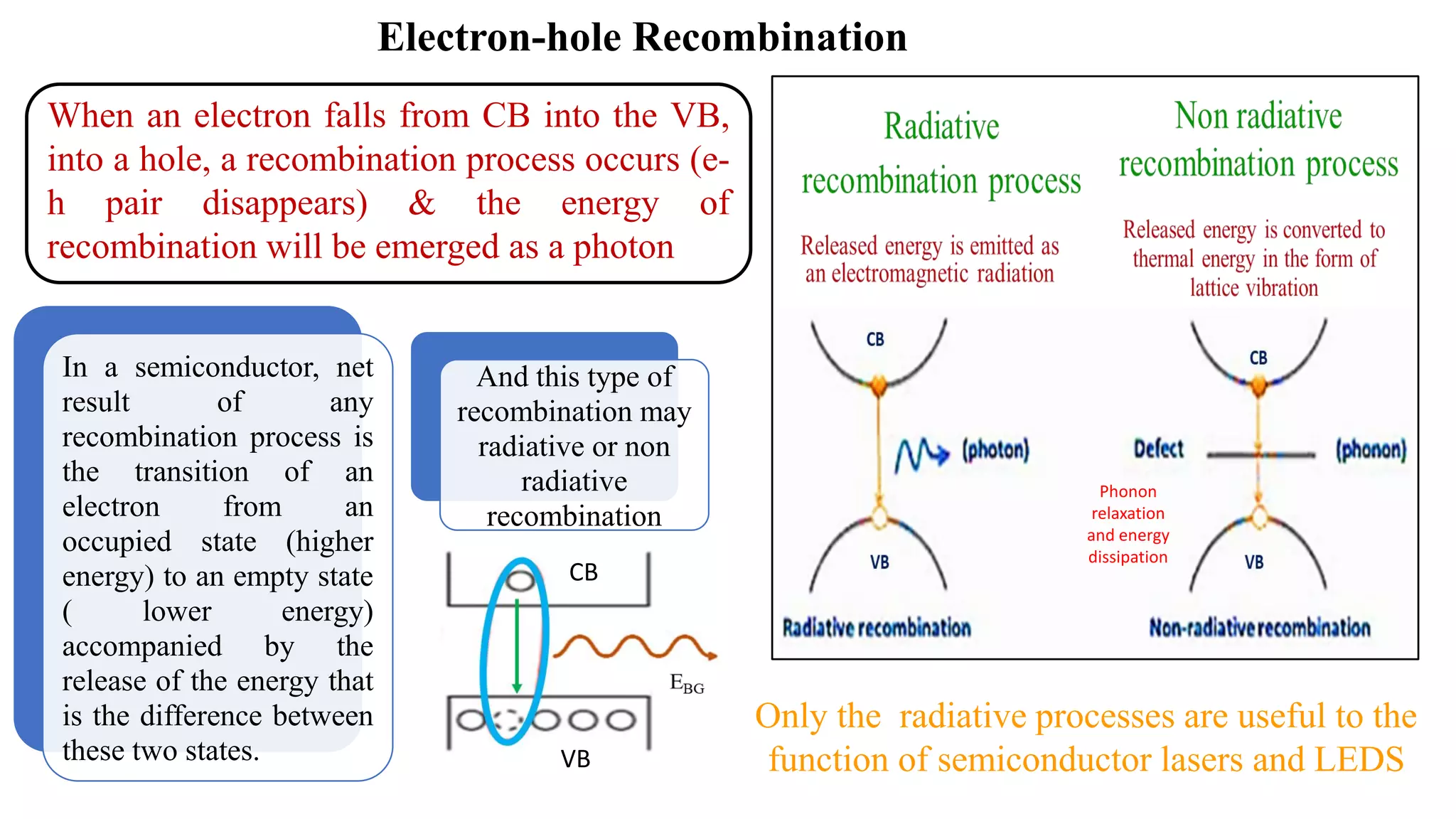
Electron-hole Recombination
VB
CB
Phonon
relaxation
and energy
dissipation
When an electron falls from CB into the VB,
into a hole, a recombination process occurs (e-
h pair disappears) & the energy of
recombination will be emerged as a photon
In a semiconductor, net
result of any
recombination process is
the transition of an
electron from an
occupied state (higher
energy) to an empty state
( lower energy)
accompanied by the
release of the energy that
is the difference between
these two states.
And this type of
recombination may
radiative or non
radiative
recombination
Only the radiative processes are useful to the
function of semiconductor lasers and LEDS
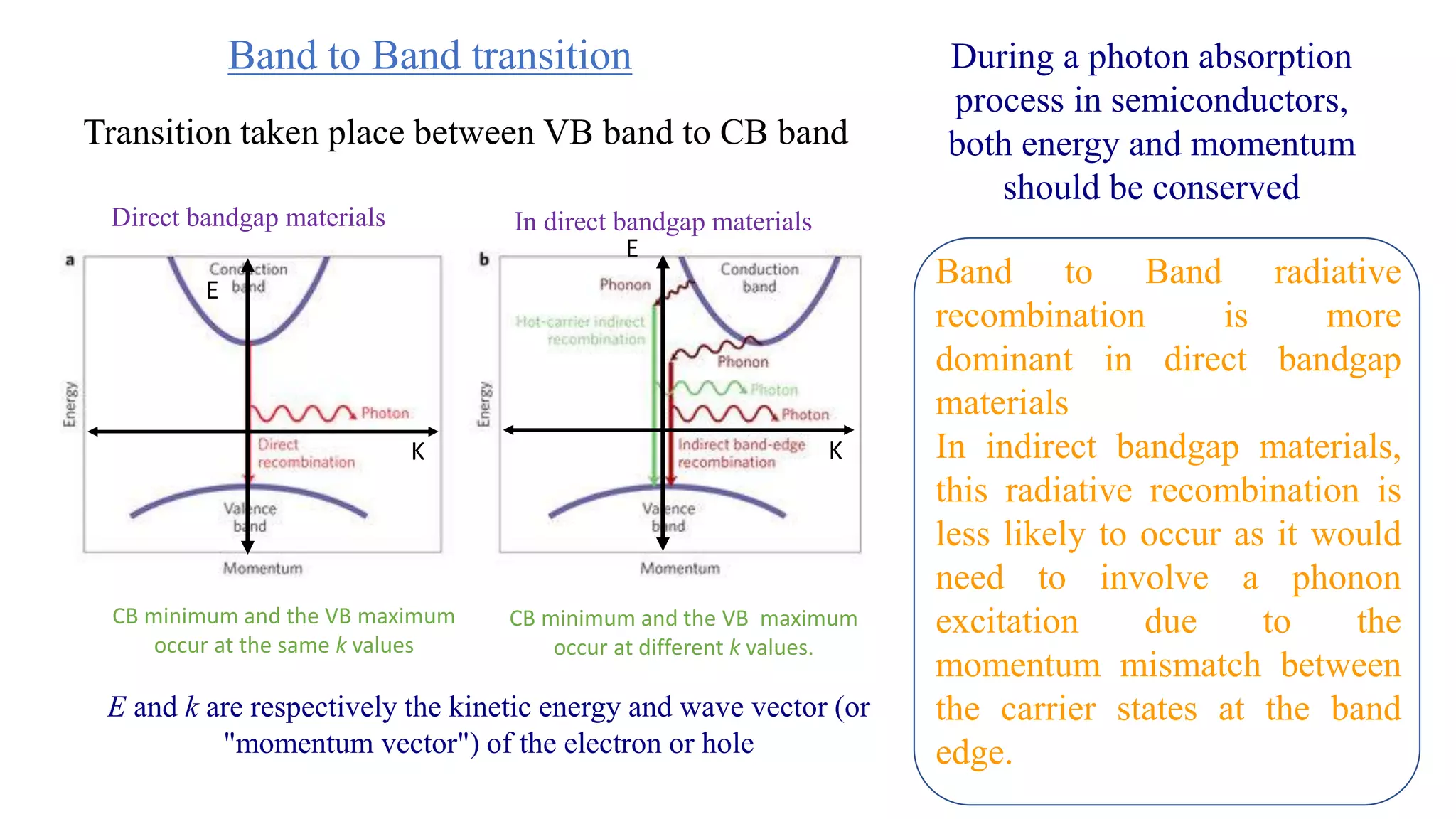
CB minimum and the VB maximum
occur at different k values.
CB minimum and the VB maximum
occur at the same k values
Band to Band radiative
recombination is more
dominant in direct bandgap
materials
In indirect bandgap materials,
this radiative recombination is
less likely to occur as it would
need to involve a phonon
excitation due to the
momentum mismatch between
the carrier states at the band
edge.
E and k are respectively the kinetic energy and wave vector (or
"momentum vector") of the electron or hole
Direct bandgap materials In direct bandgap materials
During a photon absorption
process in semiconductors,
both energy and momentum
should be conserved
Band to Band transition
Transition taken place between VB band to CB band
E
E
K K
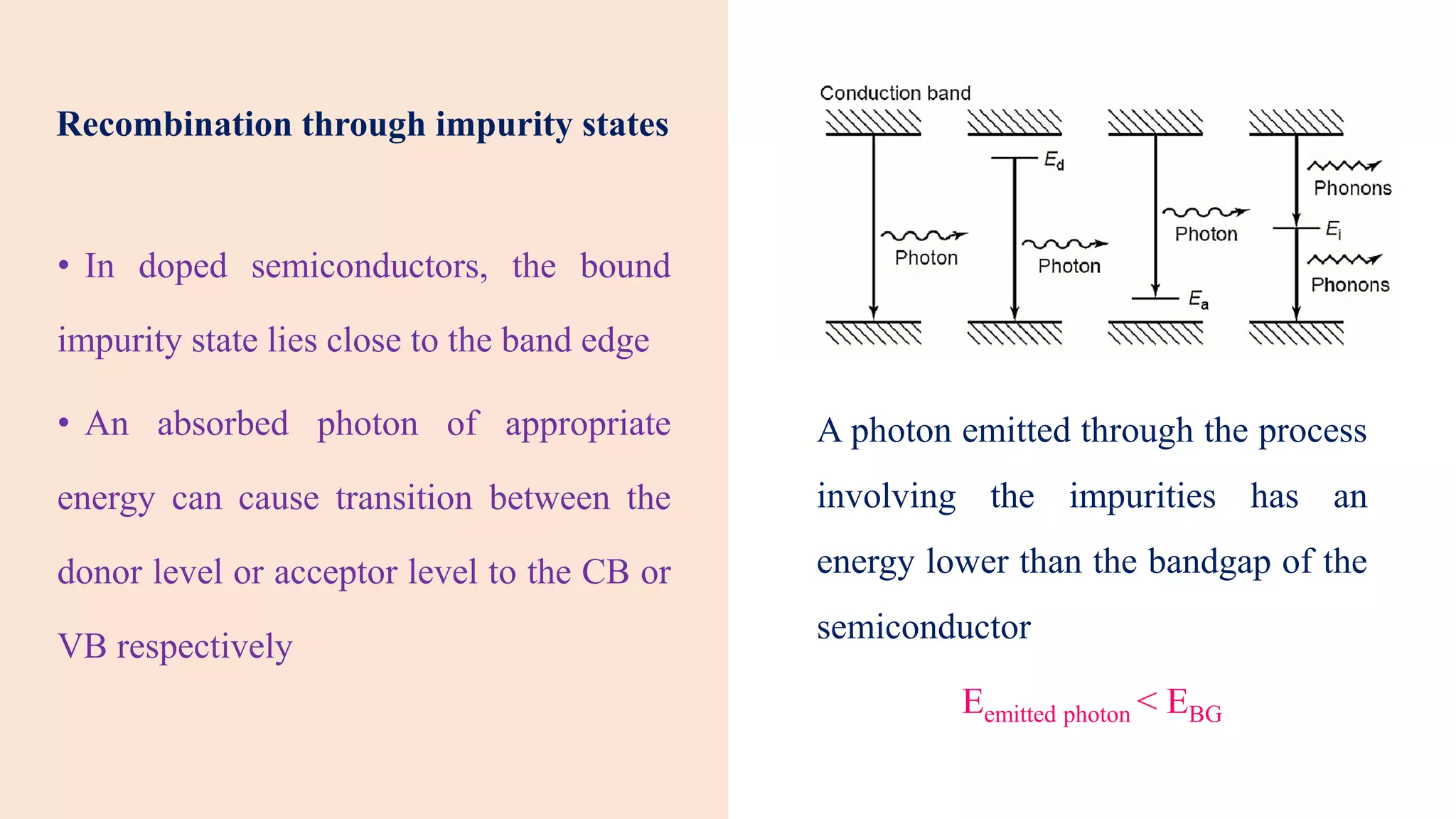
• In doped semiconductors, the bound
impurity state lies close to the band edge
• An absorbed photon of appropriate
energy can cause transition between the
donor level or acceptor level to the CB or
VB respectively
A photon emitted through the process
involving the impurities has an
energy lower than the bandgap of the
semiconductor
Eemitted photon < EBG
Recombination through impurity states
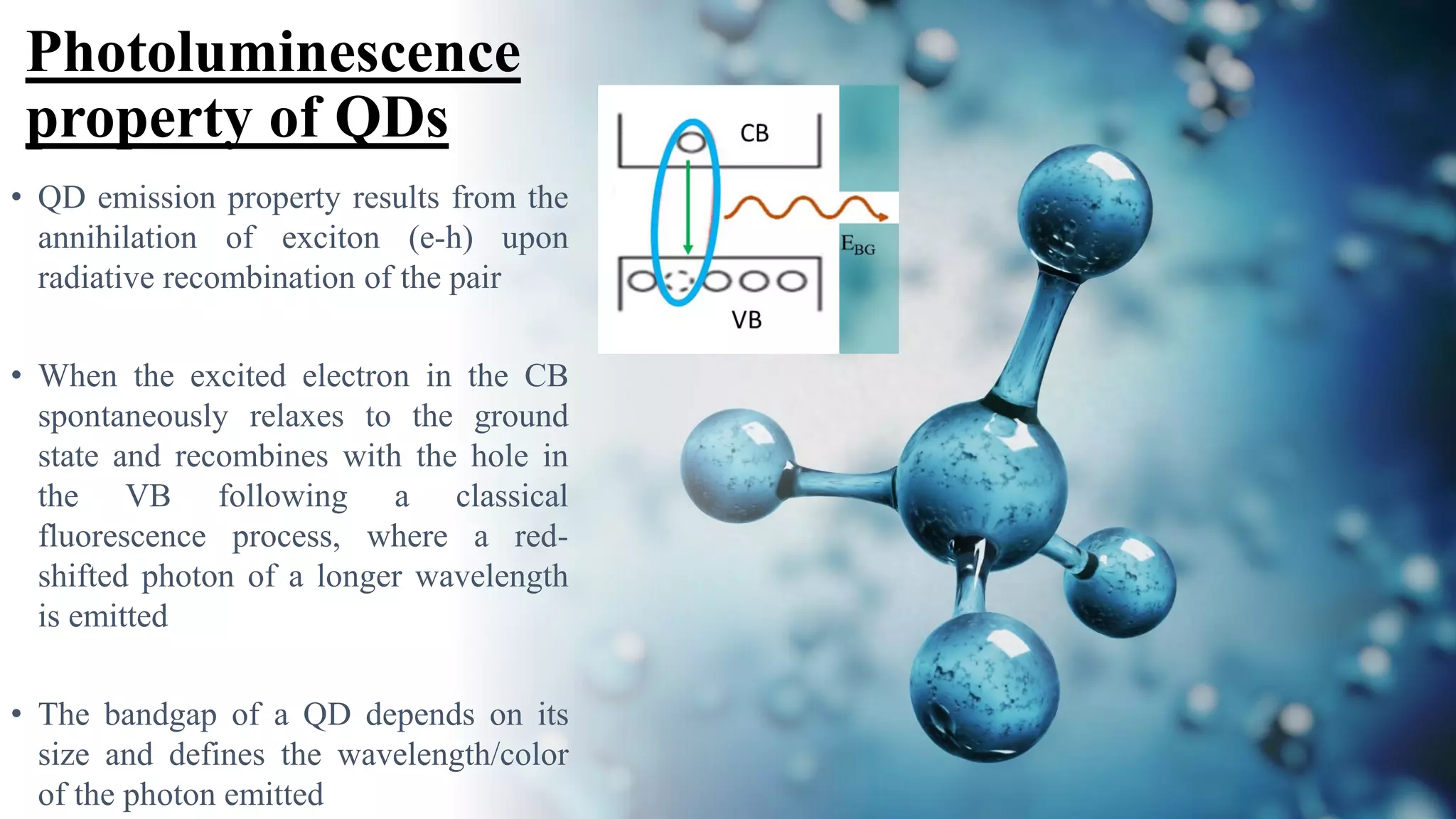
Photoluminescence
property of QDs
• QD emission property results from the
annihilation of exciton (e-h) upon
radiative recombination of the pair
• When the excited electron in the CB
spontaneously relaxes to the ground
state and recombines with the hole in
the VB following a classical
fluorescence process, where a red-
shifted photon of a longer wavelength
is emitted
• The bandgap of a QD depends on its
size and defines the wavelength/color
of the photon emitted
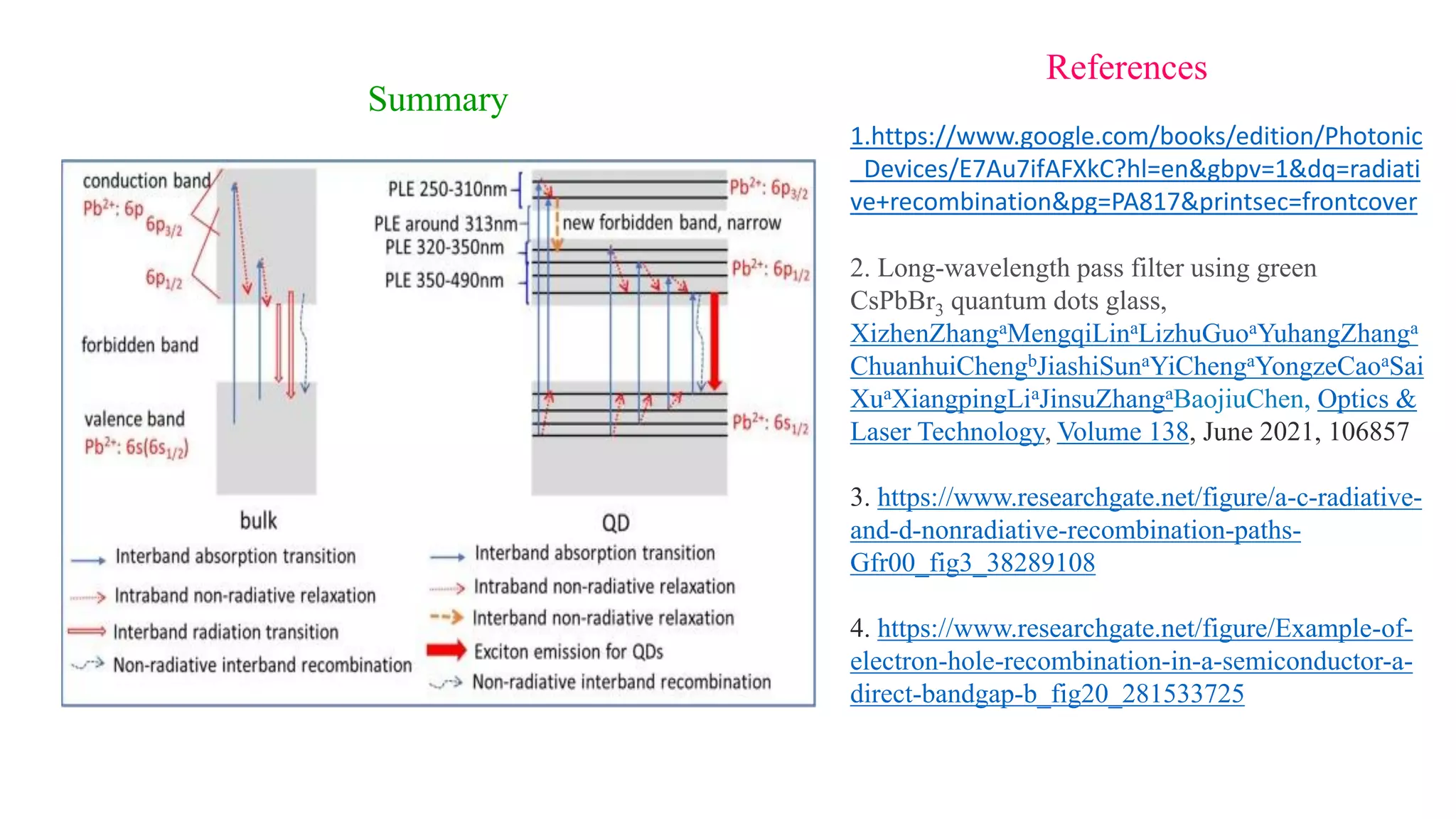
1.https://www.google.com/books/edition/Photonic
_Devices/E7Au7ifAFXkC?hl=en&gbpv=1&dq=radiati
ve+recombination&pg=PA817&printsec=frontcover
2. Long-wavelength pass filter using green
CsPbBr3 quantum dots glass,
XizhenZhangaMengqiLinaLizhuGuoaYuhangZhanga
ChuanhuiChengbJiashiSunaYiChengaYongzeCaoaSai
XuaXiangpingLiaJinsuZhangaBaojiuChen, Optics &
Laser Technology, Volume 138, June 2021, 106857
3. https://www.researchgate.net/figure/a-c-radiative-
and-d-nonradiative-recombination-paths-
Gfr00_fig3_38289108
4. https://www.researchgate.net/figure/Example-of-
electron-hole-recombination-in-a-semiconductor-a-
direct-bandgap-b_fig20_281533725
References
Summary
Thank you

Interband and intraband electronic transition in quantum nanostructures

  • 1.
    E=MC2 Interbrand and intrabandelectronic transitions in quantum nanostructures R.Gandhimathi
  • 2.
    Semiconductor light sources Semiconductor lasers& LEDs are semiconductor light sources based on electroluminescence, which results from the radiative recombination of electrons and holes in a semiconductor
  • 3.
    Optical properties of Quantumnanostructures • Interaction of EM radiation with matter or Photon-electron interaction determines the optical properties (emission, absorption, and scattering) of bulk as well as nano structured materials • Study of interaction of radiation with matter helps to understand the interband transition of electrons in quantum nanostructures Initial and final states belong to different energy bands Interband transition Intra band transition Initial and final states belong to same energy bands • QDs can confine the wavefunctions of free electrons and holes such that the CBs and VBs become more discretized into distinct energy levels • Electron changes energy levels, when it is given energy. Electronic transition https://www.sciencedirect.com/science/article/pii/B9781907568671500058
  • 4.
    https://www.google.com/books/edition/Physics_of_Semiconductors_and_Nanostruct/cCGeDwAAQB AJ?hl=en&gbpv=1&dq=Interband+and+intraband+transition+in+Qds&pg=PR12&printsec=frontcover If an absorbedphoton of energy close to BG/slightly less than BG energy can result in the formation of a weakly bound state of excited e-h pair due to coulomb interaction between the excited electron and hole, whose states lie just below the CB and above the VB respectively. i.e., a spatially delocalized bound electron-hole pair Exciton - quasi particle, a coupled e-h pair Can propagate through the semiconductor as a single particle Excitonic transition Energy of exciton is quantized
  • 5.
    Electron-hole Recombination VB CB Phonon relaxation and energy dissipation Whenan electron falls from CB into the VB, into a hole, a recombination process occurs (e- h pair disappears) & the energy of recombination will be emerged as a photon In a semiconductor, net result of any recombination process is the transition of an electron from an occupied state (higher energy) to an empty state ( lower energy) accompanied by the release of the energy that is the difference between these two states. And this type of recombination may radiative or non radiative recombination Only the radiative processes are useful to the function of semiconductor lasers and LEDS
  • 6.
    CB minimum andthe VB maximum occur at different k values. CB minimum and the VB maximum occur at the same k values Band to Band radiative recombination is more dominant in direct bandgap materials In indirect bandgap materials, this radiative recombination is less likely to occur as it would need to involve a phonon excitation due to the momentum mismatch between the carrier states at the band edge. E and k are respectively the kinetic energy and wave vector (or "momentum vector") of the electron or hole Direct bandgap materials In direct bandgap materials During a photon absorption process in semiconductors, both energy and momentum should be conserved Band to Band transition Transition taken place between VB band to CB band E E K K
  • 7.
    • In dopedsemiconductors, the bound impurity state lies close to the band edge • An absorbed photon of appropriate energy can cause transition between the donor level or acceptor level to the CB or VB respectively A photon emitted through the process involving the impurities has an energy lower than the bandgap of the semiconductor Eemitted photon < EBG Recombination through impurity states
  • 8.
    Photoluminescence property of QDs •QD emission property results from the annihilation of exciton (e-h) upon radiative recombination of the pair • When the excited electron in the CB spontaneously relaxes to the ground state and recombines with the hole in the VB following a classical fluorescence process, where a red- shifted photon of a longer wavelength is emitted • The bandgap of a QD depends on its size and defines the wavelength/color of the photon emitted
  • 9.
    1.https://www.google.com/books/edition/Photonic _Devices/E7Au7ifAFXkC?hl=en&gbpv=1&dq=radiati ve+recombination&pg=PA817&printsec=frontcover 2. Long-wavelength passfilter using green CsPbBr3 quantum dots glass, XizhenZhangaMengqiLinaLizhuGuoaYuhangZhanga ChuanhuiChengbJiashiSunaYiChengaYongzeCaoaSai XuaXiangpingLiaJinsuZhangaBaojiuChen, Optics & Laser Technology, Volume 138, June 2021, 106857 3. https://www.researchgate.net/figure/a-c-radiative- and-d-nonradiative-recombination-paths- Gfr00_fig3_38289108 4. https://www.researchgate.net/figure/Example-of- electron-hole-recombination-in-a-semiconductor-a- direct-bandgap-b_fig20_281533725 References Summary
  • 10.