NESLİHAN YAĞMUR
23/01/2013
POLYMERIC MATERIALS FOR
ORGANIC SOLAR CELLS
1
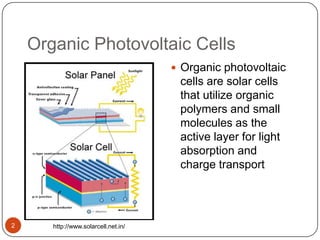
Organic Photovoltaic Cells
 Organic photovoltaic
cells are solar cells
that utilize organic
polymers and small
molecules as the
active layer for light
absorption and
charge transport
http://www.solarcell.net.in/2
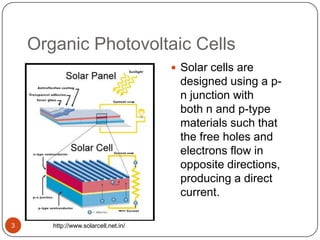
Organic Photovoltaic Cells
 Solar cells are
designed using a p-
n junction with
both n and p-type
materials such that
the free holes and
electrons flow in
opposite directions,
producing a direct
current.
http://www.solarcell.net.in/3
The Steps for the Charge
Transfer
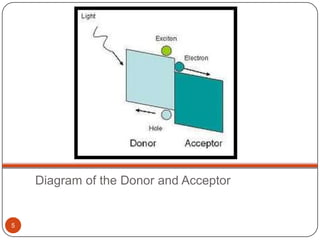
1) Excitation on donor
2) Excitation delocalized on a donor-acceptor
complex
3) Charge-transfer initiated.
4) Charge separation.
4
Diagram of the Donor and Acceptor
5
Advantages of Polymeric
Materials
 Compared to silicon structures, organic materials
have several advantages:
1) Low cost of the technology
2) Possible to achieve fully flexible structures,
3) Relatively low voltages.
6
Polymeric Materials
 Materials having a delocalized electron
system can absorb sunlight, create
photogenerated charge carriers, and transport
these charge carriers.
 Organic solar cells generally focuses either on
solution processable organic semiconducting
polymers.
7
Donor
(P-Type)
Examples
8
Polymeric Materials as Donor
 1. Phthalocyanine
 2. Poly(3-hexylthiophene) “P3HT”
9
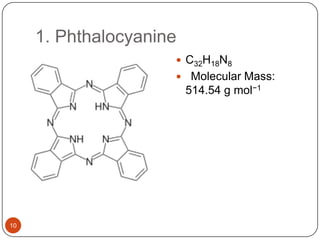
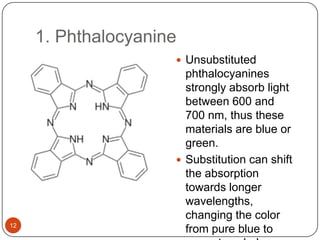
1. Phthalocyanine
 C32H18N8
 Molecular Mass:
514.54 g mol−1
10
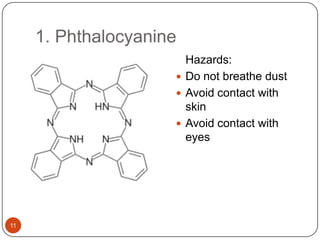
1. Phthalocyanine
Hazards:
 Do not breathe dust
 Avoid contact with
skin
 Avoid contact with
eyes
11
1. Phthalocyanine
 Unsubstituted
phthalocyanines
strongly absorb light
between 600 and
700 nm, thus these
materials are blue or
green.
 Substitution can shift
the absorption
towards longer
wavelengths,
changing the color
from pure blue to12
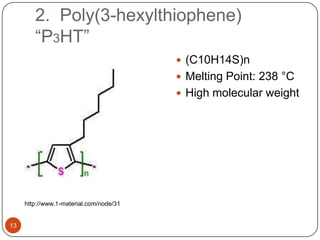
2. Poly(3-hexylthiophene)
“P3HT”
 (C10H14S)n
 Melting Point: 238 °C
 High molecular weight
http://www.1-material.com/node/31
13
Acceptor
(N-Type)
Examples
14
Polymeric Materials as Acceptor
 1. Perylene
 2. Perylene-3,4,9,10-tetracarboxylic
dianhydride
“PTCDA”
 3. Phenyl-C61-butyric acid methyl ester
“PCBM”
 4. Buckminsterfullerene “C60”
15
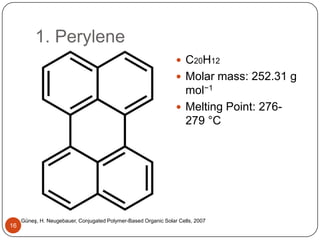
1. Perylene
 C20H12
 Molar mass: 252.31 g
mol−1
 Melting Point: 276-
279 °C
S. Güneş, H. Neugebauer, Conjugated Polymer-Based Organic Solar Cells, 2007
16
1. Perylene
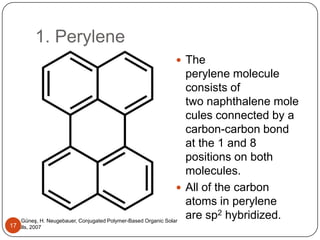
 The
perylene molecule
consists of
two naphthalene mole
cules connected by a
carbon-carbon bond
at the 1 and 8
positions on both
molecules.
 All of the carbon
atoms in perylene
are sp2 hybridized.S. Güneş, H. Neugebauer, Conjugated Polymer-Based Organic Solar
Cells, 200717
1. Perylene
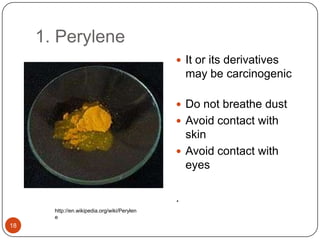
 It or its derivatives
may be carcinogenic
 Do not breathe dust
 Avoid contact with
skin
 Avoid contact with
eyes
.
http://en.wikipedia.org/wiki/Perylen
e
18
1. Perylene
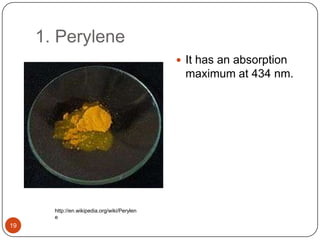
 It has an absorption
maximum at 434 nm.
http://en.wikipedia.org/wiki/Perylen
e
19
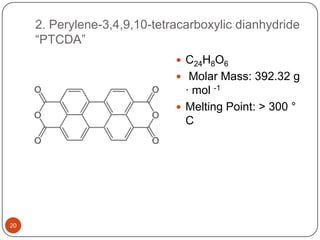
2. Perylene-3,4,9,10-tetracarboxylic dianhydride
“PTCDA”
 C24H8O6
 Molar Mass: 392.32 g
· mol -1
 Melting Point: > 300 °
C
20
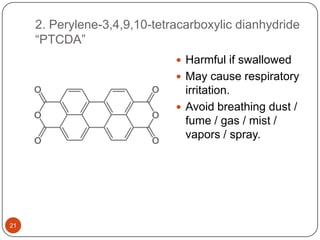
2. Perylene-3,4,9,10-tetracarboxylic dianhydride
“PTCDA”
 Harmful if swallowed
 May cause respiratory
irritation.
 Avoid breathing dust /
fume / gas / mist /
vapors / spray.
21
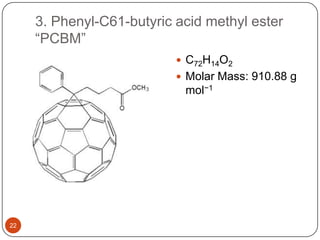
3. Phenyl-C61-butyric acid methyl ester
“PCBM”
 C72H14O2
 Molar Mass: 910.88 g
mol−1
22
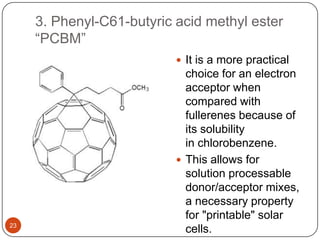
3. Phenyl-C61-butyric acid methyl ester
“PCBM”
 It is a more practical
choice for an electron
acceptor when
compared with
fullerenes because of
its solubility
in chlorobenzene.
 This allows for
solution processable
donor/acceptor mixes,
a necessary property
for "printable" solar
cells.23
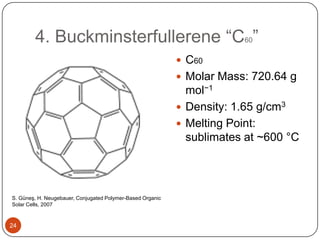
4. Buckminsterfullerene “C60”
 C60
 Molar Mass: 720.64 g
mol−1
 Density: 1.65 g/cm3
 Melting Point:
sublimates at ~600 °C
S. Güneş, H. Neugebauer, Conjugated Polymer-Based Organic
Solar Cells, 2007
24
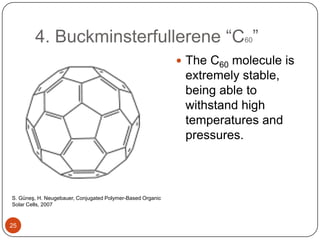
4. Buckminsterfullerene “C60”
 The C60 molecule is
extremely stable,
being able to
withstand high
temperatures and
pressures.
S. Güneş, H. Neugebauer, Conjugated Polymer-Based Organic
Solar Cells, 2007
25
References
 S. Gunes, H. Neugebauer, Conjugated Polymer-
Based Organic Solar Cells, 2007
 A. Moliton1, R. Hiorns, Review of electronic and
optical properties of semiconducting π-conjugated
polymers: applications in optoelectronics, 2004
 A. Facchetti, π-Conjugated Polymers for Organic
Electronics and Photovoltaic Cell Applications,
Northwestern University, 2011
 www.wikipedia.com
26
Thank You for Your
Attention
27

Polymeric materials for organic solar cells

  • 1.
  • 2.
    Organic Photovoltaic Cells Organic photovoltaic cells are solar cells that utilize organic polymers and small molecules as the active layer for light absorption and charge transport http://www.solarcell.net.in/2
  • 3.
    Organic Photovoltaic Cells Solar cells are designed using a p- n junction with both n and p-type materials such that the free holes and electrons flow in opposite directions, producing a direct current. http://www.solarcell.net.in/3
  • 4.
    The Steps forthe Charge Transfer 1) Excitation on donor 2) Excitation delocalized on a donor-acceptor complex 3) Charge-transfer initiated. 4) Charge separation. 4
  • 5.
    Diagram of theDonor and Acceptor 5
  • 6.
    Advantages of Polymeric Materials Compared to silicon structures, organic materials have several advantages: 1) Low cost of the technology 2) Possible to achieve fully flexible structures, 3) Relatively low voltages. 6
  • 7.
    Polymeric Materials  Materialshaving a delocalized electron system can absorb sunlight, create photogenerated charge carriers, and transport these charge carriers.  Organic solar cells generally focuses either on solution processable organic semiconducting polymers. 7
  • 8.
  • 9.
    Polymeric Materials asDonor  1. Phthalocyanine  2. Poly(3-hexylthiophene) “P3HT” 9
  • 10.
    1. Phthalocyanine  C32H18N8 Molecular Mass: 514.54 g mol−1 10
  • 11.
    1. Phthalocyanine Hazards:  Donot breathe dust  Avoid contact with skin  Avoid contact with eyes 11
  • 12.
    1. Phthalocyanine  Unsubstituted phthalocyanines stronglyabsorb light between 600 and 700 nm, thus these materials are blue or green.  Substitution can shift the absorption towards longer wavelengths, changing the color from pure blue to12
  • 13.
    2. Poly(3-hexylthiophene) “P3HT”  (C10H14S)n Melting Point: 238 °C  High molecular weight http://www.1-material.com/node/31 13
  • 14.
  • 15.
    Polymeric Materials asAcceptor  1. Perylene  2. Perylene-3,4,9,10-tetracarboxylic dianhydride “PTCDA”  3. Phenyl-C61-butyric acid methyl ester “PCBM”  4. Buckminsterfullerene “C60” 15
  • 16.
    1. Perylene  C20H12 Molar mass: 252.31 g mol−1  Melting Point: 276- 279 °C S. Güneş, H. Neugebauer, Conjugated Polymer-Based Organic Solar Cells, 2007 16
  • 17.
    1. Perylene  The perylenemolecule consists of two naphthalene mole cules connected by a carbon-carbon bond at the 1 and 8 positions on both molecules.  All of the carbon atoms in perylene are sp2 hybridized.S. Güneş, H. Neugebauer, Conjugated Polymer-Based Organic Solar Cells, 200717
  • 18.
    1. Perylene  Itor its derivatives may be carcinogenic  Do not breathe dust  Avoid contact with skin  Avoid contact with eyes . http://en.wikipedia.org/wiki/Perylen e 18
  • 19.
    1. Perylene  Ithas an absorption maximum at 434 nm. http://en.wikipedia.org/wiki/Perylen e 19
  • 20.
    2. Perylene-3,4,9,10-tetracarboxylic dianhydride “PTCDA” C24H8O6  Molar Mass: 392.32 g · mol -1  Melting Point: > 300 ° C 20
  • 21.
    2. Perylene-3,4,9,10-tetracarboxylic dianhydride “PTCDA” Harmful if swallowed  May cause respiratory irritation.  Avoid breathing dust / fume / gas / mist / vapors / spray. 21
  • 22.
    3. Phenyl-C61-butyric acidmethyl ester “PCBM”  C72H14O2  Molar Mass: 910.88 g mol−1 22
  • 23.
    3. Phenyl-C61-butyric acidmethyl ester “PCBM”  It is a more practical choice for an electron acceptor when compared with fullerenes because of its solubility in chlorobenzene.  This allows for solution processable donor/acceptor mixes, a necessary property for "printable" solar cells.23
  • 24.
    4. Buckminsterfullerene “C60” C60  Molar Mass: 720.64 g mol−1  Density: 1.65 g/cm3  Melting Point: sublimates at ~600 °C S. Güneş, H. Neugebauer, Conjugated Polymer-Based Organic Solar Cells, 2007 24
  • 25.
    4. Buckminsterfullerene “C60” The C60 molecule is extremely stable, being able to withstand high temperatures and pressures. S. Güneş, H. Neugebauer, Conjugated Polymer-Based Organic Solar Cells, 2007 25
  • 26.
    References  S. Gunes,H. Neugebauer, Conjugated Polymer- Based Organic Solar Cells, 2007  A. Moliton1, R. Hiorns, Review of electronic and optical properties of semiconducting π-conjugated polymers: applications in optoelectronics, 2004  A. Facchetti, π-Conjugated Polymers for Organic Electronics and Photovoltaic Cell Applications, Northwestern University, 2011  www.wikipedia.com 26
  • 27.
    Thank You forYour Attention 27