SURFACE ENHANCED RAMAN
SPECTROSCOPY(SERS)
Prepared by:-
Name: RAHTOSH RANJAN
EnrollmentNo.:MGCU2017PHYS3020
Semester - 6th
Session-2017-2020
Guided by:-
Prof Sunil Kumar Srivastava
PREPARED BY-
RAHUTOSH RANJAN
Contents
Introduction to SERS
Features of SERS
Principle
Instrumentation
Plasmons and Plasmonics
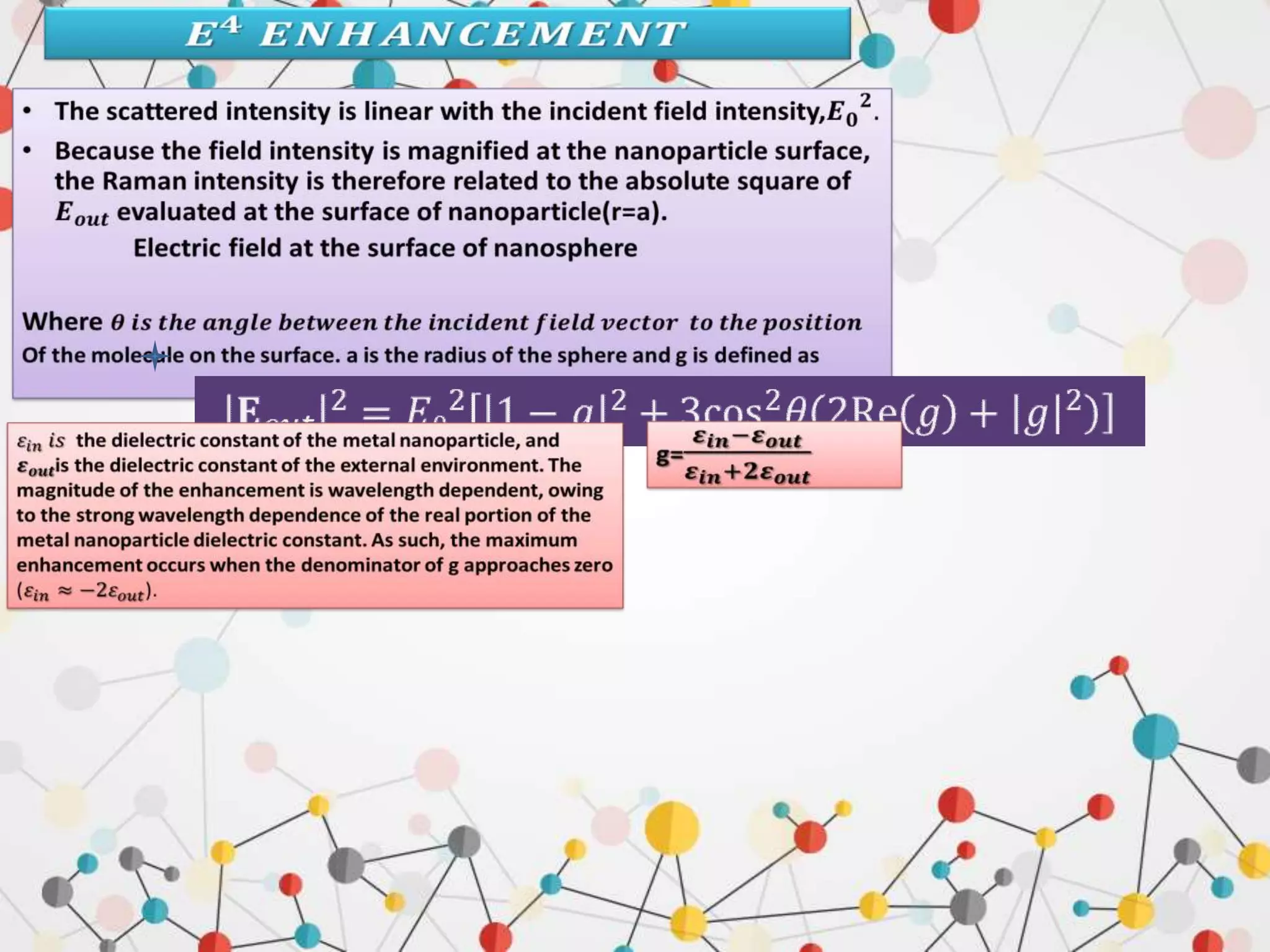
SERS Enhancement
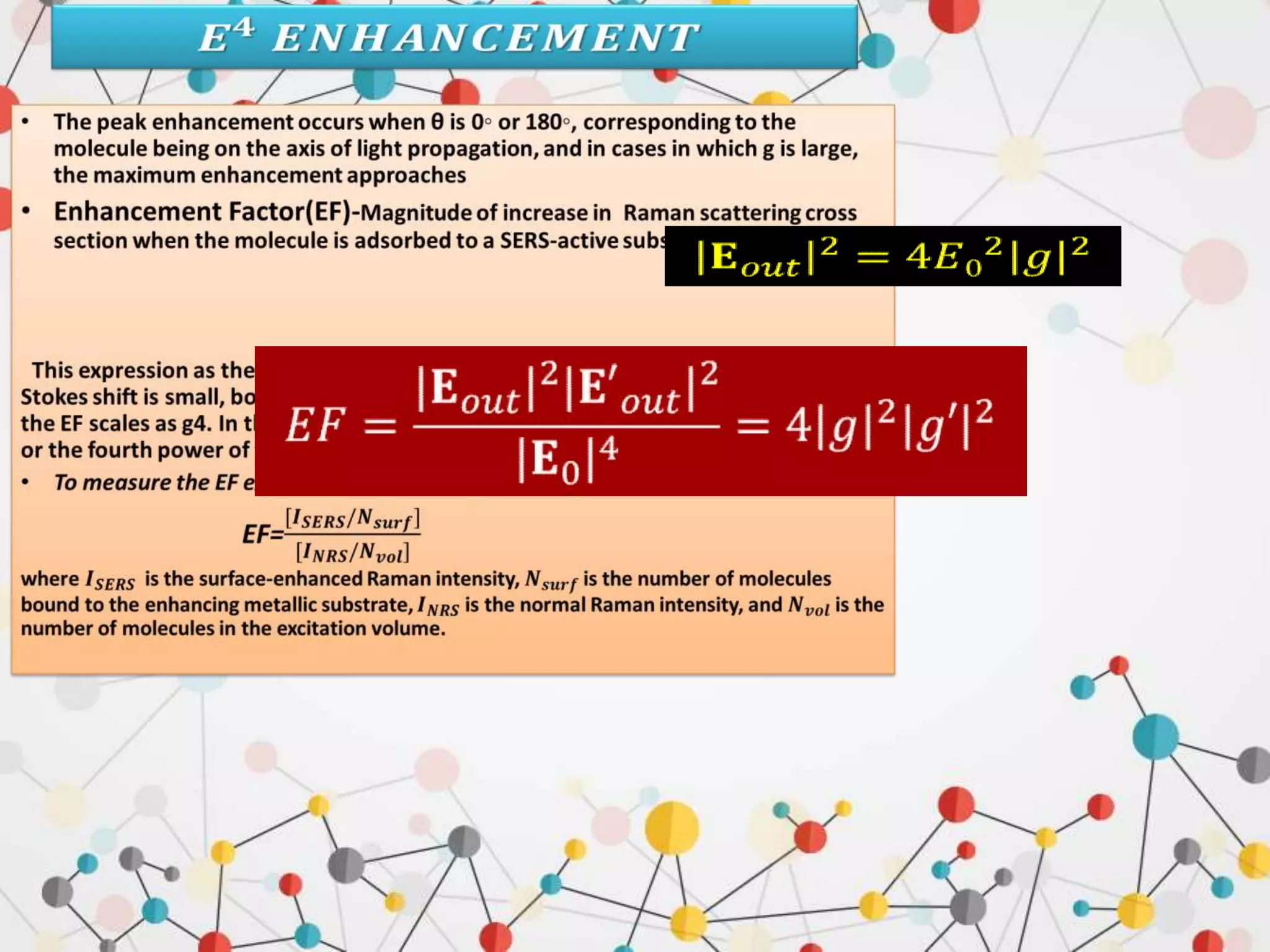
Enhancement Factor
Hotspots
SERS Substrate
Experimental detail
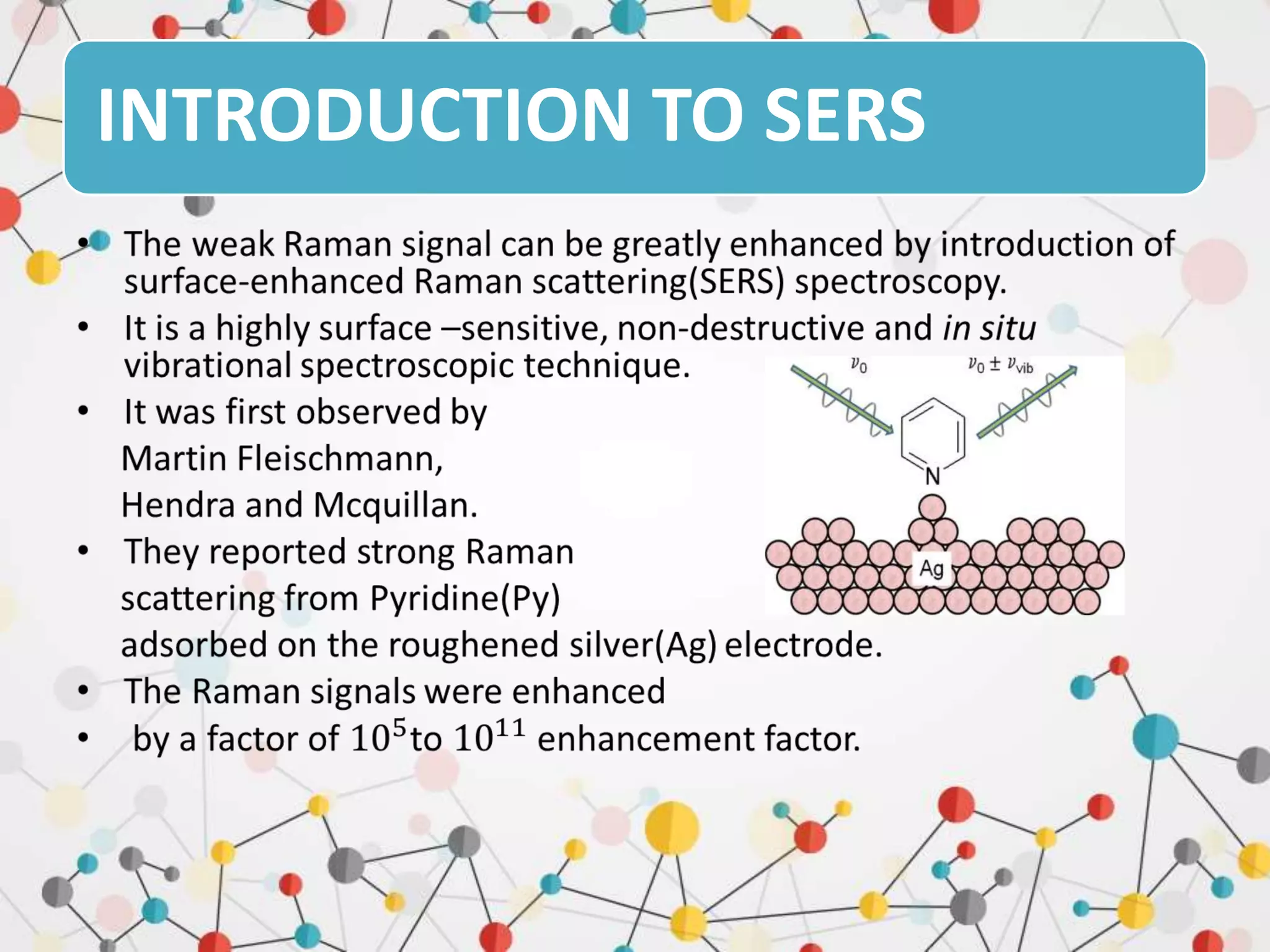
INTRODUCTION TO SERS
• They initially thought the intense surface Raman signal of Py
was due to increased surface area.
• Prevailing explanation was proposed by Van Duyne in
1977.
• Van Duyne hypothesized that the phenomenon was
originated by strong electrochemical electric field at
the metal surface.
• Moskivits proposed that the large signal was originated
by optical excitation of collective oscillation of the
electron in the metallic nano sized features at the
surface.
• A comprehensive theory of this effect was given by
Lombardy and Birke.
FEATURES OF SERS
It is a highly surface-sensitive, non-destructive and in situ vibrational spectroscopic technique.
SERS occurs when target molecules are brought within a few nanometers of the surface of SERS active
substrates of different morphologies.
The excitation profile (scattering intensity versus excitation frequency) deviates from the fourth power dependence of
normal Raman scattering.
It has extremely high spatial resolution. The enhancement range is several nanometers, effective for one or several molecular layers close
to the SERS active substrate.
SERS activity strongly depends on the nature of metal and surface roughness.
SERS active substrate fabrication is a very important field in SERS research. The two most common SERS active substrates are metal
colloids of coinage metals of Au, Ag and.
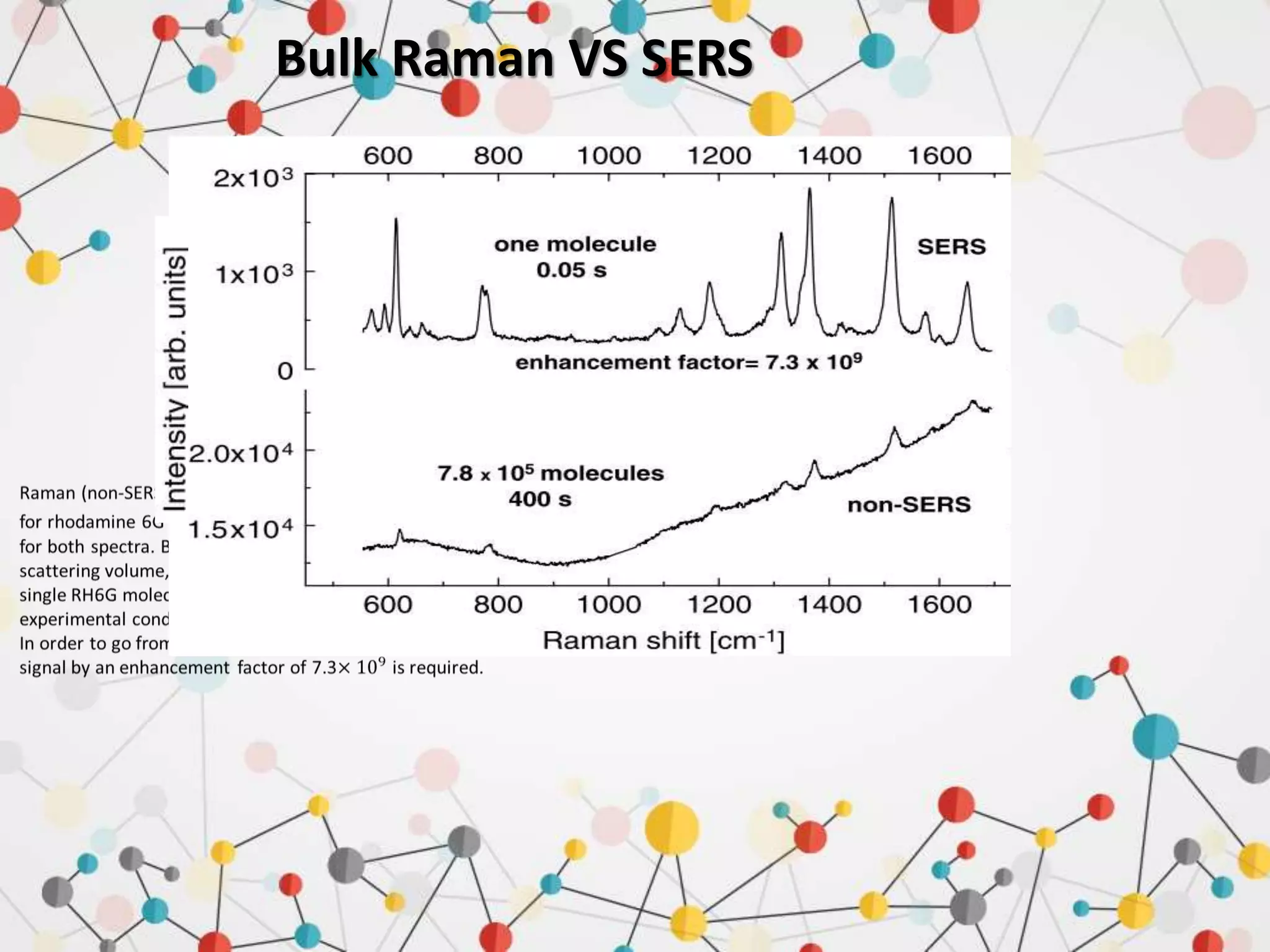
The SERS technique is so sensitive that even single molecule can be detected.
Bulk Raman VS SERS
SERS is truly a surface selective effect.
SERS is a molecular spectroscopic technique which is based on plasmon assisted scattering of molecules on or near metal
nano structures.
SERS consist in using the large local field enhancement that can exist at metallic surfaces under the right condition.
The SERS enhancement of the nano structures strongly relies upon the optical resonance property of the coinage
metal(i.e. Au, Ag, Cu).
The SERS effect is due to the amplification of Raman signal of analytes by several orders of magnitude, when the analytes
are located at or very close to coinage metal nano structures.
PRINCIPLE
Cont..
Localized Surface Plasmon Resonance (LSPR) boost the Raman signal of molecules at (or close to) the
surface.
There are two ways for enhancement of the Raman signals-
• Electromagnetic Enhancement.
• Chemical Enhancement.
Electromagnetic Enhancement mechanism results from the amplification
of light by excited LSPR.
Chemical Enhancement involve charge transfer mechanism . Where the excitation wavelength is resultant
with the metal molecule charge transfer electronic state.
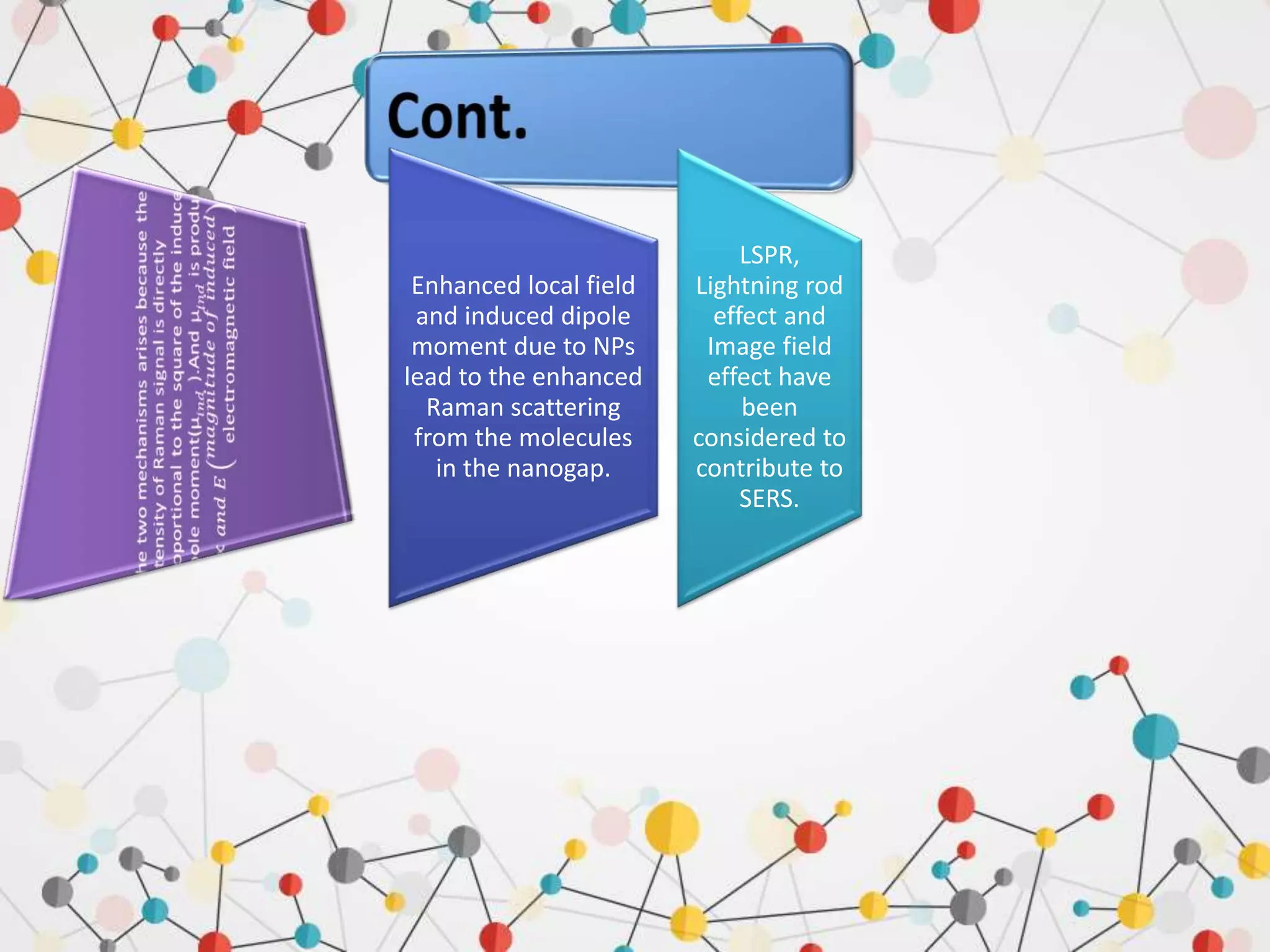
Enhanced local field
and induced dipole
moment due to NPs
lead to the enhanced
Raman scattering
from the molecules
in the nanogap.
LSPR,
Lightning rod
effect and
Image field
effect have
been
considered to
contribute to
SERS.
PLASMON AND PLASMONICS
Plasmonics is the study of the interaction of light and metal under precise conditions.
Plasmonics is the study of optical property of noble metals in particular gold and silver.
Optical property of noble metal
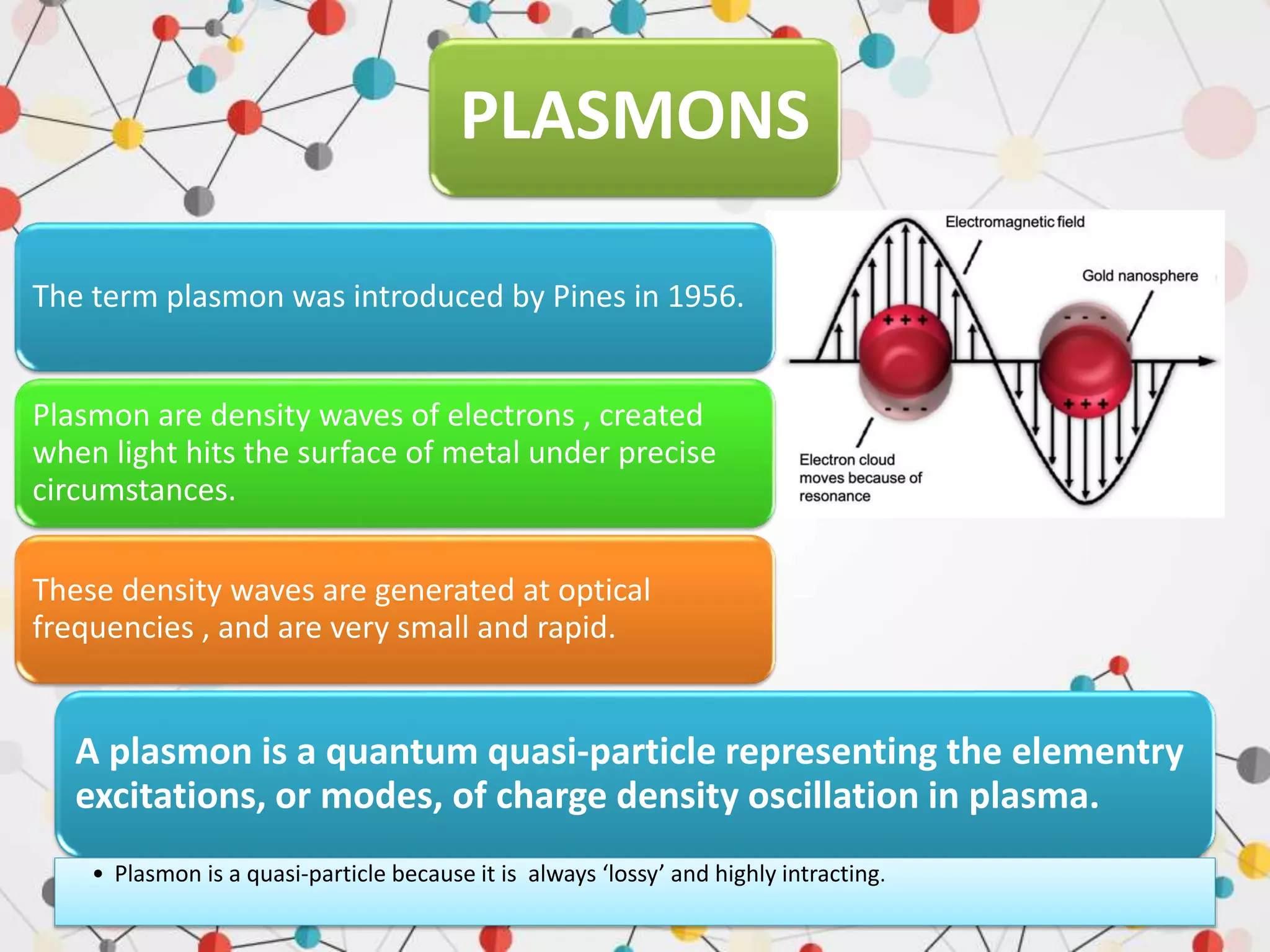
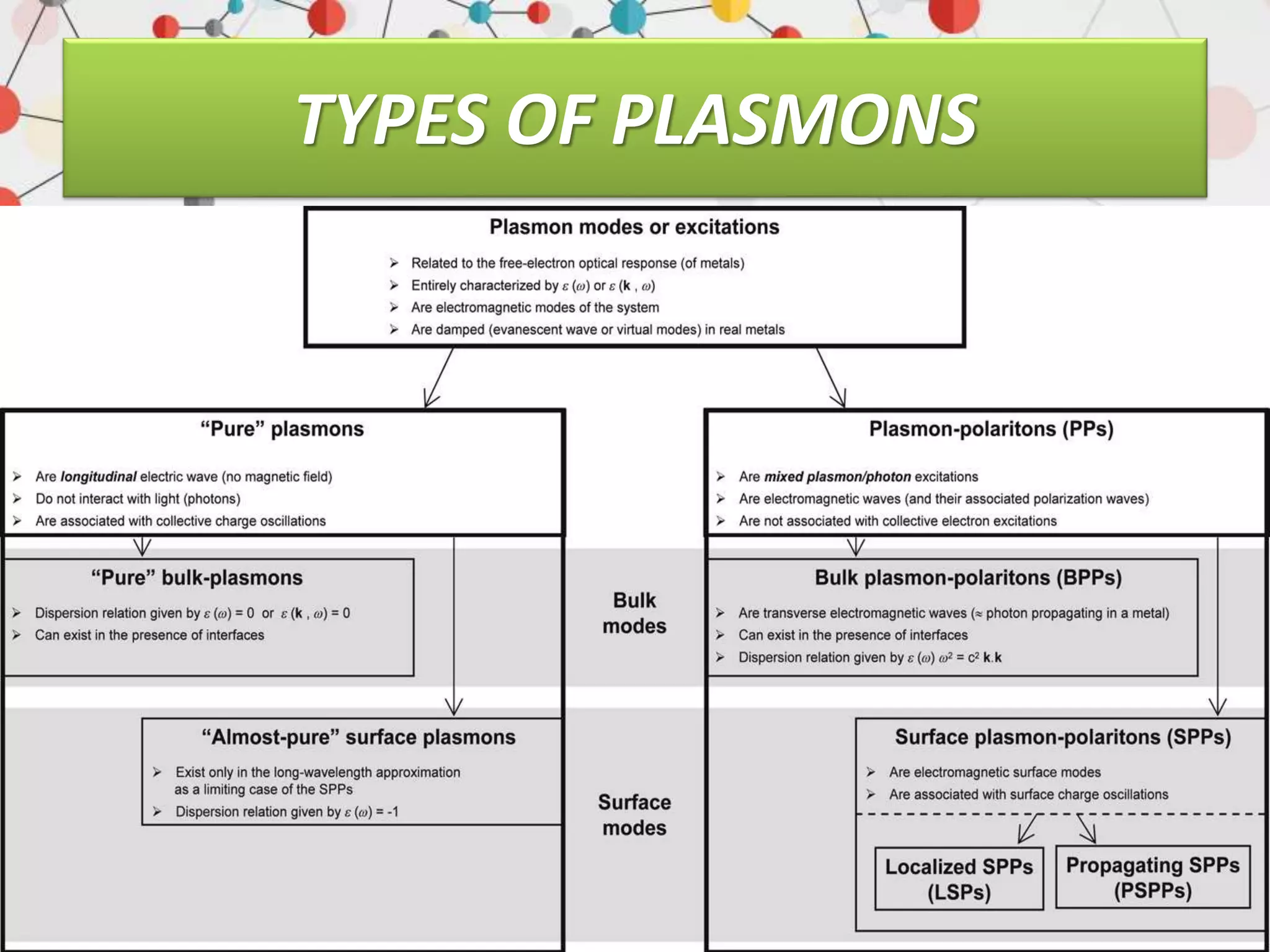
PLASMONS
The term plasmon was introduced by Pines in 1956.
Plasmon are density waves of electrons , created
when light hits the surface of metal under precise
circumstances.
These density waves are generated at optical
frequencies , and are very small and rapid.
A plasmon is a quantum quasi-particle representing the elementry
excitations, or modes, of charge density oscillation in plasma.
• Plasmon is a quasi-particle because it is always ‘lossy’ and highly intracting.
PLASMONS CONT.
Plasmon exists mainly in metals, where electrons are weakly bound
to the atom and free to roam.
The electrons in a metal can wobble like a piece of jelly, pulled back
by the attraction of the positive metal ions that they leave behind.
A plasmon is a collective wave where billions of electrons oscillate
in sync.
Plasmon can exist either by themselvesi.e. without mixing with a
photon or as a mixed plasma-photon mode(plasmon-polaritons).
Plasmon-polaritons Bosonic quasi-particle resulting from
strong coupling of photons with an electric
or magnetic dipole.
Photon-induced
plasmon(plasmon +
photon coupled)
TYPES OF PLASMONS
SURFACE PLASMON
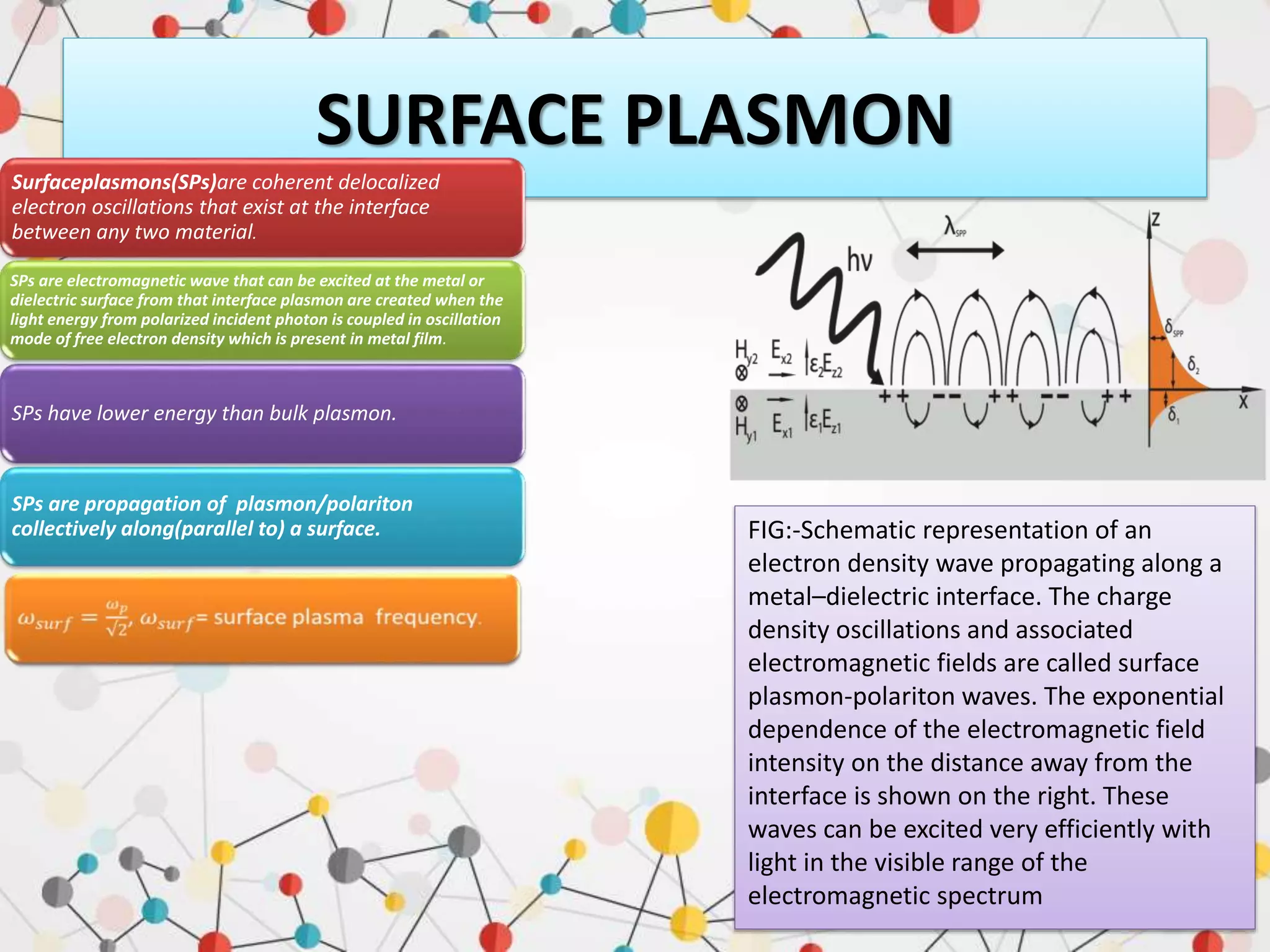
FIG:-Schematic representation of an
electron density wave propagating along a
metal–dielectric interface. The charge
density oscillations and associated
electromagnetic fields are called surface
plasmon-polariton waves. The exponential
dependence of the electromagnetic field
intensity on the distance away from the
interface is shown on the right. These
waves can be excited very efficiently with
light in the visible range of the
electromagnetic spectrum
Surfaceplasmons(SPs)are coherent delocalized
electron oscillations that exist at the interface
between any two material.
SPs are electromagnetic wave that can be excited at the metal or
dielectric surface from that interface plasmon are created when the
light energy from polarized incident photon is coupled in oscillation
mode of free electron density which is present in metal film.
SPs have lower energy than bulk plasmon.
SPs are propagation of plasmon/polariton
collectively along(parallel to) a surface.
SURFACE PLASMON RESONANCE(SPR)
Plasmon resonance are due
to collective charge
oscillation of free electron.
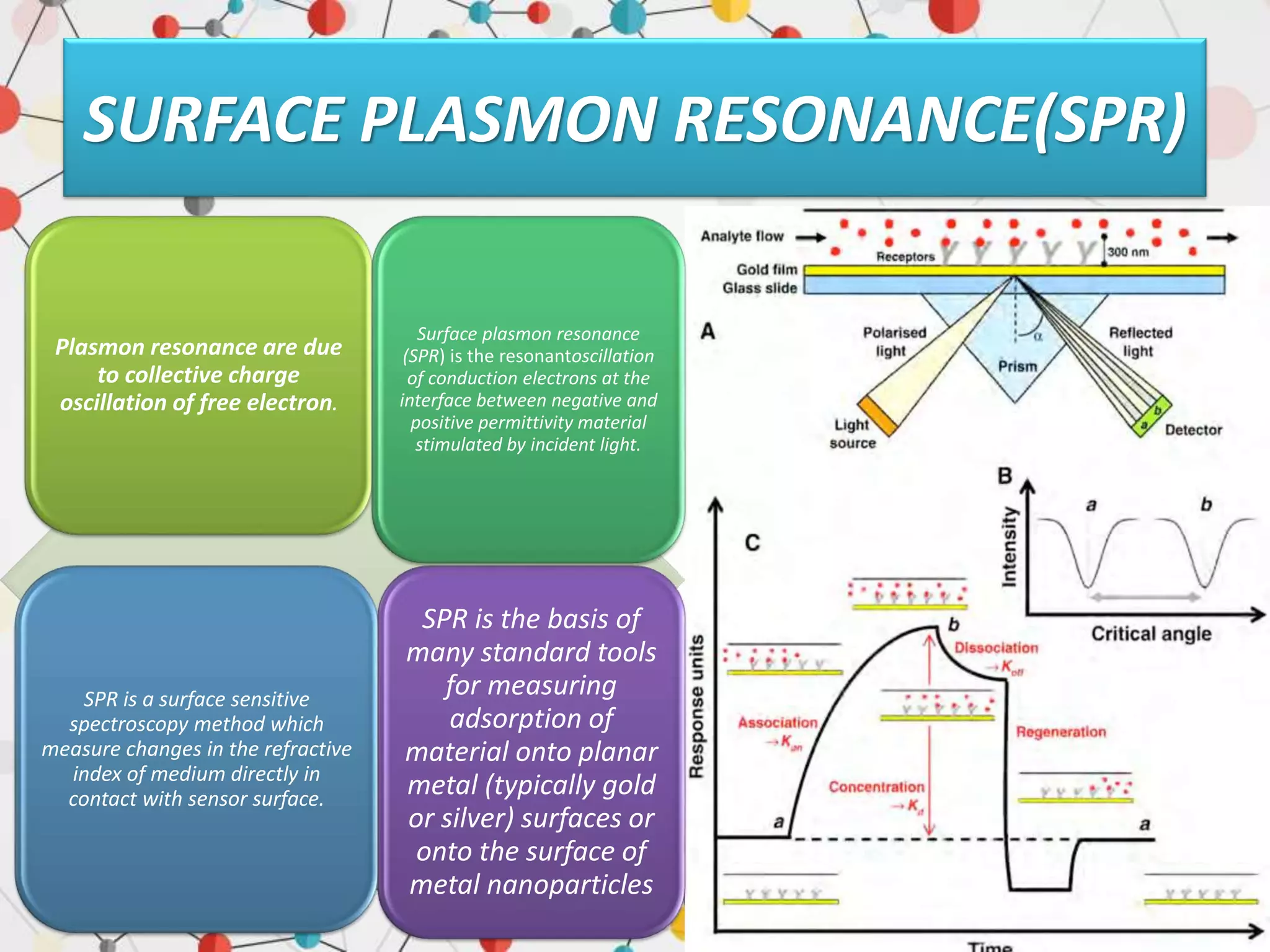
Surface plasmon resonance
(SPR) is the resonantoscillation
of conduction electrons at the
interface between negative and
positive permittivity material
stimulated by incident light.
SPR is a surface sensitive
spectroscopy method which
measure changes in the refractive
index of medium directly in
contact with sensor surface.
SPR is the basis of
many standard tools
for measuring
adsorption of
material onto planar
metal (typically gold
or silver) surfaces or
onto the surface of
metal nanoparticles
SPR CONT…
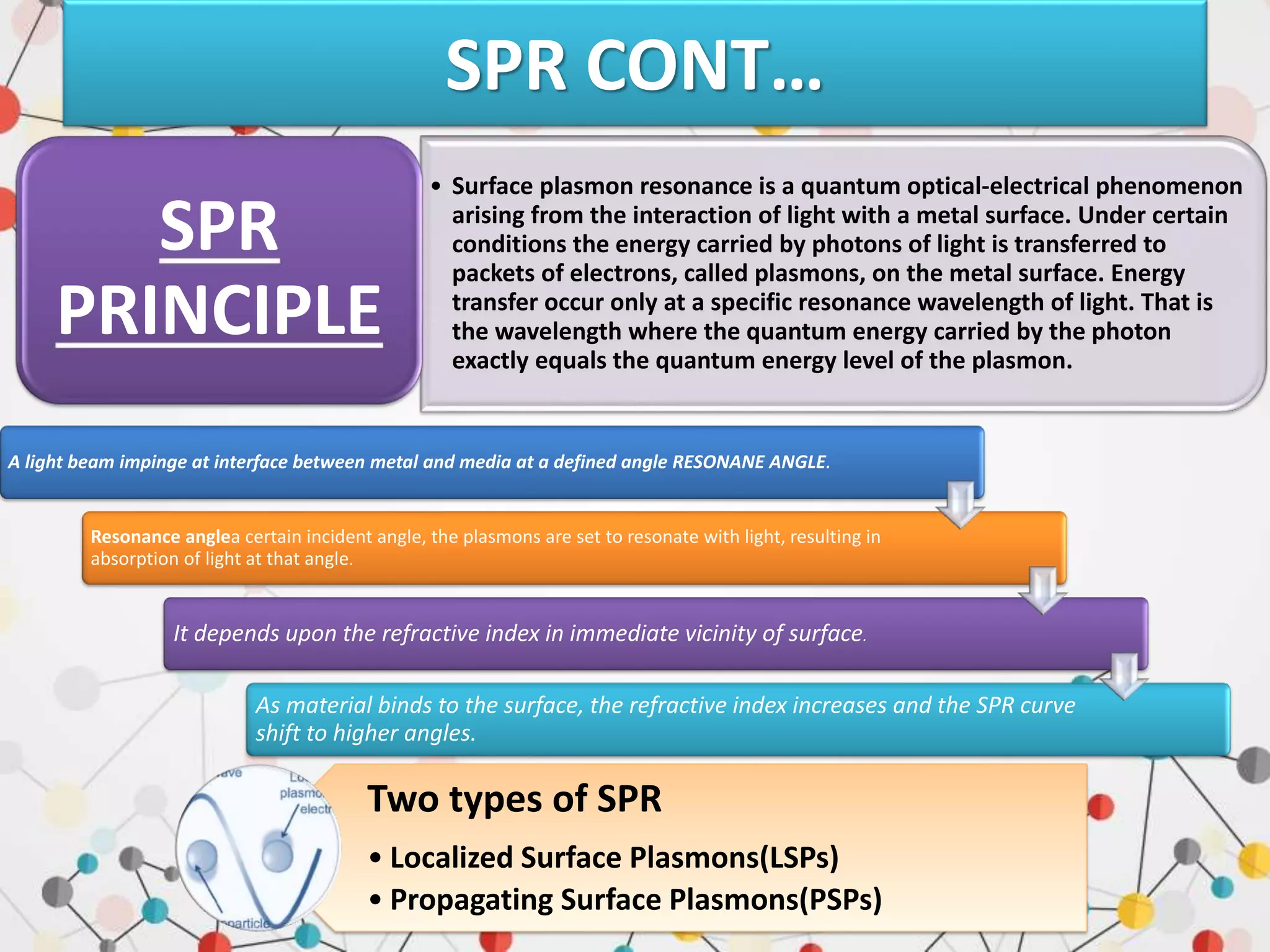
• Surface plasmon resonance is a quantum optical-electrical phenomenon
arising from the interaction of light with a metal surface. Under certain
conditions the energy carried by photons of light is transferred to
packets of electrons, called plasmons, on the metal surface. Energy
transfer occur only at a specific resonance wavelength of light. That is
the wavelength where the quantum energy carried by the photon
exactly equals the quantum energy level of the plasmon.
SPR
PRINCIPLE
A light beam impinge at interface between metal and media at a defined angle RESONANE ANGLE.
Resonance anglea certain incident angle, the plasmons are set to resonate with light, resulting in
absorption of light at that angle.
It depends upon the refractive index in immediate vicinity of surface.
As material binds to the surface, the refractive index increases and the SPR curve
shift to higher angles.
Two types of SPR
• Localized Surface Plasmons(LSPs)
• Propagating Surface Plasmons(PSPs)
LOCALIZED SURFACE PLASMONS(LSPs)
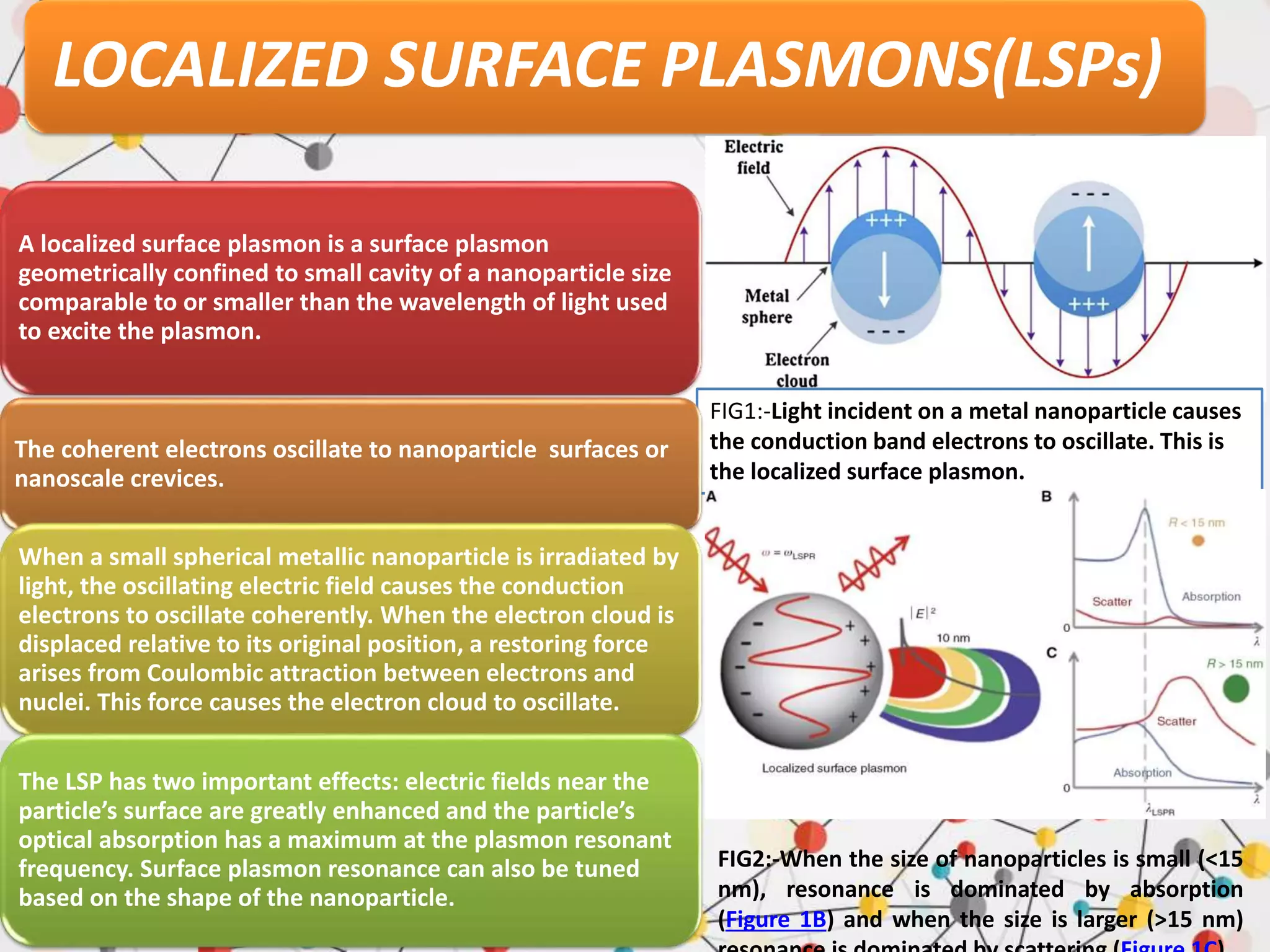
FIG1:-Light incident on a metal nanoparticle causes
the conduction band electrons to oscillate. This is
the localized surface plasmon.
A localized surface plasmon is a surface plasmon
geometrically confined to small cavity of a nanoparticle size
comparable to or smaller than the wavelength of light used
to excite the plasmon.
The coherent electrons oscillate to nanoparticle surfaces or
nanoscale crevices.
When a small spherical metallic nanoparticle is irradiated by
light, the oscillating electric field causes the conduction
electrons to oscillate coherently. When the electron cloud is
displaced relative to its original position, a restoring force
arises from Coulombic attraction between electrons and
nuclei. This force causes the electron cloud to oscillate.
The LSP has two important effects: electric fields near the
particle’s surface are greatly enhanced and the particle’s
optical absorption has a maximum at the plasmon resonant
frequency. Surface plasmon resonance can also be tuned
based on the shape of the nanoparticle.
FIG2:-When the size of nanoparticles is small (<15
nm), resonance is dominated by absorption
(Figure 1B) and when the size is larger (>15 nm)
MECHANISM
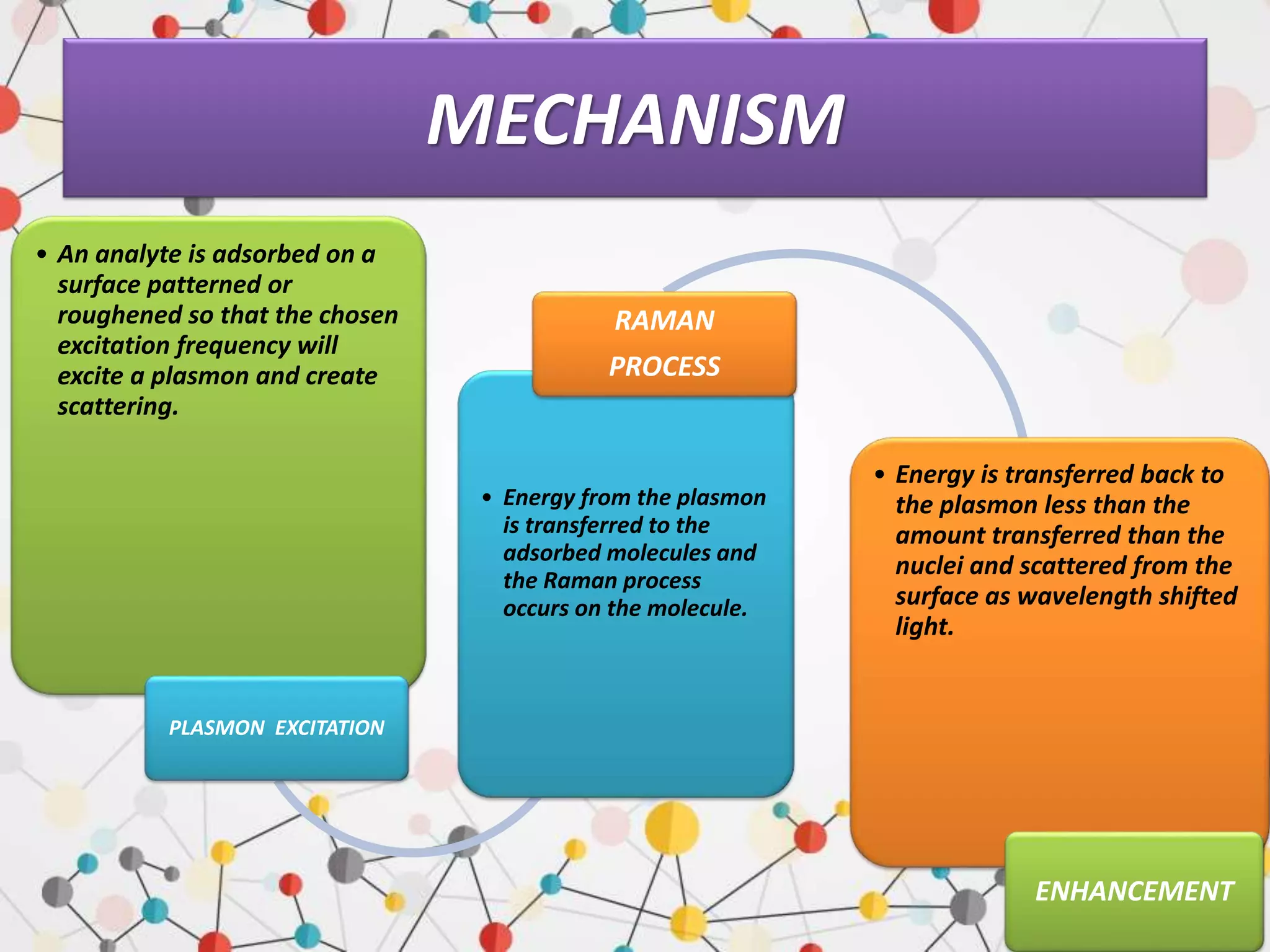
• An analyte is adsorbed on a
surface patterned or
roughened so that the chosen
excitation frequency will
excite a plasmon and create
scattering.
PLASMON EXCITATION
• Energy from the plasmon
is transferred to the
adsorbed molecules and
the Raman process
occurs on the molecule.
RAMAN
PROCESS
• Energy is transferred back to
the plasmon less than the
amount transferred than the
nuclei and scattered from the
surface as wavelength shifted
light.
ENHANCEMENT
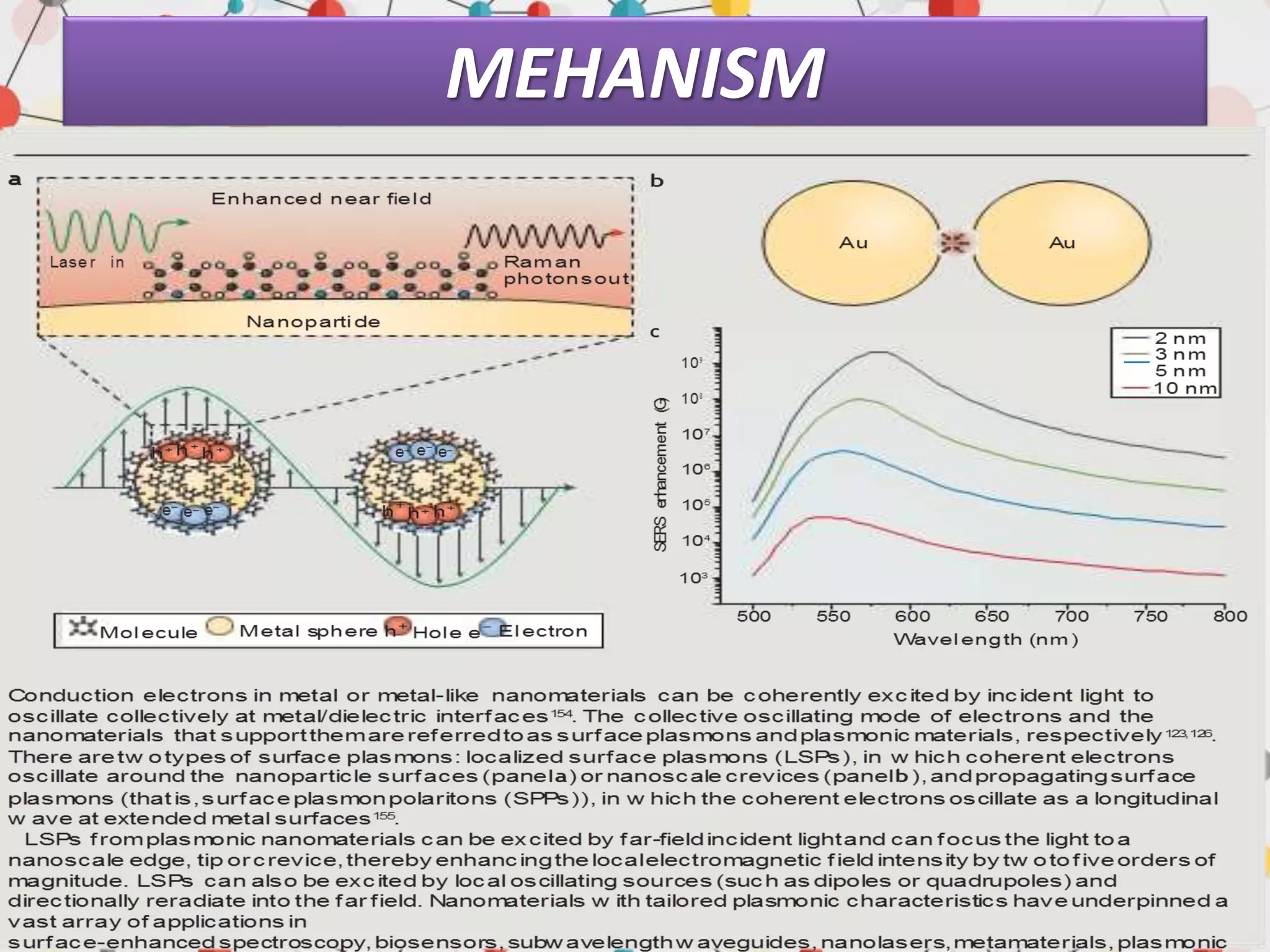
MEHANISM
EXPERIMENTAL CONSIDERATIONS
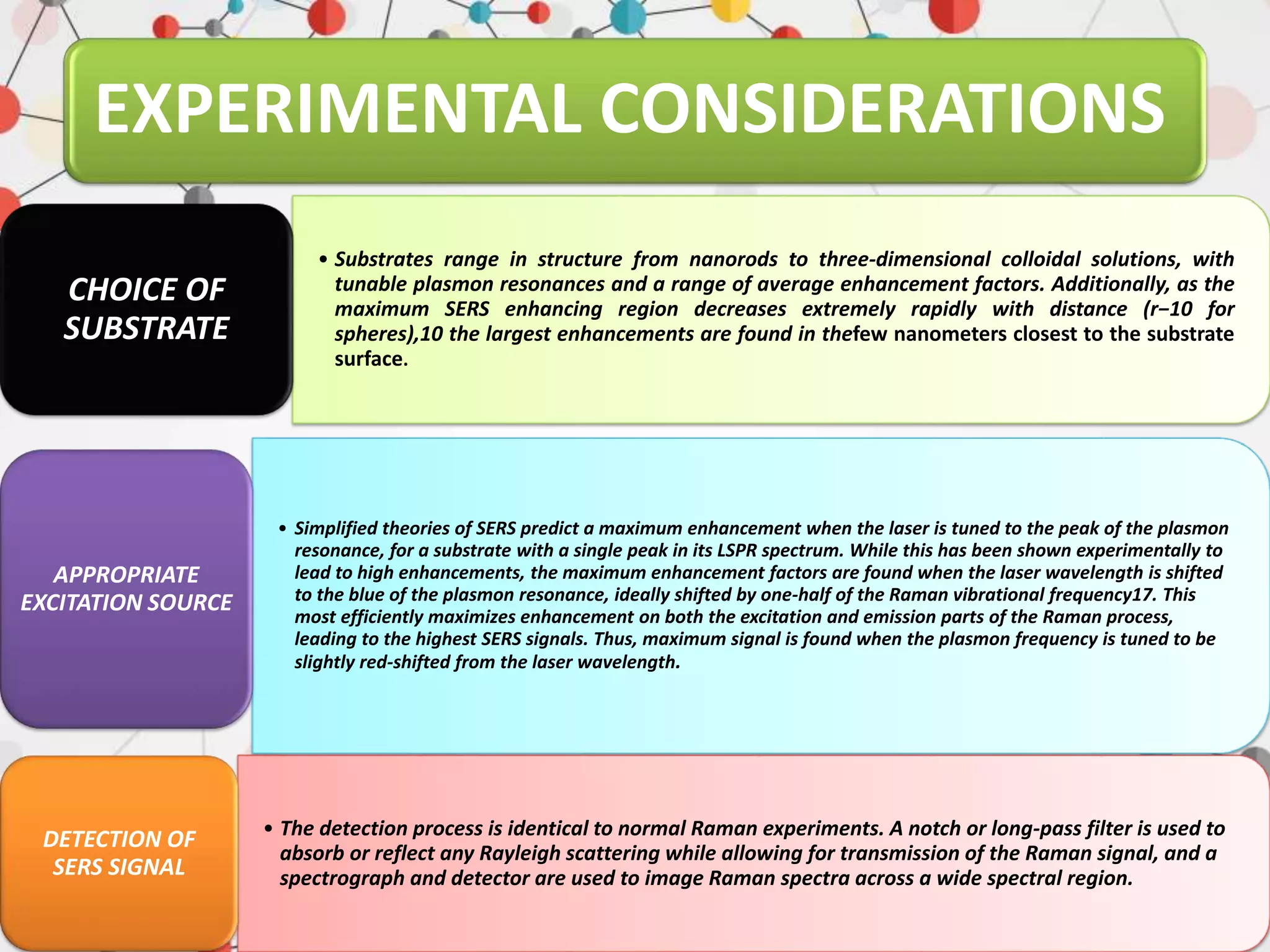
• Substrates range in structure from nanorods to three-dimensional colloidal solutions, with
tunable plasmon resonances and a range of average enhancement factors. Additionally, as the
maximum SERS enhancing region decreases extremely rapidly with distance (r−10 for
spheres),10 the largest enhancements are found in thefew nanometers closest to the substrate
surface.
CHOICE OF
SUBSTRATE
• Simplified theories of SERS predict a maximum enhancement when the laser is tuned to the peak of the plasmon
resonance, for a substrate with a single peak in its LSPR spectrum. While this has been shown experimentally to
lead to high enhancements, the maximum enhancement factors are found when the laser wavelength is shifted
to the blue of the plasmon resonance, ideally shifted by one-half of the Raman vibrational frequency17. This
most efficiently maximizes enhancement on both the excitation and emission parts of the Raman process,
leading to the highest SERS signals. Thus, maximum signal is found when the plasmon frequency is tuned to be
slightly red-shifted from the laser wavelength.
APPROPRIATE
EXCITATION SOURCE
• The detection process is identical to normal Raman experiments. A notch or long-pass filter is used to
absorb or reflect any Rayleigh scattering while allowing for transmission of the Raman signal, and a
spectrograph and detector are used to image Raman spectra across a wide spectral region.
DETECTION OF
SERS SIGNAL
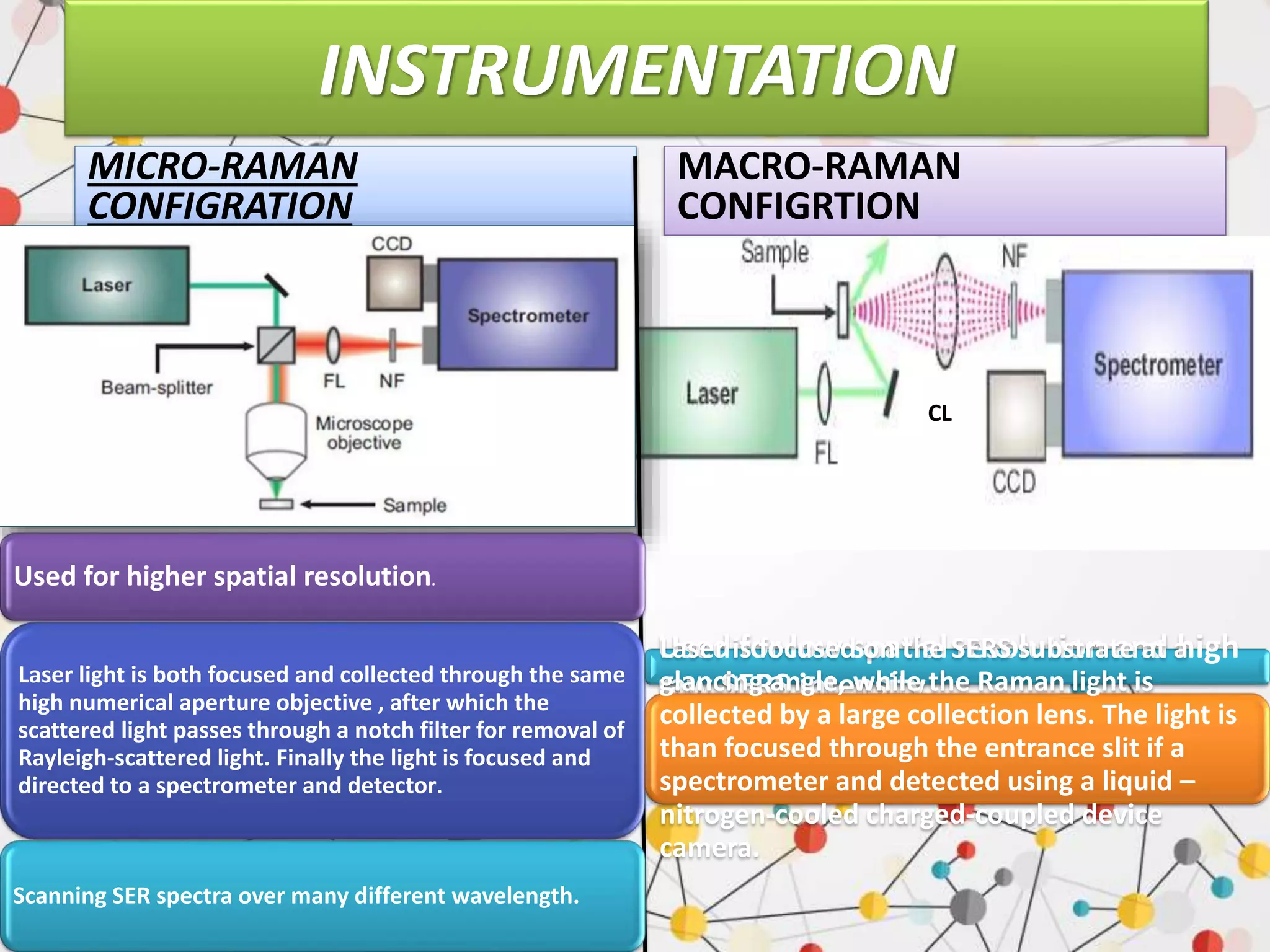
INSTRUMENTATION
MICRO-RAMAN
CONFIGRATION
MACRO-RAMAN
CONFIGRTION
CL
Used for higher spatial resolution.
Laser light is both focused and collected through the same
high numerical aperture objective , after which the
scattered light passes through a notch filter for removal of
Rayleigh-scattered light. Finally the light is focused and
directed to a spectrometer and detector.
Scanning SER spectra over many different wavelength.
Used for low spatial resolution and high
raw SERS intensity.
Laser is focused on the SERS substrate at a
glancing angle, while the Raman light is
collected by a large collection lens. The light is
than focused through the entrance slit if a
spectrometer and detected using a liquid –
nitrogen-cooled charged-coupled device
camera.
MULTILASER RAMAN INSTRUMENTATION
Fig:- Schematic diagram of the experimental setup as laid out on the laser table. The setup allows
for easy tunability over the visible wavelength, using a combination of laser while maintaining
alignment on the sample. The triple spectrograph analyzes Raman scattering excited at
wavelengths throughout the visible spectrum.
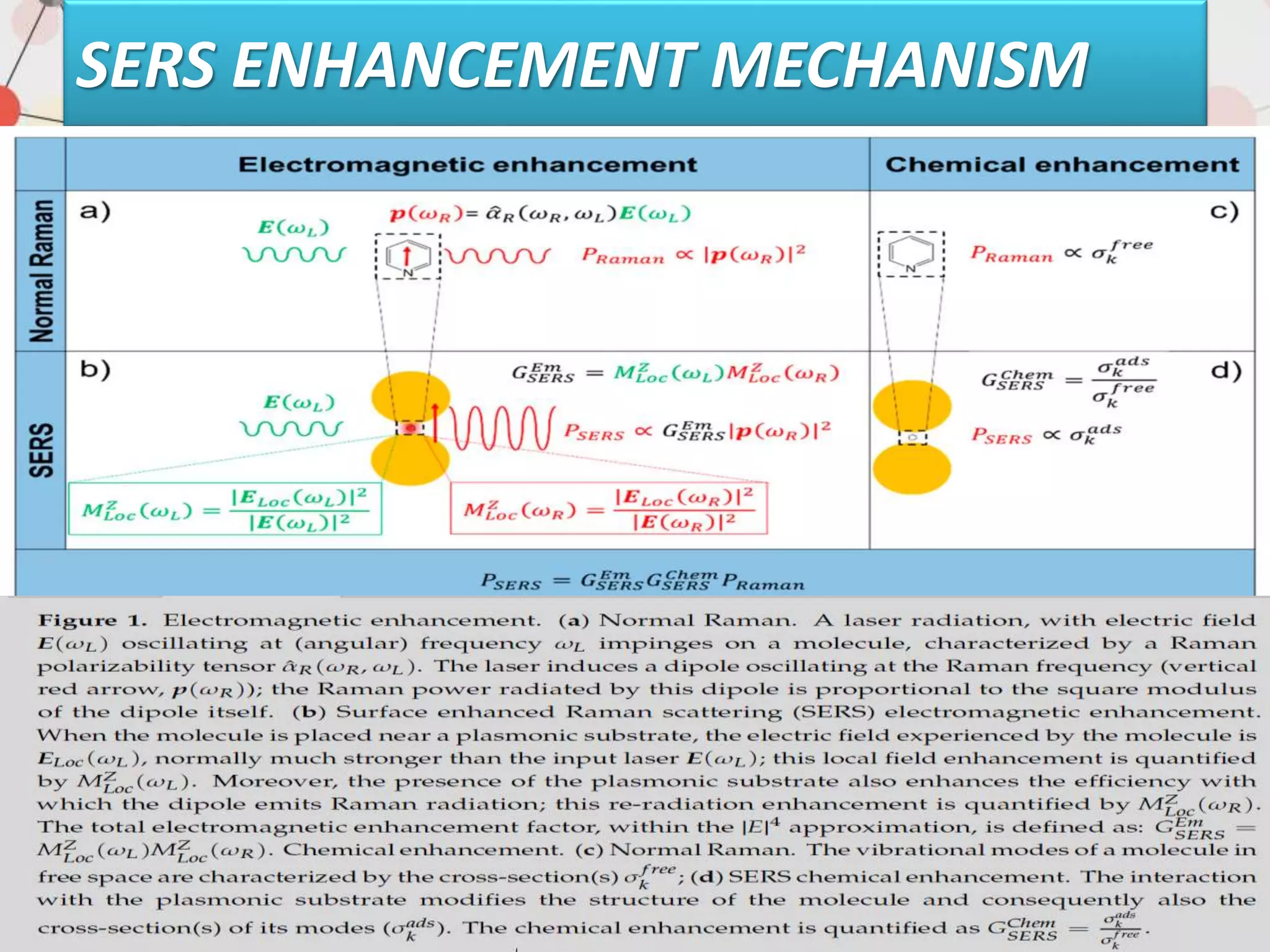
SERS ENHANCEMENT
ELECTROMAGNETIC
ENHANCEMENT CHEMICAL ENHANCEMENT
SERS ENHANCEMENT MECHANISM
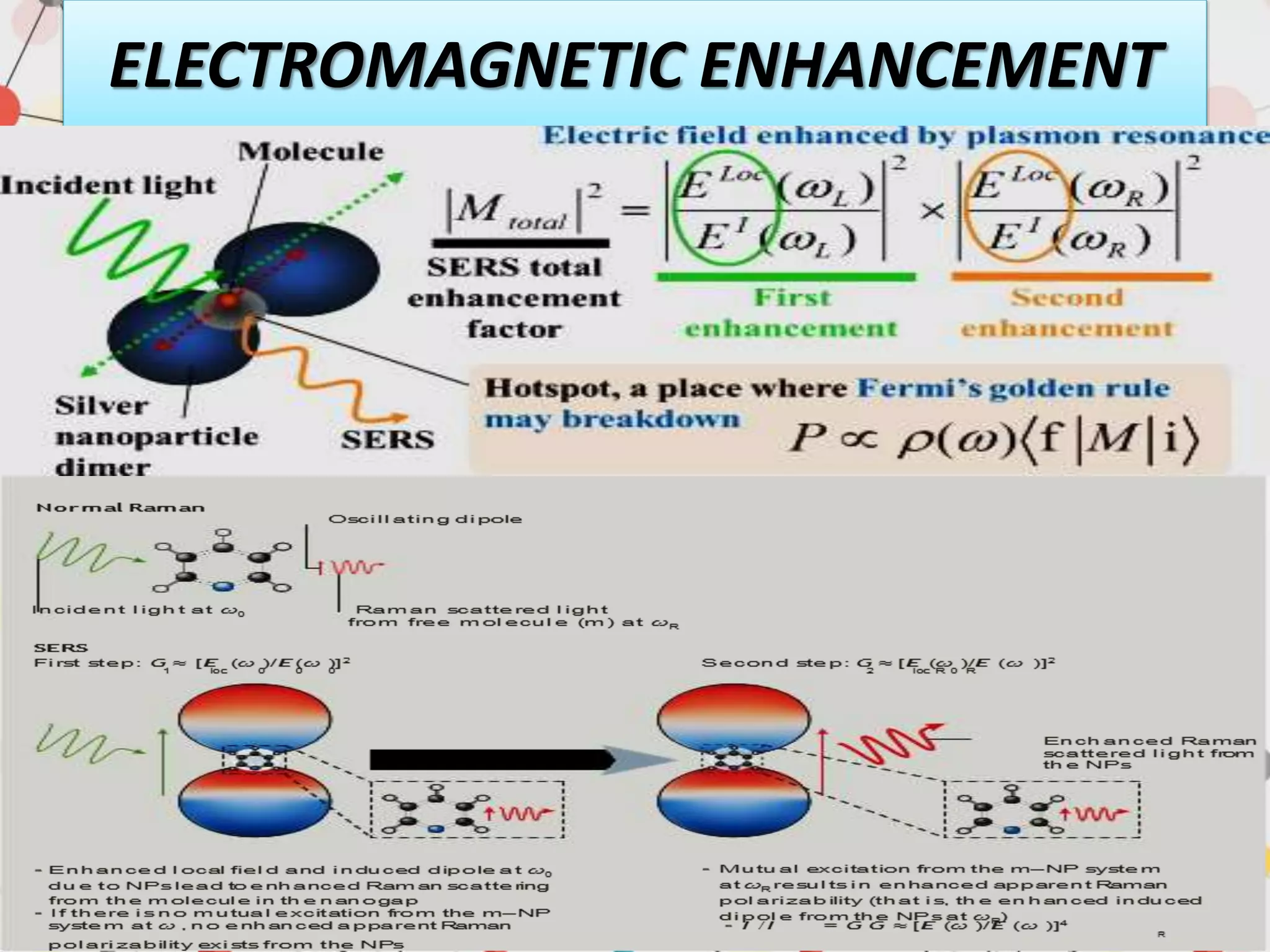
ELECTROMAGNETIC ENHANCEMENT
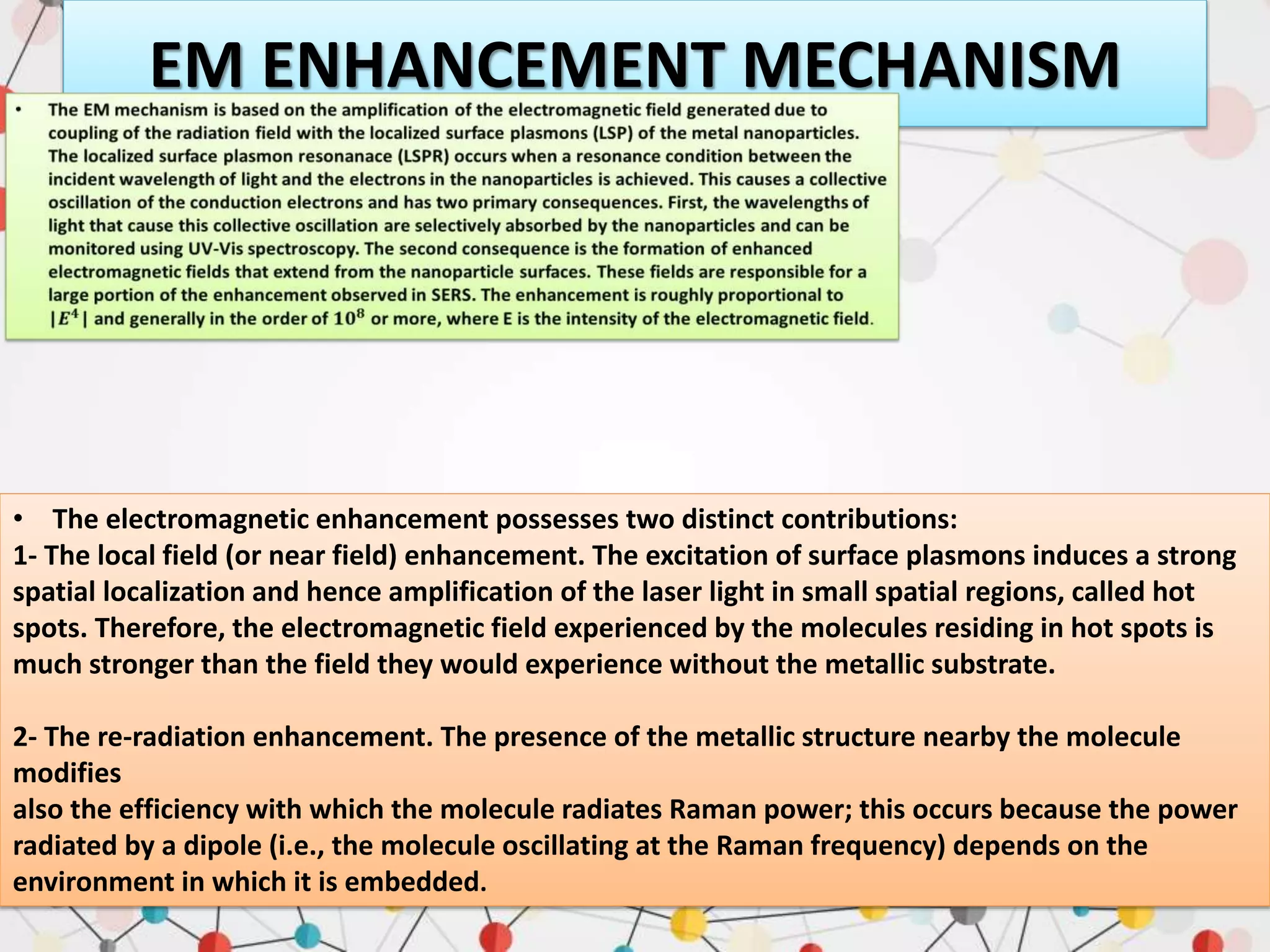
EM ENHANCEMENT MECHANISM
• The electromagnetic enhancement possesses two distinct contributions:
1- The local field (or near field) enhancement. The excitation of surface plasmons induces a strong
spatial localization and hence amplification of the laser light in small spatial regions, called hot
spots. Therefore, the electromagnetic field experienced by the molecules residing in hot spots is
much stronger than the field they would experience without the metallic substrate.
2- The re-radiation enhancement. The presence of the metallic structure nearby the molecule
modifies
also the efficiency with which the molecule radiates Raman power; this occurs because the power
radiated by a dipole (i.e., the molecule oscillating at the Raman frequency) depends on the
environment in which it is embedded.
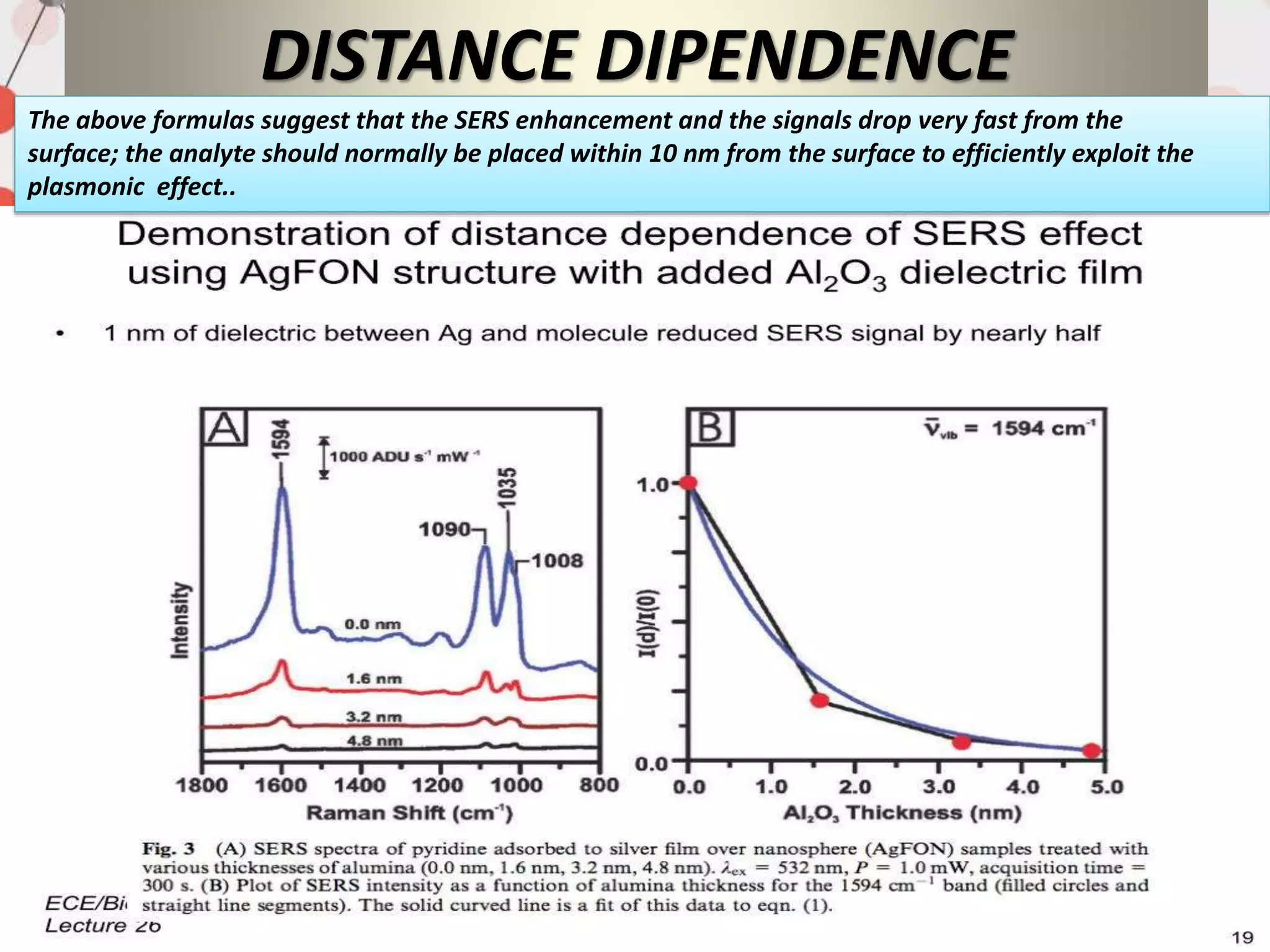
DISTANCE DEPENDENCE
fig-SERS signal as a function of the distance from
the surface. A short and a long-range
component are identified; they are associated to
morphological features of the metallic substrate
with
a size of approximately 1 nm and 20 nm,
respectively. In the insets, a scanning electron
microscopy
(SEM) picture of the SERS substrate (silver film over
nanospheres) and a simulation of the electric
field are presented. Reproduced with permission
from Masango et al. [236]. Copyright (2016),
DISTANCE DIPENDENCE
The above formulas suggest that the SERS enhancement and the signals drop very fast from the
surface; the analyte should normally be placed within 10 nm from the surface to efficiently exploit the
plasmonic effect..
WAVELENGTH DEPENDENCE
a Wavelength (nm)
800 700 600 500
0.25
0.2
0.15
0.1
0.05
2.0E+7
1.6E+7
1.2E+7
8.0E+6
4.0E+6
0.0E+0
b
900
0.24
0.2
0.16
0.12
0.08
0.04
800
Wavelength (nm)
700 600 500
2.0E+7
1.6E+7
1.2E+7
8.0E+6
4.0E+6
0.0E+0
14,000 18,000 22,000 12,000 16,000 20,000
νvib = 1575 cm-1
shift = 734 cm-1
Enhancementfactor
Enhancementfactor
Extinction
Extinction
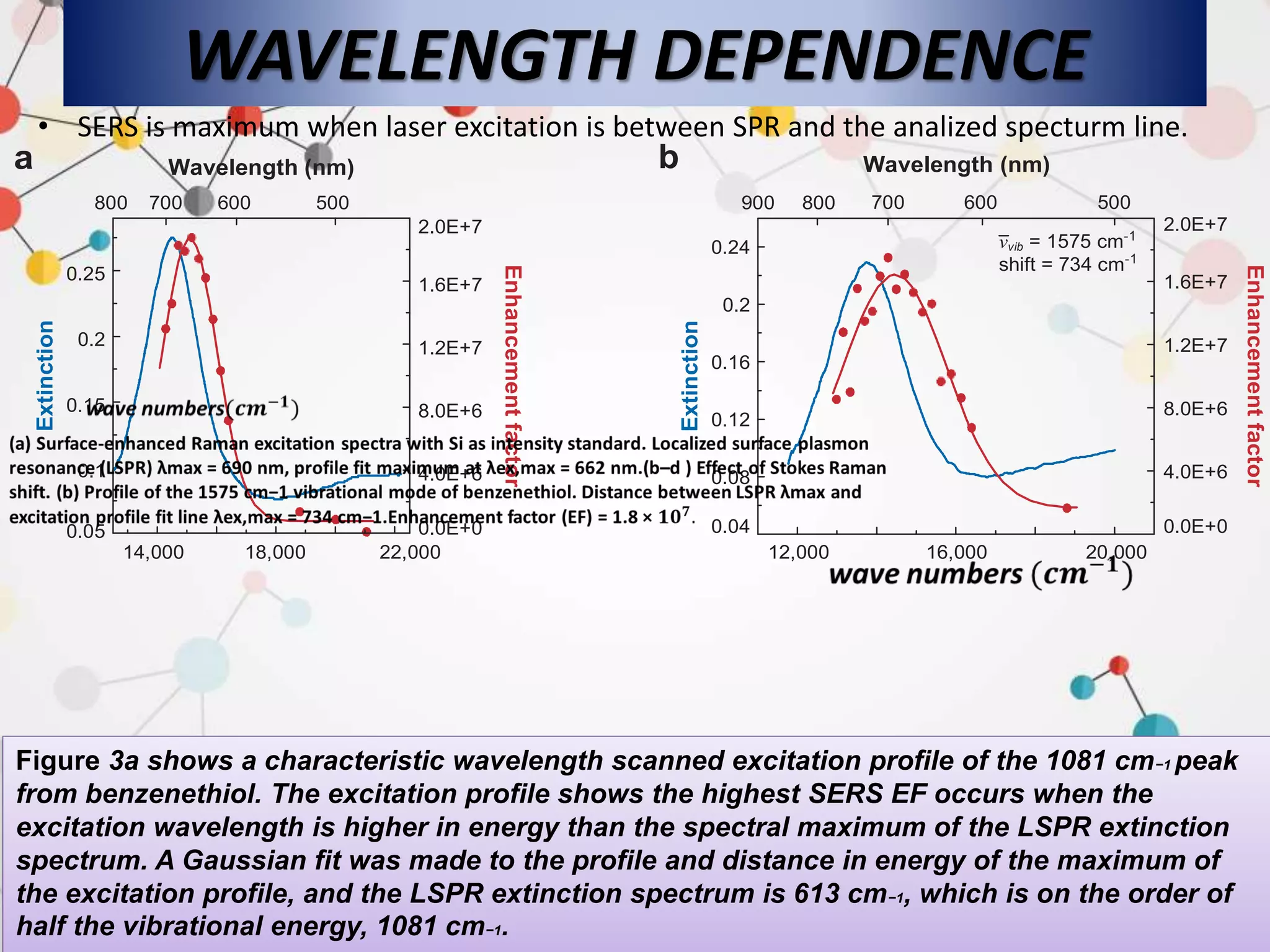
• SERS is maximum when laser excitation is between SPR and the analized specturm line.
Figure 3a shows a characteristic wavelength scanned excitation profile of the 1081 cm−1 peak
from benzenethiol. The excitation profile shows the highest SERS EF occurs when the
excitation wavelength is higher in energy than the spectral maximum of the LSPR extinction
spectrum. A Gaussian fit was made to the profile and distance in energy of the maximum of
the excitation profile, and the LSPR extinction spectrum is 613 cm−1, which is on the order of
half the vibrational energy, 1081 cm−1.
WAVELENGTH DEPENDENCE
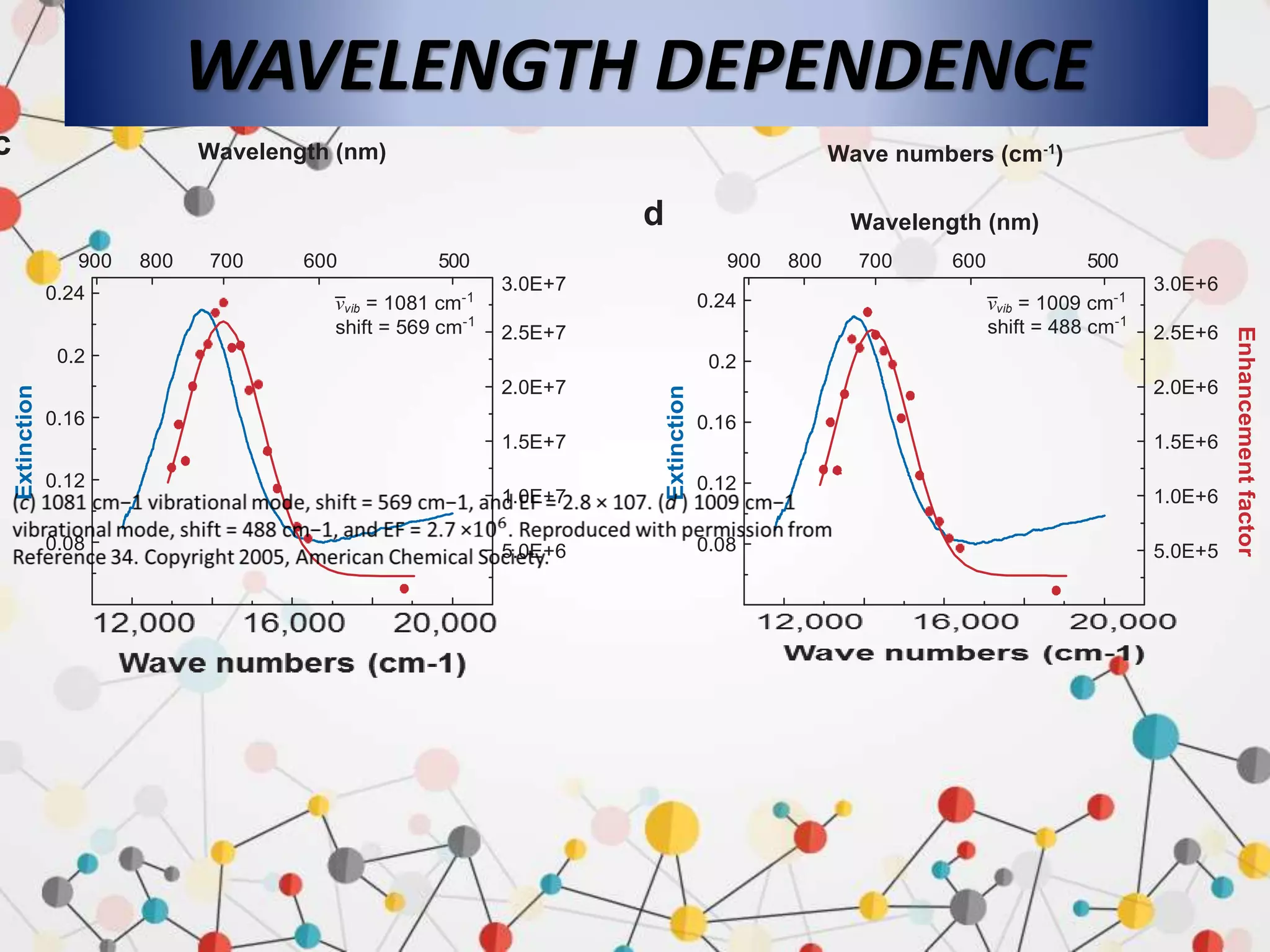
c Wavelength (nm) Wave numbers (cm-1
)
d Wavelength (nm)
900
0.24
0.2
0.16
0.12
0.08
800 700 600 500
3.0E+7
2.5E+7
2.0E+7
1.5E+7
1.0E+7
5.0E+6
900
0.24
0.2
0.16
0.12
0.08
800 700 600 500
3.0E+6
2.5E+6
2.0E+6
1.5E+6
1.0E+6
5.0E+5
νvib = 1081 cm-1
shift = 569 cm-1
νvib = 1009 cm-1
shift = 488 cm-1
Enhancementfactor
Extinction
Extinction
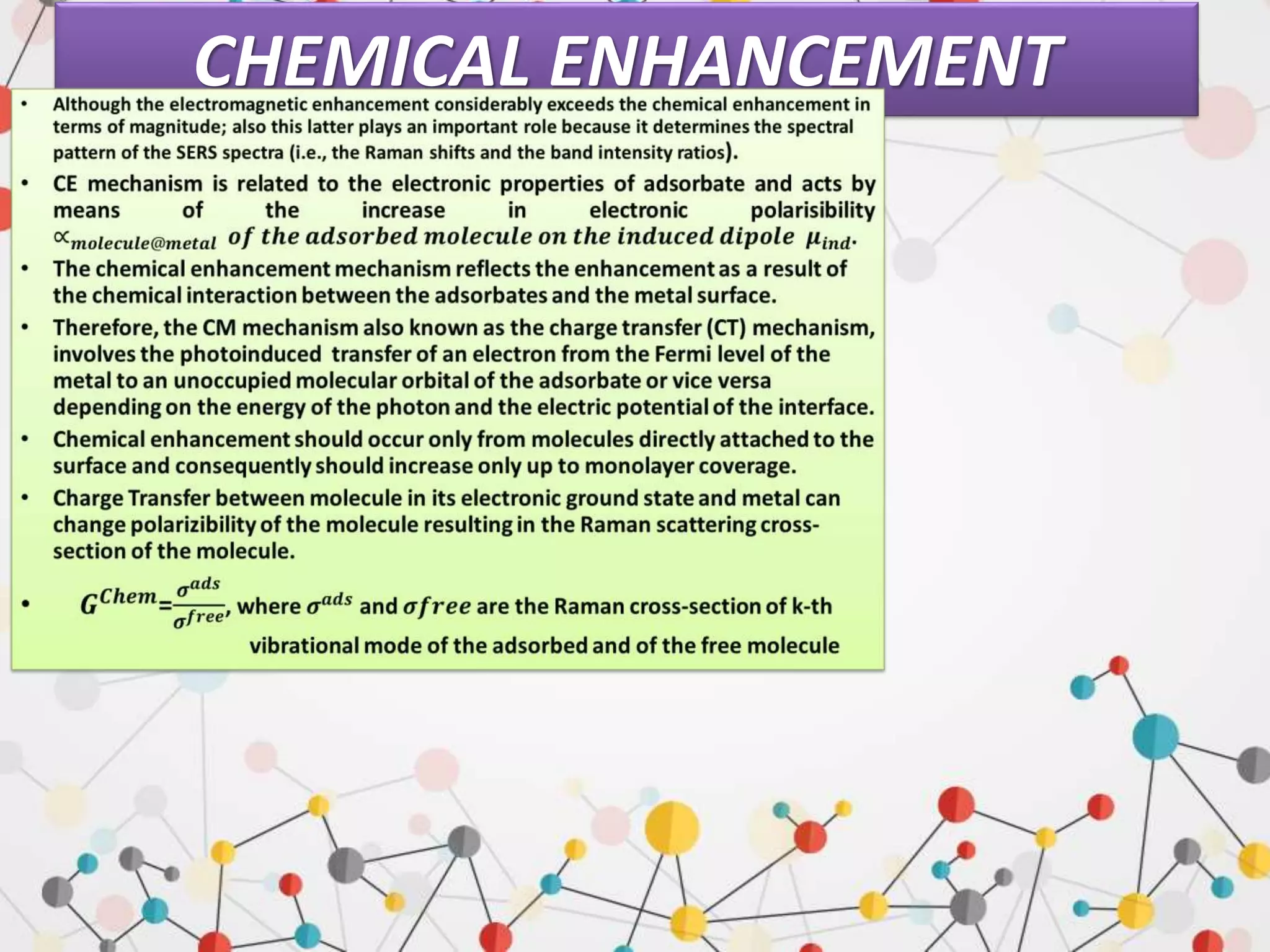
CHEMICAL ENHANCEMENT
Two different mechanisms can contribute to
the chemical enhancement.
Non-resonant chemical effect. The interaction
between the molecule and the metal does not
lead to the formation of a new electronic state
(the molecular orbitals lay at energies not
close enough to the Fermi level of the metal);
however, such interaction may induce an
appreciable change in the geometrical and
electronic structure of the molecule, that
reveals as a mild modification of the Raman
shifts and of the intensity of the vibrational
modes.
Resonant charge transfer chemical effect. The
interaction between the molecule and the
metal brings about the creation of a metal–
molecule charge transfer (CT) state. If the
Raman scattering is excited with a laser source
in resonance or pre-resonance with this state,
some Raman modes can be strongly enhanced,
in particular those ones coupled to the
allowed electronic transitions
(resonant Raman scattering).
(a) Spectral distribution of the plasmonic
(red line), charge transfer (CT, black line),
and intramolecular (green, blue, and violet
lines) resonances for pyridine adsorbed on
silver. Reprinted (adapted) with permission
from Lombardi et al. [9]. Copyright (2008)
American Chemical Society.
CHEMICAL ENHANCEMENT
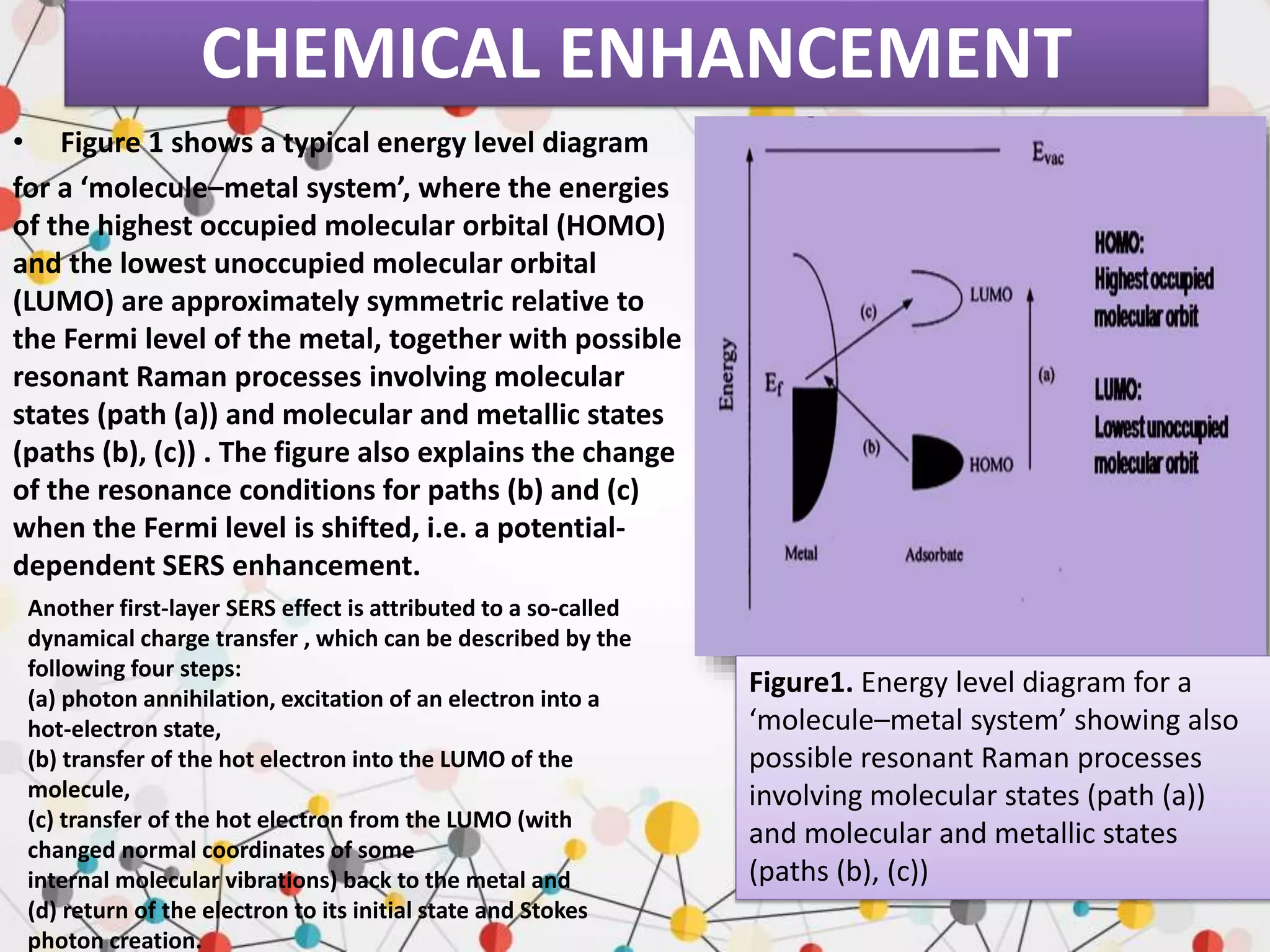
• Figure 1 shows a typical energy level diagram
for a ‘molecule–metal system’, where the energies
of the highest occupied molecular orbital (HOMO)
and the lowest unoccupied molecular orbital
(LUMO) are approximately symmetric relative to
the Fermi level of the metal, together with possible
resonant Raman processes involving molecular
states (path (a)) and molecular and metallic states
(paths (b), (c)) . The figure also explains the change
of the resonance conditions for paths (b) and (c)
when the Fermi level is shifted, i.e. a potential-
dependent SERS enhancement.
Figure1. Energy level diagram for a
‘molecule–metal system’ showing also
possible resonant Raman processes
involving molecular states (path (a))
and molecular and metallic states
(paths (b), (c))
Another first-layer SERS effect is attributed to a so-called
dynamical charge transfer , which can be described by the
following four steps:
(a) photon annihilation, excitation of an electron into a
hot-electron state,
(b) transfer of the hot electron into the LUMO of the
molecule,
(c) transfer of the hot electron from the LUMO (with
changed normal coordinates of some
internal molecular vibrations) back to the metal and
(d) return of the electron to its initial state and Stokes
photon creation.
HOTSPOTS
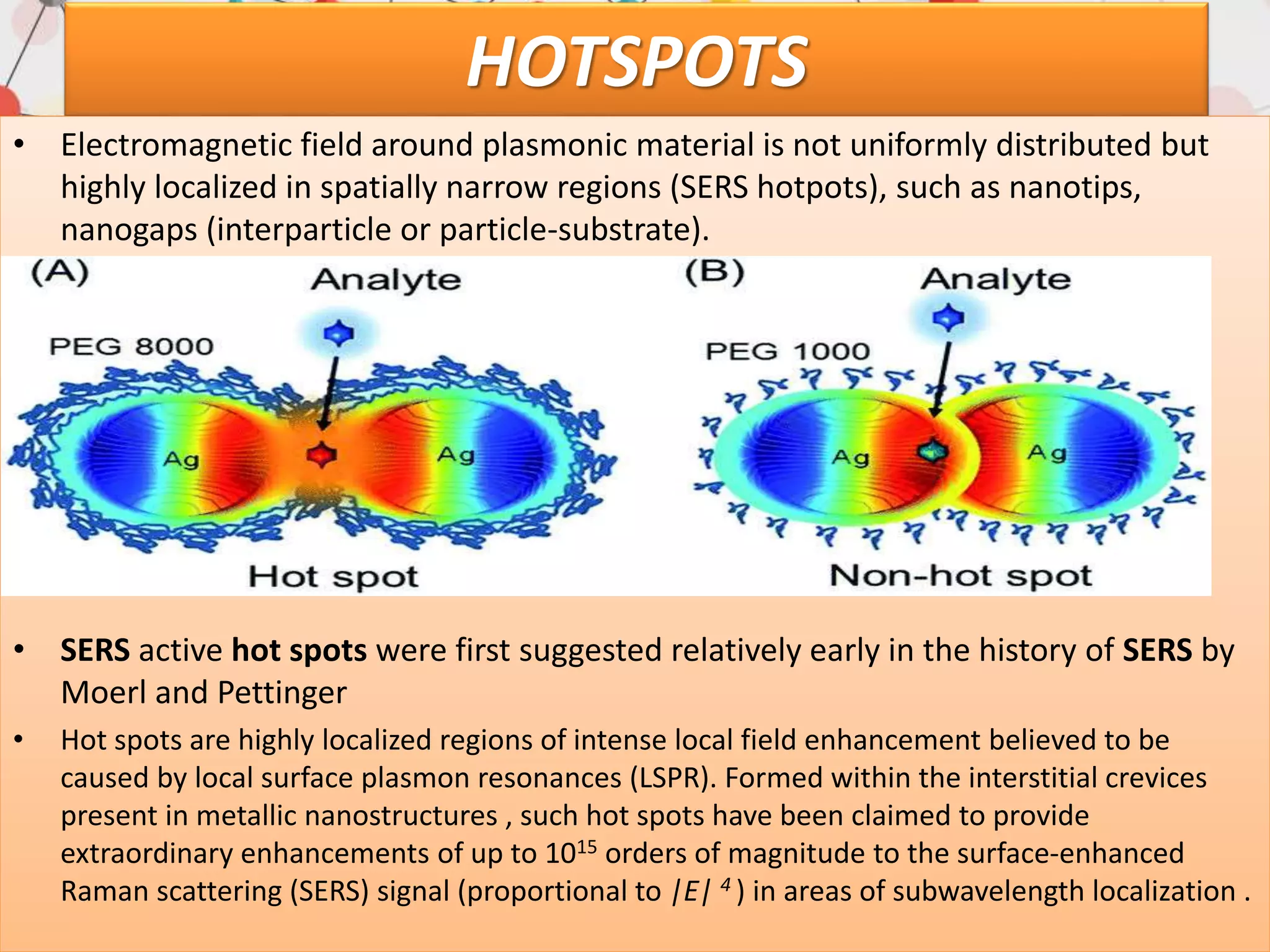
• Electromagnetic field around plasmonic material is not uniformly distributed but
highly localized in spatially narrow regions (SERS hotpots), such as nanotips,
nanogaps (interparticle or particle-substrate).
• SERS active hot spots were first suggested relatively early in the history of SERS by
Moerl and Pettinger
• Hot spots are highly localized regions of intense local field enhancement believed to be
caused by local surface plasmon resonances (LSPR). Formed within the interstitial crevices
present in metallic nanostructures , such hot spots have been claimed to provide
extraordinary enhancements of up to 1015 orders of magnitude to the surface-enhanced
Raman scattering (SERS) signal (proportional to |E| 4 ) in areas of subwavelength localization .
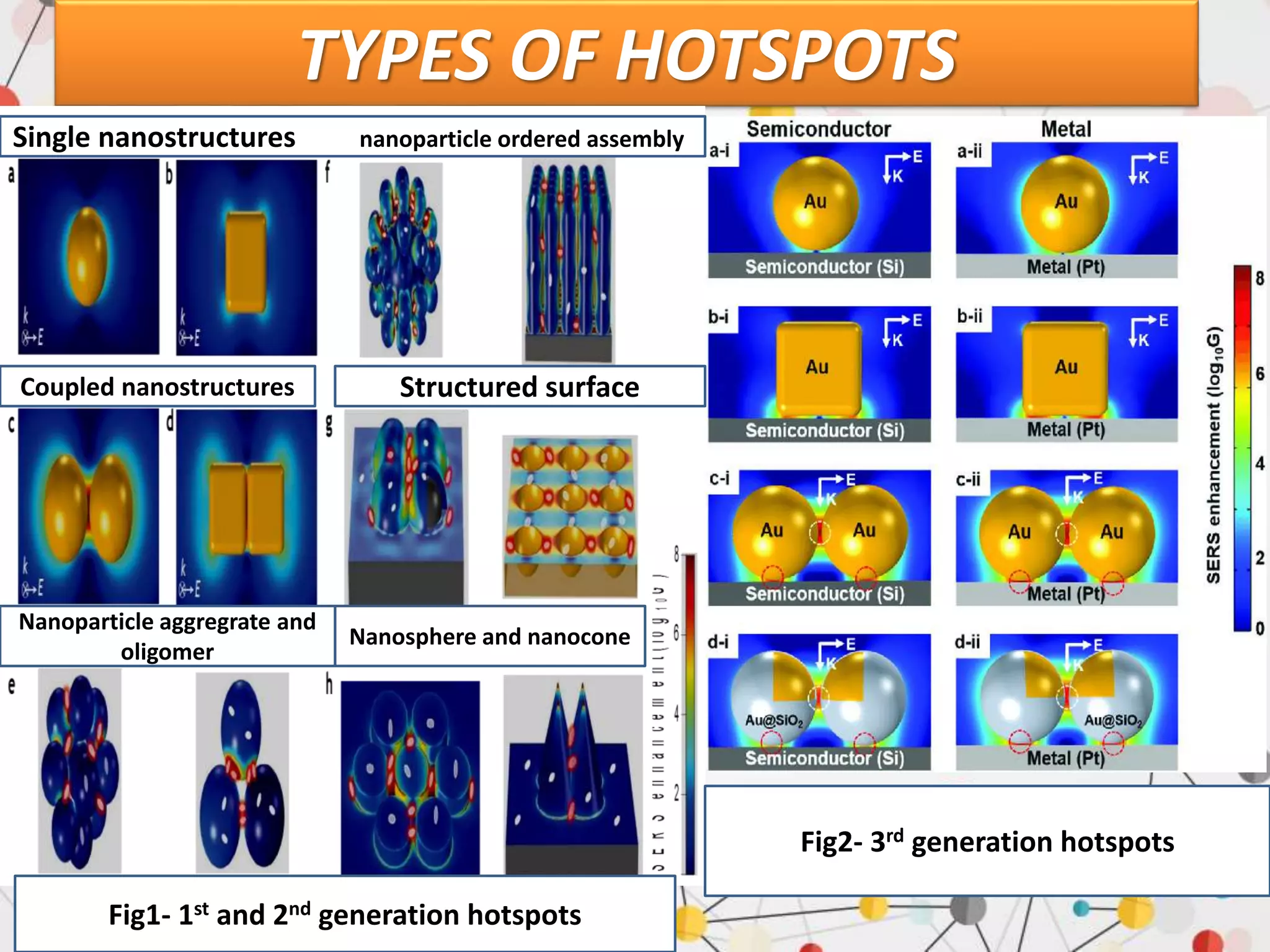
TYPES OF HOTSPOTS
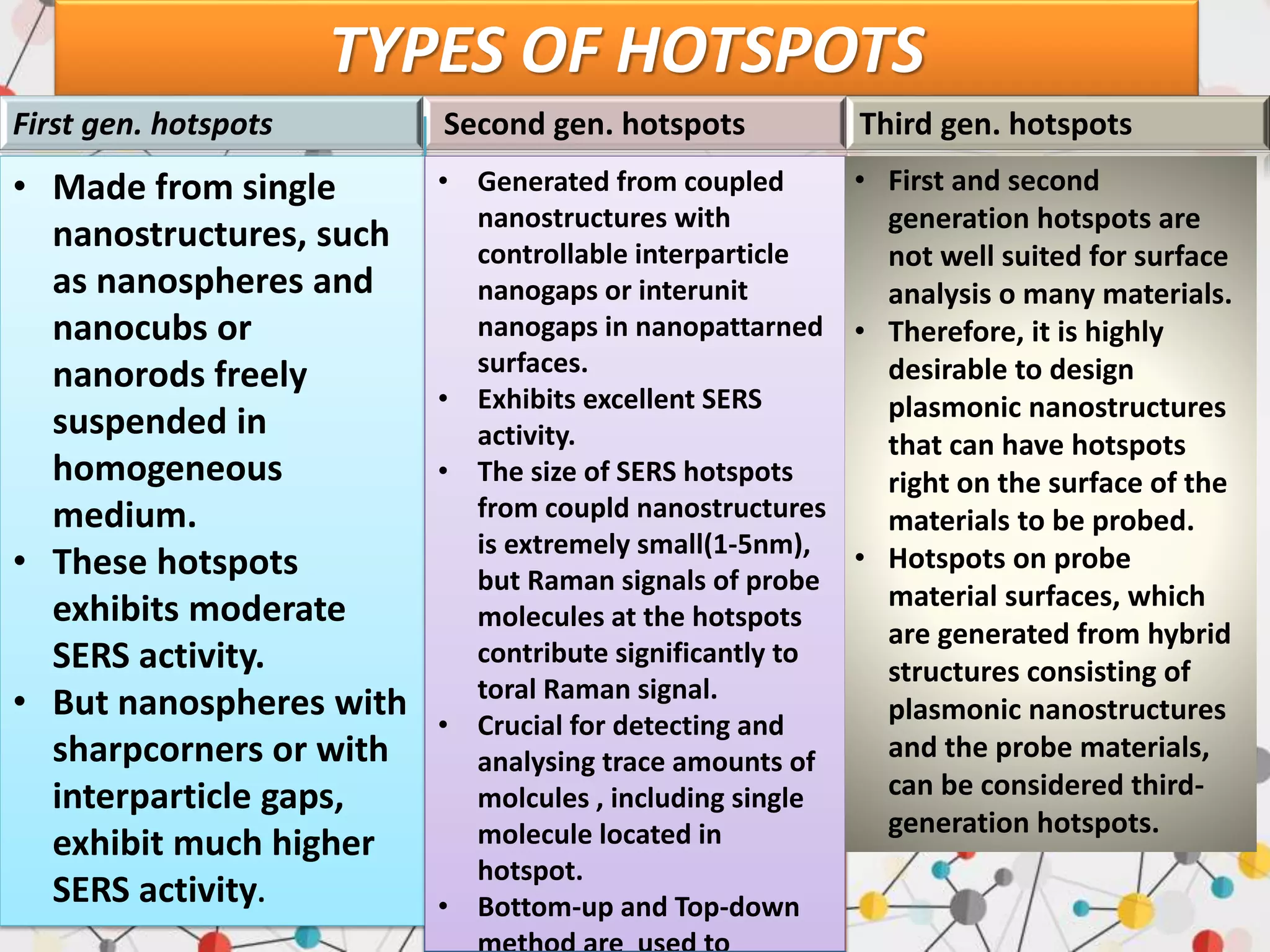
First gen. hotspots Second gen. hotspots Third gen. hotspots
• Made from single
nanostructures, such
as nanospheres and
nanocubs or
nanorods freely
suspended in
homogeneous
medium.
• These hotspots
exhibits moderate
SERS activity.
• But nanospheres with
sharpcorners or with
interparticle gaps,
exhibit much higher
SERS activity.
• Generated from coupled
nanostructures with
controllable interparticle
nanogaps or interunit
nanogaps in nanopattarned
surfaces.
• Exhibits excellent SERS
activity.
• The size of SERS hotspots
from coupld nanostructures
is extremely small(1-5nm),
but Raman signals of probe
molecules at the hotspots
contribute significantly to
toral Raman signal.
• Crucial for detecting and
analysing trace amounts of
molcules , including single
molecule located in
hotspot.
• Bottom-up and Top-down
• First and second
generation hotspots are
not well suited for surface
analysis o many materials.
• Therefore, it is highly
desirable to design
plasmonic nanostructures
that can have hotspots
right on the surface of the
materials to be probed.
• Hotspots on probe
material surfaces, which
are generated from hybrid
structures consisting of
plasmonic nanostructures
and the probe materials,
can be considered third-
generation hotspots.
TYPES OF HOTSPOTS
Single nanostructures nanoparticle ordered assembly
Coupled nanostructures Structured surface
Nanoparticle aggregrate and
oligomer
Nanosphere and nanocone
Fig1- 1st and 2nd generation hotspots
Fig2- 3rd generation hotspots
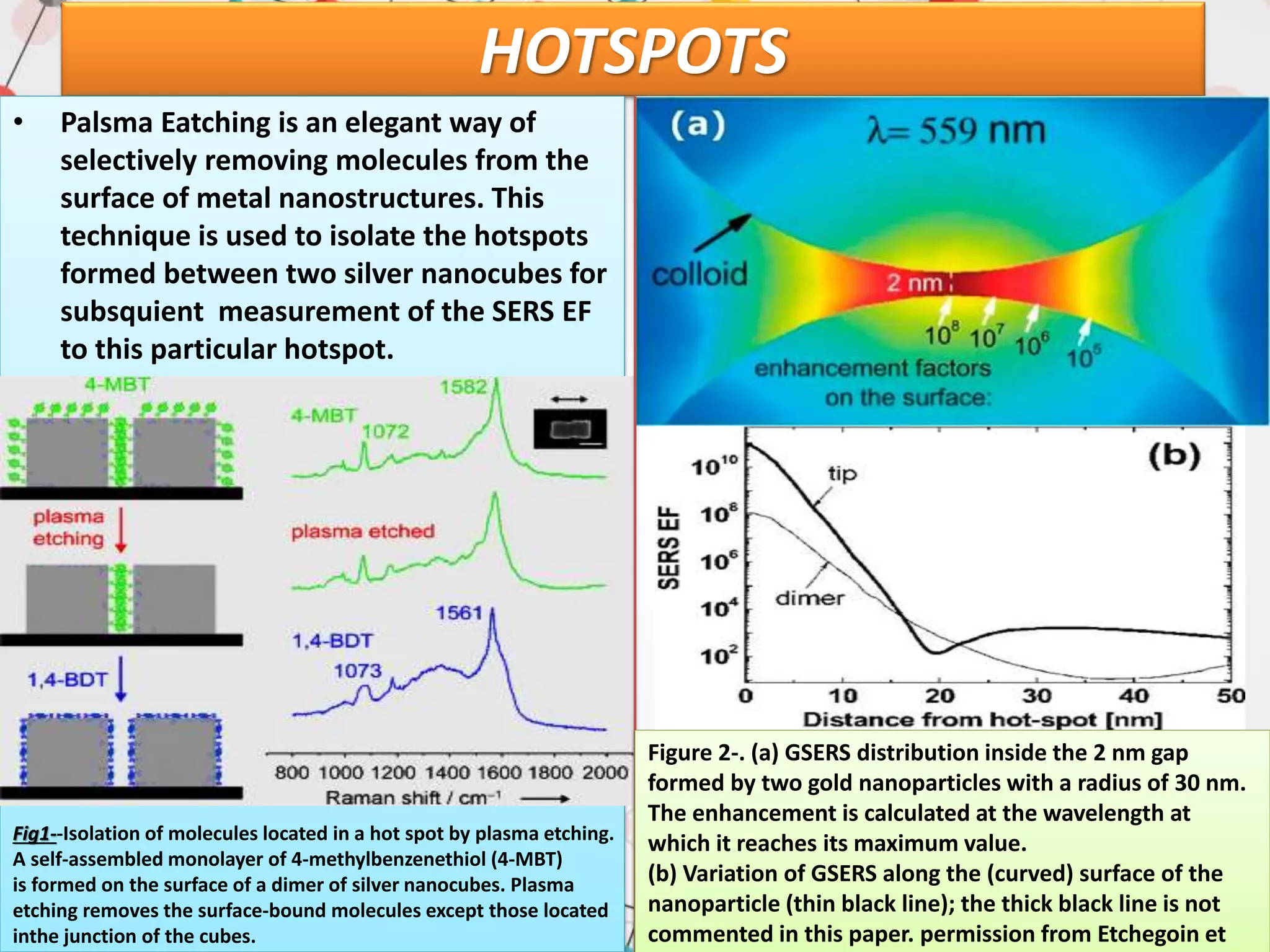
HOTSPOTS
• Palsma Eatching is an elegant way of
selectively removing molecules from the
surface of metal nanostructures. This
technique is used to isolate the hotspots
formed between two silver nanocubes for
subsquient measurement of the SERS EF
to this particular hotspot.
Fig1--Isolation of molecules located in a hot spot by plasma etching.
A self-assembled monolayer of 4-methylbenzenethiol (4-MBT)
is formed on the surface of a dimer of silver nanocubes. Plasma
etching removes the surface-bound molecules except those located
inthe junction of the cubes.
Figure 2-. (a) GSERS distribution inside the 2 nm gap
formed by two gold nanoparticles with a radius of 30 nm.
The enhancement is calculated at the wavelength at
which it reaches its maximum value.
(b) Variation of GSERS along the (curved) surface of the
nanoparticle (thin black line); the thick black line is not
commented in this paper. permission from Etchegoin et
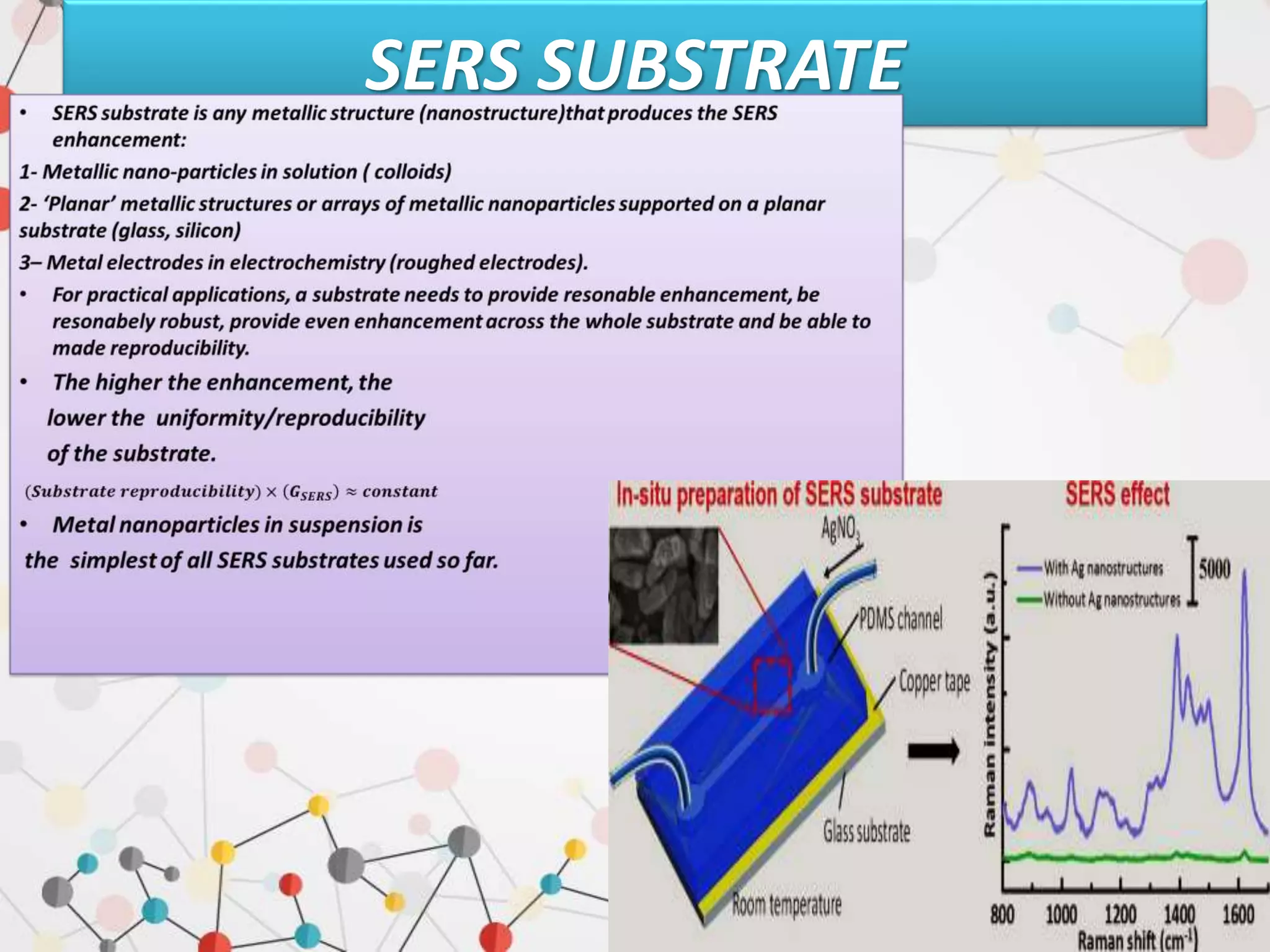
SERS SUBSTRATE
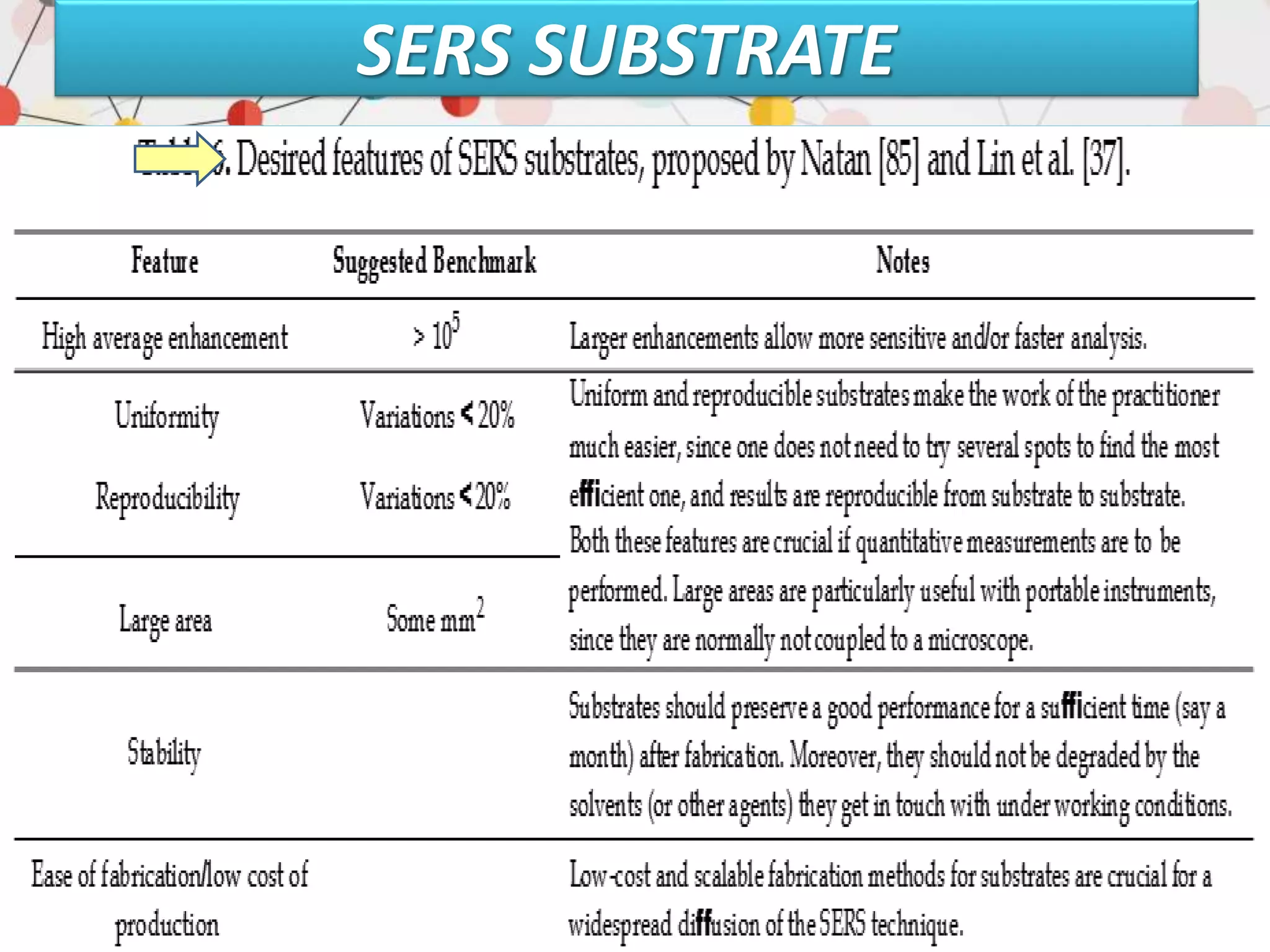
SERS SUBSTRATE
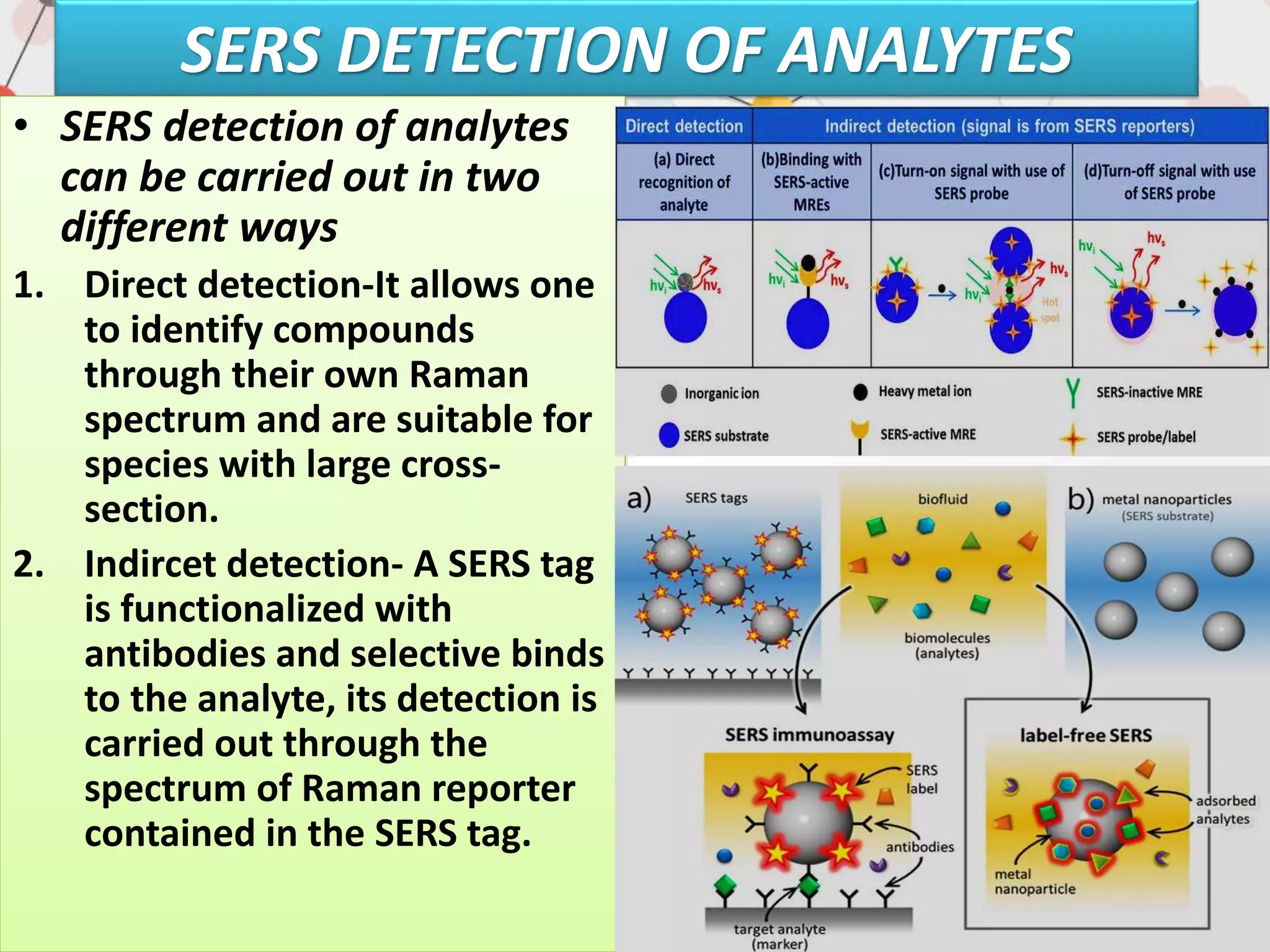
SERS DETECTION OF ANALYTES
• SERS detection of analytes
can be carried out in two
different ways
1. Direct detection-It allows one
to identify compounds
through their own Raman
spectrum and are suitable for
species with large cross-
section.
2. Indircet detection- A SERS tag
is functionalized with
antibodies and selective binds
to the analyte, its detection is
carried out through the
spectrum of Raman reporter
contained in the SERS tag.
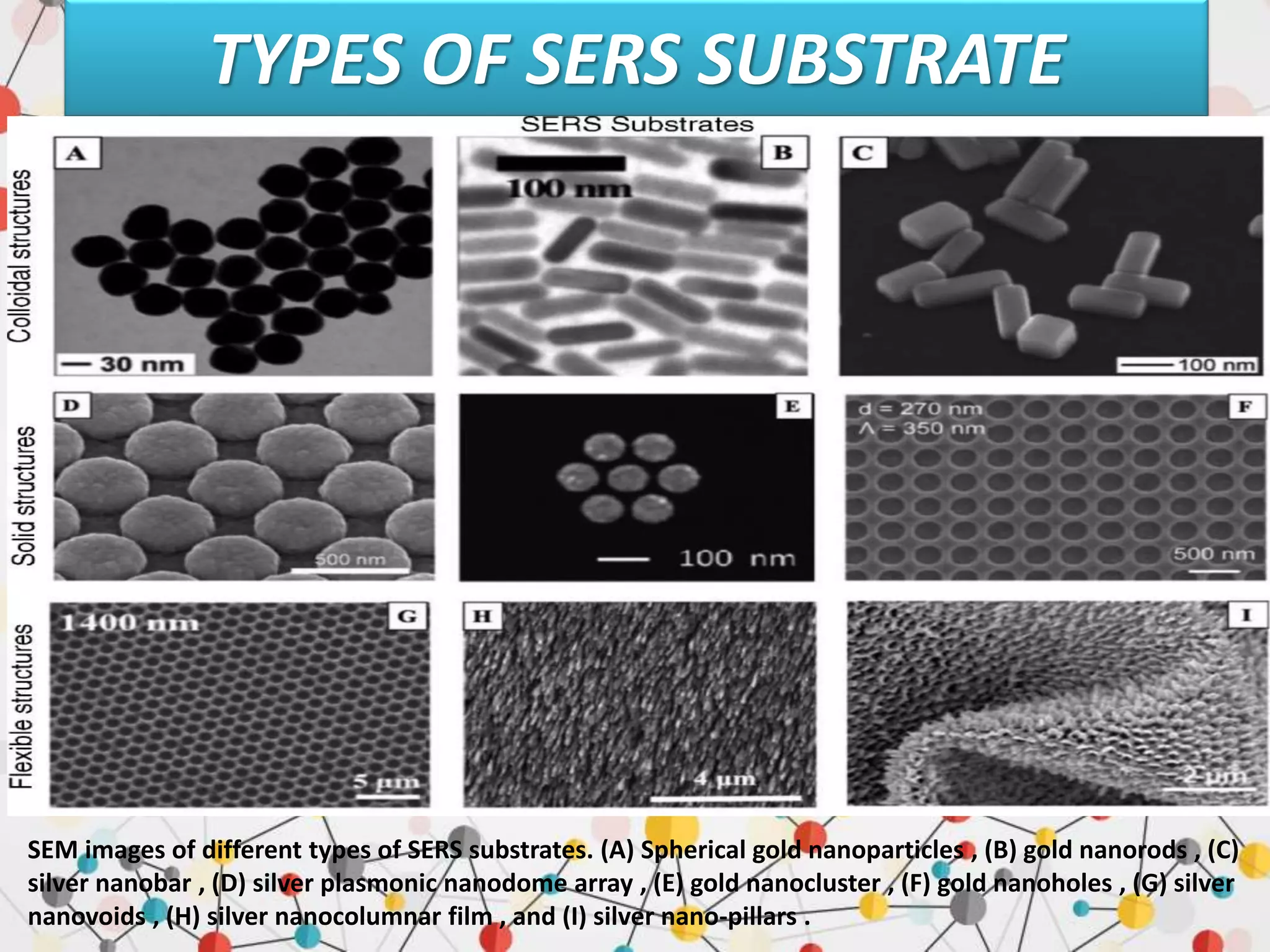
TYPES OF SERS SUBSTRATE
SEM images of different types of SERS substrates. (A) Spherical gold nanoparticles , (B) gold nanorods , (C)
silver nanobar , (D) silver plasmonic nanodome array , (E) gold nanocluster , (F) gold nanoholes , (G) silver
nanovoids , (H) silver nanocolumnar film , and (I) silver nano-pillars .
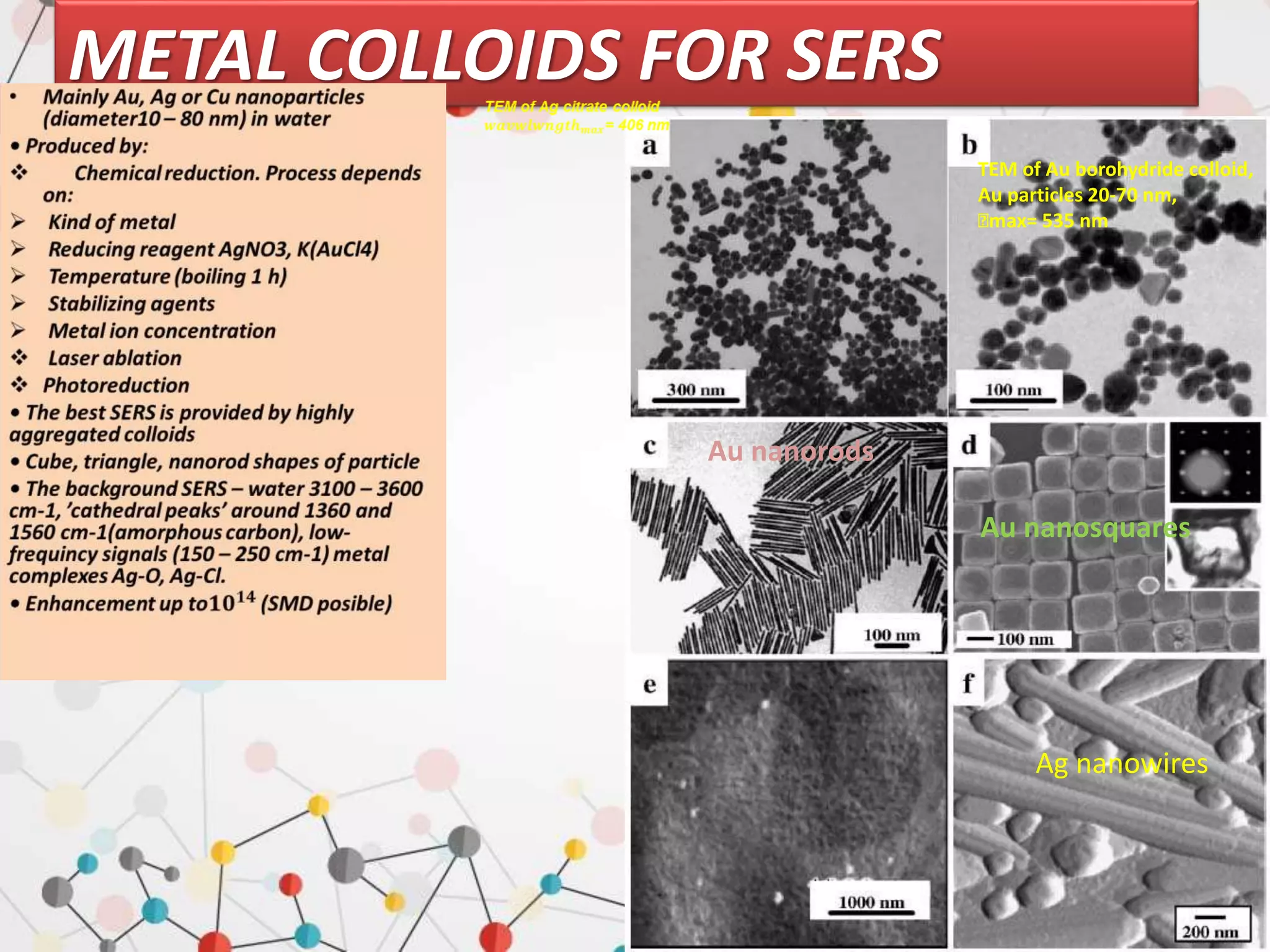
METAL COLLOIDS FOR SERS
TEM of Au borohydride colloid,
Au particles 20-70 nm,
􀉉max= 535 nm
Au nanorods
Au nanosquares
Ag nanowires
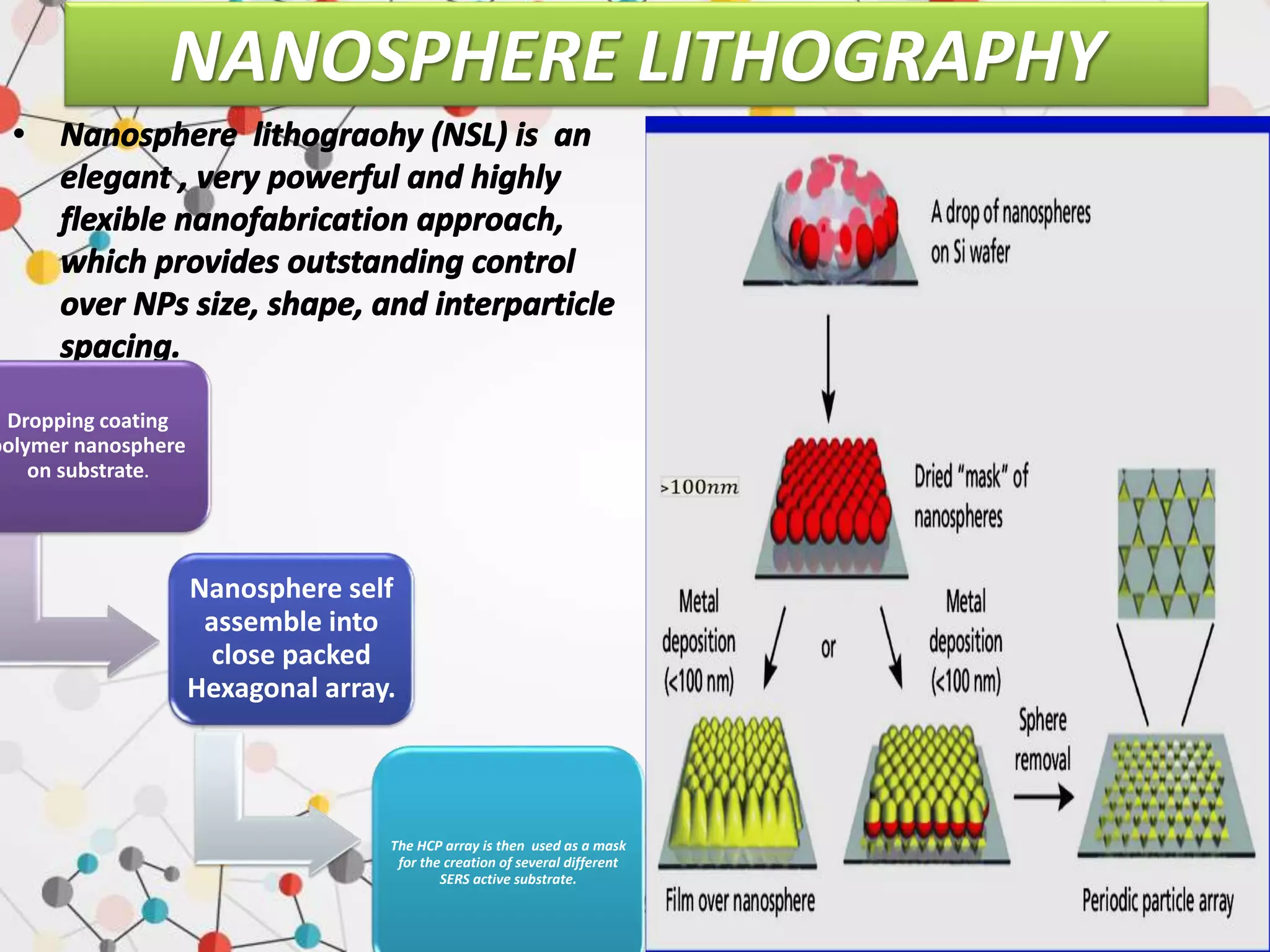
NANOSPHERE LITHOGRAPHY
Dropping coating
polymer nanosphere
on substrate.
Nanosphere self
assemble into
close packed
Hexagonal array.
The HCP array is then used as a mask
for the creation of several different
SERS active substrate.
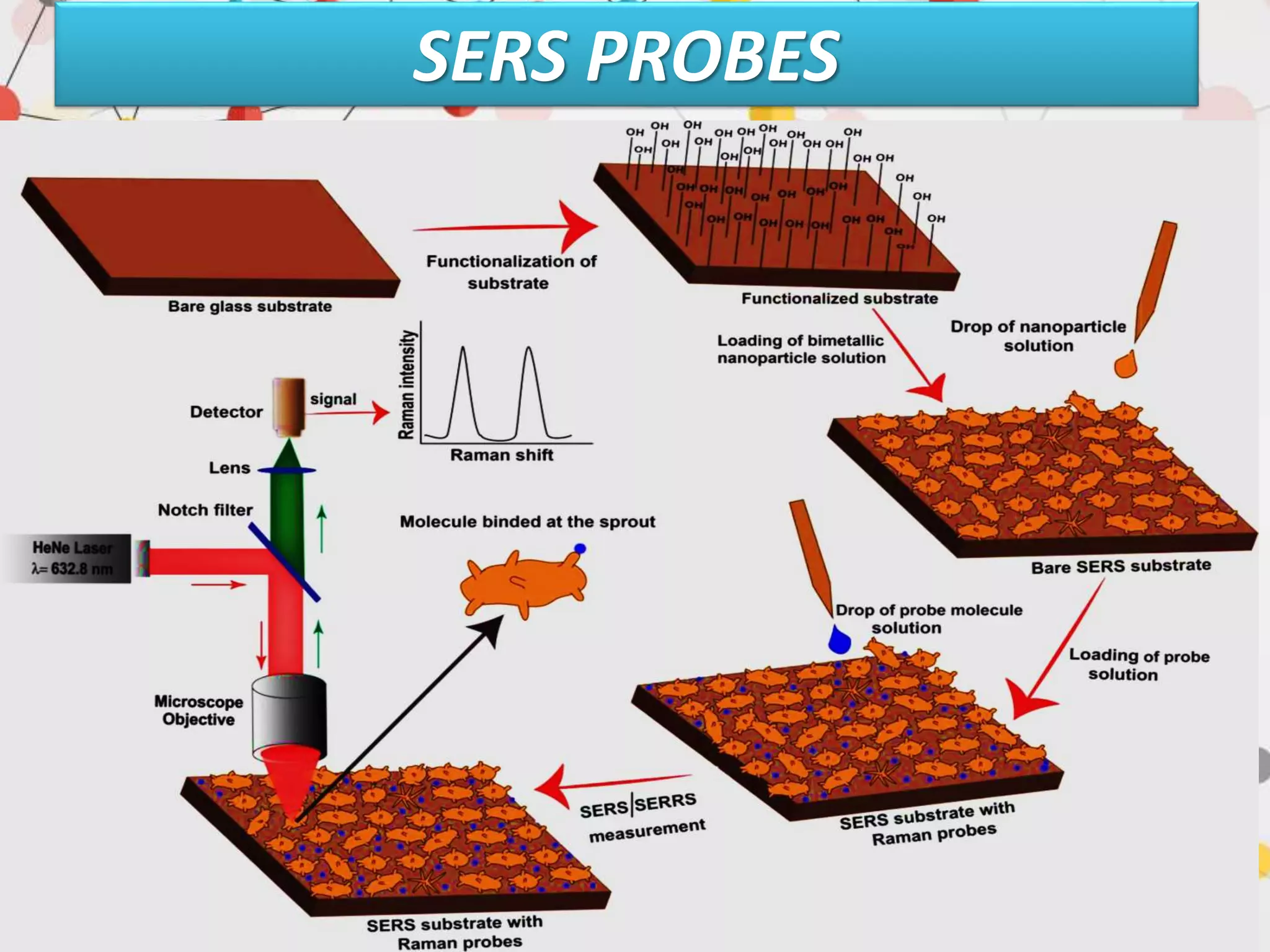
SERS PROBES
SINGLE MOLECULE DETECTION(SMD)
SMD –why?
• To push analytical tools to their ultimate
resolution limits
• The understanding of unique single-molecule
phenomena that are potentially washed out by
ensemble averages
• Early single-molecule emission was inferred
from indirect evidence
• Ultra-low concentration studies – statistical
result, but they provide hint of possibility SMD
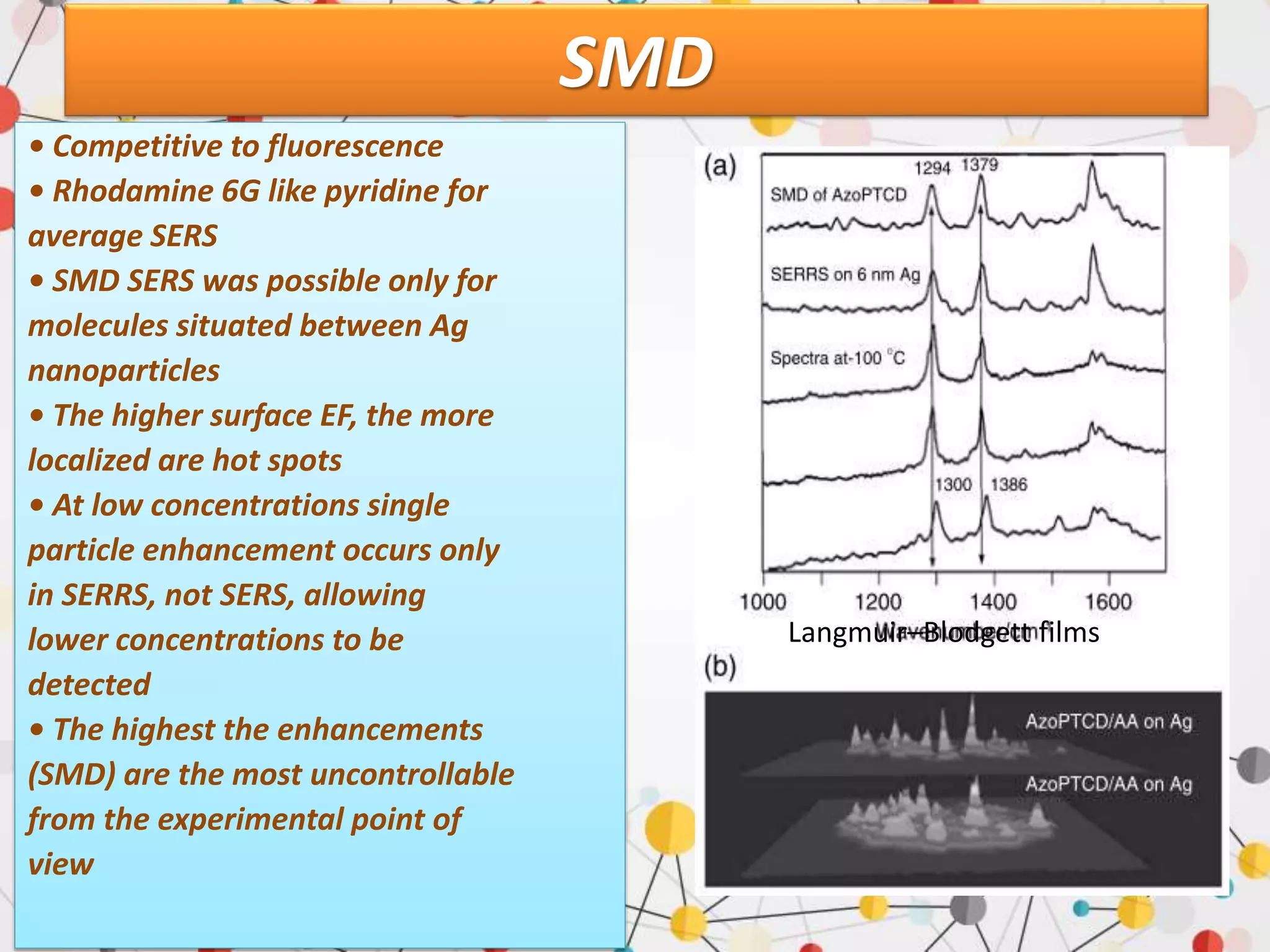
SMD
• Competitive to fluorescence
• Rhodamine 6G like pyridine for
average SERS
• SMD SERS was possible only for
molecules situated between Ag
nanoparticles
• The higher surface EF, the more
localized are hot spots
• At low concentrations single
particle enhancement occurs only
in SERRS, not SERS, allowing
lower concentrations to be
detected
• The highest the enhancements
(SMD) are the most uncontrollable
from the experimental point of
view
Langmuir–Blodgett films
TRANSITION-METAL SERS
 It is still difficult to perform SERS analysis of general adsorbates, such
as water molecules, on transition-metal surfaces.
 To improve the SERS enhancement factor on transition- metal
surfaces, a strategy (which we refer to as ‘borrowing SERS’) was
devised to coat transition metals as
an ultrathin shell or overlayer on the surface of Au and Ag
nanostructures (the active metal film is thin enough to borrow the
EM enhancement of underlying plasmoni metal).
 To avoid damping of the plasmon of underlying metal one must
ensure-
 Catalytically active overlayer is sufficiently thin.
 The layer must be thick enough to ensure full coverage and minimize
any pinhole.
 Such pinhole free overlayer will minimize any SERS signal arising
from the analyte bindind directly to the SERS active metal, instead of
catalytically active metal.
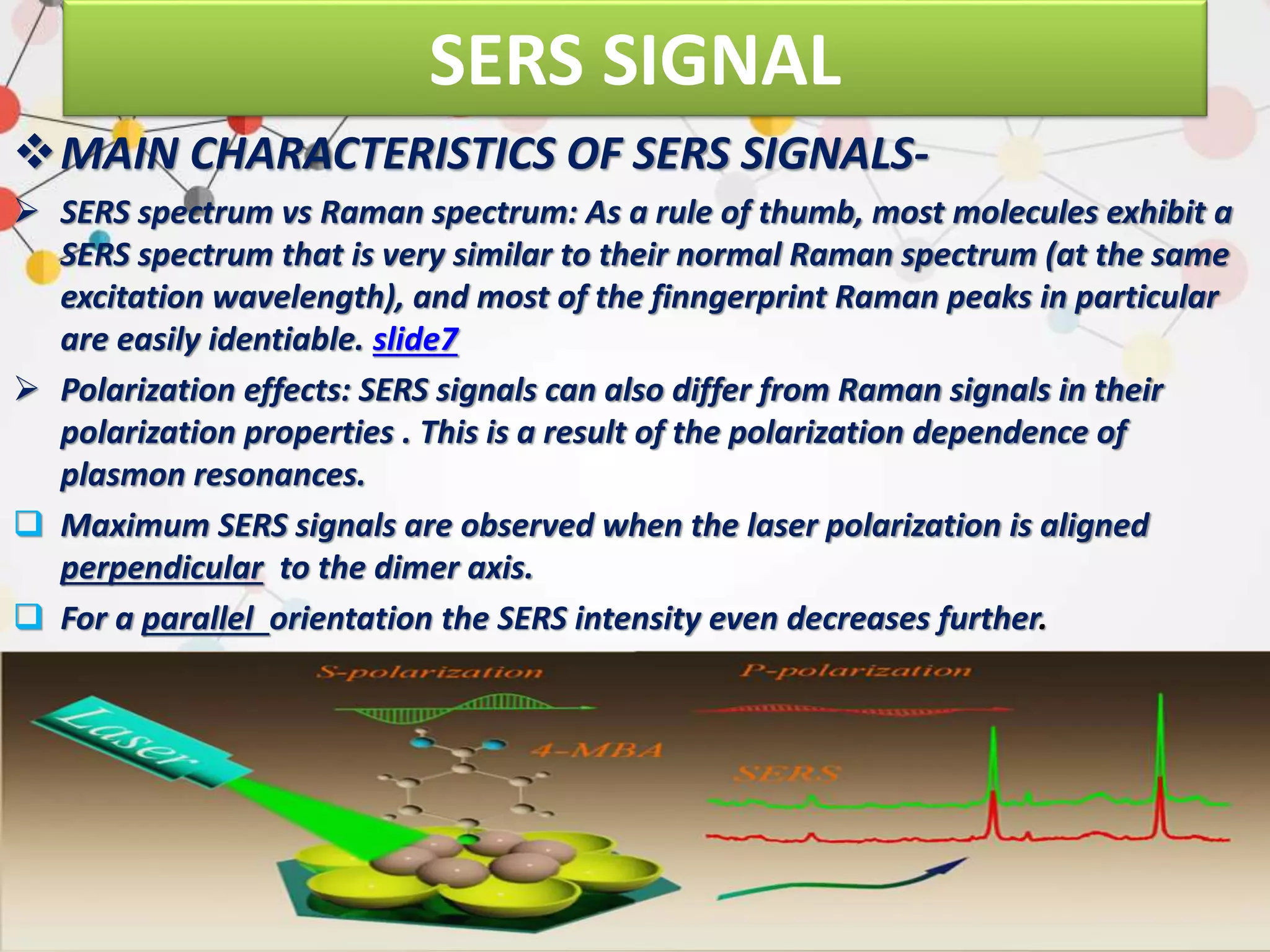
SERS SIGNAL
MAIN CHARACTERISTICS OF SERS SIGNALS-
 SERS spectrum vs Raman spectrum: As a rule of thumb, most molecules exhibit a
SERS spectrum that is very similar to their normal Raman spectrum (at the same
excitation wavelength), and most of the finngerprint Raman peaks in particular
are easily identiable. slide7
 Polarization effects: SERS signals can also differ from Raman signals in their
polarization properties . This is a result of the polarization dependence of
plasmon resonances.
 Maximum SERS signals are observed when the laser polarization is aligned
perpendicular to the dimer axis.
 For a parallel orientation the SERS intensity even decreases further.
SERS SIGNAL
SERS continuum:- SERS spectra are sometimes associated
with a broad background. A background is also present in most
Raman spectra, but attributed to impurities or residual intrinsic
fluorescence. In the case of SERS, it is believed to have, at least in
some cases, a real physical origin. This broad background is often
called the SERS continuum ,but its origin is still controversial .
The SERS continuum fluctuates like the SERS signal and has the
same polarization properties.
Photo-bleaching/photo-chemistry:-Many SERS
probes like dyes are known to photo-bleach under normal
non-SERS conditions (at least at sufficiently high excitation
powers).It is therefore not so surprising that photo-
bleaching also occurs under SERS conditions; decays of the
SERS signal because of photo-bleaching are indeed
observed experimentally, and the photo-products may also
sometimes appear in the SERS spectrum itself.
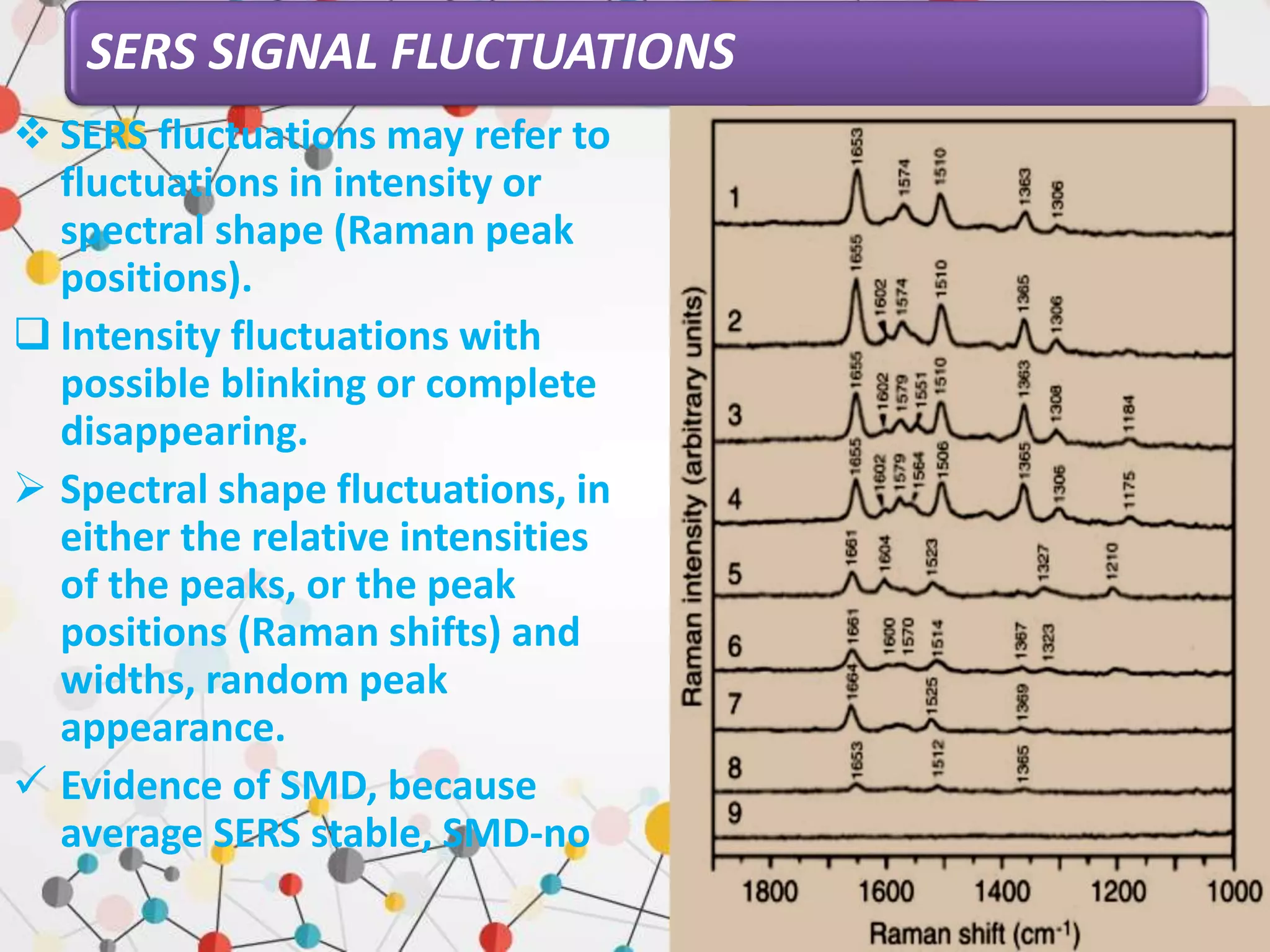
SERS SIGNAL FLUCTUATIONS
 SERS fluctuations may refer to
fluctuations in intensity or
spectral shape (Raman peak
positions).
 Intensity fluctuations with
possible blinking or complete
disappearing.
 Spectral shape fluctuations, in
either the relative intensities
of the peaks, or the peak
positions (Raman shifts) and
widths, random peak
appearance.
 Evidence of SMD, because
average SERS stable, SMD-no
SERS SIGNAL FLUCTUATION SOURCES
Photo-induced and site dependent – variation of the
local field enhancement.
Submonolayer coverage of hot spots
 Photo-induced and spontaneous dynamics –
chemistry change for long scans
 Photo-bleaching of dyes, photo-desorption,
photoinduced surface diffusion,
Substrate heating, and possibly substrate morphology
changes (through photo-oxidation for example)
Surface diffusion of a single molecule in-and-out of a
hot-spot (for SMD)
APPLICATION OF SERS
Chemical identification (bonds)
 Physical identification (crystallinity, phases,
graphene)
Stress and diameter measurements (carbon
nanotubes)
 Trace analysis (explosives and drug detection)
 Process monitoring (in-situ measurements)
Uncovering painting
 Biology (DNA) and medicine (glucose in-vivo)
 Pharmacology
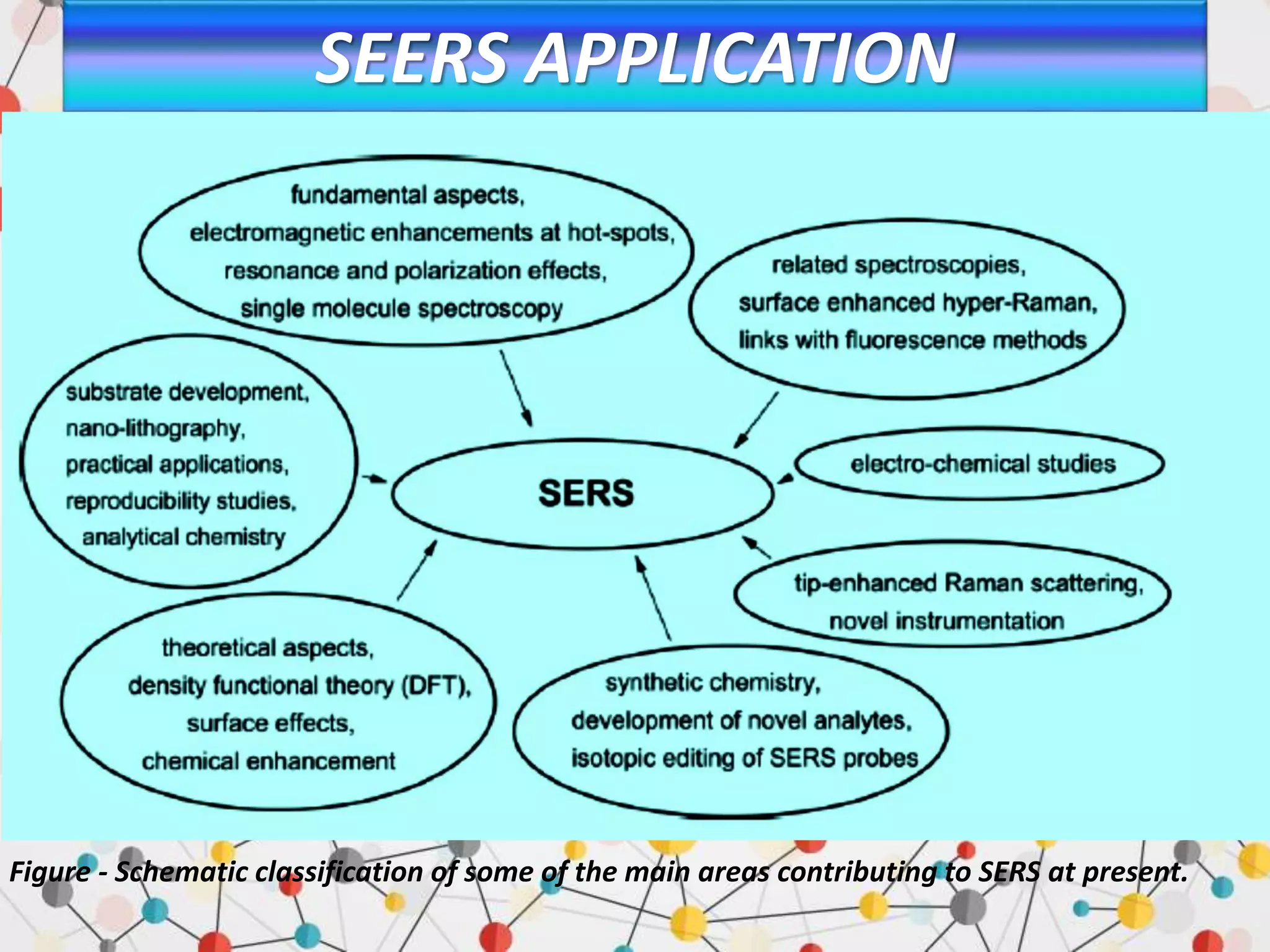
SEERS APPLICATION
Figure - Schematic classification of some of the main areas contributing to SERS at present.
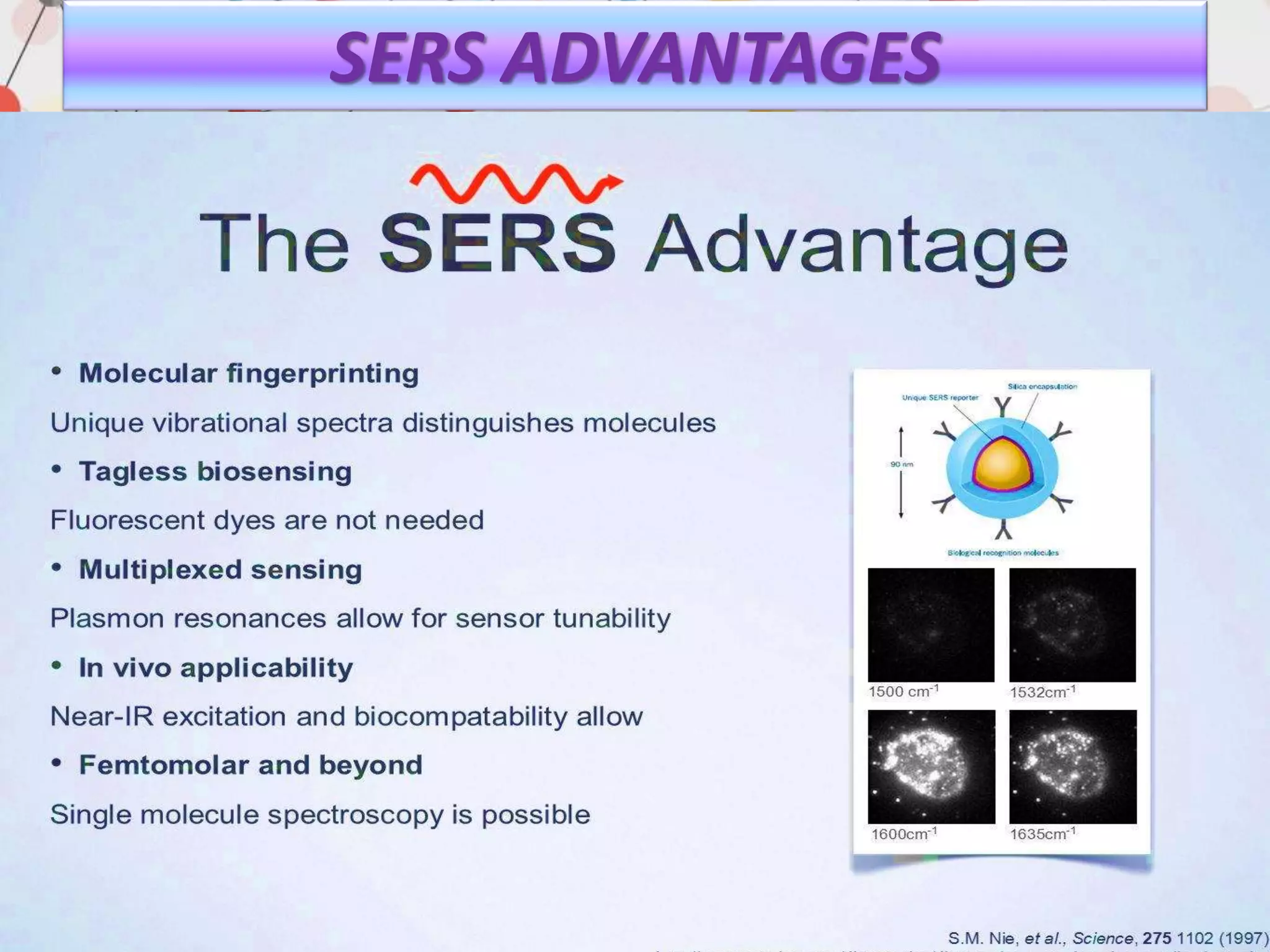
SERS ADVANTAGES
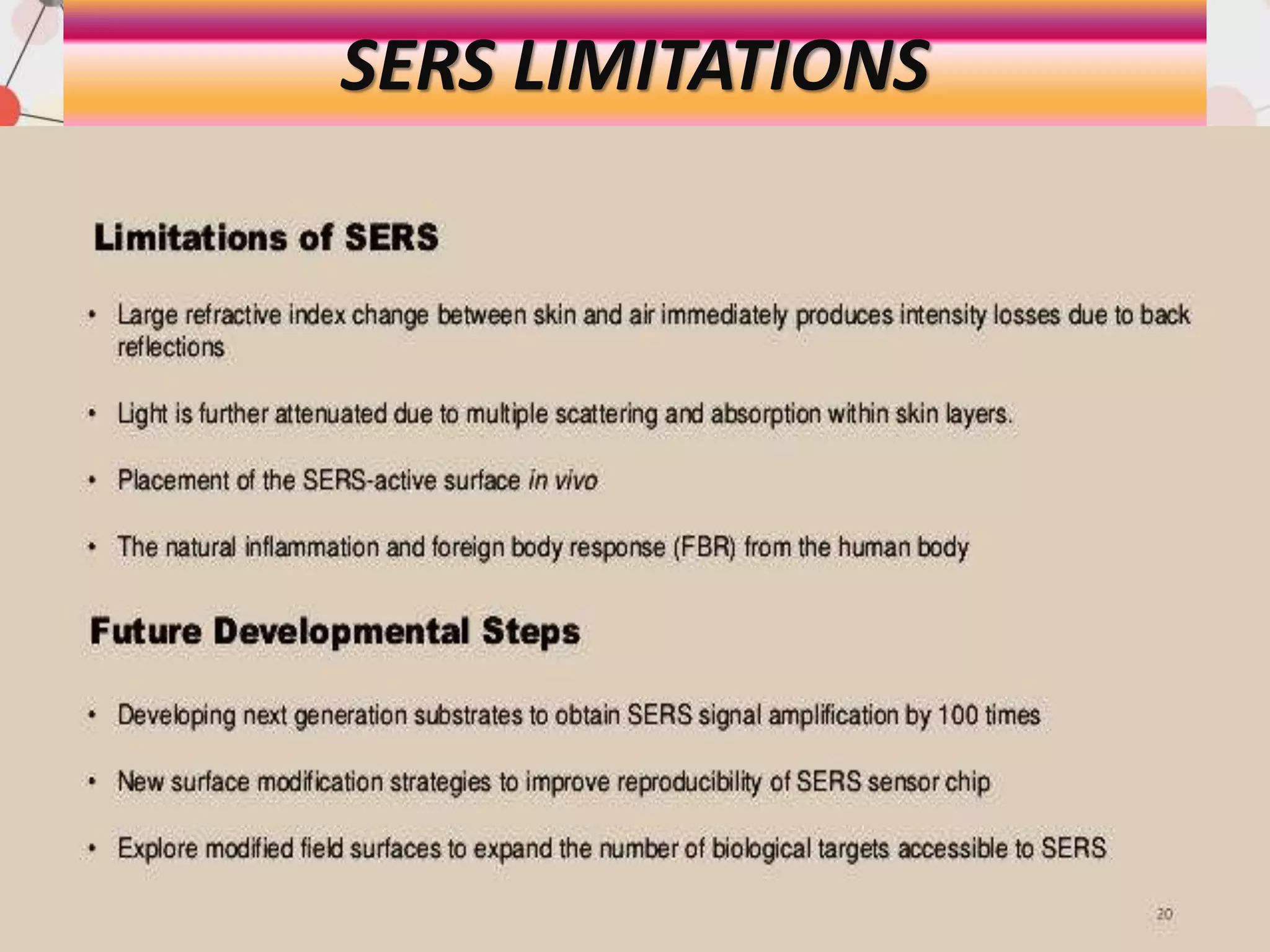
SERS LIMITATIONS
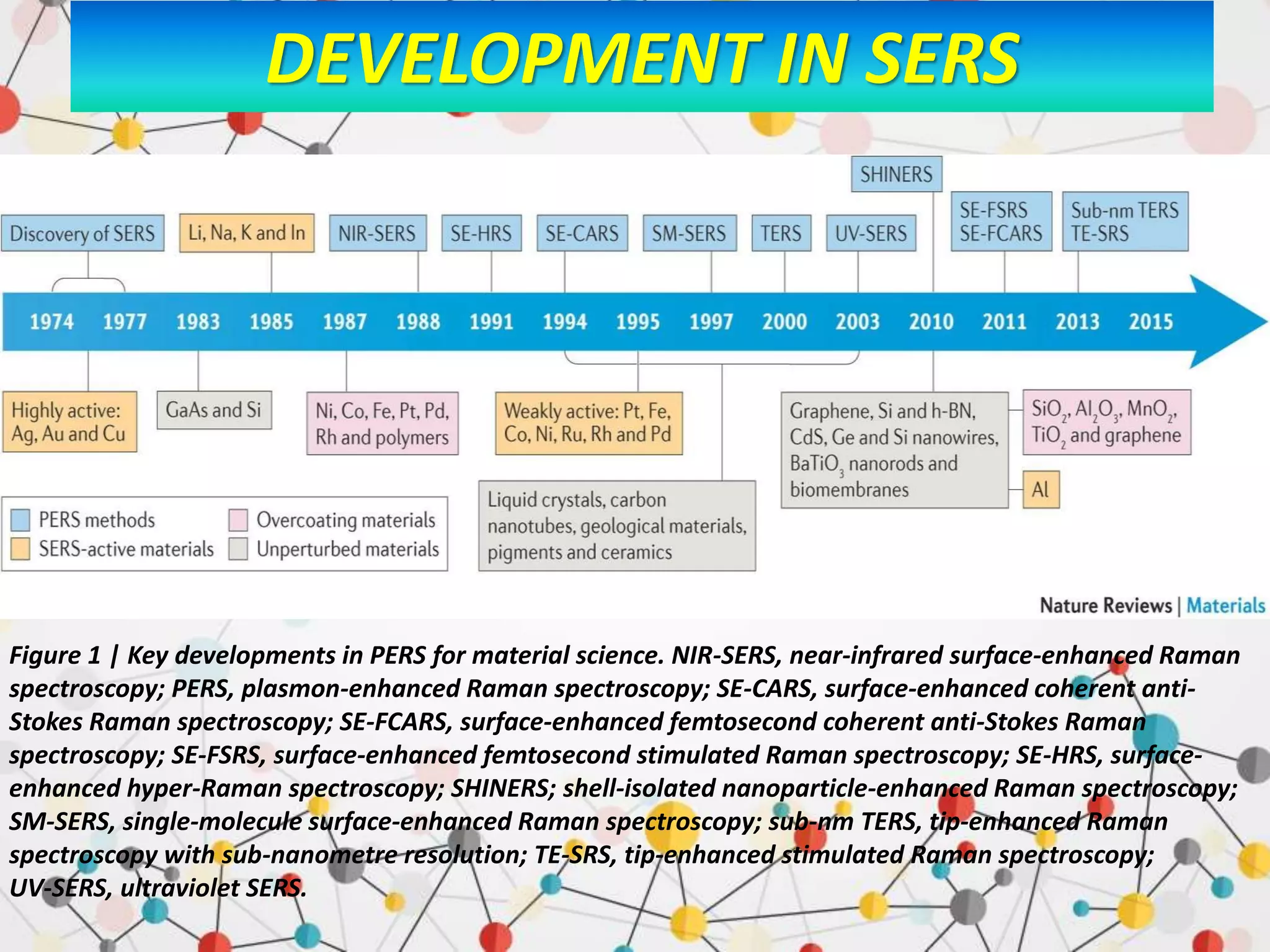
DEVELOPMENT IN SERS
Figure 1 | Key developments in PERS for material science. NIR-SERS, near-infrared surface-enhanced Raman
spectroscopy; PERS, plasmon-enhanced Raman spectroscopy; SE-CARS, surface-enhanced coherent anti-
Stokes Raman spectroscopy; SE-FCARS, surface-enhanced femtosecond coherent anti-Stokes Raman
spectroscopy; SE-FSRS, surface-enhanced femtosecond stimulated Raman spectroscopy; SE-HRS, surface-
enhanced hyper-Raman spectroscopy; SHINERS; shell-isolated nanoparticle-enhanced Raman spectroscopy;
SM-SERS, single-molecule surface-enhanced Raman spectroscopy; sub-nm TERS, tip-enhanced Raman
spectroscopy with sub-nanometre resolution; TE-SRS, tip-enhanced stimulated Raman spectroscopy;
UV-SERS, ultraviolet SERS.
SUMMARY
• Metal nanostructures provide huge EF of the
Raman scattering, making possible single
molecule detection.
• The enhancement happens due to SPR and
requires nanotechnology and simulations to
produce nanoengineered SERS substrate.
• High informativity and sensitivity of SERS
bursted multiple applications of the method in
different areas.
• SERS substrate fabrication, distribution and
reproducibility are still main problems for SERS.
REFERENCES
 https://en.wikipedia.org/wiki/Surface-enhanced_Raman_spectroscopy
 https://www.slideshare.net/NuzhetNihaar/surface-enhanced-raman-spectroscopy
 Principle of SERS and related plasmonic effects by EricLe. Ru, Pablo Etchegoin.
 REVIEWS BY-
 Surface-Enhanced Raman Spectroscopy, Recent Advancement of Raman Spectroscopy,
Ujjal Kumar Sur.
 Nanostructure-based plasmon-enhanced Raman spectroscopy for surface analysis of
materials by Song-Yuan Ding1, Jun Yi1, Jian-Feng Li1,2, Bin Ren1,2, De-Yin Wu1,
Rajapandiyan Panneerselvam1 and Zhong-Qun Tian1.
 Surface-Enhanced Raman Spectroscopy: Concepts and Chemical Applications by
Sebastian Schlcker*.
 A Review on Surface-Enhanced Raman Scattering by Roberto Pilot 1,2,* , Raaella
Signorini 1,2, Christian Durante 1,2 , Laura Orian 1,2 , Manjari Bhamidipati 3 and Laura
Fabris.
 Surface-Enhanced Raman Scattering(SERS) by Victor Ovchinnikov Aalto Nanofab , Aalto
University Espoo, Finland.
 Surface-enhanced Raman scattering and biophysics by Katrin Kneipp1, Harald Kneipp,
Irving Itzkan, Ramachandra R Dasari Michael S Feld
Surface enhanced raman spectroscopy, rahutosh ranjan

Surface enhanced raman spectroscopy, rahutosh ranjan

  • 1.
    SURFACE ENHANCED RAMAN SPECTROSCOPY(SERS) Preparedby:- Name: RAHTOSH RANJAN EnrollmentNo.:MGCU2017PHYS3020 Semester - 6th Session-2017-2020 Guided by:- Prof Sunil Kumar Srivastava PREPARED BY- RAHUTOSH RANJAN
  • 2.
    Contents Introduction to SERS Featuresof SERS Principle Instrumentation Plasmons and Plasmonics SERS Enhancement Enhancement Factor Hotspots SERS Substrate Experimental detail
  • 3.
  • 4.
    • They initiallythought the intense surface Raman signal of Py was due to increased surface area. • Prevailing explanation was proposed by Van Duyne in 1977. • Van Duyne hypothesized that the phenomenon was originated by strong electrochemical electric field at the metal surface. • Moskivits proposed that the large signal was originated by optical excitation of collective oscillation of the electron in the metallic nano sized features at the surface. • A comprehensive theory of this effect was given by Lombardy and Birke.
  • 5.
    FEATURES OF SERS Itis a highly surface-sensitive, non-destructive and in situ vibrational spectroscopic technique. SERS occurs when target molecules are brought within a few nanometers of the surface of SERS active substrates of different morphologies. The excitation profile (scattering intensity versus excitation frequency) deviates from the fourth power dependence of normal Raman scattering. It has extremely high spatial resolution. The enhancement range is several nanometers, effective for one or several molecular layers close to the SERS active substrate. SERS activity strongly depends on the nature of metal and surface roughness. SERS active substrate fabrication is a very important field in SERS research. The two most common SERS active substrates are metal colloids of coinage metals of Au, Ag and. The SERS technique is so sensitive that even single molecule can be detected.
  • 6.
  • 7.
    SERS is trulya surface selective effect. SERS is a molecular spectroscopic technique which is based on plasmon assisted scattering of molecules on or near metal nano structures. SERS consist in using the large local field enhancement that can exist at metallic surfaces under the right condition. The SERS enhancement of the nano structures strongly relies upon the optical resonance property of the coinage metal(i.e. Au, Ag, Cu). The SERS effect is due to the amplification of Raman signal of analytes by several orders of magnitude, when the analytes are located at or very close to coinage metal nano structures. PRINCIPLE
  • 8.
    Cont.. Localized Surface PlasmonResonance (LSPR) boost the Raman signal of molecules at (or close to) the surface. There are two ways for enhancement of the Raman signals- • Electromagnetic Enhancement. • Chemical Enhancement. Electromagnetic Enhancement mechanism results from the amplification of light by excited LSPR. Chemical Enhancement involve charge transfer mechanism . Where the excitation wavelength is resultant with the metal molecule charge transfer electronic state.
  • 9.
    Enhanced local field andinduced dipole moment due to NPs lead to the enhanced Raman scattering from the molecules in the nanogap. LSPR, Lightning rod effect and Image field effect have been considered to contribute to SERS.
  • 10.
    PLASMON AND PLASMONICS Plasmonicsis the study of the interaction of light and metal under precise conditions. Plasmonics is the study of optical property of noble metals in particular gold and silver. Optical property of noble metal
  • 11.
    PLASMONS The term plasmonwas introduced by Pines in 1956. Plasmon are density waves of electrons , created when light hits the surface of metal under precise circumstances. These density waves are generated at optical frequencies , and are very small and rapid. A plasmon is a quantum quasi-particle representing the elementry excitations, or modes, of charge density oscillation in plasma. • Plasmon is a quasi-particle because it is always ‘lossy’ and highly intracting.
  • 12.
    PLASMONS CONT. Plasmon existsmainly in metals, where electrons are weakly bound to the atom and free to roam. The electrons in a metal can wobble like a piece of jelly, pulled back by the attraction of the positive metal ions that they leave behind. A plasmon is a collective wave where billions of electrons oscillate in sync. Plasmon can exist either by themselvesi.e. without mixing with a photon or as a mixed plasma-photon mode(plasmon-polaritons). Plasmon-polaritons Bosonic quasi-particle resulting from strong coupling of photons with an electric or magnetic dipole. Photon-induced plasmon(plasmon + photon coupled)
  • 13.
  • 14.
    SURFACE PLASMON FIG:-Schematic representationof an electron density wave propagating along a metal–dielectric interface. The charge density oscillations and associated electromagnetic fields are called surface plasmon-polariton waves. The exponential dependence of the electromagnetic field intensity on the distance away from the interface is shown on the right. These waves can be excited very efficiently with light in the visible range of the electromagnetic spectrum Surfaceplasmons(SPs)are coherent delocalized electron oscillations that exist at the interface between any two material. SPs are electromagnetic wave that can be excited at the metal or dielectric surface from that interface plasmon are created when the light energy from polarized incident photon is coupled in oscillation mode of free electron density which is present in metal film. SPs have lower energy than bulk plasmon. SPs are propagation of plasmon/polariton collectively along(parallel to) a surface.
  • 15.
    SURFACE PLASMON RESONANCE(SPR) Plasmonresonance are due to collective charge oscillation of free electron. Surface plasmon resonance (SPR) is the resonantoscillation of conduction electrons at the interface between negative and positive permittivity material stimulated by incident light. SPR is a surface sensitive spectroscopy method which measure changes in the refractive index of medium directly in contact with sensor surface. SPR is the basis of many standard tools for measuring adsorption of material onto planar metal (typically gold or silver) surfaces or onto the surface of metal nanoparticles
  • 16.
    SPR CONT… • Surfaceplasmon resonance is a quantum optical-electrical phenomenon arising from the interaction of light with a metal surface. Under certain conditions the energy carried by photons of light is transferred to packets of electrons, called plasmons, on the metal surface. Energy transfer occur only at a specific resonance wavelength of light. That is the wavelength where the quantum energy carried by the photon exactly equals the quantum energy level of the plasmon. SPR PRINCIPLE A light beam impinge at interface between metal and media at a defined angle RESONANE ANGLE. Resonance anglea certain incident angle, the plasmons are set to resonate with light, resulting in absorption of light at that angle. It depends upon the refractive index in immediate vicinity of surface. As material binds to the surface, the refractive index increases and the SPR curve shift to higher angles. Two types of SPR • Localized Surface Plasmons(LSPs) • Propagating Surface Plasmons(PSPs)
  • 17.
    LOCALIZED SURFACE PLASMONS(LSPs) FIG1:-Lightincident on a metal nanoparticle causes the conduction band electrons to oscillate. This is the localized surface plasmon. A localized surface plasmon is a surface plasmon geometrically confined to small cavity of a nanoparticle size comparable to or smaller than the wavelength of light used to excite the plasmon. The coherent electrons oscillate to nanoparticle surfaces or nanoscale crevices. When a small spherical metallic nanoparticle is irradiated by light, the oscillating electric field causes the conduction electrons to oscillate coherently. When the electron cloud is displaced relative to its original position, a restoring force arises from Coulombic attraction between electrons and nuclei. This force causes the electron cloud to oscillate. The LSP has two important effects: electric fields near the particle’s surface are greatly enhanced and the particle’s optical absorption has a maximum at the plasmon resonant frequency. Surface plasmon resonance can also be tuned based on the shape of the nanoparticle. FIG2:-When the size of nanoparticles is small (<15 nm), resonance is dominated by absorption (Figure 1B) and when the size is larger (>15 nm)
  • 18.
    MECHANISM • An analyteis adsorbed on a surface patterned or roughened so that the chosen excitation frequency will excite a plasmon and create scattering. PLASMON EXCITATION • Energy from the plasmon is transferred to the adsorbed molecules and the Raman process occurs on the molecule. RAMAN PROCESS • Energy is transferred back to the plasmon less than the amount transferred than the nuclei and scattered from the surface as wavelength shifted light. ENHANCEMENT
  • 19.
  • 20.
    EXPERIMENTAL CONSIDERATIONS • Substratesrange in structure from nanorods to three-dimensional colloidal solutions, with tunable plasmon resonances and a range of average enhancement factors. Additionally, as the maximum SERS enhancing region decreases extremely rapidly with distance (r−10 for spheres),10 the largest enhancements are found in thefew nanometers closest to the substrate surface. CHOICE OF SUBSTRATE • Simplified theories of SERS predict a maximum enhancement when the laser is tuned to the peak of the plasmon resonance, for a substrate with a single peak in its LSPR spectrum. While this has been shown experimentally to lead to high enhancements, the maximum enhancement factors are found when the laser wavelength is shifted to the blue of the plasmon resonance, ideally shifted by one-half of the Raman vibrational frequency17. This most efficiently maximizes enhancement on both the excitation and emission parts of the Raman process, leading to the highest SERS signals. Thus, maximum signal is found when the plasmon frequency is tuned to be slightly red-shifted from the laser wavelength. APPROPRIATE EXCITATION SOURCE • The detection process is identical to normal Raman experiments. A notch or long-pass filter is used to absorb or reflect any Rayleigh scattering while allowing for transmission of the Raman signal, and a spectrograph and detector are used to image Raman spectra across a wide spectral region. DETECTION OF SERS SIGNAL
  • 21.
    INSTRUMENTATION MICRO-RAMAN CONFIGRATION MACRO-RAMAN CONFIGRTION CL Used for higherspatial resolution. Laser light is both focused and collected through the same high numerical aperture objective , after which the scattered light passes through a notch filter for removal of Rayleigh-scattered light. Finally the light is focused and directed to a spectrometer and detector. Scanning SER spectra over many different wavelength. Used for low spatial resolution and high raw SERS intensity. Laser is focused on the SERS substrate at a glancing angle, while the Raman light is collected by a large collection lens. The light is than focused through the entrance slit if a spectrometer and detected using a liquid – nitrogen-cooled charged-coupled device camera.
  • 22.
    MULTILASER RAMAN INSTRUMENTATION Fig:-Schematic diagram of the experimental setup as laid out on the laser table. The setup allows for easy tunability over the visible wavelength, using a combination of laser while maintaining alignment on the sample. The triple spectrograph analyzes Raman scattering excited at wavelengths throughout the visible spectrum.
  • 23.
  • 24.
  • 25.
  • 26.
    EM ENHANCEMENT MECHANISM •The electromagnetic enhancement possesses two distinct contributions: 1- The local field (or near field) enhancement. The excitation of surface plasmons induces a strong spatial localization and hence amplification of the laser light in small spatial regions, called hot spots. Therefore, the electromagnetic field experienced by the molecules residing in hot spots is much stronger than the field they would experience without the metallic substrate. 2- The re-radiation enhancement. The presence of the metallic structure nearby the molecule modifies also the efficiency with which the molecule radiates Raman power; this occurs because the power radiated by a dipole (i.e., the molecule oscillating at the Raman frequency) depends on the environment in which it is embedded.
  • 29.
    DISTANCE DEPENDENCE fig-SERS signalas a function of the distance from the surface. A short and a long-range component are identified; they are associated to morphological features of the metallic substrate with a size of approximately 1 nm and 20 nm, respectively. In the insets, a scanning electron microscopy (SEM) picture of the SERS substrate (silver film over nanospheres) and a simulation of the electric field are presented. Reproduced with permission from Masango et al. [236]. Copyright (2016),
  • 30.
    DISTANCE DIPENDENCE The aboveformulas suggest that the SERS enhancement and the signals drop very fast from the surface; the analyte should normally be placed within 10 nm from the surface to efficiently exploit the plasmonic effect..
  • 31.
    WAVELENGTH DEPENDENCE a Wavelength(nm) 800 700 600 500 0.25 0.2 0.15 0.1 0.05 2.0E+7 1.6E+7 1.2E+7 8.0E+6 4.0E+6 0.0E+0 b 900 0.24 0.2 0.16 0.12 0.08 0.04 800 Wavelength (nm) 700 600 500 2.0E+7 1.6E+7 1.2E+7 8.0E+6 4.0E+6 0.0E+0 14,000 18,000 22,000 12,000 16,000 20,000 νvib = 1575 cm-1 shift = 734 cm-1 Enhancementfactor Enhancementfactor Extinction Extinction • SERS is maximum when laser excitation is between SPR and the analized specturm line. Figure 3a shows a characteristic wavelength scanned excitation profile of the 1081 cm−1 peak from benzenethiol. The excitation profile shows the highest SERS EF occurs when the excitation wavelength is higher in energy than the spectral maximum of the LSPR extinction spectrum. A Gaussian fit was made to the profile and distance in energy of the maximum of the excitation profile, and the LSPR extinction spectrum is 613 cm−1, which is on the order of half the vibrational energy, 1081 cm−1.
  • 32.
    WAVELENGTH DEPENDENCE c Wavelength(nm) Wave numbers (cm-1 ) d Wavelength (nm) 900 0.24 0.2 0.16 0.12 0.08 800 700 600 500 3.0E+7 2.5E+7 2.0E+7 1.5E+7 1.0E+7 5.0E+6 900 0.24 0.2 0.16 0.12 0.08 800 700 600 500 3.0E+6 2.5E+6 2.0E+6 1.5E+6 1.0E+6 5.0E+5 νvib = 1081 cm-1 shift = 569 cm-1 νvib = 1009 cm-1 shift = 488 cm-1 Enhancementfactor Extinction Extinction
  • 33.
  • 34.
    CHEMICAL ENHANCEMENT Two differentmechanisms can contribute to the chemical enhancement. Non-resonant chemical effect. The interaction between the molecule and the metal does not lead to the formation of a new electronic state (the molecular orbitals lay at energies not close enough to the Fermi level of the metal); however, such interaction may induce an appreciable change in the geometrical and electronic structure of the molecule, that reveals as a mild modification of the Raman shifts and of the intensity of the vibrational modes. Resonant charge transfer chemical effect. The interaction between the molecule and the metal brings about the creation of a metal– molecule charge transfer (CT) state. If the Raman scattering is excited with a laser source in resonance or pre-resonance with this state, some Raman modes can be strongly enhanced, in particular those ones coupled to the allowed electronic transitions (resonant Raman scattering). (a) Spectral distribution of the plasmonic (red line), charge transfer (CT, black line), and intramolecular (green, blue, and violet lines) resonances for pyridine adsorbed on silver. Reprinted (adapted) with permission from Lombardi et al. [9]. Copyright (2008) American Chemical Society.
  • 35.
    CHEMICAL ENHANCEMENT • Figure1 shows a typical energy level diagram for a ‘molecule–metal system’, where the energies of the highest occupied molecular orbital (HOMO) and the lowest unoccupied molecular orbital (LUMO) are approximately symmetric relative to the Fermi level of the metal, together with possible resonant Raman processes involving molecular states (path (a)) and molecular and metallic states (paths (b), (c)) . The figure also explains the change of the resonance conditions for paths (b) and (c) when the Fermi level is shifted, i.e. a potential- dependent SERS enhancement. Figure1. Energy level diagram for a ‘molecule–metal system’ showing also possible resonant Raman processes involving molecular states (path (a)) and molecular and metallic states (paths (b), (c)) Another first-layer SERS effect is attributed to a so-called dynamical charge transfer , which can be described by the following four steps: (a) photon annihilation, excitation of an electron into a hot-electron state, (b) transfer of the hot electron into the LUMO of the molecule, (c) transfer of the hot electron from the LUMO (with changed normal coordinates of some internal molecular vibrations) back to the metal and (d) return of the electron to its initial state and Stokes photon creation.
  • 36.
    HOTSPOTS • Electromagnetic fieldaround plasmonic material is not uniformly distributed but highly localized in spatially narrow regions (SERS hotpots), such as nanotips, nanogaps (interparticle or particle-substrate). • SERS active hot spots were first suggested relatively early in the history of SERS by Moerl and Pettinger • Hot spots are highly localized regions of intense local field enhancement believed to be caused by local surface plasmon resonances (LSPR). Formed within the interstitial crevices present in metallic nanostructures , such hot spots have been claimed to provide extraordinary enhancements of up to 1015 orders of magnitude to the surface-enhanced Raman scattering (SERS) signal (proportional to |E| 4 ) in areas of subwavelength localization .
  • 37.
    TYPES OF HOTSPOTS Firstgen. hotspots Second gen. hotspots Third gen. hotspots • Made from single nanostructures, such as nanospheres and nanocubs or nanorods freely suspended in homogeneous medium. • These hotspots exhibits moderate SERS activity. • But nanospheres with sharpcorners or with interparticle gaps, exhibit much higher SERS activity. • Generated from coupled nanostructures with controllable interparticle nanogaps or interunit nanogaps in nanopattarned surfaces. • Exhibits excellent SERS activity. • The size of SERS hotspots from coupld nanostructures is extremely small(1-5nm), but Raman signals of probe molecules at the hotspots contribute significantly to toral Raman signal. • Crucial for detecting and analysing trace amounts of molcules , including single molecule located in hotspot. • Bottom-up and Top-down • First and second generation hotspots are not well suited for surface analysis o many materials. • Therefore, it is highly desirable to design plasmonic nanostructures that can have hotspots right on the surface of the materials to be probed. • Hotspots on probe material surfaces, which are generated from hybrid structures consisting of plasmonic nanostructures and the probe materials, can be considered third- generation hotspots.
  • 38.
    TYPES OF HOTSPOTS Singlenanostructures nanoparticle ordered assembly Coupled nanostructures Structured surface Nanoparticle aggregrate and oligomer Nanosphere and nanocone Fig1- 1st and 2nd generation hotspots Fig2- 3rd generation hotspots
  • 39.
    HOTSPOTS • Palsma Eatchingis an elegant way of selectively removing molecules from the surface of metal nanostructures. This technique is used to isolate the hotspots formed between two silver nanocubes for subsquient measurement of the SERS EF to this particular hotspot. Fig1--Isolation of molecules located in a hot spot by plasma etching. A self-assembled monolayer of 4-methylbenzenethiol (4-MBT) is formed on the surface of a dimer of silver nanocubes. Plasma etching removes the surface-bound molecules except those located inthe junction of the cubes. Figure 2-. (a) GSERS distribution inside the 2 nm gap formed by two gold nanoparticles with a radius of 30 nm. The enhancement is calculated at the wavelength at which it reaches its maximum value. (b) Variation of GSERS along the (curved) surface of the nanoparticle (thin black line); the thick black line is not commented in this paper. permission from Etchegoin et
  • 40.
  • 41.
  • 42.
    SERS DETECTION OFANALYTES • SERS detection of analytes can be carried out in two different ways 1. Direct detection-It allows one to identify compounds through their own Raman spectrum and are suitable for species with large cross- section. 2. Indircet detection- A SERS tag is functionalized with antibodies and selective binds to the analyte, its detection is carried out through the spectrum of Raman reporter contained in the SERS tag.
  • 43.
    TYPES OF SERSSUBSTRATE SEM images of different types of SERS substrates. (A) Spherical gold nanoparticles , (B) gold nanorods , (C) silver nanobar , (D) silver plasmonic nanodome array , (E) gold nanocluster , (F) gold nanoholes , (G) silver nanovoids , (H) silver nanocolumnar film , and (I) silver nano-pillars .
  • 44.
    METAL COLLOIDS FORSERS TEM of Au borohydride colloid, Au particles 20-70 nm, 􀉉max= 535 nm Au nanorods Au nanosquares Ag nanowires
  • 45.
    NANOSPHERE LITHOGRAPHY Dropping coating polymernanosphere on substrate. Nanosphere self assemble into close packed Hexagonal array. The HCP array is then used as a mask for the creation of several different SERS active substrate.
  • 46.
  • 47.
    SINGLE MOLECULE DETECTION(SMD) SMD–why? • To push analytical tools to their ultimate resolution limits • The understanding of unique single-molecule phenomena that are potentially washed out by ensemble averages • Early single-molecule emission was inferred from indirect evidence • Ultra-low concentration studies – statistical result, but they provide hint of possibility SMD
  • 48.
    SMD • Competitive tofluorescence • Rhodamine 6G like pyridine for average SERS • SMD SERS was possible only for molecules situated between Ag nanoparticles • The higher surface EF, the more localized are hot spots • At low concentrations single particle enhancement occurs only in SERRS, not SERS, allowing lower concentrations to be detected • The highest the enhancements (SMD) are the most uncontrollable from the experimental point of view Langmuir–Blodgett films
  • 49.
    TRANSITION-METAL SERS  Itis still difficult to perform SERS analysis of general adsorbates, such as water molecules, on transition-metal surfaces.  To improve the SERS enhancement factor on transition- metal surfaces, a strategy (which we refer to as ‘borrowing SERS’) was devised to coat transition metals as an ultrathin shell or overlayer on the surface of Au and Ag nanostructures (the active metal film is thin enough to borrow the EM enhancement of underlying plasmoni metal).  To avoid damping of the plasmon of underlying metal one must ensure-  Catalytically active overlayer is sufficiently thin.  The layer must be thick enough to ensure full coverage and minimize any pinhole.  Such pinhole free overlayer will minimize any SERS signal arising from the analyte bindind directly to the SERS active metal, instead of catalytically active metal.
  • 50.
    SERS SIGNAL MAIN CHARACTERISTICSOF SERS SIGNALS-  SERS spectrum vs Raman spectrum: As a rule of thumb, most molecules exhibit a SERS spectrum that is very similar to their normal Raman spectrum (at the same excitation wavelength), and most of the finngerprint Raman peaks in particular are easily identiable. slide7  Polarization effects: SERS signals can also differ from Raman signals in their polarization properties . This is a result of the polarization dependence of plasmon resonances.  Maximum SERS signals are observed when the laser polarization is aligned perpendicular to the dimer axis.  For a parallel orientation the SERS intensity even decreases further.
  • 51.
    SERS SIGNAL SERS continuum:-SERS spectra are sometimes associated with a broad background. A background is also present in most Raman spectra, but attributed to impurities or residual intrinsic fluorescence. In the case of SERS, it is believed to have, at least in some cases, a real physical origin. This broad background is often called the SERS continuum ,but its origin is still controversial . The SERS continuum fluctuates like the SERS signal and has the same polarization properties. Photo-bleaching/photo-chemistry:-Many SERS probes like dyes are known to photo-bleach under normal non-SERS conditions (at least at sufficiently high excitation powers).It is therefore not so surprising that photo- bleaching also occurs under SERS conditions; decays of the SERS signal because of photo-bleaching are indeed observed experimentally, and the photo-products may also sometimes appear in the SERS spectrum itself.
  • 52.
    SERS SIGNAL FLUCTUATIONS SERS fluctuations may refer to fluctuations in intensity or spectral shape (Raman peak positions).  Intensity fluctuations with possible blinking or complete disappearing.  Spectral shape fluctuations, in either the relative intensities of the peaks, or the peak positions (Raman shifts) and widths, random peak appearance.  Evidence of SMD, because average SERS stable, SMD-no
  • 53.
    SERS SIGNAL FLUCTUATIONSOURCES Photo-induced and site dependent – variation of the local field enhancement. Submonolayer coverage of hot spots  Photo-induced and spontaneous dynamics – chemistry change for long scans  Photo-bleaching of dyes, photo-desorption, photoinduced surface diffusion, Substrate heating, and possibly substrate morphology changes (through photo-oxidation for example) Surface diffusion of a single molecule in-and-out of a hot-spot (for SMD)
  • 54.
    APPLICATION OF SERS Chemicalidentification (bonds)  Physical identification (crystallinity, phases, graphene) Stress and diameter measurements (carbon nanotubes)  Trace analysis (explosives and drug detection)  Process monitoring (in-situ measurements) Uncovering painting  Biology (DNA) and medicine (glucose in-vivo)  Pharmacology
  • 55.
    SEERS APPLICATION Figure -Schematic classification of some of the main areas contributing to SERS at present.
  • 56.
  • 57.
  • 58.
    DEVELOPMENT IN SERS Figure1 | Key developments in PERS for material science. NIR-SERS, near-infrared surface-enhanced Raman spectroscopy; PERS, plasmon-enhanced Raman spectroscopy; SE-CARS, surface-enhanced coherent anti- Stokes Raman spectroscopy; SE-FCARS, surface-enhanced femtosecond coherent anti-Stokes Raman spectroscopy; SE-FSRS, surface-enhanced femtosecond stimulated Raman spectroscopy; SE-HRS, surface- enhanced hyper-Raman spectroscopy; SHINERS; shell-isolated nanoparticle-enhanced Raman spectroscopy; SM-SERS, single-molecule surface-enhanced Raman spectroscopy; sub-nm TERS, tip-enhanced Raman spectroscopy with sub-nanometre resolution; TE-SRS, tip-enhanced stimulated Raman spectroscopy; UV-SERS, ultraviolet SERS.
  • 59.
    SUMMARY • Metal nanostructuresprovide huge EF of the Raman scattering, making possible single molecule detection. • The enhancement happens due to SPR and requires nanotechnology and simulations to produce nanoengineered SERS substrate. • High informativity and sensitivity of SERS bursted multiple applications of the method in different areas. • SERS substrate fabrication, distribution and reproducibility are still main problems for SERS.
  • 60.
    REFERENCES  https://en.wikipedia.org/wiki/Surface-enhanced_Raman_spectroscopy  https://www.slideshare.net/NuzhetNihaar/surface-enhanced-raman-spectroscopy Principle of SERS and related plasmonic effects by EricLe. Ru, Pablo Etchegoin.  REVIEWS BY-  Surface-Enhanced Raman Spectroscopy, Recent Advancement of Raman Spectroscopy, Ujjal Kumar Sur.  Nanostructure-based plasmon-enhanced Raman spectroscopy for surface analysis of materials by Song-Yuan Ding1, Jun Yi1, Jian-Feng Li1,2, Bin Ren1,2, De-Yin Wu1, Rajapandiyan Panneerselvam1 and Zhong-Qun Tian1.  Surface-Enhanced Raman Spectroscopy: Concepts and Chemical Applications by Sebastian Schlcker*.  A Review on Surface-Enhanced Raman Scattering by Roberto Pilot 1,2,* , Raaella Signorini 1,2, Christian Durante 1,2 , Laura Orian 1,2 , Manjari Bhamidipati 3 and Laura Fabris.  Surface-Enhanced Raman Scattering(SERS) by Victor Ovchinnikov Aalto Nanofab , Aalto University Espoo, Finland.  Surface-enhanced Raman scattering and biophysics by Katrin Kneipp1, Harald Kneipp, Irving Itzkan, Ramachandra R Dasari Michael S Feld