Downloaded 12 times
![Introduction
Single or Multi layered materials having
negligible thickness (~atomic scale).
For graphene, 1 to 10 layers are treated
as 2D Material.
Multi layered materials are regarded as 3D
materials when they have considerable
thickness.
[1]. Geim, A. K.; Novoselov, K. S. Nat. Mater. 2007, 6, 183.](https://image.slidesharecdn.com/2d-materials-introduction-220217064304/75/2d-materials-introductions-3-2048.jpg)
![History
Bordie in 1859 made a failed attempt to
exfoliate a single sheet from graphite.
R.E. Peierls and L.D. Landau in 1937
suggested that strictly 2D material could
not exist.
Hahns-Peter Bohm introduced the term
graphene in 1962.
Geim and Novesolov got Nobel Prize in
2004 for exfoliation of stable graphene and
its characterization.
[1]. Brodie, B. C. Philosophical Transactions of the Royal Society of London 1859,149, 249.
[2]. Joensen, P.; Frindt, R. F.; Morrison, S. R. Mater. Res. Bull. 1986, 21, 457.
[3]. Geim, A. K.; Novoselov, K. S. Nat. Mater. 2007, 6, 183.](https://image.slidesharecdn.com/2d-materials-introduction-220217064304/75/2d-materials-introductions-4-2048.jpg)
![Different Types Of 2Ds
Graphene: Single layer of Carbon.
Germanene :Single layer of Germenium.
Silicene: Single layer of Silicon.
Phospherene: Single layer of phosphorus.
Hexa Boron Nitride: Compund 2D material
with alternating Boron and Nitrogen atoms.
Transition Metals Dichalcogenides:
Compund 2D materials of Transition
metals & Chalcogens.
1] Lee, Kangho; Kim, Hye-Young; Lotya, Mustafa; Coleman, Jonathan N.; Kim, Gyu-Tae; Duesberg, Georg S. (2011-09-22).
2] Wu, Haihua; Yang, Rong; Song, Baomin; Han, Qiusen; Li, Jingying; Zhang, Ying; Fang, Yan; Tenne, Reshef; Wang,
Chen. "Biocompatible Inorganic Fullerene-Like Molybdenum Disulfide Nanoparticles Produced by Pulsed Laser Ablation
in Water](https://image.slidesharecdn.com/2d-materials-introduction-220217064304/75/2d-materials-introductions-5-2048.jpg)
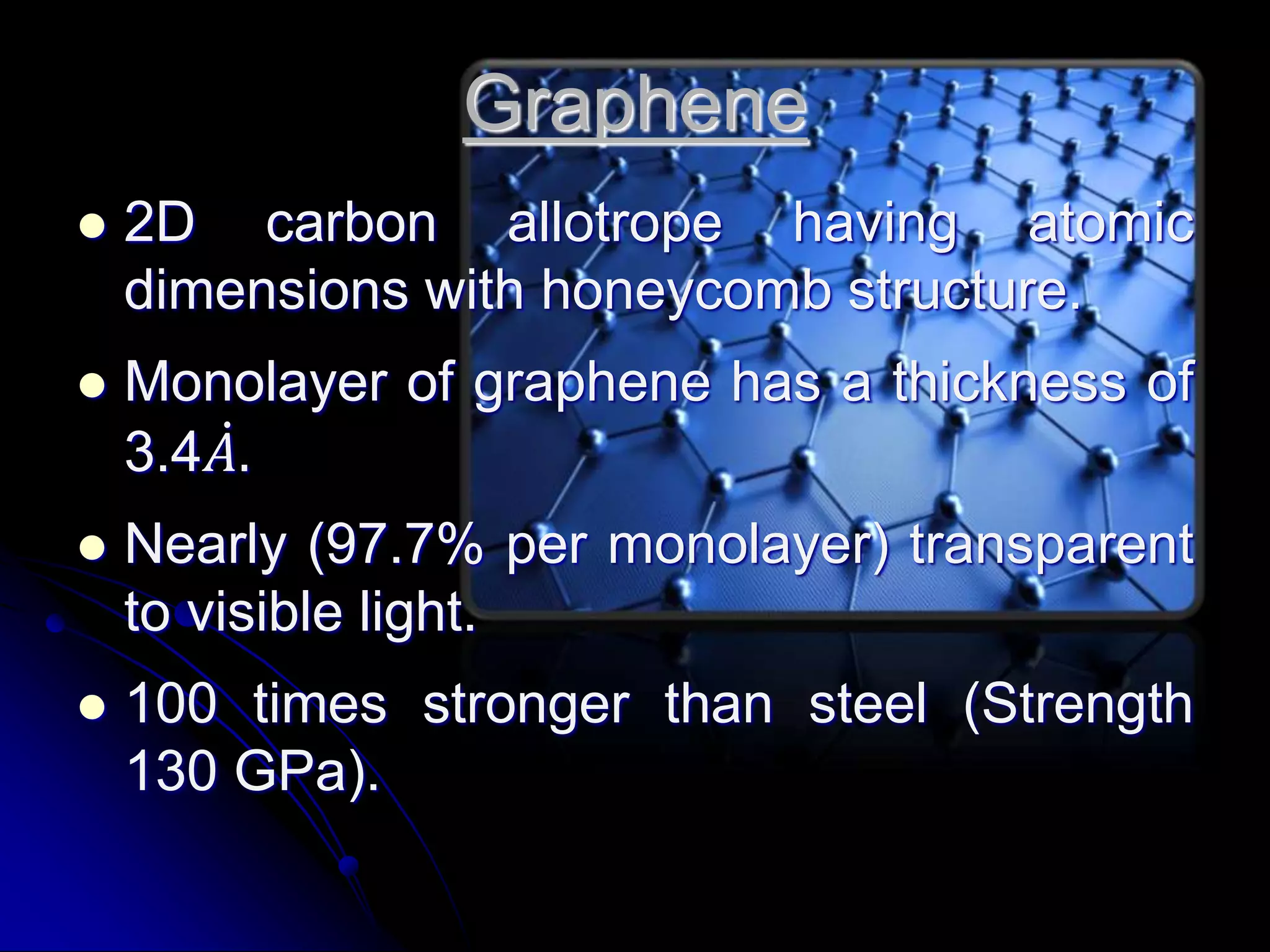


This document provides an introduction to 2D materials, including a brief history and overview of types. It discusses graphene, the earliest known 2D material, which consists of a single layer of carbon atoms arranged in a honeycomb structure. Graphene is nearly transparent, yet over 100 times stronger than steel. It has the highest thermal and electrical conductivity of any known material. The document also mentions other 2D materials like germanene, silicene, phosphorene, and transition metal dichalcogenides.


