Plasmids
The term plasmid was first introduced by the American molecular
biologist
Joshua Lederberg in 1952
He was just 33 years old when he won the 1958 Nobel
Prize in Physiology or Medicine for discovering that
bacteria can mate and exchange genes.
Plasmids and Bacteriophages
Plasmids: autonomously replicating
extrachromosomal DNA molecules present
mostly in the bacterial cells.
Sometimes found in eukaryotic organisms (e.g., the 2- micrometre-ring in
Saccharomyces cerevisiae).
Plasmids are Self replicative extrachromosomal DNA
molecules of finite size that are stably inherited and exchanged
easily between a broad spectrum of bacteria and other domains
Plasmids allow bacterial (including other domains) populations
to ‘sample’ the horizontal gene pool for adaptive traits that
might be advantageous for survival under local selective
pressure
Plasmids also provide genetic variation, acts as sources of
recombination and can allow faster gene fixation leading to
greater likelihood that the ‘new’ trait will persist
Plasmids
General properties of plasmids:
dsDNA, mostly circular
Size: 3 kb-150 kb
Transfer: self-transmissible;
mobilizable and nonconjugative;
nonconjugative and nonmobilizable
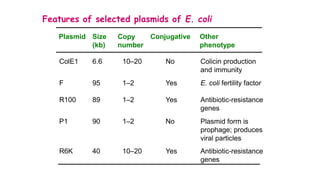
Features of selected plasmids of E. coli
Plasmid Size
(kb)
Copy
number
Conjugative Other
phenotype
ColE1 6.6 10–20 No Colicin production
and immunity
F 95 1–2 Yes E. coli fertility factor
R100 89 1–2 Yes Antibiotic-resistance
genes
P1 90 1–2 No Plasmid form is
prophage; produces
viral particles
R6K 40 10–20 Yes Antibiotic-resistance
genes
Plasmid replication:
Mode of replication
Cairns intermediate (θ or butterfly form)
Rolling circle
Bacterial Plasmids in Nature
1. Occur naturally in bacteria
and usually carry genes that
are useful but not essential
to survival: e.g. genes which
make bacteria resistant to
antibiotics.
2. Plasmids are released by
dead bacteria and absorbed
by those still living thus
genetic information is
exchanged.
Bacterial Plasmids in Nature
3. Some plasmids even
contain genes that
build a transfer tube
between bacteria.
4. There can be as many
as several hundred
copies of a single
plasmid in each
bacteria.
Plasmid Structure
1. Plasmids only need an “origin or
replication” and a “useful” gene
to be considered complete.
2. Molecular biologists have been
able to “insert” custom built
restriction sites into many
plasmids so they can be used to
“insert” DNA fragments from
other genes into them and thus
have a way to propagate those
DNA pieces.
Plasmids can be manipulated easily in the
laboratory
1. Plasmids can be collected from bacteria.
2. Restriction enzymes can be purified and used to identify and cut out specific sequences of
DNA along with the plasmid vector.
3. Ligase (enzyme) can be purified and used to “glue” pieces of DNA together.
4. Bacteria can be transformed by taking in plasmids given to them.
Types
• One way of grouping plasmids is by their ability to transfer to other bacteria.
• Conjugative plasmids contain tra genes
• Non-conjugative plasmids
• An intermediate class of plasmids are mobilizable,
*Plasmids are now being used to manipulate DNA, and may possibly be a tool for
curing many diseases.
• It is possible for plasmids of different types to coexist in a single cell. Several different plasmids have been
found in E. coli. However, related plasmids are often incompatible, in the sense that only one of them
survives in the cell line, due to the regulation of vital plasmid functions.
• Thus, plasmids can be assigned into incompatibility groups.
• Another way to classify plasmids is by function. There are five main classes:
• Fertility F-plasmids
• Resistance plasmids
• Col plasmids
• Degradative plasmids. Eg. Degradation of toluene and salicylic acid.
• Virulence plasmids

Plasmid

  • 1.
    Plasmids The term plasmidwas first introduced by the American molecular biologist Joshua Lederberg in 1952 He was just 33 years old when he won the 1958 Nobel Prize in Physiology or Medicine for discovering that bacteria can mate and exchange genes.
  • 2.
    Plasmids and Bacteriophages Plasmids:autonomously replicating extrachromosomal DNA molecules present mostly in the bacterial cells. Sometimes found in eukaryotic organisms (e.g., the 2- micrometre-ring in Saccharomyces cerevisiae).
  • 3.
    Plasmids are Selfreplicative extrachromosomal DNA molecules of finite size that are stably inherited and exchanged easily between a broad spectrum of bacteria and other domains Plasmids allow bacterial (including other domains) populations to ‘sample’ the horizontal gene pool for adaptive traits that might be advantageous for survival under local selective pressure Plasmids also provide genetic variation, acts as sources of recombination and can allow faster gene fixation leading to greater likelihood that the ‘new’ trait will persist
  • 4.
    Plasmids General properties ofplasmids: dsDNA, mostly circular Size: 3 kb-150 kb Transfer: self-transmissible; mobilizable and nonconjugative; nonconjugative and nonmobilizable
  • 5.
    Features of selectedplasmids of E. coli Plasmid Size (kb) Copy number Conjugative Other phenotype ColE1 6.6 10–20 No Colicin production and immunity F 95 1–2 Yes E. coli fertility factor R100 89 1–2 Yes Antibiotic-resistance genes P1 90 1–2 No Plasmid form is prophage; produces viral particles R6K 40 10–20 Yes Antibiotic-resistance genes
  • 6.
    Plasmid replication: Mode ofreplication Cairns intermediate (θ or butterfly form) Rolling circle
  • 9.
    Bacterial Plasmids inNature 1. Occur naturally in bacteria and usually carry genes that are useful but not essential to survival: e.g. genes which make bacteria resistant to antibiotics. 2. Plasmids are released by dead bacteria and absorbed by those still living thus genetic information is exchanged.
  • 10.
    Bacterial Plasmids inNature 3. Some plasmids even contain genes that build a transfer tube between bacteria. 4. There can be as many as several hundred copies of a single plasmid in each bacteria.
  • 11.
    Plasmid Structure 1. Plasmidsonly need an “origin or replication” and a “useful” gene to be considered complete. 2. Molecular biologists have been able to “insert” custom built restriction sites into many plasmids so they can be used to “insert” DNA fragments from other genes into them and thus have a way to propagate those DNA pieces.
  • 12.
    Plasmids can bemanipulated easily in the laboratory 1. Plasmids can be collected from bacteria. 2. Restriction enzymes can be purified and used to identify and cut out specific sequences of DNA along with the plasmid vector. 3. Ligase (enzyme) can be purified and used to “glue” pieces of DNA together. 4. Bacteria can be transformed by taking in plasmids given to them.
  • 13.
    Types • One wayof grouping plasmids is by their ability to transfer to other bacteria. • Conjugative plasmids contain tra genes • Non-conjugative plasmids • An intermediate class of plasmids are mobilizable, *Plasmids are now being used to manipulate DNA, and may possibly be a tool for curing many diseases.
  • 14.
    • It ispossible for plasmids of different types to coexist in a single cell. Several different plasmids have been found in E. coli. However, related plasmids are often incompatible, in the sense that only one of them survives in the cell line, due to the regulation of vital plasmid functions. • Thus, plasmids can be assigned into incompatibility groups. • Another way to classify plasmids is by function. There are five main classes: • Fertility F-plasmids • Resistance plasmids • Col plasmids • Degradative plasmids. Eg. Degradation of toluene and salicylic acid. • Virulence plasmids