Department of
Mechanical
Engineering
Dr Gaurang Joshi
Unit no 2
Product / Process
Planning and Design
CAPM (01ME0721 )
Facility Layout
 Layout refers to the configuration of departments, work centers,
and equipment, with particular emphasis on movement of work
(customers or materials) through the system.
 Layout decisions are important for three basic reasons:
1. require substantial investments of money and effort;
2. involve long-term commitments, which makes mistakes difficult
to overcome; and
3. have a significant impact on the cost and efficiency of
operations
Factors affecting Plant
Layout
1. Plant location and building
2. Nature of Product
3. Type of Industry
4. Plant Environment
5. Spatial Requirements
6. Repairs and Maintenance
7. Balance
8. Management Policy
9. Human Needs
10. Types of machinery and equipment
Factors affecting Plant
Layout
 The basic objective of layout design is to facilitate a smooth flow of
work, material, and information through the system. Supporting
objectives generally involve the following:
 To facilitate attainment of product or service quality.
 To use workers and space efficiently.
 To avoid bottlenecks.
 To minimize material handling costs.
 To eliminate unnecessary movements of workers or materials.
 To minimize production time or customer service time.
 To design for safety.
Plant Layout : Types
 The production process normally determines the type of plant layout
to be applied to the facility:
• Fixed position plant layout
 Product stays and resources move to it.
• Product oriented plant layout
 Machinery and Materials are placed following the product
path
• Process oriented plant layout (Functional Layout).
 Machinery is placed according to what they do and materials
go to them.
• Combined Layout
 Combine aspects of both process and product layouts
Product oriented plant
layout
 This type of plant layout is useful when the production
process is organized in a continuous or repetitive way.
 Continuous flow : The correct operations flow is reached
through the layout design and the equipment and
machinery specifications.
 Repetitive flow (assembly line): The correct operations
flow will be based in a line balancing exercise, in order to
avoid problems generated by bottle necks.
 The plant layout will be based in allocating a machine as
close as possible to the next one in line, in the correct
sequence to manufacture the product.
Product Layouts
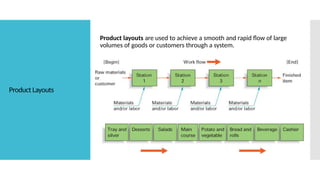
Product layouts are used to achieve a smooth and rapid flow of large
volumes of goods or customers through a system.
Product Layouts
Disadvantages
 Morale problems and to
repetitive stress injuries.
 Lack of maintaining
equipment or quality of
output.
 Iinflexible for output or
design
 highly susceptible to
shutdowns
 A high utilization of labor and
equipment
 Preventive maintenance, the
capacity for quick repairs, and
spare-parts inventories are
necessary expenses
 Incentive plans tied to
individual output are
impractical
Advantages
 A high rate of output
 Low unit cost due to high
volume
 Labor specialization
 Low material-handling cost per
unit
 A high utilization of labor and
equipment
 The establishment of routing
and scheduling in the initial
design of the system
 Fairly routine accounting,
purchasing, and inventory
control
Process Layouts
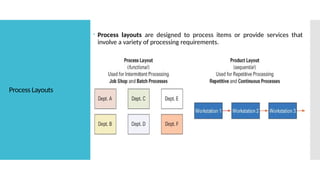
 Process layouts are designed to process items or provide services that
involve a variety of processing requirements.
Process oriented plant
layout (Functional
Layout)
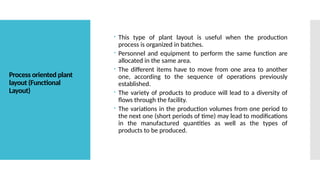
 This type of plant layout is useful when the production
process is organized in batches.
 Personnel and equipment to perform the same function are
allocated in the same area.
 The different items have to move from one area to another
one, according to the sequence of operations previously
established.
 The variety of products to produce will lead to a diversity of
flows through the facility.
 The variations in the production volumes from one period to
the next one (short periods of time) may lead to modifications
in the manufactured quantities as well as the types of
products to be produced.
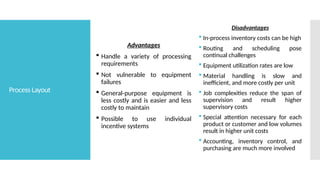
Process Layout
Advantages
 Handle a variety of processing
requirements
 Not vulnerable to equipment
failures
 General-purpose equipment is
less costly and is easier and less
costly to maintain
 Possible to use individual
incentive systems
Disadvantages
 In-process inventory costs can be high
 Routing and scheduling pose
continual challenges
 Equipment utilization rates are low
 Material handling is slow and
inefficient, and more costly per unit
 Job complexities reduce the span of
supervision and result higher
supervisory costs
 Special attention necessary for each
product or customer and low volumes
result in higher unit costs
 Accounting, inventory control, and
purchasing are much more involved
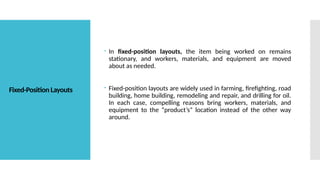
Fixed-Position Layouts
 In fixed-position layouts, the item being worked on remains
stationary, and workers, materials, and equipment are moved
about as needed.
 Fixed-position layouts are widely used in farming, firefighting, road
building, home building, remodeling and repair, and drilling for oil.
In each case, compelling reasons bring workers, materials, and
equipment to the “product’s” location instead of the other way
around.
Fixed-Position Layouts
Ship Building yard
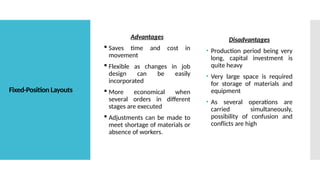
Fixed-Position Layouts
Advantages
 Saves time and cost in
movement
 Flexible as changes in job
design can be easily
incorporated
 More economical when
several orders in different
stages are executed
 Adjustments can be made to
meet shortage of materials or
absence of workers.
Disadvantages
• Production period being very
long, capital investment is
quite heavy
• Very large space is required
for storage of materials and
equipment
• As several operations are
carried simultaneously,
possibility of confusion and
conflicts are high
Combination
Layouts
 Supermarket layouts are essentially process layouts, yet we find
that most use fixed-path material-handling devices such as roller-
type conveyors in the stockroom and belt-type conveyors at the
cash registers.
 Hospitals also use the basic process arrangement, although
frequently patient care involves more of a fixed-position approach,
in which nurses, doctors, medicines, and special equipment are
brought to the patient.
 Faulty parts made in a product layout may require off-line
reworking, which involves customized processing. Moreover,
conveyors are frequently observed in both farming and
construction activities.
 Cellular manufacturing - Group technology
 Flexible manufacturing systems
Essentials of Ideal Layout
1. Principle of minimum movement
2. Principle of flow
3. Principle of space
4. Principle of safety
5. Principle of flexibility
6. Principle of interdependence
7. Principle of overall integration
8. Principle of minimum investment
Computerized Relative
Allocation of Facilities
Technique (CRAFT)/
or
Computerized technique
for relative allocation of
facility
Computerized Relative Allocation of Facilities Technique (CRAFT) is a
tool that used to help improve the existing layout of the facilities.
The facility is improved by swaping two or more departments to help
arrange the facility to an optimal floor plan
1. CRAFT is more popular than the other computer based layout
procedures.
2. It is improvement algorithm & starts with an initial layout &
proceeds to improve the layout by interchanging the
department’s pair wise to reduce the total material
transportation cost.
3. It does not give the Optimal Layout; but the results are good &
near optimal, which can be later corrected to suit the need of
the layout planner.
Features of CRAFT
1.It attempts to minimize transportation cost,
Where Transportation cost=flow × distance × unit cost
It Requires assumptions that:
(1) Move cost are independent of the equipment utilization &
(2) Move costs are linearly related to the length of the move.
2. Distance matrix used is the rectilinear distance between department
centroids
3. CRAFT being a path-oriented method, the final layout is dependent on
the initial layout. Therefore, a number of initial layouts should be used
as input to the CRAFT
4. CRAFT allows the use of dummy departments to represent fixed areas
in the layout
Features of CRAFT
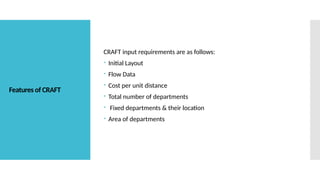
CRAFT input requirements are as follows:
 Initial Layout
 Flow Data
 Cost per unit distance
 Total number of departments
 Fixed departments & their location
 Area of departments
CRAFT
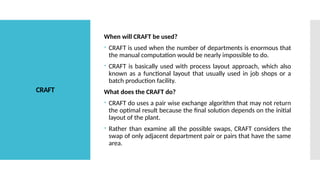
When will CRAFT be used?
 CRAFT is used when the number of departments is enormous that
the manual computation would be nearly impossible to do.
 CRAFT is basically used with process layout approach, which also
known as a functional layout that usually used in job shops or a
batch production facility.
What does the CRAFT do?
 CRAFT do uses a pair wise exchange algorithm that may not return
the optimal result because the final solution depends on the initial
layout of the plant.
 Rather than examine all the possible swaps, CRAFT considers the
swap of only adjacent department pair or pairs that have the same
area.
Steps of using CRAFT
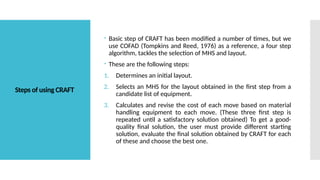
 Basic step of CRAFT has been modified a number of times, but we
use COFAD (Tompkins and Reed, 1976) as a reference, a four step
algorithm, tackles the selection of MHS and layout.
 These are the following steps:
1. Determines an initial layout.
2. Selects an MHS for the layout obtained in the first step from a
candidate list of equipment.
3. Calculates and revise the cost of each move based on material
handling equipment to each move. (These three first step is
repeated until a satisfactory solution obtained) To get a good-
quality final solution, the user must provide different starting
solution, evaluate the final solution obtained by CRAFT for each
of these and choose the best one.
Advantages of CRAFT
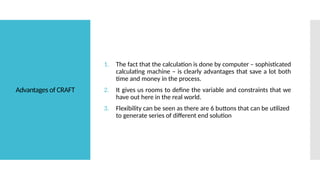
1. The fact that the calculation is done by computer – sophisticated
calculating machine – is clearly advantages that save a lot both
time and money in the process.
2. It gives us rooms to define the variable and constraints that we
have out here in the real world.
3. Flexibility can be seen as there are 6 buttons that can be utilized
to generate series of different end solution
disadvantages of CRAFT
1. Inefficient
2. Jobs time occurred Jobs do not flow through in an orderly
fashion, therefore backtracking occurs often. Idle time, more
idle time may be experienced while workers are waiting for
more work to arrive from different departments.
3. The (not) end result. End result may need to be modified,
because once CRAFT has determined a solution it may need to
be managed to create a layout that fits in the plant.
4. Greedy algorithm. It is the algorithm that always takes the best
immediate solution. In contrary, a job shop that flow through
the system is not always constant and causes fluctuations in the
process.
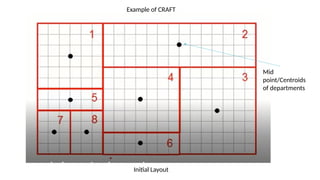
Example of CRAFT
Initial Layout
Mid
point/Centroids
of departments
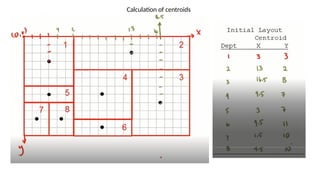
Calculation of centroids
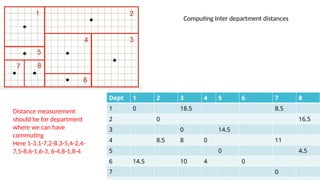
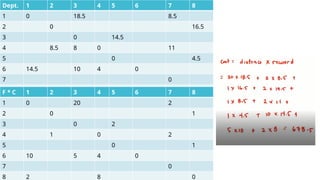
Dept 1 2 3 4 5 6 7 8
1 0 18.5 8.5
2 0 16.5
3 0 14.5
4 8.5 8 0 11
5 0 4.5
6 14.5 10 4 0
7 0
Computing Inter department distances
Distance measurement
should be for department
where we can have
commuting
Here 1-3,1-7,2-8,3-5,4-2,4-
7,5-8,6-1,6-3, 6-4,8-1,8-4
Dept. 1 2 3 4 5 6 7 8
1 0 18.5 8.5
2 0 16.5
3 0 14.5
4 8.5 8 0 11
5 0 4.5
6 14.5 10 4 0
7 0
8 8.5 8 0
F * C 1 2 3 4 5 6 7 8
1 0 20 2
2 0 1
3 0 2
4 1 0 2
5 0 1
6 10 5 4 0
7 0
8 2 8 0
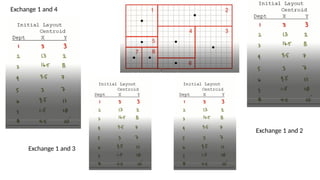
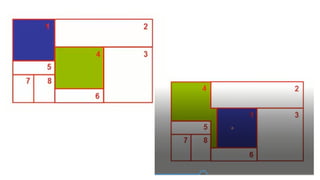
Exchange 1 and 4
Exchange 1 and 3
Exchange 1 and 2
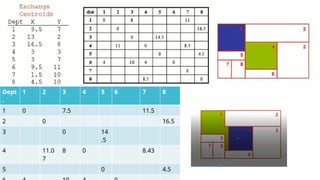
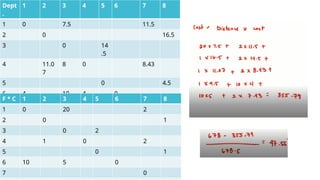
Dept
.
1 2 3 4 5 6 7 8
1 0 7.5 11.5
2 0 16.5
3 0 14
.5
4 11.0
7
8 0 8.43
5 0 4.5
Dept
.
1 2 3 4 5 6 7 8
1 0 7.5 11.5
2 0 16.5
3 0 14
.5
4 11.0
7
8 0 8.43
5 0 4.5
6 4 10 4 0
7 0
8 7.43 0
F * C 1 2 3 4 5 6 7 8
1 0 20 2
2 0 1
3 0 2
4 1 0 2
5 0 1
6 10 5 0
7 0
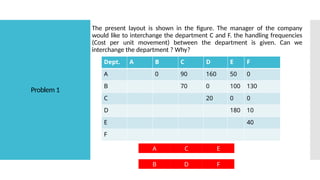
Problem 1
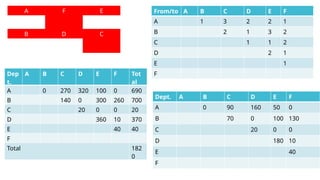
The present layout is shown in the figure. The manager of the company
would like to interchange the department C and F. the handling frequencies
(Cost per unit movement) between the department is given. Can we
interchange the department ? Why?
A
F
C E
B D
Dept. A B C D E F
A 0 90 160 50 0
B 70 0 100 130
C 20 0 0
D 180 10
E 40
F
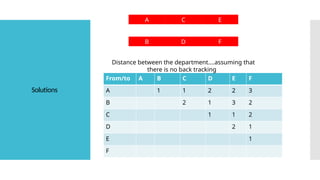
Solutions
From/to A B C D E F
A 1 1 2 2 3
B 2 1 3 2
C 1 1 2
D 2 1
E 1
F
A
F
C E
B D
Distance between the department….assuming that
there is no back tracking
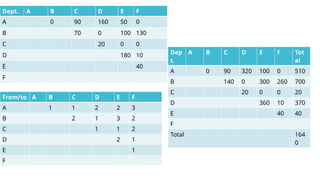
Dept. A B C D E F
A 0 90 160 50 0
B 70 0 100 130
C 20 0 0
D 180 10
E 40
F
From/to A B C D E F
A 1 1 2 2 3
B 2 1 3 2
C 1 1 2
D 2 1
E 1
F
Dep
t.
A B C D E F Tot
al
A 0 90 320 100 0 510
B 140 0 300 260 700
C 20 0 0 20
D 360 10 370
E 40 40
F
Total 164
0
A
C
F E
B D
From/to A B C D E F
A 1 3 2 2 1
B 2 1 3 2
C 1 1 2
D 2 1
E 1
F
Dept. A B C D E F
A 0 90 160 50 0
B 70 0 100 130
C 20 0 0
D 180 10
E 40
F
Dep
t.
A B C D E F Tot
al
A 0 270 320 100 0 690
B 140 0 300 260 700
C 20 0 0 20
D 360 10 370
E 40 40
F
Total 182
0
Problem 2
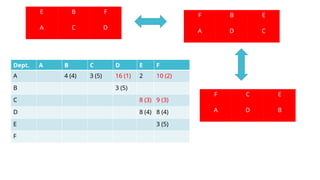
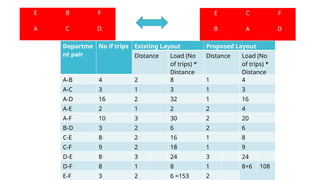
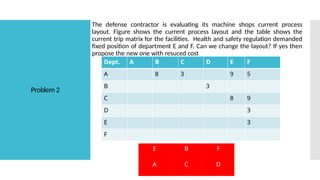
The defense contractor is evaluating its machine shops current process
layout. Figure shows the current process layout and the table shows the
current trip matrix for the facilities. Health and safety regulation demanded
fixed position of department E and F. Can we change the layout? If yes then
propose the new one with resuced cost
E
D
B F
A C
Dept. A B C D E F
A 8 3 9 5
B 3
C 8 9
D 3
E 3
F
Solution
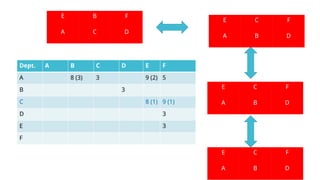
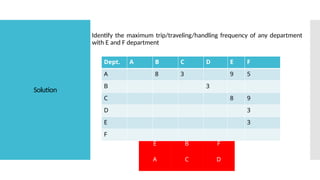
Identify the maximum trip/traveling/handling frequency of any department
with E and F department
E
D
B F
A C
Dept. A B C D E F
A 8 3 9 5
B 3
C 8 9
D 3
E 3
F
E
D
C F
A B
E
D
B F
A C
E
D
C F
A B
E
D
C F
A B
Dept. A B C D E F
A 8 (3) 3 9 (2) 5
B 3
C 8 (1) 9 (1)
D 3
E 3
F
E
D
B F
A C
E
D
C F
A B
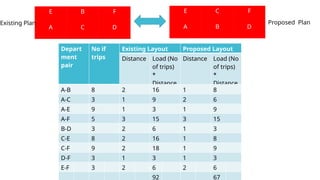
Existing Plan Proposed Plan
Depart
ment
pair
No if
trips
Existing Layout Proposed Layout
Distance Load (No
of trips)
*
Distance
Distance Load (No
of trips)
*
Distance
A-B 8 2 16 1 8
A-C 3 1 9 2 6
A-E 9 1 3 1 9
A-F 5 3 15 3 15
B-D 3 2 6 1 3
C-E 8 2 16 1 8
C-F 9 2 18 1 9
D-F 3 1 3 1 3
E-F 3 2 6 2 6
92 67
Problem 3
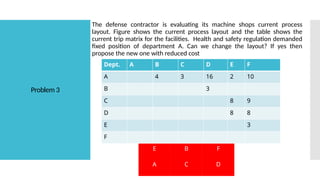
The defense contractor is evaluating its machine shops current process
layout. Figure shows the current process layout and the table shows the
current trip matrix for the facilities. Health and safety regulation demanded
fixed position of department A. Can we change the layout? If yes then
propose the new one with reduced cost
E
D
B F
A C
Dept. A B C D E F
A 4 3 16 2 10
B 3
C 8 9
D 8 8
E 3
F
Dept. A B C D E F
A 4 (4) 3 (5) 16 (1) 2 10 (2)
B 3 (5)
C 8 (3) 9 (3)
D 8 (4) 8 (4)
E 3 (5)
F
E
D
B F
A C
F
B
C E
A D
F
C
B E
A D
F
B
C E
A D
E
D
B F
A C
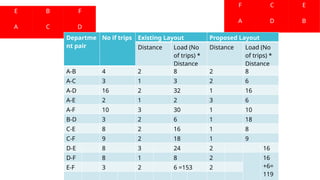
Departme
nt pair
No if trips Existing Layout Proposed Layout
Distance Load (No
of trips) *
Distance
Distance Load (No
of trips) *
Distance
A-B 4 2 8 2 8
A-C 3 1 3 2 6
A-D 16 2 32 1 16
A-E 2 1 2 3 6
A-F 10 3 30 1 10
B-D 3 2 6 1 18
C-E 8 2 16 1 8
C-F 9 2 18 1 9
D-E 8 3 24 2 16
D-F 8 1 8 2 16
+6=
119
E-F 3 2 6 =153 2
Problem 4
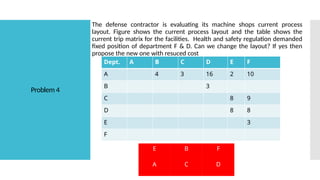
The defense contractor is evaluating its machine shops current process
layout. Figure shows the current process layout and the table shows the
current trip matrix for the facilities. Health and safety regulation demanded
fixed position of department F & D. Can we change the layout? If yes then
propose the new one with resuced cost
E
D
B F
A C
Dept. A B C D E F
A 4 3 16 2 10
B 3
C 8 9
D 8 8
E 3
F
E
D
C F
B A
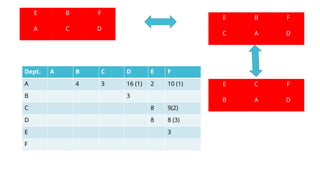
Dept. A B C D E F
A 4 3 16 (1) 2 10 (1)
B 3
C 8 9(2)
D 8 8 (3)
E 3
F
E
D
B F
A C
E
D
B F
C A
E
D
C F
B A
E
D
B F
A C
Departme
nt pair
No if trips Existing Layout Proposed Layout
Distance Load (No
of trips) *
Distance
Distance Load (No
of trips) *
Distance
A-B 4 2 8 1 4
A-C 3 1 3 1 3
A-D 16 2 32 1 16
A-E 2 1 2 2 4
A-F 10 3 30 2 20
B-D 3 2 6 2 6
C-E 8 2 16 1 8
C-F 9 2 18 1 9
D-E 8 3 24 3 24
D-F 8 1 8 1 8+6 108
E-F 3 2 6 =153 2
Department of
Mechanical
Engineering
Dr Gaurang Joshi
Unit no 3
Material
Requirement
Planning (MRP)
CAPM (01ME0721 )
What is
MRP?
 Computerized Inventory Control
 Production Planning System
 Management Information System
 Manufacturing Control System
What is
MRP?
 This is the most comprehensive approach to
manufacturing inventory and other dependents
which demand an efficient inventory management
system.
What is MRP
do ?
 The MRP system determines item-by-item, what
is to be processed and when, as well as what is
to be manufactured when.
 This is based on order priorities and available
capacities.
When to use
MRP
 Job Shop Production
 Complex Products
 Assemble-to-Order Environments
 Discrete and Dependent Demand Items
What can
MRP do?
 Reduce Inventory Levels
 Reduce Component Shortages
 Improve Shipping Performance
 Improve Customer Service
 Improve Productivity
 Simplified and Accurate Scheduling
 Reduce Purchasing Cost
 Improve Production Schedules
 Reduce Manufacturing Cost
 Reduce Lead Times
 Less Scrap and Rework
 Higher Production Quality
What can
MRP do?
 Improve Communication
 Improve Plant Efficiency
 Reduce Freight Cost
 Reduction in Excess Inventory
 Reduce Overtime
 Improve Supply Schedules
 Improve Calculation of Material Requirements
 Improve Competitive Position
Three Basic
Steps of MRP
 Identifying Requirements
 Running MRP – Creating the Suggestions
 Firming the Suggestions
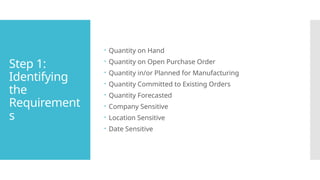
Step 1:
Identifying
the
Requirement
s
 Quantity on Hand
 Quantity on Open Purchase Order
 Quantity in/or Planned for Manufacturing
 Quantity Committed to Existing Orders
 Quantity Forecasted
 Company Sensitive
 Location Sensitive
 Date Sensitive
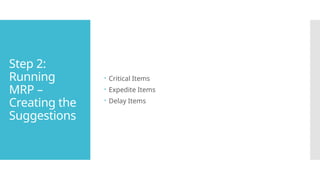
Step 2:
Running
MRP –
Creating the
Suggestions
 Critical Items
 Expedite Items
 Delay Items
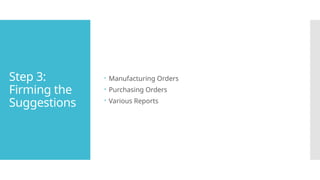
Step 3:
Firming the
Suggestions
 Manufacturing Orders
 Purchasing Orders
 Various Reports
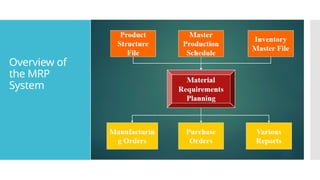
Overview of
the MRP
System
MRP Inputs
 Product Structure File
 Master Production Schedule
 Inventory Master File
Product
Structure File
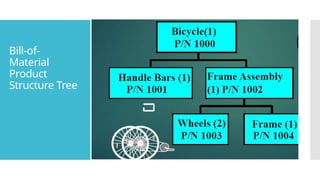
 Bill of Materials:
 It is a materials list that provides information useful to
reconstruct the manufacturing process. It is the master
product definition that contains “as designed” information.
Bill-of-
Material
Product
Structure Tree
Master
Production
Schedule
 Schedule of Finished Products
 Represents Production, not Demand
 Combination of Customer Orders and Demand
 Forecasts
 What Needs to be Produced
Inventory
Master File
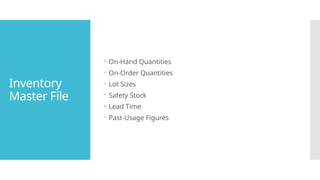
 On-Hand Quantities
 On-Order Quantities
 Lot Sizes
 Safety Stock
 Lead Time
 Past-Usage Figures
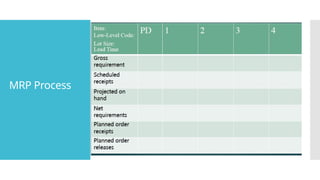
MRP Process
Terms
Defined
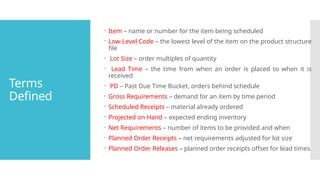
 Item – name or number for the item being scheduled
 Low-Level Code – the lowest level of the item on the product structure
file
 Lot Size – order multiples of quantity
 Lead Time – the time from when an order is placed to when it is
received
 PD – Past Due Time Bucket, orders behind schedule
 Gross Requirements – demand for an item by time period
 Scheduled Receipts – material already ordered
 Projected on Hand – expected ending inventory
 Net Requirements – number of items to be provided and when
 Planned Order Receipts – net requirements adjusted for lot size
 Planned Order Releases – planned order receipts offset for lead times
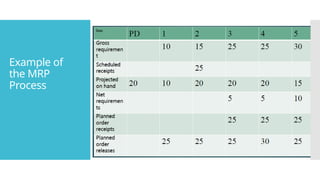
Example of
the MRP
Process
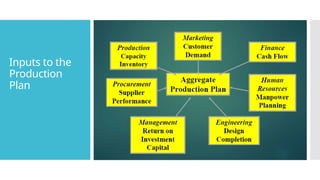
Inputs to the
Production
Plan
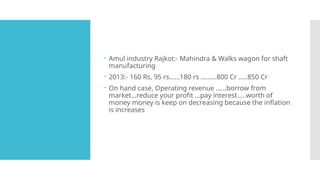
 Amul industry Rajkot:- Mahindra & Walks wagon for shaft
manufacturing
 2013:- 160 Rs, 95 rs……180 rs ………800 Cr …..850 Cr
 On hand case, Operating revenue ……borrow from
market…reduce your profit …pay interest…..worth of
money money is keep on decreasing because the inflation
is increases
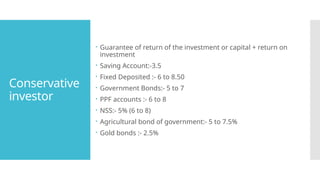
Conservative
investor
 Guarantee of return of the investment or capital + return on
investment
 Saving Account:-3.5
 Fixed Deposited :- 6 to 8.50
 Government Bonds:- 5 to 7
 PPF accounts :- 6 to 8
 NSS:- 5% (6 to 8)
 Agricultural bond of government:- 5 to 7.5%
 Gold bonds :- 2.5%
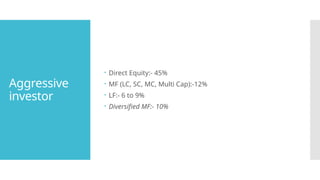
Aggressive
investor
 Direct Equity:- 45%
 MF (LC, SC, MC, Multi Cap):-12%
 LF:- 6 to 9%
 Diversified MF:- 10%
RE
 Buy car:- 1000000
 5 year
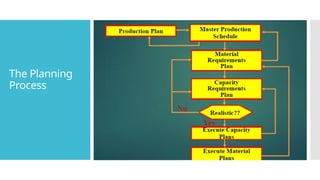
The Planning
Process
MRP
Outputs
 Manufacturing Orders
 Purchasing Orders
 Various Reports
Hubbell
Lighting
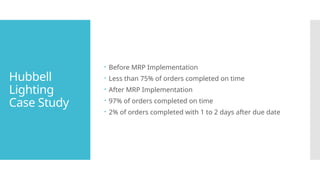
Case Study
 Before MRP Implementation
 Less than 75% of orders completed on time
 After MRP Implementation
 97% of orders completed on time
 2% of orders completed with 1 to 2 days after due date
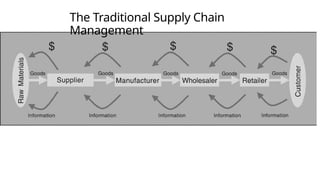
The Traditional Supply Chain
Management
Supply chain: all activities that occur between the growing or mining of raw materials
and the appearance of finished products on the
store shelf
• Traditional supply chain
• Information is passed through the supply chain reactively as participants increase
their product orders
• Inherent time lags cause problems
The
Traditional
Supply Chain
Managemen
t
The New
Technology
 Material Requirements
Planning
 (MRP)
 Sales Forecast
 Sales and Operations Plan
(SOP)
 Master Production Schedule
(MPS)
 Stock Requirements List
 Bill of Material (BOM)
 Lead Time
 Lot Sizing
 •Standard Costs
 Demand Planning
 Capacity
 Disaggregate
 Aggregate
 Inventory
 Demand Management
 Sales History
 Production Plan
 Rough Cut Plan
 Actual Costs
Non-ERP
Production
Issues
 To meet customer demand efficiently, a company must:
 Develop a forecast of customer demand
 Develop a production schedule to meet the estimated
demand
 ERP system is a good tool for developing and executing
production plans
 Goal of production planning is to schedule production
economically
Non-ERP
Production
Issues
 Production Problems
 Non-ERP Businesses have problems deciding how much to
make and when to make them
Communicatio
n problems
 Marketing and Sales personnel do not share information
with Production personnel
 Production personnel find it hard to deal with sudden
increases in demand might cause shortages or stock out
Production
Problems
Inventory problems
 Production manager lacks systematic method for:
 Meeting anticipated sales demand
 Adjusting production to reflect actual sales
Accounting and purchasing problems
 The Production and Accounting Depts. must periodically
compare
 standard costs (normal costs of manufacturing a product)
 with actual costs (overhead and labor)and then adjust the
accounts
 for the inevitable differences
The
Production
Planning ERP
Process
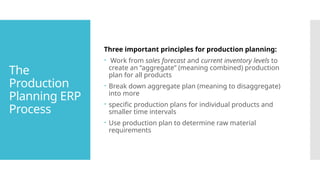
Three important principles for production planning:
 Work from sales forecast and current inventory levels to
create an “aggregate” (meaning combined) production
plan for all products
 Break down aggregate plan (meaning to disaggregate)
into more
 specific production plans for individual products and
smaller time intervals
 Use production plan to determine raw material
requirements
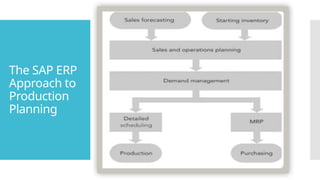
The SAP ERP
Approach to
Production
Planning
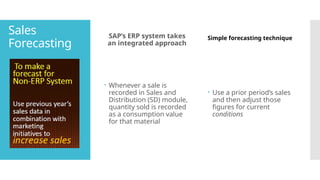
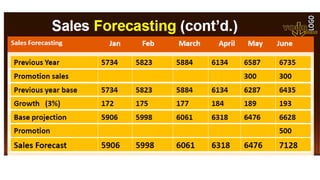
Sales
Forecasting
SAP’s ERP system takes
an integrated approach
 Whenever a sale is
recorded in Sales and
Distribution (SD) module,
quantity sold is recorded
as a consumption value
for that material
Simple forecasting technique
 Use a prior period’s sales
and then adjust those
figures for current
conditions
Sales &
Operations
Planning
In SAP ERP, sales forecast can be made using:
 Historical sales data from the Sales and Distribution (SD)
module
 Input from plans developed in Controlling (CO) module
CO module
 Profit goals for company can be set
 Sales levels needed to meet the profit goals can be
estimated
Sales &
Operations
Planning
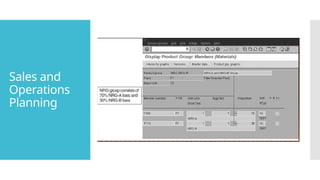
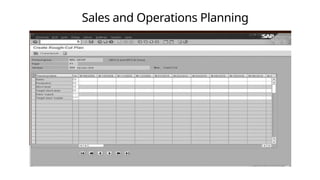
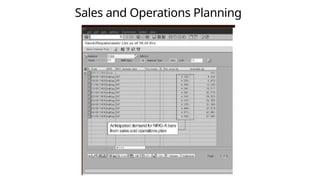
 Rough-cut planning: common term in manufacturing for
aggregate planning
 Disaggregated to generate detailed production schedules
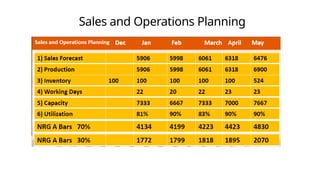
 Once SAP ERP system generates a forecast, the planner
can view the results graphically
 Rough-cut capacity planning applies simple capacity
estimating techniques to the production plan to see if the
techniques are feasible
Sales and
Operations
Planning
Sales and Operations Planning
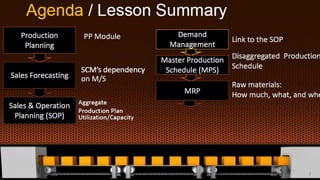
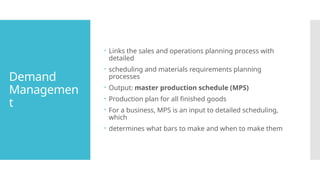
Demand
Managemen
t
 Links the sales and operations planning process with
detailed
 scheduling and materials requirements planning
processes
 Output: master production schedule (MPS)
 Production plan for all finished goods
 For a business, MPS is an input to detailed scheduling,
which
 determines what bars to make and when to make them
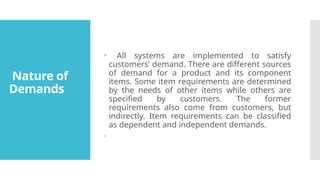
Nature of
Demands
 All systems are implemented to satisfy
customers’ demand. There are different sources
of demand for a product and its component
items. Some item requirements are determined
by the needs of other items while others are
specified by customers. The former
requirements also come from customers, but
indirectly. Item requirements can be classified
as dependent and independent demands.

Independent
demand
 Demand for an item that is unrelated to the
demand for other items. Demand for finished
goods, parts required for destructive testing,
and service part requirements are examples of
independent demand.
MRP
Procedure
 MPS procedure consolidates the independent
demands of forecasts and customer orders to
determine the requirements of the end
products in each time bucket in the planning
horizon. After netting the on-hand and on-order
inventory, and offsetting the lead-time, the
production schedule of the end products, MPS,
is determined. In MPS procedure, the available-
to-promise (ATP) is also determined. MPS is then
fed into the MRP procedure to determine the
requirements of the lower level components
and raw materials.
Dependent
demand
 Demand that is directly related to or derived
from the bill of material structure for other
items or end products. Such demands are
calculated and need not be forecasted.
 A given inventory item may have both
dependent and independent demand at any
given time. For example, a part may
simultaneously be used as a component of an
assembly and also sold as a service part.
Production to meet dependent demand should
be scheduled so as to explicitly recognize its
linkage to production intended to meet
independent demand.
MRP
Procedure
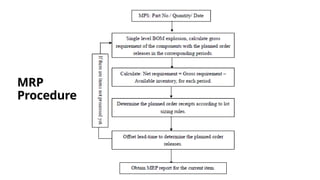
 The gross requirements of components are
determined by calculating the planned order
releases (POR) of the parents via single level BOM
explosion. The net requirements are calculated by
subtracting the on-hand inventory and scheduled
receipts (on-order) in each time bucket. After the
consideration of lot-size, the net requirements are
transformed into the planned order receipts.
Planned order receipts appear in every period. Lead-
time offsetting shifts the planned order receipts
backward and derives the POR which are the MRP
result of current item. The MRP procedure continues
to explode the POR to obtain the gross requirements
of its components. The MRP repeat the procedure
until the POR of all the items are determined. The
flow chart of the MRP procedure is described in
Figure
MRP
Procedure
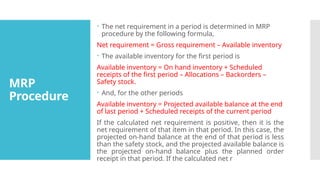
 The net requirement in a period is determined in MRP
procedure by the following formula,
Net requirement = Gross requirement – Available inventory
 The available inventory for the first period is
Available inventory = On hand inventory + Scheduled
receipts of the first period – Allocations – Backorders –
Safety stock.
 And, for the other periods
Available inventory = Projected available balance at the end
of last period + Scheduled receipts of the current period
If the calculated net requirement is positive, then it is the
net requirement of that item in that period. In this case, the
projected on-hand balance at the end of that period is less
than the safety stock, and the projected available balance is
the projected on-hand balance plus the planned order
receipt in that period. If the calculated net r
MRP
Procedure
MRP Case 1:
Sunglasses
Sets
MRP Case 1:
Sunglasses
Sets
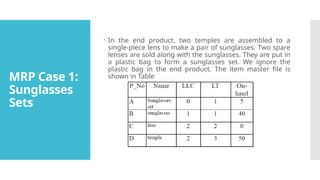
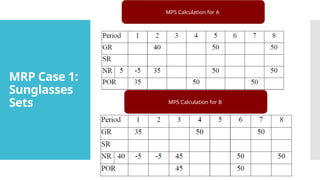
 In the end product, two temples are assembled to a
single-piece lens to make a pair of sunglasses. Two spare
lenses are sold along with the sunglasses. They are put in
a plastic bag to form a sunglasses set. We ignore the
plastic bag in the end product. The item master file is
shown in Table
MRP Case 1:
Sunglasses
Sets
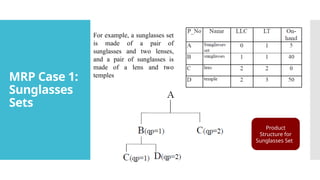
Product
Structure for
Sunglasses Set
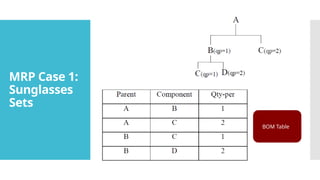
For example, a sunglasses set
is made of a pair of
sunglasses and two lenses,
and a pair of sunglasses is
made of a lens and two
temples
MRP Case 1:
Sunglasses
Sets
BOM Table
MRP Case 1:
Sunglasses
Sets
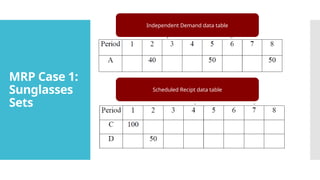
Independent Demand data table
Scheduled Recipt data table
MRP Case 1:
Sunglasses
Sets
MPS Calculation for A
MPS Calculation for B
MRP Case 1:
Sunglasses
Sets
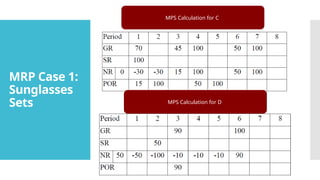
MPS Calculation for C
MPS Calculation for D
MRP Case 1:
Sunglasses
Sets
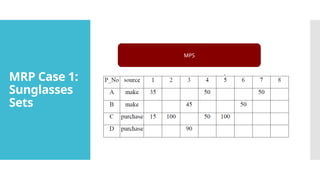
MPS
MRP Case 2:
Internation
al Airport
Services
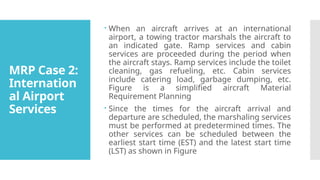
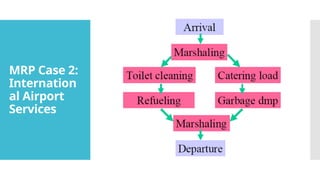
 When an aircraft arrives at an international
airport, a towing tractor marshals the aircraft to
an indicated gate. Ramp services and cabin
services are proceeded during the period when
the aircraft stays. Ramp services include the toilet
cleaning, gas refueling, etc. Cabin services
include catering load, garbage dumping, etc.
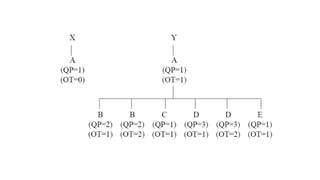
Figure is a simplified aircraft Material
Requirement Planning
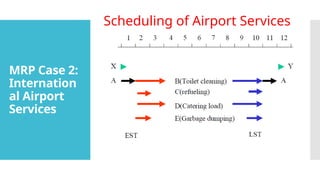
 Since the times for the aircraft arrival and
departure are scheduled, the marshaling services
must be performed at predetermined times. The
other services can be scheduled between the
earliest start time (EST) and the latest start time
(LST) as shown in Figure
MRP Case 2:
Internation
al Airport
Services
MRP Case 2:
Internation
al Airport
Services
Scheduling of Airport Services
Service
Master File
of Airport
Services
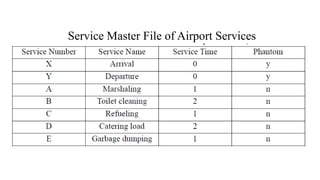
Service Master File of Airport Services
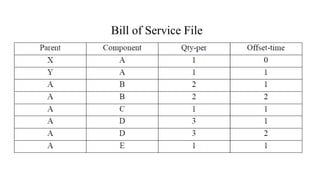
The structure of the services is shown in Figure . Since the service-time of a
service means its duration, we have to count the loads of the resources in all
time buckets from the start to the end of services. For example, the toilet
cleaning service lasts two time units, its service-time is set as 2 in the service
master file, and two records are defined in the “bill of service” file with
offset-time (OT) 1 and 2. The quantity-per (QP) defined in bill of service file
is the load of the service. The quantity-per of the toilet cleaning service is 2,
which means two lavatory trucks are needed during the service. The offset-
time and the quantity-per determine that two lavatory trucks are required
during a period of two consecutive time buckets. Note that the service times
in the service master file are used to create the offset-times in the BOM file,
and the lead-times used by MRP are all zero.
Bill of Service File
MSS for aircraft arrival and departure
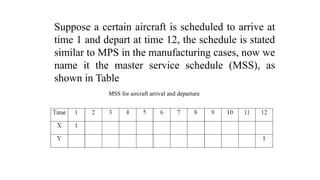
Suppose a certain aircraft is scheduled to arrive at
time 1 and depart at time 12, the schedule is stated
similar to MPS in the manufacturing cases, now we
name it the master service schedule (MSS), as
shown in Table
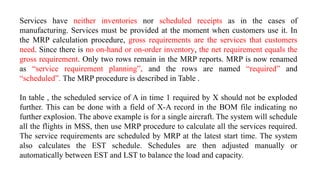
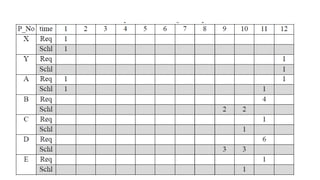
Services have neither inventories nor scheduled receipts as in the cases of
manufacturing. Services must be provided at the moment when customers use it. In
the MRP calculation procedure, gross requirements are the services that customers
need. Since there is no on-hand or on-order inventory, the net requirement equals the
gross requirement. Only two rows remain in the MRP reports. MRP is now renamed
as “service requirement planning”, and the rows are named “required” and
“scheduled”. The MRP procedure is described in Table .
In table , the scheduled service of A in time 1 required by X should not be exploded
further. This can be done with a field of X-A record in the BOM file indicating no
further explosion. The above example is for a single aircraft. The system will schedule
all the flights in MSS, then use MRP procedure to calculate all the services required.
The service requirements are scheduled by MRP at the latest start time. The system
also calculates the EST schedule. Schedules are then adjusted manually or
automatically between EST and LST to balance the load and capacity.
This example explains how ERP is used in a service business. Time buckets
are sliced as small as the minimal unit a service requires. All service times
are multiple of the time bucket length. Lead-times are all set to 0 because the
start time of the parent operation is exactly the end time of the child
operation, or differs by 1, which can be controlled by offset-time. The
service time determines how many time buckets are needed by an operation.
An operation repeats, as a child item, the required time buckets times, say n,
with offset-time from 1 to n in each BOM record. The service requirement
planning uses the same functions of item master, BOM, MPS, and MRP in
the ERP system. The idea can also be applied to manufacturing operations.
Summary of
MRP
 ERP system can improve the efficiency of production and
 purchasing processes
 Efficiency begins with Marketing sharing a sales forecast
 Production plan is created based on sales forecast and
shared
 with Purchasing so raw materials can be ordered properly
Summary of
MRP
 MRP is a…..
 Computerized Inventory Control
 Production Planning System
 that…..
 Schedules Component Items as Needed
 which will…..
 Track Inventory and…..
 Help you in many other aspects of business
Thank you for your
Kind Attention
Dr Gaurang Joshi
Associate Professor
Department of Mechanical engineering
Marwadi University, Rajkot, Gujarat, India
Email:- gaurang.joshi@marwadieducation.edu.in

Material Resource for Engineer_CAPM.pptx

  • 1.
    Department of Mechanical Engineering Dr GaurangJoshi Unit no 2 Product / Process Planning and Design CAPM (01ME0721 )
  • 2.
    Facility Layout  Layoutrefers to the configuration of departments, work centers, and equipment, with particular emphasis on movement of work (customers or materials) through the system.  Layout decisions are important for three basic reasons: 1. require substantial investments of money and effort; 2. involve long-term commitments, which makes mistakes difficult to overcome; and 3. have a significant impact on the cost and efficiency of operations
  • 3.
    Factors affecting Plant Layout 1.Plant location and building 2. Nature of Product 3. Type of Industry 4. Plant Environment 5. Spatial Requirements 6. Repairs and Maintenance 7. Balance 8. Management Policy 9. Human Needs 10. Types of machinery and equipment
  • 4.
    Factors affecting Plant Layout The basic objective of layout design is to facilitate a smooth flow of work, material, and information through the system. Supporting objectives generally involve the following:  To facilitate attainment of product or service quality.  To use workers and space efficiently.  To avoid bottlenecks.  To minimize material handling costs.  To eliminate unnecessary movements of workers or materials.  To minimize production time or customer service time.  To design for safety.
  • 5.
    Plant Layout :Types  The production process normally determines the type of plant layout to be applied to the facility: • Fixed position plant layout  Product stays and resources move to it. • Product oriented plant layout  Machinery and Materials are placed following the product path • Process oriented plant layout (Functional Layout).  Machinery is placed according to what they do and materials go to them. • Combined Layout  Combine aspects of both process and product layouts
  • 6.
    Product oriented plant layout This type of plant layout is useful when the production process is organized in a continuous or repetitive way.  Continuous flow : The correct operations flow is reached through the layout design and the equipment and machinery specifications.  Repetitive flow (assembly line): The correct operations flow will be based in a line balancing exercise, in order to avoid problems generated by bottle necks.  The plant layout will be based in allocating a machine as close as possible to the next one in line, in the correct sequence to manufacture the product.
  • 7.
    Product Layouts Product layoutsare used to achieve a smooth and rapid flow of large volumes of goods or customers through a system.
  • 8.
    Product Layouts Disadvantages  Moraleproblems and to repetitive stress injuries.  Lack of maintaining equipment or quality of output.  Iinflexible for output or design  highly susceptible to shutdowns  A high utilization of labor and equipment  Preventive maintenance, the capacity for quick repairs, and spare-parts inventories are necessary expenses  Incentive plans tied to individual output are impractical Advantages  A high rate of output  Low unit cost due to high volume  Labor specialization  Low material-handling cost per unit  A high utilization of labor and equipment  The establishment of routing and scheduling in the initial design of the system  Fairly routine accounting, purchasing, and inventory control
  • 9.
    Process Layouts  Processlayouts are designed to process items or provide services that involve a variety of processing requirements.
  • 10.
    Process oriented plant layout(Functional Layout)  This type of plant layout is useful when the production process is organized in batches.  Personnel and equipment to perform the same function are allocated in the same area.  The different items have to move from one area to another one, according to the sequence of operations previously established.  The variety of products to produce will lead to a diversity of flows through the facility.  The variations in the production volumes from one period to the next one (short periods of time) may lead to modifications in the manufactured quantities as well as the types of products to be produced.
  • 11.
    Process Layout Advantages  Handlea variety of processing requirements  Not vulnerable to equipment failures  General-purpose equipment is less costly and is easier and less costly to maintain  Possible to use individual incentive systems Disadvantages  In-process inventory costs can be high  Routing and scheduling pose continual challenges  Equipment utilization rates are low  Material handling is slow and inefficient, and more costly per unit  Job complexities reduce the span of supervision and result higher supervisory costs  Special attention necessary for each product or customer and low volumes result in higher unit costs  Accounting, inventory control, and purchasing are much more involved
  • 12.
    Fixed-Position Layouts  Infixed-position layouts, the item being worked on remains stationary, and workers, materials, and equipment are moved about as needed.  Fixed-position layouts are widely used in farming, firefighting, road building, home building, remodeling and repair, and drilling for oil. In each case, compelling reasons bring workers, materials, and equipment to the “product’s” location instead of the other way around.
  • 13.
  • 14.
    Fixed-Position Layouts Advantages  Savestime and cost in movement  Flexible as changes in job design can be easily incorporated  More economical when several orders in different stages are executed  Adjustments can be made to meet shortage of materials or absence of workers. Disadvantages • Production period being very long, capital investment is quite heavy • Very large space is required for storage of materials and equipment • As several operations are carried simultaneously, possibility of confusion and conflicts are high
  • 15.
    Combination Layouts  Supermarket layoutsare essentially process layouts, yet we find that most use fixed-path material-handling devices such as roller- type conveyors in the stockroom and belt-type conveyors at the cash registers.  Hospitals also use the basic process arrangement, although frequently patient care involves more of a fixed-position approach, in which nurses, doctors, medicines, and special equipment are brought to the patient.  Faulty parts made in a product layout may require off-line reworking, which involves customized processing. Moreover, conveyors are frequently observed in both farming and construction activities.  Cellular manufacturing - Group technology  Flexible manufacturing systems
  • 16.
    Essentials of IdealLayout 1. Principle of minimum movement 2. Principle of flow 3. Principle of space 4. Principle of safety 5. Principle of flexibility 6. Principle of interdependence 7. Principle of overall integration 8. Principle of minimum investment
  • 17.
    Computerized Relative Allocation ofFacilities Technique (CRAFT)/ or Computerized technique for relative allocation of facility Computerized Relative Allocation of Facilities Technique (CRAFT) is a tool that used to help improve the existing layout of the facilities. The facility is improved by swaping two or more departments to help arrange the facility to an optimal floor plan 1. CRAFT is more popular than the other computer based layout procedures. 2. It is improvement algorithm & starts with an initial layout & proceeds to improve the layout by interchanging the department’s pair wise to reduce the total material transportation cost. 3. It does not give the Optimal Layout; but the results are good & near optimal, which can be later corrected to suit the need of the layout planner.
  • 18.
    Features of CRAFT 1.Itattempts to minimize transportation cost, Where Transportation cost=flow × distance × unit cost It Requires assumptions that: (1) Move cost are independent of the equipment utilization & (2) Move costs are linearly related to the length of the move. 2. Distance matrix used is the rectilinear distance between department centroids 3. CRAFT being a path-oriented method, the final layout is dependent on the initial layout. Therefore, a number of initial layouts should be used as input to the CRAFT 4. CRAFT allows the use of dummy departments to represent fixed areas in the layout
  • 19.
    Features of CRAFT CRAFTinput requirements are as follows:  Initial Layout  Flow Data  Cost per unit distance  Total number of departments  Fixed departments & their location  Area of departments
  • 20.
    CRAFT When will CRAFTbe used?  CRAFT is used when the number of departments is enormous that the manual computation would be nearly impossible to do.  CRAFT is basically used with process layout approach, which also known as a functional layout that usually used in job shops or a batch production facility. What does the CRAFT do?  CRAFT do uses a pair wise exchange algorithm that may not return the optimal result because the final solution depends on the initial layout of the plant.  Rather than examine all the possible swaps, CRAFT considers the swap of only adjacent department pair or pairs that have the same area.
  • 21.
    Steps of usingCRAFT  Basic step of CRAFT has been modified a number of times, but we use COFAD (Tompkins and Reed, 1976) as a reference, a four step algorithm, tackles the selection of MHS and layout.  These are the following steps: 1. Determines an initial layout. 2. Selects an MHS for the layout obtained in the first step from a candidate list of equipment. 3. Calculates and revise the cost of each move based on material handling equipment to each move. (These three first step is repeated until a satisfactory solution obtained) To get a good- quality final solution, the user must provide different starting solution, evaluate the final solution obtained by CRAFT for each of these and choose the best one.
  • 22.
    Advantages of CRAFT 1.The fact that the calculation is done by computer – sophisticated calculating machine – is clearly advantages that save a lot both time and money in the process. 2. It gives us rooms to define the variable and constraints that we have out here in the real world. 3. Flexibility can be seen as there are 6 buttons that can be utilized to generate series of different end solution
  • 23.
    disadvantages of CRAFT 1.Inefficient 2. Jobs time occurred Jobs do not flow through in an orderly fashion, therefore backtracking occurs often. Idle time, more idle time may be experienced while workers are waiting for more work to arrive from different departments. 3. The (not) end result. End result may need to be modified, because once CRAFT has determined a solution it may need to be managed to create a layout that fits in the plant. 4. Greedy algorithm. It is the algorithm that always takes the best immediate solution. In contrary, a job shop that flow through the system is not always constant and causes fluctuations in the process.
  • 24.
    Example of CRAFT InitialLayout Mid point/Centroids of departments
  • 25.
  • 26.
    Dept 1 23 4 5 6 7 8 1 0 18.5 8.5 2 0 16.5 3 0 14.5 4 8.5 8 0 11 5 0 4.5 6 14.5 10 4 0 7 0 Computing Inter department distances Distance measurement should be for department where we can have commuting Here 1-3,1-7,2-8,3-5,4-2,4- 7,5-8,6-1,6-3, 6-4,8-1,8-4
  • 27.
    Dept. 1 23 4 5 6 7 8 1 0 18.5 8.5 2 0 16.5 3 0 14.5 4 8.5 8 0 11 5 0 4.5 6 14.5 10 4 0 7 0 8 8.5 8 0 F * C 1 2 3 4 5 6 7 8 1 0 20 2 2 0 1 3 0 2 4 1 0 2 5 0 1 6 10 5 4 0 7 0 8 2 8 0
  • 28.
    Exchange 1 and4 Exchange 1 and 3 Exchange 1 and 2
  • 30.
    Dept . 1 2 34 5 6 7 8 1 0 7.5 11.5 2 0 16.5 3 0 14 .5 4 11.0 7 8 0 8.43 5 0 4.5
  • 31.
    Dept . 1 2 34 5 6 7 8 1 0 7.5 11.5 2 0 16.5 3 0 14 .5 4 11.0 7 8 0 8.43 5 0 4.5 6 4 10 4 0 7 0 8 7.43 0 F * C 1 2 3 4 5 6 7 8 1 0 20 2 2 0 1 3 0 2 4 1 0 2 5 0 1 6 10 5 0 7 0
  • 32.
    Problem 1 The presentlayout is shown in the figure. The manager of the company would like to interchange the department C and F. the handling frequencies (Cost per unit movement) between the department is given. Can we interchange the department ? Why? A F C E B D Dept. A B C D E F A 0 90 160 50 0 B 70 0 100 130 C 20 0 0 D 180 10 E 40 F
  • 33.
    Solutions From/to A BC D E F A 1 1 2 2 3 B 2 1 3 2 C 1 1 2 D 2 1 E 1 F A F C E B D Distance between the department….assuming that there is no back tracking
  • 34.
    Dept. A BC D E F A 0 90 160 50 0 B 70 0 100 130 C 20 0 0 D 180 10 E 40 F From/to A B C D E F A 1 1 2 2 3 B 2 1 3 2 C 1 1 2 D 2 1 E 1 F Dep t. A B C D E F Tot al A 0 90 320 100 0 510 B 140 0 300 260 700 C 20 0 0 20 D 360 10 370 E 40 40 F Total 164 0
  • 35.
    A C F E B D From/toA B C D E F A 1 3 2 2 1 B 2 1 3 2 C 1 1 2 D 2 1 E 1 F Dept. A B C D E F A 0 90 160 50 0 B 70 0 100 130 C 20 0 0 D 180 10 E 40 F Dep t. A B C D E F Tot al A 0 270 320 100 0 690 B 140 0 300 260 700 C 20 0 0 20 D 360 10 370 E 40 40 F Total 182 0
  • 36.
    Problem 2 The defensecontractor is evaluating its machine shops current process layout. Figure shows the current process layout and the table shows the current trip matrix for the facilities. Health and safety regulation demanded fixed position of department E and F. Can we change the layout? If yes then propose the new one with resuced cost E D B F A C Dept. A B C D E F A 8 3 9 5 B 3 C 8 9 D 3 E 3 F
  • 37.
    Solution Identify the maximumtrip/traveling/handling frequency of any department with E and F department E D B F A C Dept. A B C D E F A 8 3 9 5 B 3 C 8 9 D 3 E 3 F
  • 38.
    E D C F A B E D BF A C E D C F A B E D C F A B Dept. A B C D E F A 8 (3) 3 9 (2) 5 B 3 C 8 (1) 9 (1) D 3 E 3 F
  • 39.
    E D B F A C E D CF A B Existing Plan Proposed Plan Depart ment pair No if trips Existing Layout Proposed Layout Distance Load (No of trips) * Distance Distance Load (No of trips) * Distance A-B 8 2 16 1 8 A-C 3 1 9 2 6 A-E 9 1 3 1 9 A-F 5 3 15 3 15 B-D 3 2 6 1 3 C-E 8 2 16 1 8 C-F 9 2 18 1 9 D-F 3 1 3 1 3 E-F 3 2 6 2 6 92 67
  • 40.
    Problem 3 The defensecontractor is evaluating its machine shops current process layout. Figure shows the current process layout and the table shows the current trip matrix for the facilities. Health and safety regulation demanded fixed position of department A. Can we change the layout? If yes then propose the new one with reduced cost E D B F A C Dept. A B C D E F A 4 3 16 2 10 B 3 C 8 9 D 8 8 E 3 F
  • 41.
    Dept. A BC D E F A 4 (4) 3 (5) 16 (1) 2 10 (2) B 3 (5) C 8 (3) 9 (3) D 8 (4) 8 (4) E 3 (5) F E D B F A C F B C E A D F C B E A D
  • 42.
    F B C E A D E D BF A C Departme nt pair No if trips Existing Layout Proposed Layout Distance Load (No of trips) * Distance Distance Load (No of trips) * Distance A-B 4 2 8 2 8 A-C 3 1 3 2 6 A-D 16 2 32 1 16 A-E 2 1 2 3 6 A-F 10 3 30 1 10 B-D 3 2 6 1 18 C-E 8 2 16 1 8 C-F 9 2 18 1 9 D-E 8 3 24 2 16 D-F 8 1 8 2 16 +6= 119 E-F 3 2 6 =153 2
  • 43.
    Problem 4 The defensecontractor is evaluating its machine shops current process layout. Figure shows the current process layout and the table shows the current trip matrix for the facilities. Health and safety regulation demanded fixed position of department F & D. Can we change the layout? If yes then propose the new one with resuced cost E D B F A C Dept. A B C D E F A 4 3 16 2 10 B 3 C 8 9 D 8 8 E 3 F
  • 44.
    E D C F B A Dept.A B C D E F A 4 3 16 (1) 2 10 (1) B 3 C 8 9(2) D 8 8 (3) E 3 F E D B F A C E D B F C A
  • 45.
    E D C F B A E D BF A C Departme nt pair No if trips Existing Layout Proposed Layout Distance Load (No of trips) * Distance Distance Load (No of trips) * Distance A-B 4 2 8 1 4 A-C 3 1 3 1 3 A-D 16 2 32 1 16 A-E 2 1 2 2 4 A-F 10 3 30 2 20 B-D 3 2 6 2 6 C-E 8 2 16 1 8 C-F 9 2 18 1 9 D-E 8 3 24 3 24 D-F 8 1 8 1 8+6 108 E-F 3 2 6 =153 2
  • 46.
    Department of Mechanical Engineering Dr GaurangJoshi Unit no 3 Material Requirement Planning (MRP) CAPM (01ME0721 )
  • 47.
    What is MRP?  ComputerizedInventory Control  Production Planning System  Management Information System  Manufacturing Control System
  • 48.
    What is MRP?  Thisis the most comprehensive approach to manufacturing inventory and other dependents which demand an efficient inventory management system.
  • 49.
    What is MRP do?  The MRP system determines item-by-item, what is to be processed and when, as well as what is to be manufactured when.  This is based on order priorities and available capacities.
  • 50.
    When to use MRP Job Shop Production  Complex Products  Assemble-to-Order Environments  Discrete and Dependent Demand Items
  • 51.
    What can MRP do? Reduce Inventory Levels  Reduce Component Shortages  Improve Shipping Performance  Improve Customer Service  Improve Productivity  Simplified and Accurate Scheduling  Reduce Purchasing Cost  Improve Production Schedules  Reduce Manufacturing Cost  Reduce Lead Times  Less Scrap and Rework  Higher Production Quality
  • 52.
    What can MRP do? Improve Communication  Improve Plant Efficiency  Reduce Freight Cost  Reduction in Excess Inventory  Reduce Overtime  Improve Supply Schedules  Improve Calculation of Material Requirements  Improve Competitive Position
  • 53.
    Three Basic Steps ofMRP  Identifying Requirements  Running MRP – Creating the Suggestions  Firming the Suggestions
  • 54.
    Step 1: Identifying the Requirement s  Quantityon Hand  Quantity on Open Purchase Order  Quantity in/or Planned for Manufacturing  Quantity Committed to Existing Orders  Quantity Forecasted  Company Sensitive  Location Sensitive  Date Sensitive
  • 55.
    Step 2: Running MRP – Creatingthe Suggestions  Critical Items  Expedite Items  Delay Items
  • 56.
    Step 3: Firming the Suggestions Manufacturing Orders  Purchasing Orders  Various Reports
  • 57.
  • 58.
    MRP Inputs  ProductStructure File  Master Production Schedule  Inventory Master File
  • 59.
    Product Structure File  Billof Materials:  It is a materials list that provides information useful to reconstruct the manufacturing process. It is the master product definition that contains “as designed” information.
  • 60.
  • 61.
    Master Production Schedule  Schedule ofFinished Products  Represents Production, not Demand  Combination of Customer Orders and Demand  Forecasts  What Needs to be Produced
  • 62.
    Inventory Master File  On-HandQuantities  On-Order Quantities  Lot Sizes  Safety Stock  Lead Time  Past-Usage Figures
  • 63.
  • 64.
    Terms Defined  Item –name or number for the item being scheduled  Low-Level Code – the lowest level of the item on the product structure file  Lot Size – order multiples of quantity  Lead Time – the time from when an order is placed to when it is received  PD – Past Due Time Bucket, orders behind schedule  Gross Requirements – demand for an item by time period  Scheduled Receipts – material already ordered  Projected on Hand – expected ending inventory  Net Requirements – number of items to be provided and when  Planned Order Receipts – net requirements adjusted for lot size  Planned Order Releases – planned order receipts offset for lead times
  • 65.
  • 66.
  • 67.
     Amul industryRajkot:- Mahindra & Walks wagon for shaft manufacturing  2013:- 160 Rs, 95 rs……180 rs ………800 Cr …..850 Cr  On hand case, Operating revenue ……borrow from market…reduce your profit …pay interest…..worth of money money is keep on decreasing because the inflation is increases
  • 68.
    Conservative investor  Guarantee ofreturn of the investment or capital + return on investment  Saving Account:-3.5  Fixed Deposited :- 6 to 8.50  Government Bonds:- 5 to 7  PPF accounts :- 6 to 8  NSS:- 5% (6 to 8)  Agricultural bond of government:- 5 to 7.5%  Gold bonds :- 2.5%
  • 69.
    Aggressive investor  Direct Equity:-45%  MF (LC, SC, MC, Multi Cap):-12%  LF:- 6 to 9%  Diversified MF:- 10%
  • 70.
    RE  Buy car:-1000000  5 year
  • 71.
  • 72.
    MRP Outputs  Manufacturing Orders Purchasing Orders  Various Reports
  • 73.
    Hubbell Lighting Case Study  BeforeMRP Implementation  Less than 75% of orders completed on time  After MRP Implementation  97% of orders completed on time  2% of orders completed with 1 to 2 days after due date
  • 75.
    The Traditional SupplyChain Management
  • 76.
    Supply chain: allactivities that occur between the growing or mining of raw materials and the appearance of finished products on the store shelf • Traditional supply chain • Information is passed through the supply chain reactively as participants increase their product orders • Inherent time lags cause problems The Traditional Supply Chain Managemen t
  • 77.
    The New Technology  MaterialRequirements Planning  (MRP)  Sales Forecast  Sales and Operations Plan (SOP)  Master Production Schedule (MPS)  Stock Requirements List  Bill of Material (BOM)  Lead Time  Lot Sizing  •Standard Costs  Demand Planning  Capacity  Disaggregate  Aggregate  Inventory  Demand Management  Sales History  Production Plan  Rough Cut Plan  Actual Costs
  • 78.
    Non-ERP Production Issues  To meetcustomer demand efficiently, a company must:  Develop a forecast of customer demand  Develop a production schedule to meet the estimated demand  ERP system is a good tool for developing and executing production plans  Goal of production planning is to schedule production economically
  • 79.
    Non-ERP Production Issues  Production Problems Non-ERP Businesses have problems deciding how much to make and when to make them
  • 80.
    Communicatio n problems  Marketingand Sales personnel do not share information with Production personnel  Production personnel find it hard to deal with sudden increases in demand might cause shortages or stock out
  • 81.
    Production Problems Inventory problems  Productionmanager lacks systematic method for:  Meeting anticipated sales demand  Adjusting production to reflect actual sales Accounting and purchasing problems  The Production and Accounting Depts. must periodically compare  standard costs (normal costs of manufacturing a product)  with actual costs (overhead and labor)and then adjust the accounts  for the inevitable differences
  • 82.
    The Production Planning ERP Process Three importantprinciples for production planning:  Work from sales forecast and current inventory levels to create an “aggregate” (meaning combined) production plan for all products  Break down aggregate plan (meaning to disaggregate) into more  specific production plans for individual products and smaller time intervals  Use production plan to determine raw material requirements
  • 83.
    The SAP ERP Approachto Production Planning
  • 84.
    Sales Forecasting SAP’s ERP systemtakes an integrated approach  Whenever a sale is recorded in Sales and Distribution (SD) module, quantity sold is recorded as a consumption value for that material Simple forecasting technique  Use a prior period’s sales and then adjust those figures for current conditions
  • 86.
    Sales & Operations Planning In SAPERP, sales forecast can be made using:  Historical sales data from the Sales and Distribution (SD) module  Input from plans developed in Controlling (CO) module CO module  Profit goals for company can be set  Sales levels needed to meet the profit goals can be estimated
  • 87.
    Sales & Operations Planning  Rough-cutplanning: common term in manufacturing for aggregate planning  Disaggregated to generate detailed production schedules  Once SAP ERP system generates a forecast, the planner can view the results graphically  Rough-cut capacity planning applies simple capacity estimating techniques to the production plan to see if the techniques are feasible
  • 88.
  • 89.
  • 90.
  • 91.
  • 92.
    Demand Managemen t  Links thesales and operations planning process with detailed  scheduling and materials requirements planning processes  Output: master production schedule (MPS)  Production plan for all finished goods  For a business, MPS is an input to detailed scheduling, which  determines what bars to make and when to make them
  • 93.
    Nature of Demands  Allsystems are implemented to satisfy customers’ demand. There are different sources of demand for a product and its component items. Some item requirements are determined by the needs of other items while others are specified by customers. The former requirements also come from customers, but indirectly. Item requirements can be classified as dependent and independent demands. 
  • 94.
    Independent demand  Demand foran item that is unrelated to the demand for other items. Demand for finished goods, parts required for destructive testing, and service part requirements are examples of independent demand.
  • 95.
    MRP Procedure  MPS procedureconsolidates the independent demands of forecasts and customer orders to determine the requirements of the end products in each time bucket in the planning horizon. After netting the on-hand and on-order inventory, and offsetting the lead-time, the production schedule of the end products, MPS, is determined. In MPS procedure, the available- to-promise (ATP) is also determined. MPS is then fed into the MRP procedure to determine the requirements of the lower level components and raw materials.
  • 96.
    Dependent demand  Demand thatis directly related to or derived from the bill of material structure for other items or end products. Such demands are calculated and need not be forecasted.  A given inventory item may have both dependent and independent demand at any given time. For example, a part may simultaneously be used as a component of an assembly and also sold as a service part. Production to meet dependent demand should be scheduled so as to explicitly recognize its linkage to production intended to meet independent demand.
  • 97.
    MRP Procedure  The grossrequirements of components are determined by calculating the planned order releases (POR) of the parents via single level BOM explosion. The net requirements are calculated by subtracting the on-hand inventory and scheduled receipts (on-order) in each time bucket. After the consideration of lot-size, the net requirements are transformed into the planned order receipts. Planned order receipts appear in every period. Lead- time offsetting shifts the planned order receipts backward and derives the POR which are the MRP result of current item. The MRP procedure continues to explode the POR to obtain the gross requirements of its components. The MRP repeat the procedure until the POR of all the items are determined. The flow chart of the MRP procedure is described in Figure
  • 98.
    MRP Procedure  The netrequirement in a period is determined in MRP procedure by the following formula, Net requirement = Gross requirement – Available inventory  The available inventory for the first period is Available inventory = On hand inventory + Scheduled receipts of the first period – Allocations – Backorders – Safety stock.  And, for the other periods Available inventory = Projected available balance at the end of last period + Scheduled receipts of the current period If the calculated net requirement is positive, then it is the net requirement of that item in that period. In this case, the projected on-hand balance at the end of that period is less than the safety stock, and the projected available balance is the projected on-hand balance plus the planned order receipt in that period. If the calculated net r
  • 99.
  • 100.
  • 101.
    MRP Case 1: Sunglasses Sets In the end product, two temples are assembled to a single-piece lens to make a pair of sunglasses. Two spare lenses are sold along with the sunglasses. They are put in a plastic bag to form a sunglasses set. We ignore the plastic bag in the end product. The item master file is shown in Table
  • 102.
    MRP Case 1: Sunglasses Sets Product Structurefor Sunglasses Set For example, a sunglasses set is made of a pair of sunglasses and two lenses, and a pair of sunglasses is made of a lens and two temples
  • 103.
  • 104.
    MRP Case 1: Sunglasses Sets IndependentDemand data table Scheduled Recipt data table
  • 105.
    MRP Case 1: Sunglasses Sets MPSCalculation for A MPS Calculation for B
  • 106.
    MRP Case 1: Sunglasses Sets MPSCalculation for C MPS Calculation for D
  • 107.
  • 108.
    MRP Case 2: Internation alAirport Services  When an aircraft arrives at an international airport, a towing tractor marshals the aircraft to an indicated gate. Ramp services and cabin services are proceeded during the period when the aircraft stays. Ramp services include the toilet cleaning, gas refueling, etc. Cabin services include catering load, garbage dumping, etc. Figure is a simplified aircraft Material Requirement Planning  Since the times for the aircraft arrival and departure are scheduled, the marshaling services must be performed at predetermined times. The other services can be scheduled between the earliest start time (EST) and the latest start time (LST) as shown in Figure
  • 109.
  • 110.
    MRP Case 2: Internation alAirport Services Scheduling of Airport Services
  • 111.
    Service Master File of Airport Services ServiceMaster File of Airport Services
  • 112.
    The structure ofthe services is shown in Figure . Since the service-time of a service means its duration, we have to count the loads of the resources in all time buckets from the start to the end of services. For example, the toilet cleaning service lasts two time units, its service-time is set as 2 in the service master file, and two records are defined in the “bill of service” file with offset-time (OT) 1 and 2. The quantity-per (QP) defined in bill of service file is the load of the service. The quantity-per of the toilet cleaning service is 2, which means two lavatory trucks are needed during the service. The offset- time and the quantity-per determine that two lavatory trucks are required during a period of two consecutive time buckets. Note that the service times in the service master file are used to create the offset-times in the BOM file, and the lead-times used by MRP are all zero.
  • 114.
  • 115.
    MSS for aircraftarrival and departure Suppose a certain aircraft is scheduled to arrive at time 1 and depart at time 12, the schedule is stated similar to MPS in the manufacturing cases, now we name it the master service schedule (MSS), as shown in Table
  • 116.
    Services have neitherinventories nor scheduled receipts as in the cases of manufacturing. Services must be provided at the moment when customers use it. In the MRP calculation procedure, gross requirements are the services that customers need. Since there is no on-hand or on-order inventory, the net requirement equals the gross requirement. Only two rows remain in the MRP reports. MRP is now renamed as “service requirement planning”, and the rows are named “required” and “scheduled”. The MRP procedure is described in Table . In table , the scheduled service of A in time 1 required by X should not be exploded further. This can be done with a field of X-A record in the BOM file indicating no further explosion. The above example is for a single aircraft. The system will schedule all the flights in MSS, then use MRP procedure to calculate all the services required. The service requirements are scheduled by MRP at the latest start time. The system also calculates the EST schedule. Schedules are then adjusted manually or automatically between EST and LST to balance the load and capacity.
  • 118.
    This example explainshow ERP is used in a service business. Time buckets are sliced as small as the minimal unit a service requires. All service times are multiple of the time bucket length. Lead-times are all set to 0 because the start time of the parent operation is exactly the end time of the child operation, or differs by 1, which can be controlled by offset-time. The service time determines how many time buckets are needed by an operation. An operation repeats, as a child item, the required time buckets times, say n, with offset-time from 1 to n in each BOM record. The service requirement planning uses the same functions of item master, BOM, MPS, and MRP in the ERP system. The idea can also be applied to manufacturing operations.
  • 119.
    Summary of MRP  ERPsystem can improve the efficiency of production and  purchasing processes  Efficiency begins with Marketing sharing a sales forecast  Production plan is created based on sales forecast and shared  with Purchasing so raw materials can be ordered properly
  • 120.
    Summary of MRP  MRPis a…..  Computerized Inventory Control  Production Planning System  that…..  Schedules Component Items as Needed  which will…..  Track Inventory and…..  Help you in many other aspects of business
  • 121.
    Thank you foryour Kind Attention Dr Gaurang Joshi Associate Professor Department of Mechanical engineering Marwadi University, Rajkot, Gujarat, India Email:- gaurang.joshi@marwadieducation.edu.in