PLANT LAYOUT
BY – PARIN SINGLA
DEFINITION
According to J.L. Zundi,
“ Plant layout ideally involves allocation of space and
arrangement of equipment in such a manner that
overall operating costs are minimized”.
FEATURES OF GOOD LAYOUT
 Sufficient space for workers and equipment
 Adequate security and safety
 Sufficient gang-way space for materials and semi-
finished goods
 Minimum material handling cost
 Stores for in-process goods
 Flexibility
 Control
OBJECTIVES
 Flow of material
 Optimum utilization of men, equipment and
floor space
 Reduce time
 Minimum investment in equipments
 Ensures flexibility in operations and
arrangements
 Manage production capacity
 Increase employee moral
 To ensure safety of workers
 Better supervision and control
 To eliminate unnecessary activities
 Allow high machine or equipment utilization
 Improve productivity
 To avoid bottlenecks and congestion
 To minimise accidents
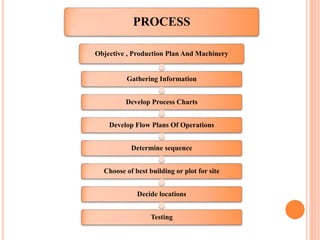
PROCESS
Objective , Production Plan And Machinery
Gathering Information
Develop Process Charts
Develop Flow Plans Of Operations
Determine sequence
Choose of best building or plot for site
Decide locations
Testing
LAYOUT PROCESS
1. Objective , Production Plan And Machinery :- Selection of
equipments on the basis of product design and volume of output
to be attained.
2. Gathering Information :-Gather all data like machine load ,
machine data card , templates (pattern , shape)
3. Develop Process Charts :- summary of production activites .
4. Develop Flow Plans Of Operations :- Draft over all flows
plans operation . E g. Process charts , machine load data ,
desired production rate etc.
5. Determine sequence
6. Choose of best building or plot for site
7. Decide locations :- For canteens , washrooms , windows and
ventilations etc.
8. Testing :- In last layout is drawn and tested . Changes are made
if required .
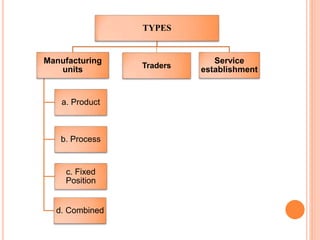
TYPES
Manufacturing
units
a. Product
b. Process
c. Fixed
Position
d. Combined
Traders
Service
establishment
MANUFACTURING UNIT
A. PRODUCT LAYOUT
 The materials move form one workstation to
another sequentially without any backtracking or
deviation.
 Materials are fed into 1st machine and semi-
finished goods travel automatically from
machine to machine.
 The output of one machine becoming input of
the next.
 E g. Food Processing Unit; Paper mill
B. PROCESS LAYOUT
 In this type of layout machines of a similar type
are arranged together at one place.
 The work has to be allocated to each department
in such a way that no machines are chosen to do
as many different job as possible.
 Eg. Process oriented layout for an hospital,
banks, auto repair
C. FIXED POSITION LAYOUT
 Here, Major products being produced is fixed at one
location.
 All other facilities are brought and arranged around the
work center.
 Eg: Ship building, Dam construction, flyover
construction.
D. COMBINATION LAYOUTS/MIXED
 In many manufacturing units, several products
are produced in repeated numbers with no
likelihood of continuous production , combined
layout is followed.
 Eg: aircraft , ships etc.
TRADERS
 Means two outlets carry almost same
merchandise , customers usually buy from that is
more appealing to them. Thus customers are
attracted by Good layout i.e. good design,
attractive colors, ventilation, AC.
 Customer is always impressed by service
efficiency and quality.
 Eg. Cloth showrooms etc.
SERVICES ESTABLISHMENTS
 Simply customer attract to that center where
quality of services is very good in nature ,
convenience.
 Eg. hotels , restaurants.
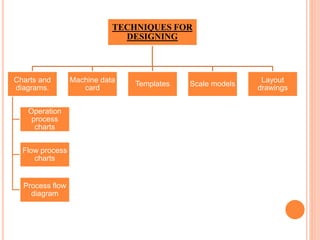
TECHNIQUES FOR
DESIGNING
Charts and
diagrams.
Operation
process
charts
Flow process
charts
Process flow
diagram
Machine data
card
Templates Scale models
Layout
drawings
Plant layout
Plant layout

Plant layout

  • 1.
    PLANT LAYOUT BY –PARIN SINGLA
  • 2.
    DEFINITION According to J.L.Zundi, “ Plant layout ideally involves allocation of space and arrangement of equipment in such a manner that overall operating costs are minimized”.
  • 4.
    FEATURES OF GOODLAYOUT  Sufficient space for workers and equipment  Adequate security and safety  Sufficient gang-way space for materials and semi- finished goods  Minimum material handling cost  Stores for in-process goods  Flexibility  Control
  • 5.
    OBJECTIVES  Flow ofmaterial  Optimum utilization of men, equipment and floor space  Reduce time  Minimum investment in equipments  Ensures flexibility in operations and arrangements  Manage production capacity  Increase employee moral
  • 6.
     To ensuresafety of workers  Better supervision and control  To eliminate unnecessary activities  Allow high machine or equipment utilization  Improve productivity  To avoid bottlenecks and congestion  To minimise accidents
  • 7.
    PROCESS Objective , ProductionPlan And Machinery Gathering Information Develop Process Charts Develop Flow Plans Of Operations Determine sequence Choose of best building or plot for site Decide locations Testing
  • 8.
    LAYOUT PROCESS 1. Objective, Production Plan And Machinery :- Selection of equipments on the basis of product design and volume of output to be attained. 2. Gathering Information :-Gather all data like machine load , machine data card , templates (pattern , shape) 3. Develop Process Charts :- summary of production activites . 4. Develop Flow Plans Of Operations :- Draft over all flows plans operation . E g. Process charts , machine load data , desired production rate etc. 5. Determine sequence 6. Choose of best building or plot for site 7. Decide locations :- For canteens , washrooms , windows and ventilations etc. 8. Testing :- In last layout is drawn and tested . Changes are made if required .
  • 9.
    TYPES Manufacturing units a. Product b. Process c.Fixed Position d. Combined Traders Service establishment
  • 10.
    MANUFACTURING UNIT A. PRODUCTLAYOUT  The materials move form one workstation to another sequentially without any backtracking or deviation.  Materials are fed into 1st machine and semi- finished goods travel automatically from machine to machine.  The output of one machine becoming input of the next.  E g. Food Processing Unit; Paper mill
  • 11.
    B. PROCESS LAYOUT In this type of layout machines of a similar type are arranged together at one place.  The work has to be allocated to each department in such a way that no machines are chosen to do as many different job as possible.  Eg. Process oriented layout for an hospital, banks, auto repair
  • 12.
    C. FIXED POSITIONLAYOUT  Here, Major products being produced is fixed at one location.  All other facilities are brought and arranged around the work center.  Eg: Ship building, Dam construction, flyover construction.
  • 13.
    D. COMBINATION LAYOUTS/MIXED In many manufacturing units, several products are produced in repeated numbers with no likelihood of continuous production , combined layout is followed.  Eg: aircraft , ships etc.
  • 14.
    TRADERS  Means twooutlets carry almost same merchandise , customers usually buy from that is more appealing to them. Thus customers are attracted by Good layout i.e. good design, attractive colors, ventilation, AC.  Customer is always impressed by service efficiency and quality.  Eg. Cloth showrooms etc.
  • 15.
    SERVICES ESTABLISHMENTS  Simplycustomer attract to that center where quality of services is very good in nature , convenience.  Eg. hotels , restaurants.
  • 16.
    TECHNIQUES FOR DESIGNING Charts and diagrams. Operation process charts Flowprocess charts Process flow diagram Machine data card Templates Scale models Layout drawings