
Submitted to
Professor Rishabh Pare
IMS SAGE UNIVERSITY
Submitted by
Ashutosh Singh
BBA CORE
SECTION 'F'
OPERATION MANAGEMENT
ENROLLMENT NO- 20MGT2BBA0329
PLANT LAYOUT
INTRODUCTION
TYPES OF LAYOUT
IMPORTANCE OF PLANT LAYOUT
OBJECTIVE OF PLANT LAYOUT
C
O
N
T
E
N
T
S
INTRODUCTION
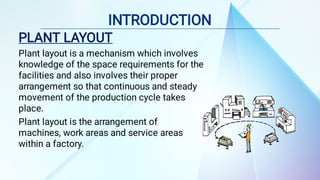
PLANT LAYOUT
Plant layout is a mechanism which involves
knowledge of the space requirements for the
facilities and also involves their proper
arrangement so that continuous and steady
movement of the production cycle takes
place.
Plant layout is the arrangement of
machines, work areas and service areas
within a factory.
TYPES OF PLANT LAYOUT
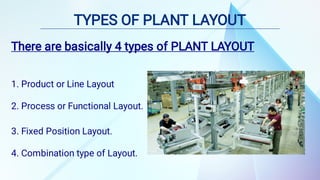
There are basically 4 types of PLANT LAYOUT
1. Product or Line Layout
2. Process or Functional Layout.
3. Fixed Position Layout.
4. Combination type of Layout.
1. Product or Line Layout
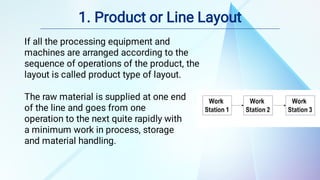
If all the processing equipment and
machines are arranged according to the
sequence of operations of the product, the
layout is called product type of layout.
The raw material is supplied at one end
of the line and goes from one
operation to the next quite rapidly with
a minimum work in process, storage
and material handling.
2. Process or Functional Layout
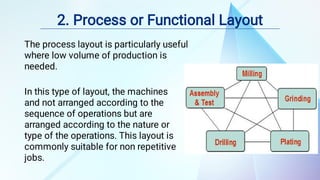
The process layout is particularly useful
where low volume of production is
needed.
In this type of layout, the machines
and not arranged according to the
sequence of operations but are
arranged according to the nature or
type of the operations. This layout is
commonly suitable for non repetitive
jobs.
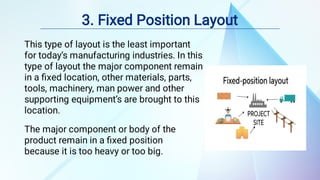
3. Fixed Position Layout
This type of layout is the least important
for today’s manufacturing industries. In this
type of layout the major component remain
in a fixed location, other materials, parts,
tools, machinery, man power and other
supporting equipment’s are brought to this
location.
The major component or body of the
product remain in a fixed position
because it is too heavy or too big.
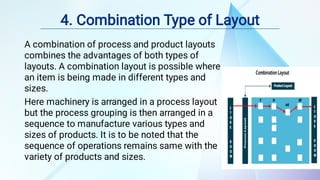
4. Combination Type of Layout
A combination of process and product layouts
combines the advantages of both types of
layouts. A combination layout is possible where
an item is being made in different types and
sizes.
Here machinery is arranged in a process layout
but the process grouping is then arranged in a
sequence to manufacture various types and
sizes of products. It is to be noted that the
sequence of operations remains same with the
variety of products and sizes.
IMPORTANCE OF PLANT LAYOUT
1.
2.
3.
4.
5.
6.
7.
Reduces material handling costs.
Provides enough production capacity.
Ensures work proceeds without delay.
Proper and efficient utilization of available
floor space.
Utilisation of labour Efficiently.
Volume and product Flexibility.
Ease of supervision and control.
OBJECTIVE OF A GOOD PLANT LAYOUT
1.
2.
3.
4.
5.
6.
7.
8.
Economy in handling of materials, work-in-process and finished
goods.
Minimization of product delays.
Lesser work-in-progress and minimum manufacturing cycle
time.process
Efficient utilization of available space.
Easy supervision and better production control.
Greater flexibility for changes in product design and for future
expansion.
Better working conditions by eliminating causes of excessive
noise, objectionable odor smoke etc.
Safety of workers and environment.
REFERENCE
1.
2.
3.
4.
https://www.yourarticlelibrary.com/industries/plant-layout/four-
main-types-of-plant-layout/34604
https://www.geektonight.com/plant-layout/
https://www.google.com/amp/s/www.mbaknol.com/
operations-management/objectives-and-principles-of-a-good-
plant-layout/%3famp
https://www.citeman.com/108-the-importance-of-layout.html#:
~:text=Plant%20layout%20is%20a%20significant,
the%20speedy%20execution%20of%20orders.ent
THANK YOU

Plant Layout

  • 1.
    Submitted to Professor RishabhPare IMS SAGE UNIVERSITY Submitted by Ashutosh Singh BBA CORE SECTION 'F' OPERATION MANAGEMENT ENROLLMENT NO- 20MGT2BBA0329
  • 2.
  • 3.
    INTRODUCTION TYPES OF LAYOUT IMPORTANCEOF PLANT LAYOUT OBJECTIVE OF PLANT LAYOUT C O N T E N T S
  • 4.
    INTRODUCTION PLANT LAYOUT Plant layoutis a mechanism which involves knowledge of the space requirements for the facilities and also involves their proper arrangement so that continuous and steady movement of the production cycle takes place. Plant layout is the arrangement of machines, work areas and service areas within a factory.
  • 5.
    TYPES OF PLANTLAYOUT There are basically 4 types of PLANT LAYOUT 1. Product or Line Layout 2. Process or Functional Layout. 3. Fixed Position Layout. 4. Combination type of Layout.
  • 6.
    1. Product orLine Layout If all the processing equipment and machines are arranged according to the sequence of operations of the product, the layout is called product type of layout. The raw material is supplied at one end of the line and goes from one operation to the next quite rapidly with a minimum work in process, storage and material handling.
  • 7.
    2. Process orFunctional Layout The process layout is particularly useful where low volume of production is needed. In this type of layout, the machines and not arranged according to the sequence of operations but are arranged according to the nature or type of the operations. This layout is commonly suitable for non repetitive jobs.
  • 8.
    3. Fixed PositionLayout This type of layout is the least important for today’s manufacturing industries. In this type of layout the major component remain in a fixed location, other materials, parts, tools, machinery, man power and other supporting equipment’s are brought to this location. The major component or body of the product remain in a fixed position because it is too heavy or too big.
  • 9.
    4. Combination Typeof Layout A combination of process and product layouts combines the advantages of both types of layouts. A combination layout is possible where an item is being made in different types and sizes. Here machinery is arranged in a process layout but the process grouping is then arranged in a sequence to manufacture various types and sizes of products. It is to be noted that the sequence of operations remains same with the variety of products and sizes.
  • 10.
    IMPORTANCE OF PLANTLAYOUT 1. 2. 3. 4. 5. 6. 7. Reduces material handling costs. Provides enough production capacity. Ensures work proceeds without delay. Proper and efficient utilization of available floor space. Utilisation of labour Efficiently. Volume and product Flexibility. Ease of supervision and control.
  • 11.
    OBJECTIVE OF AGOOD PLANT LAYOUT 1. 2. 3. 4. 5. 6. 7. 8. Economy in handling of materials, work-in-process and finished goods. Minimization of product delays. Lesser work-in-progress and minimum manufacturing cycle time.process Efficient utilization of available space. Easy supervision and better production control. Greater flexibility for changes in product design and for future expansion. Better working conditions by eliminating causes of excessive noise, objectionable odor smoke etc. Safety of workers and environment.
  • 12.
  • 13.