SIX SIGMA
Dr.T.Sivakami
Assistant Professor
Department of Management Studies
Bon Secours college for Women
Thanjavur
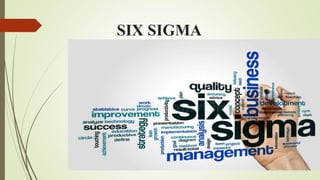
SIX SIGMA
CONTENT
1. Introduction
2. What is six sigma?
3. Methodology of six sigma
4. Objectives of six sigma
5. Steps of six sigma
6. Six sigma belt rankings
INTRODUCTION:
 Six Sigma (6σ) is a set of techniques and tools for process
improvement. It was introduced by American engineer Bill Smith while
working at Motorola in 1986.
 A six sigma process is one in which 99.99966% of all opportunities to
produce some feature of a part are statistically expected to be free of
defects.
 Six Sigma strategies seek to improve manufacturing quality by
identifying and removing the causes of defects and
minimizing variability in manufacturing and business processes.
 This is done by using empirical and statistical quality
management methods and by hiring people who serve as Six Sigma
experts.
 Each Six Sigma project follows a defined methodology and has
specific value targets, such as reducing pollution or increasing customer
satisfaction.
FATHER OF SIX SIGMA-William B. Smith
WHAT IS SIX SIGMA?
The term Six Sigma refers to a set of quality-control
tools that businesses can use to eliminate defects and improve processes to
help boost their profits. It was developed by a scientist in the 1980s while he
was working at Motorola.
Six Sigma is a statistical- and data-driven process that
works by reviewing limit mistakes or defects. It emphasizes cycle-time
improvements while reducing manufacturing defects to no more than 3.4
occurrences per million units or events.
This means that an error generally occurs with a six-
standard deviation event from the mean because only 3.4 out of a million
events along a bell curve would fall outside of six standard deviations.
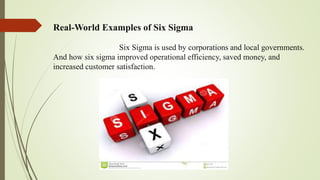
Real-World Examples of Six Sigma
Six Sigma is used by corporations and local governments.
And how six sigma improved operational efficiency, saved money, and
increased customer satisfaction.
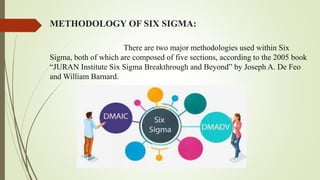
METHODOLOGY OF SIX SIGMA:
There are two major methodologies used within Six
Sigma, both of which are composed of five sections, according to the 2005 book
“JURAN Institute Six Sigma Breakthrough and Beyond” by Joseph A. De Feo
and William Barnard.
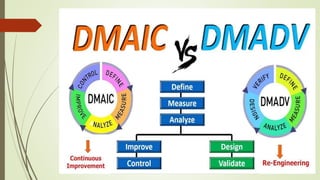
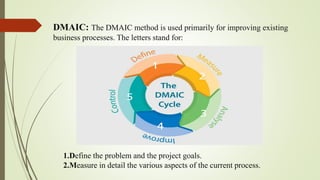
DMAIC: The DMAIC method is used primarily for improving existing
business processes. The letters stand for:
1.Define the problem and the project goals.
2.Measure in detail the various aspects of the current process.
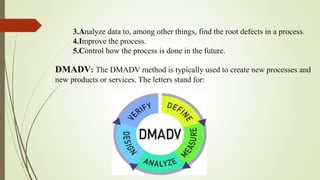
3.Analyze data to, among other things, find the root defects in a process.
4.Improve the process.
5.Control how the process is done in the future.
DMADV: The DMADV method is typically used to create new processes and
new products or services. The letters stand for:
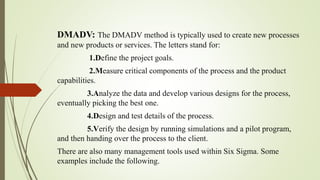
DMADV: The DMADV method is typically used to create new processes
and new products or services. The letters stand for:
1.Define the project goals.
2.Measure critical components of the process and the product
capabilities.
3.Analyze the data and develop various designs for the process,
eventually picking the best one.
4.Design and test details of the process.
5.Verify the design by running simulations and a pilot program,
and then handing over the process to the client.
There are also many management tools used within Six Sigma. Some
examples include the following.
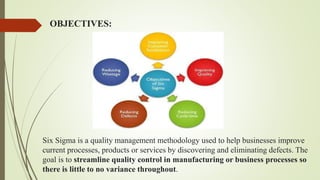
OBJECTIVES:
Six Sigma is a quality management methodology used to help businesses improve
current processes, products or services by discovering and eliminating defects. The
goal is to streamline quality control in manufacturing or business processes so
there is little to no variance throughout.
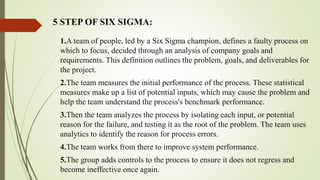
5 STEP OF SIX SIGMA:
1.A team of people, led by a Six Sigma champion, defines a faulty process on
which to focus, decided through an analysis of company goals and
requirements. This definition outlines the problem, goals, and deliverables for
the project.
2.The team measures the initial performance of the process. These statistical
measures make up a list of potential inputs, which may cause the problem and
help the team understand the process's benchmark performance.
3.Then the team analyzes the process by isolating each input, or potential
reason for the failure, and testing it as the root of the problem. The team uses
analytics to identify the reason for process errors.
4.The team works from there to improve system performance.
5.The group adds controls to the process to ensure it does not regress and
become ineffective once again.
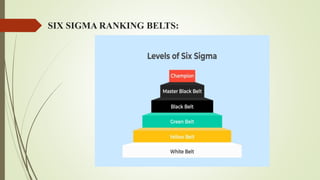
SIX SIGMA RANKING BELTS:
White Belt:
Yellow Belt:
Green Belt:
Assists with data collection and analysis for Black Belt projects.
Leads Green Belt projects or teams. The green belt certification is ideal for
individuals who work in certain industries, such as project or financial
management, as well as health care. Graduates often become project leaders.
Can work on local problem-solving teams that support overall
projects, but may not be part of a Six Sigma project team. Understands basic
Six Sigma concepts from an awareness perspective.
Participates as a project team member.
Reviews process improvements that support the project.
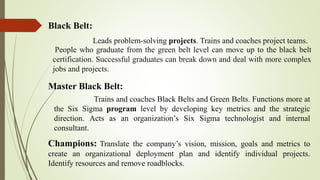
Black Belt:
People who graduate from the green belt level can move up to the black belt
certification. Successful graduates can break down and deal with more complex
jobs and projects.
Leads problem-solving projects. Trains and coaches project teams.
Master Black Belt:
Trains and coaches Black Belts and Green Belts. Functions more at
the Six Sigma program level by developing key metrics and the strategic
direction. Acts as an organization’s Six Sigma technologist and internal
consultant.
Champions: Translate the company’s vision, mission, goals and metrics to
create an organizational deployment plan and identify individual projects.
Identify resources and remove roadblocks.
THANK YOU

SIX SIGMA.pptx

  • 1.
    SIX SIGMA Dr.T.Sivakami Assistant Professor Departmentof Management Studies Bon Secours college for Women Thanjavur
  • 2.
  • 3.
    CONTENT 1. Introduction 2. Whatis six sigma? 3. Methodology of six sigma 4. Objectives of six sigma 5. Steps of six sigma 6. Six sigma belt rankings
  • 4.
    INTRODUCTION:  Six Sigma(6σ) is a set of techniques and tools for process improvement. It was introduced by American engineer Bill Smith while working at Motorola in 1986.  A six sigma process is one in which 99.99966% of all opportunities to produce some feature of a part are statistically expected to be free of defects.  Six Sigma strategies seek to improve manufacturing quality by identifying and removing the causes of defects and minimizing variability in manufacturing and business processes.
  • 5.
     This isdone by using empirical and statistical quality management methods and by hiring people who serve as Six Sigma experts.  Each Six Sigma project follows a defined methodology and has specific value targets, such as reducing pollution or increasing customer satisfaction.
  • 6.
    FATHER OF SIXSIGMA-William B. Smith
  • 7.
    WHAT IS SIXSIGMA? The term Six Sigma refers to a set of quality-control tools that businesses can use to eliminate defects and improve processes to help boost their profits. It was developed by a scientist in the 1980s while he was working at Motorola. Six Sigma is a statistical- and data-driven process that works by reviewing limit mistakes or defects. It emphasizes cycle-time improvements while reducing manufacturing defects to no more than 3.4 occurrences per million units or events. This means that an error generally occurs with a six- standard deviation event from the mean because only 3.4 out of a million events along a bell curve would fall outside of six standard deviations.
  • 8.
    Real-World Examples ofSix Sigma Six Sigma is used by corporations and local governments. And how six sigma improved operational efficiency, saved money, and increased customer satisfaction.
  • 9.
    METHODOLOGY OF SIXSIGMA: There are two major methodologies used within Six Sigma, both of which are composed of five sections, according to the 2005 book “JURAN Institute Six Sigma Breakthrough and Beyond” by Joseph A. De Feo and William Barnard.
  • 11.
    DMAIC: The DMAICmethod is used primarily for improving existing business processes. The letters stand for: 1.Define the problem and the project goals. 2.Measure in detail the various aspects of the current process.
  • 12.
    3.Analyze data to,among other things, find the root defects in a process. 4.Improve the process. 5.Control how the process is done in the future. DMADV: The DMADV method is typically used to create new processes and new products or services. The letters stand for:
  • 13.
    DMADV: The DMADVmethod is typically used to create new processes and new products or services. The letters stand for: 1.Define the project goals. 2.Measure critical components of the process and the product capabilities. 3.Analyze the data and develop various designs for the process, eventually picking the best one. 4.Design and test details of the process. 5.Verify the design by running simulations and a pilot program, and then handing over the process to the client. There are also many management tools used within Six Sigma. Some examples include the following.
  • 14.
    OBJECTIVES: Six Sigma isa quality management methodology used to help businesses improve current processes, products or services by discovering and eliminating defects. The goal is to streamline quality control in manufacturing or business processes so there is little to no variance throughout.
  • 15.
    5 STEP OFSIX SIGMA: 1.A team of people, led by a Six Sigma champion, defines a faulty process on which to focus, decided through an analysis of company goals and requirements. This definition outlines the problem, goals, and deliverables for the project. 2.The team measures the initial performance of the process. These statistical measures make up a list of potential inputs, which may cause the problem and help the team understand the process's benchmark performance. 3.Then the team analyzes the process by isolating each input, or potential reason for the failure, and testing it as the root of the problem. The team uses analytics to identify the reason for process errors. 4.The team works from there to improve system performance. 5.The group adds controls to the process to ensure it does not regress and become ineffective once again.
  • 16.
  • 17.
    White Belt: Yellow Belt: GreenBelt: Assists with data collection and analysis for Black Belt projects. Leads Green Belt projects or teams. The green belt certification is ideal for individuals who work in certain industries, such as project or financial management, as well as health care. Graduates often become project leaders. Can work on local problem-solving teams that support overall projects, but may not be part of a Six Sigma project team. Understands basic Six Sigma concepts from an awareness perspective. Participates as a project team member. Reviews process improvements that support the project.
  • 18.
    Black Belt: People whograduate from the green belt level can move up to the black belt certification. Successful graduates can break down and deal with more complex jobs and projects. Leads problem-solving projects. Trains and coaches project teams. Master Black Belt: Trains and coaches Black Belts and Green Belts. Functions more at the Six Sigma program level by developing key metrics and the strategic direction. Acts as an organization’s Six Sigma technologist and internal consultant. Champions: Translate the company’s vision, mission, goals and metrics to create an organizational deployment plan and identify individual projects. Identify resources and remove roadblocks.
  • 19.