Curriculum
Models
A Definition of Curriculum
(Daniel Tanner, 1980)
“The planned and guided learning
experiences and intended learning outcomes,
formulated through the systematic
reconstruction of knowledge and
experiences, under the auspices of the
school, for the learners’ continuous and willful
growth in personal social competence.”
SUBJECT-CENTERED
DESIGN MODEL
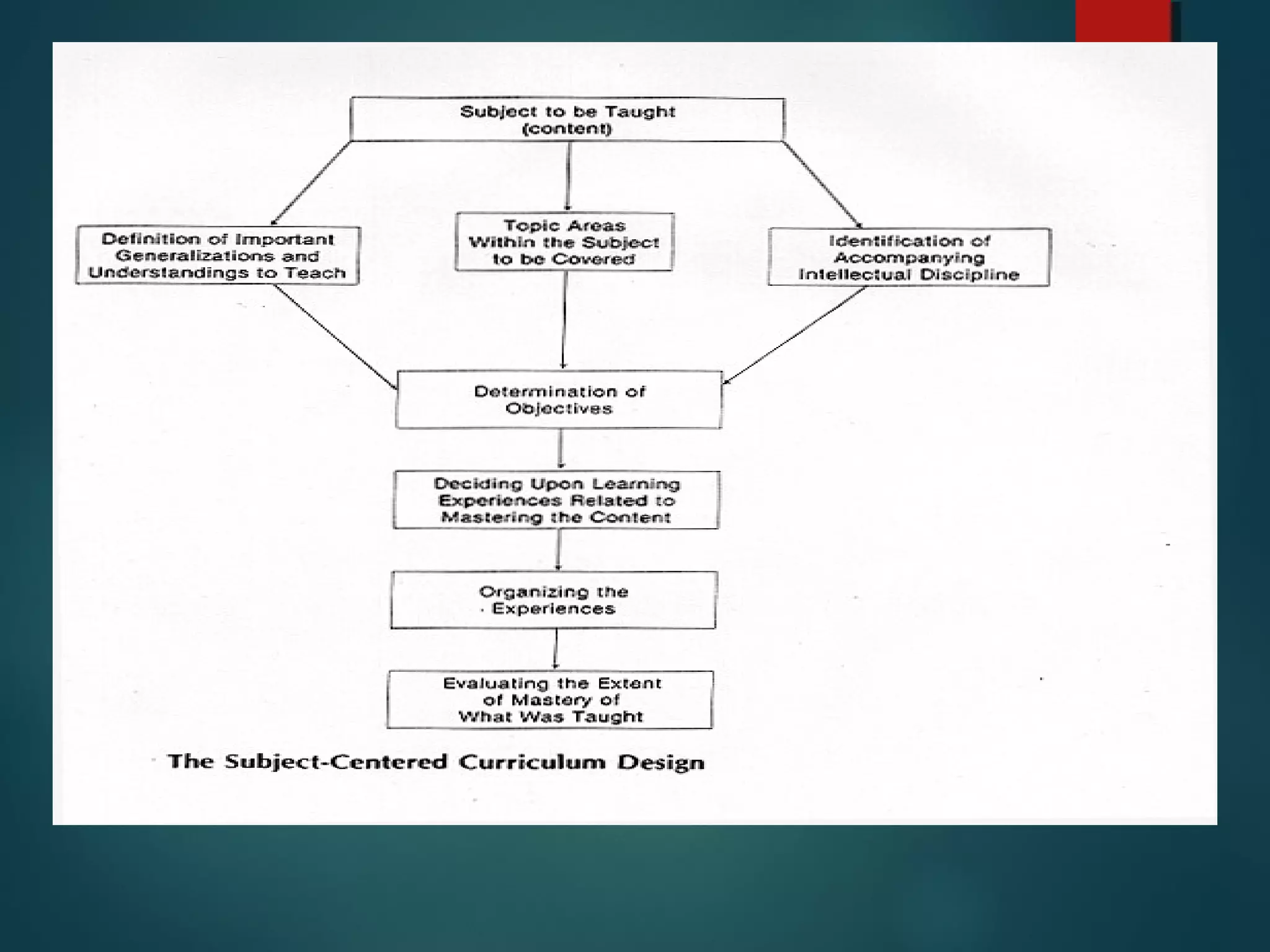
Subject-Centered Curriculum
This model focuses on the content of
the curriculum.
The subject centered design
corresponds mostly to the textbook
written for the specific subject.
Subject-Centered Curriculum
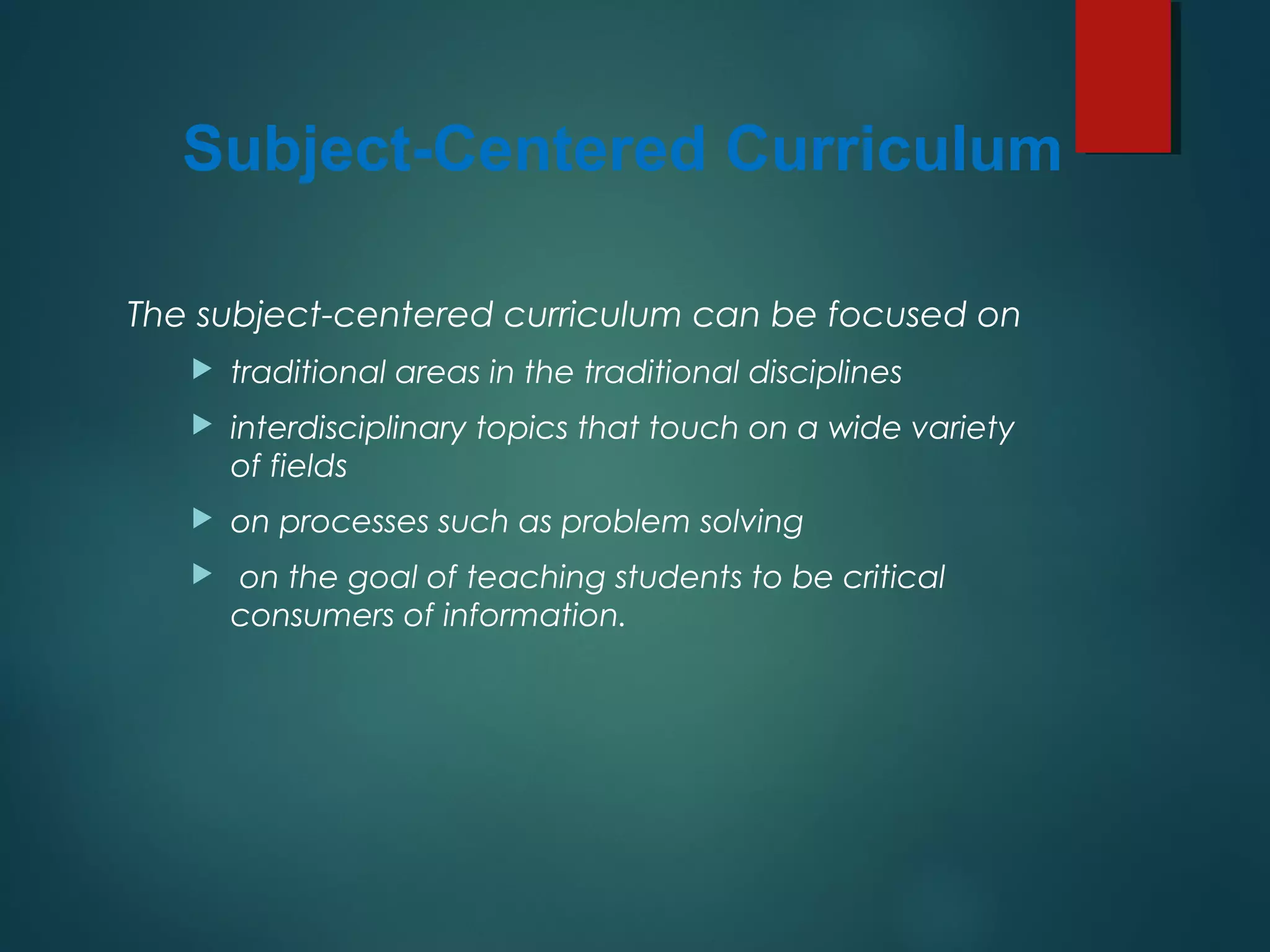
The subject-centered curriculum can be focused on
 traditional areas in the traditional disciplines
 interdisciplinary topics that touch on a wide variety
of fields
 on processes such as problem solving
 on the goal of teaching students to be critical
consumers of information.
Subject-Centered Curriculum
A curriculum can also be organized around a
subject center by focusing on certain processes,
strategies, or life-skills, such as problem solving,
decision making, or teamwork.
In the Philippines, our curricula in
any level is also divided in different
subjects or courses. Most of the
schools using this kind of structure
aim for excellence in the subject
matter content.
Subject-Centered Curriculum
Examples of Subject-centered curriculum:
1. Subject Design
The drawback of his design is that sometimes learning is
so compartmentalized.
It stresses so much the content that it forgets about
students’ natural tendencies, interest and experiences.
2. Discipline Design
Discipline refers to specific knowledge and through a method
which the scholars use to study a specific content of their
fields.
This comes from a core, correlated curriculum design that
links separate subject designs in order to reduce
fragmentation. Subjects are related to one another but each
subject a maintains its identify.
3. Correlation Design
Examples of subject-centered curriculum:
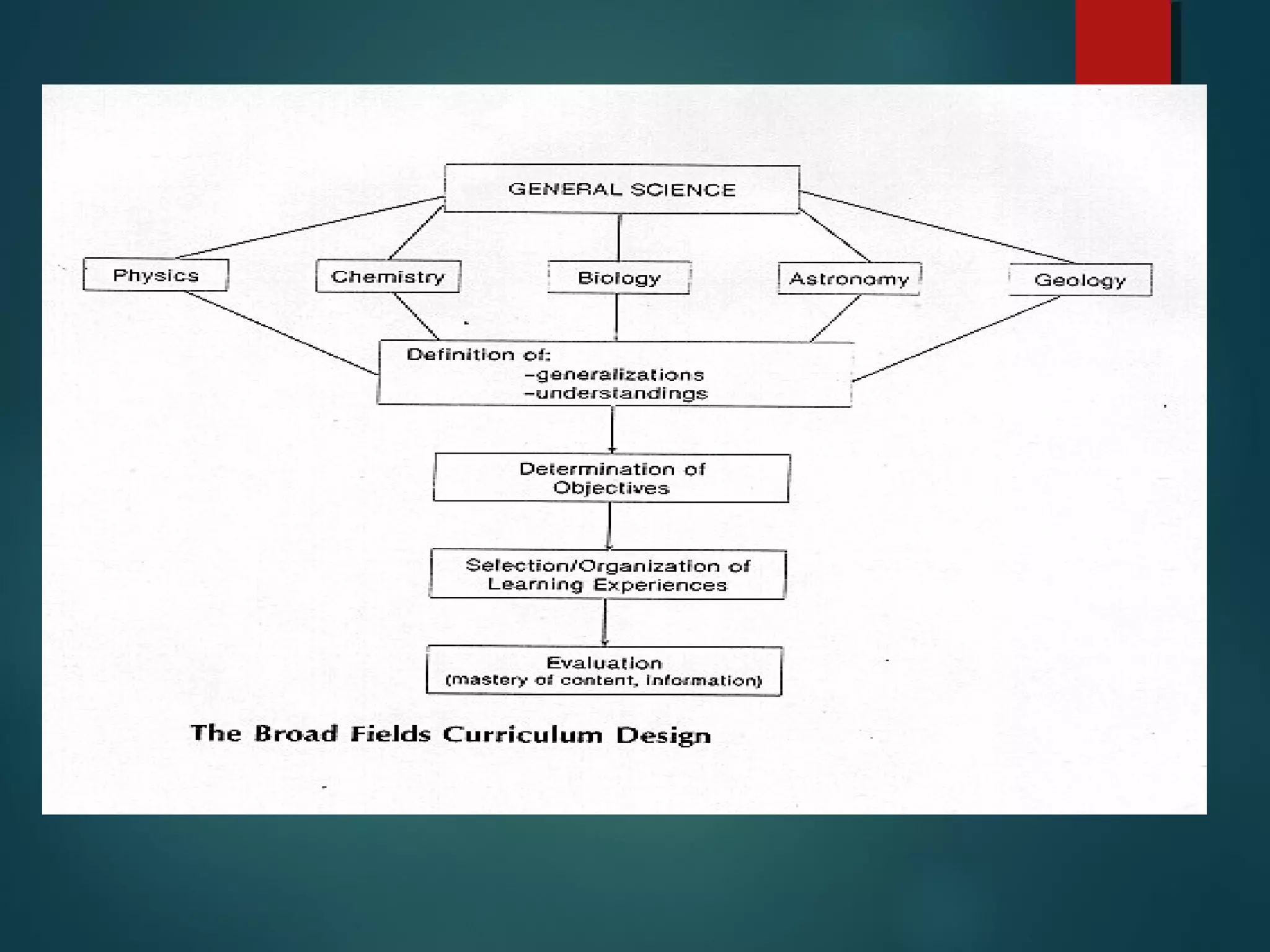
4. Broad field design/interdisciplinary
This design was made to prevent the compartmentalization
of subjects and integrate the contents that are related to
each other.
Students in history should learn the subject
matter like historians, students in biology should
learn how biologist learn, and so with students
in mathematics should learn how
mathematicians learn.
The discipline design model of curriculum is often
used in college
Discipline becomes the degree program.
Examples of Subject-centered curriculum:
Reflection:
Let’s review the following:
 Basic Education Curriculum (BEC)
 Secondary Education Development Program (SEDP)
 College Algebra syllabus
What curriculum design(s) do
you find?
Do your schools support the
subject – centered curriculum?
Learner-Centered Curriculum
centered on certain aspects of the learners
themselves.
may explore the learner’s own life or family history
or local environment.
1. Child-centered design
(John Dewey, Rouseau, Pestallozi and Froebel )
• It is anchored on the needs and interests of the child.
•The learner is not considered as a passive individual
but as one who engages with his/her environment. One
learns by doing. Learners interact with the teachers and
the environment.
Learner-Centered Curriculum
2. Experience-Centered design
Experiences of the learners become the starting point of the
curriculum.
Thus the school environment is left open and free.
Learners are made to choose from various activities that the
teacher provides.
The learners are empowered to shape their own learning from
the different opportunities given by the teacher.
Learner-Centered Curriculum
3. Humanistic design -
Abraham Maslow and Carl Rogers.Maslow
The development of self is the ultimate objective of
leaning. It stresses the whole person and the
integration of thinking, feeling and doing. It considers
the cognitive, affective and psychomotor domains to
be interconnected and must be addressed in the
curriculum. It stresses the development of positive
self-concept and interpersonal skills.
Learner-Centered Curriculum
Advantages:
 It gives power to the learners: they are identified as the
experts in knowing what they need to know.
 The constructivist element of this approach honors the social
and cultural context of the learner.
Advantages:
 It creates a direct link between in-class work and
learners' need for literacy outside the classroom.
As a result, learners can more easily
transfer new skills to day-to-day use
(Purcell-Gates, et al., 2001). The
immediacy of this transfer of skills at
home, at work, and in communities also
encourages learner persistence.
Disadvantages:
 It often relies on the teacher's ability to
create or select materials appropriate to
learners' expressed needs.
This requires skill on the part of the teacher, as
well as time and resources: at a minimum,
texts brought in from real life, a wide pool of
commercially available materials from which
to draw, and a reliable photocopier. Given
the reality of teachers' professional
preparation and working conditions (Smith,
et al., 2001), lack of skill, time and resources
makes creating curriculum with this
approach difficult.
Disadvantages:
 Teachers may also find it difficult to strike an acceptable
balance among the competing needs and interests of
students.
Alternative Methods for a
Learner-Centered Curriculum
(These are only suggestions for supplementing your style, not substituting for
it)
 Individualized diagnosis and (some) course objectives Learning
contracts
 Programmed learning sequences Organize structured
drills
 Multi-sensory instructional activities Paired activities
 Student-designed creative activities Design task cards
 Small-group activities (in and out of class) Role play
 Design competitive games Read aloud
 Design problem solving games Sit on the floor in a circle
 Focus on team learning/peer teaching Standard lecture
 Change the seating configurations Teacher
demonstrations
Alternative Methods for a
Learner-Centered Curriculum
(These are only suggestions for supplementing your style, not substituting for it)
 Go outside or meet in an alternate location
 Speedwriting
 Listserve, online forums
 Computer applications
 Socratic dialogue (question-answer-deeper question)
 Chunk knowledge and connect chunks to make “big picture”
 Multimedia presentations (film, CDs, audio-tapes, animated graphics)
 Student presentations (encourage multi-sensory supports)
 Cancel class and meet students individually
 Present multiple invention and discovery techniques (brainstorming, clustering, freewriting,
idea letters, graph and object relationships, meditations, dreams, art, etc.)
 Split Page (key phrases on one side, commentary on other)
 Color code ideas in documents and lesson plans (already known, yet-to-learn, still
negotiating)
 Reverse question (look at answers and solutions first; create a question that it answers next)
 Treat objective questions an essay questions
Reflection:
Let’s review the following:
 Basic Education Curriculum (BEC)
 Secondary Education Development Program (SEDP)
 College Algebra syllabus
What curriculum design(s) do
you find?
Do your schools support the
learner – centered curriculum?
Problem-Centered
Curriculum
Problem-centered curriculum, or
problem based learning, organizes
subject matter around a problem, real
or hypothetical, that needs to be
solved.
Problem-Centered
Curriculum
Problem-centered curriculum is inherently engaging
and authentic, because the students have a real
purpose to their inquiry -- solving the problem.
Problem-Centered
Curriculum
 Types of problems to be explored
may include:
 Life situations involving real problems of practice
 Problems that revolve around life at a given school
 Problems selected from local issues
 Philosophical or moral problems
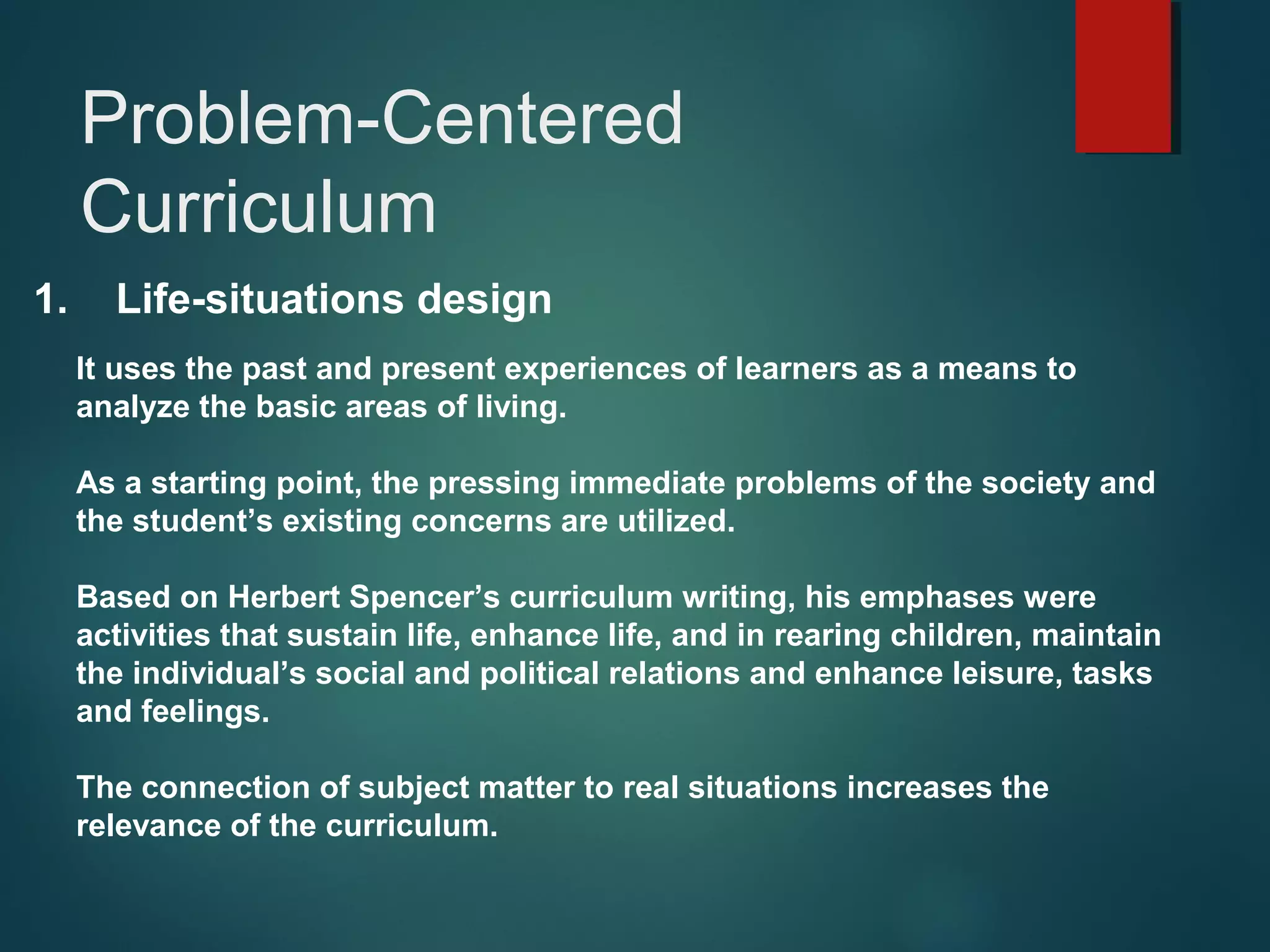
1. Life-situations design
It uses the past and present experiences of learners as a means to
analyze the basic areas of living.
As a starting point, the pressing immediate problems of the society and
the student’s existing concerns are utilized.
Based on Herbert Spencer’s curriculum writing, his emphases were
activities that sustain life, enhance life, and in rearing children, maintain
the individual’s social and political relations and enhance leisure, tasks
and feelings.
The connection of subject matter to real situations increases the
relevance of the curriculum.
Problem-Centered
Curriculum
2. Core design
It centers on general education and the problems
are based on common human activities.
The central focus of the core design includes
common needs, problems, concerns, of the
learners.
Problem-Centered
Curriculum
Reflection:
Let’s review the following:
 Basic Education Curriculum (BEC)
 Secondary Education Development Program (SEDP)
 College Algebra syllabus
What curriculum design(s) do
you find?
Do your schools support the
problem – centered
curriculum?
Curriculum Development Models
These are based on a body of theory about
teaching and learning.
These are targeted to needs &
characteristics of a particular group of
learners.
Outline approaches, methods, & procedures
for implementation.
Curriculum Development Models
Deductive Models:
1.Saylor, Alexander, and Lewis’s
2.Tyler’s
Inductive Model:
3. Taba’s model
Models of Curriculum Development
The Taba Model
Taba took what is known as a grass-roots approach to
curriculum development. She believed that the
curriculum should be designed by the teachers rather
than handed down by higher authority. Further, she
felt that teachers should begin the process by creating
teaching-learning units for their students in their
schools rather initially in creating a general curriculum
design.
Models of Curriculum Development
The Taba Model
an inductive approach to curriculum development,
starting with specifics and building up to a general
design
The Taba Model
Five-Step Sequence.
1. Producing pilot units - linking theory and practice
a.) Diagnosis of Needs
b.) Formulation of Objectives
c.) Selection of Content
d.) Organization of Content
e.) Selection of Learning Experiences
f.) Organization of Learning Activities
g.) Determination of what to evaluate and of the ways
and means of doing it
h.) Checking for Balance and Sequence
Five-Step Sequence (cont.):
1.
2.Testing Experimental Units
3.Revising and consolidating
4.Developing a Framework
5.Installing and disseminating new units.
The Taba Model
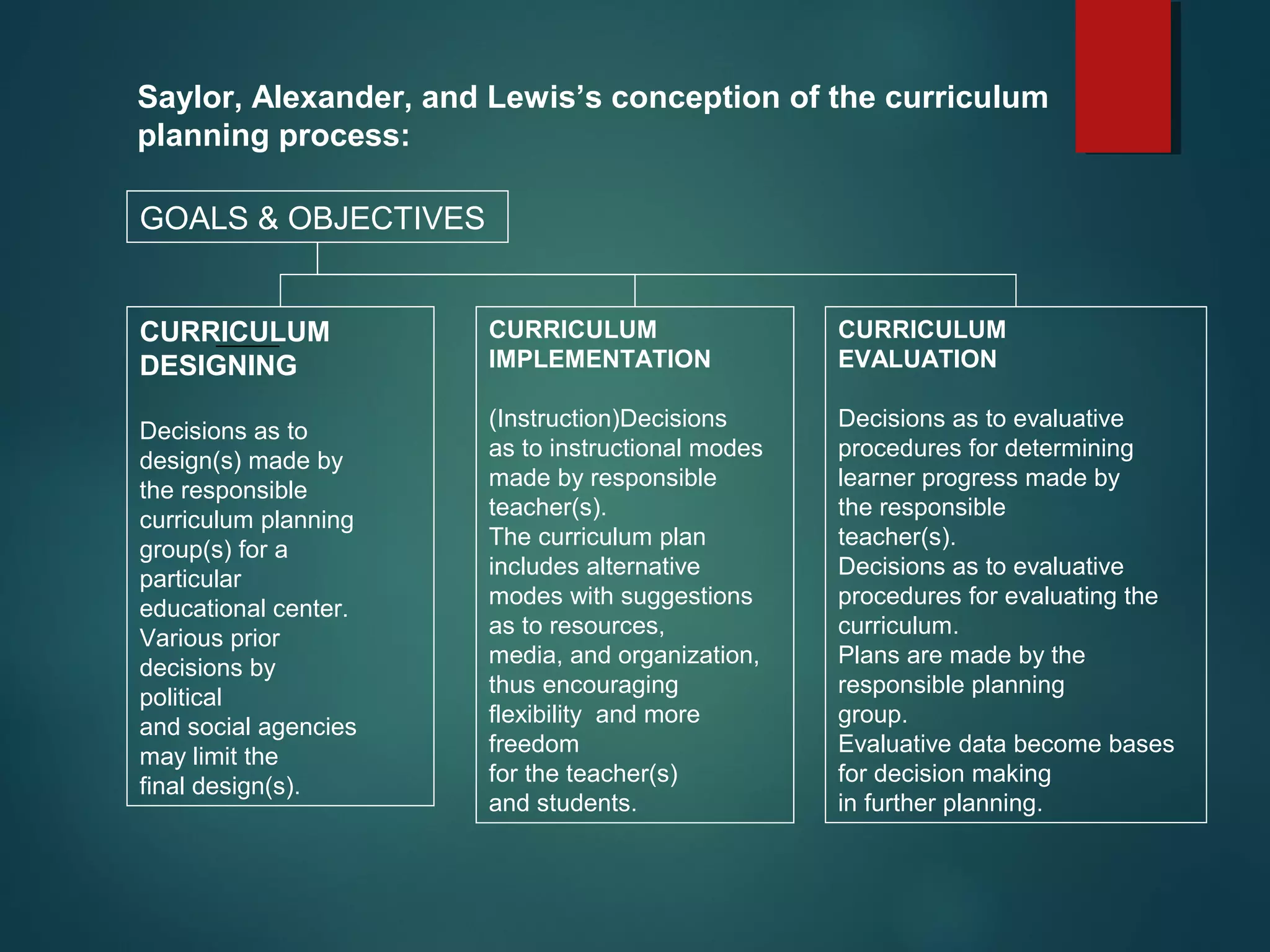
GOALS & OBJECTIVES
CURRICULUM
DESIGNING
Decisions as to
design(s) made by
the responsible
curriculum planning
group(s) for a
particular
educational center.
Various prior
decisions by
political
and social agencies
may limit the
final design(s).
CURRICULUM
IMPLEMENTATION
(Instruction)Decisions
as to instructional modes
made by responsible
teacher(s).
The curriculum plan
includes alternative
modes with suggestions
as to resources,
media, and organization,
thus encouraging
flexibility and more
freedom
for the teacher(s)
and students.
CURRICULUM
EVALUATION
Decisions as to evaluative
procedures for determining
learner progress made by
the responsible
teacher(s).
Decisions as to evaluative
procedures for evaluating the
curriculum.
Plans are made by the
responsible planning
group.
Evaluative data become bases
for decision making
in further planning.
Saylor, Alexander, and Lewis’s conception of the curriculum
planning process:
Models of Curriculum Development
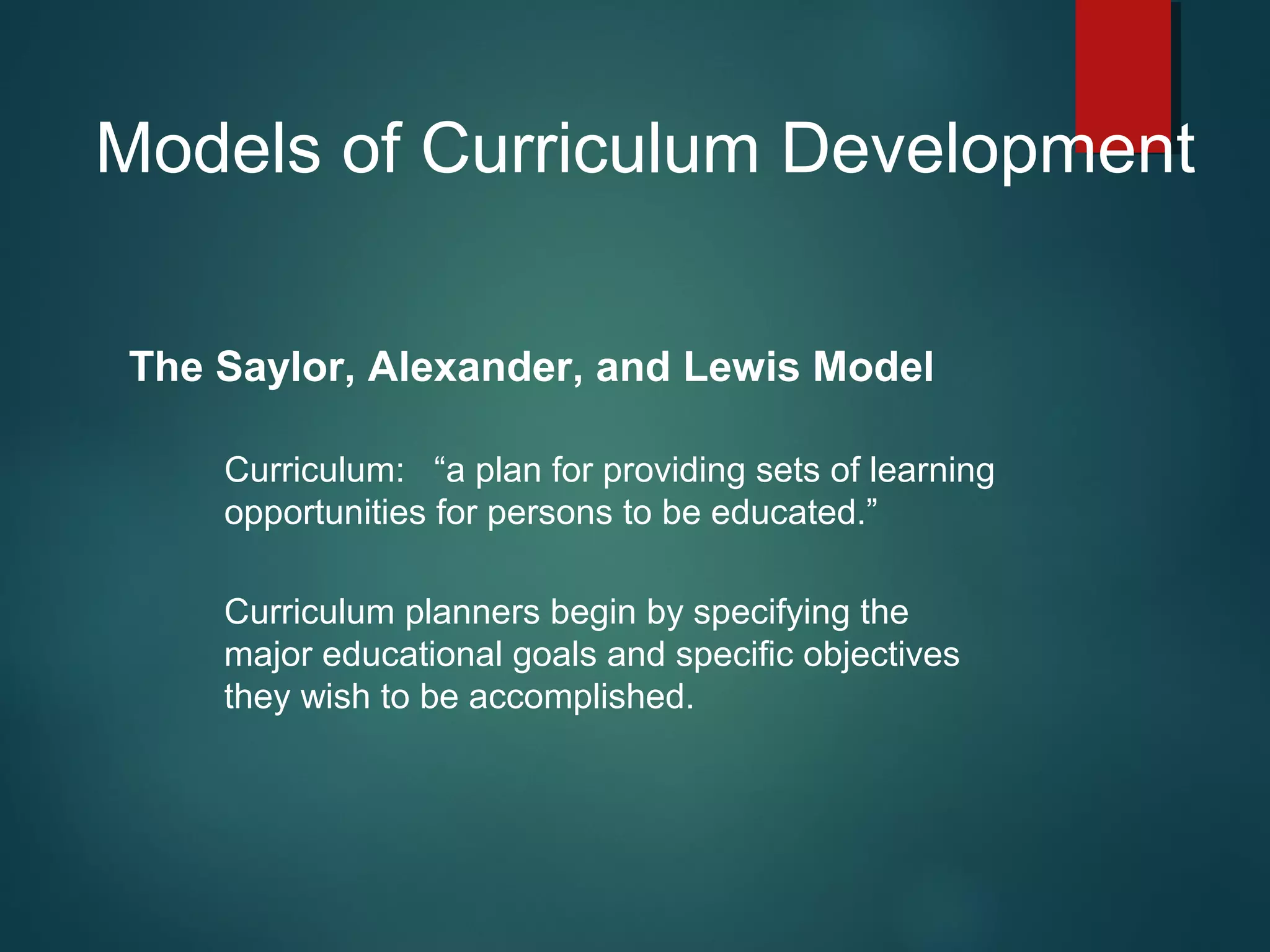
The Saylor, Alexander, and Lewis Model
Curriculum: “a plan for providing sets of learning
opportunities for persons to be educated.”
Curriculum planners begin by specifying the
major educational goals and specific objectives
they wish to be accomplished.
Models of Curriculum Development
The best or one of the best known models for
curriculum development with special attention to
planning phases is Ralph W. Tyler’s in his classic little
book, Basic Principles of Curriculum and Instruction.
The Tyler Model
The Tyler Model of Curriculum Design
The nature and structure of
knowledge
The needs of the society
The needs of the learner
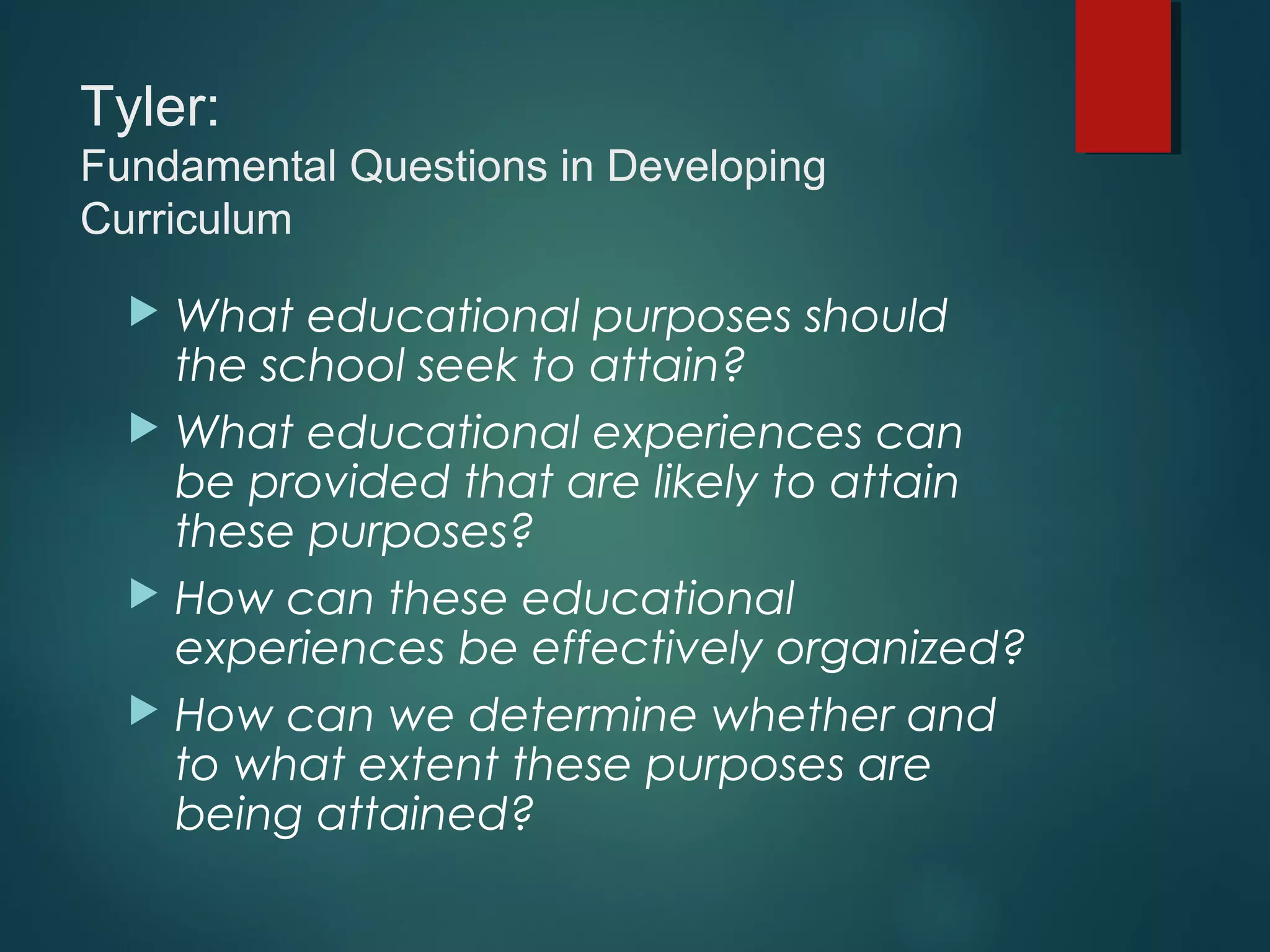
Tyler:
Fundamental Questions in Developing
Curriculum
 What educational purposes should
the school seek to attain?
 What educational experiences can
be provided that are likely to attain
these purposes?
 How can these educational
experiences be effectively organized?
 How can we determine whether and
to what extent these purposes are
being attained?
Reflection:
 On what bases would you
choose a model for curriculum
development?
 Who should decide which model
for curriculum development to
follow?
 Is the Tyler rationale a suitable
basis for current curriculum
development?

Curriculum Models

  • 1.
  • 2.
    A Definition ofCurriculum (Daniel Tanner, 1980) “The planned and guided learning experiences and intended learning outcomes, formulated through the systematic reconstruction of knowledge and experiences, under the auspices of the school, for the learners’ continuous and willful growth in personal social competence.”
  • 3.
  • 4.
    Subject-Centered Curriculum This modelfocuses on the content of the curriculum. The subject centered design corresponds mostly to the textbook written for the specific subject.
  • 5.
    Subject-Centered Curriculum The subject-centeredcurriculum can be focused on  traditional areas in the traditional disciplines  interdisciplinary topics that touch on a wide variety of fields  on processes such as problem solving  on the goal of teaching students to be critical consumers of information.
  • 6.
    Subject-Centered Curriculum A curriculumcan also be organized around a subject center by focusing on certain processes, strategies, or life-skills, such as problem solving, decision making, or teamwork.
  • 8.
    In the Philippines,our curricula in any level is also divided in different subjects or courses. Most of the schools using this kind of structure aim for excellence in the subject matter content. Subject-Centered Curriculum
  • 9.
    Examples of Subject-centeredcurriculum: 1. Subject Design The drawback of his design is that sometimes learning is so compartmentalized. It stresses so much the content that it forgets about students’ natural tendencies, interest and experiences. 2. Discipline Design Discipline refers to specific knowledge and through a method which the scholars use to study a specific content of their fields.
  • 10.
    This comes froma core, correlated curriculum design that links separate subject designs in order to reduce fragmentation. Subjects are related to one another but each subject a maintains its identify. 3. Correlation Design Examples of subject-centered curriculum: 4. Broad field design/interdisciplinary This design was made to prevent the compartmentalization of subjects and integrate the contents that are related to each other.
  • 12.
    Students in historyshould learn the subject matter like historians, students in biology should learn how biologist learn, and so with students in mathematics should learn how mathematicians learn. The discipline design model of curriculum is often used in college Discipline becomes the degree program. Examples of Subject-centered curriculum:
  • 13.
    Reflection: Let’s review thefollowing:  Basic Education Curriculum (BEC)  Secondary Education Development Program (SEDP)  College Algebra syllabus What curriculum design(s) do you find? Do your schools support the subject – centered curriculum?
  • 14.
    Learner-Centered Curriculum centered oncertain aspects of the learners themselves. may explore the learner’s own life or family history or local environment.
  • 15.
    1. Child-centered design (JohnDewey, Rouseau, Pestallozi and Froebel ) • It is anchored on the needs and interests of the child. •The learner is not considered as a passive individual but as one who engages with his/her environment. One learns by doing. Learners interact with the teachers and the environment. Learner-Centered Curriculum
  • 16.
    2. Experience-Centered design Experiencesof the learners become the starting point of the curriculum. Thus the school environment is left open and free. Learners are made to choose from various activities that the teacher provides. The learners are empowered to shape their own learning from the different opportunities given by the teacher. Learner-Centered Curriculum
  • 17.
    3. Humanistic design- Abraham Maslow and Carl Rogers.Maslow The development of self is the ultimate objective of leaning. It stresses the whole person and the integration of thinking, feeling and doing. It considers the cognitive, affective and psychomotor domains to be interconnected and must be addressed in the curriculum. It stresses the development of positive self-concept and interpersonal skills. Learner-Centered Curriculum
  • 18.
    Advantages:  It givespower to the learners: they are identified as the experts in knowing what they need to know.  The constructivist element of this approach honors the social and cultural context of the learner.
  • 19.
    Advantages:  It createsa direct link between in-class work and learners' need for literacy outside the classroom. As a result, learners can more easily transfer new skills to day-to-day use (Purcell-Gates, et al., 2001). The immediacy of this transfer of skills at home, at work, and in communities also encourages learner persistence.
  • 20.
    Disadvantages:  It oftenrelies on the teacher's ability to create or select materials appropriate to learners' expressed needs. This requires skill on the part of the teacher, as well as time and resources: at a minimum, texts brought in from real life, a wide pool of commercially available materials from which to draw, and a reliable photocopier. Given the reality of teachers' professional preparation and working conditions (Smith, et al., 2001), lack of skill, time and resources makes creating curriculum with this approach difficult.
  • 21.
    Disadvantages:  Teachers mayalso find it difficult to strike an acceptable balance among the competing needs and interests of students.
  • 22.
    Alternative Methods fora Learner-Centered Curriculum (These are only suggestions for supplementing your style, not substituting for it)  Individualized diagnosis and (some) course objectives Learning contracts  Programmed learning sequences Organize structured drills  Multi-sensory instructional activities Paired activities  Student-designed creative activities Design task cards  Small-group activities (in and out of class) Role play  Design competitive games Read aloud  Design problem solving games Sit on the floor in a circle  Focus on team learning/peer teaching Standard lecture  Change the seating configurations Teacher demonstrations
  • 23.
    Alternative Methods fora Learner-Centered Curriculum (These are only suggestions for supplementing your style, not substituting for it)  Go outside or meet in an alternate location  Speedwriting  Listserve, online forums  Computer applications  Socratic dialogue (question-answer-deeper question)  Chunk knowledge and connect chunks to make “big picture”  Multimedia presentations (film, CDs, audio-tapes, animated graphics)  Student presentations (encourage multi-sensory supports)  Cancel class and meet students individually  Present multiple invention and discovery techniques (brainstorming, clustering, freewriting, idea letters, graph and object relationships, meditations, dreams, art, etc.)  Split Page (key phrases on one side, commentary on other)  Color code ideas in documents and lesson plans (already known, yet-to-learn, still negotiating)  Reverse question (look at answers and solutions first; create a question that it answers next)  Treat objective questions an essay questions
  • 24.
    Reflection: Let’s review thefollowing:  Basic Education Curriculum (BEC)  Secondary Education Development Program (SEDP)  College Algebra syllabus What curriculum design(s) do you find? Do your schools support the learner – centered curriculum?
  • 25.
    Problem-Centered Curriculum Problem-centered curriculum, or problembased learning, organizes subject matter around a problem, real or hypothetical, that needs to be solved.
  • 26.
    Problem-Centered Curriculum Problem-centered curriculum isinherently engaging and authentic, because the students have a real purpose to their inquiry -- solving the problem.
  • 27.
    Problem-Centered Curriculum  Types ofproblems to be explored may include:  Life situations involving real problems of practice  Problems that revolve around life at a given school  Problems selected from local issues  Philosophical or moral problems
  • 28.
    1. Life-situations design Ituses the past and present experiences of learners as a means to analyze the basic areas of living. As a starting point, the pressing immediate problems of the society and the student’s existing concerns are utilized. Based on Herbert Spencer’s curriculum writing, his emphases were activities that sustain life, enhance life, and in rearing children, maintain the individual’s social and political relations and enhance leisure, tasks and feelings. The connection of subject matter to real situations increases the relevance of the curriculum. Problem-Centered Curriculum
  • 31.
    2. Core design Itcenters on general education and the problems are based on common human activities. The central focus of the core design includes common needs, problems, concerns, of the learners. Problem-Centered Curriculum
  • 33.
    Reflection: Let’s review thefollowing:  Basic Education Curriculum (BEC)  Secondary Education Development Program (SEDP)  College Algebra syllabus What curriculum design(s) do you find? Do your schools support the problem – centered curriculum?
  • 34.
    Curriculum Development Models Theseare based on a body of theory about teaching and learning. These are targeted to needs & characteristics of a particular group of learners. Outline approaches, methods, & procedures for implementation.
  • 35.
    Curriculum Development Models DeductiveModels: 1.Saylor, Alexander, and Lewis’s 2.Tyler’s Inductive Model: 3. Taba’s model
  • 36.
    Models of CurriculumDevelopment The Taba Model Taba took what is known as a grass-roots approach to curriculum development. She believed that the curriculum should be designed by the teachers rather than handed down by higher authority. Further, she felt that teachers should begin the process by creating teaching-learning units for their students in their schools rather initially in creating a general curriculum design.
  • 37.
    Models of CurriculumDevelopment The Taba Model an inductive approach to curriculum development, starting with specifics and building up to a general design
  • 38.
    The Taba Model Five-StepSequence. 1. Producing pilot units - linking theory and practice a.) Diagnosis of Needs b.) Formulation of Objectives c.) Selection of Content d.) Organization of Content e.) Selection of Learning Experiences f.) Organization of Learning Activities g.) Determination of what to evaluate and of the ways and means of doing it h.) Checking for Balance and Sequence
  • 39.
    Five-Step Sequence (cont.): 1. 2.TestingExperimental Units 3.Revising and consolidating 4.Developing a Framework 5.Installing and disseminating new units. The Taba Model
  • 40.
    GOALS & OBJECTIVES CURRICULUM DESIGNING Decisionsas to design(s) made by the responsible curriculum planning group(s) for a particular educational center. Various prior decisions by political and social agencies may limit the final design(s). CURRICULUM IMPLEMENTATION (Instruction)Decisions as to instructional modes made by responsible teacher(s). The curriculum plan includes alternative modes with suggestions as to resources, media, and organization, thus encouraging flexibility and more freedom for the teacher(s) and students. CURRICULUM EVALUATION Decisions as to evaluative procedures for determining learner progress made by the responsible teacher(s). Decisions as to evaluative procedures for evaluating the curriculum. Plans are made by the responsible planning group. Evaluative data become bases for decision making in further planning. Saylor, Alexander, and Lewis’s conception of the curriculum planning process:
  • 41.
    Models of CurriculumDevelopment The Saylor, Alexander, and Lewis Model Curriculum: “a plan for providing sets of learning opportunities for persons to be educated.” Curriculum planners begin by specifying the major educational goals and specific objectives they wish to be accomplished.
  • 42.
    Models of CurriculumDevelopment The best or one of the best known models for curriculum development with special attention to planning phases is Ralph W. Tyler’s in his classic little book, Basic Principles of Curriculum and Instruction. The Tyler Model
  • 43.
    The Tyler Modelof Curriculum Design The nature and structure of knowledge The needs of the society The needs of the learner
  • 44.
    Tyler: Fundamental Questions inDeveloping Curriculum  What educational purposes should the school seek to attain?  What educational experiences can be provided that are likely to attain these purposes?  How can these educational experiences be effectively organized?  How can we determine whether and to what extent these purposes are being attained?
  • 45.
    Reflection:  On whatbases would you choose a model for curriculum development?  Who should decide which model for curriculum development to follow?  Is the Tyler rationale a suitable basis for current curriculum development?