Introduction
In PERENNIALISM, it is
believed that one should teach
the things that one deems to be
of everlasting importance to all
people everywhere. Since
details of fact change
constantly, these cannot be the
most important.
Therefore, one should teach
principles, not facts. Since people
are human, one should teach first
about humans, not machines or
techniques. Since people are
people first, and workers second
if at all, one should teach liberal
topics first, not vocational topics.
Introduction
PERENNIALISM suggests that the
focus of education should be the
ideas that have lasted over
centuries. They believe the ideas
are as relevant and meaningful
today as when they were written.
They recommend that students
learn from reading and analyzing
the works by history's finest
thinkers and writers.
Introduction
Although PERENNIALISM may
appear similar to Essentialism,
Perennialism focuses first on personal
development, while Essentialism
focuses first on essential skills.
Essentialist curricula thus tend to be
much more vocational and fact-based,
and far less liberal and principle-based.
Introduction
The educational focus of PERENNIALISM
is on the need to return to the past, namely, to the
universal truths and absolutely reason and
faith. Perennialists believe that God and education
goes together hand in hand,
and that education prepares a person for life. They
also believe that schooling may come to an end but
a person will never stop learning throughout their
lifetime.
Introduction
The theory of PERENNIALISM also
believes that the environment plays a
big role in teaching someone. A person
learns by experience. The Philosophies
of Idealism, Realism, and Neo-Thomism
are embedded in this theory. They
believe that having a relationship to a
spiritual being is necessary for
understanding the cosmos or universe.
Introduction
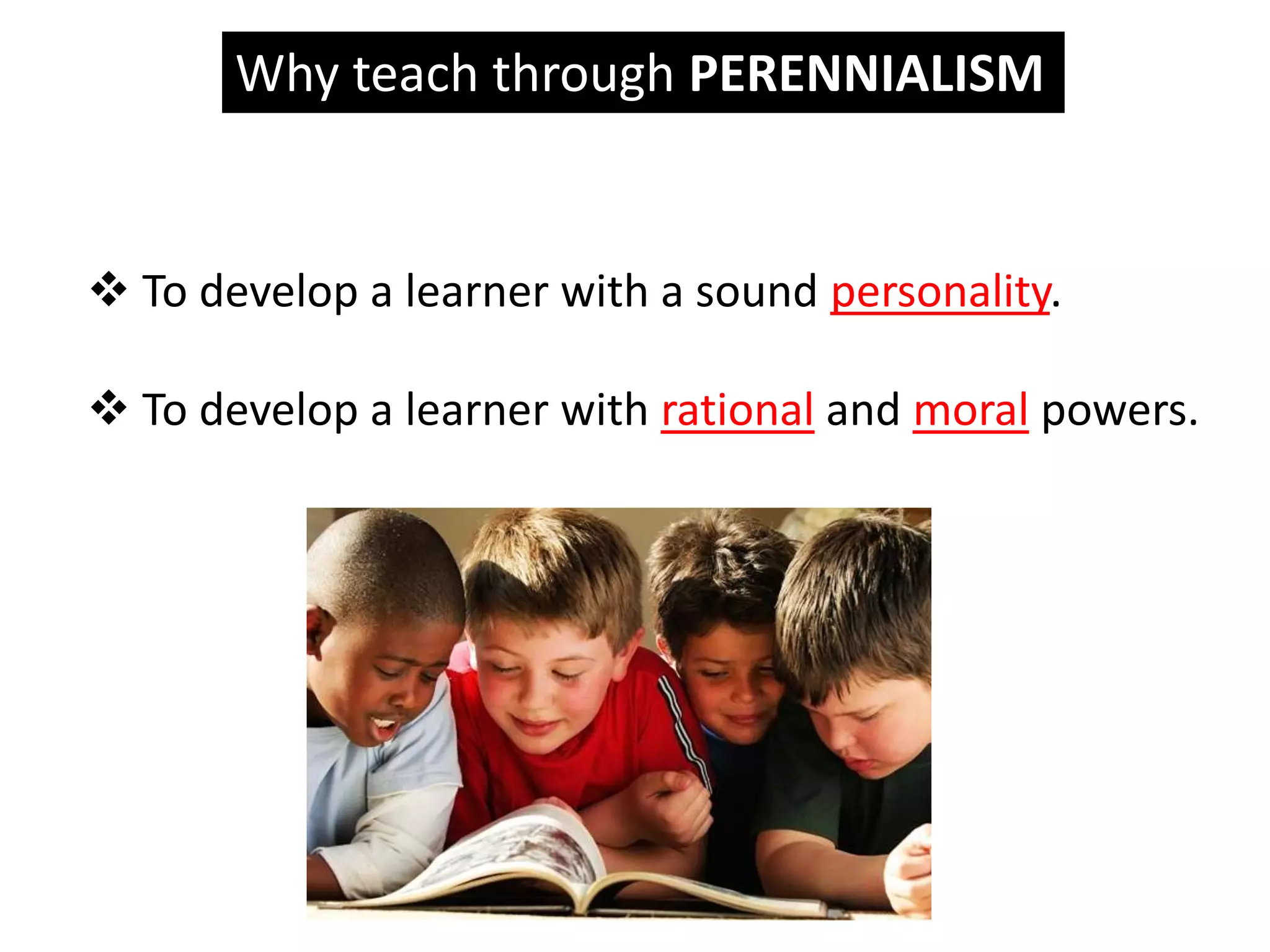
Why teach through PERENNIALISM
 To develop a learner with a sound personality.
 To develop a learner with rational and moral powers.
What to teach though PERENNIALISM
 Humanities
 Arts
 Theology
 Religion
 History
 Emphasis on the GREAT BOOKS
How to teach through PERENNIALISM
 Teachers should allow learner to learn through
the importance of reading the Great Books.
 Teachers instill to learners respect for authority,
duty, consideration and practicality.
How to teach through PERENNIALSIM
 Teachers act as the director and coach of
intellect.
 Teachers deliver clear lectures.
 Teachers coaches critical thinking skills.
Perennialism Overview
https://www.youtube.com/watch?v=NIXeigW0t1E

Perennialism in Education

  • 2.
    Introduction In PERENNIALISM, itis believed that one should teach the things that one deems to be of everlasting importance to all people everywhere. Since details of fact change constantly, these cannot be the most important.
  • 3.
    Therefore, one shouldteach principles, not facts. Since people are human, one should teach first about humans, not machines or techniques. Since people are people first, and workers second if at all, one should teach liberal topics first, not vocational topics. Introduction
  • 4.
    PERENNIALISM suggests thatthe focus of education should be the ideas that have lasted over centuries. They believe the ideas are as relevant and meaningful today as when they were written. They recommend that students learn from reading and analyzing the works by history's finest thinkers and writers. Introduction
  • 5.
    Although PERENNIALISM may appearsimilar to Essentialism, Perennialism focuses first on personal development, while Essentialism focuses first on essential skills. Essentialist curricula thus tend to be much more vocational and fact-based, and far less liberal and principle-based. Introduction
  • 6.
    The educational focusof PERENNIALISM is on the need to return to the past, namely, to the universal truths and absolutely reason and faith. Perennialists believe that God and education goes together hand in hand, and that education prepares a person for life. They also believe that schooling may come to an end but a person will never stop learning throughout their lifetime. Introduction
  • 7.
    The theory ofPERENNIALISM also believes that the environment plays a big role in teaching someone. A person learns by experience. The Philosophies of Idealism, Realism, and Neo-Thomism are embedded in this theory. They believe that having a relationship to a spiritual being is necessary for understanding the cosmos or universe. Introduction
  • 11.
    Why teach throughPERENNIALISM  To develop a learner with a sound personality.  To develop a learner with rational and moral powers.
  • 12.
    What to teachthough PERENNIALISM  Humanities  Arts  Theology  Religion  History  Emphasis on the GREAT BOOKS
  • 13.
    How to teachthrough PERENNIALISM  Teachers should allow learner to learn through the importance of reading the Great Books.  Teachers instill to learners respect for authority, duty, consideration and practicality.
  • 14.
    How to teachthrough PERENNIALSIM  Teachers act as the director and coach of intellect.  Teachers deliver clear lectures.  Teachers coaches critical thinking skills.
  • 15.