Lesson 2:
Approaches to
Curriculum Designing
Types of Curriculum
Design Models
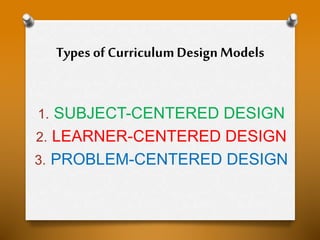
Types of CurriculumDesignModels
1. SUBJECT-CENTERED DESIGN
2. LEARNER-CENTERED DESIGN
3. PROBLEM-CENTERED DESIGN
SUBJECT-CENTERED DESIGN
1.1.Subject Design
1.2.Discipline Design
1.3.Correlation Design
1.4.Broad field
Design/Interdisciplinary
SUBJECT-CENTERED
DESIGN
O Curriculum design that focuses on the content of the
curriculum.
O Corresponds mostly to the textbook because textbooks
are usually written based the specific subject or the
course.
O Aim for excellence in the specific subject discipline
content.
O Focused on the individual subject, specific discipline
and a combination of subjects or discipline which
are a broad field or interdisciplinary.
1.1.Subject Design
OOldest and so far the most familiar
design for teachers, parents, and other
laymen.
OHas an advantages because it is easy
to deliver, by means of textbooks; a
written and instructional materials that
are commercially available.
OLearning is so compartmentalized.
1.2.Discipline Design
O Related to subject design, while the subject
design centers only on the cluster of content,
discipline design focuses on academic
disciplines.
O Discipline refers to specific knowledge learned
through a method which the scholars use to
study a specific content of their fields.
O Teachers should learn how the scholars in the
discipline will convey the particular knowledge.
O Often used in college, but not in elementary or in
secondary levels. So from the subject centered
curriculum, curriculum moves higher to a
discipline.
1.3.Correlation Design
OComing from a core, correlated
curriculum design links separate
subject design in order to reduce
fragmentation. Subjects are related to
one another and still maintain their
identity.
OTeachers should come together and
plan their lesson cooperatively.
1.4.Broad field
Design/Interdisciplinary
O It is a variation of the of the subject-centered
design.
O This design was made to cure the compartmenta-
lization of the separate subjects and integrate the
contents that are related to one another. Thus
subjects such as geography, economics, political
science, anthropology and sociology are fused into
one subject called social studies.
O Interdisciplinary design is similar to thematic
design, where a specific theme is identified, and
all other subject areas revolve around the theme.
2.LEARNER-CENTERED
DESIGN
2.1. Child-centered design
2.2. Experience-centered
design
2.3. Humanistic design
LEARNER-CENTERED
DESIGN
OAccording from it
learner is the center
of the educative
process.
2.1. Child-centered design
O This curriculum design is anchored on the needs
and interest of the child.
O The learner is not considered a passive individual
but one who engages with his/her environment.
One learns by doing.
O Learners interact with the teachers and the
environment, thus there is a collaborative effort
on both sides to plan lessons, select content and
do activities together
O Learning is a product of the child’s interaction
with the environment.
2.2 Experience-centered
design
OSimilar to child—centered design.
OFocus remains to be the child, experience-
centered design believes that the interest
and needs of learner cannot be pre-
planned. Instead, experiences of the
learners become the starting point of the
curriculum, thus the school environment is
left open and free.
OThe emerged of the multiple intelligence
theory blend well with this design.
2.3. Humanistic design
OThe key influences in this curriculum
design is Abraham Maslow and Carl
Rogers.
OMaslow’s theory of self actualization;
explains that a person who achieves this
level is accepting of self, others, and
natures.
OCarl Rogers, believed that a person can
enhance self-directed learning by
improving self understanding.
OThe developmental of self is the ultimately
objective of learning.
3.PROBLEM-CENTERED
DESIGN
3.1. Life-situations Design
3.2. Core Problem Design
PROBLEM-CENTERED
DESIGN
ODraws on social problems, needs,
interest, and abilities of the
learners.
OVarious problems are given
emphasis.
OIn this curriculum, the subject
boundaries and must be based
on the needs, concerns and
abilities of the students.
3.1. Life-situations Design
OIt uses the past and present
experience of the learners as a
mean to analyze the basic areas
of living.
OThe connection of the subject
matter to real situation increases
the relevance of the curriculum.
3.2. Core Problem Design
OIt centers on general education
and the problems that are
based on the common human
activities.
OThe central focus of the core
design includes common
needs, problems, and concerns
of the learner.
OPopularized by Faunce and
Bossing
Approaches to Curriculum
Design
Child or Learner-Centered
Approaches
OThis approach to curriculum is based on
the underlying philosophy that the child
or the learner is the center of the
educational process. It means that the
curriculum is constructed based on the
needs, purposes, and abilities of the
learners. The curriculum is also built
upon the learners knowledge, skills,
previous learnings and potential.
Subject-Centered Approach
OThis is anchored on a
curriculum design which
prescribes separate distinct
subjects for every educational
level :basic education, higher
education or vocational-
technical education.
Problem-Centered
Approach
OThis approach is based on a
design which assumes that in
the process of living, children
experience problems. Thus,
problem solving enables the
learners to become increasingly
able to achieve complete or
total development as individual.

Lesson 2 curriculum design arjay alteza

  • 1.
  • 2.
  • 3.
    Types of CurriculumDesignModels 1.SUBJECT-CENTERED DESIGN 2. LEARNER-CENTERED DESIGN 3. PROBLEM-CENTERED DESIGN
  • 4.
    SUBJECT-CENTERED DESIGN 1.1.Subject Design 1.2.DisciplineDesign 1.3.Correlation Design 1.4.Broad field Design/Interdisciplinary
  • 5.
    SUBJECT-CENTERED DESIGN O Curriculum designthat focuses on the content of the curriculum. O Corresponds mostly to the textbook because textbooks are usually written based the specific subject or the course. O Aim for excellence in the specific subject discipline content. O Focused on the individual subject, specific discipline and a combination of subjects or discipline which are a broad field or interdisciplinary.
  • 6.
    1.1.Subject Design OOldest andso far the most familiar design for teachers, parents, and other laymen. OHas an advantages because it is easy to deliver, by means of textbooks; a written and instructional materials that are commercially available. OLearning is so compartmentalized.
  • 7.
    1.2.Discipline Design O Relatedto subject design, while the subject design centers only on the cluster of content, discipline design focuses on academic disciplines. O Discipline refers to specific knowledge learned through a method which the scholars use to study a specific content of their fields. O Teachers should learn how the scholars in the discipline will convey the particular knowledge. O Often used in college, but not in elementary or in secondary levels. So from the subject centered curriculum, curriculum moves higher to a discipline.
  • 8.
    1.3.Correlation Design OComing froma core, correlated curriculum design links separate subject design in order to reduce fragmentation. Subjects are related to one another and still maintain their identity. OTeachers should come together and plan their lesson cooperatively.
  • 9.
    1.4.Broad field Design/Interdisciplinary O Itis a variation of the of the subject-centered design. O This design was made to cure the compartmenta- lization of the separate subjects and integrate the contents that are related to one another. Thus subjects such as geography, economics, political science, anthropology and sociology are fused into one subject called social studies. O Interdisciplinary design is similar to thematic design, where a specific theme is identified, and all other subject areas revolve around the theme.
  • 10.
    2.LEARNER-CENTERED DESIGN 2.1. Child-centered design 2.2.Experience-centered design 2.3. Humanistic design
  • 11.
    LEARNER-CENTERED DESIGN OAccording from it learneris the center of the educative process.
  • 12.
    2.1. Child-centered design OThis curriculum design is anchored on the needs and interest of the child. O The learner is not considered a passive individual but one who engages with his/her environment. One learns by doing. O Learners interact with the teachers and the environment, thus there is a collaborative effort on both sides to plan lessons, select content and do activities together O Learning is a product of the child’s interaction with the environment.
  • 13.
    2.2 Experience-centered design OSimilar tochild—centered design. OFocus remains to be the child, experience- centered design believes that the interest and needs of learner cannot be pre- planned. Instead, experiences of the learners become the starting point of the curriculum, thus the school environment is left open and free. OThe emerged of the multiple intelligence theory blend well with this design.
  • 14.
    2.3. Humanistic design OThekey influences in this curriculum design is Abraham Maslow and Carl Rogers. OMaslow’s theory of self actualization; explains that a person who achieves this level is accepting of self, others, and natures. OCarl Rogers, believed that a person can enhance self-directed learning by improving self understanding. OThe developmental of self is the ultimately objective of learning.
  • 15.
  • 16.
    PROBLEM-CENTERED DESIGN ODraws on socialproblems, needs, interest, and abilities of the learners. OVarious problems are given emphasis. OIn this curriculum, the subject boundaries and must be based on the needs, concerns and abilities of the students.
  • 17.
    3.1. Life-situations Design OItuses the past and present experience of the learners as a mean to analyze the basic areas of living. OThe connection of the subject matter to real situation increases the relevance of the curriculum.
  • 18.
    3.2. Core ProblemDesign OIt centers on general education and the problems that are based on the common human activities. OThe central focus of the core design includes common needs, problems, and concerns of the learner. OPopularized by Faunce and Bossing
  • 19.
  • 20.
    Child or Learner-Centered Approaches OThisapproach to curriculum is based on the underlying philosophy that the child or the learner is the center of the educational process. It means that the curriculum is constructed based on the needs, purposes, and abilities of the learners. The curriculum is also built upon the learners knowledge, skills, previous learnings and potential.
  • 21.
    Subject-Centered Approach OThis isanchored on a curriculum design which prescribes separate distinct subjects for every educational level :basic education, higher education or vocational- technical education.
  • 22.
    Problem-Centered Approach OThis approach isbased on a design which assumes that in the process of living, children experience problems. Thus, problem solving enables the learners to become increasingly able to achieve complete or total development as individual.