PLANNING & ASSESSMENT
  What do you want your students to
  know and be able to do?

  How    will you know they have learned
  it?

  What   will you do when students
  struggle with the learning?

  Planwith the end in
  mind…Backwards design (UBD)
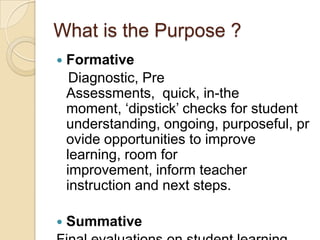
What is the Purpose ?
   Formative
     Diagnostic, Pre
    Assessments, quick, in-the
    moment, „dipstick‟ checks for student
    understanding, ongoing, purposeful, pr
    ovide opportunities to improve
    learning, room for
    improvement, inform teacher
    instruction and next steps.

   Summative
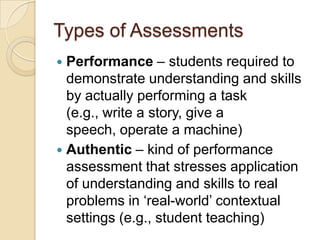
Types of Assessments
 Performance – students required to
  demonstrate understanding and skills
  by actually performing a task
  (e.g., write a story, give a
  speech, operate a machine)
 Authentic – kind of performance
  assessment that stresses application
  of understanding and skills to real
  problems in „real-world‟ contextual
  settings (e.g., student teaching)
Types of Assessments
   Alternative – non-traditional methods
    (no paper/pencil tests) used to assess

   Traditional – Tests/ quizzes
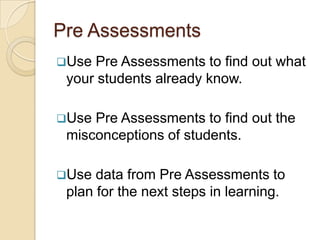
Pre Assessments
Use Pre Assessments to find out what
 your students already know.

Use Pre Assessments to find out the
 misconceptions of students.

Use  data from Pre Assessments to
 plan for the next steps in learning.
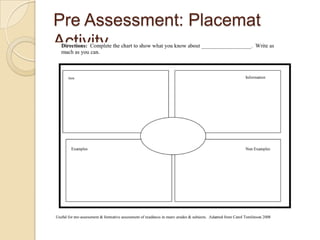
Pre Assessment: Placemat
Activity…
Pre Assessment: Journal
Writing…
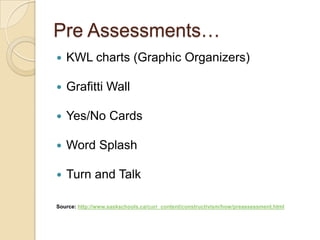
Pre Assessments…
   KWL charts (Graphic Organizers)

   Grafitti Wall

   Yes/No Cards

   Word Splash

   Turn and Talk

Source: http://www.saskschools.ca/curr_content/constructivism/how/preassessment.html
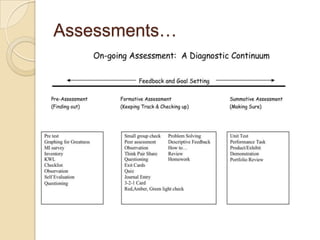
Assessments…
Planning & Preparation
What do you want your students
to know & be able to do?
 Clear   expectations

 Whatdo you want? Don‟t make the
 students guess

 What    makes a good/bad response

 How will the student know they have
 reached the goal?

 Give   constructive/timely feedback
Planning using KUD
Whenever planning a unit/lesson you
 should be able to answer these 3 key
 questions:

①   What do I want my students to Know?

②   What do I want my students to
    Understand?

③   What do I want my student to be able to
    Do?
What is a KUD?
Know your learning
outcomes...
How   will you model the learning
 outcomes and what success looks
 like?

How  will students demonstrate their
 learning of the outcomes?

How  will you know when students
 “don‟t get it”? And how will you
 respond?
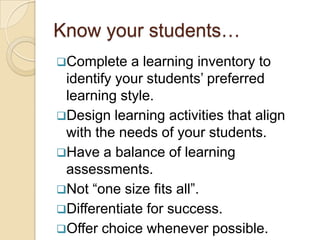
Know your students…
Complete   a learning inventory to
 identify your students‟ preferred
 learning style.
Design learning activities that align
 with the needs of your students.
Have a balance of learning
 assessments.
Not “one size fits all”.
Differentiate for success.
Offer choice whenever possible.
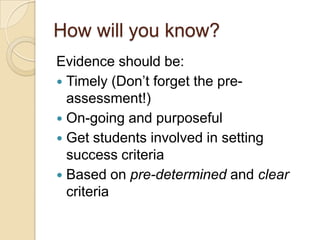
How will you know?
Evidence should be:
 Timely (Don‟t forget the pre-
  assessment!)
 On-going and purposeful
 Get students involved in setting
  success criteria
 Based on pre-determined and clear
  criteria
How will you respond?
   What is RTI?

   All students can reach high levels of
    achievement if the system is willing
    (and able) to vary the amount of time
    students have to learn and the type of
    instruction they receive.

   Differentiated Instruction
Response to Intervention (and
Instruction)
   RTI is a method to ensure that
    students receive early intervention and
    assistance before falling behind.

   Students receive supplementary
    support, guided by assessment data
    referred to as progress monitoring.

   Timely and effective intervention.
Tiers of Intervention
                                Increased
                                time, intensit
                                y, frequency
           Tier 3 : 5 – 10 %    and
                                expertise


           Tier 2 : 10 – 15 %


           Tier 1 : 75 – 85 %
Your Turn…
   **The grade 8 science class is beginning a new unit on The
    Particle Theory of Matter. The teacher needs the students to
    use appropriate vocabulary related to their investigations of
    the particle theory of matter (vocabulary such as: boiling and
    melting points, pure substance, scientific theory, particle
    theory of matter, etc.). She decided to have the students copy
    the definitions down as notes in their science notebook from
    the overhead (about 30 definitions). The students enter the
    classroom and are told to sit down and begin writing. Some
    students choose to silently engage in the note-taking (about 6
    students), while many choose to chat with friends while
    writing. The teacher responds with a „no talking‟ rule. Halfway
    through the class, the teacher realizes that there are 4
    students who have not yet begun to write down the first
    definition and there are some who are already completed the
    notes. The teacher estimated that it would take the entire 40
    minutes to write these notes, so she decides that the students
    who are done are allowed to have „free time‟ until the end of
    class.
Questions…
   How may this teacher have planned more
    effectively?

   How will you catch yourself if you make the same
    type of mistakes (ineffective planning)?

   Watch for the traps of: worksheets, „free‟-time,
    busywork, “40 minutes of silence” expectations,
    low-level thinking tasks, sit-and-get lessons.

   Lesson Closure: schedule approximately 5
    minutes at the end of each lesson to have
    students reflect, summarize, or for you to
    highlight the main focus for the class. THE BELL
    IS NOT ADEQUATE CLOSURE.
Supervision for Growth…

SJASD New Teacher Assessment

  • 1.
    PLANNING & ASSESSMENT What do you want your students to know and be able to do? How will you know they have learned it? What will you do when students struggle with the learning? Planwith the end in mind…Backwards design (UBD)
  • 2.
    What is thePurpose ?  Formative Diagnostic, Pre Assessments, quick, in-the moment, „dipstick‟ checks for student understanding, ongoing, purposeful, pr ovide opportunities to improve learning, room for improvement, inform teacher instruction and next steps.  Summative
  • 3.
    Types of Assessments Performance – students required to demonstrate understanding and skills by actually performing a task (e.g., write a story, give a speech, operate a machine)  Authentic – kind of performance assessment that stresses application of understanding and skills to real problems in „real-world‟ contextual settings (e.g., student teaching)
  • 4.
    Types of Assessments  Alternative – non-traditional methods (no paper/pencil tests) used to assess  Traditional – Tests/ quizzes
  • 5.
    Pre Assessments Use PreAssessments to find out what your students already know. Use Pre Assessments to find out the misconceptions of students. Use data from Pre Assessments to plan for the next steps in learning.
  • 6.
  • 7.
  • 8.
    Pre Assessments…  KWL charts (Graphic Organizers)  Grafitti Wall  Yes/No Cards  Word Splash  Turn and Talk Source: http://www.saskschools.ca/curr_content/constructivism/how/preassessment.html
  • 9.
  • 10.
  • 11.
    What do youwant your students to know & be able to do?  Clear expectations  Whatdo you want? Don‟t make the students guess  What makes a good/bad response  How will the student know they have reached the goal?  Give constructive/timely feedback
  • 12.
    Planning using KUD Wheneverplanning a unit/lesson you should be able to answer these 3 key questions: ① What do I want my students to Know? ② What do I want my students to Understand? ③ What do I want my student to be able to Do?
  • 13.
  • 14.
    Know your learning outcomes... How will you model the learning outcomes and what success looks like? How will students demonstrate their learning of the outcomes? How will you know when students “don‟t get it”? And how will you respond?
  • 15.
    Know your students… Complete a learning inventory to identify your students‟ preferred learning style. Design learning activities that align with the needs of your students. Have a balance of learning assessments. Not “one size fits all”. Differentiate for success. Offer choice whenever possible.
  • 16.
    How will youknow? Evidence should be:  Timely (Don‟t forget the pre- assessment!)  On-going and purposeful  Get students involved in setting success criteria  Based on pre-determined and clear criteria
  • 17.
    How will yourespond?  What is RTI?  All students can reach high levels of achievement if the system is willing (and able) to vary the amount of time students have to learn and the type of instruction they receive.  Differentiated Instruction
  • 18.
    Response to Intervention(and Instruction)  RTI is a method to ensure that students receive early intervention and assistance before falling behind.  Students receive supplementary support, guided by assessment data referred to as progress monitoring.  Timely and effective intervention.
  • 19.
    Tiers of Intervention Increased time, intensit y, frequency Tier 3 : 5 – 10 % and expertise Tier 2 : 10 – 15 % Tier 1 : 75 – 85 %
  • 20.
    Your Turn…  **The grade 8 science class is beginning a new unit on The Particle Theory of Matter. The teacher needs the students to use appropriate vocabulary related to their investigations of the particle theory of matter (vocabulary such as: boiling and melting points, pure substance, scientific theory, particle theory of matter, etc.). She decided to have the students copy the definitions down as notes in their science notebook from the overhead (about 30 definitions). The students enter the classroom and are told to sit down and begin writing. Some students choose to silently engage in the note-taking (about 6 students), while many choose to chat with friends while writing. The teacher responds with a „no talking‟ rule. Halfway through the class, the teacher realizes that there are 4 students who have not yet begun to write down the first definition and there are some who are already completed the notes. The teacher estimated that it would take the entire 40 minutes to write these notes, so she decides that the students who are done are allowed to have „free time‟ until the end of class.
  • 21.
    Questions…  How may this teacher have planned more effectively?  How will you catch yourself if you make the same type of mistakes (ineffective planning)?  Watch for the traps of: worksheets, „free‟-time, busywork, “40 minutes of silence” expectations, low-level thinking tasks, sit-and-get lessons.  Lesson Closure: schedule approximately 5 minutes at the end of each lesson to have students reflect, summarize, or for you to highlight the main focus for the class. THE BELL IS NOT ADEQUATE CLOSURE.
  • 22.

Editor's Notes

  • #18 Response to Intervention