Plagiarism and Research
Integrity
Dr. Poonam Joshi, Ph.D. Nursing
FCRMEBM, FACEN-INDIA
Associate Professor, AIIMS, New Delhi
1
Objectives
• Research Integrity
• Research Misconduct
• Plagiarism
– Types
• Stopping Plagiarism
– UGC Guidelines
– Individual level
• Plagiarism checking software
2
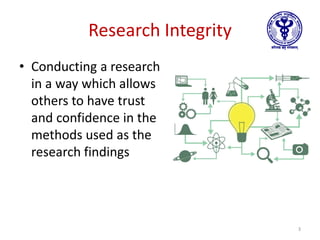
Research Integrity
• Conducting a research
in a way which allows
others to have trust
and confidence in the
methods used as the
research findings
3
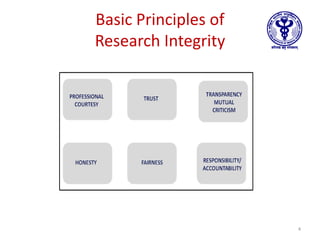
Basic Principles of
Research Integrity
4
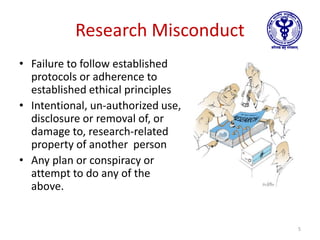
Research Misconduct
• Failure to follow established
protocols or adherence to
established ethical principles
• Intentional, un-authorized use,
disclosure or removal of, or
damage to, research-related
property of another person
• Any plan or conspiracy or
attempt to do any of the
above.
5
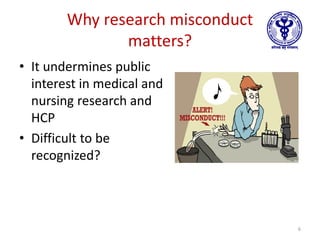
Why research misconduct
matters?
• It undermines public
interest in medical and
nursing research and
HCP
• Difficult to be
recognized?
6
Types of research misconduct
Plagiarism
Fabrication
Falsification
7
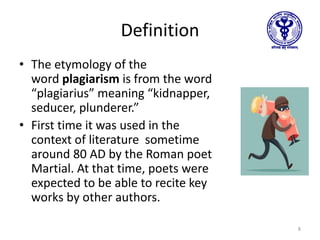
Definition
• The etymology of the
word plagiarism is from the word
“plagiarius” meaning “kidnapper,
seducer, plunderer.”
• First time it was used in the
context of literature sometime
around 80 AD by the Roman poet
Martial. At that time, poets were
expected to be able to recite key
works by other authors.
8
What is Plagiarism?
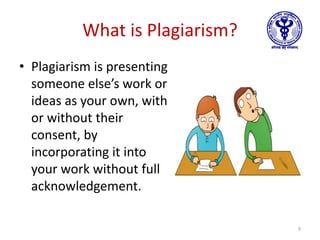
• Plagiarism is presenting
someone else’s work or
ideas as your own, with
or without their
consent, by
incorporating it into
your work without full
acknowledgement.
9
Plagiarism
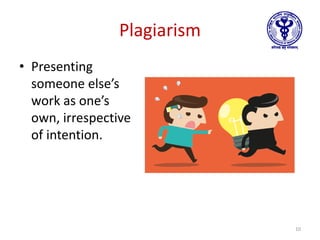
• Presenting
someone else’s
work as one’s
own, irrespective
of intention.
10
Plagiarism
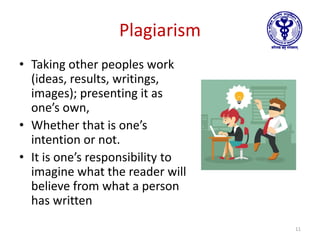
• Taking other peoples work
(ideas, results, writings,
images); presenting it as
one’s own,
• Whether that is one’s
intention or not.
• It is one’s responsibility to
imagine what the reader will
believe from what a person
has written
11
Easy access to information
• The internet has sent shock-
waves through the world of
intellectual property;
• The development of search
engines (such as Google) and
open access storage facilities
(YouTube) has created among
users an expectation of universal
availability, even a sense of
entitlement to free access.
12
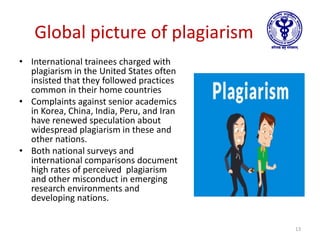
Global picture of plagiarism
• International trainees charged with
plagiarism in the United States often
insisted that they followed practices
common in their home countries
• Complaints against senior academics
in Korea, China, India, Peru, and Iran
have renewed speculation about
widespread plagiarism in these and
other nations.
• Both national surveys and
international comparisons document
high rates of perceived plagiarism
and other misconduct in emerging
research environments and
developing nations.
13
How Common is Plagiarism in India?
• In 2016 Vice-chancellor of Pondicherry University
had to quit job after a prolonged stand off with the
HRD ministry, following allegations that the person
has plagiarized large parts of one of his/her books.
• Seven Stanford University professors wrote to then
President APJ Abdul Kalam about Kumaon University
Vice-Chancellor’s conduct on the issue.
• University of Hyderabad Vice-Chancellor was accused
of plagiarizing his thesis from not one, but three
scientific papers.
Hindustan Times
14
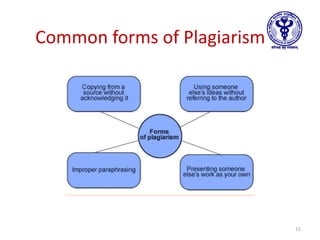
Common forms of Plagiarism
15
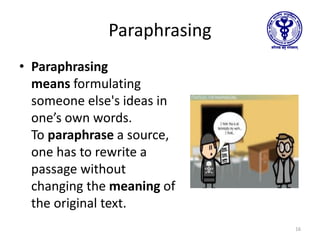
Paraphrasing
• Paraphrasing
means formulating
someone else's ideas in
one’s own words.
To paraphrase a source,
one has to rewrite a
passage without
changing the meaning of
the original text.
16
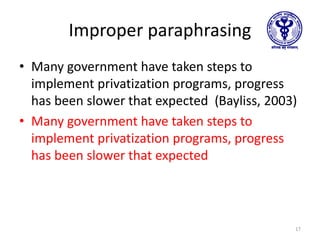
Improper paraphrasing
• Many government have taken steps to
implement privatization programs, progress
has been slower that expected (Bayliss, 2003)
• Many government have taken steps to
implement privatization programs, progress
has been slower that expected
17
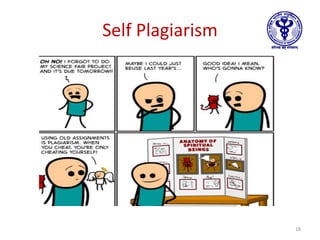
Self Plagiarism
18
Images and other media
• One must not take other people’s images (or
video clips) without explicit, written permission
from the author/publisher.
• In addition, the source must be cited.
• In most cases, using someone else’s image is
not only plagiarism, but it is illegal too.
• In almost all cases, one should create your
own diagrams.
19
20
21
UGC Professional Code of Ethics
Regulations, 2018
– They shall apply to the students, faculty,
researchers and staff of all Higher Educational
Institutions (HEI) in the country.
– These regulations shall come into force from the
date of their notification in the Official Gazette.
22
Objectives of UGC guidelines, 2018
– To create awareness about responsible conduct of
research, promotion of academic integrity and
prevention of misconduct
– To establish institutional mechanism through
education and training to facilitate deterrence
from plagiarism.
– To develop systems to detect plagiarism and to set
up mechanisms to prevent plagiarism
23
UGC guidelines
• Cardinal principles of academic integrity in the curricula of
Undergraduate (UG)/Postgraduate (PG) degree etc.
• Include elements of responsible conduct of research and
publication ethics for Masters and Research Scholars.
• Responsible conduct of research and publication ethics in
Orientation and Refresher Courses
Responsibilities of HEI…
24
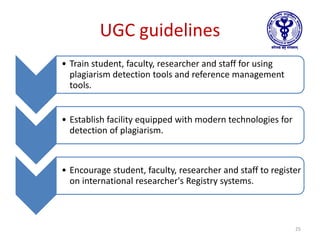
UGC guidelines
• Train student, faculty, researcher and staff for using
plagiarism detection tools and reference management
tools.
• Establish facility equipped with modern technologies for
detection of plagiarism.
• Encourage student, faculty, researcher and staff to register
on international researcher's Registry systems.
25
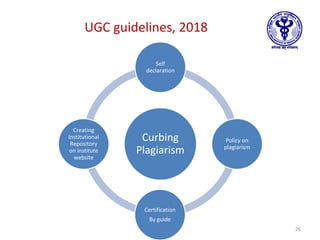
Curbing
Plagiarism
Self
declaration
Policy on
plagiarism
Certification
By guide
Creating
Institutional
Repository
on institute
website
UGC guidelines, 2018
26
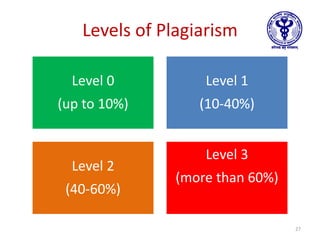
Levels of Plagiarism
Level 0
(up to 10%)
Level 1
(10-40%)
Level 2
(40-60%)
Level 3
(more than 60%)
27
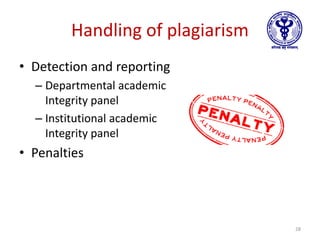
Handling of plagiarism
• Detection and reporting
– Departmental academic
Integrity panel
– Institutional academic
Integrity panel
• Penalties
28
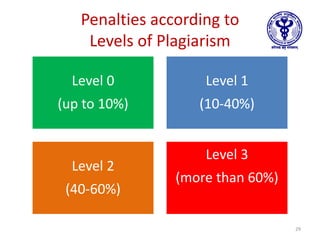
Penalties according to
Levels of Plagiarism
Level 0
(up to 10%)
Level 1
(10-40%)
Level 2
(40-60%)
Level 3
(more than 60%)
29
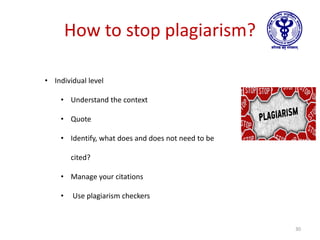
How to stop plagiarism?
• Individual level
• Understand the context
• Quote
• Identify, what does and does not need to be
cited?
• Manage your citations
• Use plagiarism checkers
30
How to stop plagiarism?
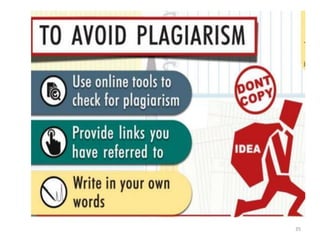
• Plagiarism is avoided by giving appropriate
citations.
• Citing adds value to one’s work
• Citing too much is better than citing too little:
if in doubt, give a citation.
31
Paraphrasing
• When repeating an argument
given by someone else, one must
paraphrase the original text.
• To avoid plagiarism, the following
is required:
– A citation, since one is still taking
the idea of the argument from
someone else.
– A substantial re-writing of the
source, not merely reproducing it
with slight changes.
32
How to paraphrase?
• Include key points and sub-points of original
source
• Write a paraphrase in your own words and use
your own sentence structure
• Always cite a paraphrase
33
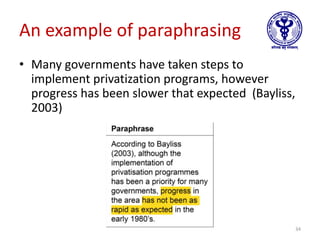
An example of paraphrasing
• Many governments have taken steps to
implement privatization programs, however
progress has been slower that expected (Bayliss,
2003)
34
35
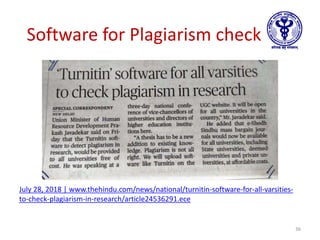
Software for Plagiarism check
July 28, 2018 | www.thehindu.com/news/national/turnitin-software-for-all-varsities-
to-check-plagiarism-in-research/article24536291.ece
36
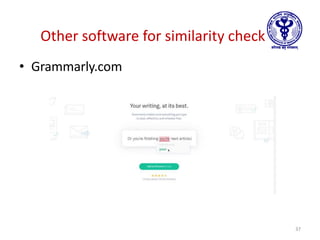
Other software for similarity check
• Grammarly.com
37
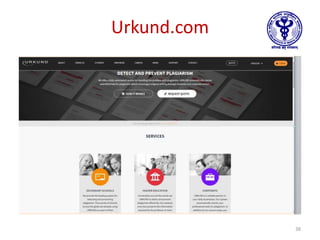
Urkund.com
38
Institutions Involved in Promoting
Research Integrity
• Society for Scientific Values (SSV), New Delhi
(est. 1986) – Website: www.scientificvalues.org
• To promote objectivity, integrity and ethical values in
pursuit of scientific research, education and
management, and,
• To discourage the unethical acts in these area.
39
Institutions Involved in Promoting
Research Integrity
• Inter Academy Panel on Ethics in Science
– Indian National Science Academy (INSA),
– Indian Academy of Sciences (IASc), and
– National Academy of Sciences India (NASI).
40
Take home message…
• Plagiarism is a disciplinary offence
• One could lose all marks on the project —even
be expelled from College!
• The College uses advanced software for
detecting it (e.g., Turn-It-In)
• Don’t do plagiarism!
41
Thank you for your kind attention.
42

Plagiarism

  • 1.
    Plagiarism and Research Integrity Dr.Poonam Joshi, Ph.D. Nursing FCRMEBM, FACEN-INDIA Associate Professor, AIIMS, New Delhi 1
  • 2.
    Objectives • Research Integrity •Research Misconduct • Plagiarism – Types • Stopping Plagiarism – UGC Guidelines – Individual level • Plagiarism checking software 2
  • 3.
    Research Integrity • Conductinga research in a way which allows others to have trust and confidence in the methods used as the research findings 3
  • 4.
  • 5.
    Research Misconduct • Failureto follow established protocols or adherence to established ethical principles • Intentional, un-authorized use, disclosure or removal of, or damage to, research-related property of another person • Any plan or conspiracy or attempt to do any of the above. 5
  • 6.
    Why research misconduct matters? •It undermines public interest in medical and nursing research and HCP • Difficult to be recognized? 6
  • 7.
    Types of researchmisconduct Plagiarism Fabrication Falsification 7
  • 8.
    Definition • The etymologyof the word plagiarism is from the word “plagiarius” meaning “kidnapper, seducer, plunderer.” • First time it was used in the context of literature sometime around 80 AD by the Roman poet Martial. At that time, poets were expected to be able to recite key works by other authors. 8
  • 9.
    What is Plagiarism? •Plagiarism is presenting someone else’s work or ideas as your own, with or without their consent, by incorporating it into your work without full acknowledgement. 9
  • 10.
    Plagiarism • Presenting someone else’s workas one’s own, irrespective of intention. 10
  • 11.
    Plagiarism • Taking otherpeoples work (ideas, results, writings, images); presenting it as one’s own, • Whether that is one’s intention or not. • It is one’s responsibility to imagine what the reader will believe from what a person has written 11
  • 12.
    Easy access toinformation • The internet has sent shock- waves through the world of intellectual property; • The development of search engines (such as Google) and open access storage facilities (YouTube) has created among users an expectation of universal availability, even a sense of entitlement to free access. 12
  • 13.
    Global picture ofplagiarism • International trainees charged with plagiarism in the United States often insisted that they followed practices common in their home countries • Complaints against senior academics in Korea, China, India, Peru, and Iran have renewed speculation about widespread plagiarism in these and other nations. • Both national surveys and international comparisons document high rates of perceived plagiarism and other misconduct in emerging research environments and developing nations. 13
  • 14.
    How Common isPlagiarism in India? • In 2016 Vice-chancellor of Pondicherry University had to quit job after a prolonged stand off with the HRD ministry, following allegations that the person has plagiarized large parts of one of his/her books. • Seven Stanford University professors wrote to then President APJ Abdul Kalam about Kumaon University Vice-Chancellor’s conduct on the issue. • University of Hyderabad Vice-Chancellor was accused of plagiarizing his thesis from not one, but three scientific papers. Hindustan Times 14
  • 15.
    Common forms ofPlagiarism 15
  • 16.
    Paraphrasing • Paraphrasing means formulating someoneelse's ideas in one’s own words. To paraphrase a source, one has to rewrite a passage without changing the meaning of the original text. 16
  • 17.
    Improper paraphrasing • Manygovernment have taken steps to implement privatization programs, progress has been slower that expected (Bayliss, 2003) • Many government have taken steps to implement privatization programs, progress has been slower that expected 17
  • 18.
  • 19.
    Images and othermedia • One must not take other people’s images (or video clips) without explicit, written permission from the author/publisher. • In addition, the source must be cited. • In most cases, using someone else’s image is not only plagiarism, but it is illegal too. • In almost all cases, one should create your own diagrams. 19
  • 20.
  • 21.
  • 22.
    UGC Professional Codeof Ethics Regulations, 2018 – They shall apply to the students, faculty, researchers and staff of all Higher Educational Institutions (HEI) in the country. – These regulations shall come into force from the date of their notification in the Official Gazette. 22
  • 23.
    Objectives of UGCguidelines, 2018 – To create awareness about responsible conduct of research, promotion of academic integrity and prevention of misconduct – To establish institutional mechanism through education and training to facilitate deterrence from plagiarism. – To develop systems to detect plagiarism and to set up mechanisms to prevent plagiarism 23
  • 24.
    UGC guidelines • Cardinalprinciples of academic integrity in the curricula of Undergraduate (UG)/Postgraduate (PG) degree etc. • Include elements of responsible conduct of research and publication ethics for Masters and Research Scholars. • Responsible conduct of research and publication ethics in Orientation and Refresher Courses Responsibilities of HEI… 24
  • 25.
    UGC guidelines • Trainstudent, faculty, researcher and staff for using plagiarism detection tools and reference management tools. • Establish facility equipped with modern technologies for detection of plagiarism. • Encourage student, faculty, researcher and staff to register on international researcher's Registry systems. 25
  • 26.
  • 27.
    Levels of Plagiarism Level0 (up to 10%) Level 1 (10-40%) Level 2 (40-60%) Level 3 (more than 60%) 27
  • 28.
    Handling of plagiarism •Detection and reporting – Departmental academic Integrity panel – Institutional academic Integrity panel • Penalties 28
  • 29.
    Penalties according to Levelsof Plagiarism Level 0 (up to 10%) Level 1 (10-40%) Level 2 (40-60%) Level 3 (more than 60%) 29
  • 30.
    How to stopplagiarism? • Individual level • Understand the context • Quote • Identify, what does and does not need to be cited? • Manage your citations • Use plagiarism checkers 30
  • 31.
    How to stopplagiarism? • Plagiarism is avoided by giving appropriate citations. • Citing adds value to one’s work • Citing too much is better than citing too little: if in doubt, give a citation. 31
  • 32.
    Paraphrasing • When repeatingan argument given by someone else, one must paraphrase the original text. • To avoid plagiarism, the following is required: – A citation, since one is still taking the idea of the argument from someone else. – A substantial re-writing of the source, not merely reproducing it with slight changes. 32
  • 33.
    How to paraphrase? •Include key points and sub-points of original source • Write a paraphrase in your own words and use your own sentence structure • Always cite a paraphrase 33
  • 34.
    An example ofparaphrasing • Many governments have taken steps to implement privatization programs, however progress has been slower that expected (Bayliss, 2003) 34
  • 35.
  • 36.
    Software for Plagiarismcheck July 28, 2018 | www.thehindu.com/news/national/turnitin-software-for-all-varsities- to-check-plagiarism-in-research/article24536291.ece 36
  • 37.
    Other software forsimilarity check • Grammarly.com 37
  • 38.
  • 39.
    Institutions Involved inPromoting Research Integrity • Society for Scientific Values (SSV), New Delhi (est. 1986) – Website: www.scientificvalues.org • To promote objectivity, integrity and ethical values in pursuit of scientific research, education and management, and, • To discourage the unethical acts in these area. 39
  • 40.
    Institutions Involved inPromoting Research Integrity • Inter Academy Panel on Ethics in Science – Indian National Science Academy (INSA), – Indian Academy of Sciences (IASc), and – National Academy of Sciences India (NASI). 40
  • 41.
    Take home message… •Plagiarism is a disciplinary offence • One could lose all marks on the project —even be expelled from College! • The College uses advanced software for detecting it (e.g., Turn-It-In) • Don’t do plagiarism! 41
  • 42.
    Thank you foryour kind attention. 42