OSCE/OSPE in Pediatric
Nursing
Prof.(Dr.) Smriti Arora
smritiamt@msn.com
Introduction
• a step in the direction of competency-based evaluation
• Inline with new BSc curriculum
• With appropriate attention to design, acceptable reliability and validity can be
achieved for the OSCE.
• inspire students' critical thinking and promote students' communication skills
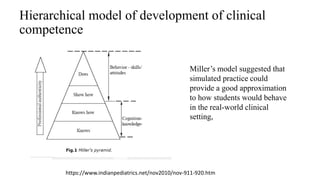
Hierarchical model of development of clinical
competence
Miller’s model suggested that
simulated practice could
provide a good approximation
to how students would behave
in the real-world clinical
setting,
https://www.indianpediatrics.net/nov2010/nov-911-920.htm
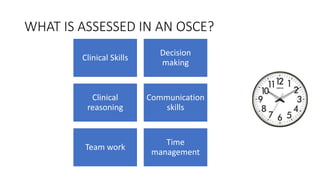
WHAT IS ASSESSED IN AN OSCE?
Clinical Skills
Decision
making
Clinical
reasoning
Communication
skills
Team work
Time
management
Where it can be done ?
• Clinical areas like wards- real patients can be used
• Labs – simulated environment can be used
Before OSCE
• Plan time – 60-120 mins, 5-10 mins at each station
• Space with sound proof partition, table, chair, articles
• Trained Manpower- examiners, simulated or real patients, helpers
• Plan stations (manned and unmanned) as per the objectives,
curriculum. Ensure adequate no. of stations (10-12, increases validity
and reliability)
• Decide on Rotations
• Make a rest station also.
• Give clear instructions to students and examiners about rotations, time
limit and evaluation criteria
• Stationery- answer sheets, drop box, paper, calculator
• Validated Checklists with scoring criteria; answer key for unmanned
stations
• bell, timer
• Camera for feedback
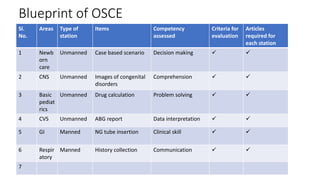
Blueprint of OSCE
Sl.
No.
Areas Type of
station
Items Competency
assessed
Criteria for
evaluation
Articles
required for
each station
1 Newb
orn
care
Unmanned Case based scenario Decision making  
2 CNS Unmanned Images of congenital
disorders
Comprehension  
3 Basic
pediat
rics
Unmanned Drug calculation Problem solving  
4 CVS Unmanned ABG report Data interpretation  
5 GI Manned NG tube insertion Clinical skill  
6 Respir
atory
Manned History collection Communication  
7
After OSCE
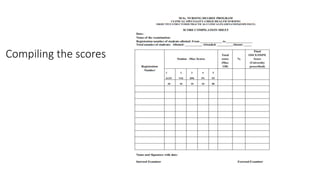
• Compile the scores
• Give Feedback
• Verbally
• Video recording
Manned stations
• Ask the student to perform at each station
• Mannequin, simulated or real patients can be
taken.
• Ensure all articles needed for the procedure
are present.
• Evaluator at a station is must
• Have prepared checklist to evaluate the
procedure
• Maintain time limit
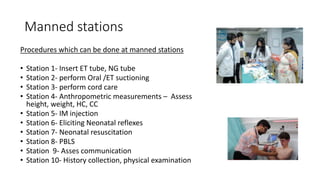
Manned stations
Procedures which can be done at manned stations
• Station 1- Insert ET tube, NG tube
• Station 2- perform Oral /ET suctioning
• Station 3- perform cord care
• Station 4- Anthropometric measurements – Assess
height, weight, HC, CC
• Station 5- IM injection
• Station 6- Eliciting Neonatal reflexes
• Station 7- Neonatal resuscitation
• Station 8- PBLS
• Station 9- Asses communication
• Station 10- History collection, physical examination
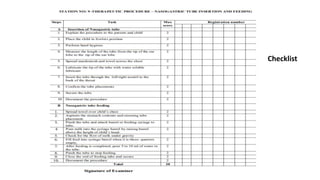
Checklist
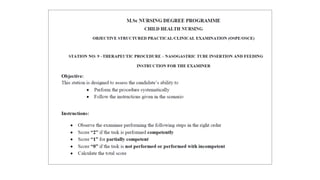
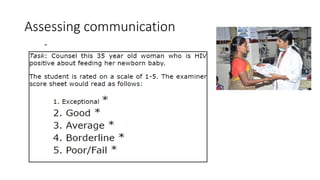
Assessing communication
Unmanned stations
• The evaluator is not present
• Student reads the instructions and writes the answers on coded
sheets.
Examples:
• Case based scenarios- to assess critical thinking
• Calculations- Drug calculations, Drop rate calculation, BSA, BMI
• Image/video based questions- disease condition, s/s, Mx
• Identification of equipment or Parts of Equipment, their uses
• Interpretation of lab reports- LFT, KFT, CBC, ABG
Examples of Unmanned Stations
• Fill in Growth charts
• Show Video clips- students record their responses
• Filling of APGAR score, BALLARD scoring
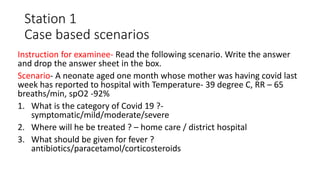
Station 1
Case based scenarios
Instruction for examinee- Read the following scenario. Write the answer
and drop the answer sheet in the box.
Scenario- A neonate aged one month whose mother was having covid last
week has reported to hospital with Temperature- 39 degree C, RR – 65
breaths/min, spO2 -92%
1. What is the category of Covid 19 ?-
symptomatic/mild/moderate/severe
2. Where will he be treated ? – home care / district hospital
3. What should be given for fever ?
antibiotics/paracetamol/corticosteroids
Station 1
Answer Key with scores
Sl. No. Answer Score
1 Moderate 2
2 District hospital 2
3 Paracetamol 2
Total 6
Station 2
• Scenario – As shown in the image, 2 year old Rajani, female child 3
hours post partial thickness scald burn due to spillage of boiling
water. The burns are on the anterior trunk and neck, right upper
extremity and the right side of the face. There are large blisters on the
trunk and upper extremity. In addition, there are splash marks on the
left lower and upper extremities without blisters and have intact skin.
Weight of the child is 12 kgs.
1. Estimate the percentage of burns using Lund and Browder burn chart
and calculate the fluid to be replaced.
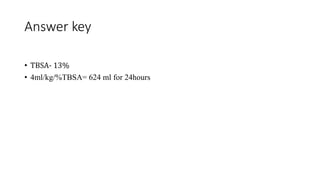
Answer key
• TBSA- 13%
• 4ml/kg/%TBSA= 624 ml for 24hours
Station 3 - Image based
Instructions for examinees- See the following
image carefully . Write the answers in the
response sheet and drop in the box
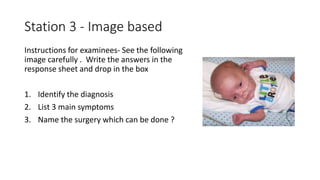
1. Identify the diagnosis
2. List 3 main symptoms
3. Name the surgery which can be done ?
Station 3
Answer Key
Sl. No. Answer Score
1 Hydrocephalus 2
2 Sunset eyes, enlarged
head, visible scalp veins
2
3 VP Shunt 2
Total 6
Station 4
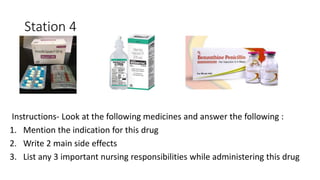
Instructions- Look at the following medicines and answer the following :
1. Mention the indication for this drug
2. Write 2 main side effects
3. List any 3 important nursing responsibilities while administering this drug
Station 5
Drug calculation
• The pediatrician has prescribed IV ringer lactate , 1 litre for 8 hours.
IV set to be used is calibrated at 10 drops/ml.
1. What will be the flow rate in ml/ hr ?
2. What will be the drop rate per minute ?
Station 5
Answer key
• Flow rate - 1000/8= 125 ml/hr
• Drop rate/min – 125/60= 20.8 drops/min= 21 drops/min
Station 6
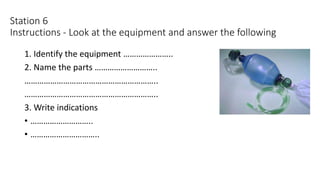
Instructions - Look at the equipment and answer the following
1. Identify the equipment …………………..
2. Name the parts ………………………..
……………………………………………………..
……………………………………………………..
3. Write indications
• ………………………..
• …………………………..
Identification of equipment
1
2
3
4
5
6
Station 7 - Interpreting reports
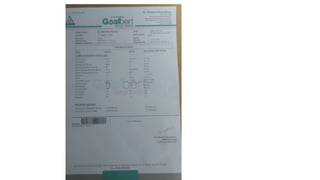
• This is the lab report of a child aged 13 years admitted with
complains of lethargy and fever. Write the interpretation in the
answer sheet.
Sl. No. Test Findings Interpretation/
Remarks
1 Serum potassium 3.6 meq/L
2 Serum sodium 140 meq/L
3 Hemoglobin 7 gm/dl
4 Platelets 50,000
5 WBC 20,000
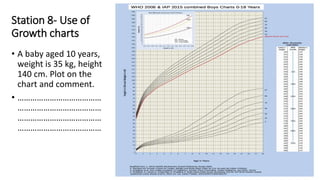
Station 8- Use of
Growth charts
• A baby aged 10 years,
weight is 35 kg, height
140 cm. Plot on the
chart and comment.
• …………………………………
…………………………………
…………………………………
…………………………………
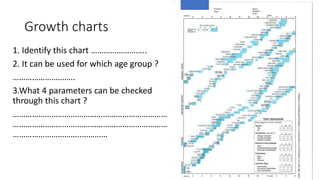
Growth charts
1. Identify this chart ……………………..
2. It can be used for which age group ?
………………………..
3.What 4 parameters can be checked
through this chart ?
………………………………………………………………
………………………………………………………………
…………………………..…………
Station 9 - Video clips
• Show the video clips of a child with chest retractions and nasal
flaring/tet spell
1. What is the finding ? ………………………………
2. What is the probable diagnosis of the child ? …………………………
3. What are the nursing interventions for this child ?
……………………………………………………………………………………………………………
……………………………………………………………………………………………………………
……………………………………………………………………………………..
Station 10-Identification of congenital anomalies
MM 2x5=10
Fig 1
Fig 2
Fig 3
Fig 4
Fig 5
Compiling the scores
Summary
• Chung-Pei Fu et al examined the satisfaction and the influences of
OSCE in pediatric occupation therapy 60 examinees and 44 child
patients. 88.3% of the examinees reported that the OSCE was
helpful for their upcoming clinical training. 73.3% preferred the
OSCE over the written exam. 60-93.4% considered the
implementation appropriate.
• Ali Emadzadeh et al determined the challenges of the OSCE
National Board Exam in Iran for final-year pediatrics and gynecology
residents. The main complaint reported was the disproportion of the
allowed time and the task load in the exam stages.
• Fu CP, Yeh JH, Su CT, Liu CH, Chang WY, Chen YL, Yang AL, Wang CC. Med Teach. 2017
Aug;39(8):851-858. doi: 10.1080/0142159X.2017.1320540. Epub 2017 Apr
27.PMID: 28449609
• https://pubmed.ncbi.nlm.nih.gov/28607655/
Well Plan is half work done !
Thank you !

OSCE paeds.pptx

  • 1.
    OSCE/OSPE in Pediatric Nursing Prof.(Dr.)Smriti Arora smritiamt@msn.com
  • 2.
    Introduction • a stepin the direction of competency-based evaluation • Inline with new BSc curriculum • With appropriate attention to design, acceptable reliability and validity can be achieved for the OSCE. • inspire students' critical thinking and promote students' communication skills
  • 3.
    Hierarchical model ofdevelopment of clinical competence Miller’s model suggested that simulated practice could provide a good approximation to how students would behave in the real-world clinical setting, https://www.indianpediatrics.net/nov2010/nov-911-920.htm
  • 4.
    WHAT IS ASSESSEDIN AN OSCE? Clinical Skills Decision making Clinical reasoning Communication skills Team work Time management
  • 5.
    Where it canbe done ? • Clinical areas like wards- real patients can be used • Labs – simulated environment can be used
  • 7.
    Before OSCE • Plantime – 60-120 mins, 5-10 mins at each station • Space with sound proof partition, table, chair, articles • Trained Manpower- examiners, simulated or real patients, helpers • Plan stations (manned and unmanned) as per the objectives, curriculum. Ensure adequate no. of stations (10-12, increases validity and reliability) • Decide on Rotations • Make a rest station also. • Give clear instructions to students and examiners about rotations, time limit and evaluation criteria • Stationery- answer sheets, drop box, paper, calculator • Validated Checklists with scoring criteria; answer key for unmanned stations • bell, timer • Camera for feedback
  • 8.
    Blueprint of OSCE Sl. No. AreasType of station Items Competency assessed Criteria for evaluation Articles required for each station 1 Newb orn care Unmanned Case based scenario Decision making   2 CNS Unmanned Images of congenital disorders Comprehension   3 Basic pediat rics Unmanned Drug calculation Problem solving   4 CVS Unmanned ABG report Data interpretation   5 GI Manned NG tube insertion Clinical skill   6 Respir atory Manned History collection Communication   7
  • 9.
    After OSCE • Compilethe scores • Give Feedback • Verbally • Video recording
  • 10.
    Manned stations • Askthe student to perform at each station • Mannequin, simulated or real patients can be taken. • Ensure all articles needed for the procedure are present. • Evaluator at a station is must • Have prepared checklist to evaluate the procedure • Maintain time limit
  • 11.
    Manned stations Procedures whichcan be done at manned stations • Station 1- Insert ET tube, NG tube • Station 2- perform Oral /ET suctioning • Station 3- perform cord care • Station 4- Anthropometric measurements – Assess height, weight, HC, CC • Station 5- IM injection • Station 6- Eliciting Neonatal reflexes • Station 7- Neonatal resuscitation • Station 8- PBLS • Station 9- Asses communication • Station 10- History collection, physical examination
  • 12.
  • 14.
  • 15.
    Unmanned stations • Theevaluator is not present • Student reads the instructions and writes the answers on coded sheets. Examples: • Case based scenarios- to assess critical thinking • Calculations- Drug calculations, Drop rate calculation, BSA, BMI • Image/video based questions- disease condition, s/s, Mx • Identification of equipment or Parts of Equipment, their uses • Interpretation of lab reports- LFT, KFT, CBC, ABG
  • 16.
    Examples of UnmannedStations • Fill in Growth charts • Show Video clips- students record their responses • Filling of APGAR score, BALLARD scoring
  • 17.
    Station 1 Case basedscenarios Instruction for examinee- Read the following scenario. Write the answer and drop the answer sheet in the box. Scenario- A neonate aged one month whose mother was having covid last week has reported to hospital with Temperature- 39 degree C, RR – 65 breaths/min, spO2 -92% 1. What is the category of Covid 19 ?- symptomatic/mild/moderate/severe 2. Where will he be treated ? – home care / district hospital 3. What should be given for fever ? antibiotics/paracetamol/corticosteroids
  • 18.
    Station 1 Answer Keywith scores Sl. No. Answer Score 1 Moderate 2 2 District hospital 2 3 Paracetamol 2 Total 6
  • 19.
    Station 2 • Scenario– As shown in the image, 2 year old Rajani, female child 3 hours post partial thickness scald burn due to spillage of boiling water. The burns are on the anterior trunk and neck, right upper extremity and the right side of the face. There are large blisters on the trunk and upper extremity. In addition, there are splash marks on the left lower and upper extremities without blisters and have intact skin. Weight of the child is 12 kgs. 1. Estimate the percentage of burns using Lund and Browder burn chart and calculate the fluid to be replaced.
  • 21.
    Answer key • TBSA-13% • 4ml/kg/%TBSA= 624 ml for 24hours
  • 22.
    Station 3 -Image based Instructions for examinees- See the following image carefully . Write the answers in the response sheet and drop in the box 1. Identify the diagnosis 2. List 3 main symptoms 3. Name the surgery which can be done ?
  • 23.
    Station 3 Answer Key Sl.No. Answer Score 1 Hydrocephalus 2 2 Sunset eyes, enlarged head, visible scalp veins 2 3 VP Shunt 2 Total 6
  • 24.
    Station 4 Instructions- Lookat the following medicines and answer the following : 1. Mention the indication for this drug 2. Write 2 main side effects 3. List any 3 important nursing responsibilities while administering this drug
  • 25.
    Station 5 Drug calculation •The pediatrician has prescribed IV ringer lactate , 1 litre for 8 hours. IV set to be used is calibrated at 10 drops/ml. 1. What will be the flow rate in ml/ hr ? 2. What will be the drop rate per minute ?
  • 26.
    Station 5 Answer key •Flow rate - 1000/8= 125 ml/hr • Drop rate/min – 125/60= 20.8 drops/min= 21 drops/min
  • 27.
    Station 6 Instructions -Look at the equipment and answer the following 1. Identify the equipment ………………….. 2. Name the parts ……………………….. …………………………………………………….. …………………………………………………….. 3. Write indications • ……………………….. • …………………………..
  • 28.
  • 29.
    Station 7 -Interpreting reports • This is the lab report of a child aged 13 years admitted with complains of lethargy and fever. Write the interpretation in the answer sheet. Sl. No. Test Findings Interpretation/ Remarks 1 Serum potassium 3.6 meq/L 2 Serum sodium 140 meq/L 3 Hemoglobin 7 gm/dl 4 Platelets 50,000 5 WBC 20,000
  • 31.
    Station 8- Useof Growth charts • A baby aged 10 years, weight is 35 kg, height 140 cm. Plot on the chart and comment. • ………………………………… ………………………………… ………………………………… …………………………………
  • 32.
    Growth charts 1. Identifythis chart …………………….. 2. It can be used for which age group ? ……………………….. 3.What 4 parameters can be checked through this chart ? ……………………………………………………………… ……………………………………………………………… …………………………..…………
  • 33.
    Station 9 -Video clips • Show the video clips of a child with chest retractions and nasal flaring/tet spell 1. What is the finding ? ……………………………… 2. What is the probable diagnosis of the child ? ………………………… 3. What are the nursing interventions for this child ? …………………………………………………………………………………………………………… …………………………………………………………………………………………………………… ……………………………………………………………………………………..
  • 34.
    Station 10-Identification ofcongenital anomalies MM 2x5=10 Fig 1 Fig 2 Fig 3 Fig 4 Fig 5
  • 35.
  • 36.
    Summary • Chung-Pei Fuet al examined the satisfaction and the influences of OSCE in pediatric occupation therapy 60 examinees and 44 child patients. 88.3% of the examinees reported that the OSCE was helpful for their upcoming clinical training. 73.3% preferred the OSCE over the written exam. 60-93.4% considered the implementation appropriate. • Ali Emadzadeh et al determined the challenges of the OSCE National Board Exam in Iran for final-year pediatrics and gynecology residents. The main complaint reported was the disproportion of the allowed time and the task load in the exam stages. • Fu CP, Yeh JH, Su CT, Liu CH, Chang WY, Chen YL, Yang AL, Wang CC. Med Teach. 2017 Aug;39(8):851-858. doi: 10.1080/0142159X.2017.1320540. Epub 2017 Apr 27.PMID: 28449609 • https://pubmed.ncbi.nlm.nih.gov/28607655/
  • 37.
    Well Plan ishalf work done ! Thank you !

Editor's Notes

  • #4 Miller’s pyramid model divides the development of clinical competence into four, hierarchical processes.1 On the lowest level of the pyramid is ‘knowledge’, tested by written exams and traditional multiple-choice questions (MCQs).2 The next level stands for ‘application of knowledge’, assessed by essays, clinical problem-solving exercises and extended MCQs.2 The third tier of the pyramid represents ‘clinical skills competency’, assessed by standardized patient exercises, simulations and clinical exams.2 Finally, on top of the pyramid is ‘clinical performance’, assessed by direct observation in real clinical settings.2 The lower level processes account for the cognitive components of competence and involve classroom-based assessments, while the two higher tiers of the pyramid account for the behavioural components of clinical competence, which involve assessment in simulated and real clinical settings.3  By placing the observable behaviour at the apex of the hierarchy, Miller’s pyramid implies a preference towards the behaviourist tradition, as opposed to cognitive perspectives. Miller’s model suggested that simulated practice could provide a good approximation to how students would behave in the real-world clinical setting, and therefore firmly argued for the introduction of performance-based assessments.