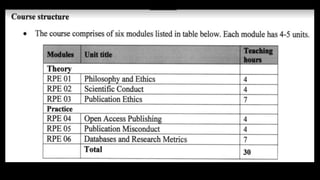
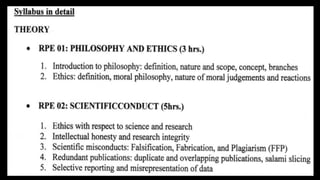
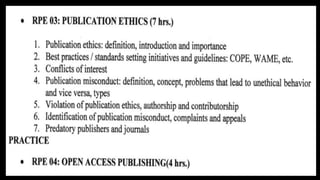
The document discusses the importance of research and publication ethics, highlighting the philosophical underpinnings of scientific inquiry and the ethical implications of scientific conduct and publishing practices. It covers various aspects including the philosophy of science, skepticism, publication ethics organizations, and research metrics such as impact factors, h-index, g-index, and i10-index. Additionally, it emphasizes the need for adherence to established ethical guidelines and the significance of contributing original knowledge to the scientific community.
Introduces the theme of research and publication ethics as an important subject for consideration.
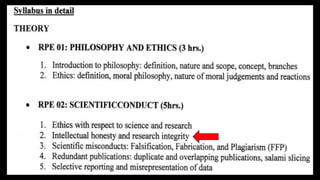
Discusses philosophy and ethics concerning scientific inquiry and theory validation. Key concepts include truth, morality, and criteria for scientific validity.
Explores the ideas of skepticism and knowability, discussing doubts about accepted beliefs and the philosophical implications of knowledge.
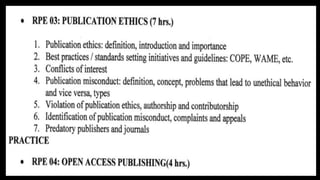
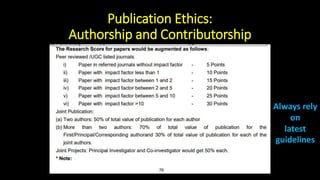
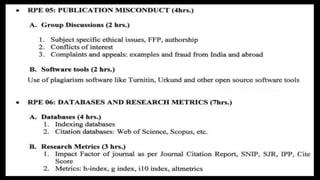
Covers essential publication ethics such as originality, authorship, plagiarism, and key organizations like COPE and WAME guiding ethical publishing.
Highlights the UGC Care List for credible journals and warns about predatory publishing practices impacting research integrity.
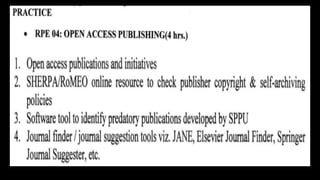
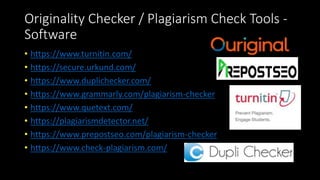
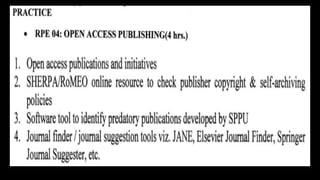
Provides information about tools and resources for academic publishing, including copyright policies, journal finders, and originality checkers.
Discusses research metrics like Journal Impact Factor, h-index, g-index, i10-index, and profiles like ORCID and Scopus to evaluate scholarly work.
Wraps up key aspects of ethics in research and publication, including ethical conduct, metrics, and researcher profiles, providing a comprehensive overview.
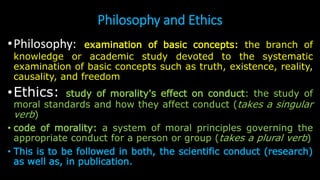
Philosophy and Ethics
•Philosophy:examination of basic concepts: the branch of
knowledge or academic study devoted to the systematic
examination of basic concepts such as truth, existence, reality,
causality, and freedom
•Ethics: study of morality's effect on conduct: the study of
moral standards and how they affect conduct (takes a singular
verb)
• code of morality: a system of moral principles governing the
appropriate conduct for a person or group (takes a plural verb)
• This is to be followed in both, the scientific conduct (research)
as well as, in publication.
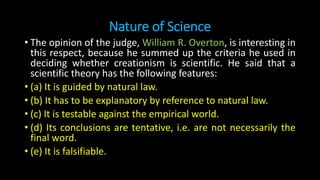
Nature of Science
•The opinion of the judge, William R. Overton, is interesting in
this respect, because he summed up the criteria he used in
deciding whether creationism is scientific. He said that a
scientific theory has the following features:
• (a) It is guided by natural law.
• (b) It has to be explanatory by reference to natural law.
• (c) It is testable against the empirical world.
• (d) Its conclusions are tentative, i.e. are not necessarily the
final word.
• (e) It is falsifiable.
11.
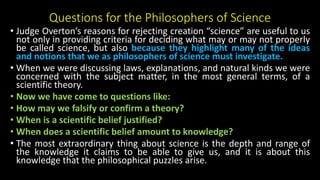
Questions for thePhilosophers of Science
• Judge Overton’s reasons for rejecting creation “science” are useful to us
not only in providing criteria for deciding what may or may not properly
be called science, but also because they highlight many of the ideas
and notions that we as philosophers of science must investigate.
• When we were discussing laws, explanations, and natural kinds we were
concerned with the subject matter, in the most general terms, of a
scientific theory.
• Now we have come to questions like:
• How may we falsify or confirm a theory?
• When is a scientific belief justified?
• When does a scientific belief amount to knowledge?
• The most extraordinary thing about science is the depth and range of
the knowledge it claims to be able to give us, and it is about this
knowledge that the philosophical puzzles arise.
12.
Skepticism and Knowability
•Skeptic:
• somebody who doubts something is true: a doubter of accepted beliefs
• somebody denying knowledge is possible: a member of an ancient
Greek school of philosophy holding the doctrine that real knowledge is
impossible, or a later follower of this doctrine. [Late 16th century. Via
Latin < Greek skeptikos "follower of the Greek philosopher Pyrrho“]
• JoHari Window: I don’t know what I don’t know
14.
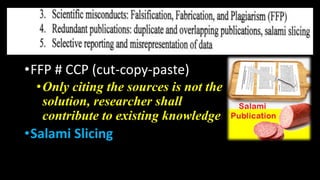
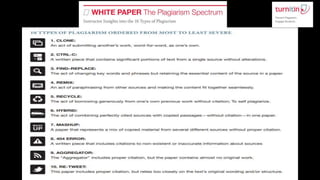
•FFP # CCP(cut-copy-paste)
•Only citing the sources is not the
solution, researcher shall
contribute to existing knowledge
•Salami Slicing
17.
COPE | WAME
•COPE (Committee on Publication Ethics) is committed to
educating and supporting editors, publishers and those
involved in publication ethics with the aim of moving the culture
of publishing towards one where ethical practices
become a normal part of the publishing culture.
• WAME (World Association of Medical Editors) (pronounced
“whammy”) is a 501(c)(3) nonprofit voluntary association of editors
of peer-reviewed medical journals from countries throughout the
world who seek to foster international cooperation among and
education of medical journal editors.
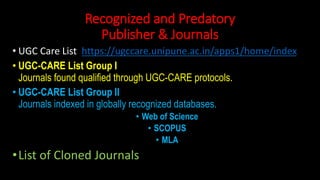
Recognized and Predatory
Publisher& Journals
• UGC Care List https://ugccare.unipune.ac.in/apps1/home/index
• UGC-CARE List Group I
Journals found qualified through UGC-CARE protocols.
• UGC-CARE List Group II
Journals indexed in globally recognized databases.
• Web of Science
• SCOPUS
• MLA
•List of Cloned Journals
21.
• SHERPA (Securinga Hybrid Environment for Research
Preservation and Access) is an organization originally set up
in 2002 to run and manage the SHERPA Project.
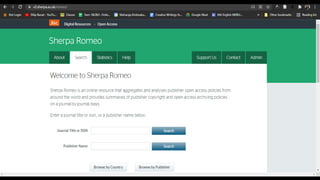
• SHERPA/RoMEO is a service run by SHERPA to show the
copyright and open access self-archiving policies of academic
journals. RoMEO is an acronym for Rights MEtadata for Open
archiving.
• https://v2.sherpa.ac.uk/romeo/ (Screen shot on next slide)
24.
Journal Finder /Suggester Tool
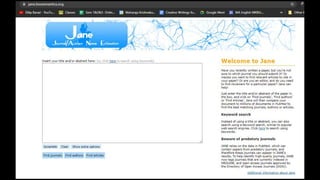
•https://jane.biosemantics.org/
•https://journalsuggester.springer.com/
•https://journalfinder.elsevier.com/
•https://ugccare.unipune.ac.in/Apps1/User/
WebA/CAREList
Research Metrics
• JournalImpact Factor
• Research metrics are measures used to quantify the influence or impact of
scholarly work. Some examples of this are bibliometrics (methods to
analyze and track scholarly literature), citation analysis, and altmetrics (a
more recent set of alternative methods that attempt to track and analyze
scholarship through various digital media.)
• The development of electronic indexes, Science Citation Index (1963) and
Social Sciences Citation Index (1973), that traced citations to scholarly articles
led to an offshoot database, Journal Citation Reports (1975), that displayed
the journal impact factor. The journal impact factor is a widely used
research metric though its use is often criticized.
27.
h-Index
• [Jorge Hirsch– /Hor-he/]
• Jorge Hirsch in 2005 published a methodology
called the h-index as a citation-based measure of a
scholars total output. This has become a required
measure in some fields.
• For example, if an author has five publications, with
9, 7, 6, 2, and 1 citations (ordered from greatest to
least), then the author's h-index is 3, because the
author has three publications with 3 or more
citations. However, the author does not have four
publications with 4 or more citations.
28.
g-Index
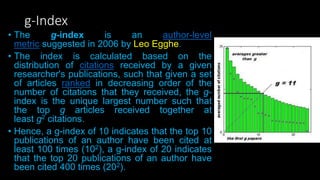
• The g-indexis an author-level
metric suggested in 2006 by Leo Egghe.
• The index is calculated based on the
distribution of citations received by a given
researcher's publications, such that given a set
of articles ranked in decreasing order of the
number of citations that they received, the g-
index is the unique largest number such that
the top g articles received together at
least g2 citations.
• Hence, a g-index of 10 indicates that the top 10
publications of an author have been cited at
least 100 times (102), a g-index of 20 indicates
that the top 20 publications of an author have
been cited 400 times (202).
29.
i10-index
• The i10-indexindicates the number of academic
publications an author has written that have been
cited by at least 10 sources.
• It was introduced in July 2011 by Google as part
of their work on Google Scholar.
30.
Research Profile
• ORCID,which stands for Open Researcher and Contributor ID, is a
global, not-for-profit organization
• https://info.orcid.org/benefits-for-researchers/
• Scopus is the largest abstract and citation database of peer-
reviewed literature: scientific journals, books and conference
proceedings. Delivering a comprehensive overview of the world's
research output in the fields of science, technology, medicine, social
sciences, and arts and humanities, Scopus features smart tools to
track, analyze and visualize research.
• https://www.scopus.com/freelookup/form/author.uri
• https://www.researcherid.com/#rid-for-researchers
31.
Thank you.
www.dilipbarad.com
•We havecovered . . .
•What is scientific conduct – ethics in research – scientific
temperament –
•Ethical behavior in research, collaboration
•Ethics in publication – plagiarism etc
•Research Metrics
• Author level metrics to journal level metrics
• Research Profile Digital Platforms