

PUBLICATION ETHICS:
DEFINITIONS, INTRODUCTION
& IMPORTANCE
Department of Education (M.Ed.)
Mangalore University, Mangalore
20 February 2022
HELLO!
I am Vasantha Raju N.
Librarian
Government First Grade College-Talakadu
You can mail me at
vasanthrz@gmail.com
2
3
What is Publication Ethics?
“the principles and standards associated with the process
of publishing the results of scientific research or scholarly
work in general.
These include such requirements as giving the appropriate credit
and authorship status to those who have earned it; ensuring that
appropriate citations are given to ideas, methodology, or findings
from another study; not submitting the same article to more than
one journal simultaneously; and not submitting results for
republication without indicating that they have already been
published elsewhere”
- APA Dictionary of Psychology
“ “Most people say that it is the
intellect which makes a great
scientist. They are wrong: it is
character.”
- Albert Einstein
4
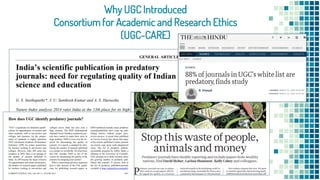
Why UGC Introduced
Consortium for Academic and Research Ethics
(UGC-CARE)
5
6
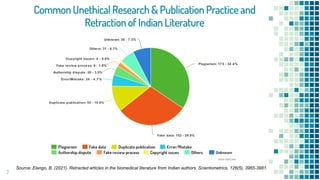
Common Unethical Research & Publication Practice and
Retraction of Indian Literature
7
Source: Elango, B. (2021). Retracted articles in the biomedical literature from Indian authors. Scientometrics, 126(5), 3965-3981.
• Authorship
An author is someone who has made a significant
contribution to the work reported: in terms of
research conception or design, or acquisition of
data, or the analysis and interpretation of data.
8
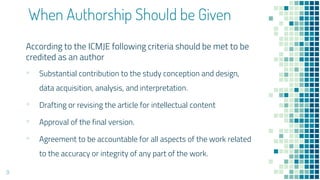
When Authorship Should be Given
According to the ICMJE following criteria should be met to be
credited as an author
▪ Substantial contribution to the study conception and design,
data acquisition, analysis, and interpretation.
▪ Drafting or revising the article for intellectual content
▪ Approval of the final version.
▪ Agreement to be accountable for all aspects of the work related
to the accuracy or integrity of any part of the work.
9
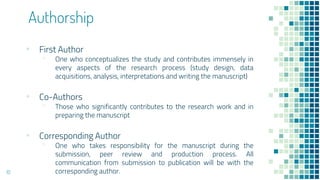
Authorship
▪ First Author
▫ One who conceptualizes the study and contributes immensely in
every aspects of the research process (study design, data
acquisitions, analysis, interpretations and writing the manuscript)
▪ Co-Authors
▫ Those who significantly contributes to the research work and in
preparing the manuscript
▪ Corresponding Author
▫ One who takes responsibility for the manuscript during the
submission, peer review and production process. All
communication from submission to publication will be with the
corresponding author.
10
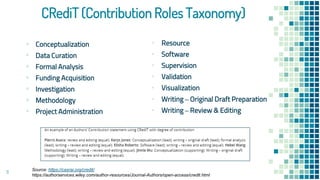
 Conceptualization
 Data Curation
 Formal Analysis
 Funding Acquisition
 Investigation
 Methodology
 Project Administration
CRediT (Contribution Roles Taxonomy)
▪ Resource
▪ Software
▪ Supervision
▪ Validation
▪ Visualization
▪ Writing – Original Draft Preparation
▪ Writing – Review & Editing
11
Source: https://casrai.org/credit/
https://authorservices.wiley.com/author-resources/Journal-Authors/open-access/credit.html
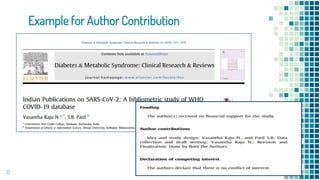
Example for Author Contribution
12
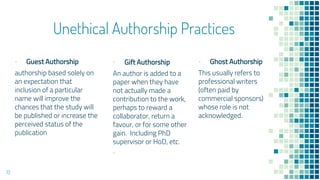
Unethical Authorship Practices
▪ Guest Authorship
authorship based solely on
an expectation that
inclusion of a particular
name will improve the
chances that the study will
be published or increase the
perceived status of the
publication
▪ Gift Authorship
An author is added to a
paper when they have
not actually made a
contribution to the work,
perhaps to reward a
collaborator, return a
favour, or for some other
gain. Including PhD
supervisor or HoD, etc.
▪
▪ Ghost Authorship
This usually refers to
professional writers
(often paid by
commercial sponsors)
whose role is not
acknowledged.
13
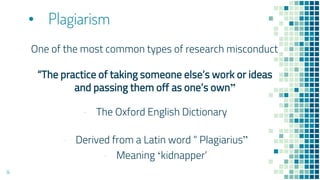
• Plagiarism
One of the most common types of research misconduct
“The practice of taking someone else’s work or ideas
and passing them off as one’s own”
- The Oxford English Dictionary
- Derived from a Latin word “ Plagiarius”
- Meaning ‘kidnapper’
14
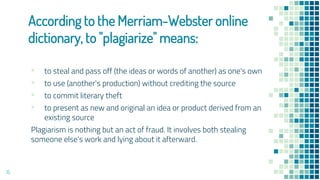
According to the Merriam-Webster online
dictionary, to "plagiarize" means:
▪ to steal and pass off (the ideas or words of another) as one's own
▪ to use (another's production) without crediting the source
▪ to commit literary theft
▪ to present as new and original an idea or product derived from an
existing source
Plagiarism is nothing but an act of fraud. It involves both stealing
someone else's work and lying about it afterward.
15
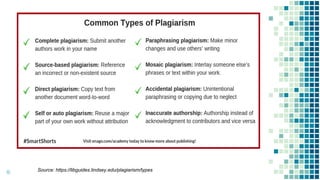
16 Source: https://libguides.lindsey.edu/plagiarism/types
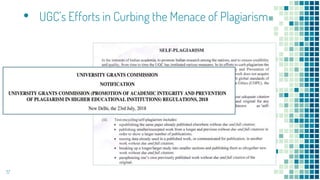
• UGC’s Efforts in Curbing the Menace of Plagiarism
17
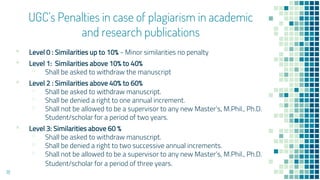
UGC’s Penalties in case of plagiarism in academic
and research publications
▪ Level 0 : Similarities up to 10% - Minor similarities no penalty
▪ Level 1: Similarities above 10% to 40%
▫ Shall be asked to withdraw the manuscript
▪ Level 2 : Similarities above 40% to 60%
▫ Shall be asked to withdraw manuscript.
▫ Shall be denied a right to one annual increment.
▫ Shall not be allowed to be a supervisor to any new Master’s, M.Phil., Ph.D.
Student/scholar for a period of two years.
▪ Level 3: Similarities above 60 %
▫ Shall be asked to withdraw manuscript.
▫ Shall be denied a right to two successive annual increments.
▫ Shall not be allowed to be a supervisor to any new Master’s, M.Phil., Ph.D.
Student/scholar for a period of three years.
18
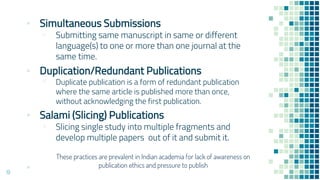
▪ Simultaneous Submissions
▫ Submitting same manuscript in same or different
language(s) to one or more than one journal at the
same time.
▪ Duplication/Redundant Publications
▫ Duplicate publication is a form of redundant publication
where the same article is published more than once,
without acknowledging the first publication.
▪ Salami (Slicing) Publications
▫ Slicing single study into multiple fragments and
develop multiple papers out of it and submit it.
▪
19
These practices are prevalent in Indian academia for lack of awareness on
publication ethics and pressure to publish
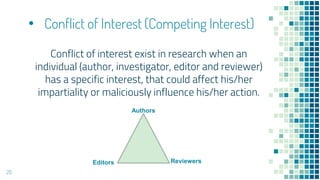
• Conflict of Interest (Competing Interest)
Conflict of interest exist in research when an
individual (author, investigator, editor and reviewer)
has a specific interest, that could affect his/her
impartiality or maliciously influence his/her action.
20
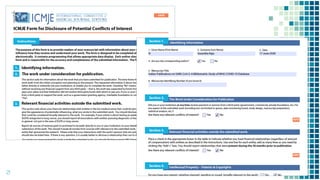
Authors
Editors Reviewers
21
• Research Frauds
▪ Fabrication
▫ Making up research data and results, and recording or
reporting them
▪ Falsification
▫ manipulating research materials, images, data, equipment,
or processes, or changing or omitting data or results such
that the research is not accurately represented in the
research record.
22
Source: Elsevier Ethics in Research & Publication
23
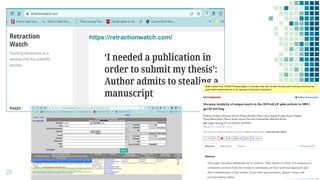
https://retractionwatch.com/
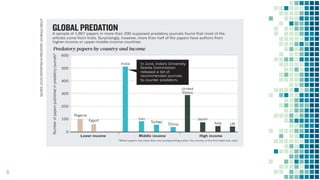
• Predatory Journals
▪ Stop publishing in predatory journals
▪ Use appropriate indexing databases to select
good journals
▫ Web of Science (Woo's)
▫ Scopus
▫ PubMed
▫ DOAJ (Directory of Open Access Journals)
▫ Cabell’s Journal Analytics
▫ UGC-CARE List
24
Be Aware of Fake Journal Metrics
▪ Advanced Science Index
▪ Cosmos Impact Factor
▪ Directory of Journal Quality Factor
▪ Global Impact Factor
▪ IndexCopernicus
▪ International Scientific Indexing (ISI)
▪ Scientific Indexing Services (SIS)
▪ Universal Impact Factor, and other fake metrics
25
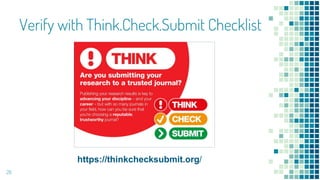
Verify with Think.Check.Submit Checklist
26
https://thinkchecksubmit.org/
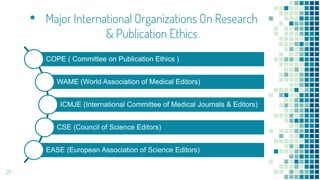
• Major International Organizations On Research
& Publication Ethics
27
COPE ( Committee on Publication Ethics )
WAME (World Association of Medical Editors)
ICMJE (International Committee of Medical Journals & Editors)
CSE (Council of Science Editors)
EASE (European Association of Science Editors)
28
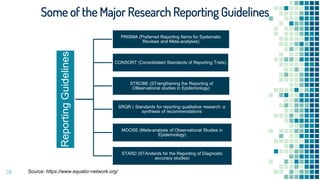
Some of the Major Research Reporting Guidelines
Reporting
Guidelines
PRISMA (Preferred Reporting Items for Systematic
Reviews and Meta-analyses)
CONSORT (Consolidated Standards of Reporting Trials)
STROBE (STrengthening the Reporting of
OBservational studies in Epidemiology)
SRQR ( Standards for reporting qualitative research: a
synthesis of recommendations
MOOSE (Meta-analysis of Observational Studies in
Epidemiology)
STARD (STAndards for the Reporting of Diagnostic
accuracy studies)
Source: https://www.equator-network.org/
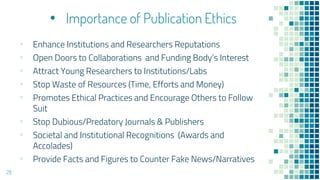
• Importance of Publication Ethics
▪ Enhance Institutions and Researchers Reputations
▪ Open Doors to Collaborations and Funding Body’s Interest
▪ Attract Young Researchers to Institutions/Labs
▪ Stop Waste of Resources (Time, Efforts and Money)
▪ Promotes Ethical Practices and Encourage Others to Follow
Suit
▪ Stop Dubious/Predatory Journals & Publishers
▪ Societal and Institutional Recognitions (Awards and
Accolades)
▪ Provide Facts and Figures to Counter Fake News/Narratives
29
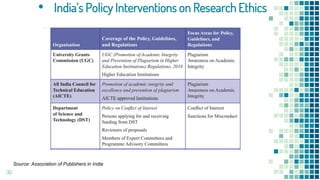
• India’s Policy Interventions on Research Ethics
30
Source: Association of Publishers in India
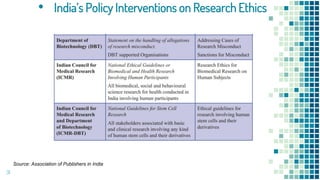
• India’s Policy Interventions on Research Ethics
31
Source: Association of Publishers in India
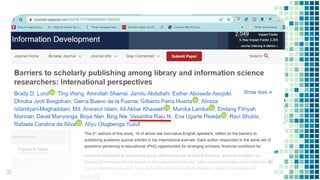
Barriers in Scholarly Publishing
& How to Overcome this by adopting
Ethical Publication Practices
Using Open Science Platforms
32
33
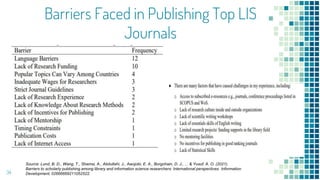
Barriers Faced in Publishing Top LIS
Journals
34
Source: Lund, B. D., Wang, T., Shamsi, A., Abdullahi, J., Awojobi, E. A., Borgohain, D. J., ... & Yusuf, A. O. (2021).
Barriers to scholarly publishing among library and information science researchers: International perspectives. Information
Development, 02666669211052522.
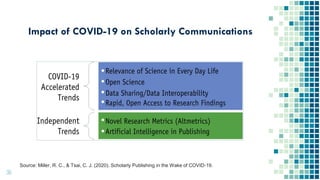
Impact of COVID-19 on Scholarly Communications
35
Source: Miller, R. C., & Tsai, C. J. (2020). Scholarly Publishing in the Wake of COVID-19.
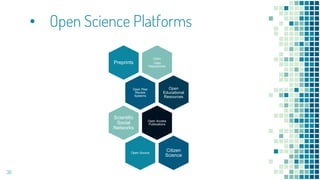
• Open Science Platforms
36
Open
Data
Repositories
Preprints
Open Peer
Review
Systems
Open
Educational
Resources
Open Access
Publications
Scientific
Social
Networks
Open Source
Citizen
Science
• Preprints
▪ “A preprint is a version of a scientific manuscript
posted on a public server prior to formal peer
review. As soon as it’s posted, your preprint
becomes a permanent part of the scientific record,
citable with its own unique DOI”
37
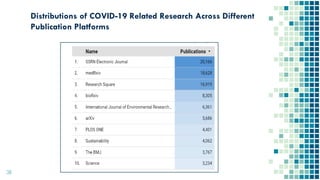
Distributions of COVID-19 Related Research Across Different
Publication Platforms
38
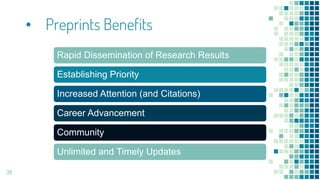
• Preprints Benefits
39
Rapid Dissemination of Research Results
Establishing Priority
Increased Attention (and Citations)
Career Advancement
Community
Unlimited and Timely Updates
40
41
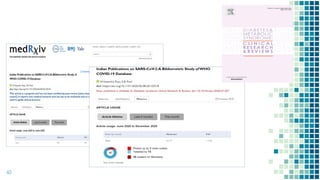
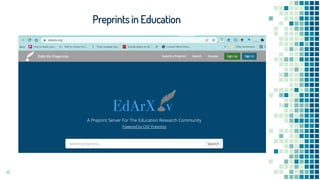
Preprints in Education
• Open Data Repositories
Open research data refers to the data
underpinning scientific research results
that has no restrictions on its access,
enabling anyone to access it.
42
43
44
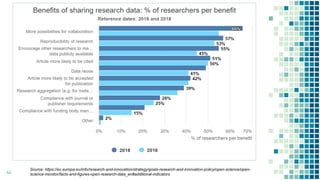
Source: https://ec.europa.eu/info/research-and-innovation/strategy/goals-research-and-innovation-policy/open-science/open-
science-monitor/facts-and-figures-open-research-data_en#additional-indicators
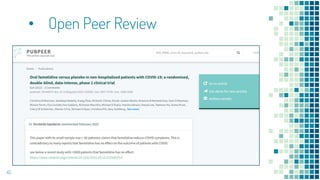
• Open Peer Review
45
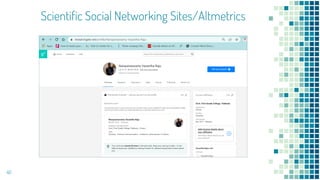
Scientific Social Networking Sites/Altmetrics
46
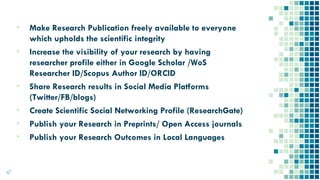
▪ Make Research Publication freely available to everyone
which upholds the scientific integrity
▪ Increase the visibility of your research by having
researcher profile either in Google Scholar /WoS
Researcher ID/Scopus Author ID/ORCID
▪ Share Research results in Social Media Platforms
(Twitter/FB/blogs)
▪ Create Scientific Social Networking Profile (ResearchGate)
▪ Publish your Research in Preprints/ Open Access journals
▪ Publish your Research Outcomes in Local Languages
47
Our Initiative
Research &
Publication Support
for College Faculty
http://researchhelpgfgctdk.in/.
48
THANKS!
Any questions?
You can mail me at:
vasanthrz@gmail.com
49
Presentation template by SlidesCarnival

Publication ethics: Definitions, Introduction and Importance

  • 1.
    PUBLICATION ETHICS: DEFINITIONS, INTRODUCTION &IMPORTANCE Department of Education (M.Ed.) Mangalore University, Mangalore 20 February 2022
  • 2.
    HELLO! I am VasanthaRaju N. Librarian Government First Grade College-Talakadu You can mail me at vasanthrz@gmail.com 2
  • 3.
    3 What is PublicationEthics? “the principles and standards associated with the process of publishing the results of scientific research or scholarly work in general. These include such requirements as giving the appropriate credit and authorship status to those who have earned it; ensuring that appropriate citations are given to ideas, methodology, or findings from another study; not submitting the same article to more than one journal simultaneously; and not submitting results for republication without indicating that they have already been published elsewhere” - APA Dictionary of Psychology
  • 4.
    “ “Most peoplesay that it is the intellect which makes a great scientist. They are wrong: it is character.” - Albert Einstein 4
  • 5.
    Why UGC Introduced Consortiumfor Academic and Research Ethics (UGC-CARE) 5
  • 6.
  • 7.
    Common Unethical Research& Publication Practice and Retraction of Indian Literature 7 Source: Elango, B. (2021). Retracted articles in the biomedical literature from Indian authors. Scientometrics, 126(5), 3965-3981.
  • 8.
    • Authorship An authoris someone who has made a significant contribution to the work reported: in terms of research conception or design, or acquisition of data, or the analysis and interpretation of data. 8
  • 9.
    When Authorship Shouldbe Given According to the ICMJE following criteria should be met to be credited as an author ▪ Substantial contribution to the study conception and design, data acquisition, analysis, and interpretation. ▪ Drafting or revising the article for intellectual content ▪ Approval of the final version. ▪ Agreement to be accountable for all aspects of the work related to the accuracy or integrity of any part of the work. 9
  • 10.
    Authorship ▪ First Author ▫One who conceptualizes the study and contributes immensely in every aspects of the research process (study design, data acquisitions, analysis, interpretations and writing the manuscript) ▪ Co-Authors ▫ Those who significantly contributes to the research work and in preparing the manuscript ▪ Corresponding Author ▫ One who takes responsibility for the manuscript during the submission, peer review and production process. All communication from submission to publication will be with the corresponding author. 10
  • 11.
     Conceptualization  DataCuration  Formal Analysis  Funding Acquisition  Investigation  Methodology  Project Administration CRediT (Contribution Roles Taxonomy) ▪ Resource ▪ Software ▪ Supervision ▪ Validation ▪ Visualization ▪ Writing – Original Draft Preparation ▪ Writing – Review & Editing 11 Source: https://casrai.org/credit/ https://authorservices.wiley.com/author-resources/Journal-Authors/open-access/credit.html
  • 12.
    Example for AuthorContribution 12
  • 13.
    Unethical Authorship Practices ▪Guest Authorship authorship based solely on an expectation that inclusion of a particular name will improve the chances that the study will be published or increase the perceived status of the publication ▪ Gift Authorship An author is added to a paper when they have not actually made a contribution to the work, perhaps to reward a collaborator, return a favour, or for some other gain. Including PhD supervisor or HoD, etc. ▪ ▪ Ghost Authorship This usually refers to professional writers (often paid by commercial sponsors) whose role is not acknowledged. 13
  • 14.
    • Plagiarism One ofthe most common types of research misconduct “The practice of taking someone else’s work or ideas and passing them off as one’s own” - The Oxford English Dictionary - Derived from a Latin word “ Plagiarius” - Meaning ‘kidnapper’ 14
  • 15.
    According to theMerriam-Webster online dictionary, to "plagiarize" means: ▪ to steal and pass off (the ideas or words of another) as one's own ▪ to use (another's production) without crediting the source ▪ to commit literary theft ▪ to present as new and original an idea or product derived from an existing source Plagiarism is nothing but an act of fraud. It involves both stealing someone else's work and lying about it afterward. 15
  • 16.
  • 17.
    • UGC’s Effortsin Curbing the Menace of Plagiarism 17
  • 18.
    UGC’s Penalties incase of plagiarism in academic and research publications ▪ Level 0 : Similarities up to 10% - Minor similarities no penalty ▪ Level 1: Similarities above 10% to 40% ▫ Shall be asked to withdraw the manuscript ▪ Level 2 : Similarities above 40% to 60% ▫ Shall be asked to withdraw manuscript. ▫ Shall be denied a right to one annual increment. ▫ Shall not be allowed to be a supervisor to any new Master’s, M.Phil., Ph.D. Student/scholar for a period of two years. ▪ Level 3: Similarities above 60 % ▫ Shall be asked to withdraw manuscript. ▫ Shall be denied a right to two successive annual increments. ▫ Shall not be allowed to be a supervisor to any new Master’s, M.Phil., Ph.D. Student/scholar for a period of three years. 18
  • 19.
    ▪ Simultaneous Submissions ▫Submitting same manuscript in same or different language(s) to one or more than one journal at the same time. ▪ Duplication/Redundant Publications ▫ Duplicate publication is a form of redundant publication where the same article is published more than once, without acknowledging the first publication. ▪ Salami (Slicing) Publications ▫ Slicing single study into multiple fragments and develop multiple papers out of it and submit it. ▪ 19 These practices are prevalent in Indian academia for lack of awareness on publication ethics and pressure to publish
  • 20.
    • Conflict ofInterest (Competing Interest) Conflict of interest exist in research when an individual (author, investigator, editor and reviewer) has a specific interest, that could affect his/her impartiality or maliciously influence his/her action. 20 Authors Editors Reviewers
  • 21.
  • 22.
    • Research Frauds ▪Fabrication ▫ Making up research data and results, and recording or reporting them ▪ Falsification ▫ manipulating research materials, images, data, equipment, or processes, or changing or omitting data or results such that the research is not accurately represented in the research record. 22 Source: Elsevier Ethics in Research & Publication
  • 23.
  • 24.
    • Predatory Journals ▪Stop publishing in predatory journals ▪ Use appropriate indexing databases to select good journals ▫ Web of Science (Woo's) ▫ Scopus ▫ PubMed ▫ DOAJ (Directory of Open Access Journals) ▫ Cabell’s Journal Analytics ▫ UGC-CARE List 24
  • 25.
    Be Aware ofFake Journal Metrics ▪ Advanced Science Index ▪ Cosmos Impact Factor ▪ Directory of Journal Quality Factor ▪ Global Impact Factor ▪ IndexCopernicus ▪ International Scientific Indexing (ISI) ▪ Scientific Indexing Services (SIS) ▪ Universal Impact Factor, and other fake metrics 25
  • 26.
    Verify with Think.Check.SubmitChecklist 26 https://thinkchecksubmit.org/
  • 27.
    • Major InternationalOrganizations On Research & Publication Ethics 27 COPE ( Committee on Publication Ethics ) WAME (World Association of Medical Editors) ICMJE (International Committee of Medical Journals & Editors) CSE (Council of Science Editors) EASE (European Association of Science Editors)
  • 28.
    28 Some of theMajor Research Reporting Guidelines Reporting Guidelines PRISMA (Preferred Reporting Items for Systematic Reviews and Meta-analyses) CONSORT (Consolidated Standards of Reporting Trials) STROBE (STrengthening the Reporting of OBservational studies in Epidemiology) SRQR ( Standards for reporting qualitative research: a synthesis of recommendations MOOSE (Meta-analysis of Observational Studies in Epidemiology) STARD (STAndards for the Reporting of Diagnostic accuracy studies) Source: https://www.equator-network.org/
  • 29.
    • Importance ofPublication Ethics ▪ Enhance Institutions and Researchers Reputations ▪ Open Doors to Collaborations and Funding Body’s Interest ▪ Attract Young Researchers to Institutions/Labs ▪ Stop Waste of Resources (Time, Efforts and Money) ▪ Promotes Ethical Practices and Encourage Others to Follow Suit ▪ Stop Dubious/Predatory Journals & Publishers ▪ Societal and Institutional Recognitions (Awards and Accolades) ▪ Provide Facts and Figures to Counter Fake News/Narratives 29
  • 30.
    • India’s PolicyInterventions on Research Ethics 30 Source: Association of Publishers in India
  • 31.
    • India’s PolicyInterventions on Research Ethics 31 Source: Association of Publishers in India
  • 32.
    Barriers in ScholarlyPublishing & How to Overcome this by adopting Ethical Publication Practices Using Open Science Platforms 32
  • 33.
  • 34.
    Barriers Faced inPublishing Top LIS Journals 34 Source: Lund, B. D., Wang, T., Shamsi, A., Abdullahi, J., Awojobi, E. A., Borgohain, D. J., ... & Yusuf, A. O. (2021). Barriers to scholarly publishing among library and information science researchers: International perspectives. Information Development, 02666669211052522.
  • 35.
    Impact of COVID-19on Scholarly Communications 35 Source: Miller, R. C., & Tsai, C. J. (2020). Scholarly Publishing in the Wake of COVID-19.
  • 36.
    • Open SciencePlatforms 36 Open Data Repositories Preprints Open Peer Review Systems Open Educational Resources Open Access Publications Scientific Social Networks Open Source Citizen Science
  • 37.
    • Preprints ▪ “Apreprint is a version of a scientific manuscript posted on a public server prior to formal peer review. As soon as it’s posted, your preprint becomes a permanent part of the scientific record, citable with its own unique DOI” 37
  • 38.
    Distributions of COVID-19Related Research Across Different Publication Platforms 38
  • 39.
    • Preprints Benefits 39 RapidDissemination of Research Results Establishing Priority Increased Attention (and Citations) Career Advancement Community Unlimited and Timely Updates
  • 40.
  • 41.
  • 42.
    • Open DataRepositories Open research data refers to the data underpinning scientific research results that has no restrictions on its access, enabling anyone to access it. 42
  • 43.
  • 44.
  • 45.
    • Open PeerReview 45
  • 46.
    Scientific Social NetworkingSites/Altmetrics 46
  • 47.
    ▪ Make ResearchPublication freely available to everyone which upholds the scientific integrity ▪ Increase the visibility of your research by having researcher profile either in Google Scholar /WoS Researcher ID/Scopus Author ID/ORCID ▪ Share Research results in Social Media Platforms (Twitter/FB/blogs) ▪ Create Scientific Social Networking Profile (ResearchGate) ▪ Publish your Research in Preprints/ Open Access journals ▪ Publish your Research Outcomes in Local Languages 47
  • 48.
    Our Initiative Research & PublicationSupport for College Faculty http://researchhelpgfgctdk.in/. 48
  • 49.
    THANKS! Any questions? You canmail me at: vasanthrz@gmail.com 49 Presentation template by SlidesCarnival