ACADEMIC MISCONDUCTS
UDAYAN BHATTACHARYA
DEPARTMENT OF LIBRARY & INFORMATION SCIENCE
JADAVPUR UNIVERSITY
MISCONDUCT
WIKIPEDIA
In law, misconduct is wrongful, improper, or unlawful conduct
motivated by premeditated or intentional purpose or by obstinate
indifference to the consequences of one's acts. Misconduct can be
considered an unacceptable or improper behavior, especially for a
professional person.
Black’s Law dictionary defines ‘Misconduct’ as “A transgression of
some established and definite rule of action, a forbidden act, a
dereliction from duty, unlawful behaviour, wilful in character, improper
or wrong behaviour”.
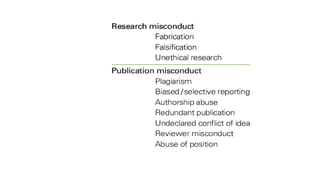
TYPES OF ACADEMIC MISCONDUCT
INCLUDES RESEARCH AND PUBLICATION MISCONDUCT
1. FABRICATION
2. FALSIFICATION
3. PLAGIARISM
4. FAILURE TO GET ETHICAL APPROVAL
5. NOT ADMITTING THAT SOME DATA RE
MISSING
6. IGNORING OUTLIERS WITHOUT DECLARING
IT
7. NOT INCLUDING DATA ON SIDE EFFECTS IN
A CLINICAL TRIAL
8. CONDUCTING RESEARCH ON HUMAN
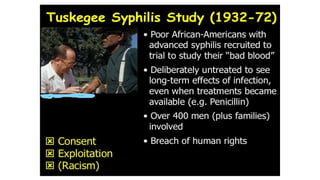
WITHOUT INFORMED CONSENT
9. PUBLICATION OF POST HOC ANALYSIS
WITHOUT DECLARING IT
10. GIFT AUTHORSHIP
11. Photo manipulation
1. GHOST AUTHORSHIP
2. NOT ATTRIBUTING OTHER AUTHORS
3. REDUNDANT PUBLICATION
4. NOT DISCLOSING CONFLICT OF INTEREST
5. NOT ATTEMPTING TO PUBLISH COMPLETE
RESEARCH
6. FAILURE TO DO AN ADEQUATE SEARCH OF
EXISTING RESEARCH BEFORE BEGINNING
NEW RESEARCH
7. DUPLICATE PUBLICATION
8. ABUSE OF THE PEER REVIEW PROCESS
9. EXPLOITATION
10. HELICOPTER RESEARCH
11. SALAMI SLICING
Fabrication
Fabrication is the construction and/or addition of data,
observations, or characterizations that never occurred
in the gathering of data or running of experiments.
Fabrication can occur when “filling out” the rest of
experiment runs, for example. Claims about results
need to be made on complete data sets (as is normally
assumed), where claims made based on incomplete or
assumed results is a form of fabrication.
ONTOGENY RECAPITULATES
PHYLOGENY-HAECKEL
Falsification
Falsification is the changing or omission of research
results (data) to support claims, hypotheses, other
data, etc. Falsification can include the manipulation of
research instrumentation, materials, or processes.
Manipulation of images or representations in a manner
that distorts the data or “reads too much between the
lines” can also be considered falsification.
Ethical approval
If a student plans to do research involving human
participants, whether directly or indirectly - e.g. interviews,
questionnaires, focus groups, observations, accessing
personal data about individuals, any human biological
materials - then the research must be independently ethically
reviewed and approved BEFORE the student begins data
gathering. The supervisor is responsible for ensuring that
this takes place. Failure to gain ethics approval may result in
the student's dissertation or thesis being failed or deemed
ineligible for submission. Guidance on the different routes for
obtaining ethics approval, and when each applies, is
available from the University's central research ethics
website, along with the University's full Research Ethics
Policy and broader guidance on ethical issues.
CONDUCTING RESEARCH
ON HUMAN WITHOUT
INFORMED CONSENT
WHAT IS INFORMED CONSENT?
Informed Consent is a voluntary agreement to participate in research. It is not merely
a form that is signed but is a process, in which the subject has an understanding of
the research and its risks. Informed consent is essential before enrolling a
participant and ongoing once enrolled. Informed Consent must be obtained for all
types of human subjects research including; diagnostic, therapeutic, interventional,
social and behavioural studies, and for research conducted domestically or abroad.
Obtaining consent involves informing the subject about his or her rights, the purpose
of the study, the procedures to be undergone, and the potential risks and benefits of
participation. Subjects in the study must participate willingly. Vulnerable populations
(i.e. prisoners, children, pregnant women, etc.) must receive extra protections. The
legal rights of subjects may not be waived and subjects may not be asked to release
or appear to release the investigator, the sponsor, the institution or its agents from
liability for negligence. The Informed Consent is described in ethical codes and
regulations for human subjects research. The goal of the informed consent process is
to provide sufficient information so that a participant can make an informed decision
about whether or not to enroll in a study or to continue participation. The informed
consent document must be written in language easily understood by the participant,
it must minimize the possibility of coercion or undue influence, and the subject must
be given sufficient time to consider participation.
CONFLICT OF INTEREST
Conflicts of interest are a clash that most often occurs
between requirements and interests. Various types of
conflicts of interest can occur because of the nature of
relationships versus rules of organizations or federal and
state laws. People can easily become biased (have an unfair
preference) because of small things like friendship, food, or
flattery, or they may be influenced to make a decision
because of the potential to gain power, prestige, or money.
Conflicts can occur when an individual makes or influences a
decision and does so for some personal gain that may be
unfair, unethical, or even illegal. The important part is what
you do in each of those situations. Do you allow your family,
friendship, financial, or inside knowledge affect your actions?
If you do, you could be violating state statute and university
policy.
EXPLOITATION
Exploitation is coercing another person to commit
an act of academic misconduct, whether for their
own benefit or the benefit of another person, through
threats, intimidation, blackmail, extortion, bribery,
offers of favours, or some other means.
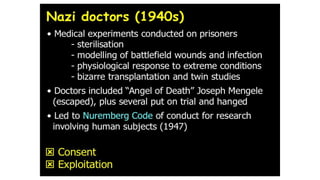
The Nuremberg Code aimed to protect human subjects from enduring the kind of
cruelty and exploitation the prisoners endured at concentration camps. The 10
elements of the code are:
1.Voluntary consent is essential
2. The results of any experiment must be for the greater good of society
3. Human experiments should be based on previous animal experimentation
4. Experiments should be conducted by avoiding physical/mental suffering and injury
5. No experiments should be conducted if it is believed to cause death/disability
6. The risks should never exceed the benefits
7. Adequate facilities should be used to protect subjects
8. Experiments should be conducted only by qualified scientists
9. Subjects should be able to end their participation at any time
10. The scientist in charge must be prepared to terminate the experiment when
injury, disability, or death is likely to occur
ABUSE OF THE PEER
REVIEW PROCESS
Abuse of peer review
There are several ways to abuse the process of peer
review. You can steal ideas and present them as your
own, or produce an unjustly harsh review to block or
at least slow down the publication of the ideas of a
competitor. These have all happened.
Sabotage
Sabotage is deliberately interfering or attempting to
interfere with one or more students’ academic work
through, but not limited to: tampering with, altering,
damaging or destroying personal or institutional
academic materials. Sabotage may also involve
interfering with a learning experience including, but
not limited to, obstructing or willfully disrupting class,
laboratory, formal testing or examination times,
proceedings or experiences, or other classroom or
academic environments.
Beginning in December of 2009, Heather Ames, a graduate student
doing basic cancer research, began noticing problems with her
research materials: switched labels on petri dishes, errant antibodies
dumped into her western blots, and several instances of ethanol in her
cell culture media. Suspecting that someone was intentionally
undermining her work, she notified her boss, Theo Ross, who contacted
university officials. The University of Michigan police launched an
investigation, and eventually installed hidden video cameras in the lab.
Within less than 24 hours of being put in, one camera captured Bhrigu
acting suspiciously. Under questioning, he confessed, saying that he
was trying to slow the student down. He was fired and taken to court,
where he pleaded guilty to malicious destruction of property. He was
subsequently ordered to pay more than $30,000 total in fines and
restitution. He’s currently repaid just over $20,000 according to
the online records Washtenaw County court.
When Magdalena Koziol suspected that someone was sabotaging her
research at Yale University, she did what comes naturally to a
scientist: She set up a controlled experiment to test her hypothesis.
Koziol’s studies of how the genome switches on after an egg is
fertilized had begun failing mysteriously in July 2011, a month after she
started her postdoc in the developmental biology lab of Antonio
Giraldez. In August, she began producing transgenic zebrafish; they all
died, not once, but time after time. A lab technician assured her she
was doing everything right, and colleagues’ fish were fine. So Koziol
produced a new batch of fish and divided them in two groups. One she
put in a container labelled with her initials, MK, as she had done before.
She left the other half unmarked. Sure enough, the labelled fish died;
the others were fi ne. The experiment was a key step in proving that
someone was tampering with her experiments, according to a lawsuit
Koziol fi led with the Superior Court in New Haven on 7 February. When
hidden cameras were installed in the lab, they revealed a fellow
postdoc poisoning her fi sh, the complaint says. Now, Koziol is suing
the alleged perpetrator, Polloneal Jymmiel Ocbina. According to the
complaint, he left Yale after he was caught on video
Helicopter research
Helicopter Research has nothing to do with aircraft;
it typically describes when researchers from
wealthier countries fly to a developing country like
Indonesia, take samples, fly out, analyse the samples
elsewhere, and publish the results with little
involvement of local scientists. At best, local
scientists are used to provide logistics.
Helicopter research is dishonoured in genomics
research. African scientists have called for more
control of their continent’s genomic data by issuing
guidelines. However, it is rampant in many fields of
research.
Example in Indonesia
In April 2018, a publication
about Indonesia's Bajau people received great
attention. These "sea nomads" had a genetic
adaptation resulting in large spleens that supply
additional oxygenated red blood cells.
Yet, a month later this publication was criticised by
Indonesian scientists. Their article
in Science questioned the ethics of scientists from
the USA and Denmark who took DNA samples of the
Bajau people and analysed them, without much
involvement of Bajau or other Indonesian people.
SALAMI SLICING
The ‘slicing’ of research that would form one
meaningful paper into several different papers is
called ‘salami publication’ or ‘salami slicing’. Unlike
duplicate publication, which involves reporting the
exact same data in two or more publications, salami
slicing involves breaking up or segmenting a large
study into two or more publications. These segments
are referred to as ‘slices’ of a study.
Photo Manipulation
A growing number of research misconduct cases
handled by the Office of Research Integrity involve
image manipulations. Manipulations may include
simple image enhancements, misrepresenting an
image as something different from what it is, and
altering specific features of an image.
Ghost authorship occurs when an individual makes a
substantial contribution to the research or the writing
of the report, but is not listed as an
author. Researchers, statisticians and writers
become ghost authors when they meet authorship
criteria but are not named as an author. Writers who
work in this capacity are called GHOST WRITERS.
Ghost authorship has been linked to partnerships
between industry and higher education. Two-thirds of
industry-initiated randomized trials may have evidence
of ghost authorship. Ghost authorship is considered
problematic because it may be used to obscure the
participation of researchers with conflicts of interest.
More specific types of honorary authorship are gift,
guest and rolling authorship.
Gift authorship consist on authorship obtained by the offer of
another author (honorary or not) with objectives that are
beyond the research article itself or are ulterior, as promotion
or favour.
Gift authorship’ is one of the most common kinds of unethical
behaviour seen in academic publishing. In this practice, an
author is added to a paper when they have not actually made a
contribution to the work, perhaps to reward a collaborator,
return a favour, or for some other gain.
Guest authorship are authors that are included with the specific
objective to increase the probability that it becomes accepted by a
journal.
A practice in which senior researchers are listed as co-authors—
despite having had little to do with the work involved in publishing origi
nal research reports—on research reports that are the works of others,
e.g., undergraduates and postdoctoral fellows working in their
lab
A rolling authorship is a special case of gift authorship in which the
honour is granted on the basis of previous research papers (published
or not) by the same research group
Duplicate publication, multiple publication, or redundant
publication refers to publishing the same intellectual material
more than once, by the author or publisher. It does not refer to
the unauthorized republication by someone else, which
constitutes plagiarism, copyright violation, or both.
Multiple submission is not plagiarism, but it is today often
viewed as academic misbehaviour
Annamalai University accused of plagiarism, data manipulation in over
200 research papers
Microbiologist & image forensics expert Elizabeth Bik has traced
duplication and manipulation in papers published by Annamalai
University researchers.
Multiple kinds of fraud
Bik has discovered multiple kinds of fraud, right from image
manipulation to plagiarism to fudging of data across the Annamalai
papers she analysed. She penned the details in her blog.
The first and most prominent kind of deception she discovered was the
manipulation of images, either by duplicating sections of an image or
repeating the same images. There is duplication in images featuring
animals as well. There are several instances where features in an
image are duplicated multiple times within the same image.
127 papers from India retracted for image
duplication, manipulation
The searchable database of retracted papers launched by
Retraction Watch shows 982 papers from India have been
retracted so far. Of these, 330 have been retracted for
plagiarism and, surprisingly, 118 papers for image duplication
and/or manipulation. The number of papers retracted for image
issues has suddenly increased since 2016, with 37 papers
retracted in 2018 alone.
Plagiarism
Plagiarism is, perhaps, the most common form of research
misconduct. Researchers must be aware to cite all sources
and take careful notes. Using or representing the work of
others as your own work constitutes plagiarism, even if
committed unintentionally. When reviewing privileged
information, such as when reviewing grants or journal article
manuscripts for peer review, researchers must recognize that
what they are reading cannot be used for their own purposes
because it cannot be cited until the work is published or
publicly available.
What is Plagiarism?...
Merriam- Webster Dictionary
 “to use the words or ideas of another person as if they were your
own words or ideas
 to steal & pass off (ideas or words of another) as one's own
 to use (another's production) without crediting sources
 to commit literary theft
 to present as new & original idea or product derived from an
existing source”
45
What constitutes a Plagiarism?...
Copying & pasting material from online resources
 Getting a paper from web & submitting as your own
 Using another persons work & claiming it as your own
 Using photographs, video, audio without acknowledgement
 Quoting a source without using quotation marks-even if
you do cite it 46
Why do People Plagiarize?...
Lack of awareness - why it is important to cite sources
 Simply not knowing what constitutes plagiarism
 Lack of confidence in own ideas & writing abilities
 Not able to figure out how to respond to writing assignment/task
 Never used or not aware of citation styles (MLA, APA, IEEE
Style Guides, Chicago Manual etc.)
Lack of knowledge on the ethics of academic / poor writing skills 47
Types of Plagiarism on Research
iThenticate have conducted a survey of scientific researchers, in which respondents were
asked identify forms of plagiarism.
1. Secondary Source
2. Invalid Source
3. Duplication
4. Paraphrasing
5. Repetitive Research
6. Replication
7. Misleading Attribution
8. Unethical Collaboration
9. Verbatim Plagiarism
10. Complete Plagiarism
Source: https://www.wiley.com/network/researchers/submission-and-navigating-peer-review/10-types-of-
plagiarism-in-research
Types of Plagiarism
Deliberate/intentional
 Copying from another source without citing
 Buying, stealing, or borrowing a paper
 Copying a friend’s work
 Cutting & pasting blocks of text from electronic sources
without proper citing
Unintentional/accidental/ignorance
 Careless paraphrasing
 Quoting excessively
 Poor documentation
 Building on someone else’s ideas without citation
 Using source too closely when paraphrasing
 Failure to use your own “voice” 49
What are the consequences?
 Depends on set policies & guidelines
 Depends on severity of act
 Warning- from instructor, higher-ups
 Reprimanding & punishment
 Failing in assignment/course
 Suspension
 Expulsion
 Noting on transcription
 Any other- depending on act of plagiarism
 Remember- academic integrity & self esteem at stake 50
 Effective management of time
 Developing good research skills
51
Effective management of time
Every task has timeline, due date, deadline
Note these dates & allocate time & follow schedule accordingly
 Collecting information
 Reading & taking notes
 Drawing an outline
 Preparing rough draft
 Final draft
 Extra time for last minute changes
52
Developing Good Research Skills…
 Follow instructions from your course instructor
 Use library & web-based resources
 Identify scholarly resources
 Search for information from these sources
 Evaluate & select right source of information
 Organize collected information sources
 Read & take proper notes of content & source
 Use right tools- databases, citation style & software
 Seek assistance from library staff 53
Quoting
o Quotations are exact words of an author, copied directly from a source, word
for word
o Quotations must be cited! Use in text citation
Use quotations when you want to,
o Add power of an author’s words to support your argument
o Disagree with an author’s argument
o Highlight eloquent or powerful phrases or passages
o Comparing & contrasting specific points of view
o Note important research that precedes your own 54
Paraphrasing
 Paraphrasing means rephrasing words of an author, putting his/her
thoughts in your own words
 When you paraphrase, you rework source’s ideas, words, phrases &
sentence structures with your own
 Like quotations, paraphrased material must be followed with in-text
documentation & cited
Paraphrase when you want to:
 Use information on your note cards & wish to avoid plagiarizing
 Avoid overusing quotations
 Use your own voice to present information 55
Summarizing
 Summarizing involves putting main idea(s) of one or several
writers into your own words along with main point(s)
 Summaries significantly shorter than original & take broad
overview of source material
 Necessary to attribute summarized ideas to their original sources
Summarize when you want to:
 Establish background or offer an overview of a topic
 Describe knowledge (from several sources) about a topic
 Determine main ideas of single source 56
Using Content in Common
Knowledge / Domain
No citation required, if information is
 Widely accessible or commonly known e.g Indian population,
first President of India
 Likely to be known by a lot of people
 Found in a general reference resources, such as a dictionary or
encyclopaedia
 Advisable to cite, if you are not clear
57
Detecting Plagiarism
 Plagiarizing & detecting it was difficult in print era
 Technology- made it easier to track down & identify plagiarism
 Search engines can easily detect
 Full-text journal articles in library databases
 Computer-assisted detection allows vast collections of documents to be
compared to each other
 Free & Commercial plagiarism detection services available
 Your instructor may well recognize source 58
Plagiarism Detection Software
Commercial
Ithenitcate http://www.ithenticate.com/
Plagium http://www.plagium.com/
Turnitin http://www.turnitin.com/
URKUND http://www.urkund.com/en/
PlagScan http://plagscan.com 59
Free Resources to Check Plagiarism
Free
 DupliChecker
http://www.duplichecker.com/
 CopyLeaks
https://copyleaks.com/
 PaperRater
http://www.paperrater.com/
 PlagiarismChecker
http://www.plagiarismchecker.com/help-teachers.php
 Quetext
http://www.quetext.com/
 Viper
http://www.scanmyessay.com/
60
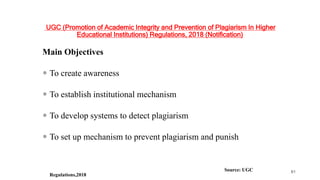
UGC (Promotion of Academic Integrity and Prevention of Plagiarism In Higher
Educational Institutions) Regulations, 2018 (Notification)
Main Objectives
 To create awareness
 To establish institutional mechanism
 To develop systems to detect plagiarism
 To set up mechanism to prevent plagiarism and punish
Source: UGC
Regulations,2018
61
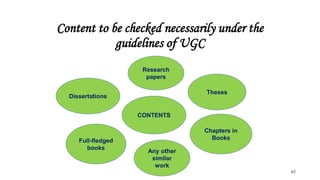
Content to be checked necessarily under the
guidelines of UGC
CONTENTS
Theses
Chapters in
Books
Any other
similar
work
Full-fledged
books
Dissertations
Research
papers
62
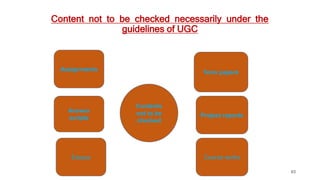
Content not to be checked necessarily under the
guidelines of UGC
Contents
not to be
checked
Term papers
Project reports
Course works
Essays
Answer
scripts
Assignments
63
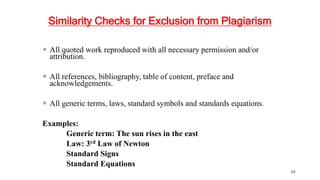
Similarity Checks for Exclusion from Plagiarism
 All quoted work reproduced with all necessary permission and/or
attribution.
 All references, bibliography, table of content, preface and
acknowledgements.
 All generic terms, laws, standard symbols and standards equations.
Examples:
Generic term: The sun rises in the east
Law: 3rd Law of Newton
Standard Signs
Standard Equations
64
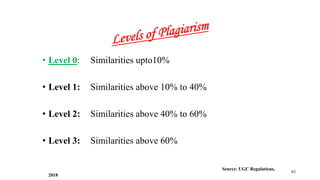
• Level 0: Similarities upto10%
• Level 1: Similarities above 10% to 40%
• Level 2: Similarities above 40% to 60%
• Level 3: Similarities above 60%
Source: UGC Regulations,
2018
65
Penalties in Case of Plagiarism in Submission of Thesis
and Dissertations
Level 0: Similarities upto10% Minor Similarities, no penalty
Level 1: Similarities above 10% to 40% Such student shall be asked to submit a
revised script within a stipulated time
period not exceeding.
Level 2: Similarities above 40% to 60% Such student shall be debarred from
submitting a revised script for a period
of one year.
Level 3: Similarities above 60% Such student registration for that
programme shall be cancelled.
Source: UGC Regulations, 2018
66
Penalties in Case of Plagiarism in Academic and
Research Publications
Level 0: Similarities upto10% Minor Similarities, no penalty
Level 1: Similarities above 10% to 40% Shall be asked to withdraw manuscript.
Level 2: Similarities above 40% to 60% i.Shall be asked to withdraw manuscript.
ii.Shall be denied a right to one annual increment.
iii.Shall not be allowed to be a supervisor for a period of two years.
Level 3: Similarities above 60% i.Shall be asked to withdraw manuscript.
ii.Shall be denied a right to two successive annual increment.
iii.Shall not be allowed to be a supervisor for a period of two years.
Source: UGC Regulations, 2018
67
UGC Reserves
• UGC reserves the right to remove difficulty/difficulties in the
course of implementations of these Regulations in
consultation with the Government of India/ Ministry of
Human Resource Development.
68
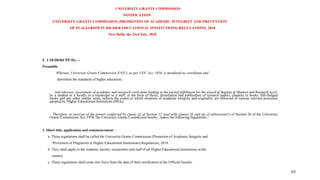
UNIVERSITY GRANTS COMMISSION
NOTIFICATION
UNIVERSITY GRANTS COMMISSION (PROMOTION OF ACADEMIC INTEGRITY AND PREVENTION
OF PLAGIARISM IN HIGHER EDUCATIONAL INSTITUTIONS) REGULATIONS, 2018
New Delhi, the 23rd July, 2018
F. 1-18/2010(CPP-II).—
Preamble
Whereas, University Grants Commission (UGC), as per UGC Act, 1956, is mandated to coordinate and
determine the standards of higher education;
And whereas, assessment of academic and research work done leading to the partial fulfillment for the award of degrees at Masters and Research level,
by a student or a faculty or a researcher or a staff, in the form of thesis, dissertation and publication of research papers, chapters in books, full-fledged
books and any other similar work, reflects the extent to which elements of academic integrity and originality are observed in various relevant processes
adopted by Higher Educational Institutions (HEIs);
Therefore, in exercise of the powers conferred by clause (j) of Section 12 read with clauses (f) and (g) of subsection(1) of Section 26 of the University
Grants Commission Act, 1956, the University Grants Commission hereby makes the following regulations:-
1. Short title, application and commencement –
a. These regulations shall be called the University Grants Commission (Promotion of Academic Integrity and
Prevention of Plagiarism in Higher Educational Institutions) Regulations, 2018.
b. They shall apply to the students, faculty, researchers and staff of all Higher Educational Institutions in the
country.
c. These regulations shall come into force from the date of their notification in the Official Gazette.
69
Penalties
 Penalties in the cases of plagiarism shall be imposed on students pursuing studies at the level of Masters and
Research
 programs and on researcher, faculty & staff of the HEI only after academic misconduct on the part of the
individual has
 been established without doubt, when all avenues of appeal have been exhausted and individual in question has
been
 Provided enough opportunity to defend himself or herself in a fair or transparent manner.
Penalties in case of plagiarism in submission of thesis and dissertations
 Institutional Academic Integrity Panel (IAIP) shall impose penalty considering the severity of the Plagiarism.
i. Level 0: Similarities upto 10% - Minor Similarities, no penalty.
ii. Level 1: Similarities above 10% to 40% - Such student shall be asked to submit a revised script within a
stipulated time period not exceeding 6 months.
iii. Level 2: Similarities above 40% to 60% - Such student shall be debarred from submitting a revised
script for a period of one year.
iv. Level 3: Similarities above 60% -Such student registration for that programme shall be cancelled.
Note 1: Penalty on repeated plagiarism- Such student shall be punished for the plagiarism of one level
higher than the
previous level committed by him/her. In case where plagiarism of highest level is committed then the
punishment for the
same shall be operative.
Note 2: Penalty in case where the degree/credit has already been obtained - If plagiarism is proved on a
date later
than the date of award of degree or credit as the case may be then his/her degree or credit shall be put in
abeyance for a
period recommended by the IAIP and approved by the Head of the Institution. 70
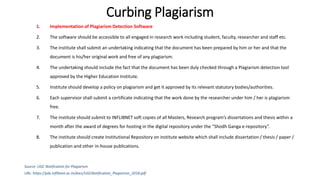
Curbing Plagiarism
1. Implementation of Plagiarism Detection Software
2. The software should be accessible to all engaged in research work including student, faculty, researcher and staff etc.
3. The institute shall submit an undertaking indicating that the document has been prepared by him or her and that the
document is his/her original work and free of any plagiarism.
4. The undertaking should include the fact that the document has been duly checked through a Plagiarism detection tool
approved by the Higher Education Institute.
5. Institute should develop a policy on plagiarism and get it approved by its relevant statutory bodies/authorities.
6. Each supervisor shall submit a certificate indicating that the work done by the researcher under him / her is plagiarism
free.
7. The institute should submit to INFLIBNET soft copies of all Masters, Research program’s dissertations and thesis within a
month after the award of degrees for hosting in the digital repository under the “Shodh Ganga e-repository”.
8. The institute should create Institutional Repository on institute website which shall include dissertation / thesis / paper /
publication and other in-house publications.
Source: UGC Notification for Plagiarism
URL: https://pds.inflibnet.ac.in/docs/UGCNotification_Plagiarism_2018.pdf
Source: https://www.ugc.ac.in/pdfnews/7680776_UGC-letter-reg-PDS.pdf
INFLIBNET ShodhShuddhi
Based on the recommendation of Sub-Committee, National Steering
Committee (NSC) of e-ShodhSindhu, The Ministry of Education, Govt. of
India has initiated a programme "ShodhShuddhi" which provides access to
Plagiarism Detection Software (PDS) to all universities/Institutions in India
since Sept 1, 2019. The following types of institutions are included:
• Central Universities
• State Universities
• Deemed to be University
• Private Universities
• Centrally funded Technical Institutions(CFTIs)
• Inter University Centre (IUCs) of UGC
Under this initiative, URKUND a Web Based Plagiarism Detection Software
system is being provided to all users of universities/Intuitions in the country.
This initiative is formally launched by Honorable Minister of HRD (now
renamed as Minister of Education) on September 21, 2019.
What is Urkund ?
URKUND is a completely automated system against plagiarism (Anti-
plagiarism software) and is being successfully used at universities and
colleges all around the world. URKUND's system checks all
documents against three central source area
a. The Internet
b. Published material such as Journals, Books etc.
c. Previously submitted student material (e.g. memoranda, case
studies and examination works)
Urkund offer a fully-automated system for handling the problem with
plagiarism. URKUND automatically checks submitted text for
plagiarism which encourages original writing amongst students and
corporate writers. Invented by a Swedish company founded in 2000
and located in Stockholm, Swiden.
74
75
WHY A PLAGIARISM CHECKER?
Increasing digitization in education makes it easier to detect
plagiarism .
• Urkund helps to maintain quality in academic writing.
• Plagiarism is an ever increasing problem in the academic world - the
rise of digitization in education makes it easier to detect plagiarism,
but also easier to plagiarize
• Universities and educational institutions using a plagiarism checker
are able to position (establish) themselves as thought and innovation
leaders worldwide by providing new knowledge and consistent quality
of thought
• An automatic plagiarism checker effectively promotes academic
integrity because it works both as prevention and as a controlling
measure against plagiarism -> leading to more time for the things that
matter Implementing a plagiarism checker promotes academic
integrity …and works as plagiarism prevention
76
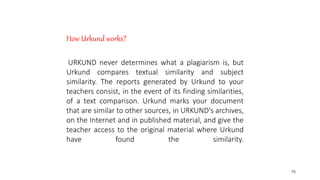
How Urkund works?
URKUND never determines what a plagiarism is, but
Urkund compares textual similarity and subject
similarity. The reports generated by Urkund to your
teachers consist, in the event of its finding similarities,
of a text comparison. Urkund marks your document
that are similar to other sources, in URKUND's archives,
on the Internet and in published material, and give the
teacher access to the original material where Urkund
have found the similarity.
77
How to get Urkund account for University?
Universities who have signed MoU with
INFLIBNET Centre, which come under
section 12(B)/2f of UGC Act and eligible for
funding from UGC, will be getting the software
free of cost from INFLIBNET Centre.
78
What file formats are supported by URKUND?
URKUND supports the following file formats:
 .doc,
.docx,
.sxw,
.ppt,
.pptx,
.pdf,
.txt,
.rtf,
.html,
.htm,
.wps,
.odt
79
What is the document limits to be
submitted?
Every document submitted for plagiarism check
will be treated as a separate document.
Documents containing more than 400,000
characters will be considered as more than one
document (actual number to be calculated using
multiples of 400,000 characters, so 800,001
characters would be 3 documents).
80
How to submit documents in Urkund?
Every submitter i.e. students, researchers, faculty or university
coordinator must have an account in Urkund. Students can
register and get an id . There are three ways for submitting the
documents in Urkund.
a. Using Urkund via e-mail to any analysis address
(manoj.Inflib@analysis.urkund.com)
b. An additional way of submitting: Students at universities
and colleges are also able to upload files to their professors
via www.urkund.com. In order to test the document, user can
email to the analysis address (manoj.Inflib@analysis.urkund.com)
contained in their registration email or upload through the
user account. Results once generated will be mailed to the mail
address.
c. Once successful, user can enter into their Dashboard for
managing the submissions.
81
How to get support if there is any problem?
For creating the user account, the link for the user guide
is http://urkund.com/en/support. The following user guide would be
required for accessing Urkund.
- For administration refer to URKUND Admin Guide from the
above link - The document has all the details that would be needed
as an administrator – method of submitting documents, adding
faculty, inbox, report, analysis, etc.
- For the user (faculty / teachers) refer to URKUND Quickstart
Guide from the above
link. http://static.urkund.com/manuals/URKUND_Userguide.pdf.
- For dealing with documents that have been sent through
twice, please
follow: http://static.urkund.com/manuals/URKUND_Master_Class_-
_Duplicates_EN.pdf/
82
How to customise Urkund Account?
Once you login to URKUND on the main
dashboard there is an option for 'Settings'
through which, you can customise the account
by using various options like Language, include
the document in URKUND archive or by
filtering sources out of future searches. It is
not recommended that sources are removed
from future searches.
Useful information
 If URKUND is used via e‐mail, the text that shall be checked must be sent in as a file. Nothing that is
pasted into or written directly in the body of the email will be analyzed.
 If someone sends an email without an attachment to an analysis address this email will be
refused and no an error message will be sent from URKUND. The e‐mail and document will
not reach the intended recipient.
 URKUND supports the 12 most common word processing formats:. DOC. DOCX. SXW. PPT.
PPTX. PDF. TXT. RTF. Html. Htm. WPS. ODT
 PDF/A are flagged as “read only” and is not accepted by URKUND as we need to be able to
extract the text
 If a student submits documents with an incorrect file format, such as "essay.% & @" Or
"My_assignment.xxx", he gets an error message from URKUND telling that the document that
cannot be analyzed. The e‐mail with the attached document will not be checked.
 If one version is submitted from the student e‐mail and version two is submitted from, say, a
yahoo address, there will be a duplicate hit
 If you use a spam filter and want to be able to receive all kinds of emails from URKUND it
may be necessary to specify the domains urkund.com and urkund.se as " trusted ".
 If there are no disturbances the result of the examination will usually be delivered within about
30 minutes after it was submitted, but it may in some rare circumstances take up to 24 hours.
83
When analyzing the results from Urkund,
note the following:
 Urkund does not show what is plagiarized – it is the supervisor’s task
to interpret the analysis. There can be other reasons for a match
between the student’s text and other texts than plagiarism (for instance
citations made with indention, methods etc can show a match).
 There is no specific percentage level that equals to plagiarism. The
supervisor has to look into the passages that are highlighted in the
analysis and go through them in order to determine why there is an
overlap.
 You can also find guides and manuals Urkund´s support
website: http://www.urkund.com/en/support
 Intentional and deceitful plagiarism is very unusual.
84
Green No matching words
Yellow 1% -15% similarity index
Yellow 16% -25% similarity index
Orange 26% -35% similarity index
Pink 36% -70% similarity index
Black
71% -100% similarity
index
Urkund differentiates the levels of index
85
Procedure for Plagiarism Check
While submitting the soft copy of the Ph.D. theses for the check with
plagiarism detection software, the research scholars and supervisors,
who are submitting their theses to the Avinashilingam Institute for
Home Science and Higher Education for Women are solicited to
consider the following guidelines
 The CD (or such device) containing the soft copy of the doctoral
theses has to be in PDF or Word file (or as directed from time to time).
 Theses covering all the chapters, from the introduction to
bibliography/references shall be in a single file, excluding preliminary
pages: declaration, acknowledgment, abstract, list of charts and
abbreviations, tables of contents, etc., and succeeding pages: glossary,
index, questionnaire, etc.
 In case the percentage of similar content is beyond the permitted limit
or any plagiarized content is detected, the researchers have to take
appropriate measures under the supervision of their guides as to ensure
originality of research output. 86
The researchers are informed to acknowledge accurately the right
authors and sources given in the text within quotes. Uniformity and
consistency are to be maintained in rendering bibliographic references.
An accepted standard format has to be followed for rendering
references.
The Library will provide plagiarism check service to all research
scholars of the Institute.
For languages like Tamil, Hindi, French, etc. no software is available
in our Institution for plagiarism check.
Plagiarism Check for Staff / Student Publication
The students and staff members are requested to fill the application
form(Annexure) for plagiarism verification and forward it through the
concerned Head of the Department. The document should be
forwarded through email or CD. After verification, the hard copy of
the report will be issued by the librarian with signature and seal.
Report to the Readers
The articles received from the readers are verified within a day. The
librarian sent the report to the concerned faculty/ student with the
following information (Annexure-10) 87
Xyz library
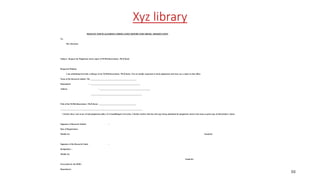
REQUEST FOR PLAGIARISM VERIFICATION REPORT FOR THESIS / DISSERTATION
To,
The Librarian
Subject : Request for Plagiarism check report of M.Phil dissertation / Ph.D thesis
Respected Madam,
I am submitting herewith a softcopy of my M.Phil dissertation / Ph.D thesis. You are kindly requested to check plagiarism and issue me a report to that effect.
Name of the Research scholar: Ms. ______________________________________________
Department : __________________________________________________
Address : __________________________________________________
___________________________________________________
Title of the M.Phil dissertation / Ph.D thesis : _____________________________________
__________________________________________________________________________________
I declare that, I am aware of anti-plagiarism policy of Avinashilingam University, I further declare that the soft copy being submitted for plagiarism check is the same as print copy of dissertation / thesis.
Signature of Research Scholar :
Date of Registration :
Mobile No: Email Id :
Signature of the Research Guide :
Designation :
Mobile No:
Email Id :
Forwarded by the HOD :
Department :
88
Xyz library
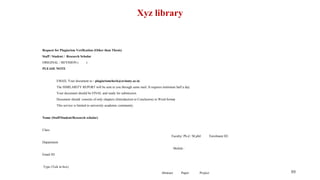
Request for Plagiarism Verification (Other than Thesis)
Staff / Student / Research Scholar
ORIGINAL / REVISION ( )
PLEASE NOTE
EMAIL Your document to - plagiarismcheck@avinuty.ac.in
The SIMILARITY REPORT will be sent to you through same mail. It requires minimum half a day.
Your document should be FINAL and ready for submission.
Document should consists of only chapters (Introduction to Conclusion) in Word format
This service is limited to university academic community.
Name (Staff/Student/Research scholar)
Class
Faculty/ Ph.d / M.phil Enrolment ID:
Department
Mobile :
Email ID
Type (Tick in box)
Abstract Paper Project 89
XYZ LIBRARY
PLAGIARISM CHECK REPORT (THESES)
1.Name of the Research Scholar
2.Roll No. and Year of Registration
3.Department
4.Name of the Research Guide
5.Title of the Thesis / Dissertation
6.Similarity Content (%) identified
Introduction/ Materials and Results/
Review of Literature Method Discussion/
Summary/
Conclusion
Acceptable maximum limit (%)
7.Software Used
8.Date of Verification
Checked by
Librarian Signature :
Date :
•
90
Source: https://pds.inflibnet.ac.in/memberState.php
Faculty Registration Process
Email to the coordinator
(in case of Jadavpur University, the coordinator is the
Information Scientist.
Requesting for registration on Urkund.
Will receive a mail from ‘noreply@urkund.se’ with the
subject “Welcome to URKUND!”
Needs to activate the accounts within next 96 hours
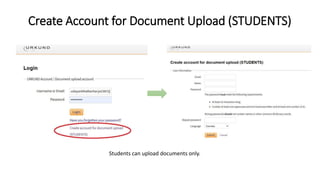
Login Process
URL: https://www.urkund.com/login/
Click
here
Create Account for Document Upload (STUDENTS)
Students can upload documents only.
Login to Urkund Account
Link for
uploading
documents
Percentage
copied
Document
Number
File name
Size of the
uploaded file
Number of
words in the
uploaded file
Date and
time of
submission
Urkund Work Flow
Submission
Relevant sources are retrieved
Machine learning powered
analysis
Report creation and delivery
Source:
1. The Internet
2. Published Material
3. Student Material
Submit Documents
After successfully submission, the report will be generated within 30 minutes to 24 hours.
Overview of Analysis
Page wise document
overview
Link for export report in
PDF file format
View the findings of
the entire document
Percentage of Text
Similarity
Submission details
Tips to interpret the
analysis
Analysis of the Entire Document (Findings)
Different types of
findings
Include/ exclude text
differences
Percentage of text
similarity of the entire
document
Next Instance
Include/ exclude
quotes
Include/ exclude
brackets
Previous instance
Percentage of text
similarity of this
instance
Original Source
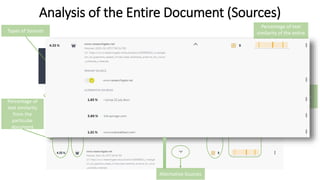
Analysis of the Entire Document (Sources)
Percentage of text
similarity of the entire
document
Types of Sources
Type of Source of
the particular
document
Percentage of
text similarity
from the
particular
document
No. of matches from
the particular source
Location in the
document from the
similarity occurred
Alternative Sources
Analysis of the Entire Document (Entire Document)
Include/ exclude text
differences
Percentage of text
similarity of the entire
document
Include/ exclude
quotes
Include/ exclude
brackets
Matching text
Guides and Tutorials
Text and Video Guide and tutorial:
• Use Guide
• Administrator Guide
• Integration Guide with Moodle, Learning Management Software
URL: https://www.urkund.com/support/guides-tutorials/
Limitation
• In most cases the reports are not shared with the students.
• A user cannot delete a document from Urkund system. This action
can be done by the Urkund Team.
• Most of the big publishers have not done partnership yet with
Urkund.
THANK YOU

publication misconduct.pptx

  • 1.
    ACADEMIC MISCONDUCTS UDAYAN BHATTACHARYA DEPARTMENTOF LIBRARY & INFORMATION SCIENCE JADAVPUR UNIVERSITY
  • 2.
    MISCONDUCT WIKIPEDIA In law, misconductis wrongful, improper, or unlawful conduct motivated by premeditated or intentional purpose or by obstinate indifference to the consequences of one's acts. Misconduct can be considered an unacceptable or improper behavior, especially for a professional person. Black’s Law dictionary defines ‘Misconduct’ as “A transgression of some established and definite rule of action, a forbidden act, a dereliction from duty, unlawful behaviour, wilful in character, improper or wrong behaviour”.
  • 4.
    TYPES OF ACADEMICMISCONDUCT INCLUDES RESEARCH AND PUBLICATION MISCONDUCT 1. FABRICATION 2. FALSIFICATION 3. PLAGIARISM 4. FAILURE TO GET ETHICAL APPROVAL 5. NOT ADMITTING THAT SOME DATA RE MISSING 6. IGNORING OUTLIERS WITHOUT DECLARING IT 7. NOT INCLUDING DATA ON SIDE EFFECTS IN A CLINICAL TRIAL 8. CONDUCTING RESEARCH ON HUMAN WITHOUT INFORMED CONSENT 9. PUBLICATION OF POST HOC ANALYSIS WITHOUT DECLARING IT 10. GIFT AUTHORSHIP 11. Photo manipulation 1. GHOST AUTHORSHIP 2. NOT ATTRIBUTING OTHER AUTHORS 3. REDUNDANT PUBLICATION 4. NOT DISCLOSING CONFLICT OF INTEREST 5. NOT ATTEMPTING TO PUBLISH COMPLETE RESEARCH 6. FAILURE TO DO AN ADEQUATE SEARCH OF EXISTING RESEARCH BEFORE BEGINNING NEW RESEARCH 7. DUPLICATE PUBLICATION 8. ABUSE OF THE PEER REVIEW PROCESS 9. EXPLOITATION 10. HELICOPTER RESEARCH 11. SALAMI SLICING
  • 5.
    Fabrication Fabrication is theconstruction and/or addition of data, observations, or characterizations that never occurred in the gathering of data or running of experiments. Fabrication can occur when “filling out” the rest of experiment runs, for example. Claims about results need to be made on complete data sets (as is normally assumed), where claims made based on incomplete or assumed results is a form of fabrication.
  • 7.
  • 11.
    Falsification Falsification is thechanging or omission of research results (data) to support claims, hypotheses, other data, etc. Falsification can include the manipulation of research instrumentation, materials, or processes. Manipulation of images or representations in a manner that distorts the data or “reads too much between the lines” can also be considered falsification.
  • 14.
    Ethical approval If astudent plans to do research involving human participants, whether directly or indirectly - e.g. interviews, questionnaires, focus groups, observations, accessing personal data about individuals, any human biological materials - then the research must be independently ethically reviewed and approved BEFORE the student begins data gathering. The supervisor is responsible for ensuring that this takes place. Failure to gain ethics approval may result in the student's dissertation or thesis being failed or deemed ineligible for submission. Guidance on the different routes for obtaining ethics approval, and when each applies, is available from the University's central research ethics website, along with the University's full Research Ethics Policy and broader guidance on ethical issues.
  • 17.
    CONDUCTING RESEARCH ON HUMANWITHOUT INFORMED CONSENT
  • 18.
    WHAT IS INFORMEDCONSENT? Informed Consent is a voluntary agreement to participate in research. It is not merely a form that is signed but is a process, in which the subject has an understanding of the research and its risks. Informed consent is essential before enrolling a participant and ongoing once enrolled. Informed Consent must be obtained for all types of human subjects research including; diagnostic, therapeutic, interventional, social and behavioural studies, and for research conducted domestically or abroad. Obtaining consent involves informing the subject about his or her rights, the purpose of the study, the procedures to be undergone, and the potential risks and benefits of participation. Subjects in the study must participate willingly. Vulnerable populations (i.e. prisoners, children, pregnant women, etc.) must receive extra protections. The legal rights of subjects may not be waived and subjects may not be asked to release or appear to release the investigator, the sponsor, the institution or its agents from liability for negligence. The Informed Consent is described in ethical codes and regulations for human subjects research. The goal of the informed consent process is to provide sufficient information so that a participant can make an informed decision about whether or not to enroll in a study or to continue participation. The informed consent document must be written in language easily understood by the participant, it must minimize the possibility of coercion or undue influence, and the subject must be given sufficient time to consider participation.
  • 20.
  • 21.
    Conflicts of interestare a clash that most often occurs between requirements and interests. Various types of conflicts of interest can occur because of the nature of relationships versus rules of organizations or federal and state laws. People can easily become biased (have an unfair preference) because of small things like friendship, food, or flattery, or they may be influenced to make a decision because of the potential to gain power, prestige, or money. Conflicts can occur when an individual makes or influences a decision and does so for some personal gain that may be unfair, unethical, or even illegal. The important part is what you do in each of those situations. Do you allow your family, friendship, financial, or inside knowledge affect your actions? If you do, you could be violating state statute and university policy.
  • 23.
  • 24.
    Exploitation is coercinganother person to commit an act of academic misconduct, whether for their own benefit or the benefit of another person, through threats, intimidation, blackmail, extortion, bribery, offers of favours, or some other means.
  • 26.
    The Nuremberg Codeaimed to protect human subjects from enduring the kind of cruelty and exploitation the prisoners endured at concentration camps. The 10 elements of the code are: 1.Voluntary consent is essential 2. The results of any experiment must be for the greater good of society 3. Human experiments should be based on previous animal experimentation 4. Experiments should be conducted by avoiding physical/mental suffering and injury 5. No experiments should be conducted if it is believed to cause death/disability 6. The risks should never exceed the benefits 7. Adequate facilities should be used to protect subjects 8. Experiments should be conducted only by qualified scientists 9. Subjects should be able to end their participation at any time 10. The scientist in charge must be prepared to terminate the experiment when injury, disability, or death is likely to occur
  • 27.
    ABUSE OF THEPEER REVIEW PROCESS
  • 28.
    Abuse of peerreview There are several ways to abuse the process of peer review. You can steal ideas and present them as your own, or produce an unjustly harsh review to block or at least slow down the publication of the ideas of a competitor. These have all happened.
  • 30.
    Sabotage Sabotage is deliberatelyinterfering or attempting to interfere with one or more students’ academic work through, but not limited to: tampering with, altering, damaging or destroying personal or institutional academic materials. Sabotage may also involve interfering with a learning experience including, but not limited to, obstructing or willfully disrupting class, laboratory, formal testing or examination times, proceedings or experiences, or other classroom or academic environments.
  • 31.
    Beginning in Decemberof 2009, Heather Ames, a graduate student doing basic cancer research, began noticing problems with her research materials: switched labels on petri dishes, errant antibodies dumped into her western blots, and several instances of ethanol in her cell culture media. Suspecting that someone was intentionally undermining her work, she notified her boss, Theo Ross, who contacted university officials. The University of Michigan police launched an investigation, and eventually installed hidden video cameras in the lab. Within less than 24 hours of being put in, one camera captured Bhrigu acting suspiciously. Under questioning, he confessed, saying that he was trying to slow the student down. He was fired and taken to court, where he pleaded guilty to malicious destruction of property. He was subsequently ordered to pay more than $30,000 total in fines and restitution. He’s currently repaid just over $20,000 according to the online records Washtenaw County court.
  • 32.
    When Magdalena Koziolsuspected that someone was sabotaging her research at Yale University, she did what comes naturally to a scientist: She set up a controlled experiment to test her hypothesis. Koziol’s studies of how the genome switches on after an egg is fertilized had begun failing mysteriously in July 2011, a month after she started her postdoc in the developmental biology lab of Antonio Giraldez. In August, she began producing transgenic zebrafish; they all died, not once, but time after time. A lab technician assured her she was doing everything right, and colleagues’ fish were fine. So Koziol produced a new batch of fish and divided them in two groups. One she put in a container labelled with her initials, MK, as she had done before. She left the other half unmarked. Sure enough, the labelled fish died; the others were fi ne. The experiment was a key step in proving that someone was tampering with her experiments, according to a lawsuit Koziol fi led with the Superior Court in New Haven on 7 February. When hidden cameras were installed in the lab, they revealed a fellow postdoc poisoning her fi sh, the complaint says. Now, Koziol is suing the alleged perpetrator, Polloneal Jymmiel Ocbina. According to the complaint, he left Yale after he was caught on video
  • 33.
    Helicopter research Helicopter Researchhas nothing to do with aircraft; it typically describes when researchers from wealthier countries fly to a developing country like Indonesia, take samples, fly out, analyse the samples elsewhere, and publish the results with little involvement of local scientists. At best, local scientists are used to provide logistics. Helicopter research is dishonoured in genomics research. African scientists have called for more control of their continent’s genomic data by issuing guidelines. However, it is rampant in many fields of research.
  • 34.
    Example in Indonesia InApril 2018, a publication about Indonesia's Bajau people received great attention. These "sea nomads" had a genetic adaptation resulting in large spleens that supply additional oxygenated red blood cells. Yet, a month later this publication was criticised by Indonesian scientists. Their article in Science questioned the ethics of scientists from the USA and Denmark who took DNA samples of the Bajau people and analysed them, without much involvement of Bajau or other Indonesian people.
  • 35.
    SALAMI SLICING The ‘slicing’of research that would form one meaningful paper into several different papers is called ‘salami publication’ or ‘salami slicing’. Unlike duplicate publication, which involves reporting the exact same data in two or more publications, salami slicing involves breaking up or segmenting a large study into two or more publications. These segments are referred to as ‘slices’ of a study.
  • 36.
    Photo Manipulation A growingnumber of research misconduct cases handled by the Office of Research Integrity involve image manipulations. Manipulations may include simple image enhancements, misrepresenting an image as something different from what it is, and altering specific features of an image.
  • 37.
    Ghost authorship occurswhen an individual makes a substantial contribution to the research or the writing of the report, but is not listed as an author. Researchers, statisticians and writers become ghost authors when they meet authorship criteria but are not named as an author. Writers who work in this capacity are called GHOST WRITERS. Ghost authorship has been linked to partnerships between industry and higher education. Two-thirds of industry-initiated randomized trials may have evidence of ghost authorship. Ghost authorship is considered problematic because it may be used to obscure the participation of researchers with conflicts of interest.
  • 38.
    More specific typesof honorary authorship are gift, guest and rolling authorship. Gift authorship consist on authorship obtained by the offer of another author (honorary or not) with objectives that are beyond the research article itself or are ulterior, as promotion or favour. Gift authorship’ is one of the most common kinds of unethical behaviour seen in academic publishing. In this practice, an author is added to a paper when they have not actually made a contribution to the work, perhaps to reward a collaborator, return a favour, or for some other gain.
  • 39.
    Guest authorship areauthors that are included with the specific objective to increase the probability that it becomes accepted by a journal. A practice in which senior researchers are listed as co-authors— despite having had little to do with the work involved in publishing origi nal research reports—on research reports that are the works of others, e.g., undergraduates and postdoctoral fellows working in their lab A rolling authorship is a special case of gift authorship in which the honour is granted on the basis of previous research papers (published or not) by the same research group
  • 40.
    Duplicate publication, multiplepublication, or redundant publication refers to publishing the same intellectual material more than once, by the author or publisher. It does not refer to the unauthorized republication by someone else, which constitutes plagiarism, copyright violation, or both. Multiple submission is not plagiarism, but it is today often viewed as academic misbehaviour
  • 41.
    Annamalai University accusedof plagiarism, data manipulation in over 200 research papers Microbiologist & image forensics expert Elizabeth Bik has traced duplication and manipulation in papers published by Annamalai University researchers. Multiple kinds of fraud Bik has discovered multiple kinds of fraud, right from image manipulation to plagiarism to fudging of data across the Annamalai papers she analysed. She penned the details in her blog. The first and most prominent kind of deception she discovered was the manipulation of images, either by duplicating sections of an image or repeating the same images. There is duplication in images featuring animals as well. There are several instances where features in an image are duplicated multiple times within the same image.
  • 42.
    127 papers fromIndia retracted for image duplication, manipulation The searchable database of retracted papers launched by Retraction Watch shows 982 papers from India have been retracted so far. Of these, 330 have been retracted for plagiarism and, surprisingly, 118 papers for image duplication and/or manipulation. The number of papers retracted for image issues has suddenly increased since 2016, with 37 papers retracted in 2018 alone.
  • 43.
    Plagiarism Plagiarism is, perhaps,the most common form of research misconduct. Researchers must be aware to cite all sources and take careful notes. Using or representing the work of others as your own work constitutes plagiarism, even if committed unintentionally. When reviewing privileged information, such as when reviewing grants or journal article manuscripts for peer review, researchers must recognize that what they are reading cannot be used for their own purposes because it cannot be cited until the work is published or publicly available.
  • 45.
    What is Plagiarism?... Merriam-Webster Dictionary  “to use the words or ideas of another person as if they were your own words or ideas  to steal & pass off (ideas or words of another) as one's own  to use (another's production) without crediting sources  to commit literary theft  to present as new & original idea or product derived from an existing source” 45
  • 46.
    What constitutes aPlagiarism?... Copying & pasting material from online resources  Getting a paper from web & submitting as your own  Using another persons work & claiming it as your own  Using photographs, video, audio without acknowledgement  Quoting a source without using quotation marks-even if you do cite it 46
  • 47.
    Why do PeoplePlagiarize?... Lack of awareness - why it is important to cite sources  Simply not knowing what constitutes plagiarism  Lack of confidence in own ideas & writing abilities  Not able to figure out how to respond to writing assignment/task  Never used or not aware of citation styles (MLA, APA, IEEE Style Guides, Chicago Manual etc.) Lack of knowledge on the ethics of academic / poor writing skills 47
  • 48.
    Types of Plagiarismon Research iThenticate have conducted a survey of scientific researchers, in which respondents were asked identify forms of plagiarism. 1. Secondary Source 2. Invalid Source 3. Duplication 4. Paraphrasing 5. Repetitive Research 6. Replication 7. Misleading Attribution 8. Unethical Collaboration 9. Verbatim Plagiarism 10. Complete Plagiarism Source: https://www.wiley.com/network/researchers/submission-and-navigating-peer-review/10-types-of- plagiarism-in-research
  • 49.
    Types of Plagiarism Deliberate/intentional Copying from another source without citing  Buying, stealing, or borrowing a paper  Copying a friend’s work  Cutting & pasting blocks of text from electronic sources without proper citing Unintentional/accidental/ignorance  Careless paraphrasing  Quoting excessively  Poor documentation  Building on someone else’s ideas without citation  Using source too closely when paraphrasing  Failure to use your own “voice” 49
  • 50.
    What are theconsequences?  Depends on set policies & guidelines  Depends on severity of act  Warning- from instructor, higher-ups  Reprimanding & punishment  Failing in assignment/course  Suspension  Expulsion  Noting on transcription  Any other- depending on act of plagiarism  Remember- academic integrity & self esteem at stake 50
  • 51.
     Effective managementof time  Developing good research skills 51
  • 52.
    Effective management oftime Every task has timeline, due date, deadline Note these dates & allocate time & follow schedule accordingly  Collecting information  Reading & taking notes  Drawing an outline  Preparing rough draft  Final draft  Extra time for last minute changes 52
  • 53.
    Developing Good ResearchSkills…  Follow instructions from your course instructor  Use library & web-based resources  Identify scholarly resources  Search for information from these sources  Evaluate & select right source of information  Organize collected information sources  Read & take proper notes of content & source  Use right tools- databases, citation style & software  Seek assistance from library staff 53
  • 54.
    Quoting o Quotations areexact words of an author, copied directly from a source, word for word o Quotations must be cited! Use in text citation Use quotations when you want to, o Add power of an author’s words to support your argument o Disagree with an author’s argument o Highlight eloquent or powerful phrases or passages o Comparing & contrasting specific points of view o Note important research that precedes your own 54
  • 55.
    Paraphrasing  Paraphrasing meansrephrasing words of an author, putting his/her thoughts in your own words  When you paraphrase, you rework source’s ideas, words, phrases & sentence structures with your own  Like quotations, paraphrased material must be followed with in-text documentation & cited Paraphrase when you want to:  Use information on your note cards & wish to avoid plagiarizing  Avoid overusing quotations  Use your own voice to present information 55
  • 56.
    Summarizing  Summarizing involvesputting main idea(s) of one or several writers into your own words along with main point(s)  Summaries significantly shorter than original & take broad overview of source material  Necessary to attribute summarized ideas to their original sources Summarize when you want to:  Establish background or offer an overview of a topic  Describe knowledge (from several sources) about a topic  Determine main ideas of single source 56
  • 57.
    Using Content inCommon Knowledge / Domain No citation required, if information is  Widely accessible or commonly known e.g Indian population, first President of India  Likely to be known by a lot of people  Found in a general reference resources, such as a dictionary or encyclopaedia  Advisable to cite, if you are not clear 57
  • 58.
    Detecting Plagiarism  Plagiarizing& detecting it was difficult in print era  Technology- made it easier to track down & identify plagiarism  Search engines can easily detect  Full-text journal articles in library databases  Computer-assisted detection allows vast collections of documents to be compared to each other  Free & Commercial plagiarism detection services available  Your instructor may well recognize source 58
  • 59.
    Plagiarism Detection Software Commercial Ithenitcatehttp://www.ithenticate.com/ Plagium http://www.plagium.com/ Turnitin http://www.turnitin.com/ URKUND http://www.urkund.com/en/ PlagScan http://plagscan.com 59
  • 60.
    Free Resources toCheck Plagiarism Free  DupliChecker http://www.duplichecker.com/  CopyLeaks https://copyleaks.com/  PaperRater http://www.paperrater.com/  PlagiarismChecker http://www.plagiarismchecker.com/help-teachers.php  Quetext http://www.quetext.com/  Viper http://www.scanmyessay.com/ 60
  • 61.
    UGC (Promotion ofAcademic Integrity and Prevention of Plagiarism In Higher Educational Institutions) Regulations, 2018 (Notification) Main Objectives  To create awareness  To establish institutional mechanism  To develop systems to detect plagiarism  To set up mechanism to prevent plagiarism and punish Source: UGC Regulations,2018 61
  • 62.
    Content to bechecked necessarily under the guidelines of UGC CONTENTS Theses Chapters in Books Any other similar work Full-fledged books Dissertations Research papers 62
  • 63.
    Content not tobe checked necessarily under the guidelines of UGC Contents not to be checked Term papers Project reports Course works Essays Answer scripts Assignments 63
  • 64.
    Similarity Checks forExclusion from Plagiarism  All quoted work reproduced with all necessary permission and/or attribution.  All references, bibliography, table of content, preface and acknowledgements.  All generic terms, laws, standard symbols and standards equations. Examples: Generic term: The sun rises in the east Law: 3rd Law of Newton Standard Signs Standard Equations 64
  • 65.
    • Level 0:Similarities upto10% • Level 1: Similarities above 10% to 40% • Level 2: Similarities above 40% to 60% • Level 3: Similarities above 60% Source: UGC Regulations, 2018 65
  • 66.
    Penalties in Caseof Plagiarism in Submission of Thesis and Dissertations Level 0: Similarities upto10% Minor Similarities, no penalty Level 1: Similarities above 10% to 40% Such student shall be asked to submit a revised script within a stipulated time period not exceeding. Level 2: Similarities above 40% to 60% Such student shall be debarred from submitting a revised script for a period of one year. Level 3: Similarities above 60% Such student registration for that programme shall be cancelled. Source: UGC Regulations, 2018 66
  • 67.
    Penalties in Caseof Plagiarism in Academic and Research Publications Level 0: Similarities upto10% Minor Similarities, no penalty Level 1: Similarities above 10% to 40% Shall be asked to withdraw manuscript. Level 2: Similarities above 40% to 60% i.Shall be asked to withdraw manuscript. ii.Shall be denied a right to one annual increment. iii.Shall not be allowed to be a supervisor for a period of two years. Level 3: Similarities above 60% i.Shall be asked to withdraw manuscript. ii.Shall be denied a right to two successive annual increment. iii.Shall not be allowed to be a supervisor for a period of two years. Source: UGC Regulations, 2018 67
  • 68.
    UGC Reserves • UGCreserves the right to remove difficulty/difficulties in the course of implementations of these Regulations in consultation with the Government of India/ Ministry of Human Resource Development. 68
  • 69.
    UNIVERSITY GRANTS COMMISSION NOTIFICATION UNIVERSITYGRANTS COMMISSION (PROMOTION OF ACADEMIC INTEGRITY AND PREVENTION OF PLAGIARISM IN HIGHER EDUCATIONAL INSTITUTIONS) REGULATIONS, 2018 New Delhi, the 23rd July, 2018 F. 1-18/2010(CPP-II).— Preamble Whereas, University Grants Commission (UGC), as per UGC Act, 1956, is mandated to coordinate and determine the standards of higher education; And whereas, assessment of academic and research work done leading to the partial fulfillment for the award of degrees at Masters and Research level, by a student or a faculty or a researcher or a staff, in the form of thesis, dissertation and publication of research papers, chapters in books, full-fledged books and any other similar work, reflects the extent to which elements of academic integrity and originality are observed in various relevant processes adopted by Higher Educational Institutions (HEIs); Therefore, in exercise of the powers conferred by clause (j) of Section 12 read with clauses (f) and (g) of subsection(1) of Section 26 of the University Grants Commission Act, 1956, the University Grants Commission hereby makes the following regulations:- 1. Short title, application and commencement – a. These regulations shall be called the University Grants Commission (Promotion of Academic Integrity and Prevention of Plagiarism in Higher Educational Institutions) Regulations, 2018. b. They shall apply to the students, faculty, researchers and staff of all Higher Educational Institutions in the country. c. These regulations shall come into force from the date of their notification in the Official Gazette. 69
  • 70.
    Penalties  Penalties inthe cases of plagiarism shall be imposed on students pursuing studies at the level of Masters and Research  programs and on researcher, faculty & staff of the HEI only after academic misconduct on the part of the individual has  been established without doubt, when all avenues of appeal have been exhausted and individual in question has been  Provided enough opportunity to defend himself or herself in a fair or transparent manner. Penalties in case of plagiarism in submission of thesis and dissertations  Institutional Academic Integrity Panel (IAIP) shall impose penalty considering the severity of the Plagiarism. i. Level 0: Similarities upto 10% - Minor Similarities, no penalty. ii. Level 1: Similarities above 10% to 40% - Such student shall be asked to submit a revised script within a stipulated time period not exceeding 6 months. iii. Level 2: Similarities above 40% to 60% - Such student shall be debarred from submitting a revised script for a period of one year. iv. Level 3: Similarities above 60% -Such student registration for that programme shall be cancelled. Note 1: Penalty on repeated plagiarism- Such student shall be punished for the plagiarism of one level higher than the previous level committed by him/her. In case where plagiarism of highest level is committed then the punishment for the same shall be operative. Note 2: Penalty in case where the degree/credit has already been obtained - If plagiarism is proved on a date later than the date of award of degree or credit as the case may be then his/her degree or credit shall be put in abeyance for a period recommended by the IAIP and approved by the Head of the Institution. 70
  • 71.
    Curbing Plagiarism 1. Implementationof Plagiarism Detection Software 2. The software should be accessible to all engaged in research work including student, faculty, researcher and staff etc. 3. The institute shall submit an undertaking indicating that the document has been prepared by him or her and that the document is his/her original work and free of any plagiarism. 4. The undertaking should include the fact that the document has been duly checked through a Plagiarism detection tool approved by the Higher Education Institute. 5. Institute should develop a policy on plagiarism and get it approved by its relevant statutory bodies/authorities. 6. Each supervisor shall submit a certificate indicating that the work done by the researcher under him / her is plagiarism free. 7. The institute should submit to INFLIBNET soft copies of all Masters, Research program’s dissertations and thesis within a month after the award of degrees for hosting in the digital repository under the “Shodh Ganga e-repository”. 8. The institute should create Institutional Repository on institute website which shall include dissertation / thesis / paper / publication and other in-house publications. Source: UGC Notification for Plagiarism URL: https://pds.inflibnet.ac.in/docs/UGCNotification_Plagiarism_2018.pdf
  • 72.
  • 73.
    INFLIBNET ShodhShuddhi Based onthe recommendation of Sub-Committee, National Steering Committee (NSC) of e-ShodhSindhu, The Ministry of Education, Govt. of India has initiated a programme "ShodhShuddhi" which provides access to Plagiarism Detection Software (PDS) to all universities/Institutions in India since Sept 1, 2019. The following types of institutions are included: • Central Universities • State Universities • Deemed to be University • Private Universities • Centrally funded Technical Institutions(CFTIs) • Inter University Centre (IUCs) of UGC Under this initiative, URKUND a Web Based Plagiarism Detection Software system is being provided to all users of universities/Intuitions in the country. This initiative is formally launched by Honorable Minister of HRD (now renamed as Minister of Education) on September 21, 2019.
  • 74.
    What is Urkund? URKUND is a completely automated system against plagiarism (Anti- plagiarism software) and is being successfully used at universities and colleges all around the world. URKUND's system checks all documents against three central source area a. The Internet b. Published material such as Journals, Books etc. c. Previously submitted student material (e.g. memoranda, case studies and examination works) Urkund offer a fully-automated system for handling the problem with plagiarism. URKUND automatically checks submitted text for plagiarism which encourages original writing amongst students and corporate writers. Invented by a Swedish company founded in 2000 and located in Stockholm, Swiden. 74
  • 75.
    75 WHY A PLAGIARISMCHECKER? Increasing digitization in education makes it easier to detect plagiarism . • Urkund helps to maintain quality in academic writing. • Plagiarism is an ever increasing problem in the academic world - the rise of digitization in education makes it easier to detect plagiarism, but also easier to plagiarize • Universities and educational institutions using a plagiarism checker are able to position (establish) themselves as thought and innovation leaders worldwide by providing new knowledge and consistent quality of thought • An automatic plagiarism checker effectively promotes academic integrity because it works both as prevention and as a controlling measure against plagiarism -> leading to more time for the things that matter Implementing a plagiarism checker promotes academic integrity …and works as plagiarism prevention
  • 76.
    76 How Urkund works? URKUNDnever determines what a plagiarism is, but Urkund compares textual similarity and subject similarity. The reports generated by Urkund to your teachers consist, in the event of its finding similarities, of a text comparison. Urkund marks your document that are similar to other sources, in URKUND's archives, on the Internet and in published material, and give the teacher access to the original material where Urkund have found the similarity.
  • 77.
    77 How to getUrkund account for University? Universities who have signed MoU with INFLIBNET Centre, which come under section 12(B)/2f of UGC Act and eligible for funding from UGC, will be getting the software free of cost from INFLIBNET Centre.
  • 78.
    78 What file formatsare supported by URKUND? URKUND supports the following file formats:  .doc, .docx, .sxw, .ppt, .pptx, .pdf, .txt, .rtf, .html, .htm, .wps, .odt
  • 79.
    79 What is thedocument limits to be submitted? Every document submitted for plagiarism check will be treated as a separate document. Documents containing more than 400,000 characters will be considered as more than one document (actual number to be calculated using multiples of 400,000 characters, so 800,001 characters would be 3 documents).
  • 80.
    80 How to submitdocuments in Urkund? Every submitter i.e. students, researchers, faculty or university coordinator must have an account in Urkund. Students can register and get an id . There are three ways for submitting the documents in Urkund. a. Using Urkund via e-mail to any analysis address (manoj.Inflib@analysis.urkund.com) b. An additional way of submitting: Students at universities and colleges are also able to upload files to their professors via www.urkund.com. In order to test the document, user can email to the analysis address (manoj.Inflib@analysis.urkund.com) contained in their registration email or upload through the user account. Results once generated will be mailed to the mail address. c. Once successful, user can enter into their Dashboard for managing the submissions.
  • 81.
    81 How to getsupport if there is any problem? For creating the user account, the link for the user guide is http://urkund.com/en/support. The following user guide would be required for accessing Urkund. - For administration refer to URKUND Admin Guide from the above link - The document has all the details that would be needed as an administrator – method of submitting documents, adding faculty, inbox, report, analysis, etc. - For the user (faculty / teachers) refer to URKUND Quickstart Guide from the above link. http://static.urkund.com/manuals/URKUND_Userguide.pdf. - For dealing with documents that have been sent through twice, please follow: http://static.urkund.com/manuals/URKUND_Master_Class_- _Duplicates_EN.pdf/
  • 82.
    82 How to customiseUrkund Account? Once you login to URKUND on the main dashboard there is an option for 'Settings' through which, you can customise the account by using various options like Language, include the document in URKUND archive or by filtering sources out of future searches. It is not recommended that sources are removed from future searches.
  • 83.
    Useful information  IfURKUND is used via e‐mail, the text that shall be checked must be sent in as a file. Nothing that is pasted into or written directly in the body of the email will be analyzed.  If someone sends an email without an attachment to an analysis address this email will be refused and no an error message will be sent from URKUND. The e‐mail and document will not reach the intended recipient.  URKUND supports the 12 most common word processing formats:. DOC. DOCX. SXW. PPT. PPTX. PDF. TXT. RTF. Html. Htm. WPS. ODT  PDF/A are flagged as “read only” and is not accepted by URKUND as we need to be able to extract the text  If a student submits documents with an incorrect file format, such as "essay.% & @" Or "My_assignment.xxx", he gets an error message from URKUND telling that the document that cannot be analyzed. The e‐mail with the attached document will not be checked.  If one version is submitted from the student e‐mail and version two is submitted from, say, a yahoo address, there will be a duplicate hit  If you use a spam filter and want to be able to receive all kinds of emails from URKUND it may be necessary to specify the domains urkund.com and urkund.se as " trusted ".  If there are no disturbances the result of the examination will usually be delivered within about 30 minutes after it was submitted, but it may in some rare circumstances take up to 24 hours. 83
  • 84.
    When analyzing theresults from Urkund, note the following:  Urkund does not show what is plagiarized – it is the supervisor’s task to interpret the analysis. There can be other reasons for a match between the student’s text and other texts than plagiarism (for instance citations made with indention, methods etc can show a match).  There is no specific percentage level that equals to plagiarism. The supervisor has to look into the passages that are highlighted in the analysis and go through them in order to determine why there is an overlap.  You can also find guides and manuals Urkund´s support website: http://www.urkund.com/en/support  Intentional and deceitful plagiarism is very unusual. 84
  • 85.
    Green No matchingwords Yellow 1% -15% similarity index Yellow 16% -25% similarity index Orange 26% -35% similarity index Pink 36% -70% similarity index Black 71% -100% similarity index Urkund differentiates the levels of index 85
  • 86.
    Procedure for PlagiarismCheck While submitting the soft copy of the Ph.D. theses for the check with plagiarism detection software, the research scholars and supervisors, who are submitting their theses to the Avinashilingam Institute for Home Science and Higher Education for Women are solicited to consider the following guidelines  The CD (or such device) containing the soft copy of the doctoral theses has to be in PDF or Word file (or as directed from time to time).  Theses covering all the chapters, from the introduction to bibliography/references shall be in a single file, excluding preliminary pages: declaration, acknowledgment, abstract, list of charts and abbreviations, tables of contents, etc., and succeeding pages: glossary, index, questionnaire, etc.  In case the percentage of similar content is beyond the permitted limit or any plagiarized content is detected, the researchers have to take appropriate measures under the supervision of their guides as to ensure originality of research output. 86
  • 87.
    The researchers areinformed to acknowledge accurately the right authors and sources given in the text within quotes. Uniformity and consistency are to be maintained in rendering bibliographic references. An accepted standard format has to be followed for rendering references. The Library will provide plagiarism check service to all research scholars of the Institute. For languages like Tamil, Hindi, French, etc. no software is available in our Institution for plagiarism check. Plagiarism Check for Staff / Student Publication The students and staff members are requested to fill the application form(Annexure) for plagiarism verification and forward it through the concerned Head of the Department. The document should be forwarded through email or CD. After verification, the hard copy of the report will be issued by the librarian with signature and seal. Report to the Readers The articles received from the readers are verified within a day. The librarian sent the report to the concerned faculty/ student with the following information (Annexure-10) 87
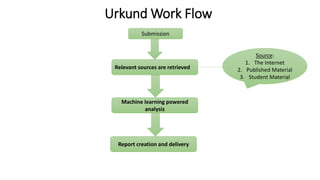
  • 88.
    Xyz library REQUEST FORPLAGIARISM VERIFICATION REPORT FOR THESIS / DISSERTATION To, The Librarian Subject : Request for Plagiarism check report of M.Phil dissertation / Ph.D thesis Respected Madam, I am submitting herewith a softcopy of my M.Phil dissertation / Ph.D thesis. You are kindly requested to check plagiarism and issue me a report to that effect. Name of the Research scholar: Ms. ______________________________________________ Department : __________________________________________________ Address : __________________________________________________ ___________________________________________________ Title of the M.Phil dissertation / Ph.D thesis : _____________________________________ __________________________________________________________________________________ I declare that, I am aware of anti-plagiarism policy of Avinashilingam University, I further declare that the soft copy being submitted for plagiarism check is the same as print copy of dissertation / thesis. Signature of Research Scholar : Date of Registration : Mobile No: Email Id : Signature of the Research Guide : Designation : Mobile No: Email Id : Forwarded by the HOD : Department : 88
  • 89.
    Xyz library Request forPlagiarism Verification (Other than Thesis) Staff / Student / Research Scholar ORIGINAL / REVISION ( ) PLEASE NOTE EMAIL Your document to - plagiarismcheck@avinuty.ac.in The SIMILARITY REPORT will be sent to you through same mail. It requires minimum half a day. Your document should be FINAL and ready for submission. Document should consists of only chapters (Introduction to Conclusion) in Word format This service is limited to university academic community. Name (Staff/Student/Research scholar) Class Faculty/ Ph.d / M.phil Enrolment ID: Department Mobile : Email ID Type (Tick in box) Abstract Paper Project 89
  • 90.
    XYZ LIBRARY PLAGIARISM CHECKREPORT (THESES) 1.Name of the Research Scholar 2.Roll No. and Year of Registration 3.Department 4.Name of the Research Guide 5.Title of the Thesis / Dissertation 6.Similarity Content (%) identified Introduction/ Materials and Results/ Review of Literature Method Discussion/ Summary/ Conclusion Acceptable maximum limit (%) 7.Software Used 8.Date of Verification Checked by Librarian Signature : Date : • 90
  • 91.
  • 92.
    Faculty Registration Process Emailto the coordinator (in case of Jadavpur University, the coordinator is the Information Scientist. Requesting for registration on Urkund. Will receive a mail from ‘noreply@urkund.se’ with the subject “Welcome to URKUND!” Needs to activate the accounts within next 96 hours
  • 93.
  • 94.
    Create Account forDocument Upload (STUDENTS) Students can upload documents only.
  • 95.
    Login to UrkundAccount Link for uploading documents Percentage copied Document Number File name Size of the uploaded file Number of words in the uploaded file Date and time of submission
  • 96.
    Urkund Work Flow Submission Relevantsources are retrieved Machine learning powered analysis Report creation and delivery Source: 1. The Internet 2. Published Material 3. Student Material
  • 97.
    Submit Documents After successfullysubmission, the report will be generated within 30 minutes to 24 hours.
  • 98.
    Overview of Analysis Pagewise document overview Link for export report in PDF file format View the findings of the entire document Percentage of Text Similarity Submission details Tips to interpret the analysis
  • 99.
    Analysis of theEntire Document (Findings) Different types of findings Include/ exclude text differences Percentage of text similarity of the entire document Next Instance Include/ exclude quotes Include/ exclude brackets Previous instance Percentage of text similarity of this instance Original Source
  • 100.
    Analysis of theEntire Document (Sources) Percentage of text similarity of the entire document Types of Sources Type of Source of the particular document Percentage of text similarity from the particular document No. of matches from the particular source Location in the document from the similarity occurred Alternative Sources
  • 101.
    Analysis of theEntire Document (Entire Document) Include/ exclude text differences Percentage of text similarity of the entire document Include/ exclude quotes Include/ exclude brackets Matching text
  • 102.
    Guides and Tutorials Textand Video Guide and tutorial: • Use Guide • Administrator Guide • Integration Guide with Moodle, Learning Management Software URL: https://www.urkund.com/support/guides-tutorials/
  • 103.
    Limitation • In mostcases the reports are not shared with the students. • A user cannot delete a document from Urkund system. This action can be done by the Urkund Team. • Most of the big publishers have not done partnership yet with Urkund.
  • 104.