






Evidence Based Research
Prof (Dr) Smriti Arora
Principal, College of Nursing AIIMS Rishikesh
Objectives
• Advantages of EBP
• Process of EBP
• Hinderances
• Overcoming hinderances
Introduction
• Research - systematic inquiry that uses disciplined methods to
answer questions and solve problems. The ultimate goal of
research is to develop, refine, and expand a body of knowledge.
• Evidence-based research – use of information which is
scientifically available to make decisions about patient care, not
opinion.
• Involves searching several sources (published articles in
medical journals or in electronic form) for data, results and
conclusions of valid, reputable studies.
EBP
• use of the best clinical evidence in making patient care
decisions, and such evidence typically comes from research
conducted by nurses and other health care professionals.
•Eg KMC, STS, early initiation of BF, delayed
cord clamping
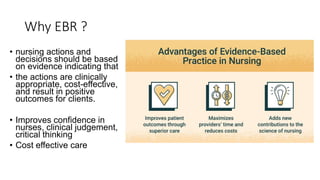
Why EBR ?
• nursing actions and
decisions should be based
on evidence indicating that
• the actions are clinically
appropriate, cost-effective,
and result in positive
outcomes for clients.
• Improves confidence in
nurses, clinical judgement,
critical thinking
• Cost effective care
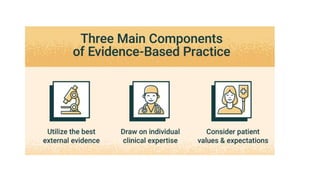
1.Best external evidence: Evaluate and implement
the most current, clinically relevant, and
scientifically sound research.
2.Individual clinical expertise: Draw on your
personal experience of what has worked and not
worked in your clinical practice.
3.Patient values and expectations: Consider and
value the preferences of your individual
patients.
Who can use EBR ?
• Knowing how to conduct evidence-based research and put it into
practice is not only a necessary skill for clinical nurses,
• but also for nurse educators to support their teaching strategies
(simulation, OSCE) , evaluations (formative, summative)
• for nurse administrators who create the guidelines for regulating
nurse practice. (SOPs)
• Regardless of the area in which you work, the common goal of all
these disciplines is to provide the best possible patient care.
What can nurses do to participate in EBP ?
• Participate in a journal club in a practice setting, which involves meetings
to discuss and critique research articles
• Attend research presentations at professional conferences
• Solve clinical problems and make clinical decisions based on rigorous
research
• Help to develop an idea for a clinical study
• Nursing research cell- committee, functions
• Review a proposed research plan and offer clinical expertise to improve
the plan
• Co investigator- Assist researchers by recruiting potential study
participants or collecting research information (e.g., distributing
questionnaires to clients)
• Provide information and advice to clients about participation in studies
Implementation of EBR
• Identify problem- daily practice in wards, college
• Assess the existing methods to manage or solve that problem.
Analyze their pros and con.
• Look out for best methods of solution to that problem in latest
journals.
• New knowledge can also be acquired from conferences, meetings,
brainstorming
• Ensure new method of solving the problem is feasible in your own
area
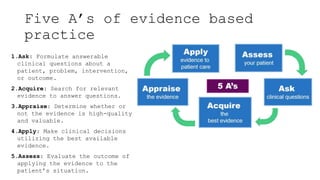
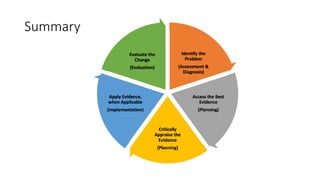
Five A’s of evidence based
practice
1.Ask: Formulate answerable
clinical questions about a
patient, problem, intervention,
or outcome.
2.Acquire: Search for relevant
evidence to answer questions.
3.Appraise: Determine whether or
not the evidence is high-quality
and valuable.
4.Apply: Make clinical decisions
utilizing the best available
evidence.
5.Assess: Evaluate the outcome of
applying the evidence to the
patient’s situation.
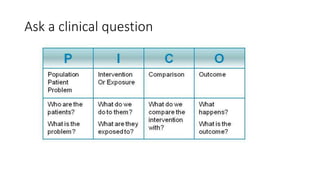
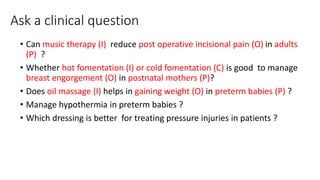
Ask a clinical question
• Can music therapy (I) reduce post operative incisional pain (O) in adults
(P) ?
• Whether hot fomentation (I) or cold fomentation (C) is good to manage
breast engorgement (O) in postnatal mothers (P)?
• Does oil massage (I) helps in gaining weight (O) in preterm babies (P) ?
• Manage hypothermia in preterm babies ?
• Which dressing is better for treating pressure injuries in patients ?
Acquire the best evidence
• Online search – pubmed, Cochrane
• Offline search – journals, library
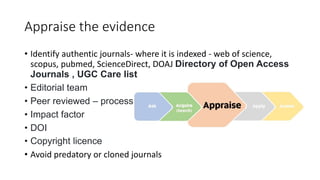
Appraise the evidence
• Identify authentic journals- where it is indexed - web of science,
scopus, pubmed, ScienceDirect, DOAJ Directory of Open Access
Journals , UGC Care list
• Editorial team
• Peer reviewed – process
• Impact factor
• DOI
• Copyright licence
• Avoid predatory or cloned journals
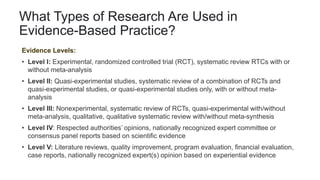
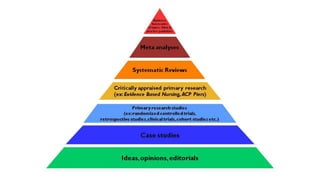
What Types of Research Are Used in
Evidence-Based Practice?
Evidence Levels:
• Level I: Experimental, randomized controlled trial (RCT), systematic review RTCs with or
without meta-analysis
• Level II: Quasi-experimental studies, systematic review of a combination of RCTs and
quasi-experimental studies, or quasi-experimental studies only, with or without meta-
analysis
• Level III: Nonexperimental, systematic review of RCTs, quasi-experimental with/without
meta-analysis, qualitative, qualitative systematic review with/without meta-synthesis
• Level IV: Respected authorities’ opinions, nationally recognized expert committee or
consensus panel reports based on scientific evidence
• Level V: Literature reviews, quality improvement, program evaluation, financial evaluation,
case reports, nationally recognized expert(s) opinion based on experiential evidence
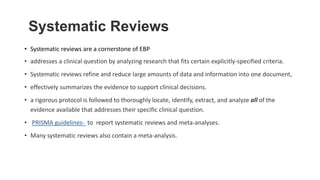
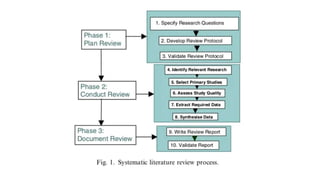
Systematic Reviews
• Systematic reviews are a cornerstone of EBP
• addresses a clinical question by analyzing research that fits certain explicitly-specified criteria.
• Systematic reviews refine and reduce large amounts of data and information into one document,
• effectively summarizes the evidence to support clinical decisions.
• a rigorous protocol is followed to thoroughly locate, identify, extract, and analyze all of the
evidence available that addresses their specific clinical question.
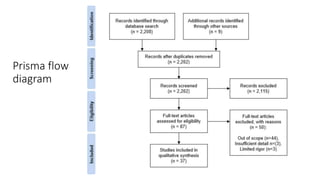
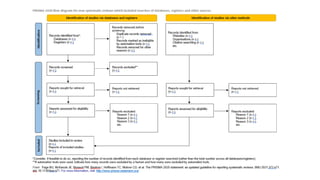
• PRISMA guidelines- to report systematic reviews and meta-analyses.
• Many systematic reviews also contain a meta-analysis.
Systematic reviews examples
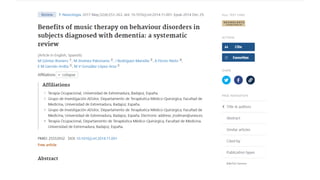
• Novak I, Honan I. Effectiveness of paediatric occupational
therapy for children with disabilities: A systematic review. Aust
Occup Ther J. 2019 Jun;66(3):258-273. doi: 10.1111/1440-
1630.12573. Epub 2019 Apr 10. PMID: 30968419; PMCID:
PMC6850210.
• Karlsson M, Bergenheim A, Larsson MEH, Nordeman L, van
Tulder M, Bernhardsson S. Effects of exercise therapy in
patients with acute low back pain: a systematic review of
systematic reviews. Syst Rev. 2020 Aug 14;9(1):182. doi:
10.1186/s13643-020-01412-8. PMID: 32795336; PMCID:
PMC7427286.
Prisma flow
diagram
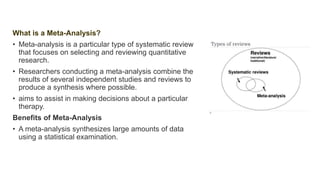
What is a Meta-Analysis?
• Meta-analysis is a particular type of systematic review
that focuses on selecting and reviewing quantitative
research.
• Researchers conducting a meta-analysis combine the
results of several independent studies and reviews to
produce a synthesis where possible.
• aims to assist in making decisions about a particular
therapy.
Benefits of Meta-Analysis
• A meta-analysis synthesizes large amounts of data
using a statistical examination.
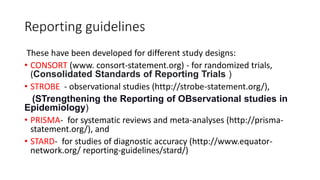
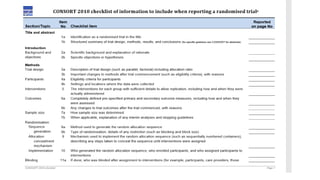
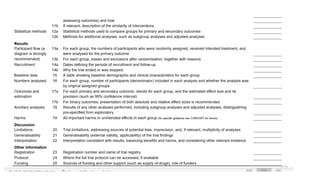
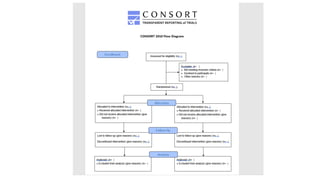
Reporting guidelines
These have been developed for different study designs:
• CONSORT (www. consort-statement.org) - for randomized trials,
(Consolidated Standards of Reporting Trials )
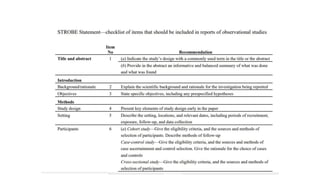
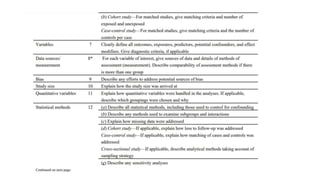
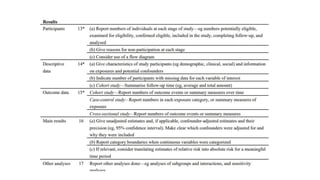
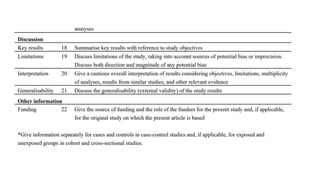
• STROBE - observational studies (http://strobe-statement.org/),
(STrengthening the Reporting of OBservational studies in
Epidemiology)
• PRISMA- for systematic reviews and meta-analyses (http://prisma-
statement.org/), and
• STARD- for studies of diagnostic accuracy (http://www.equator-
network.org/ reporting-guidelines/stard/)
Implementing EBR
• Seek permission from higher authorities
• Inform all the people involved in it – staff nurses
• Make protocol
• Implement
Hinderances in implementing EBR
• Passive attitude of nurses, laziness
• Initiative
• Inadequate knowledge about how to implement- lack of
leaders/teachers
• Obtaining administrative approval is difficult- autonomy of nurses
• Gap between teaching and clinical side
• Increased workload among nurses, lack of time
• Lack of resources- library, journals
Overcoming hurdles
• To practice EBR-
• Being a learner throughout
• Seeking knowledge, regularly update yourself, attend conferences
• Participate in research activities, enthusiasm
• Good communication with all team members
• Identifying priorities correctly – quality care
• Organization-
• Appreciate staff for research
• Allocate time and resources- budgetary approvals
Translating evidence-based research into optimal
care works best when the process is supported by
medical institutions
It is important for both the institution and individual nurses to develop a culture that
allows and encourages them to put evidence-based research into practice. This can
be accomplished by the institution when it:
• Promotes self-directed learning as a professional value
• Promotes the concept of using best evidence in daily clinical practice
• Establishes a library of electronic and paper resources on evidence-based practice
• Improves and promotes the use of informatics and library resources by staff nurses
• Studies and overcomes the gaps between research and practice
• Encourages the study of changes in nurse practice patterns
• Helps accomplished learners become teachers
Example of EBP
• KMC, Skin to skin
• Family centred care
• Infection control practices- PPE
Summary
Thank you

Evidence based research

  • 1.
    Evidence Based Research Prof(Dr) Smriti Arora Principal, College of Nursing AIIMS Rishikesh
  • 3.
    Objectives • Advantages ofEBP • Process of EBP • Hinderances • Overcoming hinderances
  • 4.
    Introduction • Research -systematic inquiry that uses disciplined methods to answer questions and solve problems. The ultimate goal of research is to develop, refine, and expand a body of knowledge. • Evidence-based research – use of information which is scientifically available to make decisions about patient care, not opinion. • Involves searching several sources (published articles in medical journals or in electronic form) for data, results and conclusions of valid, reputable studies.
  • 6.
    EBP • use ofthe best clinical evidence in making patient care decisions, and such evidence typically comes from research conducted by nurses and other health care professionals. •Eg KMC, STS, early initiation of BF, delayed cord clamping
  • 7.
    Why EBR ? •nursing actions and decisions should be based on evidence indicating that • the actions are clinically appropriate, cost-effective, and result in positive outcomes for clients. • Improves confidence in nurses, clinical judgement, critical thinking • Cost effective care
  • 9.
    1.Best external evidence:Evaluate and implement the most current, clinically relevant, and scientifically sound research. 2.Individual clinical expertise: Draw on your personal experience of what has worked and not worked in your clinical practice. 3.Patient values and expectations: Consider and value the preferences of your individual patients.
  • 10.
    Who can useEBR ? • Knowing how to conduct evidence-based research and put it into practice is not only a necessary skill for clinical nurses, • but also for nurse educators to support their teaching strategies (simulation, OSCE) , evaluations (formative, summative) • for nurse administrators who create the guidelines for regulating nurse practice. (SOPs) • Regardless of the area in which you work, the common goal of all these disciplines is to provide the best possible patient care.
  • 11.
    What can nursesdo to participate in EBP ? • Participate in a journal club in a practice setting, which involves meetings to discuss and critique research articles • Attend research presentations at professional conferences • Solve clinical problems and make clinical decisions based on rigorous research • Help to develop an idea for a clinical study • Nursing research cell- committee, functions • Review a proposed research plan and offer clinical expertise to improve the plan • Co investigator- Assist researchers by recruiting potential study participants or collecting research information (e.g., distributing questionnaires to clients) • Provide information and advice to clients about participation in studies
  • 12.
    Implementation of EBR •Identify problem- daily practice in wards, college • Assess the existing methods to manage or solve that problem. Analyze their pros and con. • Look out for best methods of solution to that problem in latest journals. • New knowledge can also be acquired from conferences, meetings, brainstorming • Ensure new method of solving the problem is feasible in your own area
  • 13.
    Five A’s ofevidence based practice 1.Ask: Formulate answerable clinical questions about a patient, problem, intervention, or outcome. 2.Acquire: Search for relevant evidence to answer questions. 3.Appraise: Determine whether or not the evidence is high-quality and valuable. 4.Apply: Make clinical decisions utilizing the best available evidence. 5.Assess: Evaluate the outcome of applying the evidence to the patient’s situation.
  • 14.
  • 15.
    Ask a clinicalquestion • Can music therapy (I) reduce post operative incisional pain (O) in adults (P) ? • Whether hot fomentation (I) or cold fomentation (C) is good to manage breast engorgement (O) in postnatal mothers (P)? • Does oil massage (I) helps in gaining weight (O) in preterm babies (P) ? • Manage hypothermia in preterm babies ? • Which dressing is better for treating pressure injuries in patients ?
  • 16.
    Acquire the bestevidence • Online search – pubmed, Cochrane • Offline search – journals, library
  • 17.
    Appraise the evidence •Identify authentic journals- where it is indexed - web of science, scopus, pubmed, ScienceDirect, DOAJ Directory of Open Access Journals , UGC Care list • Editorial team • Peer reviewed – process • Impact factor • DOI • Copyright licence • Avoid predatory or cloned journals
  • 19.
    What Types ofResearch Are Used in Evidence-Based Practice? Evidence Levels: • Level I: Experimental, randomized controlled trial (RCT), systematic review RTCs with or without meta-analysis • Level II: Quasi-experimental studies, systematic review of a combination of RCTs and quasi-experimental studies, or quasi-experimental studies only, with or without meta- analysis • Level III: Nonexperimental, systematic review of RCTs, quasi-experimental with/without meta-analysis, qualitative, qualitative systematic review with/without meta-synthesis • Level IV: Respected authorities’ opinions, nationally recognized expert committee or consensus panel reports based on scientific evidence • Level V: Literature reviews, quality improvement, program evaluation, financial evaluation, case reports, nationally recognized expert(s) opinion based on experiential evidence
  • 21.
    Systematic Reviews • Systematicreviews are a cornerstone of EBP • addresses a clinical question by analyzing research that fits certain explicitly-specified criteria. • Systematic reviews refine and reduce large amounts of data and information into one document, • effectively summarizes the evidence to support clinical decisions. • a rigorous protocol is followed to thoroughly locate, identify, extract, and analyze all of the evidence available that addresses their specific clinical question. • PRISMA guidelines- to report systematic reviews and meta-analyses. • Many systematic reviews also contain a meta-analysis.
  • 22.
    Systematic reviews examples •Novak I, Honan I. Effectiveness of paediatric occupational therapy for children with disabilities: A systematic review. Aust Occup Ther J. 2019 Jun;66(3):258-273. doi: 10.1111/1440- 1630.12573. Epub 2019 Apr 10. PMID: 30968419; PMCID: PMC6850210. • Karlsson M, Bergenheim A, Larsson MEH, Nordeman L, van Tulder M, Bernhardsson S. Effects of exercise therapy in patients with acute low back pain: a systematic review of systematic reviews. Syst Rev. 2020 Aug 14;9(1):182. doi: 10.1186/s13643-020-01412-8. PMID: 32795336; PMCID: PMC7427286.
  • 24.
  • 25.
    What is aMeta-Analysis? • Meta-analysis is a particular type of systematic review that focuses on selecting and reviewing quantitative research. • Researchers conducting a meta-analysis combine the results of several independent studies and reviews to produce a synthesis where possible. • aims to assist in making decisions about a particular therapy. Benefits of Meta-Analysis • A meta-analysis synthesizes large amounts of data using a statistical examination.
  • 26.
    Reporting guidelines These havebeen developed for different study designs: • CONSORT (www. consort-statement.org) - for randomized trials, (Consolidated Standards of Reporting Trials ) • STROBE - observational studies (http://strobe-statement.org/), (STrengthening the Reporting of OBservational studies in Epidemiology) • PRISMA- for systematic reviews and meta-analyses (http://prisma- statement.org/), and • STARD- for studies of diagnostic accuracy (http://www.equator- network.org/ reporting-guidelines/stard/)
  • 35.
    Implementing EBR • Seekpermission from higher authorities • Inform all the people involved in it – staff nurses • Make protocol • Implement
  • 36.
    Hinderances in implementingEBR • Passive attitude of nurses, laziness • Initiative • Inadequate knowledge about how to implement- lack of leaders/teachers • Obtaining administrative approval is difficult- autonomy of nurses • Gap between teaching and clinical side • Increased workload among nurses, lack of time • Lack of resources- library, journals
  • 38.
    Overcoming hurdles • Topractice EBR- • Being a learner throughout • Seeking knowledge, regularly update yourself, attend conferences • Participate in research activities, enthusiasm • Good communication with all team members • Identifying priorities correctly – quality care • Organization- • Appreciate staff for research • Allocate time and resources- budgetary approvals
  • 39.
    Translating evidence-based researchinto optimal care works best when the process is supported by medical institutions It is important for both the institution and individual nurses to develop a culture that allows and encourages them to put evidence-based research into practice. This can be accomplished by the institution when it: • Promotes self-directed learning as a professional value • Promotes the concept of using best evidence in daily clinical practice • Establishes a library of electronic and paper resources on evidence-based practice • Improves and promotes the use of informatics and library resources by staff nurses • Studies and overcomes the gaps between research and practice • Encourages the study of changes in nurse practice patterns • Helps accomplished learners become teachers
  • 40.
    Example of EBP •KMC, Skin to skin • Family centred care • Infection control practices- PPE
  • 41.
  • 42.