

Case Study Method in Nursing
Research
Prof. (Dr.) Smriti Arora
Amity College of Nursing
Amity University Haryana
Objectives
• Definition
• Advantages
• Features
• Uses
• Steps of case study
• Reporting a case study
Introduction
• Case study is a research methodology, typically seen in social and life
sciences. It is the most widely used method in academia for
researchers interested in qualitative research
• A chronicle of a patient’s progress
• Biomedical story telling
• Holistic nature of nursing care can be addressed through case study
approach
• Quantitative, qualitative approach or mixed method research
• Case is studied within a bounded system (time , place)
Definitions
• an intensive, systematic investigation of a single individual,
group, community or some other unit in which the researcher
examines in-depth data relating to several variables, aimed to
generalize over several units.
• Case study research offers the researcher an approach by
which a phenomenon can be investigated from multiple
perspectives within a bounded context, allowing the researcher
to provide a 'thick' description of the phenomenon.
Advantages of case study approach
• Case studies are an invaluable record of the clinical practices of a
profession. They are a record of clinical interactions which help us to
frame questions for more rigorously designed clinical studies.
• Case studies also provide valuable teaching material, demonstrating
both classical and unusual presentations which may confront the
practitioner.
• Can be published quickly
• Provides very detailed information
• Allows detailed investigation into situations which would be unethical
or impractical to perform using another study design
• Experimental designs- seek to test a specific hypothesis through
deliberately manipulating the environment
• Case study approach - captures information on more explanatory on
'how', 'what' and 'why' questions
• how is the intervention delivered ?
• what gaps exist in its delivery ?
• why one implementation strategy might be chosen over another ?
• This in turn can help develop or refine theory.
Features
• Identification of case
• In depth understanding
• Objective - Explore, describe, explain
• Data analysis depends on objectives of case study, usually
description, thematic analysis
• The case study approach allows in-depth, multi-faceted
explorations of complex issues in their real-life settings
• Easy to conduct
• Identifies rare manifestations of disease or drug
Hierarchy of Evidence
• Case reports do not rank highly in the hierarchy of
evidence
• Not frequently cited, as they describe the clinical
circumstances of single patients, they are seldom
published by high-impact medical journals.
• However, case reports are proposed to have significant
educational value because they advance medical
knowledge and constitute evidence for EBM.
Where to use case study approach ?
• Describe in detail a patient's episode of care
• Explore professional attitudes
• Understand experiences of a new policy initiative or service development
• Identifying an unexpected association between diseases or symptoms.
• An unexpected event in the course of observing or treating a patient.
• Report findings that shed new light on the possible pathogenesis of a disease or
an adverse effect. Eg thalidomide and birth defects/ Unique or rare features of a
disease /Unique therapeutic approaches.
• Confirm or Refute a theory
Which clinical questions does Case Study / Case
Report / Case Series best answer?
• Emerging conditions, adverse reactions to treatments,
atypical / abnormal behaviour, new programs or methods of
treatment – all of these can be answered with case studies
/case reports / case series.
• They are generally descriptive studies based on qualitative
data e.g. observations, interviews, questionnaires, diaries,
personal notes or clinical notes.
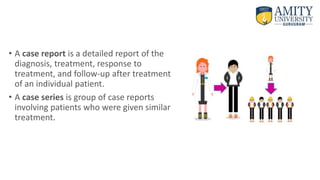
• A case report is a detailed report of the
diagnosis, treatment, response to
treatment, and follow-up after treatment
of an individual patient.
• A case series is group of case reports
involving patients who were given similar
treatment.
Single case study vs multiple case study
Single case study Multiple case study
• If a researcher wants to study a specific
phenomenon arising from a particular
entity, then a single-case study is
warranted.
• It allows for a in-depth understanding of
the single phenomenon and, would
involve collecting several different types
of data.
• Using a multiple-case research study
allows for a more in-depth
understanding of the cases as a unit,
through comparison of similarities and
differences of the individual cases
embedded within the quintain.
• Evidence arising from multiple-case
studies is often stronger and more
reliable than from single-case research.
• Multiple-case studies allow for more
comprehensive exploration of research
questions and theory development.
How are case studies conducted?
• Familiarize yourself with the case study type, style as well as the
design
1. Selecting the case
• The first step is defining the single case or identifying a group of
similar cases that can then be incorporated into a multiple-case
study. A search to determine what is known about the case(s) is
typically conducted. This may include a review of the literature,
grey literature, media, reports and more, which serves to
establish a basic understanding of the cases and informs the
development of research questions.
• Case should illustrate an important point regarding case
management- examination, evaluation, intervention or outcome.
How are case studies conducted?
2. Collecting data
• Choose the right candidate, inclusion criteria
• Observation – participant observation
• Records, diaries, Logbooks , field notes, charts
• Interview- structured, semi structured, open ended questions . You must have a
proper interview questions list to ensure you are not going to miss even a single
query.
• Case studies of individual patients often involve in-depth interviews with
participants and key informants, review of the medical records, observation,
and excerpts from patients' personal writings and diaries.
• Steps taken to address the problem
• Describe intervention ( when, by whom, duration, protocol followed ?)
How are case studies conducted?
3. Analyzing and interpreting the data
• Results: anything unique or significant
• Challenges you faced and how you overcome them
• Lessons learnt
4. Reporting the findings
How to report case studies ?
• “Good case reporting demands a clear focus, to make explicit to the
audience why a particular observation is important in the context of
existing knowledge”
• The CARE guidelines (for CAse REports) were developed by an
international group of experts to support an increase in the accuracy,
transparency, and usefulness of case reports.
2013 CARE Checklist
1.Title – The diagnosis or intervention of primary focus followed by the
words “case report”.
2.Key Words – 2 to 5 key words that identify diagnoses or interventions
in this case report (including "case report").
3.Abstract – (structured or unstructured)
1. Introduction – What is unique about this case and what does it add to the
scientific literature?
2. The patient’s main concerns and important clinical findings.
3. The primary diagnoses, interventions, and outcomes.
4. Conclusion – What are one or more “take-away” lessons from this case
report?
4. Introduction – Briefly summarizes why this case is unique and may
include medical literature references.
5. Patient Information
1. De-identified patient specific information.
2. Primary concerns and symptoms of the patient.
3. Medical, family, and psychosocial history including relevant genetic
information.
4. Relevant past interventions and their outcomes.
6. Clinical Findings – Describe significant physical examination (PE) and
important clinical findings.
7. Timeline – Historical and current information from this episode of
care organized as a timeline (figure or table).
8. Diagnostic Assessment
1. Diagnostic methods (PE, laboratory testing, imaging, surveys).
2. Diagnostic challenges.
3. Diagnosis (including other diagnoses considered).
4. Prognostic characteristics when applicable.
9. Therapeutic Intervention
1. Types of therapeutic intervention (pharmacologic, surgical, preventive).
2. Administration of therapeutic intervention (dosage, strength, duration).
3. Changes in therapeutic interventions with explanations.
10. Follow-up and Outcomes
1. Clinician- and patient-assessed outcomes if available.
2. Important follow-up diagnostic and other test results.
3. Intervention adherence and tolerability. (How was this assessed?)
4. Adverse and unanticipated events.
11. Discussion
1. Strengths and limitations in your approach to this case.
2. Discussion of the relevant medical literature.
3. The rationale for your conclusions.
4. The primary “take-away” lessons from this case report (without references) in
in a one paragraph conclusion.
13. Patient Perspective – The patient should share their perspective on
the treatment(s) they received.
14. Informed Consent – The patient should give informed consent.
(Provide if requested.)
Examples
1. Intraoperative Rupture of an Intracranial, Extradural Hydatid
Cyst: Case Report and Treatment Options
• https://www.ncbi.nlm.nih.gov/pmc/articles/PMC8699760/
2. Case Study: Transition to a Vegan Diet in an Elite Male Gaelic
Football Player
• https://www.ncbi.nlm.nih.gov/pmc/articles/PMC7824752/
3. Extensive deep vein thrombosis following prolonged gaming
(‘gamer’s thrombosis’): a case report
• https://www.ncbi.nlm.nih.gov/pmc/articles/PMC3851187/
Examples
• Capp, G. (2015). Our community, our schools: A case study of program
design for school-based mental health services. Children & Schools, 37(4),
241–248.
• A pilot program to improve school based mental health services was
instigated in one elementary school and one middle / high school. The case
study followed the program from development through to implementation,
documenting each step of the process.
• Cowdrey, F. A. & Walz, L. (2015). Exposure therapy for fear of spiders in an
adult with learning disabilities: A case report. British Journal of Learning
Learning Disabilities, 43(1), 75–82.
• One person was studied who had completed a pre- intervention and post-
intervention questionnaire. From the results of this data the exposure therapy
intervention (11 sessions) was found to be effective in reducing the phobia. This
case report highlighted a therapy that could be used to assist people with learning
disabilities who also suffered from phobias.
Limitation of case studies
• Can't always be generalised to the broader population
• Difficult to replicate
• Lacks rigor , not systematic in data collection
• Allows bias in findings, may include researcher bias
Summary
Evaluate yourself
• It involves in depth study of single case from various angles . …………
• Data collection method in case study includes ………….
• Which method is best suited when you want to report a unique case
or adverse drug reaction ?
• At least how many people are generally included in a case study?
• For case studies consent is not needed – T/ F
References
• https://ebn.bmj.com/content/21/1/7
• https://static1.squarespace.com/static/5db7b349364ff063a6c58ab8/
t/5db7bf175f869e5812fd4293/1572323098501/CARE-checklist-
English-2013.pdf
• https://www.care-statement.org/
• https://deakin.libguides.com/quantitative-study-designs/casestudy

Case study pu

  • 1.
    Case Study Methodin Nursing Research Prof. (Dr.) Smriti Arora Amity College of Nursing Amity University Haryana
  • 2.
    Objectives • Definition • Advantages •Features • Uses • Steps of case study • Reporting a case study
  • 3.
    Introduction • Case studyis a research methodology, typically seen in social and life sciences. It is the most widely used method in academia for researchers interested in qualitative research • A chronicle of a patient’s progress • Biomedical story telling • Holistic nature of nursing care can be addressed through case study approach • Quantitative, qualitative approach or mixed method research • Case is studied within a bounded system (time , place)
  • 4.
    Definitions • an intensive,systematic investigation of a single individual, group, community or some other unit in which the researcher examines in-depth data relating to several variables, aimed to generalize over several units. • Case study research offers the researcher an approach by which a phenomenon can be investigated from multiple perspectives within a bounded context, allowing the researcher to provide a 'thick' description of the phenomenon.
  • 6.
    Advantages of casestudy approach • Case studies are an invaluable record of the clinical practices of a profession. They are a record of clinical interactions which help us to frame questions for more rigorously designed clinical studies. • Case studies also provide valuable teaching material, demonstrating both classical and unusual presentations which may confront the practitioner. • Can be published quickly • Provides very detailed information • Allows detailed investigation into situations which would be unethical or impractical to perform using another study design
  • 7.
    • Experimental designs-seek to test a specific hypothesis through deliberately manipulating the environment • Case study approach - captures information on more explanatory on 'how', 'what' and 'why' questions • how is the intervention delivered ? • what gaps exist in its delivery ? • why one implementation strategy might be chosen over another ? • This in turn can help develop or refine theory.
  • 8.
    Features • Identification ofcase • In depth understanding • Objective - Explore, describe, explain • Data analysis depends on objectives of case study, usually description, thematic analysis • The case study approach allows in-depth, multi-faceted explorations of complex issues in their real-life settings • Easy to conduct • Identifies rare manifestations of disease or drug
  • 9.
  • 10.
    • Case reportsdo not rank highly in the hierarchy of evidence • Not frequently cited, as they describe the clinical circumstances of single patients, they are seldom published by high-impact medical journals. • However, case reports are proposed to have significant educational value because they advance medical knowledge and constitute evidence for EBM.
  • 11.
    Where to usecase study approach ? • Describe in detail a patient's episode of care • Explore professional attitudes • Understand experiences of a new policy initiative or service development • Identifying an unexpected association between diseases or symptoms. • An unexpected event in the course of observing or treating a patient. • Report findings that shed new light on the possible pathogenesis of a disease or an adverse effect. Eg thalidomide and birth defects/ Unique or rare features of a disease /Unique therapeutic approaches. • Confirm or Refute a theory
  • 12.
    Which clinical questionsdoes Case Study / Case Report / Case Series best answer? • Emerging conditions, adverse reactions to treatments, atypical / abnormal behaviour, new programs or methods of treatment – all of these can be answered with case studies /case reports / case series. • They are generally descriptive studies based on qualitative data e.g. observations, interviews, questionnaires, diaries, personal notes or clinical notes.
  • 13.
    • A casereport is a detailed report of the diagnosis, treatment, response to treatment, and follow-up after treatment of an individual patient. • A case series is group of case reports involving patients who were given similar treatment.
  • 14.
    Single case studyvs multiple case study Single case study Multiple case study • If a researcher wants to study a specific phenomenon arising from a particular entity, then a single-case study is warranted. • It allows for a in-depth understanding of the single phenomenon and, would involve collecting several different types of data. • Using a multiple-case research study allows for a more in-depth understanding of the cases as a unit, through comparison of similarities and differences of the individual cases embedded within the quintain. • Evidence arising from multiple-case studies is often stronger and more reliable than from single-case research. • Multiple-case studies allow for more comprehensive exploration of research questions and theory development.
  • 15.
    How are casestudies conducted? • Familiarize yourself with the case study type, style as well as the design 1. Selecting the case • The first step is defining the single case or identifying a group of similar cases that can then be incorporated into a multiple-case study. A search to determine what is known about the case(s) is typically conducted. This may include a review of the literature, grey literature, media, reports and more, which serves to establish a basic understanding of the cases and informs the development of research questions. • Case should illustrate an important point regarding case management- examination, evaluation, intervention or outcome.
  • 16.
    How are casestudies conducted? 2. Collecting data • Choose the right candidate, inclusion criteria • Observation – participant observation • Records, diaries, Logbooks , field notes, charts • Interview- structured, semi structured, open ended questions . You must have a proper interview questions list to ensure you are not going to miss even a single query. • Case studies of individual patients often involve in-depth interviews with participants and key informants, review of the medical records, observation, and excerpts from patients' personal writings and diaries. • Steps taken to address the problem • Describe intervention ( when, by whom, duration, protocol followed ?)
  • 17.
    How are casestudies conducted? 3. Analyzing and interpreting the data • Results: anything unique or significant • Challenges you faced and how you overcome them • Lessons learnt 4. Reporting the findings
  • 18.
    How to reportcase studies ? • “Good case reporting demands a clear focus, to make explicit to the audience why a particular observation is important in the context of existing knowledge” • The CARE guidelines (for CAse REports) were developed by an international group of experts to support an increase in the accuracy, transparency, and usefulness of case reports.
  • 19.
    2013 CARE Checklist 1.Title– The diagnosis or intervention of primary focus followed by the words “case report”. 2.Key Words – 2 to 5 key words that identify diagnoses or interventions in this case report (including "case report"). 3.Abstract – (structured or unstructured) 1. Introduction – What is unique about this case and what does it add to the scientific literature? 2. The patient’s main concerns and important clinical findings. 3. The primary diagnoses, interventions, and outcomes. 4. Conclusion – What are one or more “take-away” lessons from this case report?
  • 20.
    4. Introduction –Briefly summarizes why this case is unique and may include medical literature references. 5. Patient Information 1. De-identified patient specific information. 2. Primary concerns and symptoms of the patient. 3. Medical, family, and psychosocial history including relevant genetic information. 4. Relevant past interventions and their outcomes. 6. Clinical Findings – Describe significant physical examination (PE) and important clinical findings.
  • 21.
    7. Timeline –Historical and current information from this episode of care organized as a timeline (figure or table). 8. Diagnostic Assessment 1. Diagnostic methods (PE, laboratory testing, imaging, surveys). 2. Diagnostic challenges. 3. Diagnosis (including other diagnoses considered). 4. Prognostic characteristics when applicable. 9. Therapeutic Intervention 1. Types of therapeutic intervention (pharmacologic, surgical, preventive). 2. Administration of therapeutic intervention (dosage, strength, duration). 3. Changes in therapeutic interventions with explanations.
  • 22.
    10. Follow-up andOutcomes 1. Clinician- and patient-assessed outcomes if available. 2. Important follow-up diagnostic and other test results. 3. Intervention adherence and tolerability. (How was this assessed?) 4. Adverse and unanticipated events. 11. Discussion 1. Strengths and limitations in your approach to this case. 2. Discussion of the relevant medical literature. 3. The rationale for your conclusions. 4. The primary “take-away” lessons from this case report (without references) in in a one paragraph conclusion.
  • 23.
    13. Patient Perspective– The patient should share their perspective on the treatment(s) they received. 14. Informed Consent – The patient should give informed consent. (Provide if requested.)
  • 24.
    Examples 1. Intraoperative Ruptureof an Intracranial, Extradural Hydatid Cyst: Case Report and Treatment Options • https://www.ncbi.nlm.nih.gov/pmc/articles/PMC8699760/ 2. Case Study: Transition to a Vegan Diet in an Elite Male Gaelic Football Player • https://www.ncbi.nlm.nih.gov/pmc/articles/PMC7824752/ 3. Extensive deep vein thrombosis following prolonged gaming (‘gamer’s thrombosis’): a case report • https://www.ncbi.nlm.nih.gov/pmc/articles/PMC3851187/
  • 25.
    Examples • Capp, G.(2015). Our community, our schools: A case study of program design for school-based mental health services. Children & Schools, 37(4), 241–248. • A pilot program to improve school based mental health services was instigated in one elementary school and one middle / high school. The case study followed the program from development through to implementation, documenting each step of the process.
  • 26.
    • Cowdrey, F.A. & Walz, L. (2015). Exposure therapy for fear of spiders in an adult with learning disabilities: A case report. British Journal of Learning Learning Disabilities, 43(1), 75–82. • One person was studied who had completed a pre- intervention and post- intervention questionnaire. From the results of this data the exposure therapy intervention (11 sessions) was found to be effective in reducing the phobia. This case report highlighted a therapy that could be used to assist people with learning disabilities who also suffered from phobias.
  • 27.
    Limitation of casestudies • Can't always be generalised to the broader population • Difficult to replicate • Lacks rigor , not systematic in data collection • Allows bias in findings, may include researcher bias
  • 28.
  • 29.
    Evaluate yourself • Itinvolves in depth study of single case from various angles . ………… • Data collection method in case study includes …………. • Which method is best suited when you want to report a unique case or adverse drug reaction ? • At least how many people are generally included in a case study? • For case studies consent is not needed – T/ F
  • 30.