
Recent Advances in Nursing
Research in View to Clinical
Practice
Prof Dr. Smriti Arora
Principal, CENER, AIIMS Rishikesh
8 Sep 2023
(2nd International Conference
Evidence-based Nursing Care 2023, SINPS, UP)
Introduction
What is the connection between research and nursing ?
• Nursing is an evidence based area of practice
• Research provides evidence to support nursing practices.
• eg –
• Which type of thermometer is better ?,
• Which dressing is better ?
• Device, treatment or diagnostic test is better
Is research important in clinical area ?
• Yes
• Why
• To provide high quality care to patients
• To increase job satisfaction among us
• Satisfied patients and caregivers
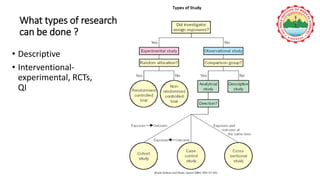
What types of research
can be done ?
• Descriptive
• Interventional-
experimental, RCTs,
QI
Recent advances in clinical research
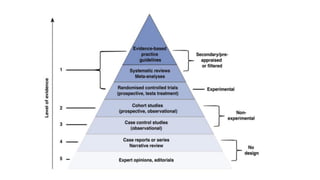
• Systematic reviews and meta-analysis
• Use of AI in research
• Telemedicine, telenursing
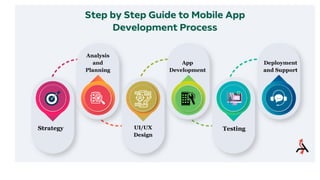
• Mobile apps
• Digital tools
• Gamification
• Patenting, copyright
Systematic reviews and meta-analysis
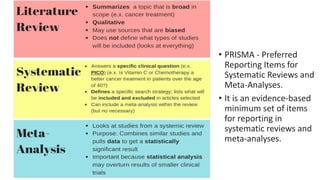
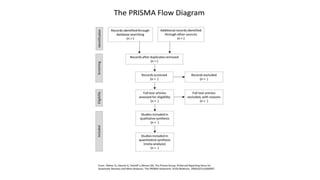
• PRISMA - Preferred
Reporting Items for
Systematic Reviews and
Meta-Analyses.
• It is an evidence-based
minimum set of items
for reporting in
systematic reviews and
meta-analyses.
Examples
• Effects of exercise therapy in patients with acute low
back pain: a systematic review
• Comparative efficacy of exercise regimens on sleep
quality in older adults: A systematic review and
network meta-analysis
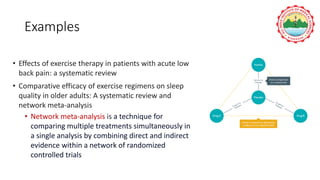
• Network meta-analysis is a technique for
comparing multiple treatments simultaneously in
a single analysis by combining direct and indirect
evidence within a network of randomized
controlled trials
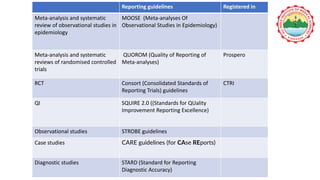
Reporting guidelines Registered in
Meta-analysis and systematic
review of observational studies in
epidemiology
MOOSE (Meta-analyses Of
Observational Studies in Epidemiology)
Meta-analysis and systematic
reviews of randomised controlled
trials
QUOROM (Quality of Reporting of
Meta-analyses)
Prospero
RCT Consort (Consolidated Standards of
Reporting Trials) guidelines
CTRI
QI SQUIRE 2.0 ((Standards for QUality
Improvement Reporting Excellence)
Observational studies STROBE guidelines
Case studies CARE guidelines (for CAse REports)
Diagnostic studies STARD (Standard for Reporting
Diagnostic Accuracy)
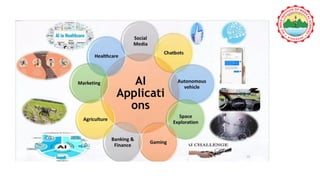
AI
• AI is development of computer systems that are capable of
performing tasks and normally require human intelligence
such as decision making, object detection , solving complex
problems etc.
• MOHFW launched 4 mHealth initiatives: Kilkari, mobile
academy, mCessation and TB missed call initiative.
Kilkari
• Kilkari, which means ‘a baby’s gurgle’, delivers free, weekly, time-
appropriate 72 audio messages about pregnancy, child birth and child
care directly to families’ mobile phones from the second trimester of
pregnancy until the child is one year old.
• Kilakri is being launched in Jharkhand, Odisha, Uttar Pradesh,
Uttarakhand and High Priority Districts (HPDs) of Madhya Pradesh
and Rajasthan in the first phase.
Mobile academy
• Mobile Academy is a free audio training course designed to expand
and refresh the knowledge base of Accredited Social Health Activists
(ASHAs) and improve their communication skills.
• Mobile Academy offers ASHAs a training opportunity via their mobile
phones which is both cost-effective and efficient.
• It reduces the need to travel – sometimes great distances – and
provides them the flexibility they need to learn at their own pace and
at times they find convenient.
• Mobile Academy is being launched in Jharkhand, Madhya Pradesh,
Rajasthan and Uttarakhand.
M - Cessation
• M-Cessation aims at reaching out to those willing to quit tobacco use
and support them towards successful quitting through text messages
sent via mobile phones.
• When offered along with traditional services, M-Cessation has been
found to be cost-effective in comparison to traditional options for
cessation support.
• This is first time in the world that such a two way service is being
provided as part of any mHealth initiative.
TB Missed Call initiative
• Under TB Missed Call initiative, a helpline with a toll free number
will provide information, counselling and treatment support services
for TB.
• Under this campaign the callers can give a missed call or call for free
to get information related to TB symptoms, treatment services
available, address and contact details of the nearest treatment facility
etc.
Application of AI in nursing
• AI - ability of computers to independently convert data into knowledge to guide decisions
or autonomous actions, science and engineering of making intelligent machines
• e.g. Fall risk prediction, it involves regular assessment and fall precaution
implementation.
• Manual risk calculation is time-consuming and vulnerable to human error, leading to
inaccurate predictions. Advantages of AI:
• the ability to quickly consider large volumes of data in the risk prediction
• increased intervention specificity (accurately flagging patients most at-risk)
• AI accurately identifies at-risk patients by considering more diverse patient information
from the EHR and other information sources.
• Eg Generating nursing staff rosters or care-related scheduling decisions
AI in nursing
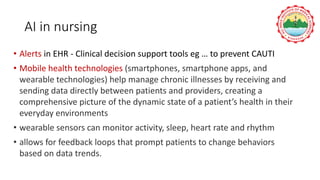
• Alerts in EHR - Clinical decision support tools eg … to prevent CAUTI
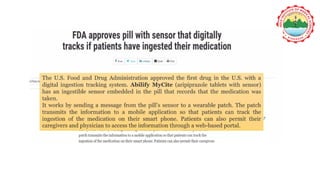
• Mobile health technologies (smartphones, smartphone apps, and
wearable technologies) help manage chronic illnesses by receiving and
sending data directly between patients and providers, creating a
comprehensive picture of the dynamic state of a patient’s health in their
everyday environments
• wearable sensors can monitor activity, sleep, heart rate and rhythm
• allows for feedback loops that prompt patients to change behaviors
based on data trends.
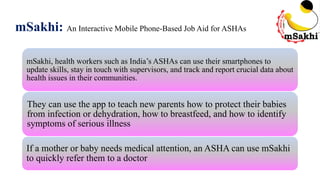
mSakhi: An Interactive Mobile Phone-Based Job Aid for ASHAs
mSakhi, health workers such as India’s ASHAs can use their smartphones to
update skills, stay in touch with supervisors, and track and report crucial data about
health issues in their communities.
They can use the app to teach new parents how to protect their babies
from infection or dehydration, how to breastfeed, and how to identify
symptoms of serious illness.
If a mother or baby needs medical attention, an ASHA can use mSakhi
to quickly refer them to a doctor
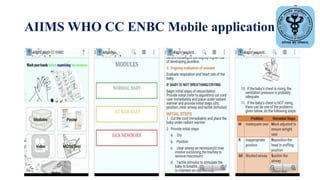
AIIMS WHO CC ENBC Mobile application
AI in nursing
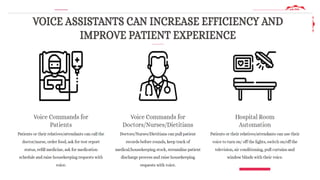
• Voice assistants (think Amazon Alexa and Google Assistant) may have a
future in EHR applications, collecting patient data in the home and
delivering interventions to augment care.
• Imagine a scenario in which a nurse uses Alexa to remind older adults to
take their medications and measure their blood pressure.
• Alexa then records patient data in the EHR for the nurse to review.
• For older adults and patients with certain disabilities (poor eyesight), these
tools may be especially useful given their voice-based interaction.
• Benefit of voice assistants depends on nurse involvement in technology
selection and its application in practice and patient care.
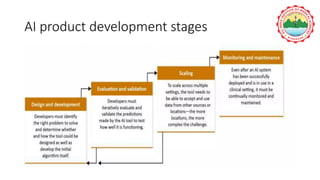
AI
• To help make the best decisions about AI tool use, nurses
should engage in all project development phases, from defining
the problem to be solved by the tool to evaluating its impact.
AI product development stages
• Gamification is an innovative teaching strategy that provides a setting
where nurses can practice clinical decision making in a realistic and
safe manner
• Gamification promotes learner engagement, critical thinking, and
enjoyment.
• Healthcare chatbots- are computer programs designed to
communicate with patients and healthcare providers to deliver
healthcare services, provide medical advice, and improve patient
experience.
Advantages of AI
• Adoption of digital health technologies can improve the quality,
accessibility, and affordability of healthcare while reducing healthcare
costs.
• Analyze large amounts of patient data, identify patterns and trends,
and provide real-time insights into patient care.
• Develop predictive models that can help healthcare professionals
identify patients who are at risk of developing certain conditions.
• Nurses can use digital health technologies to provide patient
education, monitor patients' progress, and collaborate with
healthcare providers remotely
Advantages
• Saves time, money, energy
• Remote monitoring of patients
• Guiding surgical care
• Medication adherence
• Less crowded hospitals
• Specialists care
• Prediction of complications, disease outbreaks
AI
• Improving the performance of artificial intelligence can help
patients receive more scientific-based and accurate treatments.
• There is a need for the development of new methods and
electronic health record data sharing and for increased passion
and support from healthcare workers.
QI studies
• Usually a short term project
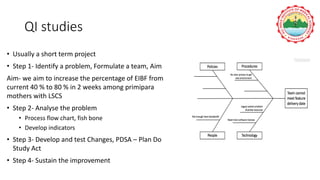
• Step 1- Identify a problem, Formulate a team, Aim
Aim- we aim to increase the percentage of EIBF from
current 40 % to 80 % in 2 weeks among primipara
mothers with LSCS
• Step 2- Analyse the problem
• Process flow chart, fish bone
• Develop indicators
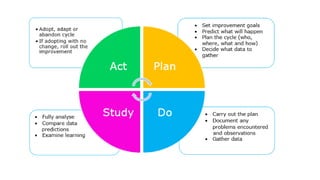
• Step 3- Develop and test Changes, PDSA – Plan Do
Study Act
• Step 4- Sustain the improvement
Telenursing
• the use of information technology in the provision of nursing services
whenever physical distance exists between patient and nurse, or
between any number of nurses.
• Telenursing allows patients to connect with their nurses through
mobile devices, computers, mobile apps, video technology, and
remote patient monitoring.
• Kotsani K, 2018, To evaluate the effect of telenursing on T1DM patients'
compliance with glucose self-monitoring and glycemic control.
...CONCLUSIONS: Patients in the intervention group achieved better glucose
control and more frequent self-monitoring than patients in routine care
Qualitative studies
• Experiences of people with Cancer
• Experiences of caregivers- stress and burn out
• Experiences of health care personnels – staff nurses/doctors/paramedics
• Stress – PPE, Infection, salary, job, ethics
• Nursing perspectives on care delivery during the early stages of the covid-19
pandemic: A qualitative study
• The Lived Experience of Nurses Caring for Patients with COVID-19: A
Phenomenological Study
• Data collection method- In-depth exploration, collect data through telephone
Methodological study
Tool development
• Develop and psychometrically test the COVID-19 prevention,
detection, and home-management self-efficacy scale (COVID-19-SES)
to assess people’s self-efficacy in preventing, detecting symptoms,
and home-managing COVID-19.
• Psychometric Evaluation of Nurses’ Intention to Care Scale (P-NICS)
for Patients with HIV
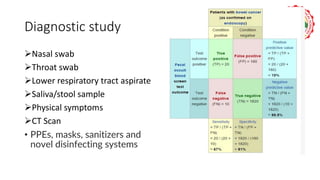
Diagnostic study
➢Nasal swab
➢Throat swab
➢Lower respiratory tract aspirate
➢Saliva/stool sample
➢Physical symptoms
➢CT Scan
• PPEs, masks, sanitizers and
novel disinfecting systems
Clinical research
• Clinical research is a branch of healthcare science that
determines the safety and effectiveness of
• medications
• devices - thermometers
• diagnostic product/tests - X ray , Blood test, sputum test
• treatment regimens intended for human use.
• It may be used for prevention, treatment, diagnosis or for
relieving symptoms of a disease
Collaboration is a good idea
• Identify stakeholders
• Interdepartmental collaborations- Nutrition, physiotherapy,
biostatistics etc.
• State or National collaborations
• International collaborations with foreign institutes/universities
Barriers
• Delayed Institutional Permissions
• Permissions from patients
• Confidentiality of data
• Lack of knowledge about methodology, protocols
• Data is not correct
• Missing data
Overcoming barriers
• Good professional relationship with all members of heath team
• The research must be of benefit to patients and institute
• Good networking within and outside departments
• Find a mentor/guide/expert
• Build a team
• Start with small projects first, show results and then take up
challenging projects
• Look out for funding agencies
Funding opportunities
• Dept of Science and Technology
• UGC- major / minor research projects
• ICMR
• UCOAST
• DAAD (Indo-German)
• All India Council for Technical Education (AICTE)
• Council of Scientific and Industrial Research (CSIR)
• Grants from corporates for social projects
• Federation of Indian Chambers of Commerce and Industry (FICCI/CII)
• INC, TNAI
• ICSSR, USAID, UNICEF
Preparing a proposal for funding
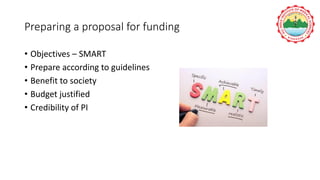
• Objectives – SMART
• Prepare according to guidelines
• Benefit to society
• Budget justified
• Credibility of PI
IPR
• The legal rights given to the inventor or creator to protect his
invention or creation for a certain period of time.
• Innovation is the creation, development and implementation of a
new product, process or service, with the aim of improving efficiency,
effectiveness or competitive advantage
• Problem + Solution = Innovation
• An idea or project is not an innovation unless it is applied in practice
and put onto the market.
Types of Innovation
✓Innovations are broadly divided into the following
types:
✓Technological innovations
✓Product innovations
✓Process innovations
✓Management innovations
46
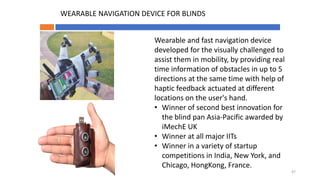
Wearable and fast navigation device
developed for the visually challenged to
assist them in mobility, by providing real
time information of obstacles in up to 5
directions at the same time with help of
haptic feedback actuated at different
locations on the user's hand.
• Winner of second best innovation for
the blind pan Asia-Pacific awarded by
iMechE UK
• Winner at all major IITs
• Winner in a variety of startup
competitions in India, New York, and
Chicago, HongKong, France.
WEARABLE NAVIGATION DEVICE FOR BLINDS
47
What is Patent Registration?
• Patent Registration is a legal process which grants exclusive rights
of ownership and usership to the inventor of a product, service, or
technology.
• As a result, the inventor gains monopoly over his invention for the
entire duration until the patent registration is valid.
• The Patent Registration process is extremely crucial for inventors
and businesses to protect their innovative ideas and prevent others
from using, selling, or manufacturing their inventions without
permission or authorization.
• In India, Patent registration is governed by the Patents Act of 1970,
and administered by the Indian Patent Office.
Patent Registration process in India:
• Step 1: Patent Search
• Step 2: Drafting Patent Specification
• Step 3: Patent Application Filing
• Step 4: Patent Publication for Public Opposition
• Step 5: Requesting Patent Examination
• Step 6: Grant of a Patent
• Once a patent is granted, it confers exclusive patent rights to
the inventor or applicant for a period of 20 years from the date
of filing the patent application form,
Summary
• Corona period opened up avenues for digital health
• mobile and wireless technologies can support the achievement of
health objectives. It helps HCP to assist with
• Information & time management
• Health record maintenance and access
• Communication and consulting
• Reference and information gathering
• Patient management and monitoring
• Clinical decision-making
• Medical education and training.
References
• https://www.ncbi.nlm.nih.gov/pmc/articles/PMC6616181/
• https://www.setindiabiz.com/learning/step-by-step-procedure-for-
patent-registration-in-india
• https://ebn.bmj.com/content/21/1/7
• https://static1.squarespace.com/static/5db7b349364ff063a6c58ab8/
t/5db7bf175f869e5812fd4293/1572323098501/CARE-checklist-
English-2013.pdf
• https://www.care-statement.org/
• https://deakin.libguides.com/quantitative-study-designs/casestudy
THANK YOU

Recent advances in nursing research.pdf

  • 1.
    Recent Advances inNursing Research in View to Clinical Practice Prof Dr. Smriti Arora Principal, CENER, AIIMS Rishikesh 8 Sep 2023 (2nd International Conference Evidence-based Nursing Care 2023, SINPS, UP)
  • 2.
    Introduction What is theconnection between research and nursing ? • Nursing is an evidence based area of practice • Research provides evidence to support nursing practices. • eg – • Which type of thermometer is better ?, • Which dressing is better ? • Device, treatment or diagnostic test is better
  • 3.
    Is research importantin clinical area ? • Yes • Why • To provide high quality care to patients • To increase job satisfaction among us • Satisfied patients and caregivers
  • 4.
    What types ofresearch can be done ? • Descriptive • Interventional- experimental, RCTs, QI
  • 6.
    Recent advances inclinical research • Systematic reviews and meta-analysis • Use of AI in research • Telemedicine, telenursing • Mobile apps • Digital tools • Gamification • Patenting, copyright
  • 7.
  • 8.
    • PRISMA -Preferred Reporting Items for Systematic Reviews and Meta-Analyses. • It is an evidence-based minimum set of items for reporting in systematic reviews and meta-analyses.
  • 9.
    Examples • Effects ofexercise therapy in patients with acute low back pain: a systematic review • Comparative efficacy of exercise regimens on sleep quality in older adults: A systematic review and network meta-analysis • Network meta-analysis is a technique for comparing multiple treatments simultaneously in a single analysis by combining direct and indirect evidence within a network of randomized controlled trials
  • 11.
    Reporting guidelines Registeredin Meta-analysis and systematic review of observational studies in epidemiology MOOSE (Meta-analyses Of Observational Studies in Epidemiology) Meta-analysis and systematic reviews of randomised controlled trials QUOROM (Quality of Reporting of Meta-analyses) Prospero RCT Consort (Consolidated Standards of Reporting Trials) guidelines CTRI QI SQUIRE 2.0 ((Standards for QUality Improvement Reporting Excellence) Observational studies STROBE guidelines Case studies CARE guidelines (for CAse REports) Diagnostic studies STARD (Standard for Reporting Diagnostic Accuracy)
  • 13.
    AI • AI isdevelopment of computer systems that are capable of performing tasks and normally require human intelligence such as decision making, object detection , solving complex problems etc. • MOHFW launched 4 mHealth initiatives: Kilkari, mobile academy, mCessation and TB missed call initiative.
  • 14.
    Kilkari • Kilkari, whichmeans ‘a baby’s gurgle’, delivers free, weekly, time- appropriate 72 audio messages about pregnancy, child birth and child care directly to families’ mobile phones from the second trimester of pregnancy until the child is one year old. • Kilakri is being launched in Jharkhand, Odisha, Uttar Pradesh, Uttarakhand and High Priority Districts (HPDs) of Madhya Pradesh and Rajasthan in the first phase.
  • 15.
    Mobile academy • MobileAcademy is a free audio training course designed to expand and refresh the knowledge base of Accredited Social Health Activists (ASHAs) and improve their communication skills. • Mobile Academy offers ASHAs a training opportunity via their mobile phones which is both cost-effective and efficient. • It reduces the need to travel – sometimes great distances – and provides them the flexibility they need to learn at their own pace and at times they find convenient. • Mobile Academy is being launched in Jharkhand, Madhya Pradesh, Rajasthan and Uttarakhand.
  • 16.
    M - Cessation •M-Cessation aims at reaching out to those willing to quit tobacco use and support them towards successful quitting through text messages sent via mobile phones. • When offered along with traditional services, M-Cessation has been found to be cost-effective in comparison to traditional options for cessation support. • This is first time in the world that such a two way service is being provided as part of any mHealth initiative.
  • 17.
    TB Missed Callinitiative • Under TB Missed Call initiative, a helpline with a toll free number will provide information, counselling and treatment support services for TB. • Under this campaign the callers can give a missed call or call for free to get information related to TB symptoms, treatment services available, address and contact details of the nearest treatment facility etc.
  • 18.
    Application of AIin nursing • AI - ability of computers to independently convert data into knowledge to guide decisions or autonomous actions, science and engineering of making intelligent machines • e.g. Fall risk prediction, it involves regular assessment and fall precaution implementation. • Manual risk calculation is time-consuming and vulnerable to human error, leading to inaccurate predictions. Advantages of AI: • the ability to quickly consider large volumes of data in the risk prediction • increased intervention specificity (accurately flagging patients most at-risk) • AI accurately identifies at-risk patients by considering more diverse patient information from the EHR and other information sources. • Eg Generating nursing staff rosters or care-related scheduling decisions
  • 19.
    AI in nursing •Alerts in EHR - Clinical decision support tools eg … to prevent CAUTI • Mobile health technologies (smartphones, smartphone apps, and wearable technologies) help manage chronic illnesses by receiving and sending data directly between patients and providers, creating a comprehensive picture of the dynamic state of a patient’s health in their everyday environments • wearable sensors can monitor activity, sleep, heart rate and rhythm • allows for feedback loops that prompt patients to change behaviors based on data trends.
  • 20.
    mSakhi: An InteractiveMobile Phone-Based Job Aid for ASHAs mSakhi, health workers such as India’s ASHAs can use their smartphones to update skills, stay in touch with supervisors, and track and report crucial data about health issues in their communities. They can use the app to teach new parents how to protect their babies from infection or dehydration, how to breastfeed, and how to identify symptoms of serious illness. If a mother or baby needs medical attention, an ASHA can use mSakhi to quickly refer them to a doctor
  • 21.
    AIIMS WHO CCENBC Mobile application
  • 22.
    AI in nursing •Voice assistants (think Amazon Alexa and Google Assistant) may have a future in EHR applications, collecting patient data in the home and delivering interventions to augment care. • Imagine a scenario in which a nurse uses Alexa to remind older adults to take their medications and measure their blood pressure. • Alexa then records patient data in the EHR for the nurse to review. • For older adults and patients with certain disabilities (poor eyesight), these tools may be especially useful given their voice-based interaction. • Benefit of voice assistants depends on nurse involvement in technology selection and its application in practice and patient care.
  • 24.
    AI • To helpmake the best decisions about AI tool use, nurses should engage in all project development phases, from defining the problem to be solved by the tool to evaluating its impact.
  • 25.
  • 29.
    • Gamification isan innovative teaching strategy that provides a setting where nurses can practice clinical decision making in a realistic and safe manner • Gamification promotes learner engagement, critical thinking, and enjoyment. • Healthcare chatbots- are computer programs designed to communicate with patients and healthcare providers to deliver healthcare services, provide medical advice, and improve patient experience.
  • 30.
    Advantages of AI •Adoption of digital health technologies can improve the quality, accessibility, and affordability of healthcare while reducing healthcare costs. • Analyze large amounts of patient data, identify patterns and trends, and provide real-time insights into patient care. • Develop predictive models that can help healthcare professionals identify patients who are at risk of developing certain conditions. • Nurses can use digital health technologies to provide patient education, monitor patients' progress, and collaborate with healthcare providers remotely
  • 31.
    Advantages • Saves time,money, energy • Remote monitoring of patients • Guiding surgical care • Medication adherence • Less crowded hospitals • Specialists care • Prediction of complications, disease outbreaks
  • 32.
    AI • Improving theperformance of artificial intelligence can help patients receive more scientific-based and accurate treatments. • There is a need for the development of new methods and electronic health record data sharing and for increased passion and support from healthcare workers.
  • 33.
    QI studies • Usuallya short term project • Step 1- Identify a problem, Formulate a team, Aim Aim- we aim to increase the percentage of EIBF from current 40 % to 80 % in 2 weeks among primipara mothers with LSCS • Step 2- Analyse the problem • Process flow chart, fish bone • Develop indicators • Step 3- Develop and test Changes, PDSA – Plan Do Study Act • Step 4- Sustain the improvement
  • 35.
    Telenursing • the useof information technology in the provision of nursing services whenever physical distance exists between patient and nurse, or between any number of nurses. • Telenursing allows patients to connect with their nurses through mobile devices, computers, mobile apps, video technology, and remote patient monitoring. • Kotsani K, 2018, To evaluate the effect of telenursing on T1DM patients' compliance with glucose self-monitoring and glycemic control. ...CONCLUSIONS: Patients in the intervention group achieved better glucose control and more frequent self-monitoring than patients in routine care
  • 36.
    Qualitative studies • Experiencesof people with Cancer • Experiences of caregivers- stress and burn out • Experiences of health care personnels – staff nurses/doctors/paramedics • Stress – PPE, Infection, salary, job, ethics • Nursing perspectives on care delivery during the early stages of the covid-19 pandemic: A qualitative study • The Lived Experience of Nurses Caring for Patients with COVID-19: A Phenomenological Study • Data collection method- In-depth exploration, collect data through telephone
  • 37.
    Methodological study Tool development •Develop and psychometrically test the COVID-19 prevention, detection, and home-management self-efficacy scale (COVID-19-SES) to assess people’s self-efficacy in preventing, detecting symptoms, and home-managing COVID-19. • Psychometric Evaluation of Nurses’ Intention to Care Scale (P-NICS) for Patients with HIV
  • 38.
    Diagnostic study ➢Nasal swab ➢Throatswab ➢Lower respiratory tract aspirate ➢Saliva/stool sample ➢Physical symptoms ➢CT Scan • PPEs, masks, sanitizers and novel disinfecting systems
  • 39.
    Clinical research • Clinicalresearch is a branch of healthcare science that determines the safety and effectiveness of • medications • devices - thermometers • diagnostic product/tests - X ray , Blood test, sputum test • treatment regimens intended for human use. • It may be used for prevention, treatment, diagnosis or for relieving symptoms of a disease
  • 40.
    Collaboration is agood idea • Identify stakeholders • Interdepartmental collaborations- Nutrition, physiotherapy, biostatistics etc. • State or National collaborations • International collaborations with foreign institutes/universities
  • 41.
    Barriers • Delayed InstitutionalPermissions • Permissions from patients • Confidentiality of data • Lack of knowledge about methodology, protocols • Data is not correct • Missing data
  • 42.
    Overcoming barriers • Goodprofessional relationship with all members of heath team • The research must be of benefit to patients and institute • Good networking within and outside departments • Find a mentor/guide/expert • Build a team • Start with small projects first, show results and then take up challenging projects • Look out for funding agencies
  • 43.
    Funding opportunities • Deptof Science and Technology • UGC- major / minor research projects • ICMR • UCOAST • DAAD (Indo-German) • All India Council for Technical Education (AICTE) • Council of Scientific and Industrial Research (CSIR) • Grants from corporates for social projects • Federation of Indian Chambers of Commerce and Industry (FICCI/CII) • INC, TNAI • ICSSR, USAID, UNICEF
  • 44.
    Preparing a proposalfor funding • Objectives – SMART • Prepare according to guidelines • Benefit to society • Budget justified • Credibility of PI
  • 45.
    IPR • The legalrights given to the inventor or creator to protect his invention or creation for a certain period of time. • Innovation is the creation, development and implementation of a new product, process or service, with the aim of improving efficiency, effectiveness or competitive advantage • Problem + Solution = Innovation • An idea or project is not an innovation unless it is applied in practice and put onto the market.
  • 46.
    Types of Innovation ✓Innovationsare broadly divided into the following types: ✓Technological innovations ✓Product innovations ✓Process innovations ✓Management innovations 46
  • 47.
    Wearable and fastnavigation device developed for the visually challenged to assist them in mobility, by providing real time information of obstacles in up to 5 directions at the same time with help of haptic feedback actuated at different locations on the user's hand. • Winner of second best innovation for the blind pan Asia-Pacific awarded by iMechE UK • Winner at all major IITs • Winner in a variety of startup competitions in India, New York, and Chicago, HongKong, France. WEARABLE NAVIGATION DEVICE FOR BLINDS 47
  • 48.
    What is PatentRegistration? • Patent Registration is a legal process which grants exclusive rights of ownership and usership to the inventor of a product, service, or technology. • As a result, the inventor gains monopoly over his invention for the entire duration until the patent registration is valid. • The Patent Registration process is extremely crucial for inventors and businesses to protect their innovative ideas and prevent others from using, selling, or manufacturing their inventions without permission or authorization. • In India, Patent registration is governed by the Patents Act of 1970, and administered by the Indian Patent Office.
  • 49.
    Patent Registration processin India: • Step 1: Patent Search • Step 2: Drafting Patent Specification • Step 3: Patent Application Filing • Step 4: Patent Publication for Public Opposition • Step 5: Requesting Patent Examination • Step 6: Grant of a Patent • Once a patent is granted, it confers exclusive patent rights to the inventor or applicant for a period of 20 years from the date of filing the patent application form,
  • 50.
    Summary • Corona periodopened up avenues for digital health • mobile and wireless technologies can support the achievement of health objectives. It helps HCP to assist with • Information & time management • Health record maintenance and access • Communication and consulting • Reference and information gathering • Patient management and monitoring • Clinical decision-making • Medical education and training.
  • 51.
    References • https://www.ncbi.nlm.nih.gov/pmc/articles/PMC6616181/ • https://www.setindiabiz.com/learning/step-by-step-procedure-for- patent-registration-in-india •https://ebn.bmj.com/content/21/1/7 • https://static1.squarespace.com/static/5db7b349364ff063a6c58ab8/ t/5db7bf175f869e5812fd4293/1572323098501/CARE-checklist- English-2013.pdf • https://www.care-statement.org/ • https://deakin.libguides.com/quantitative-study-designs/casestudy
  • 52.