Pipelining
www.sarithdivakar.info
Objectives
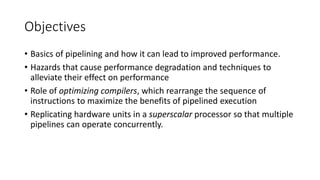
• Basics of pipelining and how it can lead to improved performance.
• Hazards that cause performance degradation and techniques to
alleviate their effect on performance
• Role of optimizing compilers, which rearrange the sequence of
instructions to maximize the benefits of pipelined execution
• Replicating hardware units in a superscalar processor so that multiple
pipelines can operate concurrently.
Basic Concepts
• Pipelining overlaps the execution of successive instructions to achieve
high performance
• The speed of execution of programs is improved by
• using faster circuit technology
• arranging the hardware so that more than one operation can be performed at
the same time
• The number of operations performed per second is increased, even
though the time needed to perform any one operation is not changed
• Pipelining is a particularly effective way of organizing concurrent
activity in a computer system.
Pipelined Execution
Pipeline Organization
Pipelining Issues
• Any condition that causes the pipeline to stall is called a hazard
• Data hazard: Value of a source operand of an instruction is not
available when needed
• Other hazards arise from memory delays, branch instructions, and
resource limitations
Writing to Register file
Operation using the old
value of the register
Data Dependencies
• Add R2, R3, #100
• Subtract R9, R2, #30
• The Subtract instruction is stalled for three cycles to delay reading
register R2 until cycle 6 when the new value becomes available.
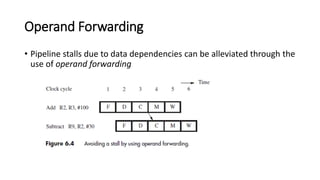
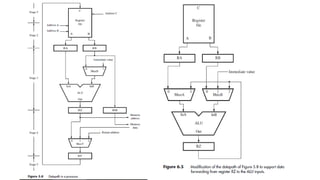
Operand Forwarding
• Pipeline stalls due to data dependencies can be alleviated through the
use of operand forwarding
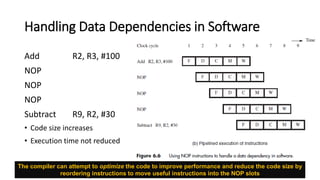
Handling Data Dependencies in Software
Add R2, R3, #100
NOP
NOP
NOP
Subtract R9, R2, #30
• Code size increases
• Execution time not reduced
The compiler can attempt to optimize the code to improve performance and reduce the code size by
reordering instructions to move useful instructions into the NOP slots
Memory Delays
• Load instruction may require more than one clock cycle to obtain its
operand from memory.
• Load R2, (R3)
• Subtract R9, R2, #30
Operand forwarding
• Operand forwarding cannot be done because the data read from
memory (the cache, in this case) are not available until they are
loaded into register RY at the beginning of cycle 5
The memory operand, which is now in register RY, can be forwarded to the ALU input in cycle 5.
Branch Delays
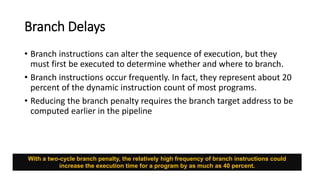
• Branch instructions can alter the sequence of execution, but they
must first be executed to determine whether and where to branch.
• Branch instructions occur frequently. In fact, they represent about 20
percent of the dynamic instruction count of most programs.
• Reducing the branch penalty requires the branch target address to be
computed earlier in the pipeline
With a two-cycle branch penalty, the relatively high frequency of branch instructions could
increase the execution time for a program by as much as 40 percent.
Unconditional Branches
• Reducing the branch penalty requires the branch target address to be
computed earlier in the pipeline
Target address is determined in the Decode
stage of the pipeline.
Conditional Branches
• For pipelining, the branch condition must be tested as early as
possible to limit the branch penalty
The Branch Delay Slot
• The location that follows a branch instruction is called the branch
delay slot.
• Rather than conditionally discard the instruction in the delay slot, we
can arrange to have the pipeline always execute this instruction,
whether or not the branch is taken
Branch Prediction
• To reduce the branch penalty further, the processor needs to
anticipate that an instruction being fetched is a branch instruction
• Predict its outcome to determine which instruction should be fetched
• Static Branch Prediction
• Dynamic Branch Prediction
Static Branch Prediction
• The simplest form of branch prediction is to assume that the branch
will not be taken and to fetch the next instruction in sequential
address order
• If the prediction is correct, the fetched instruction is allowed to
complete and there is no penalty
• Misprediction incurs the full branch penalty
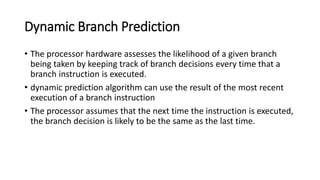
Dynamic Branch Prediction
• The processor hardware assesses the likelihood of a given branch
being taken by keeping track of branch decisions every time that a
branch instruction is executed.
• dynamic prediction algorithm can use the result of the most recent
execution of a branch instruction
• The processor assumes that the next time the instruction is executed,
the branch decision is likely to be the same as the last time.
A 2-state algorithm
• When the branch instruction is executed and the branch is taken, the
machine moves to state LT. Otherwise, it remains in state LNT.
• The next time the same instruction is encountered, the branch is
predicted as taken if the state machine is in state LT. Otherwise it is
predicted as not taken.
LT - Branch is likely to be taken
LNT - Branch is likely not to be taken
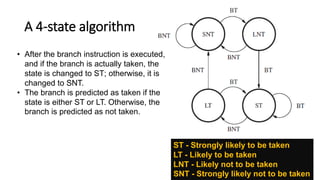
A 4-state algorithm
ST - Strongly likely to be taken
LT - Likely to be taken
LNT - Likely not to be taken
SNT - Strongly likely not to be taken
• After the branch instruction is executed,
and if the branch is actually taken, the
state is changed to ST; otherwise, it is
changed to SNT.
• The branch is predicted as taken if the
state is either ST or LT. Otherwise, the
branch is predicted as not taken.
Performance Evaluation
• Basic performance equation
• For a non-pipelined processor, the execution time, T, of a program
that has a dynamic instruction count of N is given by
• S is the average number of clock cycles it takes to fetch and execute
one instruction
• R is the clock rate in cycles per second
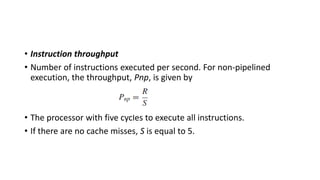
• Instruction throughput
• Number of instructions executed per second. For non-pipelined
execution, the throughput, Pnp, is given by
• The processor with five cycles to execute all instructions.
• If there are no cache misses, S is equal to 5.
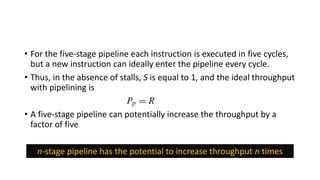
• For the five-stage pipeline each instruction is executed in five cycles,
but a new instruction can ideally enter the pipeline every cycle.
• Thus, in the absence of stalls, S is equal to 1, and the ideal throughput
with pipelining is
• A five-stage pipeline can potentially increase the throughput by a
factor of five
n-stage pipeline has the potential to increase throughput n times
Assignment
Date of Submission: 27-Jun-2016
• How much of this potential increase in instruction
throughput can actually be realizedin practice?
• What is a good value for n?
Superscalar Operation
• Add R2, R3, #100
• Load R5, 16(R6)
• Subtract R7, R8, R9
• Store R10, 24(R11)
References
• "Computer Organization", Carl Hamacher Safwat Zaky Zvonko
Vranesic, McGraw-Hill, 2002

Pipelining

  • 1.
  • 2.
    Objectives • Basics ofpipelining and how it can lead to improved performance. • Hazards that cause performance degradation and techniques to alleviate their effect on performance • Role of optimizing compilers, which rearrange the sequence of instructions to maximize the benefits of pipelined execution • Replicating hardware units in a superscalar processor so that multiple pipelines can operate concurrently.
  • 3.
    Basic Concepts • Pipeliningoverlaps the execution of successive instructions to achieve high performance • The speed of execution of programs is improved by • using faster circuit technology • arranging the hardware so that more than one operation can be performed at the same time • The number of operations performed per second is increased, even though the time needed to perform any one operation is not changed • Pipelining is a particularly effective way of organizing concurrent activity in a computer system.
  • 4.
  • 5.
  • 7.
    Pipelining Issues • Anycondition that causes the pipeline to stall is called a hazard • Data hazard: Value of a source operand of an instruction is not available when needed • Other hazards arise from memory delays, branch instructions, and resource limitations Writing to Register file Operation using the old value of the register
  • 8.
    Data Dependencies • AddR2, R3, #100 • Subtract R9, R2, #30 • The Subtract instruction is stalled for three cycles to delay reading register R2 until cycle 6 when the new value becomes available.
  • 9.
    Operand Forwarding • Pipelinestalls due to data dependencies can be alleviated through the use of operand forwarding
  • 11.
    Handling Data Dependenciesin Software Add R2, R3, #100 NOP NOP NOP Subtract R9, R2, #30 • Code size increases • Execution time not reduced The compiler can attempt to optimize the code to improve performance and reduce the code size by reordering instructions to move useful instructions into the NOP slots
  • 12.
    Memory Delays • Loadinstruction may require more than one clock cycle to obtain its operand from memory. • Load R2, (R3) • Subtract R9, R2, #30
  • 13.
    Operand forwarding • Operandforwarding cannot be done because the data read from memory (the cache, in this case) are not available until they are loaded into register RY at the beginning of cycle 5 The memory operand, which is now in register RY, can be forwarded to the ALU input in cycle 5.
  • 14.
    Branch Delays • Branchinstructions can alter the sequence of execution, but they must first be executed to determine whether and where to branch. • Branch instructions occur frequently. In fact, they represent about 20 percent of the dynamic instruction count of most programs. • Reducing the branch penalty requires the branch target address to be computed earlier in the pipeline With a two-cycle branch penalty, the relatively high frequency of branch instructions could increase the execution time for a program by as much as 40 percent.
  • 15.
    Unconditional Branches • Reducingthe branch penalty requires the branch target address to be computed earlier in the pipeline
  • 16.
    Target address isdetermined in the Decode stage of the pipeline.
  • 17.
    Conditional Branches • Forpipelining, the branch condition must be tested as early as possible to limit the branch penalty
  • 18.
    The Branch DelaySlot • The location that follows a branch instruction is called the branch delay slot. • Rather than conditionally discard the instruction in the delay slot, we can arrange to have the pipeline always execute this instruction, whether or not the branch is taken
  • 20.
    Branch Prediction • Toreduce the branch penalty further, the processor needs to anticipate that an instruction being fetched is a branch instruction • Predict its outcome to determine which instruction should be fetched • Static Branch Prediction • Dynamic Branch Prediction
  • 21.
    Static Branch Prediction •The simplest form of branch prediction is to assume that the branch will not be taken and to fetch the next instruction in sequential address order • If the prediction is correct, the fetched instruction is allowed to complete and there is no penalty • Misprediction incurs the full branch penalty
  • 22.
    Dynamic Branch Prediction •The processor hardware assesses the likelihood of a given branch being taken by keeping track of branch decisions every time that a branch instruction is executed. • dynamic prediction algorithm can use the result of the most recent execution of a branch instruction • The processor assumes that the next time the instruction is executed, the branch decision is likely to be the same as the last time.
  • 23.
    A 2-state algorithm •When the branch instruction is executed and the branch is taken, the machine moves to state LT. Otherwise, it remains in state LNT. • The next time the same instruction is encountered, the branch is predicted as taken if the state machine is in state LT. Otherwise it is predicted as not taken. LT - Branch is likely to be taken LNT - Branch is likely not to be taken
  • 24.
    A 4-state algorithm ST- Strongly likely to be taken LT - Likely to be taken LNT - Likely not to be taken SNT - Strongly likely not to be taken • After the branch instruction is executed, and if the branch is actually taken, the state is changed to ST; otherwise, it is changed to SNT. • The branch is predicted as taken if the state is either ST or LT. Otherwise, the branch is predicted as not taken.
  • 25.
    Performance Evaluation • Basicperformance equation • For a non-pipelined processor, the execution time, T, of a program that has a dynamic instruction count of N is given by • S is the average number of clock cycles it takes to fetch and execute one instruction • R is the clock rate in cycles per second
  • 26.
    • Instruction throughput •Number of instructions executed per second. For non-pipelined execution, the throughput, Pnp, is given by • The processor with five cycles to execute all instructions. • If there are no cache misses, S is equal to 5.
  • 27.
    • For thefive-stage pipeline each instruction is executed in five cycles, but a new instruction can ideally enter the pipeline every cycle. • Thus, in the absence of stalls, S is equal to 1, and the ideal throughput with pipelining is • A five-stage pipeline can potentially increase the throughput by a factor of five n-stage pipeline has the potential to increase throughput n times
  • 28.
    Assignment Date of Submission:27-Jun-2016 • How much of this potential increase in instruction throughput can actually be realizedin practice? • What is a good value for n?
  • 29.
  • 30.
    • Add R2,R3, #100 • Load R5, 16(R6) • Subtract R7, R8, R9 • Store R10, 24(R11)
  • 31.
    References • "Computer Organization",Carl Hamacher Safwat Zaky Zvonko Vranesic, McGraw-Hill, 2002