 Estimated timings for each of
the stages:
Instruction
Fetch
2ns
Instruction
Decode
1ns
Execution 2ns
Memory
and IO
2ns
Write Back 1ns
Advantages:
 More efficient use of processor
 Quicker time of execution of large number of
instructions
Disadvantages:
 Pipelining involves adding hardware to the chip
 Inability to continuously run the pipeline
at full speed because of pipeline hazards
which disrupt the smooth execution of the
pipeline.
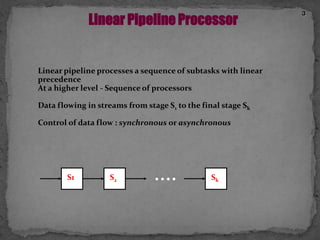
Linear Pipeline Processor
Linear pipeline processes a sequence of subtasks with linear
precedence
At a higher level - Sequence of processors
Data flowing in streams from stage S1 to the final stage Sk
Control of data flow : synchronous or asynchronous
S1 S2 Sk   
3
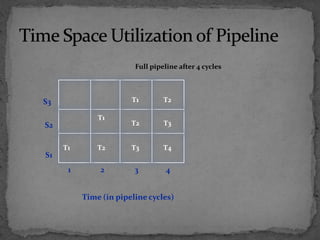
S1
S2
S3
T1
T1
T1
T2
T2
T2
T3
T3
T4
1 2 3 4
Time (in pipeline cycles)
Full pipeline after 4 cycles
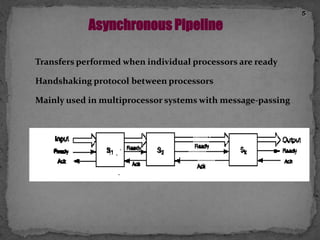
Asynchronous Pipeline
Transfers performed when individual processors are ready
Handshaking protocol between processors
Mainly used in multiprocessor systems with message-passing
5
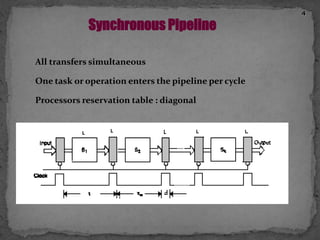
Synchronous Pipeline
All transfers simultaneous
One task or operation enters the pipeline per cycle
Processors reservation table : diagonal
4
 A technique used in advanced microprocessors where the
microprocessor begins executing a second instruction
before the first has been completed.
- A Pipeline is a series of stages, where some work is done at
each stage. The work is not finished until it has passed
through all stages.
 With pipelining, the computer architecture allows the next
instructions to be fetched while the processor is
performing arithmetic operations, holding them in a buffer
close to the processor until each instruction operation can
performed.
 The pipeline is divided into segments and each
segment can execute it operation concurrently with
the other segments. Once a segment completes an
operations, it passes the result to the next segment in
the pipeline and fetches the next operations from the
preceding segment.
Instruction 1 Instruction 2
Instruction 3Instruction 4
X X
XX
Four sample instructions, executed linearly
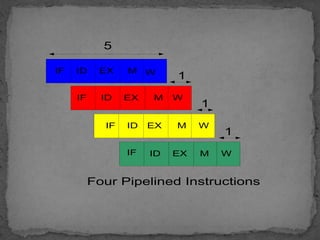
Four Pipelined Instructions
IF
IF
IF
IF
ID
ID
ID
ID
EX
EX
EX
EX M
M
M
M
W
W
W
W
5
1
1
1
Instructions Fetch
 The instruction Fetch (IF) stage is responsible for obtaining
the requested instruction from memory. The instruction
and the program counter (which is incremented to the next
instruction) are stored in the IF/ID pipeline register as
temporary storage so that may be used in the next stage at
the start of the next clock cycle.
Instruction Decode
 The Instruction Decode (ID) stage is responsible for
decoding the instruction and sending out the various
control lines to the other parts of the processor. The
instruction is sent to the control unit where it is decoded
and the registers are fetched from the register file.
Execution
 The Execution (EX) stage is where any calculations are
performed. The main component in this stage is the ALU.
The ALU is made up of arithmetic, logic and capabilities.
Memory and IO
 The Memory and IO (MEM) stage is responsible for storing
and loading values to and from memory. It also responsible
for input or output from the processor. If the current
instruction is not of Memory or IO type than the result
from the ALU is passed through to the write back stage.
Write Back
 The Write Back (WB) stage is responsible for writing
the result of a calculation, memory access or input into
the register file.
Presentation In Pipelining
Submitted to :
Preeti mam
Submitted by :
Pradeep Shrivastava
Sudhir Saurav

 thank you…………….
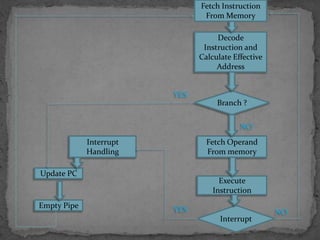
Decode
Instruction and
Calculate Effective
Address
Fetch Instruction
From Memory
Branch ?
Update PC
Empty Pipe
Interrupt
Handling
Fetch Operand
From memory
Execute
Instruction
Interrupt
YES
NO
YES NO
INTRODUCTION
Pipelining is technique of decomposing a
sequential process into suboperation, with each
subprocess being executed in a special dedicated
segment that operates concurrently with all other
segments.
The name “pipeline” implies a flows of
information analogous to an industrial assembly
line.
The name “pipeline” implies a flow of
information analogous to an industrial assembly
line.
It is characteristic of pipelines that several
computation can be in progress in distinct at the
same time.
Each subtask can be processed independently
on a different machine.
The pipelining design provides a way to start a
new task before an old one has been completed.
F
1
E
1
F
2
E
2
F
3
E
3
I1 I2 I3
(a) Sequential execution
Instruction
fetch
unit
Exelution
unit
Interstage buffer
B1
(b) Hardware organization
Time
F1 E1
F2 E2
F3 E3
I1
I2
I3
Instruction
(c) Pipelined execution
Clock cycle 1 2 3 4
Time
Fetch + Execution
 pipelining processing:
 Perform arithmetic operation (Ai*Bi)+(Ci*Di) with a
stream of number. A specify pipeline configuration to
carry out the task. Register in the pipeline for i=1
through 6.
It consist of seven registers that receive new data with
every clock pulse ,two multipliers and one adder circuits .
R1 R2 R3 R4
MULTIPLIER MULTIPLIER
R5 R6
ADDER
R7
Stage 1
Stage 2
Stage 3
Ai Bi Ci Di

pipelining

  • 2.
     Estimated timingsfor each of the stages: Instruction Fetch 2ns Instruction Decode 1ns Execution 2ns Memory and IO 2ns Write Back 1ns
  • 3.
    Advantages:  More efficientuse of processor  Quicker time of execution of large number of instructions Disadvantages:  Pipelining involves adding hardware to the chip  Inability to continuously run the pipeline at full speed because of pipeline hazards which disrupt the smooth execution of the pipeline.
  • 4.
    Linear Pipeline Processor Linearpipeline processes a sequence of subtasks with linear precedence At a higher level - Sequence of processors Data flowing in streams from stage S1 to the final stage Sk Control of data flow : synchronous or asynchronous S1 S2 Sk    3
  • 5.
    S1 S2 S3 T1 T1 T1 T2 T2 T2 T3 T3 T4 1 2 34 Time (in pipeline cycles) Full pipeline after 4 cycles
  • 6.
    Asynchronous Pipeline Transfers performedwhen individual processors are ready Handshaking protocol between processors Mainly used in multiprocessor systems with message-passing 5
  • 8.
    Synchronous Pipeline All transferssimultaneous One task or operation enters the pipeline per cycle Processors reservation table : diagonal 4
  • 9.
     A techniqueused in advanced microprocessors where the microprocessor begins executing a second instruction before the first has been completed. - A Pipeline is a series of stages, where some work is done at each stage. The work is not finished until it has passed through all stages.  With pipelining, the computer architecture allows the next instructions to be fetched while the processor is performing arithmetic operations, holding them in a buffer close to the processor until each instruction operation can performed.
  • 10.
     The pipelineis divided into segments and each segment can execute it operation concurrently with the other segments. Once a segment completes an operations, it passes the result to the next segment in the pipeline and fetches the next operations from the preceding segment.
  • 11.
    Instruction 1 Instruction2 Instruction 3Instruction 4 X X XX Four sample instructions, executed linearly
  • 12.
  • 13.
    Instructions Fetch  Theinstruction Fetch (IF) stage is responsible for obtaining the requested instruction from memory. The instruction and the program counter (which is incremented to the next instruction) are stored in the IF/ID pipeline register as temporary storage so that may be used in the next stage at the start of the next clock cycle.
  • 14.
    Instruction Decode  TheInstruction Decode (ID) stage is responsible for decoding the instruction and sending out the various control lines to the other parts of the processor. The instruction is sent to the control unit where it is decoded and the registers are fetched from the register file.
  • 15.
    Execution  The Execution(EX) stage is where any calculations are performed. The main component in this stage is the ALU. The ALU is made up of arithmetic, logic and capabilities.
  • 16.
    Memory and IO The Memory and IO (MEM) stage is responsible for storing and loading values to and from memory. It also responsible for input or output from the processor. If the current instruction is not of Memory or IO type than the result from the ALU is passed through to the write back stage.
  • 17.
    Write Back  TheWrite Back (WB) stage is responsible for writing the result of a calculation, memory access or input into the register file.
  • 18.
    Presentation In Pipelining Submittedto : Preeti mam Submitted by : Pradeep Shrivastava Sudhir Saurav
  • 20.
  • 21.
    Decode Instruction and Calculate Effective Address FetchInstruction From Memory Branch ? Update PC Empty Pipe Interrupt Handling Fetch Operand From memory Execute Instruction Interrupt YES NO YES NO
  • 22.
    INTRODUCTION Pipelining is techniqueof decomposing a sequential process into suboperation, with each subprocess being executed in a special dedicated segment that operates concurrently with all other segments. The name “pipeline” implies a flows of information analogous to an industrial assembly line.
  • 23.
    The name “pipeline”implies a flow of information analogous to an industrial assembly line. It is characteristic of pipelines that several computation can be in progress in distinct at the same time. Each subtask can be processed independently on a different machine. The pipelining design provides a way to start a new task before an old one has been completed.
  • 24.
    F 1 E 1 F 2 E 2 F 3 E 3 I1 I2 I3 (a)Sequential execution Instruction fetch unit Exelution unit Interstage buffer B1 (b) Hardware organization Time F1 E1 F2 E2 F3 E3 I1 I2 I3 Instruction (c) Pipelined execution Clock cycle 1 2 3 4 Time Fetch + Execution
  • 25.
     pipelining processing: Perform arithmetic operation (Ai*Bi)+(Ci*Di) with a stream of number. A specify pipeline configuration to carry out the task. Register in the pipeline for i=1 through 6. It consist of seven registers that receive new data with every clock pulse ,two multipliers and one adder circuits .
  • 26.
    R1 R2 R3R4 MULTIPLIER MULTIPLIER R5 R6 ADDER R7 Stage 1 Stage 2 Stage 3 Ai Bi Ci Di