Stability Testing During
Product Development:
 PRACTICAL CONDUCT OF STABILITY TESTING
 PRESENTATION AND RECORDING OF RESULTS
 STABILITY DATA HANDLING AND ESTIMATION OF
SHELF LIFE
 PACKAGE LABELLING
Practical conduct of stability
testing
 Protocol has been laid down.
 Followed by ,preparation or collection of the sample in
proposed final packs.
 Then those are charged to stability chamber.
 The chamber set at appropriate storage condition.
 Sample for product development usually subjected to
accelerated conditions.
 Registration batches are exposed both accelerated and long term test
condition.
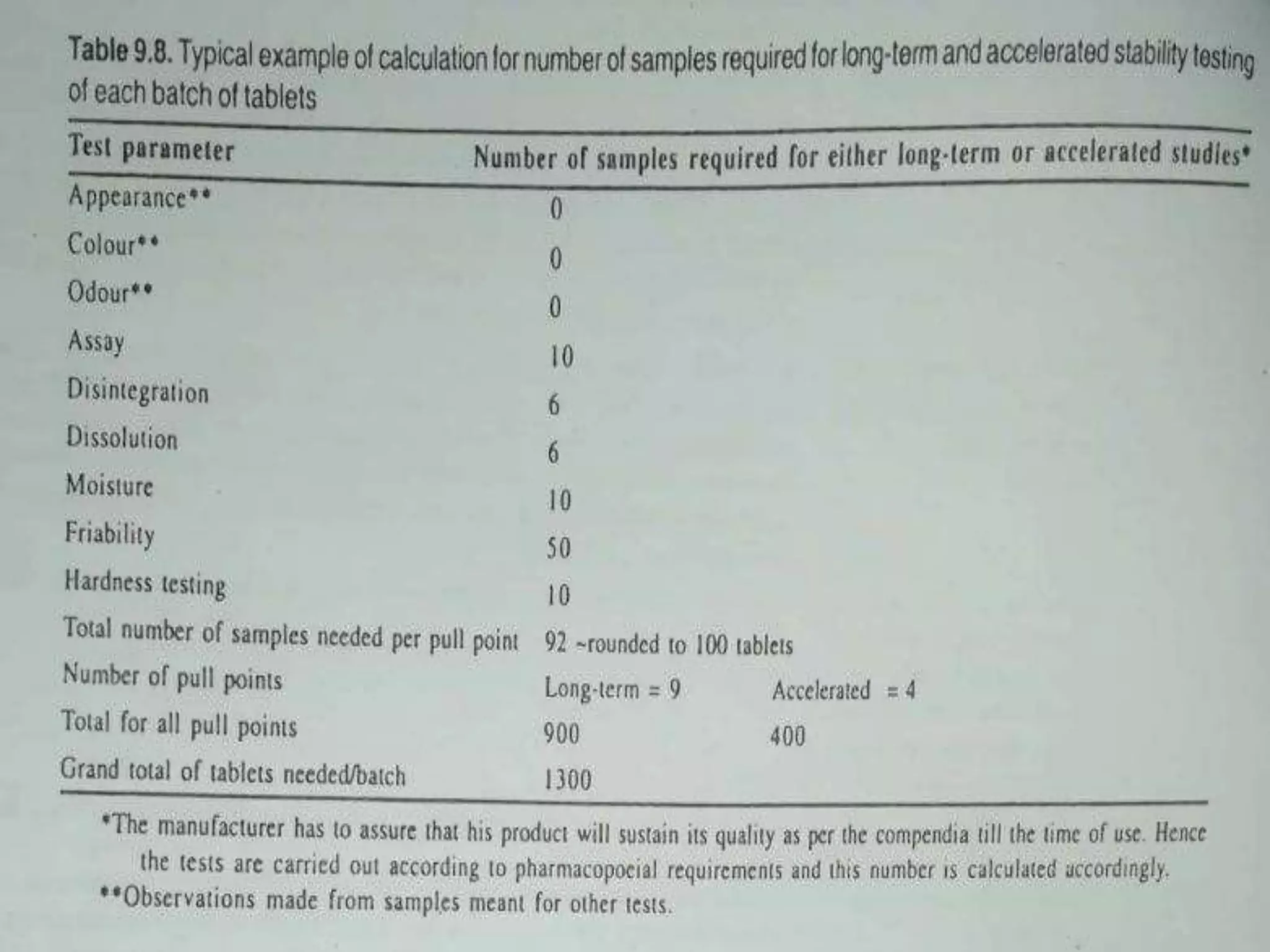
 Have to sufficient number of samples so that we can test all the parameter
at each pull point.
 The samples are analyzed after being withdrawn from the chamber.
Practical conduct of stability testing
Presentation and recording of results
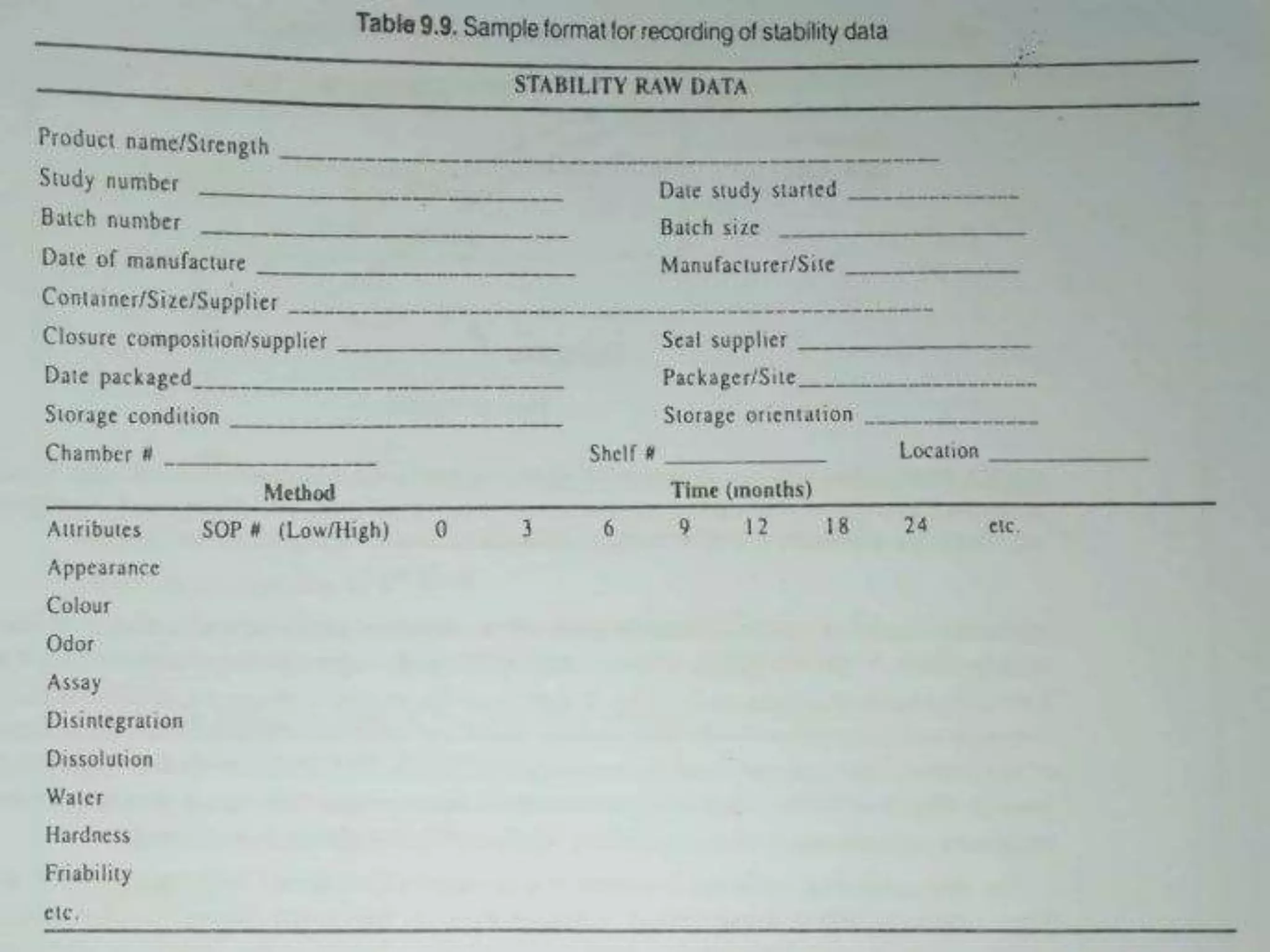
 We should record data in proper format.
 The all information of a batch is recorded at one place.
 Similar sheets are prepared for each batch.
Stability data handling and estimation of
shelf life
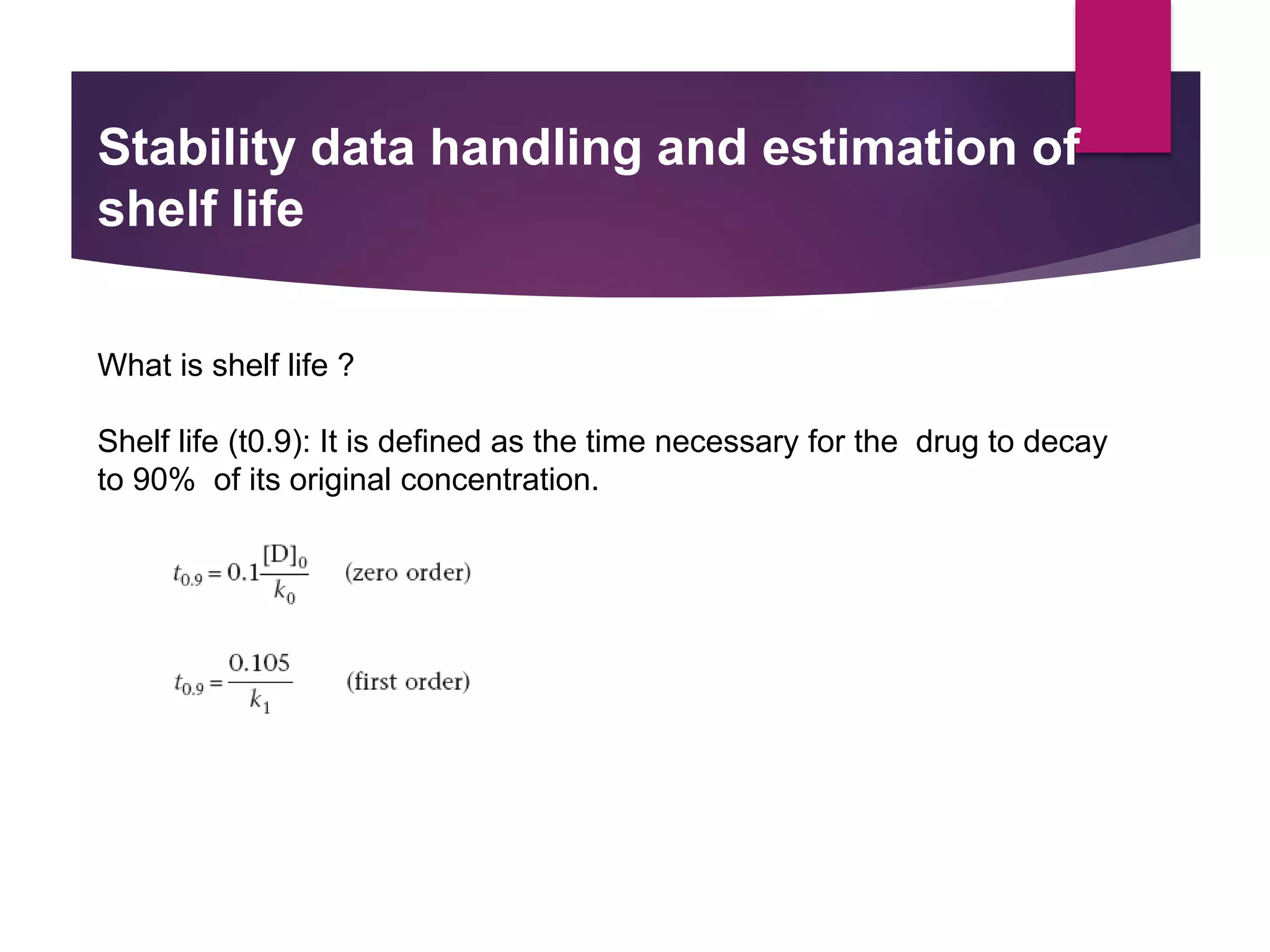
What is shelf life ?
Shelf life (t0.9): It is defined as the time necessary for the drug to decay
to 90% of its original concentration.
Arrhenius equation is a formula which can explain how the rate
constant of a reaction depend on the temperature at which the
reaction is carried out .
As per Arrhenius equation , K=A e –Ea/RT
where ,
k= rate constant
A=frequency factor
Ea=Activation energy
R=Gas constant
T= Absolute temperature.
Arrhenius equation
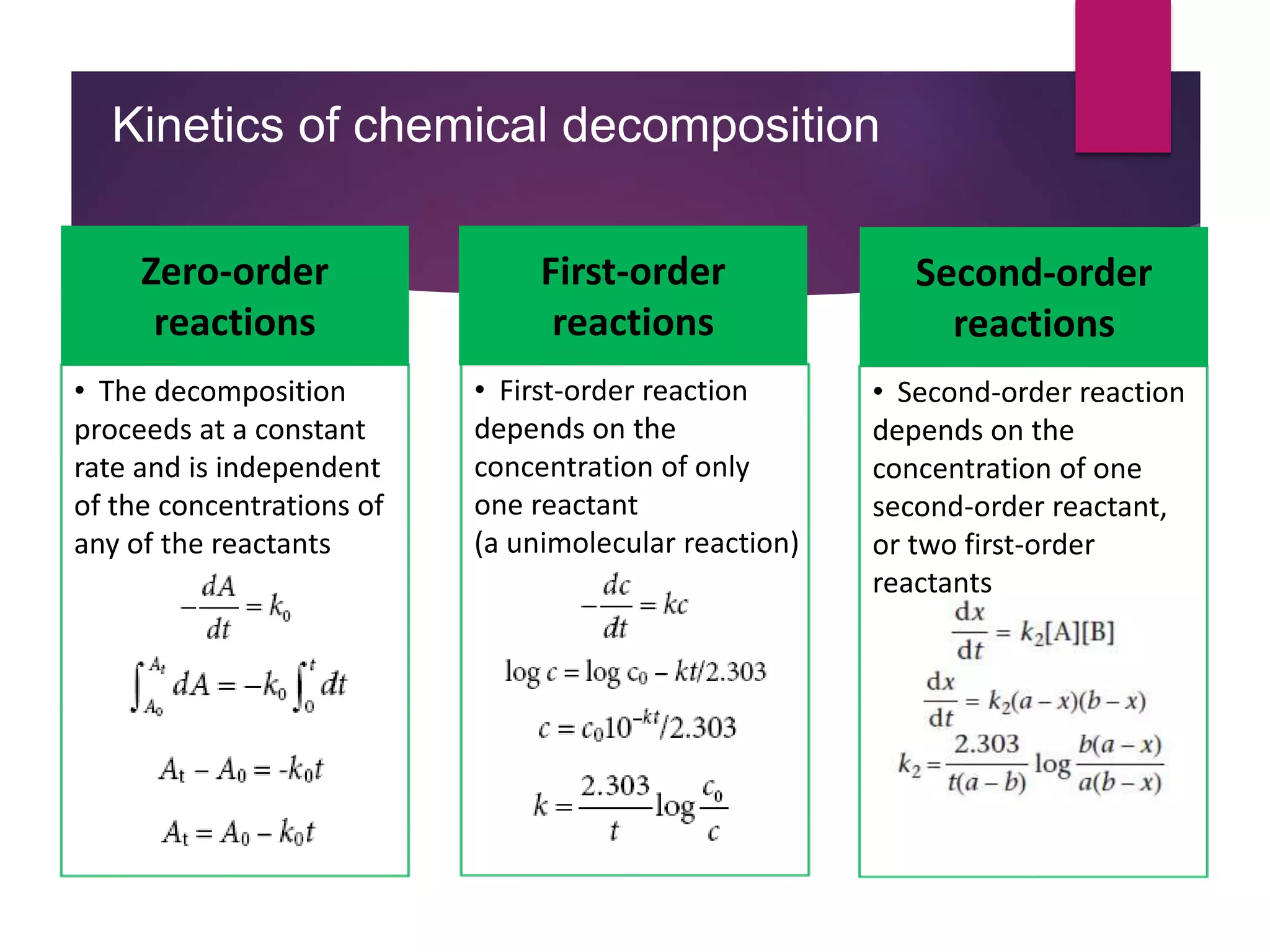
• Second-order reaction
depends on the
concentration of one
second-order reactant,
or two first-order
reactants
• First-order reaction
depends on the
concentration of only
one reactant
(a unimolecular reaction)
Kinetics of chemical decomposition
First-order
reactions
Second-order
reactions
Zero-order
reactions
• The decomposition
proceeds at a constant
rate and is independent
of the concentrations of
any of the reactants
Stability data handling and
estimation of shelf life
Stability studies can be performed on:
1.Active pharmaceutical ingredient (API) or pure drug :
The synthetic ,semi-synthetic or naturally obtained drug substance that may
later be formulated into a dosage form with the help of excipients.
2. Finished pharmaceutical product (FPP):
The formulation in the final primary packaging designed for marketing.
Long term: After every 3 month in 1st year, after every 6 months
in 2nd year and than annually till re-test period .
Accelerated :Three points i.e. 0,3,6 months.
Intermediate : Four time points i.e. 0,6,9 and 12 months
Testing frequency will be :
1.By Real time stability studies .
2.By accelerated stability studies.
Methods to determine Shelf life:
1. Product kept at specific normal storage condition for a long period of time until
a significant change occurs in the quality of the product.
2. Samples withdrawn at specific time intervals and tested for recommended
parameters.
3. The point where significant change is observed marks the end of the self life.
4. It is time taking process.
Real time stability studies :
Accelerated stability studies:
1.Product is kept at elevated stress conditions(i.e. above the recommended
temperature ,PH, Humidity levels ,Illumination etc.)
2.Samples withdrawn at specific time intervals and tested for recommended
parameters.
3. To predict the fate or shelf life of the product at recommended storage
conditions the relationship between
(already established ) acceleration factor and the rate of degradation is used
.
4. It is a faster process.
Package Labelling
 The package label should bear an expiry date or the
retest period.
 The label also contains a recommendation regarding the
shelf –life, before and after opening the container and
after dilution or reconstitution ,and storage during
marketing and use.
 The labels should also contain the storage instruction, as
determined from the stability study.
 The maximum(or minimum) storage temperature should
be stated in degree Celsius.
References
 www.wikipedia.org
 Google images.
 Pharmaceutical Product Development by
N.K. Jain.

Stability Testing During Product Development

  • 1.
    Stability Testing During ProductDevelopment:  PRACTICAL CONDUCT OF STABILITY TESTING  PRESENTATION AND RECORDING OF RESULTS  STABILITY DATA HANDLING AND ESTIMATION OF SHELF LIFE  PACKAGE LABELLING
  • 2.
    Practical conduct ofstability testing  Protocol has been laid down.  Followed by ,preparation or collection of the sample in proposed final packs.  Then those are charged to stability chamber.  The chamber set at appropriate storage condition.  Sample for product development usually subjected to accelerated conditions.
  • 3.
     Registration batchesare exposed both accelerated and long term test condition.  Have to sufficient number of samples so that we can test all the parameter at each pull point.  The samples are analyzed after being withdrawn from the chamber. Practical conduct of stability testing
  • 5.
    Presentation and recordingof results  We should record data in proper format.  The all information of a batch is recorded at one place.  Similar sheets are prepared for each batch.
  • 7.
    Stability data handlingand estimation of shelf life What is shelf life ? Shelf life (t0.9): It is defined as the time necessary for the drug to decay to 90% of its original concentration.
  • 8.
    Arrhenius equation isa formula which can explain how the rate constant of a reaction depend on the temperature at which the reaction is carried out . As per Arrhenius equation , K=A e –Ea/RT where , k= rate constant A=frequency factor Ea=Activation energy R=Gas constant T= Absolute temperature. Arrhenius equation
  • 9.
    • Second-order reaction dependson the concentration of one second-order reactant, or two first-order reactants • First-order reaction depends on the concentration of only one reactant (a unimolecular reaction) Kinetics of chemical decomposition First-order reactions Second-order reactions Zero-order reactions • The decomposition proceeds at a constant rate and is independent of the concentrations of any of the reactants
  • 10.
    Stability data handlingand estimation of shelf life Stability studies can be performed on: 1.Active pharmaceutical ingredient (API) or pure drug : The synthetic ,semi-synthetic or naturally obtained drug substance that may later be formulated into a dosage form with the help of excipients. 2. Finished pharmaceutical product (FPP): The formulation in the final primary packaging designed for marketing.
  • 11.
    Long term: Afterevery 3 month in 1st year, after every 6 months in 2nd year and than annually till re-test period . Accelerated :Three points i.e. 0,3,6 months. Intermediate : Four time points i.e. 0,6,9 and 12 months Testing frequency will be :
  • 12.
    1.By Real timestability studies . 2.By accelerated stability studies. Methods to determine Shelf life:
  • 13.
    1. Product keptat specific normal storage condition for a long period of time until a significant change occurs in the quality of the product. 2. Samples withdrawn at specific time intervals and tested for recommended parameters. 3. The point where significant change is observed marks the end of the self life. 4. It is time taking process. Real time stability studies :
  • 14.
    Accelerated stability studies: 1.Productis kept at elevated stress conditions(i.e. above the recommended temperature ,PH, Humidity levels ,Illumination etc.) 2.Samples withdrawn at specific time intervals and tested for recommended parameters. 3. To predict the fate or shelf life of the product at recommended storage conditions the relationship between (already established ) acceleration factor and the rate of degradation is used . 4. It is a faster process.
  • 15.
    Package Labelling  Thepackage label should bear an expiry date or the retest period.  The label also contains a recommendation regarding the shelf –life, before and after opening the container and after dilution or reconstitution ,and storage during marketing and use.  The labels should also contain the storage instruction, as determined from the stability study.  The maximum(or minimum) storage temperature should be stated in degree Celsius.
  • 16.
    References  www.wikipedia.org  Googleimages.  Pharmaceutical Product Development by N.K. Jain.