Welcome
Major Intra & Extra-Cellular Fluids
A Presentation On
 Md. Rakibul Hasan (171023)
 Md. Alamin Hossain (171024)
 Tahmim Zaman Mishu (171025)
 Al Riyad Hasan (171026)
 Humaira Khatun Lisa (171027)
 Abu Sayeem Tamim (171028)
 Mahjabin Nessa Tumpa (171029)
Members of Group-3 (Retinol)
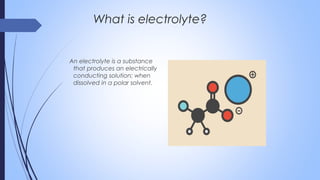
An electrolyte is a substance
that produces an electrically
conducting solution; when
dissolved in a polar solvent.
What is electrolyte?
 Maintain water balance.
 Helping muscles (including heart) contract and relax.
  Help in transmit nerve impulses.
 Maintain acid-base balance.
 Maintain a constant environment in the whole body tissue.
Importance of electrolytes in
human body
 Calcium (Ca)
 Magnesium (Mg)
 Sodium (Na)
 Potassium (K)
 Chloride (Cl-)
 Bicarbonate (HCO3-)
 Phosphate (PO4-)
 Iron (Fe)
Major physiological ions:
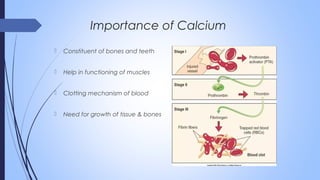
 Constituent of bones and teeth
 Help in functioning of muscles
 Clotting mechanism of blood
 Need for growth of tissue & bones
Importance of Calcium
 Found in bone; combine with Ca
 Used for protein synthesis
 Important for Neuromuscular system
 Insufficient Mg ion can cause Cardiac Disturbance
Importance of Magnesium
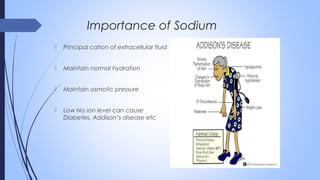
 Principal cation of extracellular fluid
 Maintain normal hydration
 Maintain osmotic pressure
 Low Na ion level can cause
Diabetes, Addison’s disease etc
Importance of Sodium
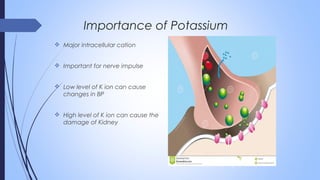
 Major intracellular cation
 Important for nerve impulse
 Low level of K ion can cause
changes in BP
 High level of K ion can cause the
damage of Kidney
Importance of Potassium
 Maintain the osmotic pressure
 The major extracellular anion
 Maintain proper hydration
 Hyperchloremic condition can cause Congestive Heart Failure
Importance of Chloride
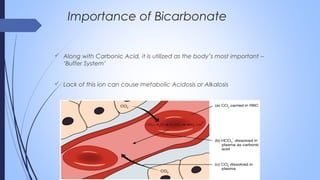
 Along with Carbonic Acid, it is utilized as the body’s most important –
‘Buffer System’
 Lack of this ion can cause metabolic Acidosis or Alkalosis
Importance of Bicarbonate
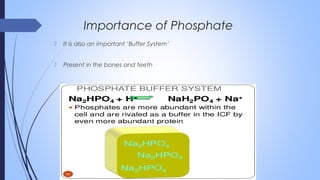
 It is also an important ‘Buffer System’
 Present in the bones and teeth
Importance of Phosphate
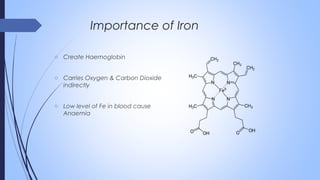
o Create Haemoglobin
o Carries Oxygen & Carbon Dioxide
indirectly
o Low level of Fe in blood cause
Anaemia
Importance of Iron
Sodium chloride
 Mol weight =58.44
 It contains not less than 99.5% of NaCl
 It is found in the sea
 It occurs as odourless, colourless,
colourless crystals or white crystaline
powder.
 Soluble in water.
 Slightly soluble in alcohole
Uses:
Its is an electrolyte replensher ,emetic, topical
inflammatory
Used to treat extracellular volume depletion ,
dehydration.
May be used in eye drops, nasal drops.
Used in homeopathic
Has adverse effect on vomitting, sweating, diarrhoea.
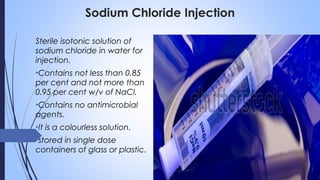
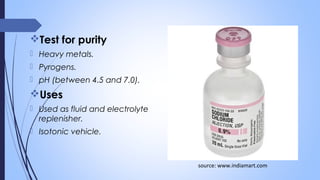
Sodium Chloride Injection
Sterile isotonic solution of
sodium chloride in water for
injection.
•Contains not less than 0.85
per cent and not more than
0.95 per cent w/v of NaCl.
•Contains no antimicrobial
agents.
•It is a colourless solution.
•stored in single dose
containers of glass or plastic.
Test for purity
 Heavy metals.
 Pyrogens.
 pH (between 4.5 and 7.0).
Uses
 Used as fluid and electrolyte
replenisher.
 Isotonic vehicle.
source: www.indiamart.com
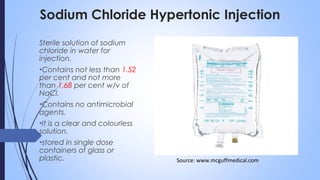
Sodium Chloride Hypertonic Injection
Sterile solution of sodium
chloride in water for
injection.
•Contains not less than 1.52
per cent and not more
than 1.68 per cent w/v of
NaCl.
•Contains no antimicrobial
agents.
•It is a clear and colourless
solution.
•stored in single dose
containers of glass or
plastic. Source: www.mcguffmedical.com
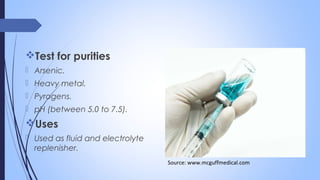
Test for purities
 Arsenic.
 Heavy metal.
 Pyrogens.
 pH (between 5.0 to 7.5).
Uses
 Used as fluid and electrolyte
replenisher.
Source: www.mcguffmedical.com
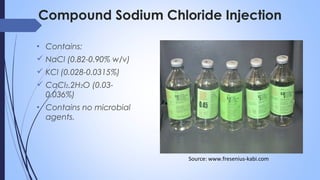
Compound Sodium Chloride Injection
• Contains:
 NaCl (0.82-0.90% w/v)
 KCl (0.028-0.0315%)
 CaCl2.2H2O (0.03-
0.036%)
• Contains no microbial
agents.
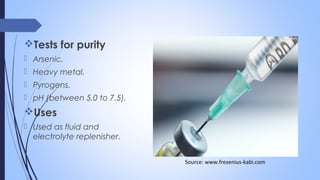
Source: www.fresenius-kabi.com
Tests for purity
 Arsenic.
 Heavy metal.
 Pyrogens.
 pH (between 5.0 to 7.5).
Uses
 Used as fluid and
electrolyte replenisher.
Source: www.fresenius-kabi.com
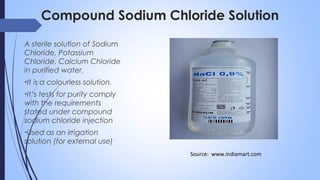
Compound Sodium Chloride Solution
A sterile solution of Sodium
Chloride, Potassium
Chloride, Calcium Chloride
in purified water.
•It is a colourless solution.
•It’s tests for purity comply
with the requirements
stated under compound
sodium chloride injection
•Used as an irrigation
solution (for external use)
Source: www.indiamart.com
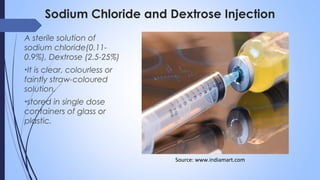
Sodium Chloride and Dextrose Injection
A sterile solution of
sodium chloride(0.11-
0.9%), Dextrose (2.5-25%)
•It is clear, colourless or
faintly straw-coloured
solution.
•stored in single dose
containers of glass or
plastic.
Source: www.indiamart.com
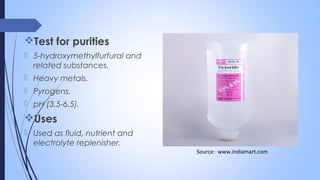
Test for purities
 5-hydroxymethylfurfural and
related substances.
 Heavy metals.
 Pyrogens.
 pH (3.5-6.5).
Uses
 Used as fluid, nutrient and
electrolyte replenisher.
Source: www.indiamart.com
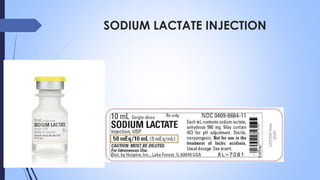
SODIUM LACTATE INJECTION
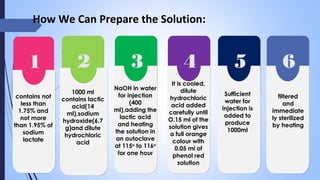
1
contains not
less than
1.75% and
not more
than 1.95% of
sodium
lactate
2
1000 ml
contains lactic
acid(14
ml),sodium
hydroxide(6.7
g)and dilute
hydrochloric
acid
3
NaOH in water
for injection
(400
ml),adding the
lactic acid
and heating
the solution in
an autoclave
at 115o
to 116o
for one hour
4
It is cooled,
dilute
hydrochloric
acid added
carefully until
O.15 ml of the
solution gives
a full orange
colour with
0.05 ml of
phenol red
solution
5
Sufficient
water for
injection is
added to
produce
1000ml
6
filtered
and
immediate
ly sterilized
by heating
How We Can Prepare the Solution:
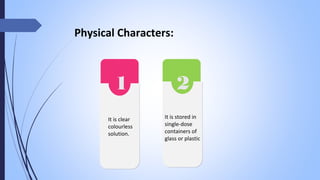
Physical Characters:
1
It is clear
colourless
solution.
2
It is stored in
single-dose
containers of
glass or plastic
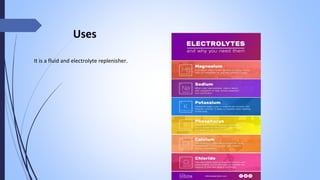
It is a fluid and electrolyte replenisher.
Uses
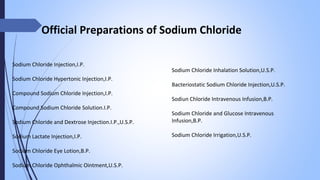
Sodium Chloride Injection,I.P.
Sodium Chloride Hypertonic Injection,I.P.
Compound Sodium Chloride Injection,I.P.
Compound Sodium Chloride Solution.I.P.
Sodium Chloride and Dextrose Injection.I.P.,U.S.P.
Sodium Lactate Injection,I.P.
Sodium Chloride Eye Lotion,B.P.
Sodium Chloride Ophthalmic Ointment,U.S.P.
Official Preparations of Sodium Chloride
Sodium Chloride Inhalation Solution,U.S.P.
Bacteriostatic Sodium Chloride Injection,U.S.P.
Sodiun Chloride Intravenous Infusion,B.P.
Sodium Chloride and Glucose Intravenous
Infusion,B.P.
Sodium Chloride Irrigation,U.S.P.
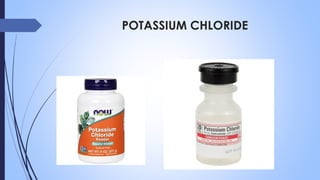
POTASSIUM CHLORIDE
Introduction
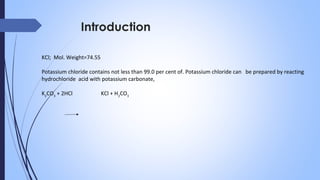
KCl; Mol. Weight=74.55
Potassium chloride contains not less than 99.0 per cent of. Potassium chloride can be prepared by reacting
hydrochloride acid with potassium carbonate,
K2
CO3
+ 2HCl KCl + H2
CO3
Physical Characteristics:
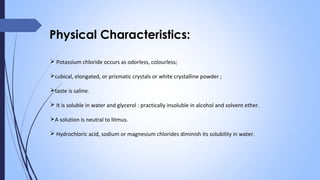
 Potassium chloride occurs as odorless, colourless;
cubical, elongated, or prismatic crystals or white crystalline powder ;
taste is saline.
 It is soluble in water and glycerol : practically insoluble in alcohol and solvent ether.
A solution is neutral to litmus.
 Hydrochloric acid, sodium or magnesium chlorides diminish its solubility in water.
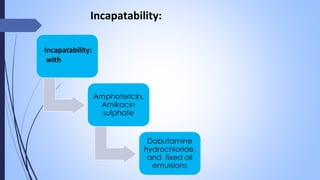
Incapatability:
with
Incapatability:
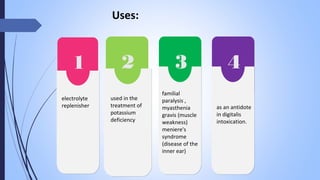
1
electrolyte
replenisher
2
used in the
treatment of
potassium
deficiency
3
familial
paralysis ,
myasthenia
gravis (muscle
weakness)
meniere's
syndrome
(disease of the
inner ear)
4
as an antidote
in digitalis
intoxication.
Uses:
What happed :Excessive Use
1
hyperkalaemia
causing muscles
weakness
2
Paralysis
3
Hypotension
4
Heart block and
cardiac arrest.
Potassium Chloride and Sodium chloride Intravenous Infusion(BP)
It is a sterile colourless solution of potassitun chloride and thw sodium chloride in water.
Potassium Chloride and Glucose Intravenous Infusion (B.P.)
It is a sterile colourless or faintly straw-coloured solution of Potassium chloride and either
anhydrous glucose or glucose in water.
Potassium Chloride, Sodium Chloride and Glucose Intravenous Infusions (B. P.)
It is. a sterile solution of potassium chloride, sodium chloride and either anhydrous glucose or
glucose in water.
Effervescent Potassium Chloride Tablets (B.P.)
Potassium Chloride Elixir, U. S.P
Potassium Chlorme Mixture, A. P. F.
Potassium Chlorme Injection, U. S. P.
Potassium chloride in Dextrose Injection, U. S. P.
Potassium chloride Oral Solution, U. S. P.
Potassium Chloride Extended-release Capsules Tablets. U. S. P.
Potassium Chloride, potassium Bicarbonate, and Potassium
citrate Effervescent Tablets for Oral Solution , U. S. P.
OFFICIAL POTASSIUM CHLORIDE PREPARATIONS
Electrolytes used in acid base in
acid base therapy
The sodium salts of bicarbonate, lactate, acetate and
sometimes citrate and ammonium salts are used to treat
metabolic acidosis. supply of bicarbonate increase the
HCO3/H2CO3 ratio. lactate, acetare and citrate ions are
degraded to CO2 and water by tricarboxylic acid cycle.
The major functions of electrolytes are to maintain
electrolytic imbalance, including acid base balance and
osmotic equilibrium and to facilitate specific metabolic function
through supplyofspecific ion to body fluids.
Sodium acetate:
CH3COONa 3 H20 mol weight =136.08
Sodium acetate contains not less than 99.0 per centof CH3CooNa.3H20. It is
prepared by neutralization of acetic acid with sodium carbonate or sodium
hydroxide,and then crystallizing the product.
2CH3COOH + Na2CO3=2 CH3COONa + CO2+ H20
Characters:
1. Colourless & odourless
2.soluble in water and alcohol
3.5% solution in Waterhas a pH of 7.5 to 9.2.
4.kept in airtight containers.
Uses:
1. Used as pharmaceutical aid
2. Acidulant in food
3.used as effective buffer in metabolic acedosis.
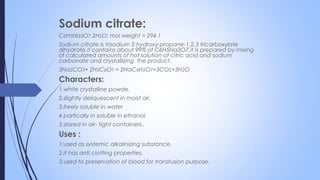
Sodium citrate:
C6H5Na3O7.2H2O; mol weight = 294.1
Sodium citrate is trisodium 2-hydroxy-propane-1,2,3 tricarboxylate
dihydrate.it contains about 99% of C6H5Na3O7.it is prepared by mixing
of calculated amounts of hot solution of citric acid and sodium
carbonate and crystallizing the product.
3Na2CO3+ 2H3C6O7 = 2NaC6H5O7+3CO2+3H2O
Characters:
1.white crystalline powde.
2.slightly deliquescent in moist air.
3.freely soluble in water
4.partically in soluble in ethanol.
5.stored in air- tight containers..
Uses :
1:used as systemic alkalinizing substance.
2.it has anti clotting properties.
3.used to preservation of blood for transfusion purpose.
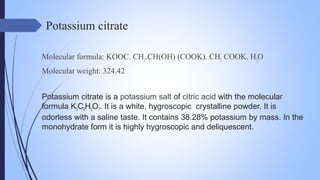
Potassium citrate
Molecular formula: KOOC. CH2.CH(OH) (COOK). CH2 COOK. H2O
Molecular weight: 324.42
Potassium citrate is a potassium salt of citric acid with the molecular
formula K3C6H5O7. It is a white, hygroscopic crystalline powder. It is
odorless with a saline taste. It contains 38.28% potassium by mass. In the
monohydrate form it is highly hygroscopic and deliquescent.
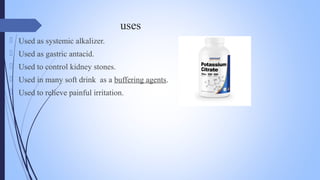
uses
 Used as systemic alkalizer.
 Used as gastric antacid.
 Used to control kidney stones.
 Used in many soft drink as a buffering agents.
 Used to relieve painful irritation.
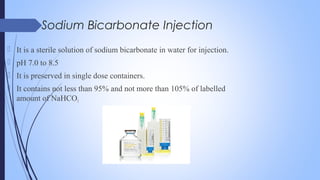
Sodium Bicarbonate Injection
 It is a sterile solution of sodium bicarbonate in water for injection.
 pH 7.0 to 8.5
 It is preserved in single dose containers.
 It contains not less than 95% and not more than 105% of labelled
amount of NaHCO3
Ammonium Chloride injection
 Ammonium chloride is an inorganic compound with the formula
NH4Cl and a white crystalline salt that is highly soluble in water.
Solutions of ammonium chloride are mildly acidic.
 Ammonium chloride injection is a sterile solution of ammonium
chloride in water for injection .
 It contains not less than 95% and not more than 105% of labelled
amount of NH4Cl
 It is preserved in single dose or in multiple dose containers.
Electrolyte combination therapy
 When a patient undergoes a surgery , he is unable to take normal
diet, therefore he is given infusion’s containing saline and
glucose he also needs additional electrolytes . which are intended
for the fluid maintain of the body. Usually the combination of
electrolyte are prepared and given to the patient according to his
requirement this type treatment is called electrolyte combination
therapy.
Oral Rehydration Therapy
Oral rehydration therapy (ORT) is a type of fluid replacement used to prevent
and treat dehydration, especially that due to diarrhea. Oral rehydration
therapy can also be given by a nasogastric tube.
Nasogastric intubation is a medical process involving the insertion of a plastic
tube through the nose, past the throat, and down into the stomach.
Oral rehydration therapy consists of
two phases of treatment:
(1)a rehydration phase, in which water and electrolytes are given as ORS to
replace existing losses.
(2) a maintenance phase, which includes replacement of ongoing
fluid and electrolyte losses and adequate dietary intake Oral rehydration
therapy can be-
1.ORT solutions
2.Rice based solutions
3.Glucose
Salt intake and Hypertension
Reduced salt intake lowering the blood pressure and enhance the
effect of drug treatment.
Multiple Electrolyte Powders
Oral rehydration salt(Electral)
Each packet (35g) contains-
•Sodium chloride-1.25 g.
•Potassium chloride-1.50 g.
•Sodium Citrate-2.90 g.
•Anhydrous dextrose-27 g.
Used in-
Replacement of fluid & electrolytes loss.
Maintenance of hydrogen in diarrhoea due to Rota virus, E. coli.
Muscle weekness & muscle cramps.
For athletes & industrial workers.
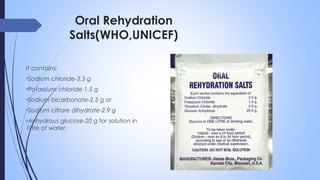
Oral Rehydration
Salts(WHO,UNICEF)
It contains:
•Sodium chloride-3.5 g
•Potassium chloride-1.5 g
•Sodium bicarbonate-2.5 g or
•Sodium citrare dihydrate-2.9 g
•Anhydrous glucose-20 g for solution in
1litre of water.
Multiple Electrolyte Solutions
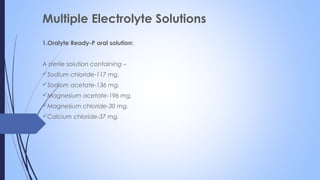
1.Oralyte Ready-P oral solution:
A sterile solution containing –
Sodium chloride-117 mg.
Sodium acetate-136 mg.
Magnesium acetate-196 mg.
Magnesium chloride-30 mg.
Calcium chloride-37 mg.
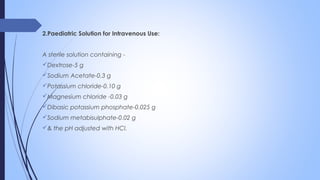
2.Paediatric Solution for Intravenous Use:
A sterile solution containing -
Dextrose-5 g
Sodium Acetate-0.3 g
Potassium chloride-0.10 g
Magnesium chloride -0.03 g
Dibasic potassium phosphate-0.025 g
Sodium metabisulphate-0.02 g
& the pH adjusted with HCl.
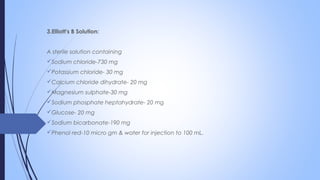
3.Elliott's B Solution:
A sterile solution containing
Sodium chloride-730 mg
Potassium chloride- 30 mg
Calcium chloride dihydrate- 20 mg
Magnesium sulphate-30 mg
Sodium phosphate heptahydrate- 20 mg
Glucose- 20 mg
Sodium bicarbonate-190 mg
Phenol red-10 micro gm & water for injection to 100 mL.
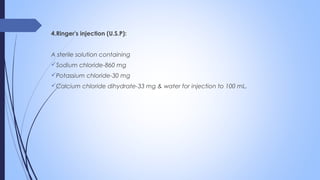
4.Ringer's injection (U.S.P):
A sterile solution containing
Sodium chloride-860 mg
Potassium chloride-30 mg
Calcium chloride dihydrate-33 mg & water for injection to 100 mL.
Dialysis Solutions
In dialysis, bicarbonate is the best given as acetate or lactate in order to avoid
the release of carbon dioxide into solution.
Used in-
Management of Renal Failure
Poisoning
Removal of toxic substances & electrolytes
Haemodialysis-The exchange of ions between the solution and the patients blood is made
across a synthetic semi-permeable membrane.
Peritoneal dialysis-The exchange is made across the membranes of the peritoneal cavity.
Intraperitoneal Dialysis Fluid(I.P.):
Sodium chloride-5.56 g.
Sodium acetate-4.76 g.
Calcium chloride-0.22 g.
Magnesium chloride-0.152 g.
Sodium metabisulphite-0.15 g.
Anhydrous dextrose -17 g & purified water sufficient to produce (1000 ml).
Reference
 Text book of pharmaceutical Chemistry- I by Mohammed Ali
 Wikipidea
 WWW.Google.com
Major Intra & Extra-Cellular Fluids

Major Intra & Extra-Cellular Fluids

  • 1.
  • 2.
    Major Intra &Extra-Cellular Fluids A Presentation On
  • 3.
     Md. RakibulHasan (171023)  Md. Alamin Hossain (171024)  Tahmim Zaman Mishu (171025)  Al Riyad Hasan (171026)  Humaira Khatun Lisa (171027)  Abu Sayeem Tamim (171028)  Mahjabin Nessa Tumpa (171029) Members of Group-3 (Retinol)
  • 4.
    An electrolyte is asubstance that produces an electrically conducting solution; when dissolved in a polar solvent. What is electrolyte?
  • 5.
     Maintain waterbalance.  Helping muscles (including heart) contract and relax.   Help in transmit nerve impulses.  Maintain acid-base balance.  Maintain a constant environment in the whole body tissue. Importance of electrolytes in human body
  • 6.
     Calcium (Ca) Magnesium (Mg)  Sodium (Na)  Potassium (K)  Chloride (Cl-)  Bicarbonate (HCO3-)  Phosphate (PO4-)  Iron (Fe) Major physiological ions:
  • 7.
     Constituent ofbones and teeth  Help in functioning of muscles  Clotting mechanism of blood  Need for growth of tissue & bones Importance of Calcium
  • 8.
     Found inbone; combine with Ca  Used for protein synthesis  Important for Neuromuscular system  Insufficient Mg ion can cause Cardiac Disturbance Importance of Magnesium
  • 9.
     Principal cationof extracellular fluid  Maintain normal hydration  Maintain osmotic pressure  Low Na ion level can cause Diabetes, Addison’s disease etc Importance of Sodium
  • 10.
     Major intracellularcation  Important for nerve impulse  Low level of K ion can cause changes in BP  High level of K ion can cause the damage of Kidney Importance of Potassium
  • 11.
     Maintain theosmotic pressure  The major extracellular anion  Maintain proper hydration  Hyperchloremic condition can cause Congestive Heart Failure Importance of Chloride
  • 12.
     Along withCarbonic Acid, it is utilized as the body’s most important – ‘Buffer System’  Lack of this ion can cause metabolic Acidosis or Alkalosis Importance of Bicarbonate
  • 13.
     It isalso an important ‘Buffer System’  Present in the bones and teeth Importance of Phosphate
  • 14.
    o Create Haemoglobin oCarries Oxygen & Carbon Dioxide indirectly o Low level of Fe in blood cause Anaemia Importance of Iron
  • 15.
    Sodium chloride  Molweight =58.44  It contains not less than 99.5% of NaCl  It is found in the sea  It occurs as odourless, colourless, colourless crystals or white crystaline powder.  Soluble in water.  Slightly soluble in alcohole
  • 16.
    Uses: Its is anelectrolyte replensher ,emetic, topical inflammatory Used to treat extracellular volume depletion , dehydration. May be used in eye drops, nasal drops. Used in homeopathic Has adverse effect on vomitting, sweating, diarrhoea.
  • 17.
    Sodium Chloride Injection Sterileisotonic solution of sodium chloride in water for injection. •Contains not less than 0.85 per cent and not more than 0.95 per cent w/v of NaCl. •Contains no antimicrobial agents. •It is a colourless solution. •stored in single dose containers of glass or plastic.
  • 18.
    Test for purity Heavy metals.  Pyrogens.  pH (between 4.5 and 7.0). Uses  Used as fluid and electrolyte replenisher.  Isotonic vehicle. source: www.indiamart.com
  • 19.
    Sodium Chloride HypertonicInjection Sterile solution of sodium chloride in water for injection. •Contains not less than 1.52 per cent and not more than 1.68 per cent w/v of NaCl. •Contains no antimicrobial agents. •It is a clear and colourless solution. •stored in single dose containers of glass or plastic. Source: www.mcguffmedical.com
  • 20.
    Test for purities Arsenic.  Heavy metal.  Pyrogens.  pH (between 5.0 to 7.5). Uses  Used as fluid and electrolyte replenisher. Source: www.mcguffmedical.com
  • 21.
    Compound Sodium ChlorideInjection • Contains:  NaCl (0.82-0.90% w/v)  KCl (0.028-0.0315%)  CaCl2.2H2O (0.03- 0.036%) • Contains no microbial agents. Source: www.fresenius-kabi.com
  • 22.
    Tests for purity Arsenic.  Heavy metal.  Pyrogens.  pH (between 5.0 to 7.5). Uses  Used as fluid and electrolyte replenisher. Source: www.fresenius-kabi.com
  • 23.
    Compound Sodium ChlorideSolution A sterile solution of Sodium Chloride, Potassium Chloride, Calcium Chloride in purified water. •It is a colourless solution. •It’s tests for purity comply with the requirements stated under compound sodium chloride injection •Used as an irrigation solution (for external use) Source: www.indiamart.com
  • 24.
    Sodium Chloride andDextrose Injection A sterile solution of sodium chloride(0.11- 0.9%), Dextrose (2.5-25%) •It is clear, colourless or faintly straw-coloured solution. •stored in single dose containers of glass or plastic. Source: www.indiamart.com
  • 25.
    Test for purities 5-hydroxymethylfurfural and related substances.  Heavy metals.  Pyrogens.  pH (3.5-6.5). Uses  Used as fluid, nutrient and electrolyte replenisher. Source: www.indiamart.com
  • 26.
  • 27.
    1 contains not less than 1.75%and not more than 1.95% of sodium lactate 2 1000 ml contains lactic acid(14 ml),sodium hydroxide(6.7 g)and dilute hydrochloric acid 3 NaOH in water for injection (400 ml),adding the lactic acid and heating the solution in an autoclave at 115o to 116o for one hour 4 It is cooled, dilute hydrochloric acid added carefully until O.15 ml of the solution gives a full orange colour with 0.05 ml of phenol red solution 5 Sufficient water for injection is added to produce 1000ml 6 filtered and immediate ly sterilized by heating How We Can Prepare the Solution:
  • 28.
    Physical Characters: 1 It isclear colourless solution. 2 It is stored in single-dose containers of glass or plastic
  • 29.
    It is afluid and electrolyte replenisher. Uses
  • 30.
    Sodium Chloride Injection,I.P. SodiumChloride Hypertonic Injection,I.P. Compound Sodium Chloride Injection,I.P. Compound Sodium Chloride Solution.I.P. Sodium Chloride and Dextrose Injection.I.P.,U.S.P. Sodium Lactate Injection,I.P. Sodium Chloride Eye Lotion,B.P. Sodium Chloride Ophthalmic Ointment,U.S.P. Official Preparations of Sodium Chloride Sodium Chloride Inhalation Solution,U.S.P. Bacteriostatic Sodium Chloride Injection,U.S.P. Sodiun Chloride Intravenous Infusion,B.P. Sodium Chloride and Glucose Intravenous Infusion,B.P. Sodium Chloride Irrigation,U.S.P.
  • 31.
  • 32.
    Introduction KCl; Mol. Weight=74.55 Potassiumchloride contains not less than 99.0 per cent of. Potassium chloride can be prepared by reacting hydrochloride acid with potassium carbonate, K2 CO3 + 2HCl KCl + H2 CO3
  • 33.
    Physical Characteristics:  Potassiumchloride occurs as odorless, colourless; cubical, elongated, or prismatic crystals or white crystalline powder ; taste is saline.  It is soluble in water and glycerol : practically insoluble in alcohol and solvent ether. A solution is neutral to litmus.  Hydrochloric acid, sodium or magnesium chlorides diminish its solubility in water.
  • 34.
  • 35.
    1 electrolyte replenisher 2 used in the treatmentof potassium deficiency 3 familial paralysis , myasthenia gravis (muscle weakness) meniere's syndrome (disease of the inner ear) 4 as an antidote in digitalis intoxication. Uses:
  • 36.
    What happed :ExcessiveUse 1 hyperkalaemia causing muscles weakness 2 Paralysis 3 Hypotension 4 Heart block and cardiac arrest.
  • 37.
    Potassium Chloride andSodium chloride Intravenous Infusion(BP) It is a sterile colourless solution of potassitun chloride and thw sodium chloride in water. Potassium Chloride and Glucose Intravenous Infusion (B.P.) It is a sterile colourless or faintly straw-coloured solution of Potassium chloride and either anhydrous glucose or glucose in water. Potassium Chloride, Sodium Chloride and Glucose Intravenous Infusions (B. P.) It is. a sterile solution of potassium chloride, sodium chloride and either anhydrous glucose or glucose in water. Effervescent Potassium Chloride Tablets (B.P.) Potassium Chloride Elixir, U. S.P Potassium Chlorme Mixture, A. P. F. Potassium Chlorme Injection, U. S. P. Potassium chloride in Dextrose Injection, U. S. P. Potassium chloride Oral Solution, U. S. P. Potassium Chloride Extended-release Capsules Tablets. U. S. P. Potassium Chloride, potassium Bicarbonate, and Potassium citrate Effervescent Tablets for Oral Solution , U. S. P. OFFICIAL POTASSIUM CHLORIDE PREPARATIONS
  • 38.
    Electrolytes used inacid base in acid base therapy The sodium salts of bicarbonate, lactate, acetate and sometimes citrate and ammonium salts are used to treat metabolic acidosis. supply of bicarbonate increase the HCO3/H2CO3 ratio. lactate, acetare and citrate ions are degraded to CO2 and water by tricarboxylic acid cycle. The major functions of electrolytes are to maintain electrolytic imbalance, including acid base balance and osmotic equilibrium and to facilitate specific metabolic function through supplyofspecific ion to body fluids.
  • 39.
    Sodium acetate: CH3COONa 3H20 mol weight =136.08 Sodium acetate contains not less than 99.0 per centof CH3CooNa.3H20. It is prepared by neutralization of acetic acid with sodium carbonate or sodium hydroxide,and then crystallizing the product. 2CH3COOH + Na2CO3=2 CH3COONa + CO2+ H20 Characters: 1. Colourless & odourless 2.soluble in water and alcohol 3.5% solution in Waterhas a pH of 7.5 to 9.2. 4.kept in airtight containers. Uses: 1. Used as pharmaceutical aid 2. Acidulant in food 3.used as effective buffer in metabolic acedosis.
  • 40.
    Sodium citrate: C6H5Na3O7.2H2O; molweight = 294.1 Sodium citrate is trisodium 2-hydroxy-propane-1,2,3 tricarboxylate dihydrate.it contains about 99% of C6H5Na3O7.it is prepared by mixing of calculated amounts of hot solution of citric acid and sodium carbonate and crystallizing the product. 3Na2CO3+ 2H3C6O7 = 2NaC6H5O7+3CO2+3H2O Characters: 1.white crystalline powde. 2.slightly deliquescent in moist air. 3.freely soluble in water 4.partically in soluble in ethanol. 5.stored in air- tight containers.. Uses : 1:used as systemic alkalinizing substance. 2.it has anti clotting properties. 3.used to preservation of blood for transfusion purpose.
  • 41.
    Potassium citrate Molecular formula:KOOC. CH2.CH(OH) (COOK). CH2 COOK. H2O Molecular weight: 324.42 Potassium citrate is a potassium salt of citric acid with the molecular formula K3C6H5O7. It is a white, hygroscopic crystalline powder. It is odorless with a saline taste. It contains 38.28% potassium by mass. In the monohydrate form it is highly hygroscopic and deliquescent.
  • 42.
    uses  Used assystemic alkalizer.  Used as gastric antacid.  Used to control kidney stones.  Used in many soft drink as a buffering agents.  Used to relieve painful irritation.
  • 43.
    Sodium Bicarbonate Injection It is a sterile solution of sodium bicarbonate in water for injection.  pH 7.0 to 8.5  It is preserved in single dose containers.  It contains not less than 95% and not more than 105% of labelled amount of NaHCO3
  • 44.
    Ammonium Chloride injection Ammonium chloride is an inorganic compound with the formula NH4Cl and a white crystalline salt that is highly soluble in water. Solutions of ammonium chloride are mildly acidic.  Ammonium chloride injection is a sterile solution of ammonium chloride in water for injection .  It contains not less than 95% and not more than 105% of labelled amount of NH4Cl  It is preserved in single dose or in multiple dose containers.
  • 45.
    Electrolyte combination therapy When a patient undergoes a surgery , he is unable to take normal diet, therefore he is given infusion’s containing saline and glucose he also needs additional electrolytes . which are intended for the fluid maintain of the body. Usually the combination of electrolyte are prepared and given to the patient according to his requirement this type treatment is called electrolyte combination therapy.
  • 46.
    Oral Rehydration Therapy Oralrehydration therapy (ORT) is a type of fluid replacement used to prevent and treat dehydration, especially that due to diarrhea. Oral rehydration therapy can also be given by a nasogastric tube. Nasogastric intubation is a medical process involving the insertion of a plastic tube through the nose, past the throat, and down into the stomach.
  • 47.
    Oral rehydration therapyconsists of two phases of treatment: (1)a rehydration phase, in which water and electrolytes are given as ORS to replace existing losses. (2) a maintenance phase, which includes replacement of ongoing fluid and electrolyte losses and adequate dietary intake Oral rehydration therapy can be- 1.ORT solutions 2.Rice based solutions 3.Glucose
  • 48.
    Salt intake andHypertension Reduced salt intake lowering the blood pressure and enhance the effect of drug treatment.
  • 49.
    Multiple Electrolyte Powders Oralrehydration salt(Electral) Each packet (35g) contains- •Sodium chloride-1.25 g. •Potassium chloride-1.50 g. •Sodium Citrate-2.90 g. •Anhydrous dextrose-27 g. Used in- Replacement of fluid & electrolytes loss. Maintenance of hydrogen in diarrhoea due to Rota virus, E. coli. Muscle weekness & muscle cramps. For athletes & industrial workers.
  • 50.
    Oral Rehydration Salts(WHO,UNICEF) It contains: •Sodiumchloride-3.5 g •Potassium chloride-1.5 g •Sodium bicarbonate-2.5 g or •Sodium citrare dihydrate-2.9 g •Anhydrous glucose-20 g for solution in 1litre of water.
  • 51.
    Multiple Electrolyte Solutions 1.OralyteReady-P oral solution: A sterile solution containing – Sodium chloride-117 mg. Sodium acetate-136 mg. Magnesium acetate-196 mg. Magnesium chloride-30 mg. Calcium chloride-37 mg.
  • 52.
    2.Paediatric Solution forIntravenous Use: A sterile solution containing - Dextrose-5 g Sodium Acetate-0.3 g Potassium chloride-0.10 g Magnesium chloride -0.03 g Dibasic potassium phosphate-0.025 g Sodium metabisulphate-0.02 g & the pH adjusted with HCl.
  • 53.
    3.Elliott's B Solution: Asterile solution containing Sodium chloride-730 mg Potassium chloride- 30 mg Calcium chloride dihydrate- 20 mg Magnesium sulphate-30 mg Sodium phosphate heptahydrate- 20 mg Glucose- 20 mg Sodium bicarbonate-190 mg Phenol red-10 micro gm & water for injection to 100 mL.
  • 54.
    4.Ringer's injection (U.S.P): Asterile solution containing Sodium chloride-860 mg Potassium chloride-30 mg Calcium chloride dihydrate-33 mg & water for injection to 100 mL.
  • 55.
    Dialysis Solutions In dialysis,bicarbonate is the best given as acetate or lactate in order to avoid the release of carbon dioxide into solution. Used in- Management of Renal Failure Poisoning Removal of toxic substances & electrolytes Haemodialysis-The exchange of ions between the solution and the patients blood is made across a synthetic semi-permeable membrane. Peritoneal dialysis-The exchange is made across the membranes of the peritoneal cavity.
  • 56.
    Intraperitoneal Dialysis Fluid(I.P.): Sodiumchloride-5.56 g. Sodium acetate-4.76 g. Calcium chloride-0.22 g. Magnesium chloride-0.152 g. Sodium metabisulphite-0.15 g. Anhydrous dextrose -17 g & purified water sufficient to produce (1000 ml).
  • 57.
    Reference  Text bookof pharmaceutical Chemistry- I by Mohammed Ali  Wikipidea  WWW.Google.com