PHARMACOGNOSY-II
FIBRES
(UNIT-V)
Mayank Mehendiratta
(G.G.S.C.O.P.)
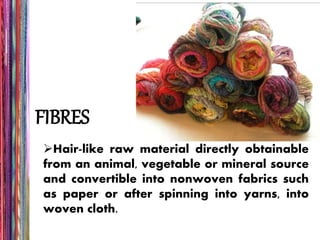
FIBRES
Hair-like raw material directly obtainable
from an animal, vegetable or mineral source
and convertible into nonwoven fabrics such
as paper or after spinning into yarns, into
woven cloth.
CLASSIFICATION OF FIBRES
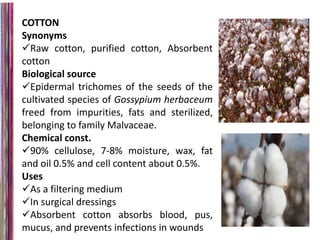
COTTON
Synonyms
Raw cotton, purified cotton, Absorbent
cotton
Biological source
Epidermal trichomes of the seeds of the
cultivated species of Gossypium herbaceum
freed from impurities, fats and sterilized,
belonging to family Malvaceae.
Chemical const.
90% cellulose, 7-8% moisture, wax, fat
and oil 0.5% and cell content about 0.5%.
Uses
As a filtering medium
In surgical dressings
Absorbent cotton absorbs blood, pus,
mucus, and prevents infections in wounds
PREPARATION OF COTTON
Plants after flowering, bear fruits known as capsules (3-5 celled)
bearing numerous seeds covered with hairs known as bolls.
Bolls collected, dried and taken to ginning press where trichomes are
separated from seeds
2 types of gins :
(i) Saw gins – circular saws that grip the fibres and pull them through
narrow slot. Produces variety with shorter length known as linters/lints
which are used for manufacture of absorbent cotton
(ii) Roller gins – has a rough roller to grab the fiber and pull it under a
rotating bar. Produces long fibres which are used for preparation of cloth
The impurities removed from the raw fibres, washed, bleached, dried,
packed and sterilized by gamma radiations.
Then the raw fibres passed through the pipes to a press where it is
compressed into bales (55 inches tall, 28 inches wide, 21 inches thick –
500 pounds weight known as Universal Density Bale)
Absorbent cotton (to remove all the non-cellulosic materials) prepared
by a process known as Scouring where the lints are treated with alkali like
sodium hydroxide at boiling and under pressure for 10-15 hours.
JUTE
Synonym
Gunny
Biological Source
It consists of phloem fibres from the stem of
various species of the Corchorus; C. capsularis, C.
olitorius, family Tiliaceae
Chemical constituents
cellulose 50-53%
hemicellulose 20%
lignin 10-11%
moisture NMT 12-13%
Uses
For making cloth for wrapping bales
of raw cotton
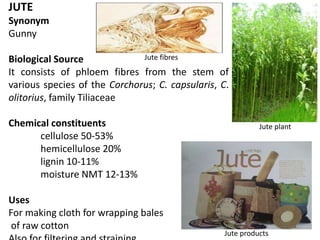
Jute fibres
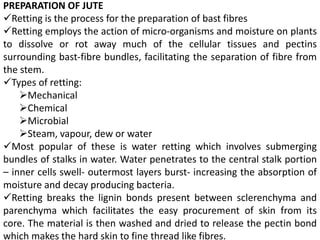
Jute plant
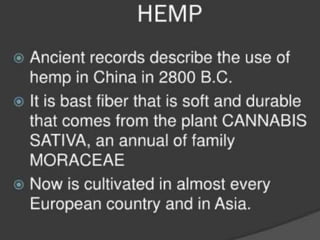
Jute products
PREPARATION OF JUTE
Retting is the process for the preparation of bast fibres
Retting employs the action of micro-organisms and moisture on plants
to dissolve or rot away much of the cellular tissues and pectins
surrounding bast-fibre bundles, facilitating the separation of fibre from
the stem.
Types of retting:
Mechanical
Chemical
Microbial
Steam, vapour, dew or water
Most popular of these is water retting which involves submerging
bundles of stalks in water. Water penetrates to the central stalk portion
– inner cells swell- outermost layers burst- increasing the absorption of
moisture and decay producing bacteria.
Retting breaks the lignin bonds present between sclerenchyma and
parenchyma which facilitates the easy procurement of skin from its
core. The material is then washed and dried to release the pectin bond
which makes the hard skin to fine thread like fibres.
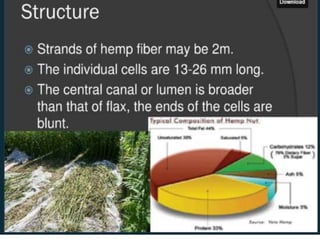
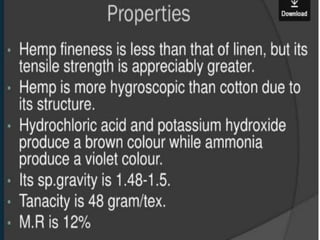
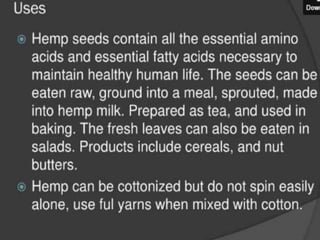
HEMP
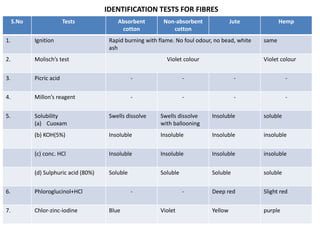
S.No Tests Absorbent
cotton
Non-absorbent
cotton
Jute Hemp
1. Ignition Rapid burning with flame. No foul odour, no bead, white
ash
same
2. Molisch’s test Violet colour Violet colour
3. Picric acid - - - -
4. Millon’s reagent - - - -
5. Solubility
(a) Cuoxam
Swells dissolve Swells dissolve
with ballooning
Insoluble soluble
(b) KOH(5%) Insoluble Insoluble Insoluble insoluble
(c) conc. HCl Insoluble Insoluble Insoluble insoluble
(d) Sulphuric acid (80%) Soluble Soluble Soluble soluble
6. Phloroglucinol+HCl - - Deep red Slight red
7. Chlor-zinc-iodine Blue Violet Yellow purple
IDENTIFICATION TESTS FOR FIBRES
THANK YOU

Fibres- B pharm(4th Sem)

  • 1.
  • 2.
    FIBRES Hair-like raw materialdirectly obtainable from an animal, vegetable or mineral source and convertible into nonwoven fabrics such as paper or after spinning into yarns, into woven cloth.
  • 3.
  • 4.
    COTTON Synonyms Raw cotton, purifiedcotton, Absorbent cotton Biological source Epidermal trichomes of the seeds of the cultivated species of Gossypium herbaceum freed from impurities, fats and sterilized, belonging to family Malvaceae. Chemical const. 90% cellulose, 7-8% moisture, wax, fat and oil 0.5% and cell content about 0.5%. Uses As a filtering medium In surgical dressings Absorbent cotton absorbs blood, pus, mucus, and prevents infections in wounds
  • 5.
    PREPARATION OF COTTON Plantsafter flowering, bear fruits known as capsules (3-5 celled) bearing numerous seeds covered with hairs known as bolls. Bolls collected, dried and taken to ginning press where trichomes are separated from seeds 2 types of gins : (i) Saw gins – circular saws that grip the fibres and pull them through narrow slot. Produces variety with shorter length known as linters/lints which are used for manufacture of absorbent cotton (ii) Roller gins – has a rough roller to grab the fiber and pull it under a rotating bar. Produces long fibres which are used for preparation of cloth The impurities removed from the raw fibres, washed, bleached, dried, packed and sterilized by gamma radiations. Then the raw fibres passed through the pipes to a press where it is compressed into bales (55 inches tall, 28 inches wide, 21 inches thick – 500 pounds weight known as Universal Density Bale) Absorbent cotton (to remove all the non-cellulosic materials) prepared by a process known as Scouring where the lints are treated with alkali like sodium hydroxide at boiling and under pressure for 10-15 hours.
  • 6.
    JUTE Synonym Gunny Biological Source It consistsof phloem fibres from the stem of various species of the Corchorus; C. capsularis, C. olitorius, family Tiliaceae Chemical constituents cellulose 50-53% hemicellulose 20% lignin 10-11% moisture NMT 12-13% Uses For making cloth for wrapping bales of raw cotton Jute fibres Jute plant Jute products
  • 7.
    PREPARATION OF JUTE Rettingis the process for the preparation of bast fibres Retting employs the action of micro-organisms and moisture on plants to dissolve or rot away much of the cellular tissues and pectins surrounding bast-fibre bundles, facilitating the separation of fibre from the stem. Types of retting: Mechanical Chemical Microbial Steam, vapour, dew or water Most popular of these is water retting which involves submerging bundles of stalks in water. Water penetrates to the central stalk portion – inner cells swell- outermost layers burst- increasing the absorption of moisture and decay producing bacteria. Retting breaks the lignin bonds present between sclerenchyma and parenchyma which facilitates the easy procurement of skin from its core. The material is then washed and dried to release the pectin bond which makes the hard skin to fine thread like fibres.
  • 8.
  • 14.
    S.No Tests Absorbent cotton Non-absorbent cotton JuteHemp 1. Ignition Rapid burning with flame. No foul odour, no bead, white ash same 2. Molisch’s test Violet colour Violet colour 3. Picric acid - - - - 4. Millon’s reagent - - - - 5. Solubility (a) Cuoxam Swells dissolve Swells dissolve with ballooning Insoluble soluble (b) KOH(5%) Insoluble Insoluble Insoluble insoluble (c) conc. HCl Insoluble Insoluble Insoluble insoluble (d) Sulphuric acid (80%) Soluble Soluble Soluble soluble 6. Phloroglucinol+HCl - - Deep red Slight red 7. Chlor-zinc-iodine Blue Violet Yellow purple IDENTIFICATION TESTS FOR FIBRES
  • 15.