PHYSIOTHERAPY IN
Epidemiology Tissue injury caused by thermal, electrical, or chemical agents Can be fatal, disfiguring, or incapacitating ~ 1.25 million burn injuries per year 45,000 hospitalized per year 4500 die per year (3750 from housefires) 3rd largest cause of accidental death
Risk Factors Fire/Combustion Firefighter Industrial Worker Occupant of burning structures Chemical Exposure Industrial Worker Electrical Exposure Electrician Electrical Power Distribution Worker
Types of Burn  Injuries Thermal burn Skin injury Inhalation injury Chemical burn Skin injury Inhalation injury Mucous membrane injury Electrical burn Lightning Radiation burn
 
Effects Burn injury causes destruction of tissue, usually the skin, from exposure to thermal extremes (either hot or cold), electricity, chemicals, and/or radiation The mucosa of the upper GI system (mouth, esophagus, stomach) can be burned with ingestion of chemicals The respiratory system can be damaged if hot gases, smoke, or toxic chemical fumes are inhaled Fat, muscle, bone, and peripheral nerves can be affected in electrical injuries or prolonged thermal or chemical exposure Skin damage can result in altered ability to sense pain, touch, and temperature
Skin Largest body organ.  Much more than a passive organ. Protects underlying tissues from injury Temperature regulation Acts as water tight seal, keeping body fluids in Sensory organ
Skin Injuries to skin which result in loss, have problems with: Infection Inability to maintain normal water balance Inability to maintain body temperature
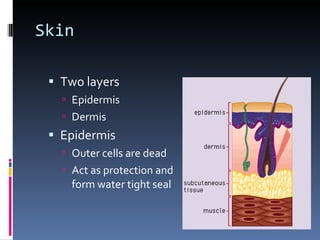
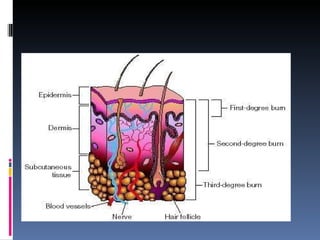
Skin Two layers Epidermis Dermis Epidermis Outer cells are dead Act as protection and form water tight seal
Skin Epidermis Deeper layers divide to produce the stratum corneum and also contain pigment to protect against UV radiation Dermis Consists of tough, elastic connective tissue which contains specialized structures
Skin   Dermis - Specialized Structures Nerve endings Blood vessels Sweat glands Oil glands - keep skin waterproof, usually discharges around hair shafts Hair follicles - produce hair from hair root or papilla Each follicle has a small muscle (arrectus pillorum) which can pull the hair upright and cause goose flesh
CLASSIFICATION OF BURNS
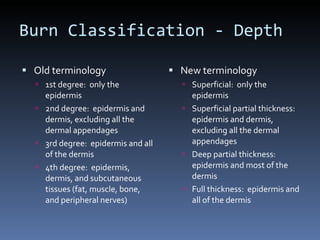
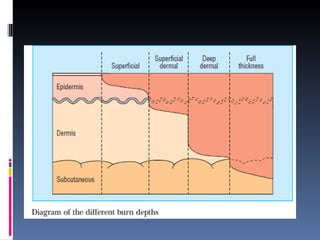
Burn Classification - Depth Old terminology 1st degree:  only the epidermis 2nd degree:  epidermis and dermis, excluding all the dermal appendages 3rd degree:  epidermis and all of the dermis 4th degree:  epidermis, dermis, and subcutaneous tissues (fat, muscle, bone, and peripheral nerves) New terminology Superficial:  only the epidermis Superficial partial thickness:  epidermis and dermis, excluding all the dermal appendages Deep partial thickness:  epidermis and most of the dermis Full thickness:  epidermis and all of the dermis
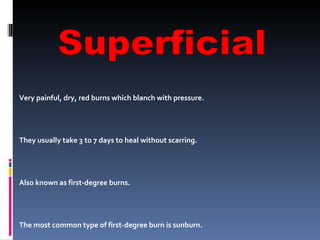
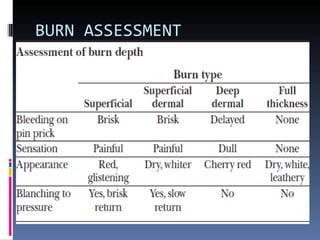
Very painful, dry, red burns which blanch with pressure. They usually take 3 to 7 days to heal without scarring. Also known as first-degree burns.  The most common type of first-degree burn is sunburn. First-degree burns are limited to the epidermis, or upper layers of skin.   Superficial
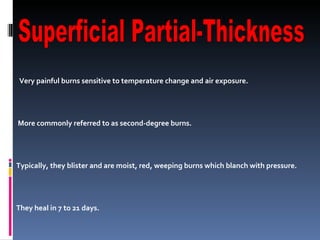
Very painful burns sensitive to temperature change and air exposure. More commonly referred to as second-degree burns.  Typically, they blister and are moist, red, weeping burns which blanch with pressure.  They heal in 7 to 21 days.  Scarring is usually confined to changes in skin pigment. Superficial Partial-Thickness
Blistering or easily unroofed burns which are wet or waxy dry, and are painful to pressure.  Their color may range from patchy, cheesy white to red, and they do not blanch with pressure.  They take over 21 days to heal and scarring may be severe. It is sometimes difficult to differentiate these burns from full-thickness burns. Deep Partial-Thickness
Burns which cause the skin to be waxy white to a charred black a Burns which cause the skin to be waxy white to a charred black and tend to be painless. Healing is very slow, if at all, and may require skin grafting.  Severe scarring usually occurs
 
 
Burn Classifications
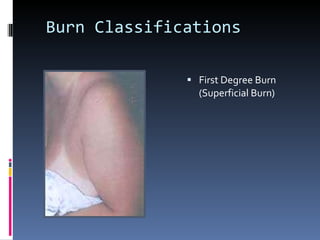
Burn Classifications 1st degree (Superficial burn) Involves the epidermis Characterized by reddening Tenderness and Pain Increased warmth Edema may occur, but no blistering Burn blanches under pressure Example - sunburn Usually heal in ~ 7 days
Burn Classifications First Degree Burn (Superficial Burn)
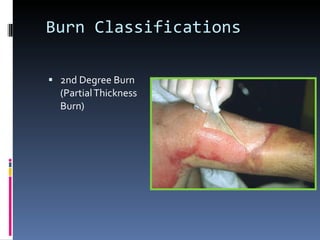
Burn Classifications 2nd degree Damage extends through the epidermis and involves the dermis. Not enough to interfere with regeneration of the epithelium Moist, shiny appearance Salmon pink to red color Painful Does not have to blister to be 2nd degree Usually heal in ~7-21 days
Burn Classifications 2nd Degree Burn (Partial Thickness Burn)
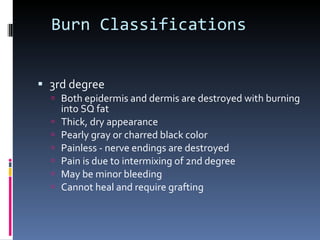
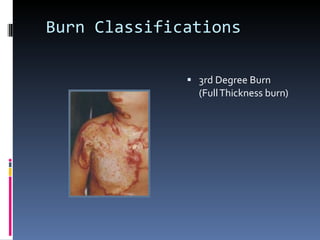
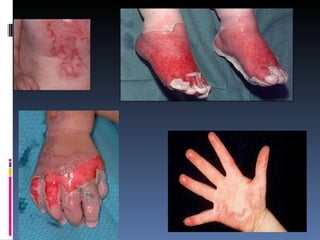
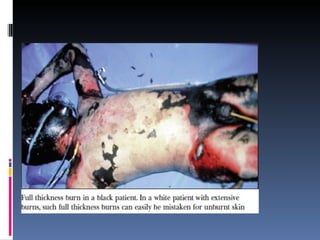
Burn Classifications 3rd degree Both epidermis and dermis are destroyed with burning into SQ fat Thick, dry appearance Pearly gray or charred black color Painless - nerve endings are destroyed Pain is due to intermixing of 2nd degree May be minor bleeding Cannot heal and require grafting
Burn Classifications 3rd Degree Burn (Full Thickness burn)
 
 
BURN ASSESSMENT
BURN ASSESSMENT
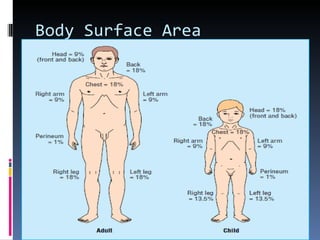
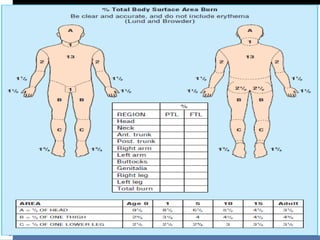
Body Surface Area Estimation
 
Burn Patient Severity Factors to Consider Depth or Classification Body Surface area burned Age: Adult vs Pediatric Preexisting medical conditions Associated Trauma blast injury  fall injury airway compromise child abuse
Burn Patient Severity Patient age Less than 2 or greater than 55 Have increased incidence of complication Burn configuration Circumferential burns can cause total occlusion of circulation to an area due to edema Restrict ventilation if encircle the chest Burns on joint area can cause disability due to scar formation
Burn Criteria
Critical Burn Criteria 3 0  > 10% BSA 2 0  > 30% BSA >20% pediatric Burns with respiratory injury Hands, face, feet, or genitalia Burns complicated by other trauma Underlying health problems Electrical and deep chemical burns
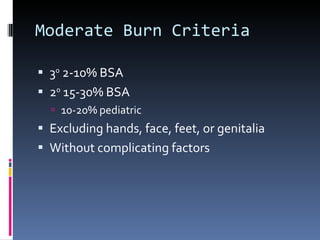
Moderate Burn Criteria 3 0  2-10% BSA 2 0  15-30% BSA 10-20% pediatric Excluding hands, face, feet, or genitalia Without complicating factors
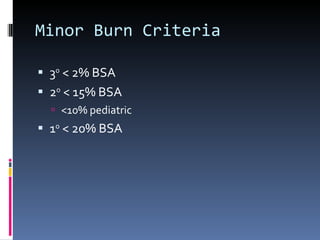
Minor Burn Criteria 3 0  < 2% BSA 2 0  < 15% BSA <10% pediatric 1 0  < 20% BSA
 
Pathophysiology of Burn Injury Pathophysiology refers to the complex chain of mechanisms that occur in the skin (local effects) and in other organ systems (systemic effects) when a burn injury occurs, as well as what happens as the skin regenerates and heals Local Effects Systematic Effects Skin Regeneration and Scarring Electrical Burns
Thermal Burn Injury Pathophysiology Emergent phase Response to pain    catecholamine release Fluid shift phase massive shift of fluid - intravascular    extravascular Hypermetabolic phase    demand for nutrients    repair tissue damage Resolution phase scar tissue and remodeling of tissue
Thermal Burn Injury Pathophysiology Jackson’s Thermal Wound Theory Zone of Coagulation area nearest burn  cell membranes rupture, clotted blood and thrombosed vessels Zone of Stasis area surrounding zone of coagulation  inflammation, decreased blood flow Zone of Hyperemia peripheral area of burn limited inflammation, increased blood flow
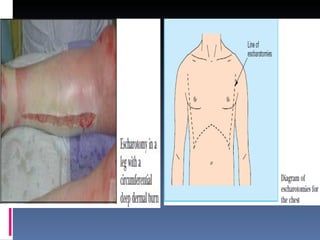
Thermal Burn Injury Pathophysiology Eschar formation Skin denaturing hard and leathery Skin constricts over wound increased pressure underneath restricts blood flow Respiratory compromise secondary to circumferential eschar around the thorax Circulatory compromise secondary to circumferential eschar around extremity
COMPLICATIONS
Fluid and Electrolyte loss    Hypovolemia Hypothermia, Infection, Acidosis    catecholamine release, vasoconstriction Renal or hepatic failure Formation of eschar Complications of circumferential burn
Psychological changes Fear & anxiety Denial Depression Guilty feeling Grief &mourning Loss of will to live Apathy Necrophilous orientation Anger
Psychiatric complications Delirium Post traumatic stress disorder Disfigured face syndrome psychosis
Electrical Burns
Electrical Burns Usually follows accidental contact with exposed object conducting electricity Electrically powered devices Electrical wiring Power transmission lines Can also result from Lightning Damage depends on intensity of current
Electrical Burns Current kills, voltage simply determines whether current can enter the body Ohm’s law:  I=V/R Electrical follows shortest path to ground Low Voltage usually cannot enter body unless: Skin is broken or moist Low Resistance (follows blood vessels/nerves) High Voltage easily overcomes resistance
Electrical Burns Severity depends upon: what tissue current passes through width or extent of the current pathway AC or DC duration of current contact
Electrical Burns Lightning HIGH VOLTAGE!!! Injury may result from Direct Strike Side Flash Severe injuries often result Provides additional risk to EMS provider Weather capable of producing lightning is still in the area
Electrical Burns Pathophysiology of Injuries External Burn Internal Burn Musculoskeletal injury Cardiovascular injury Respiratory injury Neurologic injury Rhabdomyolysis and Renal injury
Electrical Burn Management Make sure current is off Lightning hazards Do not go near patient until current is off ABC’s Ventilate and perform CPR as needed Oxygen ECG monitoring Treat dysrhythmias
Electrical Burn Management Rhabdomyolysis Considerations Fluid? Dopamine? Assess for additional injuries Consider transport to trauma center
Any patient with an electrical  burn  regardless of how trivial it looks needs to go to the hospital.  There is no way to tell how bad the burn is on the inside by the way it looks on the outside.
Pediatric Burns Thin skin increases severity of burning relative to adults Large surface/volume ratio rapid fluid loss increased heat loss    hypothermia Delicate balance between dehydration and over hydration Immature immunological response    sepsis Always consider possibility of child abuse
Geriatric Burns Decreased myocardial reserve fluid resuscitation difficulty Peripheral vascular disease, diabetes slow healing COPD increases complications of airway injury Poor immunological response - Sepsis % mortality ~= age + % BSA burned
WOUND IFECTION/SEPSIS Colonization Invasive wound sepsis Sepsis  Prevention by aseptic measures Local anti microbial therapy/systemic antibiotics/wound debridement Early excision of necrotic tissues and skin grafting Treat septicemia
WOUND HEALING Stage of inflammation Stage of proliferation/tissue repair Remodeling
WOUND DEBRIDEMENT Mechanical- wet/dry Hydrotherapy- immersion/spray Enzymatic-sutilains Surgical-sequencial/fascial excision & escharotomies Proteolysis-fibrinolysis-collagenolysis
WOUND DRESSINGS Biological dressings/skin graft Synthetic dressings Topical antimicrobials
Assessment & Management
HYPOVOLAEMIC SHOCK Hypotension Oliguria Tachy cardia Sweating Pallor Hyper ventilation Clouding of consciousness
SEPTIC SHOCK Increased T* Hypotension < 90 mmhg Oliguria < 30 ml Dry &pink exremities Altered pulmonary functions
SKIN ASSESSMENT Inspection Appearance Temperature Moisture Dryness Texture Color Size Palpate lymph nodes Cyanosis Pulses Area Duration Itching/burning
 
 
PHYSIOTHERAPY MANAGEMENT
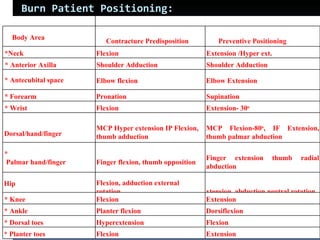
POSITIONING AND SPLINTING minimize edema formation prevent tissue destruction  maintain soft tissue in an elongated state to facilitate function recovery. &quot;anticontracture&quot; positions &quot;the position of comfort (fetal position)
The basic rule for positioning burned areas is place and maintain the body part in the opposite plane and direction to which it will potentially contract
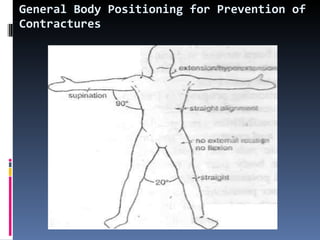
General Body Positioning for Prevention of Contractures
Burn Patient Positioning: Body Area Contracture Predisposition Preventive Positioning *Neck Flexion Extension /Hyper ext. * Anterior Axilla Shoulder Adduction Shoulder Adduction * Antecubital space Elbow flexion Elbow Extension * Forearm Pronation Supination * Wrist Flexion Extension- 30 o Dorsal/hand/finger MCP Hyper extension IP Flexion, thumb adduction MCP Flexion-80 o , IF Extension, thumb palmar abduction * Palmar hand/finger Finger flexion, thumb opposition Finger extension thumb radial abduction Hip Flexion, adduction external rotation Extension, abduction neutral rotation * Knee Flexion Extension * Ankle Planter flexion Dorsiflexion * Dorsal toes Hyperextension Flexion * Planter toes Flexion Extension
splints splints and protection of Joints and tendons splinting in edema reduction Splinting following skin grafting Splints for uncooperative or unconscious patient
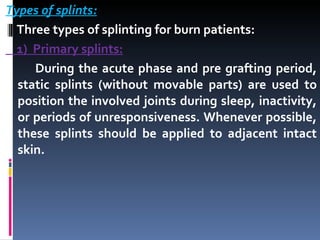
Types of splints: Three types of splinting for burn patients:  1)  Primary splints: During the acute phase and pre grafting period, static splints (without movable parts) are used to position the involved joints during sleep, inactivity, or periods of unresponsiveness. Whenever possible, these splints should be applied to adjacent intact skin.
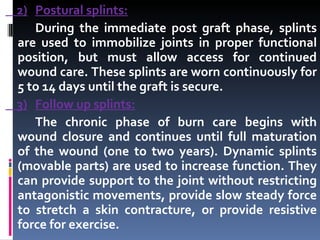
2) Postural splints: During the immediate post graft phase, splints are used to immobilize joints in proper functional position, but must allow access for continued wound care. These splints are worn continuously for 5 to 14 days until the graft is secure. 3) Follow up splints: The chronic phase of burn care begins with wound closure and continues until full maturation of the wound (one to two years). Dynamic splints (movable parts) are used to increase function. They can provide support to the joint without restricting antagonistic movements, provide slow steady force to stretch a skin contracture, or provide resistive force for exercise.
Various types of splints that used for the treatment of anterior neck burns,  Soft cervical collar  is a circumferential foam neck orthosis covered with stockinet, it maintains neutral extension and prevents lateral flexion,  Molded neck splint or collar , it is a total contact, rigid neck support, it maintains exact position (extension) and' prevents rotation and lateral flexion,  Halo neck splint , it is a thermoplastic orthosis that positions the neck in extension using the head and upper torso for stabilization,  Watusi collar,  it is a series of cylindrical plastic or foam tubes fastened circumferentially around the neck. Additional tubes are added as neck extension improves (Figs. 5, 6 and 7).
Neck Willis splint  is one of the most effective means of preventing neck contractures. This splint should be applied directly over the burn wound or over a single layer of gauze. When a tracheostomy has not been performed, the splint can be applied early and adjustments made as the edema subsides
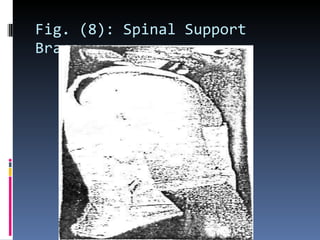
Fig. (8): Spinal Support Brace.
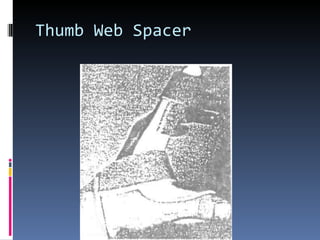
Thumb Web Spacer
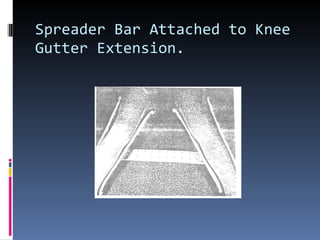
Spreader Bar Attached to Knee Gutter Extension.
Positioning Techniques in Edema Control Elevation of an extremity above heart level can be accomplished using common items such as pillows, bath blankets, towels, foam, wedges, beside tables, and stockinet.
contracture Johnson and Silverberg (1995)  found that serial casting is a conservative method and effective modality in correcting contracture resulting from burns.
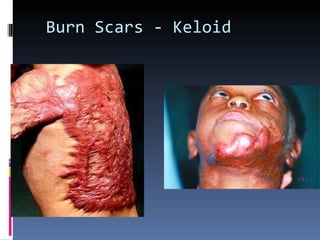
Burn Scars - Keloid
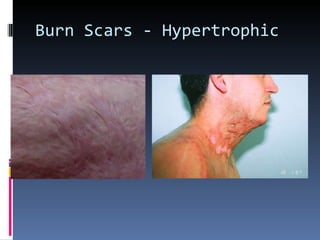
Burn Scars - Hypertrophic
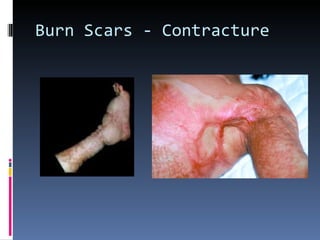
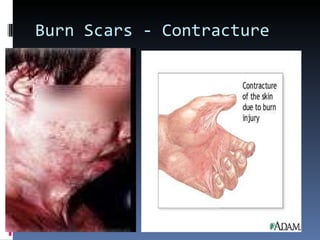
Burn Scars - Contracture
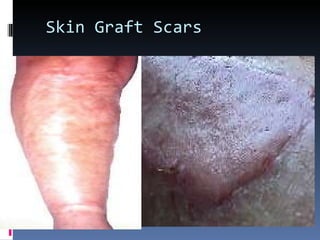
Skin Graft Scars
SCAR MANAGEMENT Pressure therapy Silicone gel sheet Intra lesional injection Split skin graft Laser therapy Cryotherapy Radi0 therapy Combination therapy Elevation Itching Redness
CONTRACTURE MANAGEMENT Types Intrinsic extrinsic Splintig/positioning Skin grafting(early) Plastic surgery physiotherapy
Functional Limitations Acute Limitations Patients may experience delirium that precludes their participation in treatment Edema, pain, bulky dressings, and immobilizing splints impair the person's ability to perform usual daily activities  Sleep is frequently disrupted Anxiety and fear can be present Postdischarge Limitations The most frequent functional limitations involve scarring and joint contracture Other functional sequelae may result in permanent impairment
Vocational Limitations It should be emphasized that many of the functional limitations that have already been discussed are not overtly apparent If they are not recognized as valid, the RC could very easily conclude that a person is malingering, whining, or unmotivated Seriousness, etiology, and site of the burn injury can significantly affect return-to-work and how long it takes All of the studies cited in the text suggest that size, depth, and location are factors that influence time to return to work
Rehabilitation Burn Treatment Postdischarge Wound care continues If there is a risk of hypertrophic scarring, or it has already started, continuous pressure applied to the area will prevent its progress Garments need to be worn 20 hours per day for up to 1 year - uncomfortable, hot, and unattractive Contracture control continues through PT and/or OT Reconditioning and strengthening exercises begin Counseling is a possibility to work on emotional difficulties that have resulted from the burn injury Reconstructive surgery may be needed if the functional or cosmetic limitations are not responsive to rehabilitation treatment

Physiotherapy in burns

  • 1.
  • 2.
    Epidemiology Tissue injurycaused by thermal, electrical, or chemical agents Can be fatal, disfiguring, or incapacitating ~ 1.25 million burn injuries per year 45,000 hospitalized per year 4500 die per year (3750 from housefires) 3rd largest cause of accidental death
  • 3.
    Risk Factors Fire/CombustionFirefighter Industrial Worker Occupant of burning structures Chemical Exposure Industrial Worker Electrical Exposure Electrician Electrical Power Distribution Worker
  • 4.
    Types of Burn Injuries Thermal burn Skin injury Inhalation injury Chemical burn Skin injury Inhalation injury Mucous membrane injury Electrical burn Lightning Radiation burn
  • 5.
  • 6.
    Effects Burn injurycauses destruction of tissue, usually the skin, from exposure to thermal extremes (either hot or cold), electricity, chemicals, and/or radiation The mucosa of the upper GI system (mouth, esophagus, stomach) can be burned with ingestion of chemicals The respiratory system can be damaged if hot gases, smoke, or toxic chemical fumes are inhaled Fat, muscle, bone, and peripheral nerves can be affected in electrical injuries or prolonged thermal or chemical exposure Skin damage can result in altered ability to sense pain, touch, and temperature
  • 7.
    Skin Largest bodyorgan. Much more than a passive organ. Protects underlying tissues from injury Temperature regulation Acts as water tight seal, keeping body fluids in Sensory organ
  • 8.
    Skin Injuries toskin which result in loss, have problems with: Infection Inability to maintain normal water balance Inability to maintain body temperature
  • 9.
    Skin Two layersEpidermis Dermis Epidermis Outer cells are dead Act as protection and form water tight seal
  • 10.
    Skin Epidermis Deeperlayers divide to produce the stratum corneum and also contain pigment to protect against UV radiation Dermis Consists of tough, elastic connective tissue which contains specialized structures
  • 11.
    Skin Dermis - Specialized Structures Nerve endings Blood vessels Sweat glands Oil glands - keep skin waterproof, usually discharges around hair shafts Hair follicles - produce hair from hair root or papilla Each follicle has a small muscle (arrectus pillorum) which can pull the hair upright and cause goose flesh
  • 12.
  • 13.
    Burn Classification -Depth Old terminology 1st degree: only the epidermis 2nd degree: epidermis and dermis, excluding all the dermal appendages 3rd degree: epidermis and all of the dermis 4th degree: epidermis, dermis, and subcutaneous tissues (fat, muscle, bone, and peripheral nerves) New terminology Superficial: only the epidermis Superficial partial thickness: epidermis and dermis, excluding all the dermal appendages Deep partial thickness: epidermis and most of the dermis Full thickness: epidermis and all of the dermis
  • 14.
    Very painful, dry,red burns which blanch with pressure. They usually take 3 to 7 days to heal without scarring. Also known as first-degree burns. The most common type of first-degree burn is sunburn. First-degree burns are limited to the epidermis, or upper layers of skin. Superficial
  • 15.
    Very painful burnssensitive to temperature change and air exposure. More commonly referred to as second-degree burns. Typically, they blister and are moist, red, weeping burns which blanch with pressure. They heal in 7 to 21 days. Scarring is usually confined to changes in skin pigment. Superficial Partial-Thickness
  • 16.
    Blistering or easilyunroofed burns which are wet or waxy dry, and are painful to pressure. Their color may range from patchy, cheesy white to red, and they do not blanch with pressure. They take over 21 days to heal and scarring may be severe. It is sometimes difficult to differentiate these burns from full-thickness burns. Deep Partial-Thickness
  • 17.
    Burns which causethe skin to be waxy white to a charred black a Burns which cause the skin to be waxy white to a charred black and tend to be painless. Healing is very slow, if at all, and may require skin grafting. Severe scarring usually occurs
  • 18.
  • 19.
  • 20.
  • 21.
    Burn Classifications 1stdegree (Superficial burn) Involves the epidermis Characterized by reddening Tenderness and Pain Increased warmth Edema may occur, but no blistering Burn blanches under pressure Example - sunburn Usually heal in ~ 7 days
  • 22.
    Burn Classifications FirstDegree Burn (Superficial Burn)
  • 23.
    Burn Classifications 2nddegree Damage extends through the epidermis and involves the dermis. Not enough to interfere with regeneration of the epithelium Moist, shiny appearance Salmon pink to red color Painful Does not have to blister to be 2nd degree Usually heal in ~7-21 days
  • 24.
    Burn Classifications 2ndDegree Burn (Partial Thickness Burn)
  • 25.
    Burn Classifications 3rddegree Both epidermis and dermis are destroyed with burning into SQ fat Thick, dry appearance Pearly gray or charred black color Painless - nerve endings are destroyed Pain is due to intermixing of 2nd degree May be minor bleeding Cannot heal and require grafting
  • 26.
    Burn Classifications 3rdDegree Burn (Full Thickness burn)
  • 27.
  • 28.
  • 29.
  • 30.
  • 31.
  • 32.
  • 33.
    Burn Patient SeverityFactors to Consider Depth or Classification Body Surface area burned Age: Adult vs Pediatric Preexisting medical conditions Associated Trauma blast injury fall injury airway compromise child abuse
  • 34.
    Burn Patient SeverityPatient age Less than 2 or greater than 55 Have increased incidence of complication Burn configuration Circumferential burns can cause total occlusion of circulation to an area due to edema Restrict ventilation if encircle the chest Burns on joint area can cause disability due to scar formation
  • 35.
  • 36.
    Critical Burn Criteria3 0 > 10% BSA 2 0 > 30% BSA >20% pediatric Burns with respiratory injury Hands, face, feet, or genitalia Burns complicated by other trauma Underlying health problems Electrical and deep chemical burns
  • 37.
    Moderate Burn Criteria3 0 2-10% BSA 2 0 15-30% BSA 10-20% pediatric Excluding hands, face, feet, or genitalia Without complicating factors
  • 38.
    Minor Burn Criteria3 0 < 2% BSA 2 0 < 15% BSA <10% pediatric 1 0 < 20% BSA
  • 39.
  • 40.
    Pathophysiology of BurnInjury Pathophysiology refers to the complex chain of mechanisms that occur in the skin (local effects) and in other organ systems (systemic effects) when a burn injury occurs, as well as what happens as the skin regenerates and heals Local Effects Systematic Effects Skin Regeneration and Scarring Electrical Burns
  • 41.
    Thermal Burn InjuryPathophysiology Emergent phase Response to pain  catecholamine release Fluid shift phase massive shift of fluid - intravascular  extravascular Hypermetabolic phase  demand for nutrients  repair tissue damage Resolution phase scar tissue and remodeling of tissue
  • 42.
    Thermal Burn InjuryPathophysiology Jackson’s Thermal Wound Theory Zone of Coagulation area nearest burn cell membranes rupture, clotted blood and thrombosed vessels Zone of Stasis area surrounding zone of coagulation inflammation, decreased blood flow Zone of Hyperemia peripheral area of burn limited inflammation, increased blood flow
  • 43.
    Thermal Burn InjuryPathophysiology Eschar formation Skin denaturing hard and leathery Skin constricts over wound increased pressure underneath restricts blood flow Respiratory compromise secondary to circumferential eschar around the thorax Circulatory compromise secondary to circumferential eschar around extremity
  • 44.
  • 45.
    Fluid and Electrolyteloss  Hypovolemia Hypothermia, Infection, Acidosis  catecholamine release, vasoconstriction Renal or hepatic failure Formation of eschar Complications of circumferential burn
  • 46.
    Psychological changes Fear& anxiety Denial Depression Guilty feeling Grief &mourning Loss of will to live Apathy Necrophilous orientation Anger
  • 47.
    Psychiatric complications DeliriumPost traumatic stress disorder Disfigured face syndrome psychosis
  • 48.
  • 49.
    Electrical Burns Usuallyfollows accidental contact with exposed object conducting electricity Electrically powered devices Electrical wiring Power transmission lines Can also result from Lightning Damage depends on intensity of current
  • 50.
    Electrical Burns Currentkills, voltage simply determines whether current can enter the body Ohm’s law: I=V/R Electrical follows shortest path to ground Low Voltage usually cannot enter body unless: Skin is broken or moist Low Resistance (follows blood vessels/nerves) High Voltage easily overcomes resistance
  • 51.
    Electrical Burns Severitydepends upon: what tissue current passes through width or extent of the current pathway AC or DC duration of current contact
  • 52.
    Electrical Burns LightningHIGH VOLTAGE!!! Injury may result from Direct Strike Side Flash Severe injuries often result Provides additional risk to EMS provider Weather capable of producing lightning is still in the area
  • 53.
    Electrical Burns Pathophysiologyof Injuries External Burn Internal Burn Musculoskeletal injury Cardiovascular injury Respiratory injury Neurologic injury Rhabdomyolysis and Renal injury
  • 54.
    Electrical Burn ManagementMake sure current is off Lightning hazards Do not go near patient until current is off ABC’s Ventilate and perform CPR as needed Oxygen ECG monitoring Treat dysrhythmias
  • 55.
    Electrical Burn ManagementRhabdomyolysis Considerations Fluid? Dopamine? Assess for additional injuries Consider transport to trauma center
  • 56.
    Any patient withan electrical burn regardless of how trivial it looks needs to go to the hospital. There is no way to tell how bad the burn is on the inside by the way it looks on the outside.
  • 57.
    Pediatric Burns Thinskin increases severity of burning relative to adults Large surface/volume ratio rapid fluid loss increased heat loss  hypothermia Delicate balance between dehydration and over hydration Immature immunological response  sepsis Always consider possibility of child abuse
  • 58.
    Geriatric Burns Decreasedmyocardial reserve fluid resuscitation difficulty Peripheral vascular disease, diabetes slow healing COPD increases complications of airway injury Poor immunological response - Sepsis % mortality ~= age + % BSA burned
  • 59.
    WOUND IFECTION/SEPSIS ColonizationInvasive wound sepsis Sepsis Prevention by aseptic measures Local anti microbial therapy/systemic antibiotics/wound debridement Early excision of necrotic tissues and skin grafting Treat septicemia
  • 60.
    WOUND HEALING Stageof inflammation Stage of proliferation/tissue repair Remodeling
  • 61.
    WOUND DEBRIDEMENT Mechanical-wet/dry Hydrotherapy- immersion/spray Enzymatic-sutilains Surgical-sequencial/fascial excision & escharotomies Proteolysis-fibrinolysis-collagenolysis
  • 62.
    WOUND DRESSINGS Biologicaldressings/skin graft Synthetic dressings Topical antimicrobials
  • 63.
  • 64.
    HYPOVOLAEMIC SHOCK HypotensionOliguria Tachy cardia Sweating Pallor Hyper ventilation Clouding of consciousness
  • 65.
    SEPTIC SHOCK IncreasedT* Hypotension < 90 mmhg Oliguria < 30 ml Dry &pink exremities Altered pulmonary functions
  • 66.
    SKIN ASSESSMENT InspectionAppearance Temperature Moisture Dryness Texture Color Size Palpate lymph nodes Cyanosis Pulses Area Duration Itching/burning
  • 67.
  • 68.
  • 69.
  • 70.
    POSITIONING AND SPLINTINGminimize edema formation prevent tissue destruction maintain soft tissue in an elongated state to facilitate function recovery. &quot;anticontracture&quot; positions &quot;the position of comfort (fetal position)
  • 71.
    The basic rulefor positioning burned areas is place and maintain the body part in the opposite plane and direction to which it will potentially contract
  • 72.
    General Body Positioningfor Prevention of Contractures
  • 73.
    Burn Patient Positioning:Body Area Contracture Predisposition Preventive Positioning *Neck Flexion Extension /Hyper ext. * Anterior Axilla Shoulder Adduction Shoulder Adduction * Antecubital space Elbow flexion Elbow Extension * Forearm Pronation Supination * Wrist Flexion Extension- 30 o Dorsal/hand/finger MCP Hyper extension IP Flexion, thumb adduction MCP Flexion-80 o , IF Extension, thumb palmar abduction * Palmar hand/finger Finger flexion, thumb opposition Finger extension thumb radial abduction Hip Flexion, adduction external rotation Extension, abduction neutral rotation * Knee Flexion Extension * Ankle Planter flexion Dorsiflexion * Dorsal toes Hyperextension Flexion * Planter toes Flexion Extension
  • 74.
    splints splints andprotection of Joints and tendons splinting in edema reduction Splinting following skin grafting Splints for uncooperative or unconscious patient
  • 75.
    Types of splints:Three types of splinting for burn patients: 1) Primary splints: During the acute phase and pre grafting period, static splints (without movable parts) are used to position the involved joints during sleep, inactivity, or periods of unresponsiveness. Whenever possible, these splints should be applied to adjacent intact skin.
  • 76.
    2) Postural splints:During the immediate post graft phase, splints are used to immobilize joints in proper functional position, but must allow access for continued wound care. These splints are worn continuously for 5 to 14 days until the graft is secure. 3) Follow up splints: The chronic phase of burn care begins with wound closure and continues until full maturation of the wound (one to two years). Dynamic splints (movable parts) are used to increase function. They can provide support to the joint without restricting antagonistic movements, provide slow steady force to stretch a skin contracture, or provide resistive force for exercise.
  • 77.
    Various types ofsplints that used for the treatment of anterior neck burns, Soft cervical collar is a circumferential foam neck orthosis covered with stockinet, it maintains neutral extension and prevents lateral flexion, Molded neck splint or collar , it is a total contact, rigid neck support, it maintains exact position (extension) and' prevents rotation and lateral flexion, Halo neck splint , it is a thermoplastic orthosis that positions the neck in extension using the head and upper torso for stabilization, Watusi collar, it is a series of cylindrical plastic or foam tubes fastened circumferentially around the neck. Additional tubes are added as neck extension improves (Figs. 5, 6 and 7).
  • 78.
    Neck Willis splint is one of the most effective means of preventing neck contractures. This splint should be applied directly over the burn wound or over a single layer of gauze. When a tracheostomy has not been performed, the splint can be applied early and adjustments made as the edema subsides
  • 79.
    Fig. (8): SpinalSupport Brace.
  • 80.
  • 81.
    Spreader Bar Attachedto Knee Gutter Extension.
  • 82.
    Positioning Techniques inEdema Control Elevation of an extremity above heart level can be accomplished using common items such as pillows, bath blankets, towels, foam, wedges, beside tables, and stockinet.
  • 83.
    contracture Johnson andSilverberg (1995) found that serial casting is a conservative method and effective modality in correcting contracture resulting from burns.
  • 84.
  • 85.
    Burn Scars -Hypertrophic
  • 86.
    Burn Scars -Contracture
  • 87.
    Burn Scars -Contracture
  • 88.
  • 89.
    SCAR MANAGEMENT Pressuretherapy Silicone gel sheet Intra lesional injection Split skin graft Laser therapy Cryotherapy Radi0 therapy Combination therapy Elevation Itching Redness
  • 90.
    CONTRACTURE MANAGEMENT TypesIntrinsic extrinsic Splintig/positioning Skin grafting(early) Plastic surgery physiotherapy
  • 91.
    Functional Limitations AcuteLimitations Patients may experience delirium that precludes their participation in treatment Edema, pain, bulky dressings, and immobilizing splints impair the person's ability to perform usual daily activities Sleep is frequently disrupted Anxiety and fear can be present Postdischarge Limitations The most frequent functional limitations involve scarring and joint contracture Other functional sequelae may result in permanent impairment
  • 92.
    Vocational Limitations Itshould be emphasized that many of the functional limitations that have already been discussed are not overtly apparent If they are not recognized as valid, the RC could very easily conclude that a person is malingering, whining, or unmotivated Seriousness, etiology, and site of the burn injury can significantly affect return-to-work and how long it takes All of the studies cited in the text suggest that size, depth, and location are factors that influence time to return to work
  • 93.
    Rehabilitation Burn TreatmentPostdischarge Wound care continues If there is a risk of hypertrophic scarring, or it has already started, continuous pressure applied to the area will prevent its progress Garments need to be worn 20 hours per day for up to 1 year - uncomfortable, hot, and unattractive Contracture control continues through PT and/or OT Reconditioning and strengthening exercises begin Counseling is a possibility to work on emotional difficulties that have resulted from the burn injury Reconstructive surgery may be needed if the functional or cosmetic limitations are not responsive to rehabilitation treatment

Editor's Notes