Management of the
burn patient

NATHAN STEWART
ADAPTED FROM PRESENTATION BY DR ALAN PHIPPS


In 1997-2005 the rate of total Burn Injury related
deaths for Australia was 0.5 per 100,000 persons.



In 2003-04 the age-adjusted hospitalisation rate of
fire, burn and scald related injury in Australia was
31.9 cases per 100,000 population per year.



During the period of 2001-02, throughout Australia,
burns and scalds were responsible for 6,248
hospitalisations in public hospitals with the
average length of stay being 7.1 days incurring an
estimated cost of $132 million.
Progress in Burn Care
Fluid resuscitation
Dedicated burns units
Antimicrobials
Intensive care
Nutrition
Early excision
Skin cover
Specialisation

3
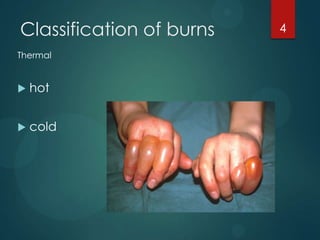
Classification of burns
Thermal



hot



cold

4
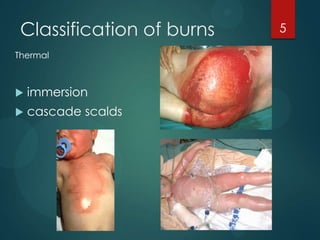
Classification of burns
Thermal



immersion



cascade scalds

5
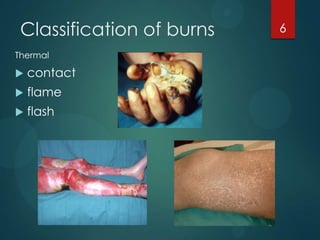
Classification of burns
Thermal



contact



flame



flash

6
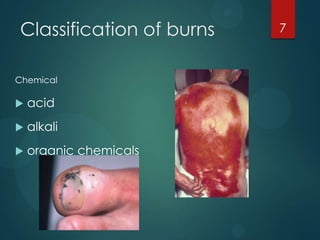
Classification of burns
Chemical



acid



alkali



organic chemicals

7
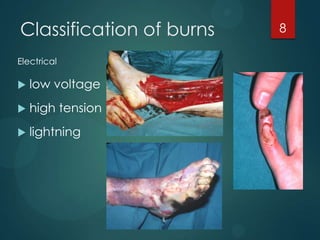
Classification of burns
Electrical



low voltage



high tension



lightning

8
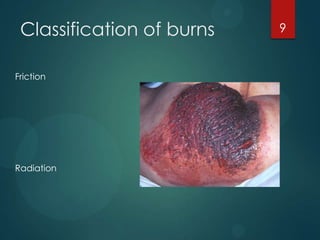
Classification of burns
Friction

Radiation

9
Everybody

Every intervention influences the scar worn for life,
therefore, everyone who assists in the management
of that patient becomes a member of the burn care
team
First Aid for burns
Remove from burn source
Cold water - except when in contact with electricity

This has the most effect on the final outcome!
Still some effectiveness up to 4 hours post burn.
At least 20 minutes of cold running water.
Remove clothes. Need to avoid Hypothermia though!
Gels e.g. Burnshield
Cling film & dry clean sheet
No ointments, creams, powders, butter, etc. etc.

11
12

Minor
burns
Minor burns
Defined by exclusion of


area more than 5% of body surface



deep



infected



problem area - face, hands, perineum, feet



inhalation injury



other injury or underlying medical problem



suspected non-accidental injury

13
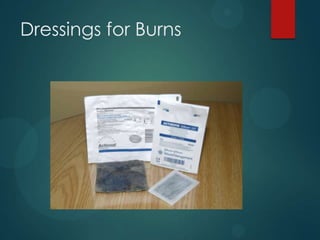
Dressings for Burns
15

Major
burns
Burns Resuscitation:
At the Scene






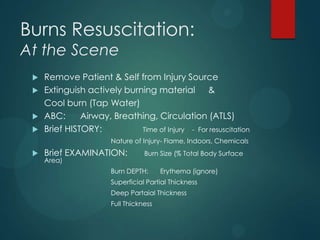
Remove Patient & Self from Injury Source
Extinguish actively burning material &
Cool burn (Tap Water)
ABC:
Airway, Breathing, Circulation (ATLS)
Brief HISTORY:
Time of Injury - For resuscitation
Nature of Injury- Flame, Indoors, Chemicals



Brief EXAMINATION:
Area)

Burn Size (% Total Body Surface

Burn DEPTH:

Erythema (ignore)

Superficial Partial Thickness
Deep Partaial Thickness
Full Thickness
Burns Resuscitation:

In the A&E Department


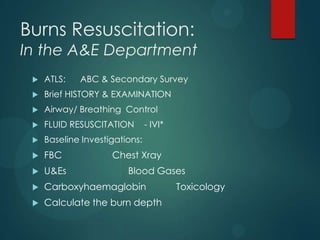
ATLS:

ABC & Secondary Survey



Brief HISTORY & EXAMINATION



Airway/ Breathing Control



FLUID RESUSCITATION



Baseline Investigations:



FBC



U&Es



Carboxyhaemaglobin



Calculate the burn depth

- IVI*

Chest Xray
Blood Gases
Toxicology
Burns Resuscitation:
In the Burns Unit


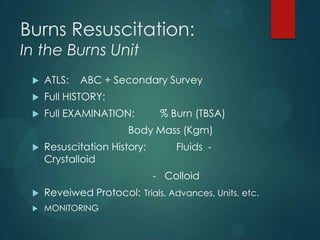
ATLS:

ABC + Secondary Survey



Full HISTORY:



Full EXAMINATION:

% Burn (TBSA)

Body Mass (Kgm)


Resuscitation History:
Crystalloid

Fluids -

- Colloid


Reveiwed Protocol: Trials, Advances, Units, etc.



MONITORING
Burns Resuscitation:
Monitoring


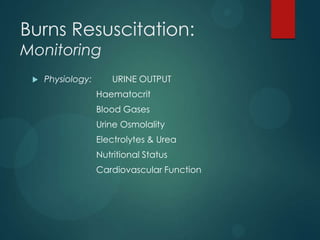
Physiology:

URINE OUTPUT
Haematocrit
Blood Gases

Urine Osmolality
Electrolytes & Urea
Nutritional Status
Cardiovascular Function
Burn Resuscitation:
A Team Effort









Anaesthetist
Surgeon
Intensivist
Microbiologist
Paediatrician
Haematologist
Chemical
Pathologist
etc



Specialist Nurse



Physiotherapist



Occupational Therapist



Theatre Nurse



Ward Clerk



Secretary



Play Therapist



etc
Burn Resuscitation:
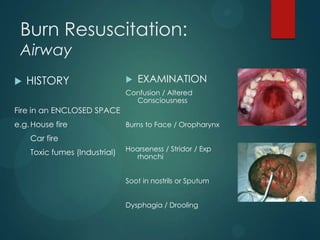
Airway


HISTORY



EXAMINATION

Confusion / Altered
Consciousness

Fire in an ENCLOSED SPACE
e.g. House fire

Burns to Face / Oropharynx

Car fire
Toxic fumes (Industrial)

Hoarseness / Stridor / Exp
rhonchi
Soot in nostrils or Sputum
Dysphagia / Drooling
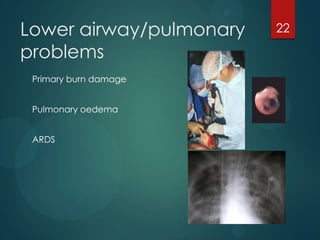
Lower airway/pulmonary
problems
Primary burn damage
Pulmonary oedema
ARDS

22
Burn Resuscitation:
Airway

INVESTIGATIONS


Blood Gases



Carboxyhaemaglobin



Chest X-ray
Burn Resuscitation:
Airway

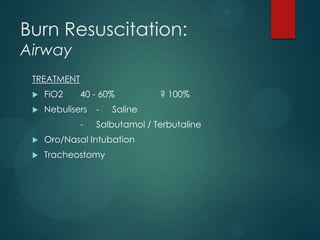
TREATMENT


FiO2

40 - 60%



Nebulisers

-

-

? 100%

Saline

Salbutamol / Terbutaline



Oro/Nasal Intubation



Tracheostomy
Burn Resuscitation:
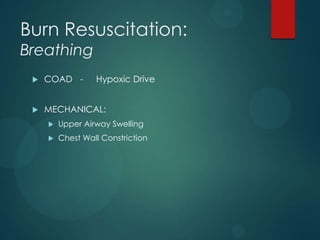
Breathing


COAD -

Hypoxic Drive



MECHANICAL:


Upper Airway Swelling



Chest Wall Constriction
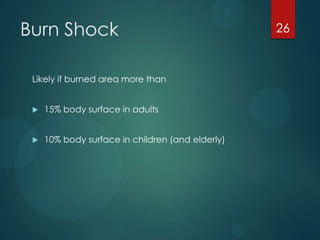
Burn Shock
Likely if burned area more than


15% body surface in adults



10% body surface in children (and elderly)

26
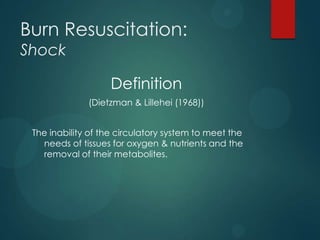
Burn Resuscitation:
Shock

Definition
(Dietzman & Lillehei (1968))
The inability of the circulatory system to meet the
needs of tissues for oxygen & nutrients and the
removal of their metabolites.
Parkland formula
for fluid resuscitation

4ml Hartmann’s solution per 1% burn per
kg body weight



half in first 8hrs post-burn
half in the following 16hrs

= 0.25ml/%burn/kg/hr in first 8 hrs from
time of burn
colloid in second 24hrs

28
Burn Resuscitation:
Burn Depth


Erythema

-

ignore



Superficial Partial Thickness



Deep Partial Thickness



Full Thickness
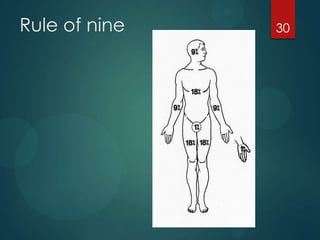
Rule of nine

30
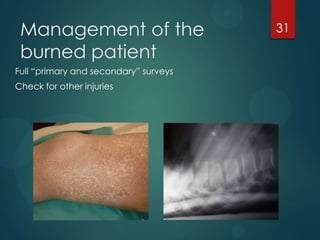
Management of the
burned patient
Full “primary and secondary” surveys

Check for other injuries

31
Managing the burn wound
- considerations

Surgery vs. spontaneous healing
Mechanisms of healing
Pathological zones in the burn
Determination of burn depth
Influence of dressings

32
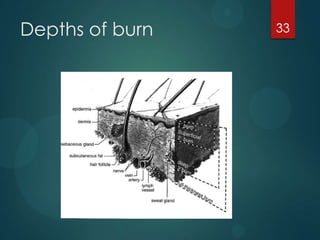
Depths of burn

33
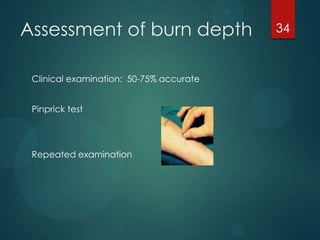
Assessment of burn depth
Clinical examination: 50-75% accurate

Pinprick test

Repeated examination

34
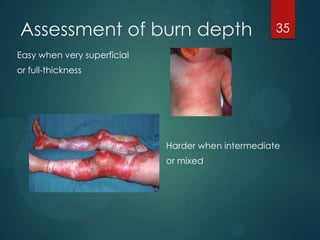
Assessment of burn depth

35

Easy when very superficial
or full-thickness

Harder when intermediate
or mixed
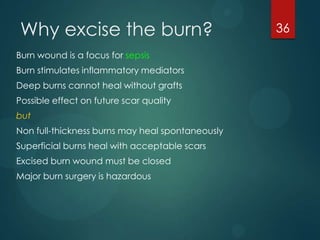
Why excise the burn?
Burn wound is a focus for sepsis
Burn stimulates inflammatory mediators

Deep burns cannot heal without grafts
Possible effect on future scar quality
but
Non full-thickness burns may heal spontaneously
Superficial burns heal with acceptable scars
Excised burn wound must be closed
Major burn surgery is hazardous

36
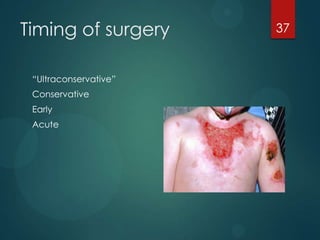
Timing of surgery
“Ultraconservative”
Conservative
Early

Acute

37
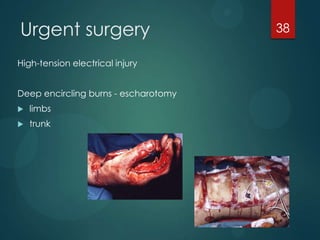
Urgent surgery
High-tension electrical injury
Deep encircling burns - escharotomy


limbs



trunk

38
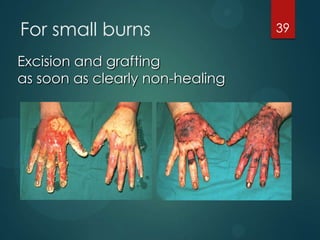
For small burns
Excision and grafting
as soon as clearly non-healing

39
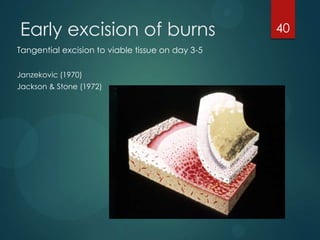
Early excision of burns
Tangential excision to viable tissue on day 3-5
Janzekovic (1970)
Jackson & Stone (1972)

40
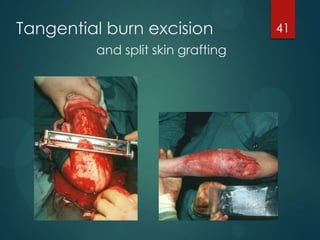
Tangential burn excision
and split skin grafting

41
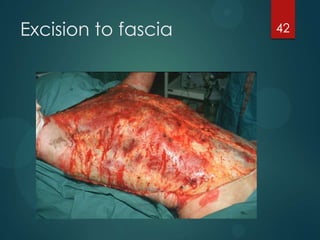
Excision to fascia

42
Early burn surgery
Superior outcomes where suitably equipped


mortality



length of hospital stay



morbidity during acute burn



scar quality

43
Desirable surgical
management
Excision of all non-shallow burns as soon as
practicable in as few stages as possible
Closure of excised wounds with autograft, allograft
or artificial material
Definitive wound closure

44
Large area burns - the
problem
Area / mass of necrotic tissue
Shortage of donor sites
Infection

Systemic effects (SIRS, ARDS)
Associated problems of inhalation

45
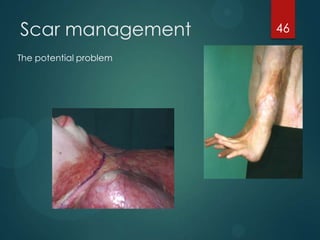
Scar management
The potential problem

46
Scar management
Pre-emptive measures


prompt surgery



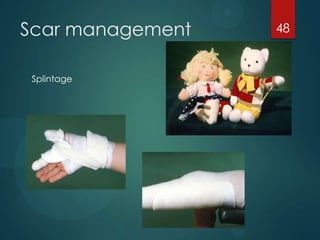
splintage & physiotherapy

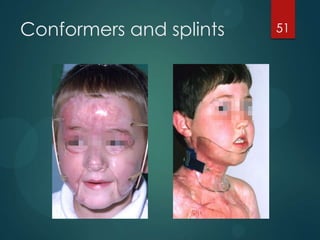
Pressure garments and conformers
Silicone gel and contact media

Medical and surgical treatment

47
Scar management
Splintage

48
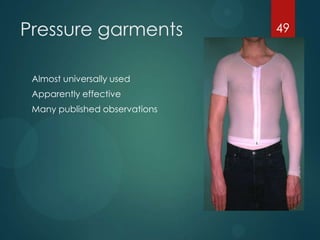
Pressure garments
Almost universally used
Apparently effective

Many published observations

49
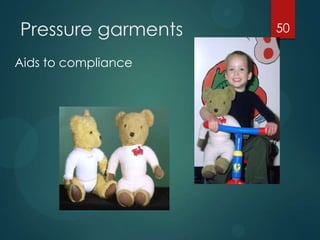
Pressure garments
Aids to compliance

50
Conformers and splints

51
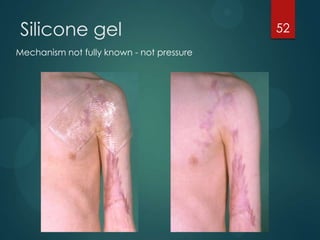
Silicone gel
Mechanism not fully known - not pressure

52

Burns management