NON EXPERIMENTAL
DESIGN
NON EXPERIMENTAL
DESIGN
 A design in which the researcher is a passive agent, who observes,
measures, and describes a phenomenon as it occurs or exists
CHARACTERISTICS OF
NON-EXPERIMENTAL
DESIGN
 No manipulation.
 No causality establishment.
 A question or hypothesis is proposed.
 A variable, two or more… different level of complexity.
 Gives an overall picture of a phenomenon
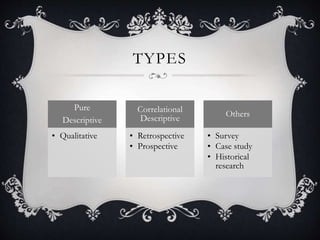
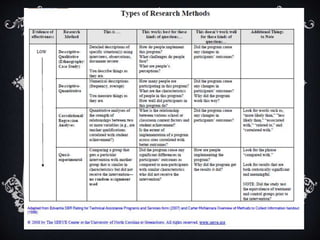
TYPES
Pure
Descriptive
• Qualitative
Correlational
Descriptive
• Retrospective
• Prospective
Others
• Survey
• Case study
• Historical
research
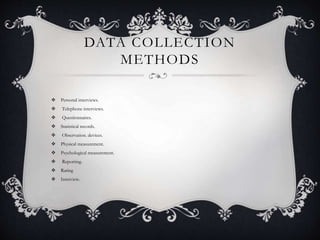
DATA COLLECTION
METHODS
 Personal interviews.
 Telephone interviews.
 Questionnaires.
 Statistical records.
 Observation. devices.
 Physical measurement.
 Psychological measurement.
 Reporting.
 Rating
 Interview.
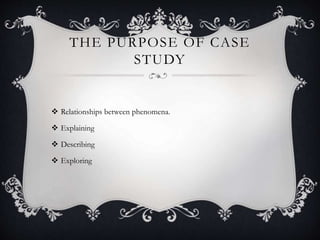
THE PURPOSE OF CASE
STUDY
 Relationships between phenomena.
 Explaining
 Describing
 Exploring
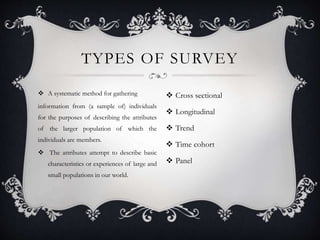
 A systematic method for gathering
information from (a sample of) individuals
for the purposes of describing the attributes
of the larger population of which the
individuals are members.
 The attributes attempt to describe basic
characteristics or experiences of large and
small populations in our world.
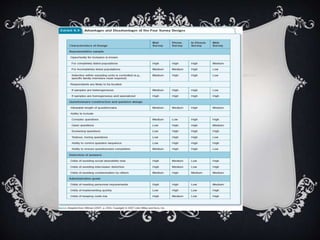
TYPES OF SURVEY
 Cross sectional
 Longitudinal
 Trend
 Time cohort
 Panel
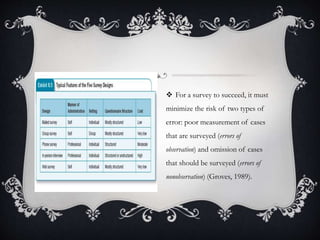
 For a survey to succeed, it must
minimize the risk of two types of
error: poor measurement of cases
that are surveyed (errors of
observation) and omission of cases
that should be surveyed (errors of
nonobservation) (Groves, 1989).
CHARACTERISTICS OF A
GOOD RESEARCH
DESIGN
 Appropriateness to the research problem.
 Lack of bias.
 Control.
 Precision.
 Internal validity.
 External validity.
Non experimental design

Non experimental design

  • 1.
  • 2.
    NON EXPERIMENTAL DESIGN  Adesign in which the researcher is a passive agent, who observes, measures, and describes a phenomenon as it occurs or exists
  • 3.
    CHARACTERISTICS OF NON-EXPERIMENTAL DESIGN  Nomanipulation.  No causality establishment.  A question or hypothesis is proposed.  A variable, two or more… different level of complexity.  Gives an overall picture of a phenomenon
  • 4.
    TYPES Pure Descriptive • Qualitative Correlational Descriptive • Retrospective •Prospective Others • Survey • Case study • Historical research
  • 5.
    DATA COLLECTION METHODS  Personalinterviews.  Telephone interviews.  Questionnaires.  Statistical records.  Observation. devices.  Physical measurement.  Psychological measurement.  Reporting.  Rating  Interview.
  • 6.
    THE PURPOSE OFCASE STUDY  Relationships between phenomena.  Explaining  Describing  Exploring
  • 7.
     A systematicmethod for gathering information from (a sample of) individuals for the purposes of describing the attributes of the larger population of which the individuals are members.  The attributes attempt to describe basic characteristics or experiences of large and small populations in our world. TYPES OF SURVEY  Cross sectional  Longitudinal  Trend  Time cohort  Panel
  • 8.
     For asurvey to succeed, it must minimize the risk of two types of error: poor measurement of cases that are surveyed (errors of observation) and omission of cases that should be surveyed (errors of nonobservation) (Groves, 1989).
  • 10.
    CHARACTERISTICS OF A GOODRESEARCH DESIGN  Appropriateness to the research problem.  Lack of bias.  Control.  Precision.  Internal validity.  External validity.